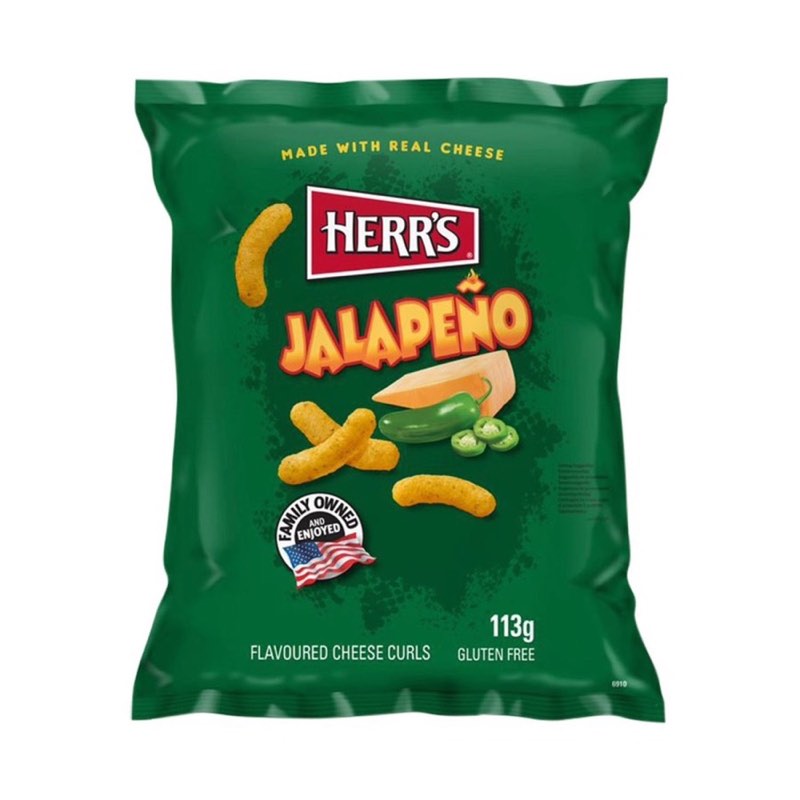
Herr's Jalapeno Cheese Curls 113g
Most people arriving at Herr's Jalapeno Cheese Curls 113g are not buying it on its own. They are building something — a film-night table, a party spread, a box to send someone — and this is the item that stops the whole thing being sugar from end to end. That is the job it does here, and it is worth starting with, because getting the proportions right is most of the difference between a table people graze at all evening and one they abandon after ten minutes.
Sweet gets boring faster than savoury does. Not because it is worse, but because the palate adapts to it quickly: the fourth sweet thing registers less than the first, and by the tenth you are eating out of habit rather than appetite. Salt resets that. A savoury interruption partway through a sugary spread makes the next sweet thing taste properly sweet again, and people go back round the table instead of drifting away from it.
The full guide to Herr's Jalapeno Cheese Curls 113g
5,309 words on how it eats, who it suits, how to serve it and what to put beside it.
Building a spread around a savoury bag
The salt principle
This is not a new insight — every seaside pier and every cinema foyer has understood it for as long as either has existed, which is why the popcorn stand and the sweet counter have always been within arm's reach of each other. What is relatively new is being able to put the savoury half on a sweet shop order rather than making a second stop, and that is the whole reason we keep a small snacks shelf at all.
Proportions that work on a real table
A rough structure for a mixed sweet-and-savoury spread, by volume rather than by weight:
- Half sweet and soft. The bulk of the table — jellies, gums, chews, whatever your crowd actually eats.
- A fifth chocolate or boxed. The richer, slower items people take one of.
- A fifth savoury. This bag, or something like it. Enough to be a real option, not so much that it becomes the main event.
- A tenth sharp or odd. The palate-cleanser and the talking point.
For the sweet half, the loose sweets shelves are where the weight comes from, because buying by the bag lets you choose exactly how much of each thing goes on the table. For the boxed fifth, the candy and chocolate listing covers the items that want to be presented rather than poured into a bowl. And for the savoury fifth, the choice on this site is deliberately small, which makes it easy.
What to put beside it
Within our own savoury corner, the obvious partner is Herr's Buffalo Blue Cheese Curls 113g — the same maker, the same 113 g bag, the same £3.79, and a different name on the front. Two bags of the same format with two different names is the cheapest tasting experiment you can run on a table, and it gives people something to have an opinion about, which is half of what a spread is for.
For a genuine change of register rather than a variation on a theme, Van Holten's Garlic Joe Zesty Garlic Pickle at £1.49 is the other thing on our savoury shelf and it could hardly be more different — a single wet, sharp item against two bags of dry, light ones. On an American-leaning table it is the piece people photograph. At £1.49 it is also the cheapest thing you will put out all night.
The sharp tenth
For the last tenth — the reset — anything with real acidity or real sourness does the job, and on a sweet counter that usually means a sour line from the pick and mix range, where the ready-built jars and pouches already contain a spread of sharp and mild. If you would rather not assemble the sweet side yourself at all, a made-up mix plus this bag plus the pickle is a complete table in three purchases, which is about as little work as a spread can be.
Serving order, if you care about it
People eat from a table in whatever order they like, but the layout nudges them. Put the savoury bag at the near end, where hands land first, and the sweet bulk in the middle. That way most people start salty, move to sweet and come back, rather than starting sweet and finding the savoury too late to want it. It is a small thing and it visibly changes how much of a spread gets eaten.
What you are actually buying
This is a 113 g bag at £3.79, in one size, from an American maker whose curls are a fixture of the imported-snack shelf in Britain. It is not a sweet, it is not sold by weight, and it is not part of a pick and mix. It is a single sealed bag of a savoury snack, and it sits on this site because a sweet shop that cannot offer you anything salty is a sweet shop that loses half the table.
The name on the front is Jalapeno Cheese Curls, and the name is doing the work of telling you the direction: a curl, named for jalapeño and for cheese. We do not publish ingredient or nutrition information for this line and we are not going to interpret the name on the maker's behalf — what is in the bag, in what quantity, and what allergens are declared, is on the manufacturer's own packaging, which arrives with your order and should be read before anyone with an allergy or intolerance eats from it. That applies to everything we sell, and it applies here with the usual force.
What we can tell you about with confidence is the format, the size, the price, and how a bag like this fits into an order — which is, in practice, what most people actually want to know.
The size, in context
One hundred and thirteen grams is a sharing bag rather than a single-serve one, but only just. It is more than one person needs in a sitting and less than a table of six will get through, which puts it squarely in the two-to-four people band. For a film night for two, one bag is right. For a party, buy more than one and expect them to go earlier in the evening than the sweets do.
How a curl eats
The curl is one of the great snack formats, and what makes it distinctive is lightness. A crisp is thin and flat and snaps; a curl has volume, so it collapses instead. You feel the shape give way between the teeth before it breaks down, and the whole piece is gone in a couple of seconds without much chewing involved. That is the opposite of everything else on this site, where the entire point is usually to make a small thing last.
Volume also means a bag of curls looks like considerably more than its weight suggests. Air is most of what you are holding. That is not a complaint — it is the format working as intended, and it is why a light savoury bag can hold its own on a table against items that weigh three times as much.
The other thing lightness does is make the eating fast and repetitive. Curls are a handful snack, not a one-at-a-time snack, and a bag empties in a way that a bag of sweets does not. If you are budgeting for an evening, assume it goes quicker than you planned. If you are serving into bowls, put out less than you think and refill, because a full bowl of light snacks empties faster than a half-full one does.
As for how hot or how strong this particular bag is: the name points in a clear direction, but heat is personal and we do not publish a rating for it. Some people find anything named for a chilli warm and some find it mild. If you are buying for someone else and you are unsure, the sensible move is to have something plain on the table as well, so nobody is stuck.
Who this is on the site for
Three sorts of shopper reach for this bag. The first is the one building a spread, covered above — they want the savoury quarter of a table and they want it in the same order as the sweets rather than from a separate shop.
The second is the American-snack shopper. There is a substantial and long-standing British appetite for the imported shelf — snacks that are familiar in form but not quite like the domestic equivalent, in bags that look different from the ones in the supermarket. For that shopper, a Herr's bag is the point of the order rather than the accompaniment, and the sweets are what gets added on.
The third is the gift-builder, who is putting together a box for someone and knows that a box of nothing but sugar is a box that gets half-eaten. That use has a whole section to itself further down, because it is the single most common reason a savoury bag ends up on a sweet shop order.
Who it is not for: anyone expecting a sweet. This is a savoury snack sitting on a sweet counter and it makes no attempt to be anything else. It is also not the item to buy if you need to know exactly what is in it before you commit — in that case, order it knowing the packaging is the source, or choose something you already know.
The corner shop, the pier and the import shelf
To understand why a bag of American cheese curls is sitting on a British sweet shop's site at all, it helps to look at what the British sweet shop has always actually been. It was never only sweets.
The corner shop model
The archetypal corner shop was a general store that happened to have the best-lit shelf given over to confectionery. Jars behind the counter, a spinner of chocolate bars, a chest freezer with ice lollies, and — crucially — crisps. The crisps were never an afterthought. They were the other half of the pocket-money economy, and the choice of what to do with your coins was frequently a choice between sweet and salty rather than between one sweet and another.
That is the tradition this bag belongs to, and it is why it does not feel out of place here even though it is not a sweet. A shop that sells you something to eat on the walk home has always sold both kinds. The only thing that has changed is that the shelf now runs to imports as well as domestic brands.
The seaside shop
The seaside version of the same idea took it further. A sweet shop on a promenade is not really a confectionery retailer, it is a holiday retailer — it sells rock and fudge and pick and mix, but it also sells buckets and postcards and, always, something salty to eat while you walk along the front. The logic is the same as the film-night logic: people on a long slow day want to alternate, and a shop that only offers one direction loses the second sale.
Seaside shops also normalised the idea of the sweet counter as a place of novelty rather than routine. You did not go in for a specific thing. You went in to look, and you bought whatever caught you — which is precisely the behaviour that makes an imported snack bag work on a site like this one. Nobody sets out to buy curls. They see them while they are choosing sweets, and the bag goes in the basket.
How the import shelf appeared
The American import shelf in British sweet shops grew out of that novelty instinct. Once a shop is in the business of selling things people have not seen before, imported confectionery is the obvious next move, and imported savoury snacks follow it almost immediately because they answer the same impulse. The appeal is not that the imported version is better. It is that it is not the one in the supermarket, and the whole pleasure of a sweet shop is that it is not the supermarket.
What you get from that shelf, practically, is format variety. Domestic savoury snacks in Britain skew towards the thin crisp. The curl, the puff and the ring are more prominent elsewhere, and having them available widens the range of textures you can put on a table. On our own shelf, the buffalo blue cheese curls at £3.79 and this bag are the two curl options, and the Van Holten's pickle is the third item and by far the most obviously imported of the three — a single wrapped pickle is not a British snack-shelf idea at all.
Why the savoury shelf stays small
We keep the savoury corner of the site deliberately tight — three lines, no more. A sweet shop that starts stocking a full crisp aisle stops being a sweet shop, and the reason people come to a specialist is that somebody has already made the choices. Three savoury items is enough to complete a table and not enough to distract from what the shop is actually for.
It also means the three are chosen to be different from each other rather than to cover a range of flavours. Two curls and a pickle is a spread of formats: two dry and light, one wet and sharp. If we stocked twelve savoury lines they would inevitably start to overlap, and you would have to do the choosing yourself.
Pocket money, price points and what has changed
One thing worth being honest about: the corner shop economy ran on coins, and an imported snack bag does not. At £3.79 this is a considered purchase rather than an impulse one, in a way that a bag of crisps from a spinner never was. The imports carry a premium for the obvious reasons, and pretending otherwise would be silly.
What that changes is how you buy. Nobody adds three of these to a basket without thinking. They add one, as the savoury element of a larger order, and the maths of the whole basket is what matters rather than the maths of the bag. The full shop listing is worth a browse with that in mind — an order that combines weighed-out sweets with one or two imported items lands at a sensible total, where an order made entirely of imports does not.
Gifts, hampers, parcels and boxes
The single most common reason a savoury bag ends up on a sweet shop order is that somebody is building a present. This section is about doing that well, because sweet gifting goes wrong in predictable ways and most of them are avoidable.
Why an all-sweet gift disappoints
A box containing nothing but sugar looks generous on arrival and gets tiring by the third item. The recipient eats the best thing first, works through the middle, and abandons the rest. Adding one savoury item changes the whole shape of it: there is now something to alternate with, the box gets returned to over days rather than exhausted in one sitting, and it reads as thought-through rather than bought in bulk.
One savoury item in a box of eight is the right ratio. Two if the box is large. More than that and the gift stops being a sweet gift, which may be fine if that is what you intended, but it is a different present.
The hamper build
A hamper wants layers, and they have different jobs. The top layer is what gets seen when the lid comes off, so it should be boxed and presentable — the boxed candy and chocolate shelf is where that comes from. The middle layer is variety: several smaller items, of which this bag is an excellent one because it is a different shape, a different colour and a different category from everything around it. The bottom layer is weight, and that means bags from the loose, weighed-out side of the shop, which is where you get the most for your money.
Physically, a light bag of curls is useful in a hamper for a reason nobody mentions: it fills space without adding weight. Hampers that are all dense items look half-empty and cost a fortune to post. One or two light bags fill the gaps, make the whole thing look fuller, and add almost nothing to the parcel weight.
Care parcels and students
The care parcel is the format this bag suits best of all. Someone away from home — at university, working away, in hospital for a stretch, newly moved — does not want eight sweet things. They want a small box that feels like somebody thought about them, and the savoury item is the one that gets messaged about.
A workable care parcel: one boxed item, one savoury bag, two or three bags of sweets, and one thing that is simply odd. For the odd slot, a £1.49 wrapped pickle is hard to beat and costs almost nothing. The whole box lands under a sensible budget and there is not a single dull item in it.
Letterbox and postal constraints
If you are sending something that has to go through a letterbox, depth is your enemy and weight is not. A bag of curls is bulky, so it is the wrong shape for a letterbox parcel unless you are prepared to let the bag be squashed — and a crushed bag of light snacks is a bag of crumbs.
For letterbox gifts, keep to flat items and small bags of sweets, and save the savoury bag for boxes that travel in a proper parcel. If you are posting a box rather than a letterbox envelope, put the curls near the top with soft items beneath, not at the bottom under a kilo of anything.
Teacher gifts, thank-yous and office boxes
End-of-term and thank-you gifts have a particular problem: you often do not know the person's tastes well, and a box that assumes a sweet tooth can misfire. Including one savoury bag hedges that neatly — it means there is something in the box for someone who does not much like sweets, without you having to ask.
For an office or a staff room, the calculation is different again. A box that will be shared by a dozen people wants a couple of savoury bags rather than one, because savoury goes first in a communal setting almost without exception. Two bags of curls and a ready-built pick and mix jar is a perfectly respectable staff-room offering and takes one order to assemble.
Presentation without much effort
Three things make a home-built gift box look intentional. First, vary the shapes — flat boxes, bags, and one odd item. Second, put the tallest or most colourful thing where the lid opens. Third, fill the gaps rather than letting things rattle; a light snack bag is the easiest gap-filler there is. None of that requires ribbon or craft skills, and it is the difference between a present and a delivery.
Serving it well
A few practical points that apply to a light savoury bag specifically.
Decant, but not too early. Curls are at their best straight from a freshly opened bag. Tipped into a bowl an hour before guests arrive, they soften, and softness is the one thing this format cannot survive. Open it when people arrive, not before.
Use a shallow, wide bowl. Light snacks compress under their own weight in a deep container and the ones at the bottom end up crushed. A wide dish keeps them intact and also makes a modest quantity look like plenty.
Keep them away from the wet items. Anything with moisture nearby will soften a light snack over the course of an evening. If the garlic pickle is on the table too, keep it at the other end and give it its own dish and its own fork.
Have napkins out. Savoury snacks of this type leave something on the fingers and people will otherwise wipe their hands on whatever is nearest, which is frequently your sofa.
Put a plain option alongside if heat is in play. Anything named for a chilli divides a room. One bowl of this and one bowl of something else means nobody has to be polite about it.
What £3.79 works out at
The arithmetic on a single-size bag is short. 113 g for £3.79 comes out at about £3.35 per 100 g, which is firmly at the imported-speciality end of the scale rather than the everyday one. It is the price of a bag you cannot get in the supermarket, and that is the honest description of what you are paying for.
In portions, 113 g is:
- roughly two generous individual servings at 55 g or so each;
- four smaller bowls at around 28 g, which is the right size for a spread where there are six other things to eat;
- enough for one film night for two, with nothing left over.
At four servings a bag, you are at about 95p a portion. That is more than a sweet portion from the loose shelves and less than most single items in a cinema foyer, which is roughly the right mental bracket for it.
The way to make the price sit comfortably is to treat it as one line in a larger order rather than as a purchase in itself. A basket with one imported bag and several weighed-out sweet bags averages out to something reasonable; a basket of nothing but imports does not. If cost per gram is the thing driving your order, build the bulk from bags of loose sweets and let this be the accent.
Keeping it crisp
Light savoury snacks have exactly one enemy and it is moisture in the air. An open bag left on a counter overnight will be noticeably softer by morning, and once a curl has gone soft there is no getting it back.
Sealed, the bag looks after itself. It wants a cupboard rather than a windowsill — not because warmth ruins it, but because sunlight and heat are unkind to any packaged food over time, and a dark cupboard costs nothing. There is no reason to refrigerate it and good reason not to, since the fridge is a damp environment and damp is the problem.
Once opened, get the air out and clip it shut, or decant into an airtight container. A clip is better than folding the top over, and a proper sealed tub is better than a clip. If you have opened a bag for a party and there is some left, seal it that night rather than the next morning — the overnight gap is where most of the damage happens.
Physically, treat the bag gently in transit and in storage. This is the most crushable thing in any order it turns up in, so do not stack tins of sweets on top of it, and do not put it at the bottom of a hamper. The packaging will keep it dry; it will not keep it whole.
One size, and one sibling
We list this in a single size at a single price: 113 g for £3.79. There is no larger bag and no multipack, so if one bag is not enough the answer is simply to buy two — and for a party of more than four, two is the realistic number.
The one genuine choice to make is between this and its 113 g stablemate, which is the same maker, the same format, the same weight and the same £3.79, with a different name on the front. Because the price and size are identical, the decision is purely about which name appeals — there is no value calculation to do, and no reason not to have both if you are feeding a group.
For a table of four or more, buying one of each is the better move than buying two of the same. Two names gives people a choice and gives them something to disagree about; two identical bags gives you more of one thing and no conversation. The same logic applies to a gift box, where variety reads as effort.
Beyond the pair, the third line on the shelf is the Van Holten's pickle at £1.49, which is not an alternative to a bag of curls so much as a completely different proposition sitting in the same corner. If you are covering the savoury side of a spread properly, it is the one that makes the shelf feel like a selection rather than a duplicate.
Finding it, and what sits near it
This one lives on the snacks listing, which is the smallest shelf we keep — three lines in total, all savoury, all imported in character. If you have landed here from a sweet search, that shelf is worth two minutes of your time, because it is short enough to read completely and it is the only part of the site that is not sugar.
Everything else on the site is on the sweet side of the line. The loose sweets shelves are where the weighed-out bags live and where most orders get their bulk. The pick and mix section holds the pre-built jars and pouches for when you would rather not assemble a mix yourself. The chocolate and boxed candy shelf is where the presentable items are, which matters most when you are building a gift.
And a browse of everything we carry is the right move if you are assembling a spread or a parcel rather than hunting for one specific thing, since the whole point of an order like that is to end up with items that are different from each other. Start there, pick the savoury element first — it is the shortest list and therefore the quickest decision — and build the sweet side around it.
Questions we are asked about this one
Is this a sweet?
No. It is a savoury snack in a sealed bag, sitting on a sweet shop because a sweet shop without anything salty is an incomplete shop. It is not sold by weight, it is not part of a pick and mix, and it will not go into a jar with the gummies. Think of it as the item that makes the rest of your order work on a table, rather than as something competing with the sweets.
How spicy is it?
We do not publish a heat rating for this line, and we would rather not guess on the maker's behalf. The name points in a clear direction, and beyond that, heat is genuinely personal — the same bag reads as warm to one person and mild to another. If you are buying for someone whose tolerance you do not know, put something plain alongside it so nobody is stuck, and read the manufacturer's packaging when the order arrives.
What is in it, and what allergens does it declare?
We do not hold or publish verified ingredient, nutrition or allergen information for this line, so we cannot tell you and will not speculate. The manufacturer's own packaging is the authoritative source and it comes with your order — please read it before anyone eats from the bag, and particularly before anyone with an allergy or intolerance does. That is the honest answer and it is the same one we give for everything on the site.
How many people will one bag feed?
Two people comfortably as the snack for an evening, or four as one item among several on a table. At 113 g you are looking at roughly two generous servings or four smaller bowls. For a party of six or more, buy two bags — and preferably one of each name, since the other curl in the pair costs exactly the same and gives people a choice.
Is £3.79 expensive for 113 g?
Compared with a supermarket crisp bag, yes — it works out at about £3.35 per 100 g, which is the imported-speciality bracket. What you are paying for is availability rather than quantity. The way to keep an order sensible is to use one bag like this as the savoury accent and build the weight of the basket from weighed-out sweets, where the cost per 100 g is a fraction of this.
Will it arrive crushed?
It is the most fragile thing in most orders, being light and bulky, so it gets packed accordingly. Bags of this type do travel well when nothing heavy is stacked on them. If anything arrives genuinely broken up rather than simply settled, tell us and we will put it right. When you are re-packing it into a gift box yourself, put it near the top for the same reason.
Can I put it in a hamper?
It is one of the better hamper items, for a practical reason as much as a culinary one: it is bulky and light, so it fills space without adding postage weight, and it breaks up a box that would otherwise be sweet from top to bottom. Put it in the middle layer, with the boxed items above it and the heavier bags below, and keep it away from anything damp.
What goes with it on a film night?
Something sweet and soft as the counterweight, and something sharp to reset between the two. A bag of this, a couple of bags from the loose shelves, and a jar from our pick and mix jars covers a table for four without any assembly. If you want the full savoury range on show, add the Van Holten's Garlic Joe zesty garlic pickle and put it at the opposite end of the table so it does not soften anything.
How long does an open bag stay good?
Sealed properly, a few days without much loss. Left open, one night is enough to notice the difference, because the only thing that ruins a light savoury snack is moisture from the air. Clip it or decant it into an airtight tub the same evening you open it, keep it in a cupboard rather than on a sunny worktop, and do not put it in the fridge — a fridge is a damp place and damp is exactly the problem.
What is the difference between the two Herr's bags you stock?
Price, weight and format are identical: both are 113 g at £3.79. The difference is the name on the front, and therefore the direction each one is pointing. We do not publish flavour breakdowns or ingredient detail for either, so the packaging is where you will find the specifics. Practically, if you are feeding a group, buy one of each; if you are buying for yourself, pick the name that appeals and try the other next time.
Do you stock more savoury snacks than these?
Only three lines in total, and that is on purpose. A sweet shop that grows a full crisp aisle stops being a sweet shop, and the value of a small selected shelf is that the choosing has been done for you. Two bags of curls and one pickle is enough to complete any spread. If you want to see the whole of it, it takes about ten seconds on that three-line snacks shelf.
Is it in stock?
Yes at the time of writing. Imported lines can be less predictable than the sweets we buy domestically, so if it ever shows as unavailable the other curl in the pair is the closest thing we have, and after that it is a matter of waiting for stock rather than substituting. The complete listing will show you what else is available in the meantime.
The savoury quarter of the order
Herr's Jalapeno Cheese Curls 113g is here to do one specific job, and it does it well: it is the salty, light, imported thing that stops an order of sweets being a wall of sugar. On a film-night table it is what people alternate with. In a gift box it is the item that makes the box read as considered. In a care parcel it is the one that gets mentioned in the thank-you message.
At £3.79 for a single 113 g bag it is a speciality purchase rather than an everyday one, so buy it as the accent on a larger order rather than on its own. Buy two if you are feeding more than four, and make one of them the other name for variety's sake. And when it arrives, read the packaging before anyone with an allergy goes near it — as with everything here, the pack is the authority and we are not.
Where this sits
Herr's Jalapeno Cheese Curls 113g appears on these shelves. Browse them, or jump to something nearby.
You might also like