Home / Loose Sweets / Royal Family Mochi Minis Vanilla Creme Flavour Pack 40g
Royal Family · 40g
Read the full guide
Royal Family Mochi Minis Vanilla Creme Flavour Pack 40g
£1.99
✔ In stock — ready to ship
Fresh stock
Free over £20
Same-day dispatch
Secure checkout
There is an unwritten specification for a good film-night sweet and almost nobody writes it down, so here it is. It must be quiet. It must not need looking at. It must not leave anything on your fingers that will end up on the remote, the controller or the sofa. It must last long enough that you are not reaching every eight seconds. And it must not be so demanding of attention that you miss what somebody just said on screen.
The Royal Family Mochi Minis Vanilla Creme Flavour Pack — 40 g, £1.99 — meets that specification better than most things in this shop, and it is worth walking through why, because the same reasoning applies to a lot of other decisions you will make on a Friday night.
The full guide to Royal Family Mochi Minis Vanilla Creme Flavour Pack 40g
5,574 words on how it eats, who it suits, how to serve it and what to put beside it.
The snack that does not interrupt the film
Noise
Crunch is the enemy. Anything that snaps, shatters or crackles turns your own head into the loudest thing in the room, and it is genuinely true that you hear less of the dialogue while you are chewing something hard. A soft chew makes almost no sound at all. Nor does the pack, once it is open — there is one seal to break at the start and then nothing, as against a bowl of individually wrapped sweets which generates a small rustle every ninety seconds for two hours. If you have ever sat next to somebody working through Barratt Black Jack Chews at £5.49 during a tense scene, you know precisely the problem being described. Those are excellent sweets and a terrible cinema companion, and both things are true at once.
Hands
The second criterion is the one people underestimate until they have ruined a controller with it. Sticky fingers plus a games console is a genuinely annoying combination, and sticky fingers plus somebody else's sofa is worse. The mochi-style surface here is matt and dry to the touch rather than tacky, so pieces come out of the pack cleanly and go into your mouth without leaving a trace. No bowl required, no napkin required, no wiping your hands on your jeans and hoping.
Compare that with the alternatives honestly. Anything coated in sugar sheds it everywhere. Anything with chocolate on it is a summer liability. Anything you have to bite a piece off and put the rest down between mouthfuls is a two-handed operation, and you only have two hands if you are not holding a controller. Bite-sized minis you eat whole solve all three problems at once, which is the whole quiet argument for this format.
Pacing
Here is the part most snack writing misses entirely. The rate at which you eat something is set by how long each unit occupies your mouth, and that is a design decision the maker took, not a matter of your self-control. A sweet that dissolves in five seconds will be eaten at twelve a minute. A long chew will be eaten at two or three. Over a ninety-minute film that is the difference between finishing your snack in the first act and still having some during the credits.
These sit at the slow end. A single mini occupies a decent stretch of time, the texture holds its structure the whole way through rather than collapsing, and there is no point rushing because there is nothing to rush towards. That means a 40 g pack — which looks alarmingly small on the counter — stretches a lot further in practice than its weight suggests. It is a genuinely different experience from a large bag of fast-dissolving sweets, where the pack size gives you a false sense of security and then you look down and it is gone.
The gaming case is a sharper version of the same argument. A film has a fixed length; a session does not. What you want is something that rations itself, because there is no natural point at which you decide to stop. A slow chew does that for you. It also does not require you to look away from the screen, which is the other thing a controller-holding snacker actually cares about and which rules out about half the shop.
Sharing, and the politics of it
Now the awkward part. This is a 40 g personal pack, and a 40 g personal pack does not share well between four people. It shares perfectly well between two, and that is the honest limit.
That is not a criticism, it is a planning fact, and getting it wrong is how snack evenings go slightly sour. If it is you and one other person, one pack is a reasonable contribution alongside something bigger. If it is a room, you need either multiples of these or something built for volume. A Candy Realms Tutti Frutti Tubes Tub 780g at £7.99 is a room-sized purchase; this is not, and pretending otherwise just means somebody goes without.
There is also the question of the shared bowl versus the individual pack, and it deserves a moment. Shared bowls are sociable and they are also how one fast eater accidentally has seventy per cent of everything. Individual packs are less sociable and completely fair. For a group of friends who know each other well, a bowl is right. For a mixed group, or for children, or for anyone with dietary questions who needs to read a label rather than trust a bowl, individual sealed packs are the better call — and at £1.99 each they are an affordable way to run an evening that way.
Building the rest of the spread around it
A good film-night table has three jobs to fill and most people only fill one. There is the slow item, which is what you eat for most of the running time. There is the sharp item, which resets your mouth when the slow item starts tasting of nothing. And there is the event item, the thing everyone reaches for at once in the first ten minutes and which is gone by the twenty-minute mark, and which you should buy in the full knowledge that this will happen.
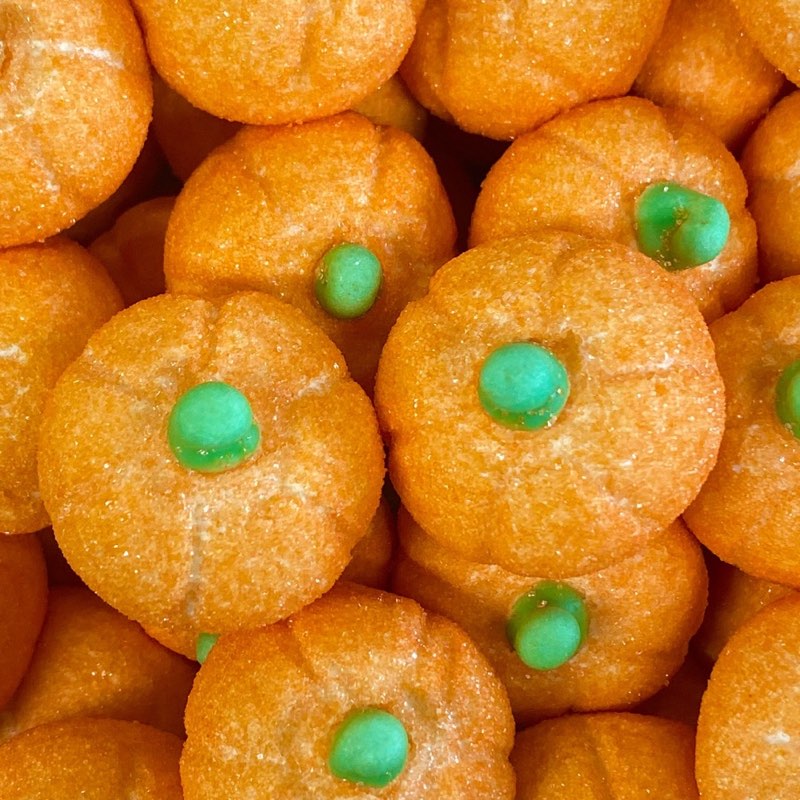
This pack is the slow item. For the sharp item, go to the sour and fizzy end of our loose sweets counter and pick anything with proper acidity. For the event item, you want something with visual pull — Bulgari Pumpkin Mallows at £5.49 do that job well because mallows look generous in a bowl and disappear at a rate that is frankly comic. Three items, three jobs, and nobody gets bored at the forty-minute mark.
What is actually in the pack
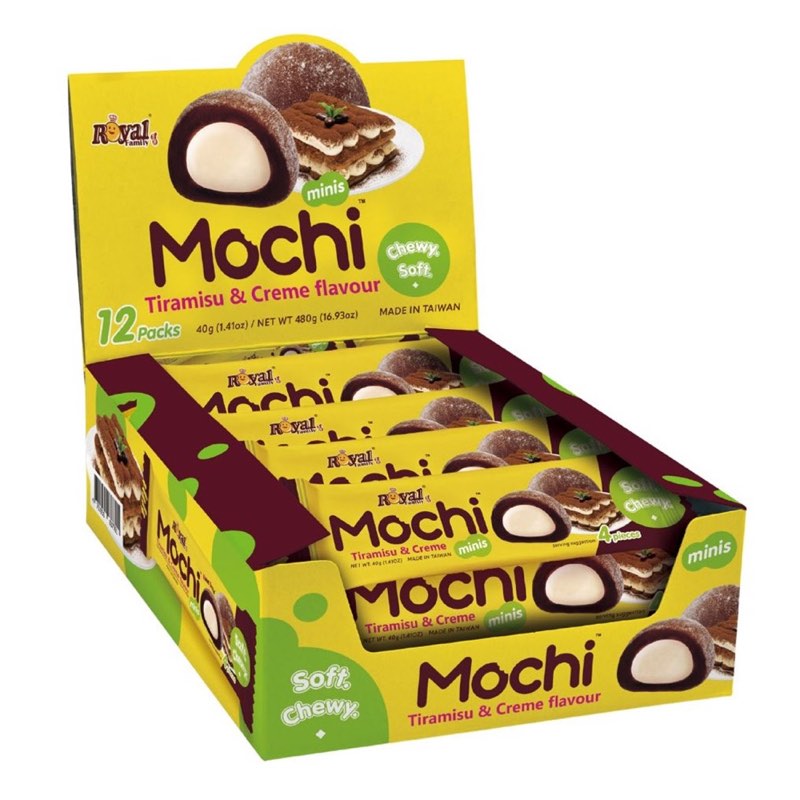
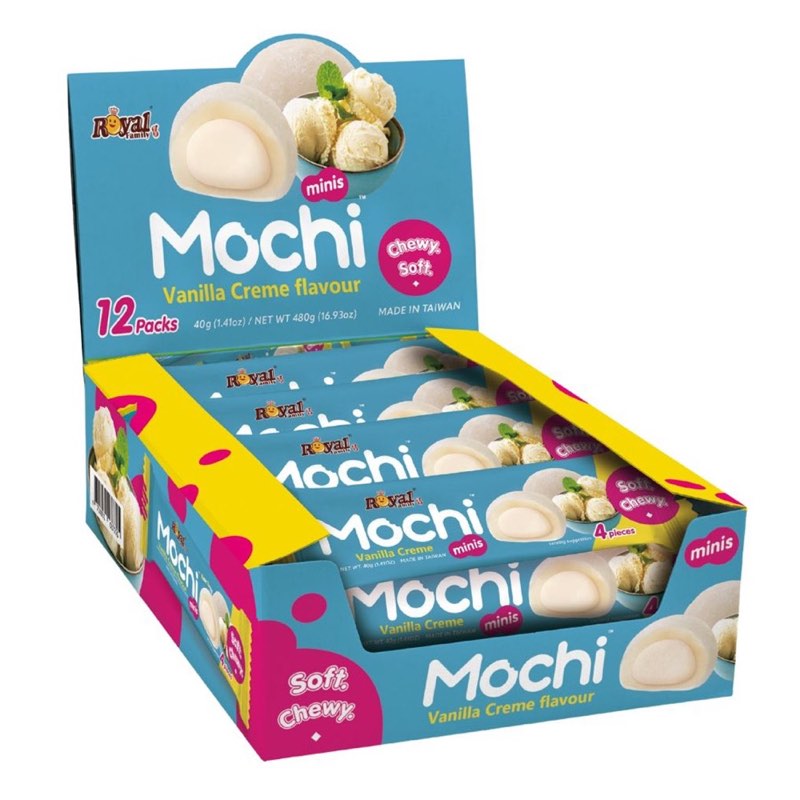
Small pieces, meant to be eaten whole, in a pack that fits in a coat pocket. The listing carries a single image and it is an accurate one.
The word "minis" is doing real work in the name. These are not the large mochi you might be picturing from a dessert counter, where one piece is a whole serving and you approach it with a fork. They are bite-sized, which changes the entire character of the thing: a large mochi is a pudding and a pack of minis is a snack, and they belong in completely different parts of an evening.
The outside has the soft matt finish the style is known for. It is not glossy, it is not sticky, and the pieces do not weld themselves to one another in the pack. Practically this means you can tip a few into a palm, or eat straight from the pack, without any of the small irritations that come with most chewy confectionery.
The vanilla version, specifically
Of the three flavours in this range, this is the gentle one, and the description ought to reflect that rather than inventing drama it does not have.
The bite is soft and slow. There is a moment of compression where the piece gives without breaking, then the whole thing yields at once, then a long springy chew that pulls back slightly against the teeth. The texture stays even throughout — it does not turn grainy, watery or gluey as it is worked, which is the main thing that separates a good chew from a poor one.
The flavour comes up almost immediately and then simply stays. That is unusual. Most sweets have an arc — a bright arrival, a peak, a fade — and this one has more of a plateau. Vanilla is a warm, pale, rounded flavour with a faintly floral edge to it, and paired with the crème side it reads as smooth and comforting rather than exciting. Nothing spikes. Nothing surprises you. It is the confectionery equivalent of a plain biscuit with your tea, and that is a compliment, because there is a reason plain biscuits outsell everything else.
The finish is clean and short. You are not left with a heavy coating, and there is no aftertaste to speak of beyond a soft sweetness that fades within a few seconds. That is exactly why it works as a long-session snack: flavours that linger heavily become tiring after the tenth piece, and this one does not.
Sweetness sits at moderate. It will taste mild to anybody who arrives from the sour aisle and about right to anybody who arrives from a toffee or a fudge. Set beside its own sibling, the difference is stark — the Tiramisu & Creme pack at £1.99 leads with a dark, roasted, faintly bitter note where this one leads with warmth, and eating the two back to back is the clearest possible demonstration of how much a flavour changes a format.
Who this particular flavour suits
The cautious eater, first. Vanilla is the least divisive flavour in confectionery and this is the least divisive item in its own range. If you are buying for somebody whose tastes you do not know — a colleague, a new neighbour, a friend's child — this is the safe pick, and safe picks are underrated.
The texture-curious, second. Anyone who wants to find out what a mochi-style chew is like without a strong flavour getting in the way should start here rather than with the dark or fruity siblings. Plain flavours let you notice texture; loud ones mask it.
Children, third, with the usual supervision caveat for small chewy sweets. There is no acquired-taste element here and no bitterness to negotiate. For a child, this is simply a nice chewy sweet, which is all it needs to be.
And the mixer, fourth — the person who is assembling a table or a hamper rather than buying one thing to eat. A mild item is structurally useful in a spread because it gives the loud items something to be loud against. Put this next to anything sour or anything dark and both improve.
How this chew compares with the other chews we stock
"Chewy" covers a surprising amount of ground, and the 78 lines on that shelf are not interchangeable. It is worth knowing where this one sits, because people who like one kind of chew often dislike another kind entirely and assume the whole category is not for them.
The oldest kind is the pull chew — dense, elastic, and genuinely hard work for the jaw. You bite, it resists, and it stays resisting for a long time. The Black Jack chews at £5.49 are in that tradition, and a fair part of their appeal is the effort involved. Children love them for exactly that reason and people with dental work tend to avoid them for exactly that reason too.
Then there is the bar chew, which is the same idea in a different shape — something you bite pieces off rather than eat whole, usually wrapped individually and usually built to be carried. A ten-pack of chew bars at £2.50 is the standard form of that, and the format decision matters more than it looks: a bar is a two-handed, put-it-down-and-pick-it-up sweet, where a mini is a one-handed, eat-it-and-forget-it sweet.
Then the soft chews, which is where toffee and fudge sit. These yield more readily and break down faster, turning from solid to smooth as they warm in the mouth. That 150 g toffee carton at £3.49 is the clearest example — it starts firm and finishes creamy, which is a completely different arc from anything that stays consistent.
And then there is this one, which is its own thing: soft on entry like a fudge, but persistent like a pull chew, with a springiness neither of the others has. It does not fight you and it does not collapse. If you have tried the other three kinds and found the first too much work and the third too quick, this is the gap in the middle you were looking for.
The practical consequence is that these three kinds should not all go in the same bowl. A mixed chewy bowl sounds sensible and eats badly, because your jaw keeps having to recalibrate. Group by effort level rather than by category name and everything tastes better.
Planning a table: quantities, timing, and what vanishes first
Anyone who has catered a birthday knows that sweets on a table do not deplete evenly. Some bowls are empty before the candles and some are still three-quarters full when you are clearing up. That is predictable, and planning around it saves both money and embarrassment.
The rules of what runs out
Four things drive the rate at which a bowl empties, and flavour is not the main one.
- Visibility. Whatever is tallest, brightest or nearest the door goes first, more or less regardless of what it is. Green & Red Candy Poles at £5.49 will empty faster than something small and brown sitting behind them, purely because people take what they can see.
- Grab size. Anything you can take a handful of goes at handful speed. Anything you take one of goes at one-at-a-time speed. Small loose sweets in an open bowl disappear roughly three times faster than the same weight in individual pieces people feel they should take singly.
- Speed of eating. Fast-dissolving items get replaced quickly because the eater's mouth is free again. Long chews slow the whole table down, which is why putting one on the table is a budgeting decision as much as a flavour one.
- Familiarity. At a mixed-age gathering, familiar things go first and novel things go second, then the novel things go very quickly once one brave person has tried them and reported back. Plan for a lag, not for a failure.
Quantities that actually work
For a children's party, plan on roughly 75–100 g of sweets per child across the whole table if there is also cake, and closer to 150 g if there is not. For adults grazing through an evening, 100 g per head is generous and most of it will be eaten in the first hour. These are rules of thumb rather than laws, but they are a great deal better than guessing, and the usual error is buying far too much of one thing and not enough variety.
Translated into this pack: at 40 g each, one pack per two children as a taster element, or one per adult if you want everybody to have their own sealed thing. For a table of twelve you would want six to twelve packs as a component — but you would not build the table out of them, because a table needs bulk underneath and this is not a bulk item. Buy the bulk from the loose sweets shelf by weight and use packs like this for the top layer.
Timing
Put the table out later than you think. Sweets set out an hour before guests arrive will be picked at by the people helping you set up, will warm up, and in the case of anything chewy will soften. Thirty minutes ahead is plenty.
Hold something back. The single best piece of party advice in confectionery is to keep a reserve in a cupboard and bring it out at the ninety-minute mark when the first wave has cleared and the table looks depressing. It costs nothing and it completely changes how generous the spread feels. Individual sealed packs are ideal for the reserve, because they have not been sitting out.
Stagger the loud things. If you put every eye-catching item out at once, the table peaks in the first fifteen minutes and then declines for three hours. Put half out, and bring the rest out in the second half.
The bowl plan
A good spread has five or six bowls, not two enormous ones, and they should differ by type rather than by flavour. A practical set: one chewy, one hard or boiled, one jelly, one mallow or foam, one chocolate-format item, and one novelty. That covers every preference in a room without anybody having to be catered for individually.
For the chewy bowl, these minis work alongside Drumstick Chew Bars (10 Pack) at £2.50, which brings a wrapped format and a different chew character into the same bowl. For the jelly bowl, browse jelly and gummy sweets and pick on shape — children choose jellies by what they look like, not by flavour, and Hannah's Animals at £5.49 is a reliable example of why animal shapes have never stopped selling. For the mallow bowl, the pumpkin mallows already mentioned will do the job and look seasonal doing it. For the chocolate-format bowl, the candy and chocolate shelf has the range. For the novelty, something like a Chupa Chups Mini Candy Sushi Tray 100g at £2.99 earns its place by being talked about rather than by being eaten, which is a perfectly legitimate job for one item on a table.
Allergies and mixed tables
One practical, non-negotiable point. If anybody at your gathering has a food allergy, sealed individual packs are far easier to manage than open bowls, because the packaging can be read and the contents have not been handled. We cannot tell you what is or is not in any line — check the manufacturer's packaging on arrival before eating, and let the person concerned make their own call from the label. That is the correct process and it is worth building your table around it rather than improvising on the night.
Vanilla as a flavour family
Vanilla has a reputation problem. Used as an adjective it means dull, which is unfair to a flavour that does an enormous amount of quiet work across the whole of confectionery.
Its real character is warmth and roundness. It sits low and wide rather than high and narrow — the opposite of a citrus note, which is bright, sharp and instantly identifiable. Vanilla is identifiable too, but slowly, and mostly by feel: things that contain it taste fuller and softer than things that do not.
That is why it appears so often as a partner rather than a lead. It smooths edges. It gives a fruit flavour a floor to stand on. It turns a sharp thing into a rounded thing. There are fifteen lines on our vanilla shelf and if you scan them you will notice how few of them are vanilla alone — most pair it with something, because that is what it is best at.
When it does lead, as it does here, the effect is deliberately unassertive. A vanilla-led sweet is asking you to enjoy the format rather than the flavour. That is a reasonable thing to ask when the format is the interesting part, which in a mochi-style mini it plainly is.
The family it belongs to is the pale-and-creamy one: the soft, warm, low-pitched flavours that stand opposite the fruit wing of the shop. Gray's Traditional Teacakes at £6.49 live in the same territory from a completely different era and format — soft, mild, domestic, teatime rather than party. Buchanan's Highland Toffee Carton 150g at £3.49 is the same family pushed towards depth, and Bristow's Traditional Salted Caramel Bon Bons at £5.49 is the same family with salt used as a counterweight. Line those three up next to this pack and you have a small education in how one flavour family is stretched across four completely different textures.
Pick and mix, and where this fits in one
If you are assembling a bag rather than buying packs, the useful way to think about a mild item is as connective tissue. A bag made entirely of loud sweets is exhausting; a bag with a mild element in it gives you somewhere to go between the loud ones.
A workable ratio is one mild item for every three assertive ones. Any more and the bag goes flat; any less and the assertive ones stop registering because your palate never gets a rest. The pick and mix section is where to build this, and the order you eat in matters nearly as much as the contents — mild first, sharp second, and never the other way round, because a sour sweet will flatten a vanilla one for a good minute afterwards.
The other structural use for a mild chew in a bag is as a finisher. Whatever you eat last is what you remember, and ending on something soft and warm leaves a better impression than ending on something acidic. Keep a couple back deliberately.
Beyond the sofa: other occasions
Lunchboxes, because a small sealed pack survives being carried and does not need a container. Hampers, because a neat unusual pack fills a gap without looking like filler. Long journeys, because a slow chew passes time and does not require hands or attention. Desk drawers, because it keeps and does not melt over anything.
Gifting at the small end works well too, and the three-flavour set is the obvious move: buy all three packs, which comes to under six pounds, and you have given somebody a small tasting exercise rather than a sweet. Add the Strawberry Cheesecake flavour at £1.99 to this one and the tiramisu, and the set covers pale, fruity and dark in one go.
For seasonal tables, the mild flavour is an asset rather than a limitation — seasonal spreads tend to be heavy on strong flavours and short on neutral ones, and the neutral ones are what stop people flagging by the third bowl.
What £1.99 for 40 g really buys
£1.99 for 40 g is just under £5 per 100 g. Against the tubs and cartons in this shop that is expensive by weight, and there is no honest way to dress it up otherwise — the 780 g tub mentioned above lands near £1.02 per 100 g, which is about a fifth of the rate.
What the small pack buys you instead is three things. First, a sealed unit that stays sealed until you want it, which matters for lunchboxes, reserves and hampers in a way that loose weight does not. Second, the ability to try something for the price of a coffee-shop biscuit rather than committing to a tub. Third, portion control that is built into the purchase rather than requiring willpower, which for some shoppers is the entire reason to buy small.
On how far it goes: because the chew is slow, 40 g lasts noticeably longer in practice than 40 g of anything fast-dissolving. As a solo film-night snack, one pack is light — pair it with something bigger. As a rationed desk-drawer item, it will cover three or four separate afternoons. As a party component, count it as one contribution among six rather than as the table.
If per-gram value is what you are optimising for, buy weight from the loose counter and treat packs like this as accents. If convenience, portioning and trying something new are what you are optimising for, this is priced about where it should be.
Keeping them right
Room temperature, dry cupboard, out of the sun. That is the whole of it, but the details are worth having.
Heat is the main risk. A pack left in a car in summer, on a windowsill or near a radiator will soften and the pieces will start sticking to one another. Nothing is spoiled, but the clean matt surface that makes them so tidy to eat is the first casualty, and once they have clumped they do not fully un-clump.
Cold is the mistake people make while trying to avoid heat. Do not refrigerate chewy sweets. Cold stiffens the chew, slows the flavour right down and takes away the springiness that is the point of the format. If a pack has been chilled, let it come back to room temperature for half an hour before eating and it will recover.
Once open, keep the air out — fold and clip the pack, or tip the rest into a small airtight tub. Left open, chewy sweets dry at the surface over a few days and firm up. That is a quality issue rather than a safety one and it is easy to prevent.
Keep them away from strongly scented neighbours in the cupboard. A mild flavour picks up smells far more readily than a loud one, and vanilla is about as mild as it gets. The spice shelf is the wrong shelf.
Follow the date and storage instructions on the manufacturer's packaging, which is the authority here. If anybody eating them has an allergy, check that packaging before eating. And the standing note across the shop: sweets are a treat, and small chewy pieces are a choking risk for young children, so supervise them.
One size, and how the three flavours compare
There is one size of this line — 40 g at £1.99 — and no larger format, so the only real decision is flavour. Three exist and they are genuinely different from one another rather than being three shades of the same thing.
| Flavour | Character | Best for | Price |
|---|---|---|---|
| Vanilla Crème | Warm, pale, mild, no spikes | Unknown tastes, children, long sessions, mixing | £1.99 |
| Tiramisu & Crème | Dark, roasted, faintly bitter over creamy | Adults, after dinner, people bored of fruit | £1.99 |
| Strawberry Cheesecake | Bright and fruit-forward over a creamy base | Fruit eaters who still want the dessert idea | £1.99 |
Buying one: take this one if you are unsure, because it is the flavour fewest people dislike. Buying two: take this and the tiramisu, because they are the furthest apart. Buying three: open them mildest first, or the dark one will flatten everything that follows it.
There is one more way to split the three, which is by who you are buying for rather than by what you like. For a mixed table of adults and children, this vanilla pack is the one everybody can eat happily. For a group of adults after a meal, the darker tiramisu pack reads as the more grown-up choice and suits the hour. And for anybody who says they do not much like dessert flavours but does like fruit, the strawberry cheesecake option is the bridge between the two positions — same 40 g, same £1.99, and a considerably brighter flavour than either of its siblings.
Finding it, and what sits nearby
This pack appears on three shelves. The chewy shelf runs to 78 lines and is where to browse if texture is your buying criterion. The loose sweets counter, at 356 lines, is the largest single section on the site. And the vanilla flavour shelf, at 15 lines, is small enough to read end to end in a couple of minutes, which makes it unusually useful.
Worth a look nearby: the retro section, which is where the traditional formats live and which makes an interesting contrast with the newer borrowed formats; our pick and mix pages for building a bag rather than buying packs; and the complete listing of everything we stock when you would rather scroll than navigate.
Common questions
Is 40 g enough for a film night?
For one person, it is on the light side but workable, because the slow chew stretches it further than the weight suggests. For two people it is a contribution rather than the whole snack. For a group, buy multiples or pair it with something bulk-sized. The honest planning figure is one pack per person if everyone is to have their own, or one pack per two people if it is one element among several on a table.
Will it make a mess on a controller or a remote?
No, and this is one of its genuine strengths. The surface is matt and dry rather than sticky, the pieces are eaten whole so there is nothing to put down half-finished, and there is no coating to shed. There is one seal to open and then no further packaging to deal with. It is about as low-mess as chewy confectionery gets.
How does it compare with the tiramisu flavour?
Same format, same chew, same price, completely different flavour intent. This one is warm, pale and mild with no bitterness. The tiramisu version leads with a dark roasted note before settling into something creamier. If you want easy, take this. If you want interesting, take that. If you want to understand what the format is doing, take both and alternate.
Is it too plain?
It is deliberately restrained rather than plain, and whether that is a fault depends on what you want. A mild flavour lets the texture be the main event, which is the right decision for a format most British shoppers have not eaten much of. If you find it underpowered, the strawberry and tiramisu siblings are both louder, and nothing is lost — each pack is under two pounds.
Can I put these out in a bowl at a party?
You can, and they behave well in one because they do not stick together or to the bowl. But remember they arrive as a sealed pack rather than loose, so a bowl means opening several packs. For a mixed group, or where anyone needs to read a label before eating, leaving them sealed and letting people take a pack is the better approach.
Do they melt?
They do not melt in the way chocolate does, but they soften in heat and will stick to one another if a pack is left somewhere warm. Keep them at ordinary room temperature. Do not use the fridge to fix this; cold damages the chew more than warmth does and the texture is the reason to buy them.
Are they suitable for vegetarians, vegans or anyone with an allergy?
Our supplier has supplied no dietary tags for this line, so we cannot say, and we will not guess on something that matters. Check the manufacturer's packaging when the pack arrives and before anybody eats from it. That applies to allergens as much as to dietary preference.
How long do they take to eat?
Longer than most sweets of the same size, which is the point. The chew holds its structure rather than dissolving, so each piece occupies your mouth for a decent stretch. In practice that means you eat them at a much slower rate than a comparable weight of hard or fizzy sweets, and a small pack goes further through an evening than you would expect.
What should I buy alongside for a proper spread?
Something sharp and something visual. Sharp gives the table a palate reset; visual gives it presence. Pull the sharp element from the sour end of the loose counter and the visual element from anything tall or brightly coloured — the candy poles mentioned earlier are a straightforward answer, and the pumpkin mallows add bulk that looks like more than it weighs.
Is there a multipack or a bigger bag?
Not of this line. It is sold in one size only, 40 g at £1.99. If you want more, buy more packs — with the small advantage that each stays sealed until opened, so the last one is in the same condition as the first, which is not true of a large bag you opened a week ago.
Will children eat it?
Usually yes. There is nothing acquired about the flavour and the chew is the kind of texture children tend to enjoy. As with any small chewy sweet, supervise young children while they are eating, and use your judgement with very young ones.
Does the order I eat things in really matter?
More than most people expect. A mild flavour eaten straight after something sour or strongly minty will taste of very little, because your palate has been temporarily reset and a gentle sweet cannot compete with it. The same piece eaten after a cup of tea, or on its own, tastes full and rounded. If you are working through a mixed bag, go mild to sharp rather than sharp to mild, and keep a couple of the soft ones back to finish on.
What is the difference between these and the large mochi you see on dessert counters?
Size and purpose. A large one is a single serving you sit down with and eat with some ceremony; these are bite-sized pieces eaten whole, one at a time, alongside something else you are doing. That changes everything about how they fit into an evening. If you were expecting a pudding, this is not it — it is a snack that borrows a pudding format, and at £1.99 for 40 g it is priced as a snack too.
Is it in stock?
Yes, this line is currently listed as in stock at £1.99. The product listing is the live authority on availability rather than this description, so check there before planning a table around it.
To sum up
A quiet, clean-handed, slow-eating chew with a mild warm flavour, in a pack small enough to put in a coat pocket and priced at under two pounds. It is not the loudest thing in the shop and it is not trying to be — its value is in behaving well: not making noise, not making mess, not running out in the first ten minutes, and not fighting with anything else you put beside it. For an evening in front of a screen, for a lunchbox, or as the calm element on a busy party table, that is a more useful set of qualities than excitement.
More from Royal Family
More chewy sweets



More vanilla sweets
Where this sits
Royal Family Mochi Minis Vanilla Creme Flavour Pack 40g appears on these shelves. Browse them, or jump to something nearby.
You might also like