Home / Loose Sweets / Maoam Sour Blue Raspberry Pinballs
Maoam · 250g
Read the full guide
Maoam Sour Blue Raspberry Pinballs
£5.49
✔ In stock — ready to ship
Fresh stock
Free over £20
Same-day dispatch
Secure checkout
Most pick-and-mix bags go wrong in the same way: they are assembled as a list of favourites rather than as a set of things that work next to one another. You end up with six sweets that all do the same job, or with one loud item that flattens everything around it. The useful way to build a bag is to choose a centre first — one sweet that sets the tone and takes up the most room — and then pick everything else in relation to it. Maoam Sour Blue Raspberry Pinballs make an unusually good centre, and that is where this page starts, because it is the question most people are really asking when they land here.
A centre sweet needs three things. It needs to be eaten one at a time rather than by the handful, so that it paces the bag instead of vanishing from it. It needs a clear flavour direction, so the rest of the bag has something to agree or disagree with. And it needs to look like it belongs at the front of the scoop. A sour chew in a strong blue does all three. The sour finish slows people down, blue raspberry is an unmistakable direction to build from, and the colour does the visual work for you before anyone has tasted anything.
The full guide to Maoam Sour Blue Raspberry Pinballs
7,284 words on how it eats, who it suits, how to serve it and what to put beside it.
Starting a mix with a blue sour chew at the centre
From there the build is a matter of balance rather than volume. A bag with a sour centre wants a soft landing somewhere in it, or the whole thing becomes hard work by the third handful. That is the role of something creamy and slow — the salted caramel bon bons at £5.49 are the obvious answer, because they sit at the same price point as the Pinballs and eat at completely the opposite speed. Where a sour chew is quick and bright, a bon bon is long, quiet and powdery, and the two together give a bag a proper shape.
Next you want a second sour, but not a copy of the first. Duplicating the sourness is the commonest mistake in a homemade mix. The trick is to change the format rather than the intensity, so the mouth gets a different experience even though the direction is the same. Kingsway Fizzy Meerkats, also £5.49, are a fizzy jelly rather than a chew, so they deliver their tang as a quick crackle on the tongue instead of a slow build through chewing. Put them alongside the Pinballs and the two sours read as different sweets rather than as a repeated note.
If you want to go harder in that direction, the mega sour apple bags at £3.99 take the sourness up several rungs and swap blue raspberry for green apple, which is the natural partner flavour. They are a hard sweet rather than a chew, which again keeps the formats varied. Use them sparingly — a small handful in a big bag is enough to give people something to dare each other over without making the mix unapproachable.
Every mix also needs one thing that is not fruit at all. Fruit fatigue is real, and a bag made entirely of berries and citrus starts to taste like one long sweet somewhere around the middle. A dark, aromatic chew resets the palate completely: the aniseed-leaning Black Jack chews are the traditional choice for this job and share the £5.49 price, so they slot into a bag without changing the maths. If aniseed is not to your taste, a £3.49 carton of Highland toffee does the same palate-clearing work from the buttery end instead.
Finally, give the bag one piece of theatre — something that makes people look twice when they see it. Juicy grenade gummies at just £1.39 are the cheapest way to do it, and at that price you can add them to a bag almost as a garnish. Cool cola skulls at £7.50 are the more serious version: a cola flavour and a shape that sits oddly and brilliantly next to a tray of round blue chews.
That is a six-part bag with the Pinballs taking the largest share: one sour chew centre, one creamy slow sweet, one fizzy jelly, one hard sour, one non-fruit palate-reset, and one novelty. Scale the proportions to suit the crowd, but keep the roles. Once you have built one bag this way it is hard to go back to grabbing handfuls at random.
What actually comes out of the bag
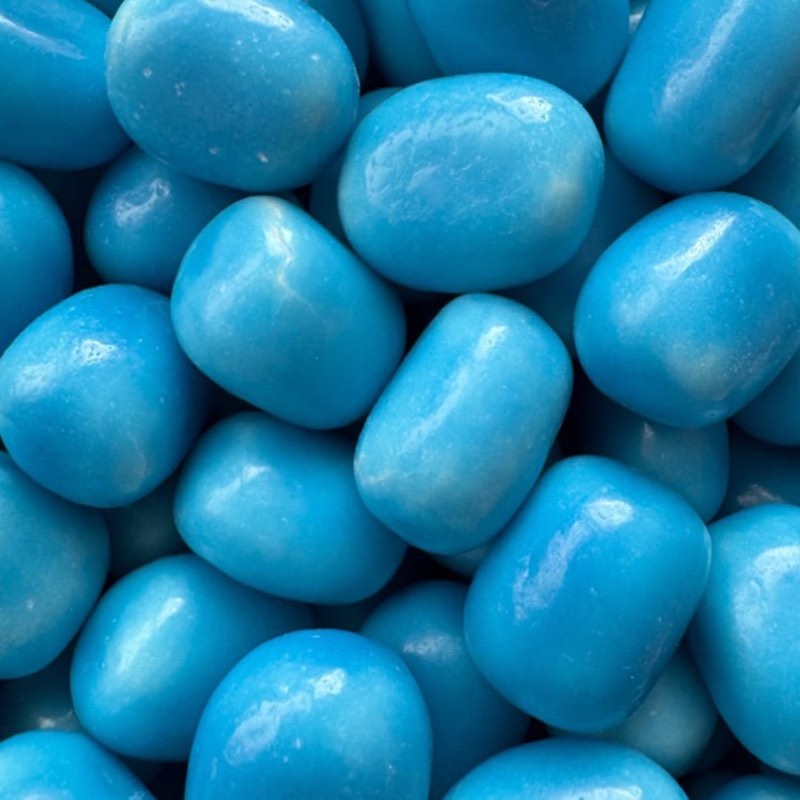
Open a bag and the first thing you register is the colour, because there is nothing subtle about it. These are blue — properly blue, the kind of blue that has no equivalent in a fruit bowl and makes no attempt to pretend otherwise. Against the browns, reds and yellows that make up most of a sweet counter, a scoop of these reads as a block of colour rather than as individual sweets. That matters more than it sounds, and there is a whole section further down about what it lets you do.
The name tells you the format. Pinballs are round, and roundness changes how a sweet behaves in the hand and in the mouth. They do not stack, they roll, and a handful settles into the palm rather than sitting in a flat layer. Tip a few into a bowl and they find the lowest point and gather there, which is why they look so good in a curved dish and slightly awkward in a square one. It is also why they are easy to portion by eye: a rounded tablespoon is a recognisable amount, and people take them in ones and twos rather than in fistfuls.
The eating experience is a chew, and it is worth being precise about what that means, because chew is a category that covers a lot of ground. This is not a gummy — it does not have that springy, bouncy resistance that snaps back against the teeth. It is not a hard sweet either, so there is no shell to crack and no long period of sucking before anything happens. A chew gives way under pressure, compresses, and then works with you for a while. The first bite is the softest moment. After that the sweet firms up slightly as you work it, and the flavour comes out gradually rather than all at once.
The sour arrives first and arrives outside. On a sour chew, the tang sits on the surface, so it hits the tip and the sides of the tongue within the first second or two — a sharp, prickling edge that makes you salivate and pulls your attention to the sweet. That opening is the most intense moment of the whole thing, and it is short. Within a few chews the surface has dissolved and you drop into the body of the sweet, which is where the blue raspberry lives.
Blue raspberry is a confident, slightly artificial-tasting berry note, and that is the point of it rather than a failing. It is a sweetshop flavour rather than a fruit-bowl one: rounder and softer than a real raspberry, with none of the seediness or the acidity you would get from the actual fruit, and with a faint sweet-and-tart quality that sits somewhere between raspberry and blackcurrant. It is bold enough to be recognised instantly by anyone who grew up on slush drinks and ice lollies, and that recognition is a large part of why the flavour works so well in a sweet.
The finish is where chews differ most from other formats. A hard sweet ends abruptly when it has gone. A gummy ends when you swallow. A chew lingers, because the last of it stays on the teeth and in the corners of the mouth and keeps releasing for a minute or so after you have stopped chewing. With a sour chew that tail is slightly tart, which is what makes people reach for a second one — you are still half-tasting the first when the next one starts to look appealing. It is worth knowing about this if you are putting them on a table, because it means a bowl of these disappears in a rhythm rather than in a rush.
One practical note on texture: chews respond to temperature more than almost any other sweet. Warm, they are soft and stretchy and give way immediately. Cold, they are firmer, take longer to break down and hold their sourness on the surface for longer. Neither is wrong, and the difference is big enough that it is worth trying both before you decide how you like them. There is more on this under storage.
Reading the sour spectrum, and knowing where this sits on it
Sour is not one thing, and the single most useful idea for anyone who shops for sweets regularly is that sourness runs along a spectrum with at least four distinct positions on it. Most disappointment with sour sweets comes from buying at the wrong point on that spectrum for the occasion — putting something punishing on a children's party table, or buying something gentle for a friend who wanted to be challenged. Once you can place a sweet on the scale, you stop guessing.
At the bottom of the scale is what you might call a tang: a faint acidity worked into the body of a sweet rather than applied to the outside. You notice it as brightness rather than as sourness, and if you asked someone whether the sweet was sour they might say no, it is just fruity. Fizzy sweets often sit here or just above, because fizz reads to most people as liveliness rather than as sour. This end of the scale is where sweets go when they need to be safe for every guest at a table.
The next position up is the sour finish, where there is a genuine coating doing genuine work, but it is calibrated so that the sourness is an event rather than a trial. It makes you blink once, it makes the mouth water, and then it resolves into the flavour underneath within a couple of seconds. This is where the widest range of sweets live, because it is the position that pleases the most people, and it is where these Pinballs sit. Adults who think they do not like sour sweets are usually fine here. Children who have decided sour sweets are their whole personality find it pleasant but will tell you it is not very sour, which is a useful piece of information in itself.
Above that is the proper sour, where the coating is heavy enough that you feel it before you taste it and where one sweet at a time is the sensible pace. The sourness is no longer a doorway into the flavour; it is a substantial part of the experience, and it lasts long enough that you would not want two in your mouth at once. A sour theatre box at £2.25 is a good example of this band being done at a shareable scale, and it is a smart way to find out how a group feels about the step up without committing to a large bag.
At the top is the challenge sour, which is not really a confectionery product so much as a dare with sugar attached. These exist to be filmed, passed round and endured, and they are genuinely unpleasant for a moment, which is entirely the intention. The mega sour apple bags mentioned earlier live up here. They are a fantastic thing to own and a terrible thing to put out as the only sour option at a party.
So what do you do with the spectrum once you can see it? The first use is straightforward: buy for the person, not for the idea. If you are shopping for somebody who says they like sour sweets, ask yourself which of the four bands they mean, because the gap between the second and the fourth is enormous. The sour finish band is the one to buy when you do not know, which makes this line a genuinely safe gift in a way that the top of the scale never is.
The second use is in building a table or a bag, and it is the more interesting one. A spread that offers one point on the spectrum is monotonous no matter how good that point is. A spread that offers three is a small experience — people move up and down the scale, compare, and talk about it, and the sweets do some of the social work for you. The classic arrangement is a gentle option, a sour finish option and one proper sour, with the numbers weighted heavily towards the first two. Put out equal quantities of all three and the top end will still be sitting there at the end of the night, because sour sweets are eaten in far smaller quantities than sweet ones.
The third use is about order. Sourness has a cumulative effect: once your mouth has been through a strong sour coating, the next few things you eat taste different, and mild sweets taste bland for a minute or two afterwards. If you are serving a spread rather than a bowl, it is worth putting the sour items where people will reach them after they have eaten something else rather than as the first thing they encounter. This is not fussiness. It is the difference between a spread where everything gets eaten and one where the delicate items are left behind because nobody could taste them properly.
The fourth use is in pairing across the spectrum rather than along it. The opposite of sour is not sweet — it is creamy. Sugar on its own does not soften sourness; fat and dairy character do. That is why a caramel, a toffee or a fudge alongside a sour sweet works so much better than another fruit item, and it is why the fizzy, sherbety Refresher chews at £5.49 read as a companion rather than a competitor: they sit lower on the scale, they are built around a different kind of lift, and they hand your mouth back to you between sour sweets.
The last thing to say about the spectrum is that it moves with the person. Tolerance builds. Somebody who finds the sour-finish band lively in January will find it mild by the summer if they have been eating it regularly, which is why so many households start in the middle and end up buying something from the band above. It is worth knowing when you are choosing a size: if you are buying two kilos of a mild sour for a household that is clearly climbing the ladder, you may be buying for a taste that is about to move on. Buying a smaller bag and a second, sharper option is often the better call than buying the biggest bag of one thing.
Blue as a design decision: photographs, jars and tables
Blue is the most useful colour on a sweet counter and the least common one, and those two facts are connected. Almost nothing in the food world is genuinely blue. Walk through a greengrocer, a bakery or a butcher and you will find every colour except this one. That absence is exactly what makes a blue sweet so effective visually: it reads as unmistakably confectionery, it cannot be mistaken for anything else on the table, and it does not blend into the warm palette that dominates every other dish you might put next to it.
Start with photographs, because a great many sweets are now bought to be photographed — for a party post, a shop listing, a birthday message, a school fundraiser flyer. Blue is the easiest sweet colour to photograph well. Warm colours like red, orange and amber shift dramatically under indoor lighting, going muddy under old bulbs and washing out under bright white LEDs. A strong blue holds its identity under almost any light, because there is nothing else in the frame competing for that part of the spectrum. On a white plate it is graphic and clean. On a wooden board it is striking, because wood is the warmest possible background and the contrast does all the work for you. On a black or navy cloth it goes quiet and moody, which is the one setup to avoid if you want the sweets to be the subject.
Roundness helps here too. Round sweets photograph better than flat ones because they catch a highlight on the top of each piece, which gives a pile of them depth and separation rather than reading as a single mass. Pile them rather than spreading them, shoot slightly from above rather than straight down, and let a few roll out of the pile so the eye has somewhere to travel. That is genuinely all there is to it.
Jars are the second place colour earns its keep. A jar of mixed sweets is a nice thing; a jar of colour-blocked sweets is a display. If you keep sweets in glass at home or on a stall, the single most effective arrangement is to fill in horizontal bands of solid colour, and blue is the band that makes the whole jar work, because it stops the warm colours merging into one another. A layer of blue between a layer of red and a layer of yellow gives you three distinct stripes instead of one orange blur. Round sweets settle into level bands much more readily than irregular shapes do, so this arrangement is easier with Pinballs than with almost anything else.
If you are filling jars properly, think about the size of the vessel relative to what you are putting in it. The 250 g bag fills a small kitchen jar or a generous desk bowl. The larger sizes are what you want for the big display jars — the tall ones that look magnificent when they are two-thirds full and slightly sad when they are a quarter full. It is always better to fill a smaller jar completely than a bigger one partly, and that is worth remembering before you buy the vessel.
Tables are the third application, and the principle is different. On a table you are not composing a single image; you are creating a path for people's eyes and hands. Colour is how you do it. A long table with everything in warm tones is visually flat, and guests tend to graze whatever is nearest to them rather than travelling along it. Put a bowl of something strongly blue at the far end and people walk the length of the table to get to it, which means they see everything else on the way. Spread two or three blue points along a table and you have created a rhythm that pulls people through the whole spread.
There is a colour-scheme argument as well. Blue is the anchor of a huge number of party palettes — baby showers, football colours, under-the-sea parties, space themes, school colours, winter and ice themes, and any occasion where somebody has chosen blue and white and then discovered that almost no food comes in blue. If you have ever tried to source food in a specific colour you will know that this is the hardest one to find, which is why a blue sweet is worth keeping in the cupboard even when you have no immediate use for it.
Pair it well and the effect multiplies. Blue against white is crisp and clean. Blue against a bright yellow or orange is a proper contrast that looks deliberate rather than accidental — a 780 g tub of multicoloured tutti frutti tubes at £7.99 gives you all of those warm tones in a single purchase and enough volume to fill a table alongside a bowl of blue. Blue against brown is the sophisticated version of the same idea, which is where chocolate-toned sweets and toffees come in. Blue against green is the one combination to be careful with, because the two colours sit close enough on the spectrum that they can read as a single murky band unless you separate them with something pale.
Finally, a small point that gets overlooked: colour survives being mixed but shape does not. If you tip several sweets together into one bowl, the shapes disappear into each other almost immediately and colour becomes the only thing that reads from more than a metre away. So if you are mixing, mix for colour first and worry about shape second. The scoop that looks best in a mixed bag is the one that brings a distinct colour with it, and this one does that better than nearly anything else on the shelf.
Notes on the blue raspberry family
Blue raspberry sits in an odd and rather wonderful corner of the flavour world. It is a sweetshop flavour that has no exact equivalent in nature, which frees it from the usual comparison: nobody eats it and thinks it tastes nothing like the real thing, because there is no real thing to hold it against. What it does have is a very strong set of associations — slush drinks, ice lollies, fairground stalls, the specific summer-holiday feeling of a cold blue drink — and those associations are doing at least half of the flavour's work.
Taste-wise, it reads as a soft, rounded berry with a little tartness at the edges. It is less sharp than lemon, less perfumed than strawberry, less deep than blackcurrant and less tannic than cherry. That middling quality is why it takes so well to a sour coating: there is room around it for something sharp on the outside, and the berry underneath is broad enough that the tang does not overwhelm it. A more delicate flavour would be buried by the same coating.
Which flavours sit well beside it? Green apple is the classic partner, because the two are complementary rather than similar — apple is crisper and more acidic where raspberry is rounder and softer, and each makes the other taste more like itself. Cola is the other natural neighbour, because it is aromatic and spiced rather than fruity, so it occupies completely different ground without clashing; that cola flavour in a skull format is a ready-made example of how well the two sit together in one bowl. Bubblegum belongs in the same family too, sharing the same sweetshop-invented, nostalgic quality — the sour pink bubblegum Pinballs at the same £5.49 are the obvious pairing, since they are the same format and the same size of purchase in a different direction entirely.
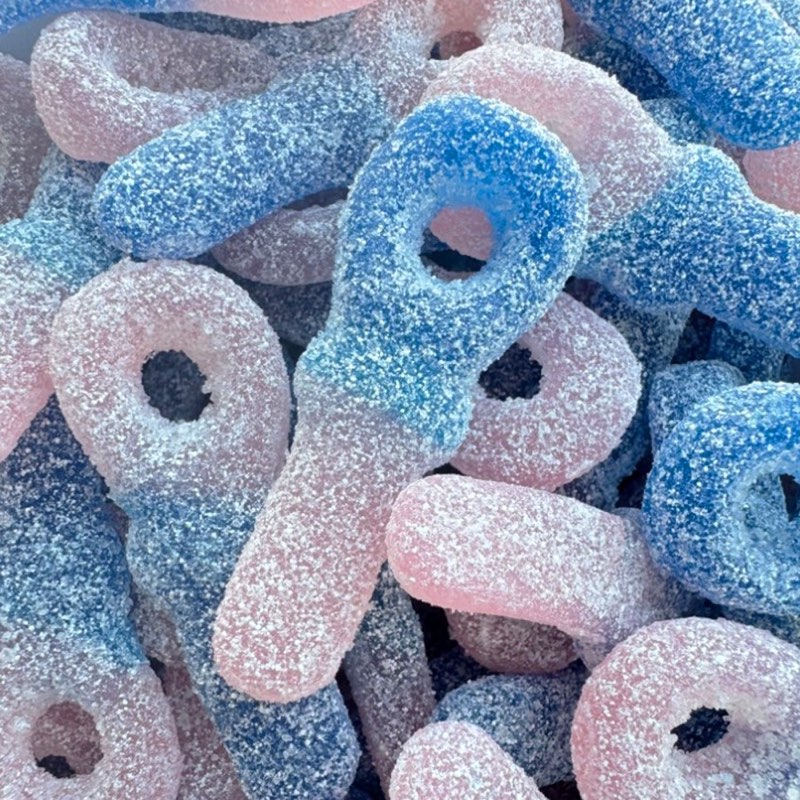
Two blue sweets side by side in pink and blue is also, frankly, the easiest good-looking pairing available to you. If you want a table that reads as deliberate with a minimum of effort, two bowls of the same round chew in two strong contrasting colours will do it, and the fact that they eat identically means nobody has to think about which they prefer.
What does not sit well beside blue raspberry? Anything mint, which fights it. Anything heavily aniseed, unless you are using it deliberately as a palate break rather than as a partner. And anything else that is also trying to be the loud fruit in the bowl: two competing berry flavours next to each other simply cancel out, and you end up with a bowl of generic fruit sweetness where you intended contrast.
Who this suits, and when to reach for it
This is a mid-scale sour in a widely liked flavour at a shareable size, which makes it one of the easier sweets to buy for other people. If you are shopping for a household rather than for yourself, it is a more reliable choice than something from the top of the sour spectrum, because it pleases the people who like sour sweets without alienating anyone else.
It suits a shared bowl better than a solo snack, precisely because of how it is eaten. Chews are slow. You cannot eat them quickly even if you want to, and the sour opening adds another pause. In a group setting that is an advantage — a bowl lasts, conversation continues, nobody empties it in one sitting. Eaten alone in front of a screen, the same qualities mean a small handful goes a surprisingly long way.
It suits people who like a defined flavour rather than a subtle one. Blue raspberry does not ask to be considered; it announces itself. If you are buying for somebody who prefers traditional boiled sweets, fudges or delicate florals, this is the wrong shelf, and something like a traditional bon bon will land far better.
It suits mixed-age gatherings, with one sensible caution. As with all small sweets, whole pieces are a choking risk for young children, so keep them supervised and away from the very small ones. Sweets are a treat rather than a staple, and it is worth saying plainly that they are best enjoyed as such. If anyone in your household manages an allergy, check the manufacturer's packaging when the bag arrives and before anyone eats from it — the pack in your hands is always the authority on what is in it.
It suits anyone building a themed table, for the colour reasons above. And it suits people who are new to sour sweets and want to find out where they stand, because the sour-finish band is the right place to start a climb rather than the top.
Occasions that these actually fit
Birthday parties are the obvious one, and the colour is the reason. If the party has a palette — and most children's parties do — a blue sweet is the hardest element to source and the easiest to build around. A bowl on the table, a scoop in each party bag, and you have covered both the display and the going-home gift with one purchase. For party bags specifically, weigh out small portions in advance rather than filling bags by eye, or the first six bags will be twice the size of the last six.
Film nights work well because of the pacing. A sweet that takes time to eat and asks for a pause between pieces is far better company for a two-hour film than something you can inhale in the opening credits. Set out a bowl of these and something creamy alongside, and the two formats trade off against each other for the length of the film.
Gifting is straightforward at this price. A £5.49 bag is a proper present rather than an afterthought, and it does not require wrapping to look like something. If you want to build a small gift rather than give a single bag, three bags at three price points make a far better parcel than one big bag: pair these with a smaller 140 g bag of Pinballs at £1.99 for a stocking-sized addition and something from the toffee end, and you have a present with variety in it.
Hampers are where the colour works hardest, because a hamper is seen all at once. Almost everything that goes in one is brown, gold or red — biscuits, chocolate, preserves, shortbread, tea. A block of blue in the middle of that is the single cheapest way to stop a hamper looking like every other hamper. Put it at the front where it can be seen through the cellophane rather than buried at the back.
Seasonal tables each have a version of the same argument. At Christmas, blue is the alternative to the red-and-gold everyone else is using, and it sits beautifully in an ice-and-silver scheme. At Easter, it breaks up the pastel wash. In summer, blue is the obvious seaside and pool colour and belongs on any outdoor table. At Halloween it is the odd one out, which can be used deliberately for an alien or potion theme but works against a traditional orange-and-black scheme; for that one, reach for something in the right palette instead.
Fundraisers, stalls and school fêtes deserve a mention because they run on two things: visibility from a distance and easy portioning. Blue round sweets score well on both. From across a hall, a jar of these is visible in a way a jar of brown sweets is not, and round sweets scoop cleanly into bags without jamming or needing to be untangled.
Office and shared-desk sweets are the last category, and the case here is the pacing again. A bowl of something quick to eat vanishes in an hour. A bowl of chews with a sour edge lasts most of a week, gets talked about, and does not need refilling every afternoon.
The five sizes and what each one is really for
The listing runs from a 250 g bag up to two kilos, and the price per 100 g falls the whole way. Here is the arithmetic laid out, because it is the part that decides most purchases.
| Size | Price | Price per 100 g | Cost of the step up |
|---|---|---|---|
| 250 g | £5.49 | £2.20 | — |
| 500 g | £9.99 | £2.00 | +250 g for £4.50 |
| 750 g | £12.99 | £1.73 | +250 g for £3.00 |
| 1 kg | £16.49 | £1.65 | +250 g for £3.50 |
| 2 kg | £28.99 | £1.45 | +1 kg for £12.50 |
The interesting column is the last one, and it does something unusual. The first step up costs £4.50 for an extra 250 g — a real saving on the £5.49 you paid for the first quarter-kilo, but not a dramatic one. The second step, from 500 g to 750 g, costs only £3.00 for the same extra quantity, which makes it the best-value step in the whole range. In other words, if you have already decided to go past the small bag, the 750 g is where the range is most generous, and stopping at 500 g leaves the best part of the pricing on the table.
Above that it flattens. The move to a kilo costs £3.50 for the next 250 g, which is still comfortably better than the small-bag rate but no longer a bargain relative to the step below it. The two-kilo jump is a different kind of decision altogether: £12.50 for another whole kilo brings you to £1.45 per 100 g, the cheapest rate available by a distance, but it commits you to a quantity that needs an occasion behind it.
Turn that into portions and it becomes easier to picture. Counted in 25 g helpings — a small after-dinner handful — the 250 g bag gives you ten, the 500 g twenty, the 750 g thirty, the kilo forty and the two-kilo eighty. Counted in 50 g portions, which is closer to what somebody takes at a party or what you would tip into a paper bag at a counter, the numbers halve: five, ten, fifteen, twenty and forty.
Those 50 g portions are the honest number for catering. For a party, budget around 50 g a head across the whole sweet table, not 50 g of each item — so a kilo of these is not twenty guests' worth, it is a substantial share of a table for a considerably larger group, with other sweets filling the rest. Sour sweets in particular are eaten in smaller amounts than the numbers suggest, because the sourness paces people. It is one of the few categories where over-buying is genuinely easy to do.
Our practical recommendation: the 250 g bag if you have not tried the line and want to find out whether the sour level suits your household. The 750 g if you know you like them and want the best value in the range. The 2 kg only if you have a stall, a big event, a jar you intend to keep refilled, or a household that has already got through the kilo. Between those, the 500 g is the sensible party size for a single occasion and the kilo is the right choice for a household that eats sweets weekly rather than occasionally.
One more way to look at the money: at the small-bag rate you are paying £2.20 per 100 g, and at the two-kilo rate you are paying £1.45. That difference — about seventy-five pence per 100 g — is what you are buying with the commitment. Whether that is worth it depends less on the arithmetic than on whether you will actually eat two kilos of the same sweet before you are tired of it, which is a question only you can answer honestly.
Keeping chews in good condition
Chews are among the more forgiving sweets to keep, but they have two specific vulnerabilities and both are easy to manage once you know about them.
The first is air. A sour coating is the part that suffers, because the surface is where all the character lives and the surface is what is exposed. Left open in a warm kitchen, a sour chew gradually loses its edge and becomes a pleasant but ordinary fruit chew. Get them into something airtight as soon as the bag is opened and the problem disappears. A clip on the bag is fine for a day or two; a proper sealed tub or a jar with a good lid is what you want for anything longer. This matters far more on the larger sizes, since a two-kilo bag is going to be open for weeks rather than days — decant it into several smaller sealed containers and only open one at a time, rather than opening and closing one enormous bag daily.
The second is heat. Chews soften markedly when they are warm, and warm chews stick to each other. A bag left on a sunny windowsill or in a car can turn from a bag of individual sweets into a single mass, and while nothing has gone wrong with them, separating them afterwards is a nuisance. Keep them somewhere cool, dark and dry — a cupboard away from the oven and the kettle is ideal. Avoid the fridge as a default, since moving sweets between cold and warm air encourages condensation on the surface, which is the one thing a sour coating really does not want. If your kitchen runs hot in summer, the coolest cupboard in the house beats the fridge every time.
Both of those failure modes are about comfort rather than safety, and neither is dramatic. Stored sensibly in a sealed container somewhere cool, a bag of these stays exactly as it should be for as long as anyone realistically keeps sweets around. Always go by the date on the manufacturer's packaging rather than by guesswork, and give the bag a look when it arrives.
A last tip for display jars: only put out what you expect to be eaten in a week or so, and keep the rest sealed. A jar that is opened twenty times a day is not an airtight container in any meaningful sense, and it is much better to refill a small jar often from a sealed reserve than to slowly stale your way through a large one.
Finding your way around the rest of the shop
This product sits across three shelves, and each one is a different way into the same catalogue. The broadest is the loose sweets section, which runs to 356 lines — that is the main body of the shop, the weighed-out bags rather than the boxed and packaged items, and it is where to browse if you are stocking up rather than looking for one specific thing.
Narrower and more useful if you know what texture you want is the chewy shelf with its 78 products. Everything there shares the slow, worked-through eating experience described further up this page, from fruit chews to toffees, so it is the right place to look if what you liked here was the format rather than the flavour.
If the sourness was the appeal, the sour shelf and its 49 lines is the direct route, and it spans the whole spectrum discussed above — gentle tangs through to the challenge end — so it rewards a proper browse rather than a quick scan.
Beyond those, there are a handful of wider hubs worth knowing. The full catalogue in one place is the exhaustive option when you would rather see everything than filter. The pick and mix section is the natural companion to the bag-building advice at the top of this page. The candy and chocolate shelf covers the sweets that are neither loose nor jelly — a good place to find the creamy counterweights that balance a sour bag. The jelly and gummy shelf is where to go for the springier textures that contrast with a chew. And the retro shelf is for the older-fashioned lines, which is where a lot of the aniseed, toffee and boiled-sweet palate breaks live.
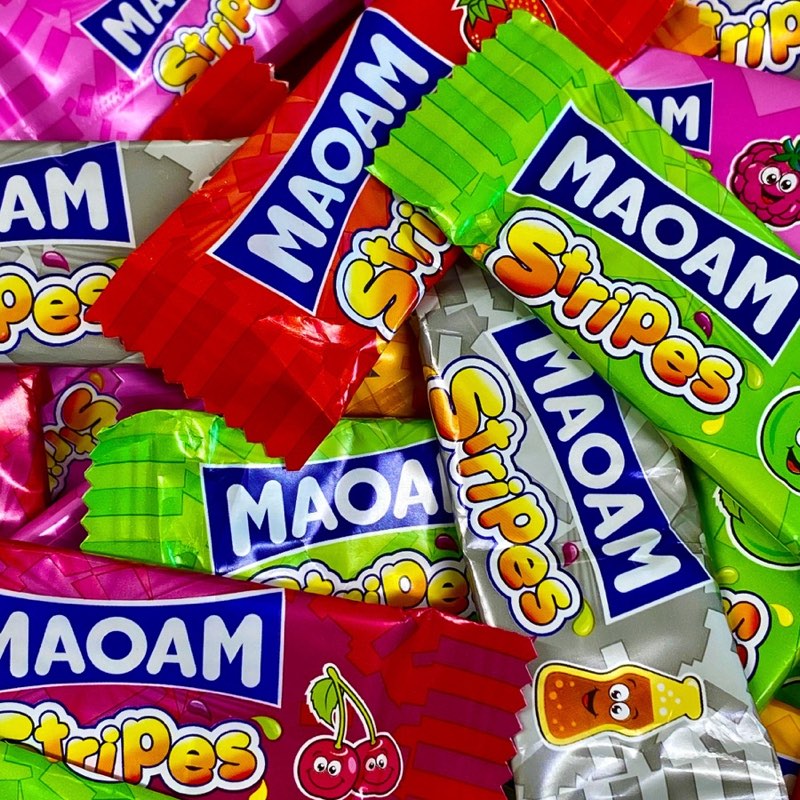
If you want to stay with the same brand, there are a few obvious places to go next. Maoam Stripes at £5.49 are the flat, striped format rather than the round one, at exactly the same price and weight tier, so swapping between them changes the eating experience without changing your basket total. The 140 g bag at £1.99 is the small-format version for a lunchbox or a stocking rather than a bowl. And the pink bubblegum version of these Pinballs, also £5.49 is the direct sibling: same format, same size, same price, different flavour and a contrasting colour, which makes buying both an easy decision for a table.
For neighbouring lines in other directions, a 120 g sour theatre box at £2.25 is the cheap way to test a sharper sour, the fizzy meerkats bring a jelly texture at the same £5.49, Refresher chews offer a fizzy chew as a lower-intensity alternative, and the 104 g mega sour apple bags take you to the top of the scale. On the softer side, a 150 g toffee carton at £3.49, the traditional Black Jack chews, salted caramel bon bons, grenade-shaped gummies at £1.39 and the big 780 g tutti frutti tub all give you somewhere to go when the mouth wants a change of direction.
Questions we get asked about these
How sour are they, really?
They sit in the middle of the sour range rather than at the top. The tang is on the surface, it arrives quickly, it makes the mouth water, and it resolves into the blue raspberry flavour underneath within a couple of seconds. Adults who think they dislike sour sweets are usually comfortable with this level. Committed sour fans will enjoy them but will tell you they wanted more, in which case the mega sour apple bags are the step up you are looking for.
What is the difference between these and the pink bubblegum ones?
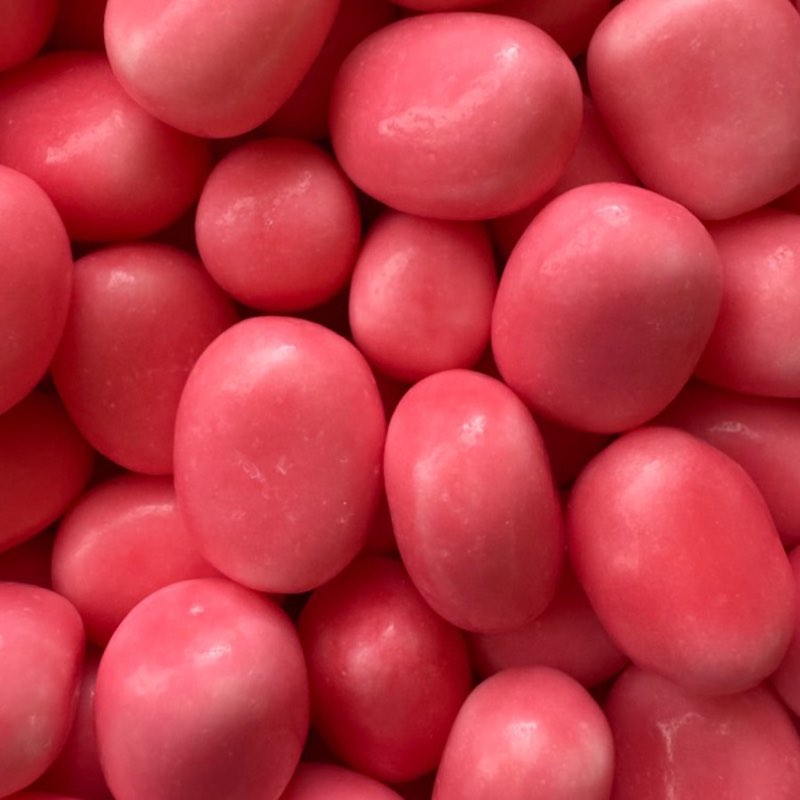
Format, price and weight are identical — both are round chews with a sour finish, both are £5.49 at 250 g. The difference is flavour and colour: blue raspberry here, bubblegum there. Because they are so closely matched in every other respect, buying both is a simple way to put two contrasting colours and two flavours on a table without having to think about whether they eat well together. They do.
Are they hard work to chew?
No. They give way on the first bite and then firm up slightly as you work them, which is normal for a chew and is where the flavour release comes from. They are noticeably softer than a toffee and firmer than a jelly. Temperature makes a real difference — warm ones are soft and stretchy, cold ones are firmer and hold their sour edge for longer — so if you find the texture not quite to your liking, try them from a cooler cupboard.
Which size should I buy first?
The 250 g at £5.49 if you have not had them before, because the sour level is the variable you cannot predict from a description. If you already know you like them, the 750 g at £12.99 is the best value step in the range: the jump from 500 g to 750 g costs only £3.00 for that extra quarter-kilo, which is the most generous step on the whole list.
How many do I need for a party?
Budget roughly 50 g a head across your whole sweet table rather than 50 g of each item. Sour sweets are eaten in smaller amounts than people expect because the sourness paces them, so a kilo goes further here than a kilo of something mild would. For most gatherings, a 500 g or 750 g bag alongside two or three other sweets is plenty, and the 2 kg is for stalls, fêtes and standing displays.
Will they stick together in the bag?
Only if they get warm. Chews soften in heat and soft chews cling to one another, so a bag left in a car or on a sunny shelf can arrive as a cluster. Nothing has gone wrong when that happens, but it is a nuisance to separate. Keep them in a cool, dark, dry cupboard and it does not occur. If they have warmed up, an hour somewhere cool firms them back up.
How should I store the big bags once they are open?
Decant them. A two-kilo bag that gets opened and reclosed every day is not really sealed, and the sour coating is the part that suffers from air exposure. Split the contents into several airtight tubs or jars, keep them somewhere cool and dark, and open one at a time. Refill a small display jar from that reserve rather than putting the whole quantity out at once.
What goes well with them in a pick and mix?
Something creamy to balance the sour, something with a different texture, and one thing that is not fruit at all. In practice that means a bon bon or a toffee, a fizzy jelly, and an aniseed or cola item to reset the palate. The full build is at the top of this page. The one thing to avoid is a second sweet at the same point on the sour spectrum in a similar berry flavour, because the two will simply blur together.
Are they suitable for young children?
They are a treat rather than an everyday food, and as with all small whole sweets they present a choking risk for young children, so keep little ones supervised and choose something more suitable for the very small. Beyond that, anyone in your household who manages an allergy should read the manufacturer's packaging on the bag when it arrives, before eating — the pack in your hands is always the definitive source on what it contains.
Do they work for a colour-themed table?
Extremely well, and that is one of the main reasons to buy them. Genuinely blue food is very hard to find, so if a party has a blue element — a football palette, an under-the-sea or space theme, a winter scheme, a baby shower — this solves a problem that is otherwise surprisingly difficult. Blue against white is crisp, blue against yellow or orange is a strong contrast, and blue against green is the one pairing to separate with something pale.
Can I put them in a jar on display?
Yes, and round sweets are among the best for it because they settle into even, level bands rather than sitting at odd angles. If you are layering colours in a clear jar, blue is the band that keeps the warm colours from merging into one another. Fill a smaller jar completely rather than a large one partly — a two-thirds-full jar looks generous and a quarter-full one looks neglected — and keep your reserve sealed elsewhere.
Is the flavour artificial-tasting?
Blue raspberry is a sweetshop flavour rather than an attempt at a real fruit, and that is the point of it rather than a shortcoming. It is rounder and softer than an actual raspberry, with none of the seediness, and it carries a strong set of associations with slush drinks and ice lollies that are a large part of the appeal. If you want something that tastes like fruit from a bowl, this is not it; if you want something that tastes like a sweet shop, it is exactly it.
The short version
A round chew with a sour finish, in a blue you will not find anywhere else on the table, at £5.49 for 250 g and with four larger sizes above it if it becomes a fixture. It sits in the middle of the sour range, which makes it a safe thing to buy for other people, and its colour makes it one of the most useful sweets in the shop for anyone putting together a themed table, a display jar or a photograph. Build a mix around it rather than dropping it into one, and it will do more work than its share of the bag suggests.
More from Maoam
More chewy sweets
More loose sweets sweets
Where this sits
Maoam Sour Blue Raspberry Pinballs appears on these shelves. Browse them, or jump to something nearby.
You might also like