Home / Loose Sweets / Barnett's Mega Sour Apple Candy Bags 104g
Barnett's · 104g
Read the full guide
Barnett's Mega Sour Apple Candy Bags 104g
£3.99
✔ In stock — ready to ship
Fresh stock
Free over £20
Same-day dispatch
Secure checkout
Start with the number, because for a small bag of intense sweets the number is the decision. Barnett's Mega Sour Apple Candy Bags 104g costs £3.99, which puts it at £3.84 per 100 g. Against the general run of Loose Sweets, where a standard bag more often sits around £5.49 for a lot more weight, that looks steep on paper. It is worth understanding why it is not, before you talk yourself out of it or into it for the wrong reason.
Weight is the wrong unit for this category. Nobody eats a strong sour by the handful — the format physically prevents it, because each piece occupies your mouth for minutes and resets your palate while it is there. The honest unit is the sitting, and a sitting here is two or three sweets. Call that 20 g. On that basis a 104 g bag holds about five sittings, and a sitting costs you roughly 77p. Held against a takeaway coffee or a single chocolate bar, five separate evenings of something for under four pounds is not expensive at all.
The full guide to Barnett's Mega Sour Apple Candy Bags 104g
6,360 words on how it eats, who it suits, how to serve it and what to put beside it.
£3.99 for 104 grams: doing the sums before you decide
The comparison that really settles it is against the other small, high-intensity formats rather than against bulk jellies. The Toxic Waste Blue Sour Candy Drum is £1.99 for 42 g, which works out at £4.74 per 100 g — so this bag is cheaper per gram than the small drums while handing you two and a half times the quantity in one purchase. Seen from that side, £3.99 is the mid-price option in its own category, not the premium one.
| Line | Price | Weight | Per 100 g |
|---|---|---|---|
| This apple bag | £3.99 | 104 g | £3.84 |
| Toxic Waste Blue Sour Candy Drum | £1.99 | 42 g | £4.74 |
| Red Band Dizzy Dolphins Bag | £1.39 | 100 g | £1.39 |
| Barratt Sweet Shop Wham Fizzy Belts & Sweet Eggs | £1.15 | 120 g | £0.96 |
| Sweetzone Fizzy Rings Tub | £7.99 | 800 g | £1.00 |
Read that table the right way round and it tells you what to buy for what. The bottom two rows are your volume — things you put in a bowl and let a room get through without counting. Sweetzone Fizzy Rings Tub 800g at a pound per 100 g is the clearest example: 800 g of fizzy rings for £7.99 is the kind of purchase that feeds an afternoon. The top two rows are your intensity, bought in small amounts, doing a job that no quantity of rings can do. Mixing those two roles up is the single most common way people end up disappointed with a sweet order.
Making a bag last, if that is what you want
Because each sweet is slow, this is one of the few bags in the shop you can genuinely ration without willpower. One a day makes 104 g last somewhere in the region of six or seven weeks, and one a day is a real treat rather than a token — you get five minutes out of it, which is longer than most sweets give you at any quantity. Two a day, which is the pace most people settle into, gets you around a month.
That slow burn also makes this an unusually good desk or glovebox bag. It does not melt, it does not need a bowl, it survives being carried about, and one sweet occupies the gap between two tasks quite neatly. If you have ever bought a large bag of something soft for a desk drawer and got through it in four days, the arithmetic of a small hard bag is worth a second look — you spend less, you get more occasions, and the bag is still there next month.
Where it stops making sense
There is a point at which this is the wrong purchase, and it is worth naming. If you need to fill a table for twenty people, do not buy six of these. Six bags is £23.94 for 624 g, and 624 g of strong sour is more than a room of twenty will get through in a week, let alone an afternoon — the format paces people whether they like it or not. For that job you want volume at a pound per 100 g and one bag of these as the sharp corner. The maths only works in this line's favour at small quantities, which is exactly how it is packaged.
Who the apple bag suits
The person this is built for already knows they like sour sweets and has stopped wanting surprises. That is the real dividing line between this bag and the mixed fruit bag at the identical £3.99 — not flavour preference, but appetite for variance. A mixed bag is a lottery with a good prize pool; this is the same £3.99 spent on certainty. Every piece you pull out will do the same thing, and for a certain kind of eater that is the whole appeal.
It suits the flavour loyalist particularly well. Green apple is one of a handful of confectionery flavours people are properly partisan about — you either reach for it first every time or you leave it in the bag for someone else, and there is not much middle ground. If you are in the first camp, buying a mixed bag means paying full price for a minority of sweets you actually wanted. This is the fix, and the apple flavour shelf exists for the same reason.
It suits anyone who needs a known colour on a table. This line is recorded as green, which sounds trivial until you are assembling a themed spread and discover that most mixed bags cannot promise you anything. Green is a demanding colour to source in sweets and an easy one to need — a football table, a St Patrick's spread, a dinosaur birthday, an alien-themed party, a Halloween table that wants slime rather than blood. A single-flavour bag with a colour on the record is worth more to a planner than any amount of variety.
It suits the sharp end of a self-built mix, for reasons set out at length further down. And it suits anyone who wants sweets that are quiet, slow and pocketable rather than fast and shareable.
It does not suit young children, both because small hard sweets are a choking risk for the very young and need an adult supervising, and because the strength here is genuinely beyond what most small children find enjoyable. It does not suit anyone who wants to eat a lot of sweets quickly. And it does not suit anyone who finds one flavour repeated wearing — for those people the mixed bag is not a compromise, it is the correct product.
How a hard sour is built, and why the construction decides everything
Texture in confectionery is not decoration. It is the mechanism by which flavour is delivered, timed and paced, and in a sour sweet it is doing more work than anywhere else in the shop. Two sweets can carry identical flavour and land completely differently depending on how they are put together, and this bag is a good case study because its construction is unusually legible — you can feel every stage of it happening.
A sweet with an outside and an inside
The defining fact about this product is that it is two experiences wearing one shell. There is a surface, which is dry, matte, slightly powdery and carries all of the sourness, and there is a body underneath, which is a hard boiled sweet carrying all of the apple. They are not blended. They are stacked, and you meet them in order.
You can verify this yourself in about ten seconds. Take one, hold it in your mouth without moving it, and pay attention to where the sensation is. At first it is entirely on the surfaces your tongue touches — flat, wide, immediate, and with no apple in it at all. Then, as the surface gives way, apple appears from underneath and the sharpness recedes. That handover is the product. Everything else about the design exists to make that handover happen cleanly and at the right speed.
The matte finish is the visual signature of this construction. A bare boiled sweet is glassy and reflective; anything with a loose surface layer goes dull. Which means you can tell by eye, across a shelf, roughly what a sweet is going to do — and it is why pouring these out gives you a dusty, chalky-looking heap rather than a heap of jewels.
Why hard hits harder than soft
The same coating on a jelly and on a hard sweet produce noticeably different experiences, and the reason is physical rather than to do with strength. A jelly is soft, wet and yielding: the moment it goes in, it starts deforming, it mixes with saliva, and the coating is diluted and spread across a body that is itself soft and sweet. The peak is blunted almost immediately by the sweet underneath.
A hard sweet does none of that. It does not deform, it does not release anything from its interior for a good while, and it presents an unchanging rigid surface to your tongue. So the coating dissolves into your mouth and nothing arrives to soften the blow. There is no sweetness coming up to meet it, because the sweetness is locked behind a wall that will take minutes to come down. That gap between the sourness arriving and the sweetness arriving is the entire reason a hard sour feels more severe than a soft one carrying the same coating.
It also explains why people who happily eat coated jellies are sometimes caught out here. On the fizzy sweets shelf most of what you meet is soft-bodied and self-buffering. Step across to a hard body and the same nominal intensity lands twice as hard. That is not a flaw in either product; it is a straightforward consequence of what the sweet is made rigid or soft.
The prickle, and how long it lasts
Underneath the sourness there is a second, separate sensation: a fine effervescent prickle that arrives once the surface is properly wet and works across the tongue for perhaps ten or fifteen seconds. It is a physical tickle rather than a taste, and it is the reason this line is filed as fizzy as well as sour.
The prickle is short-lived by design and only happens once. It belongs to the surface, so once the surface has gone it does not come back — which is why the fizz is something you notice at the start of each sweet and never again during it. It is also why the pace at which you eat changes the experience. Suck slowly and you get one long, mild prickle. Roll the sweet around actively and you get a shorter, sharper one, because you are wetting the whole surface at once instead of a face at a time. Experienced eaters do this deliberately.
Geometry, erosion and the five-minute sweet
A hard sweet disappears by erosion from the outside in, at a rate set almost entirely by how much surface it has relative to how much of it there is. This is why size matters so much more in boiled sweets than in any other category. A small sweet has a high proportion of surface to volume and goes quickly. A large one has a low proportion and takes much longer — not proportionally longer, but disproportionately so.
These sit at the small end, which is a deliberate choice and the right one. If a sweet this sour were the size of a gobstopper, the coating would be a genuinely unpleasant length of time rather than a five-second event, and the apple half would arrive so late that most people would have given up. Made small, the surface is gone fast, the payoff comes quickly, and the remaining body still lasts several minutes because a boiled body is dense and does not give in easily. Small is what makes the whole arc work.
Shape plays into it too. Rounded, compact pieces erode evenly and keep their character to the end. Flat, wide pieces — belts and laces — behave completely differently, because they are nearly all surface: Vidal Apple Belts at £5.49 are the same flavour family in a form with almost no body at all, so you get coating and chew together rather than in sequence. Whether that is better is a matter of taste, but it is unquestionably a different sweet, and the difference is geometry rather than recipe.
What happens when you bite
Biting is a legitimate way to eat these, but it is worth knowing what it does to the design. Bite early and you shatter the body while the surface is still active, which puts sour and apple into your mouth simultaneously instead of in sequence. The handover is destroyed; you get one loud composite hit and then it is over in under a minute. This is the version people choose for a dare, and it is the most intense way to eat the sweet.
Bite late — after a minute or so, once the surface has gone — and you get something much better balanced. The sourness is behind you, the fragments are pure apple, and the increased surface area from breaking it up means the flavour comes out fast and warm. A lot of regular eaters do exactly this without ever having thought about it: suck until the sharpness fades, then crunch through for the finish. It is the best of both halves and takes about two minutes.
Leave it whole and you are in the longest version — five minutes or so of a steadily shrinking, steadily sweeter apple drop, the last minute of which is barely flavoured at all. That is the traditional boiled-sweet ending, familiar to anyone who has spent time with our boiled sweets, and it is the reason these work during a film or a long drive when nothing else does.
Temperature, and the one thing that ruins it
Hard sweets are essentially indifferent to warmth in a way that nothing soft is. They do not bloom, sag, stick or go greasy in a warm pocket, which is why they are the correct sweet to carry in summer. What they cannot tolerate is damp. Moisture attacks the surface layer specifically — the one part of the sweet that is doing all the interesting work — and turns a dry, matte, free-rattling piece into a tacky one that clings to its neighbours.
The flavour survives that entirely. The construction does not. A sweet whose surface has gone sticky has effectively become an ordinary apple drop with a slight edge, because the layer that produced the opening event has partly dissolved before it ever reached your mouth. Everything in the storage section below is really about protecting that one layer, and it is the only real care this product needs.
Green apple as a single note, held for five minutes
Apple in confectionery is not an attempt to reproduce an apple, and it is better understood on its own terms. It is a bright, crisp, high, slightly green-tasting note — closer to the smell of a freshly cut tart apple than to the taste of eating one, and quite deliberately sharper and cleaner than any real fruit. It is one of the few sweet flavours that reads as cold, which is part of why it pairs so naturally with a sour surface: both sensations point the same direction.
That alignment is the key difference between this and its siblings. In a mixed bag, the sourness and the fruit underneath are often in tension — a round, sweet fruit arriving after a sharp opening, which is a contrast and a relief. Here they agree. The surface is sharp, the body is sharp, and instead of a relief you get a continuation at lower volume. The result is more coherent and less dramatic: one idea, stated loudly and then quietly, rather than two ideas handing over.
Eaten in sequence, single-note sweets behave differently from mixed ones in a way worth planning around. The first sweet is vivid. The second is slightly less so, because your palate is already carrying the flavour. By the fourth or fifth, the apple has receded into the background and what you are mostly experiencing is the sour surface, which does not fade with repetition the way flavour does. This is not a criticism — it is simply how one note works over a long run, and it is precisely why the mixed bag exists as an alternative.
The practical consequence is that this bag rewards spacing. Two or three in a sitting is where it is at its best. Ten in a row turns it into a texture experience with a memory of apple attached, and you will enjoy it less than you enjoyed the first two. Anyone who has worked through half a bag of one flavour in one go knows the feeling; the answer is not a better sweet, it is a longer gap.
Choosing between the four Barnett's bags
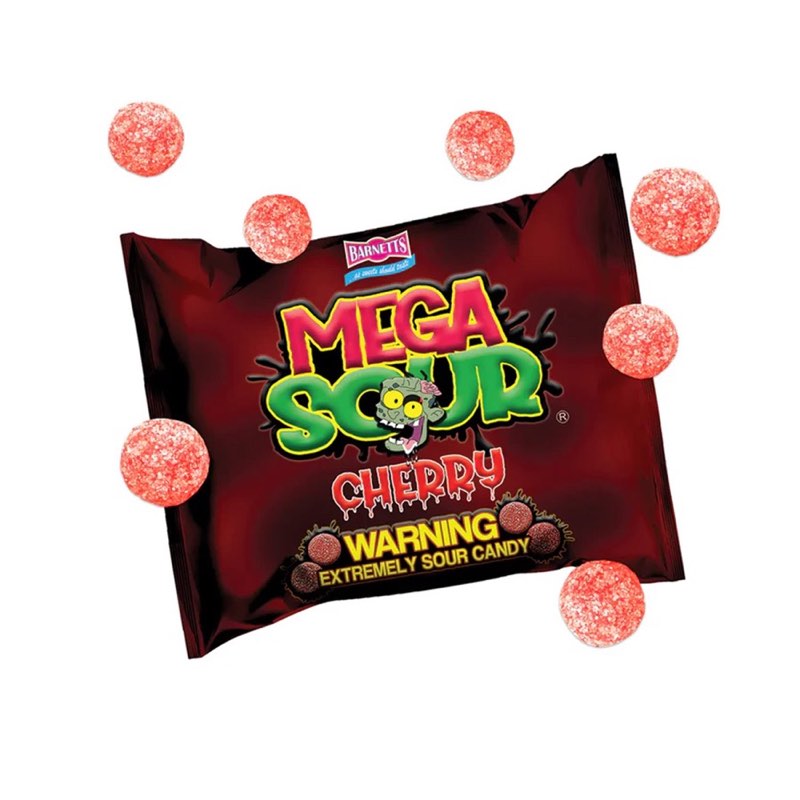
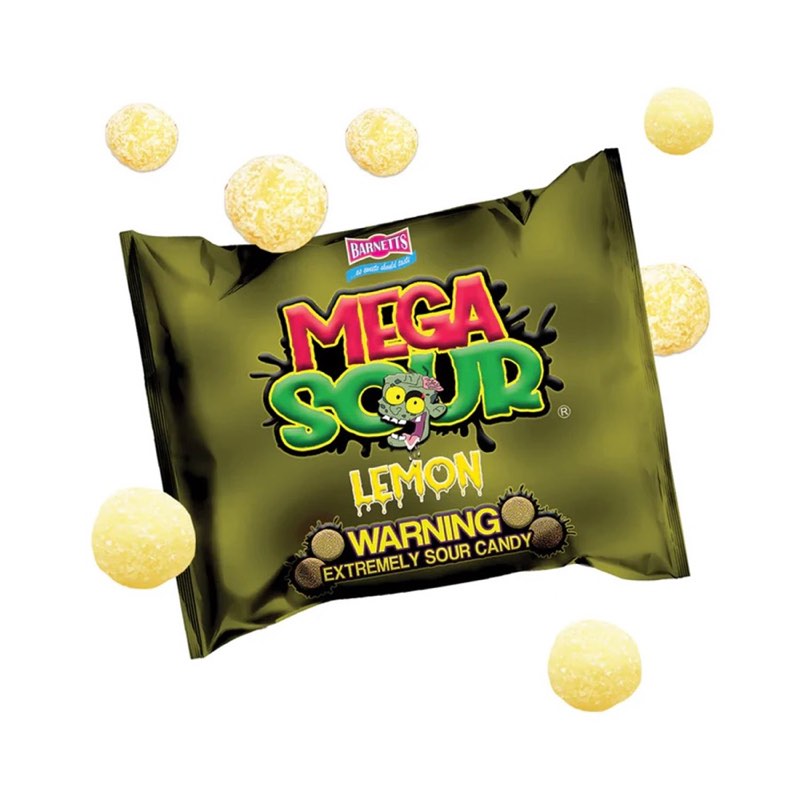
All four bags in this family are 104 g at £3.99, which makes the choice purely a question of what you want from the second half of each sweet. The lemon version is the most aligned of the lot — lemon is inherently sharp, so sourness and flavour reinforce each other completely and the whole sweet reads as one continuous bright note. Apple sits just behind it, sharp but with a rounder, greener body. Barnett's Mega Sour Cherry Candy Bag 104g goes the other way: a dark, deep, rounded flavour under a sharp surface, which gives you the biggest contrast between the two halves and the most dramatic handover.
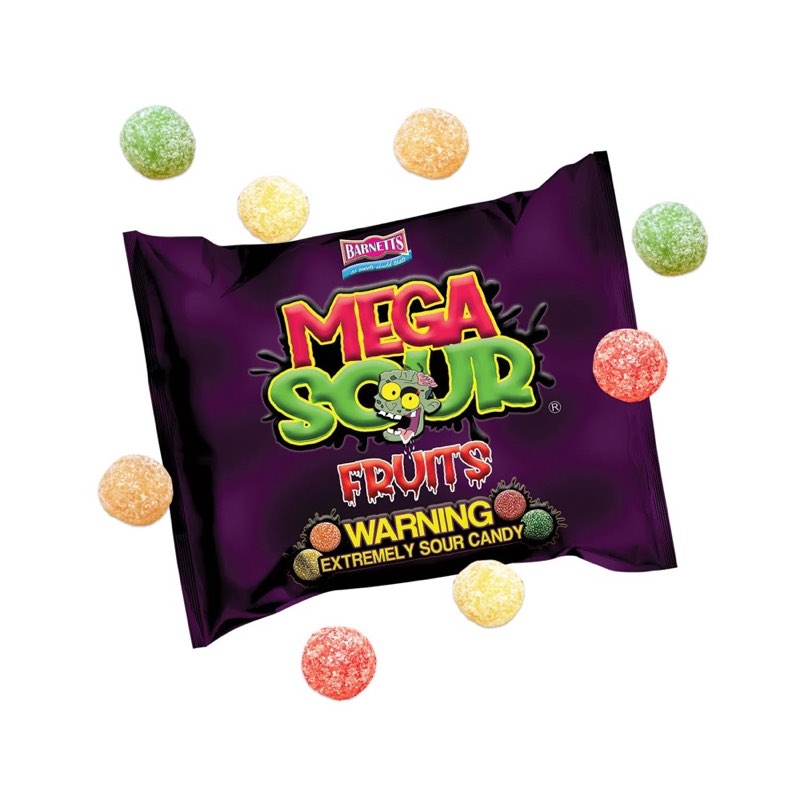
The mixed bag gives you the variance and the swapping. So the honest ranking depends on what you are after: maximum coherence is lemon, maximum contrast is cherry, maximum variety is fruits, and apple is the one most people find easiest to eat repeatedly — sharp enough to be interesting, not so sharp that it becomes hard work.
What it is like once you know what to expect
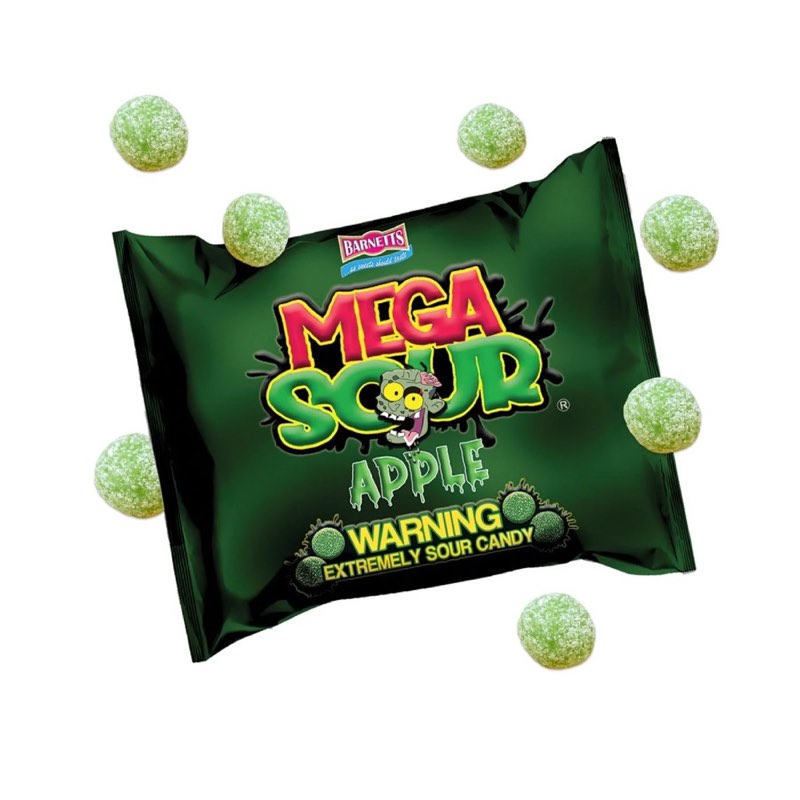
Knowing the construction changes how the first thirty seconds read. The pour is dry and granular and the pieces do not cling — they rattle rather than shuffle, and they come out of the bag cleanly. They are compact enough that four or five sit comfortably in a cupped hand, and dull green rather than bright: the surface layer mutes the colour along with the shine, so these look more like something you would find in an old jar than like a modern gummy.
Your fingers pick up a fine dust from handling them, which will give you a faint echo of the sourness if you touch your mouth afterwards. That is worth knowing before you eat them over a keyboard or a light-coloured sofa. It is also the first sign of how much loose material is sitting on the outside of each piece.
Then the sequence runs as described: a flat, wide sharpness for the first few seconds with no apple in it at all, a prickle underneath it, the sharpness dropping away, green apple arriving from the inside, and a long quiet tail as an ordinary hard drop. Once you have had a few you stop noticing the opening as an event and start using it as a marker — it tells you the sweet has started, and you wait for the apple the way you would wait for a kettle.
The thing regulars value most, and the thing that does not come across in any description, is the length. Five minutes from a sweet is an unusual amount, and it means one of these genuinely occupies a gap. That is why people keep them at a desk rather than in a kitchen.
Putting it in a bag with other things
Half the shop is loose lines that exist to be combined, and building a good mixed bag is a real skill with real rules. Most of those rules are about how sweets behave next to each other over hours and days in a closed bag, not about how they taste on their own — and a coated hard sour is the single most opinionated component you can put in one.
It sheds, and what it sheds goes everywhere
Start with the rule that catches everybody out. The surface layer on these is loose. Put them in a bag, carry that bag around, and a measurable amount of that layer ends up on every other sweet in there. Tacky and soft items collect the most; dry, hard and wrapped items collect almost none.
Over a few hours it is negligible. Over several days it is not, and the effect is one-directional — the sours do not become milder, the neighbours become sharper. If your mix is bright and fizzy throughout, this is harmless and arguably an improvement, because it pulls the bag together. If your mix contains anything creamy, milky, delicate or floral, that thing will be quietly spoiled and you will not work out why. The fix is not complicated: keep the sours in a separate bag and tip them into the bowl at serving time. Ten seconds of effort, and both components stay as intended.
The texture census
A good mixed bag is a census of textures rather than a census of flavours, and most disappointing ones fail because they accidentally bought five versions of the same mouthfeel. Run down what you have chosen and check you have covered: something soft and chewy, something firm and springy, something that dissolves slowly, something with a snap, and ideally something aerated.
These cover the dissolve slot, and they cover it emphatically — nothing else in a typical mix lasts anything like as long. That gives them a structural role beyond flavour: they are the slow item, the one that changes the pace of eating. A bag of nothing but chews and gummies is eaten fast and mindlessly. Put a few hard sours in and people slow down, because every so often they draw one that takes five minutes. That single property makes a bag last measurably longer, which is a useful trick if you are catering.
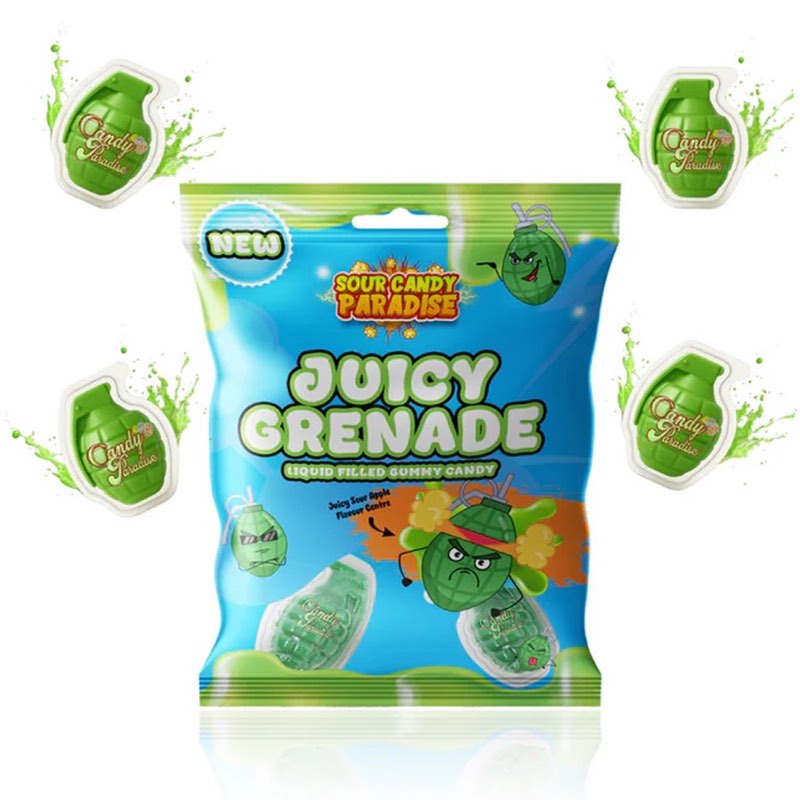
For the springy slot next to them, Candy Paradise Juicy Grenade Gummies at £1.39 are a cheap and effective contrast — a soft, yielding body against a rigid one. For the soft slot, Red Band Dizzy Dolphins Bag 100g at £1.39 for 100 g gives you a gentler, non-coated presence that acts as a landing place after a sour, and the shape reads as friendly in a bowl that otherwise looks severe.
The chew slot is the one most people forget, and it is the cheapest to fill. Barratt Sweet Shop Wham Fizzy Belts & Sweet Eggs 120g at £1.15 for 120 g covers it twice over, since the pack carries both a belt and an egg — a long chew and a small round one in a single line, at under a pound per 100 g. Dropped into a bag built around hard sours, that gives you a fast item next to a slow one, which is the contrast that stops a bowl feeling monotonous. It is also the component to reach for when you want the bag to look fuller without spending more, because belts take up a great deal of visual space for their weight.
How many to put in
Think in encounter rate rather than percentage. The question to ask is: how often do I want someone reaching into this bowl to draw a sour? Once every handful is lively. Once every three or four handfuls is a pleasant surprise. Every time is a sour bag with decoration.
In practice, for a 500 g mixed bag, somewhere between 40 g and 60 g of these — a third to half of a 104 g bag — gives you the pleasant-surprise rate. Go above 100 g in 500 g and you have changed the character of the whole thing. It is also worth remembering that people can see these coming: the matte green is distinctive, so anyone who does not want one can avoid them, which means the practical encounter rate for a sour-averse guest is lower than the arithmetic suggests. Visible components are more forgiving than hidden ones, and that is a point in this bag's favour when catering for mixed company.
Colour, and what green does in a bowl
Because this line has a colour on the record, it is genuinely useful for building to a palette. Green is the hardest of the primary sweet colours to find and the one most often missing from a themed table. A mix that is all reds, oranges and yellows looks like a bowl of the same sweet from across a room; one green component fixes that instantly and costs you one bag.
Bear in mind these are muted green rather than bright, because of the matte surface. Against glossy sweets they read as the dusty, matte element — which is a look, and a good one. If you want bright green instead, a belt or a gloss-finished jelly will give you that and these will not. Planning to both a colour and a finish is the difference between a spread that looks assembled and one that looks designed.
Flavour adjacency: what sits well beside green apple
Green apple is a high, cold, sharp note, so the flavours that work beside it are the ones that occupy space it leaves empty: deep, dark, warm or savoury-leaning things. Cola is the classic partner for exactly that reason — BUBS Cool Cola Skulls at £7.50 bring a dark, spiced register that survives a sour palate reset instead of being flattened by it, which most gentle fruits do not.
Sherbet-centred sweets are an interesting middle case. They share the fizz idea but arrive completely differently, because the sharp part is buried in the middle rather than sitting on the outside — so the order of sensations is reversed. Royale Lemon Sherbets at £5.49 make that reversal very clear when eaten alongside these, and Stockley's Sherbet Strawberries at the same price bring a rounder fruit into the same inside-out structure. A bowl containing both a coated sour and a filled sherbet is quietly educational as well as good to eat.
What to avoid putting directly beside it: anything delicate, anything milky, anything whose pleasure depends on subtlety. Those are not ruined by being in the same bowl, but they are ruined by being eaten in the same five minutes, and people do not pace themselves.
Going the other way: doubling down on apple
The opposite approach — an all-apple bag — is a genuinely good idea for anyone with the loyalty described earlier, and there is enough on the shelf to do it. Put these in for the hard, slow, coated element, add Kingsway Sour Apples at £5.49 for volume at a lower unit price, and add an apple belt for the chew. Three textures, one flavour, and the whole bag reads as deliberate. All ten apple lines we carry are on one shelf, which makes this the easiest single-flavour build in the shop.
The failure mode of a single-flavour bag is the palate fatigue discussed above, so keep it smaller than you would a mixed one. A 300 g all-apple bag is a pleasure; a kilo of it is a chore by the third day.
Whichever direction you go, you can assemble it by hand from the loose counter or start from a prepared base and adjust — Pick & Mix has the ready-made routes, and it is usually quicker to take one of those and drop in the sharp element than to build 500 g from nothing.
When to put these out
Film nights and long journeys are where this format is genuinely better than the alternatives rather than merely acceptable. Five minutes a sweet, no crunch, no wrapper, no mess, no melting — decant a handful into a dish before the lights go down and a bag will get two people through a long film without anyone reaching for anything. On a drive they are better still, because a slow sweet occupies the exact gap that snacking is trying to fill without leaving you sticky.
Teenage gatherings are the obvious social use. The reaction is the entertainment, and because these are visibly what they are, the sharing is consensual rather than a trick. Put a couple of bags out among fifteen people and they will last longer than anything softer on the table.
Themed tables are where the green earns its keep. A single colour you can rely on is worth planning around, and these are a rare sour that also tells you what colour it will be. Halloween takes them easily, and so does any spread that wants a slime-green element without resorting to novelty.
Small children's parties are the place to be careful. Put them out separately if at all, keep them away from the youngest, and remember that small hard sweets need an adult watching. For that crowd, softer and milder is better in every respect, and the rest of the jelly and gummy shelf is the sensible place to shop instead.
For gifting, a single 104 g bag is a stocking-filler or a hamper accent rather than a present in itself. It is a very good accent, though, because a box full of soft and sweet things is improved enormously by one item with an edge. Build the base from Candy & Chocolate and use this as the item that makes the box feel personal. If you are building for someone with a nostalgic streak, Retro is the other shelf worth raiding for the same purpose.
Keeping the surface intact
Everything about storing these follows from one fact: the layer that makes them worth buying is the layer that damp destroys. Protect it and they keep indefinitely well; neglect it and you are left with a pleasant but ordinary apple drop.
Seal the bag properly — folded and clipped, or tipped into a jar with a real lid rather than a loose-fitting one. Keep them in a cupboard rather than on a worktop, away from the kettle, the hob and the dishwasher's steam, and out of sunlight. Do not put them in the fridge: a fridge is humid, and moving cold sweets into a warm room condenses moisture straight onto the surface, which is the exact thing you are guarding against.
If they do stick together, they are perfectly fine to eat — a sharp knock against a worktop separates a clumped bag, and the flavour is untouched. What you will have lost is some of the opening intensity, because part of the surface layer has migrated. There is no way to restore that, which is why it is worth spending the two seconds on the clip.
Check the date printed on the manufacturer's packaging when the bag arrives, and if anyone eating them has an allergy, read that packaging before opening it. Sweets are a treat rather than everyday food, and this particular kind is best enjoyed a couple at a time anyway.
Size options
There is one size: the 104 g bag at £3.99, currently in stock. No tub, no larger pouch, no multipack — so there is no bulk discount to chase and no size decision to agonise over. More simply means more bags at the same unit price.
If you want volume at a better rate, the answer is a different product rather than a bigger version of this one, and the fizzy tubs are where to look. If you want variety at the same intensity, buy sideways across the flavours rather than upwards in size. And if you want the same flavour in a different texture, the apple shelf has the belts and the bagged sours to do it.
Where this sits in the shop
Five shelves hold this product, and each answers a different question. The loose sweets counter is the parent, running to 356 lines and covering the whole weigh-and-bag half of the shop. The sour shelf holds 49 lines and is where to go if you are working out how much intensity you actually enjoy. The fizzy shelf, at 41 lines, is the gentler neighbour and mostly soft-bodied, for the reasons set out above.
The boiled shelf is the smallest at 30 lines and is the one to browse if what appealed here was the duration rather than the sourness — it is full of sweets built to last rather than to be chewed. The apple shelf is the narrowest of the five at just 10 lines, which makes it genuinely browsable in a minute; if apple is your flavour, you can see everything we have in one sitting.
Beyond those, every line we stock is listed in one place if you would rather scan the whole thing, and build your own mix is the shortcut if you already know you want a bit of several things rather than a lot of one.
Common questions
How does the apple bag compare to the mixed one?
Same maker, same 104 g, same £3.99, same construction — what differs is variance. Every piece here does the same thing, which means no disappointing draws and no swapping, but also more palate fatigue over a long run. The mixed bag gives you different fruit characters in the second half of each sweet and the sorting-and-trading game that goes with an assortment. Buy this one if you already know apple is your flavour; buy the mixed one if you enjoy the lottery or are still deciding.
Is the whole sweet sour, or just the outside?
Just the outside. The sourness lives in a loose surface layer, lasts roughly five to fifteen seconds, and then gives way to a hard apple drop that is not sour at all. That layered construction is deliberate and it is the whole design of the product. If you bite through straight away you get both at once and a much more intense result, which is why people bite for a dare and suck if they want the sweet as intended.
How long does one last?
Left to dissolve whole, around five minutes, most of which is the plain apple body after the sharp part has gone. Sucked for a minute then crunched, around two minutes, which is how most regular eaters do it. Bitten immediately, under a minute. That range is unusually long for anything in a bag this size, and it is the main practical reason to choose a hard sour over a soft one.
Are they very green, or a pale green?
They are recorded as green, and in practice it is a muted, dusty green rather than a bright one, because the matte surface layer mutes the colour along with the shine. If you need a vivid green for a table, a glossy jelly or a belt will give you that and these will not. If you want a green that reads as natural or old-fashioned in a bowl, these are ideal.
Will they stick together in the bag?
Not if they are kept dry. The loose surface layer keeps the pieces from touching properly, which is why a fresh bag rattles rather than shuffles. Damp changes that: the layer goes tacky and the pieces start clinging. Clumped sweets are still perfectly good and usually separate with a knock, but some of the opening sharpness will have been lost. Sealing the bag and keeping it in a cool cupboard prevents it entirely.
Can I use these in a pick and mix with soft sweets?
Yes, and they add a useful slow element that makes the whole bag last longer. The one thing to watch is that the surface layer sheds onto neighbours over days, and soft or tacky sweets pick it up most. If your mix is bright and fizzy throughout that is harmless; if it contains anything creamy or delicate, bag the sours separately and combine at serving time.
How many should I put in a 500 g mix?
Between 40 g and 60 g — roughly a third to a half of one bag — gives you a sour roughly every third or fourth handful, which most people find lively rather than punishing. Double that and the mix becomes a sour mix with other things in it. Because these are visually distinctive, guests who do not want them can avoid them, so you can be slightly more generous here than with a hidden component.
Is £3.99 for 104 g good value?
For this category, yes. It works out at £3.84 per 100 g, which is cheaper per gram than the small sour drums while giving you more than twice as much, and each sweet lasts minutes rather than seconds, so the cost per occasion is low — around 77p for a two-or-three-sweet sitting. It is poor value if you are trying to fill a table for twenty; for that you want a large fizzy tub at around a pound per 100 g and one of these as the accent.
Are they suitable for children?
Sweets are a treat rather than everyday food, and small hard sweets are a choking risk for young children, so they need an adult supervising and are not a sensible choice for the youngest. Beyond safety, the strength simply does not suit most small children — what older kids find funny is unpleasant at five. Older children and teenagers are the natural audience.
What if someone in the house has an allergy?
Check the manufacturer's packaging when the order arrives, and read it before anyone eats anything. We do not publish ingredient or allergen details for this line on this page; the pack is the authoritative source. If it does not answer your question, do not risk it.
What else should I buy if I like these?
Three directions. Same flavour, different texture: an apple belt for chew, or a bagged sour apple for volume. Same intensity, different flavour: the lemon or cherry bags, both at £3.99. Same idea, bigger quantity: a large fizzy tub for the bowl, with these kept back as the sharp element. Most people who like this line end up doing the first and the third at once — an apple run for themselves, and volume for everybody else.
The short version
A small, dense, matte green sour built in two layers: a sharp surface that lasts seconds and a hard apple drop underneath that lasts minutes. The construction is the product — rigid body, loose coating, small size — and it is what makes this hit harder and last longer than the soft-bodied sours most people have met. Single-flavour means certainty rather than variety, which suits the apple loyalist and the table planner who needs a colour they can count on. At £3.99 for 104 g it is a small, slow, deliberate purchase: five sittings for one person, or the sharp corner of a much larger bag.
More from Barnett's
More sour sweets
More apple sweets
Where this sits
Barnett's Mega Sour Apple Candy Bags 104g appears on these shelves. Browse them, or jump to something nearby.
You might also like