Home / Loose Sweets / Toxic Waste Green Drum 42g
Toxic Waste · 42g
Read the full guide
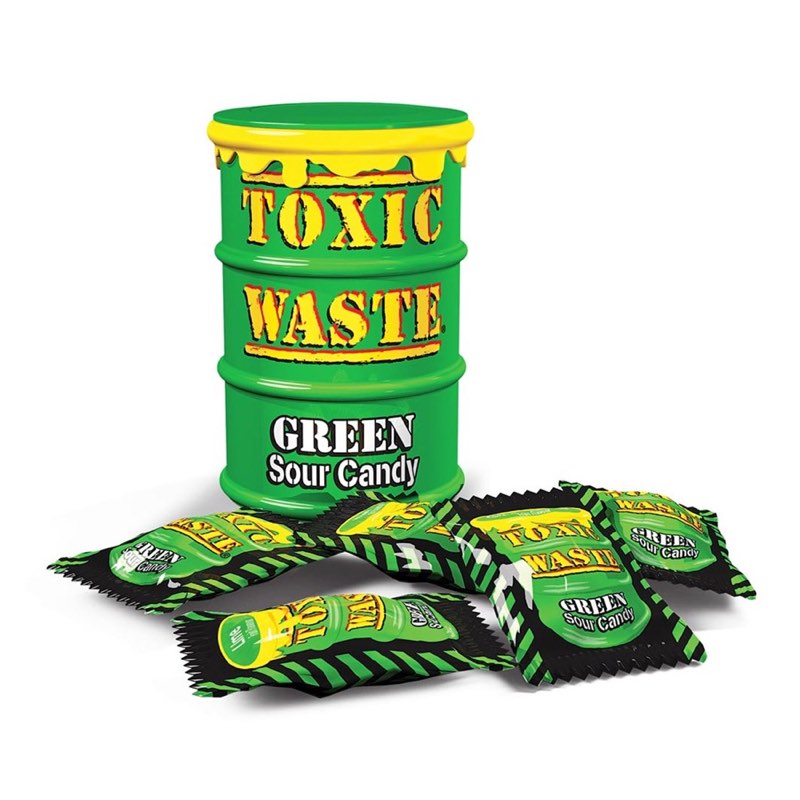
Toxic Waste Green Drum 42g
£1.99
✔ In stock — ready to ship
Fresh stock
Free over £20
Same-day dispatch
Secure checkout
Most people do not buy a 42 g drum on its own. They buy three or four of them, or they drop one into a basket that already has a kilo of something soft in it, and the interesting question is not "is this nice?" but "what does it do to everything around it?" So let us begin there, because that is the decision you are actually making.
A mixed bowl of sweets has a problem that nobody names: it gets boring faster than the sweets in it are eaten. Not because any individual sweet is bad, but because after eight or nine pieces your mouth has stopped noticing. Soft chew, soft chew, soft chew, and by the fourth handful you are eating on autopilot. What fixes that is not a better sweet, it is a different sweet — something that interrupts the rhythm and makes the next thing you eat taste new again.
The full guide to Toxic Waste Green Drum 42g
5,462 words on how it eats, who it suits, how to serve it and what to put beside it.
Start here: what a green drum does inside a mix
The Toxic Waste Green Drum is an interrupter. It is small, it is hard, it is sour, and there are only 42 g of it, which is exactly the right amount for something whose job is to punctuate rather than to fill. Drop eight or ten pieces into a large bowl of soft sweets and you have changed the whole character of the bowl without changing its bulk. The people who like sharpness will hunt for them. The people who do not will avoid them and eat around them quite happily. Either way, the bowl stays interesting for longer.
The three-layer build. The most reliable way to assemble a mix, whatever the occasion, is to think in three layers rather than in individual products.
- The base — 60 to 70 per cent of the weight. Soft, mild, universally liked, eaten without thought. This is your bulk and it should be cheap per gram.
- The texture layer — 20 to 30 per cent. Things that behave differently in the mouth: something that shatters, something that has to be sucked, something with a long chew.
- The punctuation — 5 to 10 per cent. Small quantities of things that are intense, unusual, or funny. This drum lives here.
For a base, weight is what you are buying and price per gram is what matters, so an 800 g tub of Sweetzone fizzy rings at £7.99 does the job at a sensible rate and already carries a mild sharpness that sets up the harder hit from a drum. If you would rather the base be soft and completely unsharp, so that the contrast is starker, BUBS Cool Fruity Pear Minis at £7.50 give you a firm, clean, Scandinavian-style piece with none of the sour edge.
For the texture layer, you want at least two things that are not jellies. Kingsway Fizzy Chips at £5.49 bring a flat, thin, fizzy piece that eats nothing like a gummy and clears the palate fast. McAdam's England football chopped rock — a 150 g pouch at £1.99, the same price as this drum — adds a hard, shattering sweet with a long suck to it, which is the single most under-used texture in home-built mixes. And Stockley's chocolate flavoured limes at £5.49 give you something with two components in one piece, which reads as a completely different class of sweet next to plain jellies.
For punctuation, this drum and one or two others. Mike & Ike Mega Mix Sour Theatre Box 120g at £2.25 is the cheapest way to add a second sour note in a different format — a soft sour chew against this drum's hard sour suck, which is a more interesting contrast than two hard sours would be. Park Lane's sour blackcurrant rings at £5.49 push the same idea into a darker fruit register. And if the mix is for children, one genuinely silly item earns its place: Fuji Candy's DIY ramen kit at £2.99 is a 20 g box that is as much an activity as a sweet, and it will occupy a table for twenty minutes.
A worked example. For a mix of roughly a kilo and a half: 800 g of fizzy rings as the base, 150 g of chopped rock and a bag of fizzy chips as the texture layer, and three drums plus a theatre box as the punctuation. That is about £18 all in, it covers a party of fifteen to twenty at 70 g a head, and no two handfuls out of it are the same. If you would rather not assemble it yourself, our pick and mix range does the same job pre-built, and our loose sweets shelf — 356 lines sold by weight — is where to go if you want to build it piece by piece with total control over the proportions.
The object itself
It is small. That is the first thing to register, because photographs on a white background flatter everything and this is a product that sits comfortably in a closed hand. Forty-two grams is a pocket quantity: about the weight of a small bag of crisps, and considerably less bulky, because the sweets inside are hard and dense rather than aerated. It goes in a coat pocket, a school bag, a glovebox or a jiffy bag without announcing itself.
The container is what the name tells you it is — a drum rather than a bag, which is a genuinely different proposition from the usual sweet packaging. A bag, once opened, is open. It rolls up, it gets clipped, it splits at the seam, and eventually somebody tips the last of it into a bowl and forgets about it. A rigid drum closes again. That single fact changes how the product gets used: it becomes a thing you carry with you and take one or two from over a week, rather than a thing you sit down and finish. For a sweet this sharp, that is exactly the right format, because nobody wants to eat 42 g of it in a sitting anyway.
The colour is green, and it is worth being precise about what that means and what it does not. Green is how we list and how you identify this drum on a shelf where several look otherwise alike — it is the label on the tin, the thing you point at. It is not a flavour claim. We list the flavour of this line simply as fruit, because that is what we hold, and we are not going to invent a specific fruit to make the page read better. The exact flavour is printed on the manufacturer's own packaging, and if that detail matters to you — because you are buying for someone with a firm preference, or because you are trying to match one you had before — the drum itself will tell you the moment it arrives. What we can tell you with confidence is the family: bright, fruit-led, and sharp.
Inside, the sweets are small hard pieces — boiled sweets, in the proper sense, meaning they are solid rather than chewy and they are designed to be sucked rather than bitten. Small enough that several fit in the palm, dense enough that 42 g is more pieces than the weight suggests to someone used to gummies.
How it eats, second by second
Hard sour sweets have a much more defined shape to them than soft ones, and it is worth walking through it, because knowing the shape is what lets you decide whether this is a sweet for you.
The first two or three seconds are the sharp part. It arrives fast and it arrives hard — this is a sour sweet by classification and it does not understate the case. The sensation is concentrated along the sides of the tongue and at the hinge of the jaw. Your eyes narrow. There is a rush of saliva. Most people's instinct on a first piece is to move it around the mouth rather than hold it still, which is the body trying to spread the sensation out.
Seconds three to fifteen are the negotiation. The sharpness is still there but it is receding, and underneath it the fruit flavour starts to come through — broad, bright and clearly defined rather than delicate. This is the stretch that separates people. Some find it uncomfortable and take the sweet out. Some find it exhilarating and put a second one in alongside the first, which is a thing that people genuinely do and which we would gently suggest you work up to.
From about fifteen seconds it becomes an ordinary boiled sweet. The sharpness has gone, the fruit has the floor, and what you are left with is a long, slow, pleasant suck that lasts a couple of minutes if you are patient with it. This is the part nobody talks about and it is half the value of the product. A hard boiled sweet is a genuinely long-lasting thing. One piece occupies the same stretch of time as six or seven gummies, which is why 42 g goes further than it looks like it should.
The bite. Somewhere in that final phase most people crunch it, because the sweet has thinned to the point where it gives. Some people hold out. Whether you crunch or wait is a personality test more than a technique, and it materially changes how long the drum lasts.
Two practical notes. First, hard sweets and speed do not mix: these are made to be sucked slowly, and biting straight into a full-size piece is hard work on the teeth and wastes the best part of the experience. Second, the sharpness is cumulative across a session. Three or four pieces in quick succession will leave the roof of your mouth feeling worked, and a break of half an hour resets it entirely. Most people find their own limit within a single drum, which is another argument for the small size.
The pence-per-gram of a very small tin
This is where a shopkeeper has to be straight with you, because on the face of it a 42 g drum at £1.99 looks expensive, and on pence per gram it is.
£1.99 for 42 g is £4.74 per 100 g. That is roughly four times the rate you would pay for a kilo tub of ordinary jellies. If you converted your whole sweet budget into drums you would be paying a premium that no sensible person would defend.
| Format | Weight | Price | Per 100 g |
|---|---|---|---|
| Single drum | 42 g | £1.99 | £4.74 |
| Christmas carry box | 295 g | £7.99 | £2.71 |
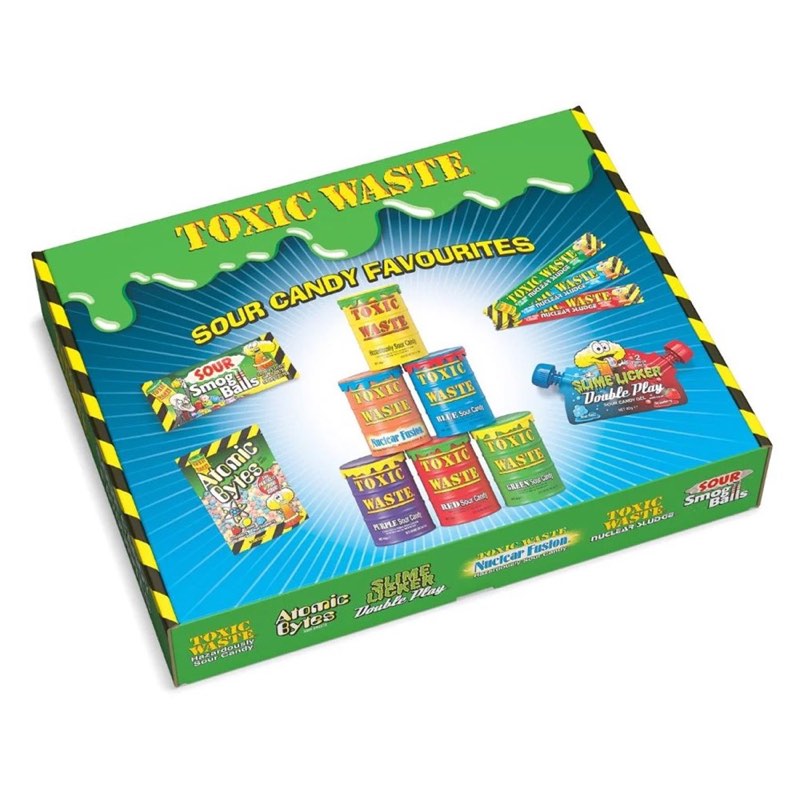
| Large sour candy gift box | 460 g | £14.99 | £3.26 |
| Eleven drums (for comparison) | 462 g | £21.89 | £4.74 |
Read the bottom two rows together and the picture is clear. To assemble 460 g out of individual drums costs £21.89. The 460 g sour candy gift box gets you the same weight for £14.99 — you save nearly seven pounds. And the 295 g Christmas carry box at £7.99 is the best rate of the lot at £2.71 per 100 g, though it is a seasonal item and you are buying its presentation as much as its contents.
So why buy the drum? Three reasons, and they are all about the unit rather than the rate.
Because £1.99 is a price point, not a quantity. There are a great many situations where what you need is "a small sweet thing for about two pounds" — a party bag filler, a stocking, a reward, a something-to-take-round. The weight is almost irrelevant; the price and the shape of the object are the whole point. At £1.99 you can buy six of them for twelve pounds and have six separate gifts, which no single box can give you.
Because 42 g is the right dose. This is an intense sweet. A 460 g box of intense sweets is, for most households, a 460 g box that sits half-finished in a cupboard. The drum is sized to be finished, which means it gets eaten fresh rather than going stale in a drawer. Paying more per gram for a quantity you will actually consume is better value than paying less per gram for a quantity you will not.
Because variety costs weight. If you want to try several colours across the range, buying five small drums at £9.95 gets you five different ones. The equivalent spend on one large box gets you one box. When the point of the purchase is comparison, small units are the efficient choice.
Per-guest maths. If you are using drums as favours rather than as a bowl, the sum is simple: one drum per guest, £1.99 a head. For a party of ten that is £19.90, and every child goes home with a sealed, intact, rattling object of their own rather than a handful of loose sweets in a bag. Compare that to the alternative — a kilo of loose sweets at a pound-something per hundred grams, split ten ways — and the loose sweets are cheaper, but they do not survive the car journey and they do not look like a present. You are paying about a pound a head for the packaging to do a job, and sometimes that is a pound well spent.
Per-handful maths. If you are treating it as a bowl item instead, work on the basis that people take two or three hard sweets rather than a fistful, because hard sweets pace themselves. A drum spread across a bowl covers perhaps six or seven people's worth of "one each, maybe two". Three drums is £5.97 and does a room of twenty as punctuation within a bigger mix. That is a very different, and much more reasonable, way to look at the same price.
Small, sealed and postable: this drum as a gift
There is a category of present that is hard to buy for and easy to get wrong — the small, cheap, thoughtful thing. Not a proper gift, not an afterthought. Something under a fiver that shows you thought about the person rather than about the shop. Small sealed tins of intense sweets are unreasonably good at this, and it is worth understanding why before we get to the specific occasions.
A good small gift needs four properties. It has to be sealed, because unwrapped food from a near-stranger is awkward. It has to be intact on arrival, because a crushed present is worse than no present. It has to be specific, so it reads as chosen rather than grabbed. And it has to be consumable, so the recipient is not left with an object they have to find a home for. A rigid drum of sour sweets hits all four, which is why it turns up in so many of the situations below.
Letterbox treats. This is the format's best use. Forty-two grams in a rigid container goes into a padded envelope, weighs almost nothing to post, and cannot be squashed flat by a letterbox. If you send someone a bar of chocolate it arrives as a bent bar of chocolate; if you send a drum it arrives as a drum. For a friend having a bad week, a student in their first term away, or a grandchild you cannot get to, a couple of drums and a note is a genuinely good small parcel — and because the contents rattle, it announces itself before it is opened, which children find enormously satisfying.
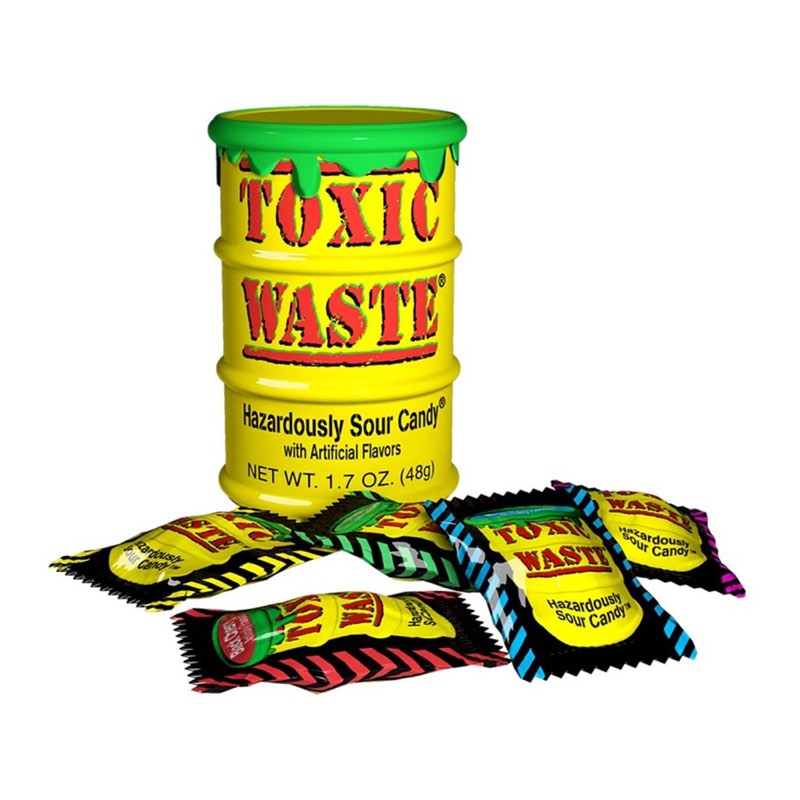
Teacher and end-of-term gifts. The difficulty with teacher gifts is that the obvious options arrive by the dozen, and a staff room in July has more boxed chocolates than it knows what to do with. A small drum of sour sweets is not a serious present, which is its advantage — it is cheap enough not to be awkward, unusual enough to raise a smile, and small enough to go in a bag at the end of the day. Buy several, vary the colours, and hand them out as a set. The yellow drum and the red drum at the same £1.99 mean nobody has to get the same one.
Care parcels. For someone away — at university, working abroad, in hospital for a stretch, on a long stint somewhere dull — the value of a parcel is in the variety and the durability of what is in it, not the total weight. Small sealed units survive the journey and can be rationed. Three or four drums in different colours is a better care-parcel contribution than one large box, because it gives the recipient four separate small events instead of one.
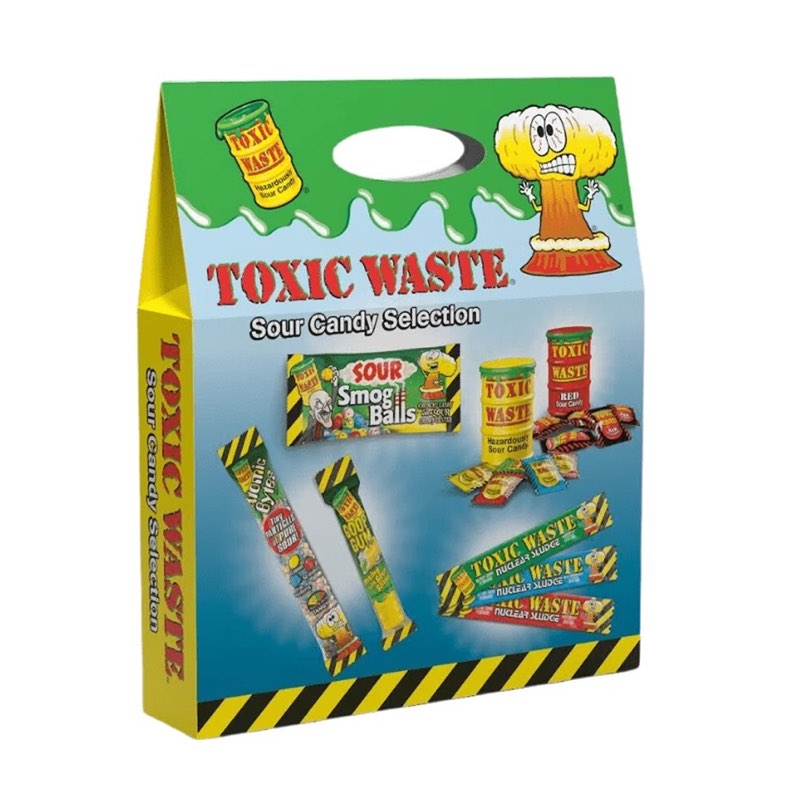
Hampers. A hamper needs small items to fill the gaps between the big ones, and it needs at least one thing that makes the recipient laugh. Drums do both. They sit upright, they hold their shape under the weight of whatever is stacked on them, and their appearance among the chutneys and shortbread is a small joke that lands well. If you want the whole hamper to run on a single theme, the large gift box gives you an anchor item and the drums fill in around it.
Stockings and advent. Rigid, small, cheap, and the right shape for the toe of a stocking. If you are filling an advent calendar by hand or running a countdown of small daily gifts, a run of different-coloured drums gives you variety across the days with almost no planning. Nuclear Fusion and the purple drum round the set out, so five different days can be five different tins.
Party bags and prizes. One drum, one bag, done. It is more durable than loose sweets, it does not need bagging up by hand, and at £1.99 it is close to the price most people budget for a party bag's main item. As a prize for pass-the-parcel or a school raffle it works for the same reasons — it looks like something, and it is instantly recognisable as a proper sweet rather than a consolation.
What not to use it for. Honesty helps here. It is not a bereavement gift, a thank-you to a host, or anything requiring gravity — it is a cheerful, slightly silly object and it should be given in that spirit. It is also not the right gift for someone who dislikes sour sweets, and if you do not know, a small hard sweet this sharp is a gamble. In that case, something gentler from the traditional shelf is the safer parcel.
Fruit, and how to place it against everything else
We list one flavour family for this line: fruit. That covers a great deal of ground, and in a sour boiled sweet it behaves in a particular way that is worth understanding.
In a soft sweet, flavour and texture arrive together and blur into one another. In a hard boiled sweet they are separate events. The sharpness comes first and almost entirely alone; the fruit comes second, once the sharpness has cleared enough room for you to notice it; and then the fruit has a long, uninterrupted run at the end while the sweet slowly dissolves. That means the fruit flavour in a sweet like this gets more of your attention than the fruit flavour in a gummy does, simply because for a minute or so it is the only thing happening.
It also means the flavour has to be robust. Delicate, layered fruit notes would be wiped out by the opening and lost in the middle. What works is bright and declarative — the kind of fruit flavour you identify instantly without effort. If you want to explore that register more widely, our fruit-flavoured lines run to 161 products and cover everything from these sharp hard sweets to soft mild jellies at the other end.
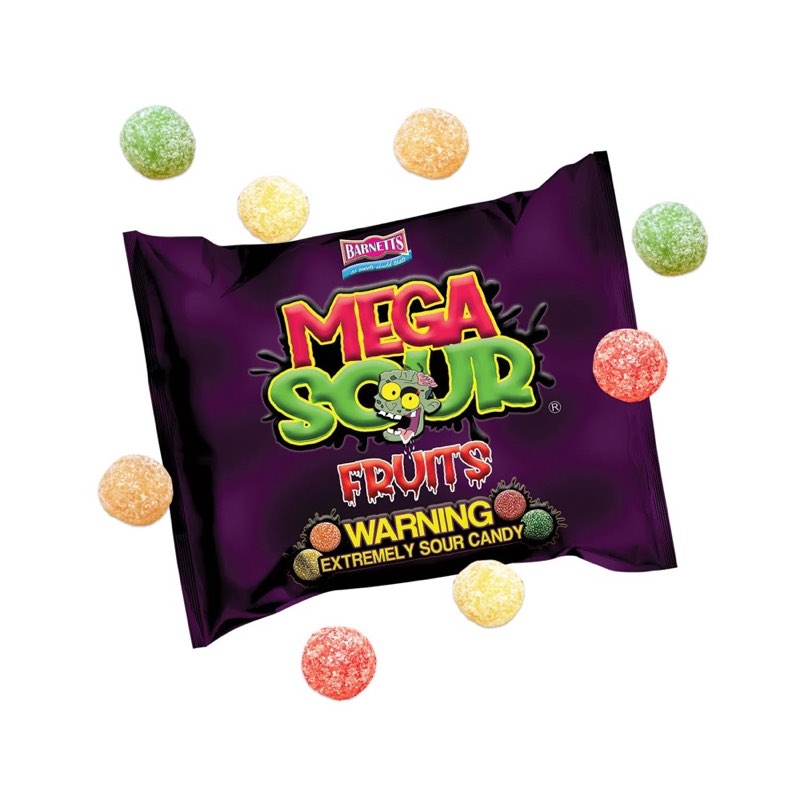
Against the rest of the sour shelf, this drum sits at the intense end without being a novelty challenge item. It is meaningfully sharper than a fizzy jelly and meaningfully more sustained, because a hard sweet holds its sharpness in place rather than releasing it all at once. Barnett's Mega Sour Fruits Candy Bags 104g at £3.99 are the natural comparison — a larger quantity at a much better rate per gram, in the same broad intensity band, and the sensible next purchase if you have decided that sharpness is a thing you want a proper supply of rather than a taste of. The whole of our sour sweets category runs to 49 lines, which is a big enough field to find your own level in.
Against the boiled shelf, it is an outlier — most hard sweets are built for the long, mild, comforting suck rather than for a sharp opening. Looking through the boiled sweets we carry, 30 lines in all, is the quickest way to see what the format usually does, and therefore what this drum is doing differently.
Who buys it, and when
Children and teenagers, buying with their own money. Two pounds is a pocket-money price, and the appeal of an intense sweet in a container that looks like it means business is not complicated. This is the classic use.
Adults who want a small thing, not a lot of things. A hard sweet that lasts two minutes is a genuinely useful object for a long drive, a dull meeting or a stretch of work, and 42 g is a supply rather than a binge. The rigid lid is what makes this practical — it lives in a bag and stays sealed between uses.
People assembling something bigger. Party mixes, hampers, care parcels, advent runs. The drum's real career is as a component.
Collectors and comparers. There are five colours on our shelf and a certain sort of shopper will buy all of them and rank them. We are not going to pretend this is not a substantial part of why the format exists.
Who should think twice. Anyone who finds sour sweets genuinely unpleasant rather than fun — this is not the one to convert you. Very young children, for whom small hard sweets are a choking risk and who should be supervised, and who in any case will probably not enjoy the intensity. And anyone shopping mainly on price per gram, for whom the larger boxes are simply the better buy.
Keeping it in good order
Hard sweets are more robust than jellies and less robust than people assume. The thing that damages them is moisture, and the failure mode is stickiness — pieces bonding to each other or developing a tacky surface that was not there when the drum was sealed.
Keep it closed. This sounds obvious and it is the whole of the advice. A rigid lid pressed properly shut keeps room humidity out, and a drum treated that way will stay exactly as it was for a long time. A drum left open on a kitchen worktop while the kettle boils twice a day will not.
Keep it cool and out of the sun. Hard sweets do not melt in the way chocolate does, but sustained warmth softens their surface and makes the moisture problem worse. A cupboard or a drawer is ideal. A car glovebox in August is the worst place you could choose, and it is also, realistically, where a lot of these end up.
Do not refrigerate. Cold plus the condensation you get on taking it out again is precisely the combination that turns a good hard sweet tacky. The fridge is the wrong instinct for almost all sweets and especially for this one.
If pieces do stick together, they are perfectly fine to eat — a firm tap of the closed drum against a hard surface usually separates them. Check the date printed on the drum for the definitive guidance on how long it keeps.
Choosing between the drums and the boxes
We stock five 42 g drums, all at £1.99, and two larger formats. There is no wrong answer here, but there is a right answer for each situation.
| If you want to… | Buy | Why |
|---|---|---|
| Try the line for the first time | One drum, £1.99 | The cheapest possible way to find out whether this level of sharpness suits you |
| Compare colours | Several drums, £1.99 each | Five different tins for £9.95 — variety is what small units are good at |
| Give a small present | One or two drums | Sealed, postable, cheap, specific |
| Keep a proper supply | The 460 g gift box, £14.99 | £3.26 per 100 g against £4.74 — a real saving at volume |
| Buy a Christmas gift | The 295 g carry box, £7.99 | Best rate on the shelf and presented as a gift already |
| Punctuate a big party mix | Three drums, £5.97 | Enough sharpness to change the character of a whole bowl |
On the colour question specifically: because we list every drum in the range at the same weight, the same price and the same fruit flavour family, the decision between them comes down to which one you or the recipient already knows. If you have no preference and no information, buy two different ones rather than two of the same and let the eating decide. Everything on the Toxic Waste shelf — eight lines in total — is laid out in one place so you can see the whole range side by side.
Finding your way around from here
This drum is filed on five shelves, and each one is a different route onward depending on what brought you here.
Came for the brand? The brand shelf, linked just above, has the drums and the boxes together. Came for the sourness? The sour category is the deepest relevant shelf at 49 lines and will take you both gentler and harder than this. Came for the format? The boiled shelf is where the other hard sweets live, most of them milder and longer-lasting. Came for the flavour? The fruit shelf is the broadest of the four. And if you arrived because you wanted loose sweets by weight rather than packaged ones, the loose shelf is the one to bookmark.
Beyond that, the whole shop is browsable in one list if you would rather scan than filter, and candy and chocolate is where the bars, blocks and boxed items sit for when a mix needs something that is not a sweet in the narrow sense. Two brand shelves worth knowing for mix-building in particular: the Kingsway shelf for traditional British shapes sold by weight, and the Haribo shelf at 43 lines for the soft, mild bulk that most home-built mixes are founded on. One last small thing for seasonal tables — Candy Realms' pumpkin light pop at £1.49 is an 11 g novelty that pairs obviously with a green drum on an October table, and costs less than the drum does.
Questions people ask before buying
How sour is it, really?
Sharp enough to make you pull a face on the first piece, and sustained for longer than a fizzy jelly because a hard sweet releases slowly rather than all at once. It is at the intense end of everyday sour sweets without being a dare-and-film novelty. The sharpness clears after ten or fifteen seconds and what is left is a long, ordinary, pleasant fruit sweet. If you already eat sour sweets happily, this will be comfortable. If you avoid them, it will not convert you.
How many sweets are in a 42 g drum?
We do not give a piece count, because it varies between drums and we would rather quote you the figure we can stand behind, which is the weight. What is useful to know is that hard sweets last far longer in the mouth than soft ones, so 42 g of these occupies a great deal more time than 42 g of gummies would. Treat it as a supply that lasts a week or two of occasional use rather than a single sitting.
What flavour is the green one?
We list the flavour family as fruit and we are not going to guess at a more specific answer, because we do not hold verified flavour data for each colour in the range and inventing one would help nobody. The colour is how you identify the drum on the shelf; the specific flavour is printed on the manufacturer's own packaging and will be clear the moment it arrives. If you are buying to match one somebody remembers, the safest approach is to buy two colours rather than risk the wrong one.
Is £1.99 for 42 g good value?
Not on pence per gram — that works out at £4.74 per 100 g, and the larger boxes beat it comfortably. It is good value if what you need is a small sealed unit at a low absolute price: a gift, a party bag filler, a first try, or a small amount of punctuation in a bigger mix. Buy the drum for the unit; buy the box for the rate.
Can I post it?
It is one of the better sweets for posting. It is light, it is rigid, and it does not crush flat in a letterbox the way a bar or a bag does. A padded envelope is plenty. Avoid sending it somewhere very hot, and do not pack it against anything that might leak, but otherwise it travels about as well as confectionery gets.
Is it suitable for young children?
These are small hard sweets, which are a choking risk for young children, so small children should be supervised while eating them and very young children are better given something else entirely. Beyond that it is a matter of taste rather than suitability — the intensity is a lot for a small child who has not met sour sweets before. Sweets are a treat rather than an everyday food, and this one in particular is best treated as an occasional one.
What is in it, and does it contain anything I might react to?
We do not publish ingredient or allergen information on our pages, because the only version we would want you to rely on is the manufacturer's own, printed on the drum. Please read that packaging when it arrives, before anyone eats anything, particularly if there is an allergy in the household. We have no supplier dietary classification for this line, so we are not going to make any claim about it either way.
How long does one drum last?
For one person using it as an occasional sweet, a week or two is realistic — the size of the drum and the intensity of the sweets both work against eating it in a sitting. For a bowl at a gathering, treat it as six or seven people taking one or two each. If you want it to last longer, keep it in a bag rather than on a desk; proximity is the main variable.
Should I buy the big box instead?
If you already know you like this line and you want a proper supply, yes — the 460 g box saves you close to seven pounds against the same weight in drums, and the Christmas box is better again per gram. If you are trying it, gifting it, or buying variety, the drum is the right purchase and the box would be a waste of money on quantity you may not want.
Do the different colours taste noticeably different from each other?
They are all in the fruit family as we list them, so the broad character is shared, and the specific differences between colours are set out on each drum's own packaging rather than on our pages. In practice most people who buy several do develop a preference, which is a good argument for buying two or three different ones at £1.99 each rather than committing to one.
Can I put them out in a bowl with soft sweets?
Yes, and it is the use we would recommend most. A small number of hard sour pieces scattered through a bowl of soft mild ones keeps the bowl interesting for far longer than either would manage alone. Keep the proportion low — under a tenth of the bowl by weight — so that the people who do not want sharpness can still eat comfortably. Do not mix them in hours in advance in a warm room; add them shortly before serving so the hard pieces stay crisp.
Will it be in stock if I come back for more?
It is in stock as this page is written, and the drums are a standing part of the range rather than a seasonal line, so it should be there when you return. The Christmas carry box is the one to buy when you see it, since seasonal packaging comes and goes. If you want to be certain of having enough for an occasion, buy for the occasion rather than planning to top up.
In short
A 42 g drum of hard, sharp, fruit-flavoured sweets for £1.99, in a rigid container that reseals, posts well and does not get crushed. It is expensive by weight and cheap by unit, and which of those matters depends entirely on what you are doing with it — buy the box if you want a supply, buy the drum if you want a gift, a first taste, or a small amount of something intense to lift a much larger mix. Keep the lid on, keep it out of the sun, and it will stay exactly as it should. Sweets are a treat; check the manufacturer's packaging on arrival if anyone has an allergy; and because these are small hard sweets, young children should be supervised while eating them.
More from Toxic Waste
More sour sweets
More fruit sweets



Where this sits
Toxic Waste Green Drum 42g appears on these shelves. Browse them, or jump to something nearby.
You might also like