Home / Loose Sweets / Toxic Waste Yellow Drum 42g
Toxic Waste · 42g
Read the full guide
Toxic Waste Yellow Drum 42g
£1.99
✔ In stock — ready to ship
Fresh stock
Free over £20
Same-day dispatch
Secure checkout
The Toxic Waste Yellow Drum is 42 g for £1.99. Before anything else, it is worth looking honestly at what that means, because the sub-£3 end of a sweet shop is the one place where price and weight come loose from each other entirely, and shoppers who work only in pence per gram end up buying the wrong things.
Here is a genuine comparison, all of it from the shelves immediately around this drum.
The full guide to Toxic Waste Yellow Drum 42g
5,539 words on how it eats, who it suits, how to serve it and what to put beside it.
Two pounds, and what two pounds is really buying
| Item | Weight | Price | Per 100 g |
|---|---|---|---|
| McAdam's football chopped rock pouch | 150 g | £1.99 | £1.33 |
| Mike & Ike sour theatre box | 120 g | £2.25 | £1.88 |
| This drum | 42 g | £1.99 | £4.74 |
| Halloween pumpkin light pop | 11 g | £1.49 | £13.55 |
| Fuji Candy DIY ramen kit | 20 g | £2.99 | £14.95 |
Look at the top and bottom rows together. For almost the same money, a 150 g pouch of England football chopped rock gives you three and a half times the weight of this drum. And the Fuji Candy handmade ramen kit costs a pound more for half the weight. Nobody buying in this bracket is optimising for grams, and pretending otherwise would be dishonest. What you are buying at this end of the shop is a unit — a self-contained, sealed, finishable thing at a price you do not have to think about.
So the useful question is not "how many grams" but how much time. This is a hard boiled sweet, and hard boiled sweets are the slowest thing in confectionery. A piece sucked properly rather than crunched occupies a couple of minutes on its own. Gummies do not do that — you can put six away in the time one of these takes. Grams are a bad proxy for how long a sweet lasts, and for this format they are a particularly bad one.
Work it that way and the drum looks different. As a personal supply, taking one or two pieces at a time — which is realistically how anybody eats something this sharp — a single drum is somewhere in the region of a fortnight of occasional use. That is roughly fourteen pence a day for a small, definite, slightly ridiculous pleasure. Framed like that, it is one of the cheapest things in the shop.
Portioning it out. If you are not eating it yourself, the drum divides badly and that is worth planning around. Forty-two grams does not split into party bags in any satisfying way — you end up with a scatter of loose hard sweets that look like the last things left in the tin. The drum is a one-person object, or a two-person object if the two people are sharing it between them on a journey. For anything involving a crowd, buy several and give one each, or buy a larger format and serve from it. Do not buy one drum and try to make it go round.
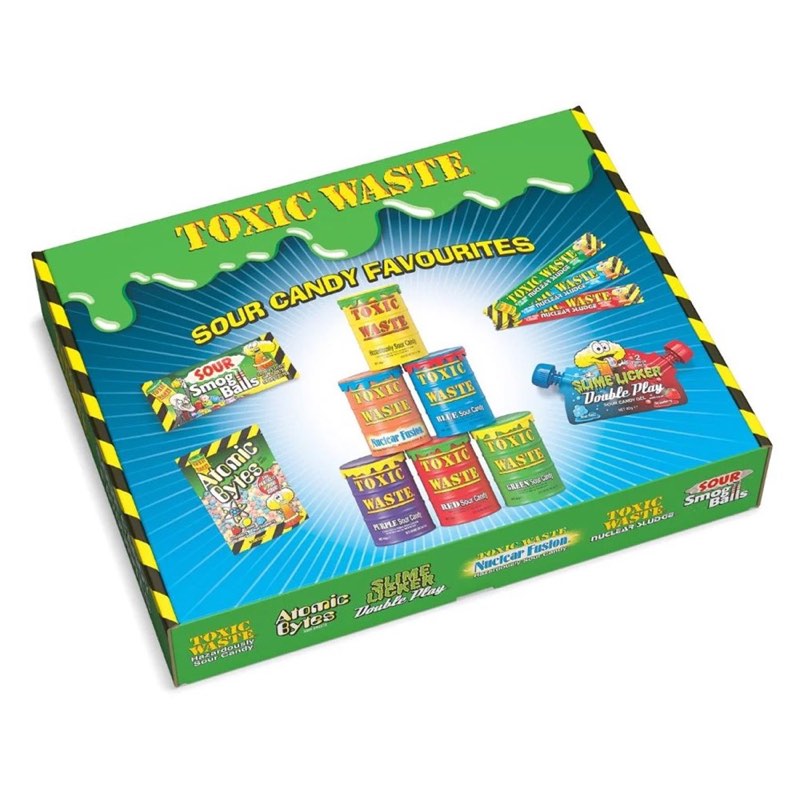
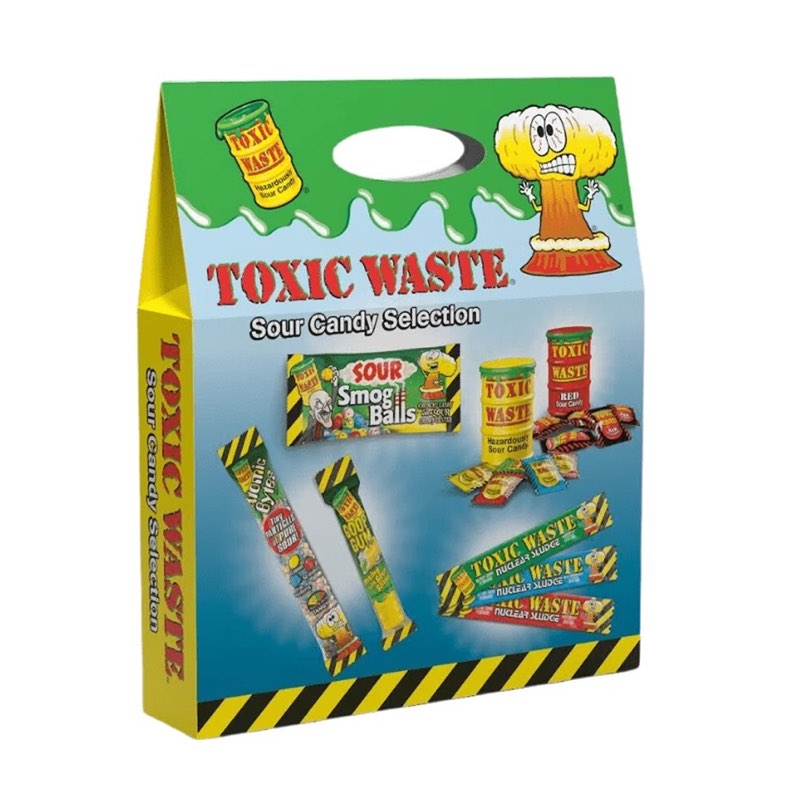
If you want quantity. The maths above tips the other way the moment you are buying a supply rather than a unit. The large sour candy gift box at £14.99 works out at £3.26 per 100 g, and the Christmas selection carry box at £7.99 for 295 g is better again at £2.71. Both beat the drum comfortably on rate. Neither replaces it, because neither fits in a coat pocket or costs two pounds.
What arrives
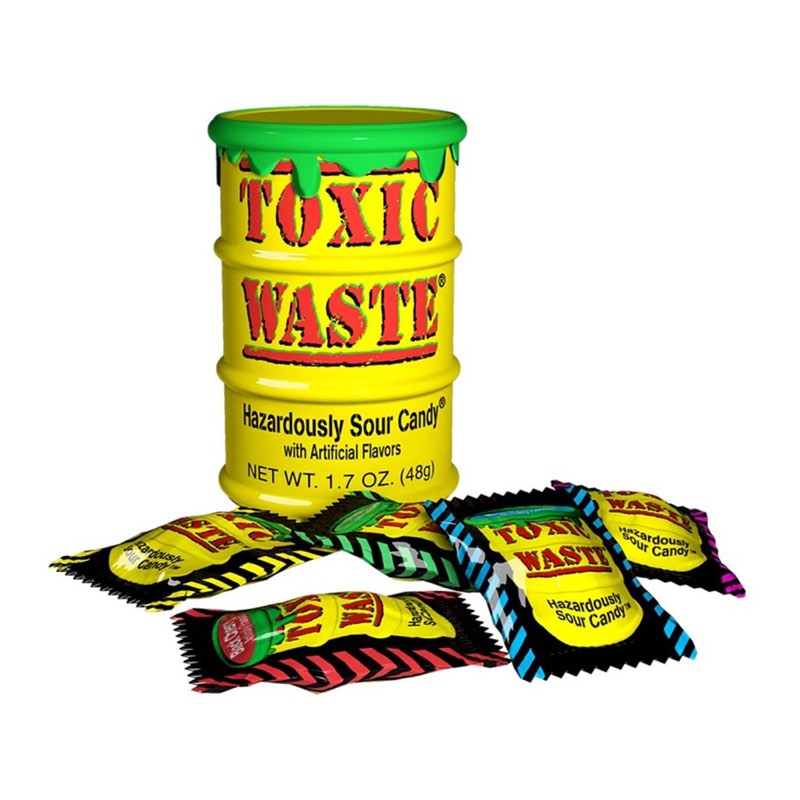
A small, rigid, resealable container — a drum, as the name has it — holding 42 g of hard sweets. The colour is yellow, and yellow is doing a specific job here: it is the label, the shelf marker, the thing you point at when several near-identical tins are lined up. We list the flavour of this line as fruit, which is the family we can stand behind. We do not publish a more specific flavour for each colour, because we do not hold verified flavour data at that level and making something up to fill a sentence would be no use to you at all. The manufacturer prints it on the drum. It will be entirely clear the second the thing is in your hand.
The size surprises people who have only seen it photographed. It closes inside a fist. It weighs almost nothing. It will travel in a blazer pocket for a week without anyone noticing it is there, which is more or less the point of the format and also the reason a great many of them are confiscated.
The rigidity is the quiet feature. A sweet in a bag is a sweet you have committed to finishing, because once the bag is open it stays open, gets folded over, gets forgotten, and goes stale. A sweet in a drum is a sweet you can take two of and shut again. For something as sharp as this, that matters more than it would for a mild jelly — you are never going to want 42 g of this in one sitting, so the packaging needs to survive being half-used. It does.
Inside, small hard pieces. Dense, solid, with the weight in the hand that boiled sweets have and jellies do not. There are more of them in 42 g than you would expect if your mental reference point is a gummy bag.
The suck, the crunch, and the decision in between
Every hard sweet poses the same question and this one poses it more sharply than most: do you wait, or do you bite?
Take a piece. The opening is immediate and it is sour in the full sense of the word — a hard, bright, concentrated sharpness that arrives before you have had a chance to identify any flavour at all. It grips the sides of the tongue. Your jaw tightens on reflex. Most people's face does something involuntary, and if there are two of you eating them at once, watching the other person's face is half the entertainment. This is a sweet with a social dimension whether you want one or not.
Hold it still and the sharpness has a peak and then a long decline. Somewhere between ten and twenty seconds the edge comes off, and the fruit underneath — broad, bright, straightforward — gets room to be tasted. This is the transition people do not expect on a first drum: the sweet becomes pleasant rather than merely intense, and stays that way for a long time.
And then it is simply a hard fruit sweet, slowly getting smaller, with a couple of unhurried minutes still in it. That is the part the reputation of the brand never mentions and it is genuinely the majority of the eating experience by time. The sharp opening is ten per cent of the sweet's life and ninety per cent of its publicity.
Which brings you to the crunch. At some point the piece thins to where it will give, and you can either finish it in one bite or keep going. The crunchers get through the drum in a fraction of the time and take the sharp opening in quick succession, which is a specific and slightly reckless way to eat sour sweets. The suckers get several times the duration out of the same 42 g. Neither is wrong, but if you are the sort of person who bought this to make it last, know that biting is what costs you.
A word of care rather than caution: these are hard, and going at a full-size piece with your back teeth early on is a poor idea. Let it thin first. And spacing matters — three or four pieces in a row leaves the mouth feeling worked, and twenty minutes off resets it completely. Almost everyone finds their own limit inside one drum.
The long British habit of sweets that fight back
Here is a thing that is easy to miss if you think of sour sweets as a modern invention: the British sweet counter has always kept a corner for confectionery that is unpleasant on purpose.
Look at what the old jars held. Aniseed balls, which taste of medicine and were sold to children anyway. Acid drops, sharp enough to make you blink. Sharp boiled drops that stripped the roof of your mouth. Liquorice in forms that no adult would eat voluntarily. Sherbet, which is essentially a delivery mechanism for a fizzing sensation rather than a flavour. Every one of those is a sweet whose appeal is partly that it is difficult, and every one of them was a staple rather than a novelty.
The reason is not complicated. A sweet that is merely sweet is a pleasant transaction and is forgotten immediately. A sweet that does something to you is an event. It can be shared, it can be dared, it can be watched, and it generates a reaction you can compare with the person standing next to you. Difficult sweets are social in a way that nice sweets are not, and children in particular have always understood this completely. The currency of a playground was never the sweet that tasted best. It was the sweet that produced the best reaction in whoever you talked into trying it.
This drum is the current form of that very old idea. What changed is not the concept but the presentation. The difficult sweets of the jar era were sold plainly — the jar said what it was, and the challenge was implicit, passed on by word of mouth from older children to younger ones. The difficult sweets of the container era put the warning on the outside. The packaging does the daring for you. That is a shift in marketing rather than in the sweet's function, and it explains why a certain generation regards this format with such immediate recognition: it was the first time the sweet announced its own difficulty before you bought it.
The second thing this drum belongs to is the era of the colour set. Somewhere along the line small sweets stopped being sold as one product and started being sold as a family of variants distinguished by colour, and the effect on how children bought sweets was substantial. You did not buy a sweet; you collected a set. You traded for the one you were missing. You had opinions about which colour was best and defended them with no evidence whatsoever. A great deal of playground conversation across several decades has been conducted entirely in colour names, and anybody who grew up in that system reads a shelf of identical drums in different colours instantly, without needing to be told what is going on.
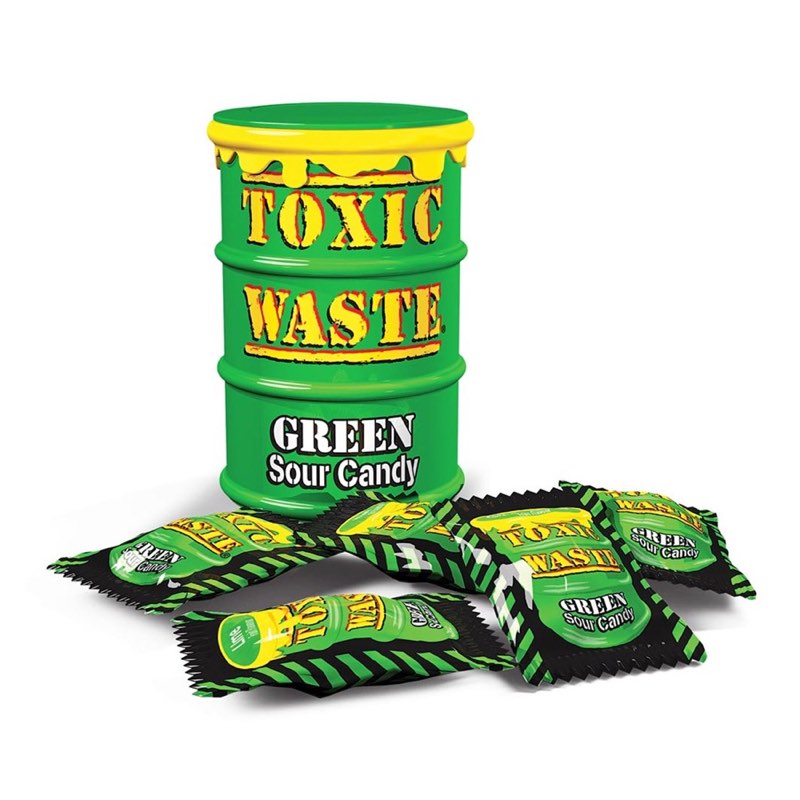
That is genuinely part of what you are buying here, and it is why this line sells in colours rather than flavours. Put the green drum next to this one and you have the beginning of a set rather than two sweets. Add a red one, then purple, then the Nuclear Fusion drum, and you have the whole shelf — five tins, all 42 g, all £1.99, £9.95 for the lot. There is no discount for buying them together and we are not going to pretend there is. What there is, is the specific and slightly childish satisfaction of having them all, which is a real thing that real adults pay for and there is no reason to be embarrassed about it.
One honest caveat about nostalgia. It is not the same as taste, and a sweet that carries a memory is not thereby a good sweet. Plenty of what people remember from the difficult end of the counter does not hold up — some of it was only ever interesting because you were nine and it was forbidden. What holds up here, in our view, is the second half: the long fruit finish after the sharpness has gone. That part is genuinely good and it is the part nobody remembers, because at nine you were eating for the reaction and never got as far as noticing the sweet.
For the older strand of the same tradition — the plain, unbranded, deliberately awkward British sweets sold by weight — Kingsway's range is the shelf to walk down, and Stockley's chocolate limes at £5.49 are a good example of a sweet that would have sat in a jar behind a counter and that still does exactly what it always did.
Intensity is one axis. Duration is the other.
Most people talk about sour sweets on a single scale from mild to savage, and that single scale is why so many shoppers end up disappointed. Two sweets can be identically sharp at their peak and be completely different experiences, because sharpness has a shape in time as well as a height.
Think of it as a grid.
High intensity, short duration. A hit that peaks hard and is gone within a few seconds. Fizzy jellies live here. The sharpness is an opening act, not the show. These are the most party-friendly sour sweets there are, because the unpleasant part is over before anyone has time to object to it — which is why Sweetzone Fizzy Rings Tub 800g at £7.99 works as a bulk bowl item in a way that harder sours never would.
High intensity, long duration. Where this drum sits. A hard sweet cannot dump its sharpness all at once, because it dissolves slowly by design. The sourness is therefore sustained — not at its peak the whole time, but present and declining over a much longer window than a soft sweet could manage. This is the band that separates people who like sour sweets from people who like the idea of sour sweets, because there is nowhere to hide. You cannot chew through it to get to the other side.
Moderate intensity, long duration. A gentle sharpness that simply keeps going. Underrated, and the most genuinely pleasant band to eat a lot of. Sour blackcurrant rings at £5.49 sit near here — sharp enough to be interesting, sustained enough to be worth a bowl, never hard work.
Moderate intensity, short duration. Essentially a tang. It lifts the fruit and prevents cloying, and most people would not describe these as sour sweets at all. BUBS Cool Fruity Pear Minis at £7.50 are firmly in the clean, unsharp territory just beyond this corner — useful as a reference point for what a fruit sweet tastes like with the sharpness taken away entirely.
The other thing to know is where in the sweet the sourness lives. In some sweets it is entirely on the outside and the inside is plain — you get a sharp front and a sweet middle, and the transition is abrupt and rather satisfying. In others it runs all the way through, so the intensity declines smoothly with the size of the sweet rather than ending at a boundary. Hard sours tend towards the second, which is why the experience here is a long fade rather than a cliff edge. It is also why a hard sour sweet is a poor choice for anyone who wants to try the sharpness once and then get on with eating something nice; there is no switch to flip.
Building around a long-duration sour. The rule is simple: everything else on the table should be shorter. If you put this drum out alongside another sustained sour, the two compete and the room gets fatigued within twenty minutes. What it wants next to it is fast sweets — things that are over quickly and reset the mouth. Kingsway Fizzy Chips at £5.49 are ideal for exactly that reason: thin, fast, sharp for a moment and then done, so they clear the palate rather than adding to the load. The Mike & Ike sour theatre box at £2.25 gives you a soft sour chew, which is a short-duration sour in a completely different texture, and the contrast between a soft fast sour and a hard slow one is much more interesting than two of either.
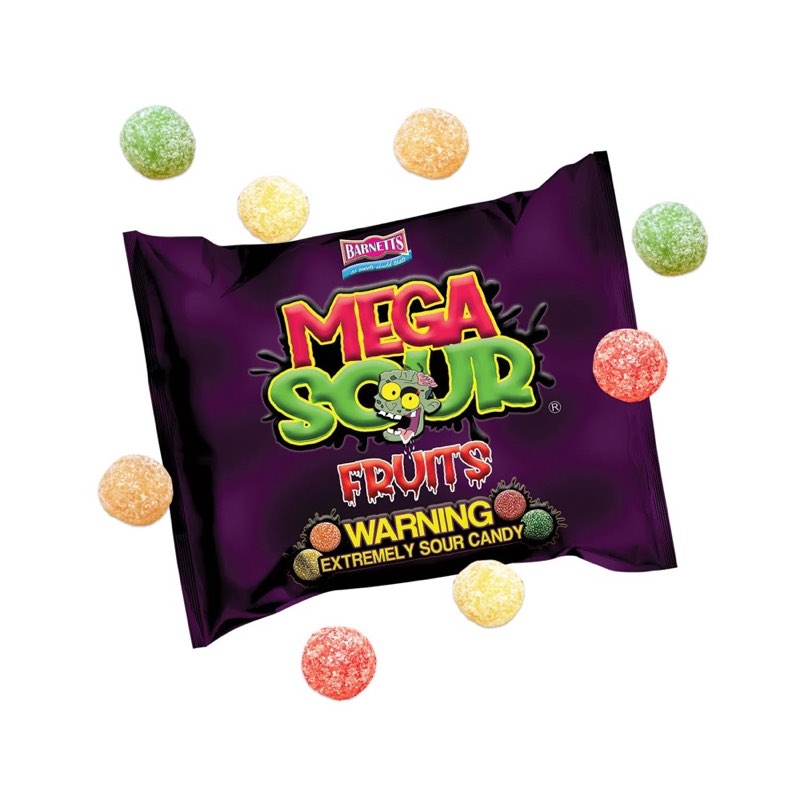
If you have decided the long, hard, high-intensity corner is where you want to live, then the sensible next step is quantity rather than novelty, and Barnett's Mega Sour Fruits at £3.99 give you 104 g in the same broad territory at a far better rate than a drum. The sour shelf runs to 49 lines in total, which is more than enough to find the exact corner of that grid you belong in.
Fruit flavour when the sweet lasts three minutes
We list this as a fruit sweet, and it is worth saying what fruit flavour has to do differently in a format that lasts this long.
A soft sweet is eaten in fifteen seconds. Its flavour only has to work for fifteen seconds, and it can afford to be loud, because it will be gone before anyone tires of it. A hard sweet has to hold your interest for minutes. Loud does not survive that — a flavour that shouts becomes wearing by the ninety-second mark. What works in a boiled sweet is a flavour with enough body to stay pleasant when it has your full attention and nothing else is happening.
Put that together with a sharp opening and you get a sequence rather than a single note: sharpness with no flavour, then sharpness and flavour together, then flavour alone for a long and quiet stretch at the end. Three distinct phases from one small sweet. That is more structure than most confectionery offers, and it is the reason hard sours reward being sucked rather than crunched — crunching collapses three phases into one.
Compared with the wider fruit range, this is at the sharp, hard, fast-opening extreme of a very broad family. Fruit flavours across the shop cover 161 lines, the great majority of them soft and mild, and walking that shelf is the quickest way to see how unusual this treatment actually is. Within the hard-sweet tradition specifically, our boiled sweets — 30 lines — are mostly built for comfort rather than confrontation, which tells you something about what this drum is doing that its shelf-mates are not.
Who this is for
The person who eats sour sweets on purpose. Not the person who tolerates a fizzy jelly — the person who seeks out the sharp end and is slightly disappointed when something described as sour turns out not to be. This drum will not disappoint them.
Anyone who wants a sweet that lasts. If your problem with confectionery is that a bag disappears without you noticing, a hard sweet is the structural answer, and a hard sweet you can only manage one or two of at a time is the answer twice over.
Pocket-money buyers. Two pounds, a sealed tin, and a reputation. This is the classic sale and there is no mystery to it.
Collectors of the set. Five colours, one price. Some people will stop at one. Others will not, and they know who they are.
Drivers, commuters and people who sit through long dull things. A slow hard sweet is genuinely useful for occupying a stretch of time, and a resealable drum in a bag beats an open packet.
Who should buy something else. Anyone who finds sourness unpleasant rather than fun — the long duration here means there is no getting past it. Anyone shopping purely on weight, for whom the larger boxes or a bag of loose sweets are plainly better value. And very young children, who should be supervised with small hard sweets because of the choking risk, and who will in any case probably find the opening far too much.
Putting it in a bowl with other things
A drum is a small enough quantity that it works better as a component than as a centrepiece, and there are two sensible ways to use it that way.
Scattered. Tip the drum through a much larger bowl of soft, mild sweets so the hard sour pieces turn up occasionally rather than constantly. Keep them well under a tenth of the bowl by weight. The effect is that every eighth or ninth sweet is an event, which keeps a bowl interesting for far longer than a uniform mix manages. Add them shortly before serving rather than hours ahead, so the hard pieces stay crisp in a warm room.
Separate. Put the drum out as its own small dish beside the main bowl, so that taking one is a deliberate choice. This is the better option with a mixed-age group or anyone who might not want the sharpness, because nobody has to pick their way round something they will not eat. It also, frankly, makes it more fun — a small dish of something notorious is an invitation.
For the bulk that goes around it, the loose counter is the cheapest route: the loose sweets counter carries 356 lines sold by weight, so you can buy exactly the soft mild base you want in exactly the quantity you need. If you would rather not assemble anything, ready-built pick and mix does the job in one purchase, and Haribo's own shelf at 43 lines is where most people's default bowl comes from. For the non-sweet half of a spread — bars, blocks and boxed things — the candy and chocolate shelves are the place to look.
Occasions where a single yellow tin earns its place
Halloween. The obvious one, and the colour helps. A yellow drum of something notorious sits well on an October table alongside a Halloween pumpkin light pop at £1.49, and between them you have a table that looks planned for eleven shillings' worth of effort. For trick-or-treat handouts, drums are on the generous side per caller, but as the one "proper" item in an otherwise ordinary bowl they work well.
Stockings and small gifts. Rigid, small, cheap, rattles. It fits the toe of a stocking and it survives being under other things.
Journeys. Slow sweets are good for long roads. The seal means it does not end up loose in the footwell.
Dares and group entertainment. We may as well be honest that a proportion of these are bought to be filmed, or to be handed to somebody who does not know what they are in for. It is a legitimate use of a sweet and has been for as long as there have been sweets. Keep it good-natured, let people opt out, and do not push it on small children.
Revision, work and long dull tasks. A sweet that takes two minutes and requires some attention is a better desk companion than a bag of things you can eat without noticing.
The £2 present. Birthdays where a proper gift is not appropriate, teachers at the end of term, the friend who has had a bad week. Two pounds of specific, silly, sealed sweet does a job that is hard to do any other way.
Looking after it
The lid is the whole of the advice and it is worth being emphatic. Hard sweets fail through moisture, and the symptom is tackiness — a slightly sticky surface, or pieces bonding to one another. A drum kept properly shut will not do this. A drum left open in a steamy kitchen will.
Beyond that: cool, dry, dark, out of direct sun. Warmth alone will not destroy hard sweets but it softens their surface and makes them far more vulnerable to the moisture in the air. A cupboard or a drawer is right. The dashboard of a car in July is the single worst place, which is unfortunate, because a resealable tin of slow sweets is otherwise perfect for a car.
Never refrigerate. Condensation on removal is exactly the failure you are trying to avoid, and the cold flattens the flavour while it is in there.
If pieces have stuck, they remain perfectly good — a sharp tap of the closed drum on a worktop will usually separate them. The date printed on the drum is the authority on how long it keeps; nothing on this page overrides it.
Five identical-looking tins: how to choose
This is the genuine question a lot of people arrive with, and it deserves a straight answer rather than a sales one. We stock five drums in the range. They are all 42 g. They are all £1.99. They are all fruit as we classify them. The visible difference is colour.
So how do you pick?
- If you are replacing one somebody remembers, the colour is the memory. People remember sweets by colour far more reliably than by flavour, so ask which tin it was rather than which fruit — you will get a much better answer.
- If you have no information at all, buy two different colours rather than two of the same. The extra pound is the cheapest possible insurance against guessing wrong, and you learn something.
- If it is a gift for more than one person, vary them deliberately. Handing out five identical tins looks like a bulk purchase; handing out five different ones looks like you chose.
- If you are buying for yourself and you have a colour you have always liked, buy that one. There is no cleverer answer and no reason to overthink it.
- If you want all of them, £9.95 gets you the full set, and you will not be the first.
If the answer turns out to be that you want a proper supply rather than a tin, the two gift boxes linked earlier are the better purchase by a clear margin, and everything we carry from Toxic Waste — eight lines — is laid out together so you can compare the drums and the boxes in one view.
Where this sits in the shop
Five shelves carry this drum, and which one you came in on tells you where to go next. The brand shelf has the rest of the range, drums and boxes together, and is the right place to start if the tin itself is what appeals. The sour shelf is the deepest of the relevant categories and goes both gentler and harder than this, which makes it the shelf to browse if you are calibrating your own tolerance. The boiled shelf is where the other hard sweets live, most of them built for comfort rather than a sharp opening, and it is worth a look if the long slow finish is the part you liked. The fruit shelf is the broadest of the four by some distance. And the loose counter is the one to use when you want the same kinds of sweets sold by weight instead of by the tin.
If you would rather see the lot without filtering, every line we stock is browsable in a single list.
Questions we get about the yellow one
What flavour is the yellow drum?
We list the family as fruit and we stop there, because that is what we can verify. We do not hold specific per-colour flavour data for this range, and guessing at one to make the page read better would be worse than useless if you were buying to match a preference. The flavour is printed on the drum by the manufacturer and is obvious on arrival. If you need to be certain before you order, buy two colours — at £1.99 each that is cheap certainty.
Is the yellow one different from the green one?
They are different drums in the same range, listed at the same weight, the same price and the same fruit family, and distinguished on our shelf by colour. The specific difference between them is a matter for the manufacturer's packaging rather than for us. In practice, most people who try more than one develop a firm preference, which is the best argument there is for buying a couple rather than committing to one.
How sour is it compared with a fizzy jelly?
Considerably more, and — more importantly — for much longer. A fizzy jelly has a sharp opening that is gone in a few seconds because you chew straight through it. A hard sour sweet dissolves slowly, so the sharpness is sustained across a much longer window and there is no way to hurry past it. If your reference point is a fizzy gummy, expect a noticeable step up in both respects.
How long does one piece last?
Sucked properly, a couple of minutes, with the sharp phase occupying only the first ten to twenty seconds of that. Crunched, obviously much less. This is why the drum goes further than 42 g sounds: hard sweets buy time rather than volume, and the people who make one last are getting several times the duration out of the same tin as the people who bite.
Is £1.99 for 42 g expensive?
By weight, yes — it comes out at £4.74 per 100 g, and almost everything around it on the shelf beats that. By unit, no: it is a sealed, self-contained, finishable tin at a price nobody has to think about, and it lasts a fortnight of occasional use. If you want quantity, the larger boxes are a much better buy. If you want a two-pound object, this is one.
Can I put it in a party bag?
One drum per bag works well and is the right approach. Dividing a single drum between several bags does not — 42 g of hard sweets scatters into a disappointing handful. Budget £1.99 a head if you are going to do it, which is at the upper end of what most people spend on a party bag's main item but does mean every child goes home with something sealed and intact rather than loose sweets in a plastic bag.
What is in it? Does it contain any allergens?
We do not print ingredient or allergen information on our pages, because the manufacturer's own packaging is the only version we would want anyone relying on. Please read the drum when it arrives, before anyone eats from it, especially if there is an allergy in the household. We hold no supplier dietary classification for this line, so we are not going to make a claim about it in either direction.
Are they safe for children?
These are small hard sweets and small hard sweets are a choking risk for young children, so children should be supervised while eating them and the very young are better off with something else. For older children it is a question of taste rather than safety, and the honest answer is that the opening is a lot for anyone who has not met a serious sour sweet before. Sweets are a treat rather than an everyday food, and this is very much an occasional one.
Do they melt or spoil in the post?
Hard sweets travel better than almost anything else in the shop. They do not melt the way chocolate does, and the rigid drum protects them from being crushed. Heat plus humidity over a long journey can leave the surface slightly tacky, which affects how they look rather than whether they are fine to eat. As a thing to post to somebody, this format is close to ideal.
Should I buy the big box instead?
If you already know you like this line and you want a standing supply, yes — the 460 g box is a real saving per gram over buying drums, and the Christmas box is better again while it is around. Buy the drum when you want a gift, a first try, a single colour, or a small amount of something intense to lift a larger mix. The two purchases are not really competing; they answer different questions.
How should I store it once it is open?
Press the lid properly shut, and keep it somewhere cool, dry and dark. That is genuinely the whole of it. Do not leave it open on a kitchen worktop, do not leave it in a hot car, and do not put it in the fridge. Treated sensibly a part-used drum stays in the condition it arrived in for a long stretch; the date on the tin is the definitive guide.
What should I buy alongside it?
Something fast and something soft. A long-duration sour needs short-duration company or the whole table gets tiring — thin fizzy pieces, a soft sour chew, or a mild unsharp jelly as the bulk of the bowl. What it does not want is a second sustained sour sitting next to it. If you are buying one other thing, make it the mild base; if you are buying two, make the second one something with a completely different texture.
To sum up
A 42 g tin of hard, sharp, fruit-flavoured sweets at £1.99 — expensive by the gram, cheap by the day, and sized so that you will actually finish it rather than leaving it half-used in a cupboard. The sharpness is at the serious end and, because these are boiled rather than chewed, it lasts longer than a fizzy jelly's does; what most people do not expect is the quiet couple of minutes of plain fruit sweet at the end, which is the better half of the experience. It belongs to a very old British habit of selling sweets that are difficult on purpose, and to a much newer one of selling them as a set of colours. Keep the lid shut, keep it out of the sun, and give it to somebody who will pull a face. Sweets are a treat rather than a staple; check the manufacturer's packaging on arrival if anyone has an allergy; and supervise young children, for whom small hard sweets are a choking risk.
More from Toxic Waste
More sour sweets
More fruit sweets




Where this sits
Toxic Waste Yellow Drum 42g appears on these shelves. Browse them, or jump to something nearby.
You might also like