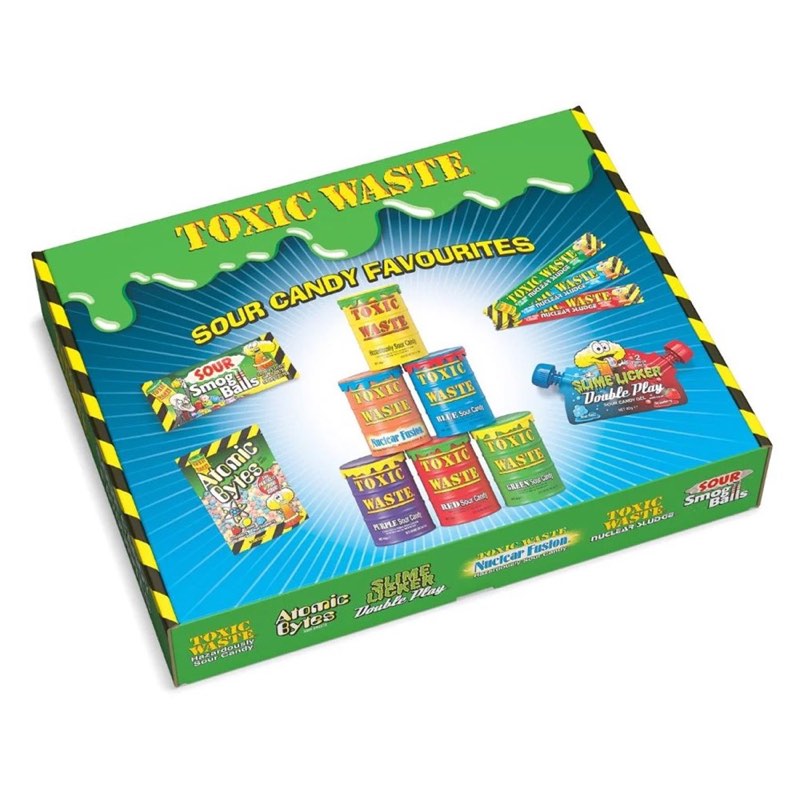
Home / Loose Sweets / Toxic Waste Red Drum 42g
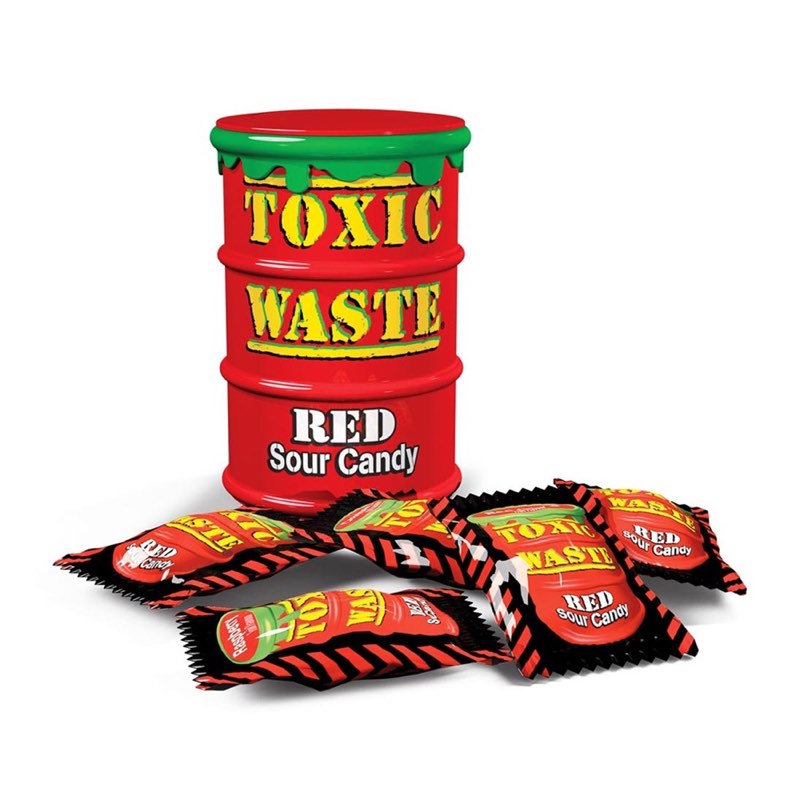
Toxic Waste · 42g
Read the full guide
Toxic Waste Red Drum 42g
£1.99
✔ In stock — ready to ship
Fresh stock
Free over £20
Same-day dispatch
Secure checkout
Put one on your tongue and do nothing. That is the right way to meet this sweet, and almost nobody does it — most people crunch within four seconds and miss two thirds of what they paid for.
Seconds one to three. Nothing much. A hard, cool, faintly dusty surface. There is a moment of complete calm that is, in hindsight, slightly funny.
The full guide to Toxic Waste Red Drum 42g
5,114 words on how it eats, who it suits, how to serve it and what to put beside it.
The first thirty seconds, in detail
Seconds three to eight. The sour coating dissolves and the calm ends. It arrives as a rising edge rather than a hit — you feel it at the sides of the tongue first, then across the whole surface, then right at the back where your jaw hinges. The muscles under your ears tighten of their own accord. This is the part people pull faces about, and it is not an exaggeration: a proper sour coating is sharp enough to make a grown adult's eyes water for a second or two.
Seconds eight to twenty. The peak holds, then starts to come off. Somewhere in here the fruit underneath becomes findable. It was always there; you simply could not get at it through the acid. As the coating thins, a sweet red-fruit note comes up behind it and the whole thing changes character — from an assault to something you would describe as pleasant.
Twenty seconds to a couple of minutes. Now it is a boiled sweet, and boiled sweets are patient. The coating is gone, the fruit is doing the work, and the piece is shrinking slowly against your tongue. This is the long, quiet stretch that most people never reach because they have already bitten it.
The crunch. Whenever you decide. A hard sweet that has thinned for a minute breaks into sharp fragments, and those fragments give you a short second wave of flavour as they dissolve. Some people hold out for the whole life cycle. Some crunch at fifteen seconds to shorten the sour phase deliberately. Both are legitimate strategies and you will know which one you are within two pieces.
Afterwards. The tongue feels scrubbed. If you have eaten several in a row, a strong sour coating can leave the tip and sides of your tongue feeling tender — that is a normal consequence of eating a lot of intensely sour sweets in one go, and the usual answer is to space them out or stop for a while. Nobody who has eaten a handful of sour sweets in one sitting will find this news.
What you are actually holding
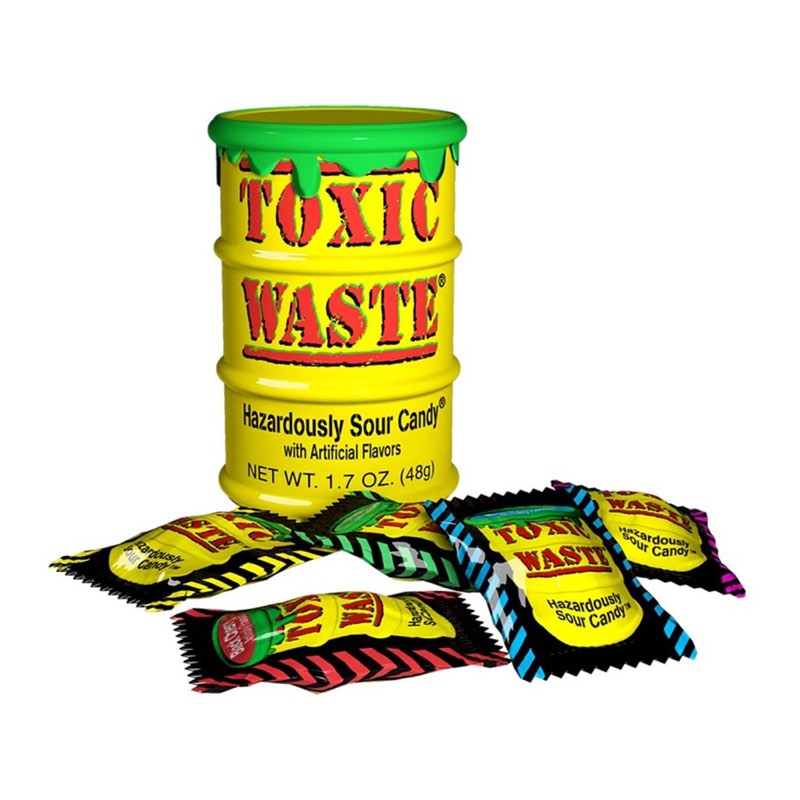
A small drum. Forty-two grams of hard sweets in a lidded tin-style tub that fits inside a closed fist, with a red colour identifying it on the shelf. It rattles. That rattle is more of a selling point than it sounds, because it is the sound a small quantity of something makes, and small quantities of something intense are exactly what this format exists to sell.
The pieces inside are small and hard — boiled and sour are the two types we list against it — with a dusted coating on the outside and a solid body underneath. The construction is the whole design: a fast, aggressive outer layer over a slow, sweet inner one, so that the eating experience has a beginning, a middle and an end rather than being one flavour held for a minute.
At £1.99 the drum is priced as an impulse item and behaves like one. It is small enough to be forgotten in a coat pocket and found again in November, and robust enough that this does the sweets no harm at all.
How a fruit note gets built
This is the part of confectionery that most people never think about, and once you know it you cannot un-know it.
A recognisable fruit flavour in a sweet is not one thing. It is three things layered on top of each other, and the layers arrive in a fixed order every time.
- The top note. Volatile, immediate, gone in seconds. This is what makes you say "that's raspberry" or "that's apple" before you have consciously tasted anything. It is the part that escapes into the air if you leave a bag open, which is why old sweets taste vague rather than wrong.
- The body. Slower, rounder, mostly sweetness with a little of the fruit's character. This is what you are tasting for most of the sweet's life. It is much harder to make distinctive than the top note, which is why so many fruit sweets are unmistakable for a second and generic for a minute.
- The tail. What is left after you swallow. Usually a faint version of the body, sometimes with an edge to it. The tail is what decides whether you reach for a second piece straight away or wait.
Acid is structural, not decorative. Here is the thing that surprises people: sourness is not a flavour that has been added on top of fruit — it is part of how the fruit reads in the first place. Real fruit is acidic. A sweet with no acidity at all does not taste like a milder fruit, it tastes like sugar with a perfume on it. Confectioners use acid to make a fruit note believable, and the difference between a subtle fruit sweet and an aggressive one is mostly a difference of how much and where.
Where the acid sits changes everything. Mixed through the body of a sweet, acidity brightens the fruit and you would not call the sweet sour at all — that is most of the fruit confectionery in the country. Concentrated on the surface as a coating, as it is here, it becomes an event: a huge spike at the start, then nothing, and the fruit underneath is left to carry the rest. Same principle, completely different product.
Why the coating comes first. Because the tongue adapts fast. If you spread intense sourness evenly through a three-minute sweet, your palate would acclimatise inside twenty seconds and you would spend two and a half minutes tasting very little. Front-loading it gets you the full effect at the moment it is most surprising, and then hands over to the sweet layer before fatigue sets in. It is a well-judged piece of design, whether or not anyone thinks of it that way while pulling a face.
Why sour sweets taste fruitier afterwards. The contrast does it. Coming off a sharp acid peak, a moderately sweet fruit body reads as much sweeter and much fruitier than the same body would on its own. The sour phase is effectively buying intensity for the phase that follows it. This is also why a sour sweet is such an effective palate reset in the middle of a bowl of soft, sweet things — it recalibrates what your mouth is measuring against.
What we will not tell you. Which fruit this is. We list the flavour family as fruit and we stop there, because we do not hold verified per-colour flavour data for this range and inventing a specific fruit to make the page read better would be worse than useless to somebody buying to match a preference. The colour is how you identify the drum; the flavour name is printed on the manufacturer's own packaging and is clear the moment it arrives. If you need certainty before the parcel lands, buy two colours — at £1.99 each, certainty is cheap.
Red as a category of its own
There is a thing that happens in British sweet-eating that is worth naming: red is treated as a flavour. Not a colour that indicates a flavour — a flavour in itself. Ask people what red sweets taste like and you will get a confident answer, and the answers will broadly agree with each other without anybody naming the same fruit.
This is not silliness. Colour genuinely changes what people taste. Give somebody the same flavour in two colours and they will describe the red one as sweeter and more berry-like than the other, and they will not be lying — colour arrives before flavour does and sets up an expectation the tongue then works within. Every confectioner on earth knows this, and it is why the colour of a sweet is chosen at the same time as the flavour rather than afterwards.
For you as a shopper, the practical use of this is simple: colour is a reliable shorthand for what somebody will enjoy, even when nobody can name the flavour. If the person you are buying for always goes for the red ones in a mixed bag, the red drum is a good bet for them, and the reason is more solid than superstition. The full Toxic Waste range is only eight lines on our shelf, and several of them are colour-differentiated versions of the same format, which makes it unusually easy to buy on this basis.
The flip side is that colour preference is stubborn. People who like the red one tend to really like it and to be uninterested in the alternatives. Which is an argument for buying one of each to find out, and then buying three of whichever wins.
The counter this came from
Sour sweets belong to a specific era of the sweet shop, and it is a more recent one than most of what we sell.
The long British tradition is comfort. Boiled fruit sweets, toffees, mints, things in paper bags weighed out by somebody who knew your mother. Sharpness existed, but it was polite — a lemon note, a bit of acid drop, nothing that made anybody pull a face. Sweets were supposed to be nice.
Then somewhere in the last few decades the logic inverted, and a whole genre appeared where the point of the sweet was that it was difficult. Not unpleasant — difficult. Something to be attempted, survived and reported on. That shift is one of the more interesting things to have happened to confectionery in a century, and it changed who sweets were sold to and how. A sour sweet is a social object in a way a toffee is not. You do not hand somebody a toffee and watch their face.
Why the format fits the era. The small drum is a product of that shift. Confectionery designed to be shared as a dare needs to be portable, cheap enough for an impulse, and small enough that a group gets through it in one sitting. Forty-two grams at £1.99 is exactly that specification. It is a unit built for a playground, a common room, a pub table or a car boot at a football match — anywhere a tin gets passed round and the passing is half the point.
What it shares with much older sweets. Strip out the sourness and the underlying object is deeply traditional: a small hard boiled sweet you suck for several minutes. That is the oldest format in the shop. McAdam's chopped rock in a 150 g pouch at £1.99 is the same money for three and a half times the weight, and it is the straight, unmodernised version of the same idea — hard, sweet, long-lasting, no ambush. Putting the two side by side is the clearest possible demonstration of what changed and what did not.
The generational split. In most families the sour tins belong to whoever is under twenty-five and the traditional boiled sweets belong to whoever is over fifty, with the middle generation moving between the two depending on the day. If you are building a bowl for a mixed-age room, stock both and keep them apart. Nothing ruins a grandparent's afternoon faster than a mystery sweet from a tin that everybody else at the table already knew about.
And a note on how these get bought. Nostalgia purchases and dare purchases behave differently. Somebody buying a remembered sweet buys one and hopes. Somebody buying a sour sweet buys four, because three of them are for other people. That is why the drums are priced and sized the way they are, and why almost nobody leaves with just one.
Who the red drum is for
The colour loyalist. Covered above. Knows what they like, has liked it since they were small, and is not looking to broaden their horizons.
The person who enjoys the face. Buys it to hand round. The sweet is a prop. This is the single most common reason a drum leaves the shop.
The mix builder. Wants one intense thing in an otherwise mild bowl. Needs a small quantity, which is precisely what this is.
The collector. Has three colours and wants the set. We would not pretend this is rational, but it is real, and the brand shelf exists partly for these people.
The cautious first-timer. Wants to know how bad it is before committing money. £1.99 is the right price for that experiment and the drum is the right size — enough for a proper test, not so much that a bad result is expensive.
Who it is not for: anyone who wants a gentle fruit sweet, anyone buying for a room of small children who have not asked for this specifically, and anyone who wants their money's worth in weight. On that last point, see the arithmetic below — it is not flattering, and it does not need to be.
Fruit at the sharp end: what to put beside it
The fruit flavour shelf is our largest by some distance — 161 lines — and it runs all the way from barely-sweet to genuinely punishing. Knowing where things sit on that run is the whole skill of buying well.
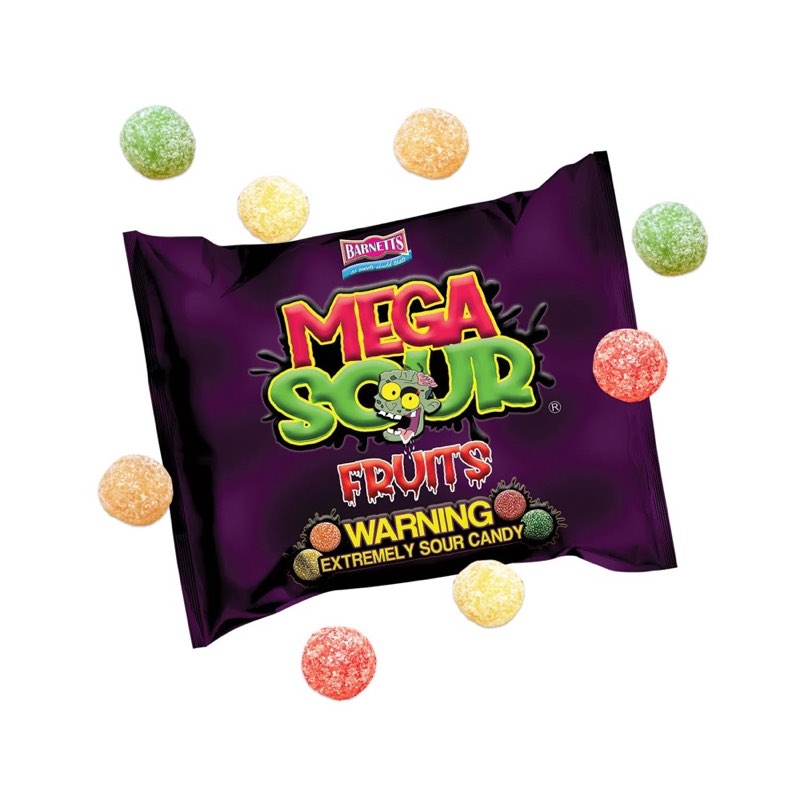
If you want more of the same intensity: Barnett's Mega Sour Fruits at £3.99 for 104 g is the obvious next step — two and a half times the weight for twice the money, and a bag rather than a tin, which makes it the better choice if the sour thing is a habit rather than a novelty. For the same idea with less commitment, the Mike & Ike sour theatre box at £2.25 for 120 g is a chewy rather than boiled format and considerably more forgiving.
If you want fizz rather than sour: fizz is the friendly cousin — a crackle and a lift instead of an ambush. Kingsway Fizzy Chips at £5.49 and the 800 g tub of Sweetzone Fizzy Rings at £7.99 are the two we would reach for, the second being much the better rate if you are filling a bowl rather than a bag. The wider Kingsway shelf is worth a look if that style suits you, as is the Haribo range for the soft end of the same idea.
If you want a specific fruit rather than a general one: Park Lane Sour Blackcurrant Rings at £5.49 are sour and named, which is the opposite of what this drum offers, and BUBS Cool Fruity Pear Minis at £7.50 take a single fruit and build the whole bag around it.
If you want a novelty alongside: the Candy Realms pumpkin light pop at £1.49 is the cheapest impulse item near this one, and the Fuji Candy DIY ramen kit at £2.99 is the make-it-yourself end of the shelf, which children will spend far longer on than they will on any tin.
If you want to go the other way entirely: Stockley's Chocolate Flavoured Limes at £5.49 are the traditional counterweight — a hard sweet with a soft, rich centre and no aggression whatsoever. A bowl with both is a bowl that suits everybody in the room.
Putting one drum into a much bigger bowl
The mistake people make with a small intense tin is treating it as a portion. It is not. It is a seasoning.
Forty-two grams into a kilo of soft sweets is about four per cent of the weight, and that is roughly the right proportion. Enough that people encounter one every few handfuls; not so much that the bowl becomes a challenge. Two drums in a kilo is the upper limit unless you are catering specifically for people who came for the sourness.
Three practical notes:
- Keep them visible. Unlike soft sweets, these are worth announcing. Half the pleasure is somebody deciding to take one.
- Do not mix them into anything that will sit for days. A dusted sour coating and a damp bowl of jellies are not friends. The coating will go tacky and the jellies will pick up an edge they were not meant to have. If the bowl is for tonight, no problem at all.
- Build the rest of the bowl soft. Hard against hard is hard work. The best partner for a boiled sweet is something with give — the pick and mix section is where most people assemble that base, and the loose sweets shelf at 356 lines is where the bulk comes from.
Occasions where one small red tin does the job
Passing it round. The core use. A table, a car, a dressing room, a queue. One tin, six people, everybody has an opinion within a minute.
Party bags for older children. Not for the very young, but for the eight-to-twelve bracket a sour tin is the item in the bag they talk about. One drum per bag is generous at £1.99 a head.
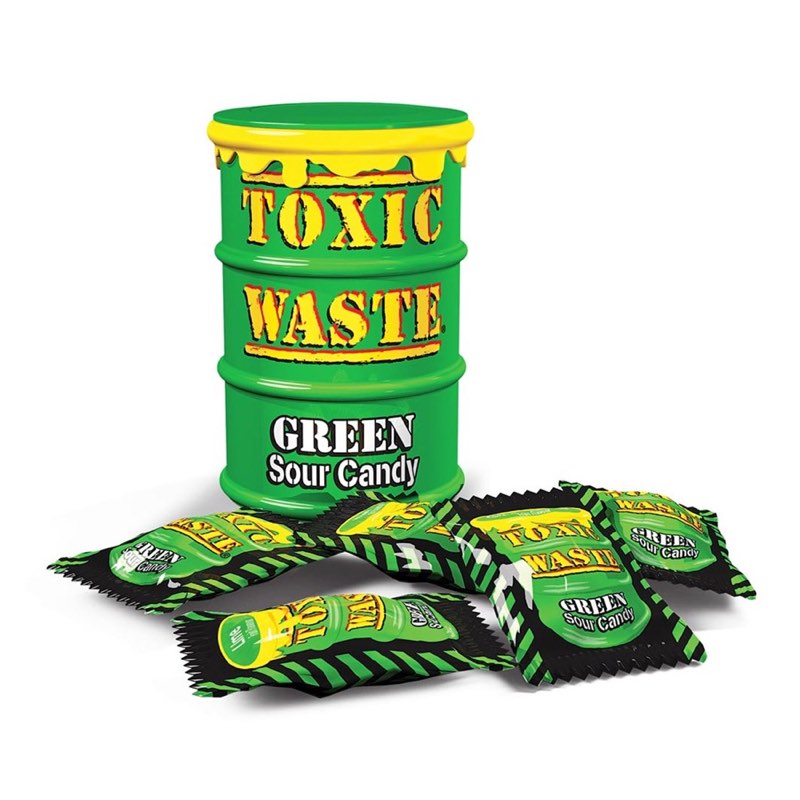
Stocking fillers. Small, sealed, rattles, cheap. Sits in a stocking toe perfectly. If you want two tins that look different in the same stocking, pair it with the green drum at the same £1.99.
Halloween. The single best-matched occasion for this whole genre — the aesthetic does half the work and the sourness does the rest. Put the drums in a bowl with the pumpkin light pop and you have a table with no other effort required.
The dare. Somebody will suggest it. There is no need to plan for it; it plans itself.
A small thank-you. Two pounds, sealed, postable in a padded envelope. Not a gift with weight behind it, but exactly right as the funny thing on top of a larger present. For something with more presence, the 460 g gift box at £14.99 is the version that can stand on its own.
Handing one to somebody for the first time
There is an etiquette to this and most people get it wrong, usually on purpose.
Tell them. The temptation is to say nothing and enjoy the result, and it is a poor trade: you get five seconds of comedy and they spend the rest of the evening declining everything else you offer them. Say what it is, then hand it over. People who want the experience will still take it, and they will take it in the right frame of mind, which makes the whole thing work better.
Give them the technique. Tell them not to crunch immediately. The single most common first-timer mistake is biting at second four, which converts a sweet with three distinct phases into one short unpleasant shock. Tell them the sour part ends, because if you do not, they will assume it goes on for the full two minutes and bail out.
One at a time. A drum passed round with everybody taking two is how you get a table full of people with tender tongues who have stopped tasting anything. One each, wait, see who wants another.
Have something mild to hand. Not as a remedy — just as somewhere to go next. Anything soft and sweet resets the mouth after a sour piece, and it is the reason a bowl of ordinary sweets should sit next to the tin rather than across the room.
Let people decline without a fuss. Sour sweets attract a small amount of social pressure and it is entirely unnecessary. Some people find them genuinely unpleasant rather than thrillingly difficult, and that is a preference rather than a failure of nerve.
Forty-two grams, and how long it lasts
The honest arithmetic. £1.99 for 42 g is about £4.74 per 100 g, and there is no way to describe that as cheap by weight. An 800 g tub at £7.99 is roughly a fifth of that rate. The 460 g box at £14.99 comes in around £3.26 per 100 g, and the 295 g Christmas carry box at £7.99 around £2.71 — which makes the seasonal box the best rate in the whole brand range by a clear margin, if you can wait for it or do not mind the festive packaging.
So why buy the drum? Because the rate is not what you are buying. You are buying:
- A low absolute price. Two pounds is a decision nobody has to think about.
- A sealed, pocketable unit. You cannot put 460 g in a coat pocket.
- A portion that ends. Intensely sour sweets are better in small, finite amounts than in a tub you can keep dipping into.
- A colour you can choose. The big boxes are assortments. The drum is a decision.
How long one lasts. Sucked properly, each piece runs for a couple of minutes, so a drum is a surprisingly long session for one person — considerably longer than 42 g of anything soft. Passed round a table of five, it is gone in ten minutes. As four per cent of a party bowl, it lasts the whole party. As a personal supply kept in a bag, most people report a drum lasting a week or two, because there is a natural limit to how many you want in a row.
Looking after a sour coating
The coating is the fragile part of this product, and everything about storage follows from that.
Damp is the enemy. A dusted surface pulls moisture out of the air. In a humid kitchen, an open drum will go from powdery to slightly tacky in a matter of days, and the pieces will start to stick to each other. Keep the lid on between sittings and keep the drum out of the bathroom, off the windowsill above the sink, and away from the kettle.
Heat matters less than it does for chocolate, but it still matters. Hard sweets do not melt at household temperatures, but warmth plus damp accelerates the tackiness. A cool cupboard is all it takes.
Do not decant into a jar with other things. This is the one people regret. Tip a sour drum into a mixed jar and within a week the coating has transferred onto everything else and the drum pieces have lost their edge. If you want them in a display jar, use a jar of their own.
The lid is part of the product. Keep it. The drum is the best container these will ever be in.
Top notes fade. As covered in the flavour-construction section, the most volatile part of any fruit flavour escapes into the air. An open drum left uncovered for a month will be duller than a sealed one — not stale exactly, just vaguer. Closed, it keeps its character until the date on the manufacturer's packaging, which is the figure to go by rather than anything on this page.
Which of the range to buy, and in what order
Six lines in the brand range sit close to this one, and they split cleanly into two groups.
The drums, all £1.99 for 42 g. Identical format, different colours. Alongside the red, there is the yellow drum, the purple drum, and the Nuclear Fusion drum, which is named rather than colour-coded. The honest advice: if you do not already have a colour preference, buy two different ones. Same total spend as buying two of the same, and you learn something.
The boxes, for volume and for gifting. The 460 g box is the one to buy if the sour habit is established and you are tired of paying drum prices. The 295 g Christmas carry box is the best value per gram in the range and the obvious December purchase, though it is a seasonal item and behaves like one on stock.
The order we would buy in: one drum to find out, a second drum in a different colour to compare, and then a box if the answer was yes. Skipping straight to a box is a £14.99 bet on a flavour profile you have not tested. Plenty of people win that bet. Plenty do not.
Shelves this appears on
Five, which is more than most products, because it is several things at once.
It is a sour sweet — a 49-line shelf that is the right starting point if intensity is what you came for. It is a boiled sweet, which is the 30-line shelf of things that last, and a far more traditional neighbourhood than the sour shelf. It is fruit flavoured, putting it among 161 lines that range from the gentlest jelly to the sharpest tin. It sits in Loose Sweets, our biggest section, and on the brand's own eight-line shelf, which is the fastest way to see the whole range side by side.
Further out: the full shop if you would rather browse than filter, pick and mix if you are assembling something, and the candy and chocolate shelf if the sour tin is one item in a bigger order and the rest of it is going to be rich rather than sharp.
Before you order: the usual questions
How sour is it really, on a scale?
Firmly at the top end of what is sold on the high street, and a long way beyond a fizzy jelly. The peak lands within a few seconds and holds for another ten or so before the fruit takes over. Most adults find the first one genuinely startling and the third one perfectly manageable, because the tongue adjusts fast. If you find ordinary sour sweets too mild to bother with, this is the right shelf. If you avoid sour sweets entirely, nothing about the red one is a gentler way in.
What flavour is the red one?
We list the family as fruit and leave it there. We do not hold verified per-colour flavour data for this range, and making one up would be unhelpful to anyone buying to match a preference. The manufacturer prints the flavour on the drum, so it is obvious the moment it arrives. If you need to be sure first, buy two colours — at £1.99 each that is the cheapest way to find out.
Can it hurt your tongue?
A strong sour coating can leave your tongue feeling tender if you eat a lot in one sitting, which is a well-known feature of extreme sour sweets rather than a fault in this one. Spacing them out sorts it. We are a sweet shop rather than anything more qualified than that, so if you have any concern beyond that, ask someone who is.
Is it suitable for young children?
These are small, hard sweets, and small hard sweets are a choking risk for young children — they should be supervised, and for the very young we would point you at something soft instead. Beyond that it is a question of taste rather than anything else: plenty of older children love them and plenty of adults cannot get through the first ten seconds. Sweets are a treat, whatever the age.
How many sweets are in the drum?
We go by weight, not count, so we do not publish a piece number. It is 42 g of small hard sweets, which is a decent handful and a long session for one person because each piece lasts a couple of minutes. Passed around a group it is a ten-minute tin.
What is in it, and does it contain anything I might react to?
We do not publish an ingredients list or allergen information for this line because we do not hold verified data for it. The manufacturer's own packaging carries the full declaration and it comes with the product. If you or anybody you are buying for has an allergy or an intolerance, read that packaging before eating anything from the drum.
Is the red one different from the other colours?
They are different drums in the same range, listed at the same 42 g, the same £1.99, and the same fruit family, and distinguished on our shelf by colour. What exactly separates them is a matter for the manufacturer's packaging rather than for us. In practice, most people who try two develop a firm preference very quickly, which is the best argument there is for buying a pair rather than committing to one.
Should I just buy the big box instead?
If you already know you like them, yes — the rate per gram is far better and you stop paying the small-tin premium. If you are trying them for the first time, no. Two pounds is the right size of bet. The middle path, which is what we would actually do, is two drums now and a box next time.
Does it keep well once opened?
Yes, provided the lid goes back on. The coating draws moisture from the air, so an open drum in a steamy kitchen will go tacky within a week or so. Closed and kept in a cupboard, it holds its character until the date printed on the packaging.
Can I post one?
It is well suited to it — small, sealed, rigid and not heat-sensitive in the way chocolate is. It goes in a padded envelope with room to spare and arrives in the condition it left in. As the funny item in a parcel it is hard to beat for £1.99.
What goes well with it on a table?
Something soft and mild in quantity, plus one thing that is neither. A bowl of soft sweets as the base, the drum as four per cent of the weight, and something traditional like a bag of chocolate limes for the people who want no part of the sourness. That covers a mixed room without anyone having to negotiate.
Will it be in stock next time?
It is available as this is written. Small sour lines sell unevenly — quiet for weeks, then a rush around Halloween and again before Christmas — so if you need several for a fixed date, order earlier than feels necessary. If your colour is out, the other drums are the same price and the same format.
The short version
A small red tin of hard, intensely sour fruit sweets for £1.99. The sourness arrives inside five seconds, peaks hard, and hands over to a sweet fruit body that runs for a couple of minutes — which means each piece has a proper shape to it rather than one note held flat. It is not cheap by weight and it is not meant to be: it is a pocketable, sealed, passable-round unit that seasons a bowl, fills a party bag, survives a coat pocket and reliably gets a reaction. Buy one to find out, buy two colours to compare, and buy a box once you know the answer.
More from Toxic Waste
More sour sweets
More fruit sweets

Where this sits
Toxic Waste Red Drum 42g appears on these shelves. Browse them, or jump to something nearby.
You might also like