Home / Loose Sweets / Vidal Chicken Feet
Vidal · 250g
Read the full guide
Vidal Chicken Feet
£5.49
✔ In stock — ready to ship
Fresh stock
Free over £20
Same-day dispatch
Secure checkout
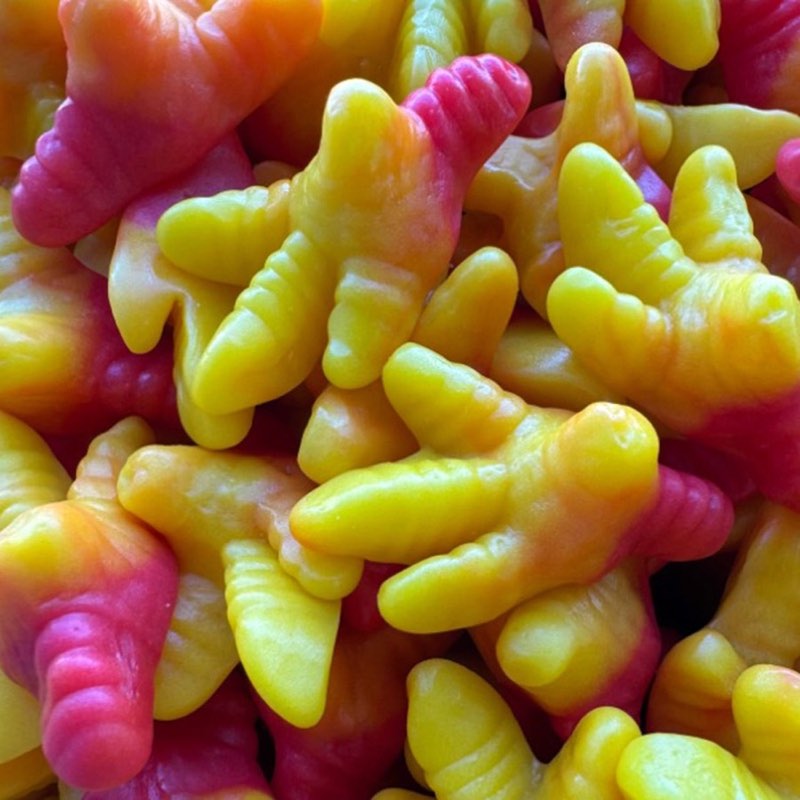
Tip a few out onto your palm and the first thing you notice is that these are a shape you have to look at twice. Each sweet is a moulded chicken foot — toes splayed forward, a little spur set behind, the whole thing cast in one clean piece of orange jelly. They are not subtle and they are not trying to be. Sweets shaped like animal parts have been a fixture of the counter for as long as there has been a counter, and Vidal Chicken Feet sit squarely in that tradition: a joke you can eat, sold by weight, at £5.49 for 250 g.
Colour first, because it is the thing that carries across a room. The pack lists these as orange, and it is an honest orange rather than a pastel one — the sort that reads clearly through a glass jar, against a wooden bowl, or in the low light of a lounge with the telly on. Because every foot is the same colour throughout rather than being a two-tone moulding, a heap of them in a dish has an unusual visual consistency. You get shape variation without colour variation, which is a rarer thing than it sounds and one of the reasons these hold together so well as a single-line bowl rather than needing company.
The full guide to Vidal Chicken Feet
5,553 words on how it eats, who it suits, how to serve it and what to put beside it.
The first handful, and what your fingers tell you before your tongue does
In the hand they behave the way a proper moulded jelly should. There is weight to each one, a slight tack to the surface that stops them skittering off the edge of a plate, and enough structure in the toes that they do not deform when you pick one up between finger and thumb. Grab a fistful and they will press together a little at the edges; shake them loose and they separate again without leaving half a foot behind. That is the practical test of a well-made jelly of this size, and it matters more than it seems when you are passing a bowl around.
The bite is where they earn their place. The first press of the teeth meets resistance — a jelly with a bit of backbone to it, not a soft foam that collapses on contact. Then it gives, and the chew that follows is the long, working kind rather than the quick one. You are not finished with a chicken foot in two seconds. The toes are thinner than the body of the foot, so the sweet actually eats in stages: the toes yield first, then you are working through the thicker heel, and that difference in thickness gives a single sweet two distinct textures. Most jellies of this size are uniform. This one is not, and once you have noticed it you cannot un-notice it.
The flavour is a general fruit note, listed simply as fruit on the pack, and it arrives in the way fruit jellies tend to — not immediately on contact, but a beat after the chew begins, once the surface has warmed and the jelly has started to break down. It builds through the middle of the chew and then tails off rather than stopping abruptly, which is why a single foot leaves you reaching for a second. Sweets that finish sharply tend to be self-limiting. This one does not finish sharply, and that shapes the whole way a bag of it gets eaten.
Who these are actually for
There are two obvious audiences and one less obvious one. The first is anybody buying for children who like sweets that are also a small performance. A chicken foot gets held up, waved about, offered to a sibling, and eaten toe by toe. That is not wasted time — it is the reason the sweet works. If you are filling a party bowl for an age group that finds a jelly bear slightly beneath them now, this is the step sideways that keeps them interested without stepping up into sour territory.
The second is the adult who likes a long chew. There is a real and under-served appetite among grown-up sweet buyers for something that lasts, and firm moulded jellies are the answer to it far more often than soft gums or foams are. If you are the sort of person who keeps a jar on the desk and takes one sweet an hour rather than a handful at nine in the evening, the chew length here is doing exactly what you want it to.
The less obvious audience is anyone building a bowl, a jar or a stall where the sweets need to be recognisable from a distance. Novelty shapes photograph, they get commented on, and they give people something to say when they take one. If you have ever set out a bowl of perfectly good but unremarkable jellies at a gathering and watched it go down slowly, the problem was probably not the flavour. It was that nothing on the table asked to be picked up. These ask.
Who they are not for: anyone after heat, sourness or fizz. There is none of that here, and if that is the shopping trip you are on, the Barnett's Mega Sour Fruits Candy Bags 104g at £3.99 are the small, cheap way to find out how much sour you actually want, and Dulce Plus Sour Strawberry Rings at the same £5.49 as these will scratch it at full bag size. Equally, if you want something that dissolves rather than chews, this is the wrong texture entirely and you are better served on the softer end of our loose sweets shelf.
Film night, controller in hand: how a firm jelly behaves when you are not paying attention to it
Snacking while you are watching or playing is a genuinely different activity from snacking at a table, and very few sweets are chosen with that in mind. It is worth being specific about what the job actually demands, because once you list it out, some sweets are obviously right and some are obviously wrong, and shape has more to do with it than flavour.
Pacing — the sweet has to slow you down for you
The failure mode of a film-night sweet is that the bag is empty before the second act. Soft, small, quick-dissolving sweets disappear at a rate your hand sets rather than your appetite, because there is no natural pause between one and the next. A long chew inserts that pause automatically. With these, the time between picking up one foot and being ready for the next is measured in a proper mouthful of chewing, and across a two-hour film that difference compounds into something you can see in the bowl.
That matters practically. A 250 g bag put out for two people at the start of a film will still have something in it at the end, which is the entire point of putting a bowl out rather than a plate. It also means you can portion sensibly — decant a smaller amount into a dish, leave the rest in the kitchen, and the pacing of the sweet itself does the rest of the work of making that portion feel sufficient.
Mess — the quiet criterion nobody lists but everybody cares about
Here is the honest assessment. These are not powdered, not sugar-dusted and not coated, so there is nothing to shed onto a sofa, a keyboard or a controller. That puts them well ahead of anything fizzy or sanded, which is a real consideration if you have ever tried to get sour powder out of the gaps in a keyboard. What you do get is the light surface tack that all moulded jellies have, which means fingers are slightly sticky after a few and will want a wipe before you go back to a controller or a laptop.
The practical fix is the one that has always worked: a small bowl for the sweets, a folded piece of kitchen roll next to it, and the discipline of taking two at a time rather than grazing with one hand while the other is occupied. If you are eating and playing simultaneously rather than eating between rounds, a cocktail stick or a small fork turns this into a genuinely clean-handed snack, which sounds fussy until the first time you do it and realise you have stopped thinking about your fingers entirely.
Compared to the alternatives, that is a good position. Chocolate is worse in a warm room. Anything with a sugar coating sheds. Belts and laces, like the Vidal Strawberry Belts or the Vidal Rainbow Belts at £5.49, are excellent sweets but they are a two-handed proposition, because a belt has to be fed into the mouth rather than dropped in. If your hands are busy, a single-piece jelly you can pick up and pop is the right format and a long strip is the wrong one.
Shareability — one bowl, several people, no negotiation
A shared bowl works when nobody has to think about what they are taking. That rules out anything with mixed flavours where people start hunting for their favourite colour and leaving the rest, which is how you end up with a bowl containing nothing but the green ones at midnight. Single-flavour, single-colour lines like these sidestep the problem completely: every foot is the same, so there is no rummaging, no picking over, and no awkward last-one-in-the-bowl standoff over the good ones.
That is a genuine argument for buying one line in quantity rather than a mixed bag for group snacking, and it runs against the instinct most people have. If you want variety on a film night, the better structure is two or three separate bowls of distinct single lines rather than one bowl of everything — put these next to something with a very different texture, and let people choose by walking to a different bowl rather than by digging. The Taveners Fruit Pastilles at £5.49 make a good second bowl for exactly this reason: also fruit, also a chew, but a different one, so the contrast is real without being jarring.
Noise, which is a real thing and nobody mentions it
Anything crunchy is a problem when the room is quiet and the film is not. Hard sweets clatter against teeth, crisps are out of the question, and even a rustling bag is enough to get you a look during a tense scene. A soft-surfaced jelly in a ceramic bowl is about as quiet as snacking gets. You can take one, eat it and go back to the film without anyone else in the room registering that you did. That is not a small advantage if you watch films with people who take them seriously.
The gaming-specific case
Sessions are longer than films and the hands are more occupied, so the calculation shifts. Long chew is even more valuable, because it stretches a given quantity across a longer stretch of time. Single-piece format matters more, because you cannot manage a belt and a controller. And the absence of coating goes from a nice-to-have to close to a requirement. Set a bowl to one side rather than in front of you, take from it between rounds rather than during them, and a 250 g bag covers an evening for two comfortably. If the session is a regular fixture and the bowl is going to be refilled weekly, the maths in the sizing section below is where you should be looking, because the jump to 500 g is the cheapest extra sweets in the range.
Which sweet counter these belong to
Every sweet carries a period with it, and part of the pleasure of a shop like this is recognising which one. Not everything in the range reads the same way: some lines feel contemporary, some feel like the supermarket, and some feel unmistakably like a counter with a scoop, a set of scales and a row of jars behind glass. Chicken feet belong to that last group, and it is worth unpacking why, because the reasons are structural rather than sentimental.
The logic of the novelty mould
A sweet shaped like an animal foot only makes sense in a shop where sweets are sold loose, by weight, from an open display. In that setting the shape is the advertising. There is no printed pack to do the work, no character on the front, no television campaign behind it — there is a jar, and inside the jar is something odd enough that a customer points at it. That is the whole marketing plan, and it is why the classic loose-sweet range is so full of shapes that make no sense on a supermarket shelf: false teeth, fried eggs, milk bottles, cola bottles, babies, bones, brains, feet.
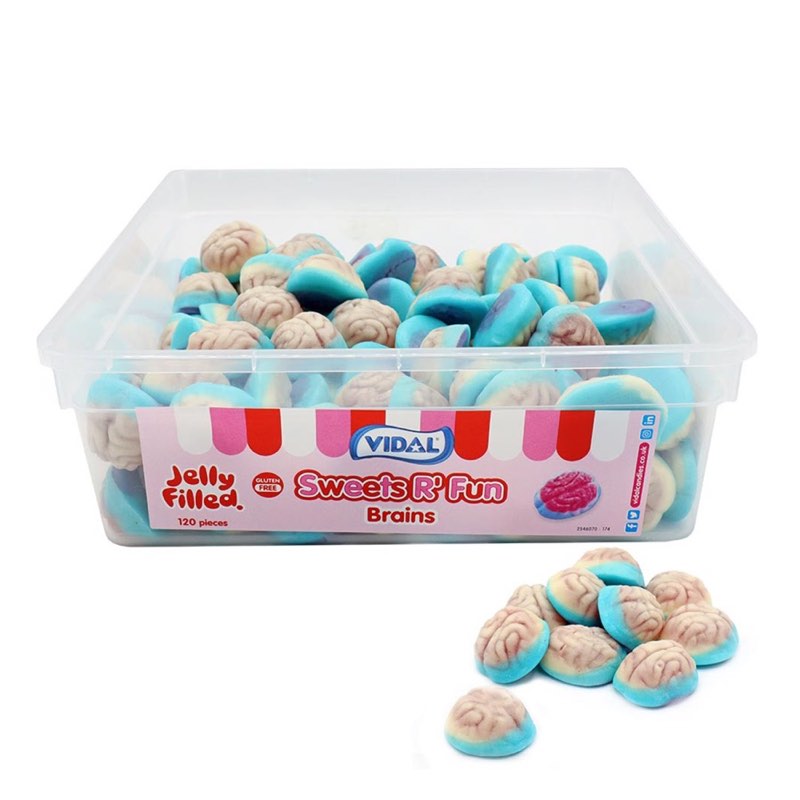
You can still see that logic working today. Pick almost anything out of the loose sweets aisle and the shapes are doing the job that packaging does elsewhere. The Vidal Jelly Filled Brains at £7.99 are the same instinct taken further — something anatomically unlikely, rendered in jelly, sold by the scoop. The shape is the reason you noticed it, and the shape is the reason you will mention it to somebody else.
The generational split you can watch happen at a party
Put a bowl of these out at a gathering with a wide age range and you can more or less date people by their reaction. Anyone who grew up buying sweets in ten-pence mixtures from a counter picks one up without comment, because novelty shapes were simply what sweets were. Anyone whose sweet-buying happened in the era of branded multipacks tends to laugh first and then eat. And children, reliably, go straight for them over anything conventionally shaped in the same bowl, because to them the whole category of "sweet shaped like a thing" is still novel and unspent.
That last point is the useful one if you are buying for a mixed group. Conventional shapes are the safe choice and the novelty shapes are the memorable one, and a table with only safe choices on it is a table nobody talks about. You do not need much of the novelty to do the job — a single bowl among three or four is plenty. The rest can be as ordinary as you like.
Why the loose format survived when so much else did not
The interesting part of the nostalgia is not that people remember these sweets; it is that the format itself never actually went away. Selling by weight persists because it does something no pre-packed bag can: it lets the customer decide the quantity and the mixture. You can buy 250 g to try, or 2 kg because you are running a stall, and the sweet is the same sweet. That flexibility is the reason the scoop-and-scales model outlived the shops it was invented in, and it is why a modern range still runs from a small bag to a two-kilo one rather than picking a single size and sticking to it.
It also means a shop's personality shows in its shelf rather than its branding. Look at what sits alongside these — the Kingsway Black & Raspberry Berries at £5.49, the Barratt Fruit Salad Chews at the same price, the Sweetzone Orange & Lemon Slices Tub 800g at £7.99 — and you are looking at several decades of counter fixtures sitting side by side without anyone pretending one of them is new. That is what a sweet shop shelf is for. If you want to browse it by maker rather than by shape, the nineteen lines we stock from Vidal and the Kingsway shelf are both worth an unhurried scroll, as is everything we carry from Haribo.
Nostalgia is not a reason to buy badly
One honest caveat. Sweets bought purely on memory have a habit of disappointing, because the memory is usually of the context rather than the confection — the walk to the shop, the coins counted out, the paper bag. The way to avoid that is to buy a small bag first and see whether you actually like the sweet as a sweet. At £5.49 for 250 g, that is an inexpensive experiment, and the pricing structure means you lose very little by starting small and scaling up later if it lands.
Where the fruit note sits, and what it does and does not do
The flavour listing here is simply fruit, which is the broad family rather than a specific one, and it is worth saying what that family means in practice for a moulded jelly like this. Fruit-flavoured jellies at this end of the market are built to be rounded rather than pointed. The note is present from early in the chew, it sits in the middle of the palate rather than at the front or the back, and it does not spike. You are not going to get the sharp top edge of a citrus line or the slow dark finish of a liquorice one. What you get is a straightforward, easy-going fruit character that works in company.
That has a direct consequence for how you use these in a mix. Rounded fruit notes are connective tissue. They sit happily next to almost anything, they do not fight with a sour line, and they stop a bowl of strong flavours from becoming exhausting. If you are building a spread and you have two or three assertive items on it, a rounded fruit jelly is the thing that makes the whole set work rather than the thing anyone remembers individually — and both roles are necessary. Browse fruit-flavoured sweets across the shop and you will find well over a hundred lines doing some version of that job, which tells you how much the category relies on it.
Within the fruit family, the useful distinctions are texture and intensity rather than named fruits. These sit at the firm end for texture and the moderate end for intensity. For a firmer, more resistant chew in the same family, the fruit pastilles are the obvious comparison and a fair one. For something markedly softer and more yielding at the same flavour intensity, look at the gummy end of the jelly shelf. For the same fruit family with a sour edge bolted on, the Swizzels Sour Shooting Stars Gums Squashies 100g at £1.29 are a cheap way to taste the difference before you commit to a big bag of anything.
Building a bowl, a jar or a mix around them
These are a strong anchor line rather than a supporting one, for three reasons: the shape carries the display, the colour is consistent, and the chew length sets the pace of the whole bowl. Build outwards from them rather than slotting them in as an afterthought.
The principle that works best is to vary texture first and flavour second. Most people do it the other way round, end up with six fruit flavours in six identical textures, and wonder why the mix feels flat. If your anchor is a firm one-piece chew, the natural partners are something soft, something with a different mouthfeel entirely, and something small and quick to act as a palate reset between the slower items.
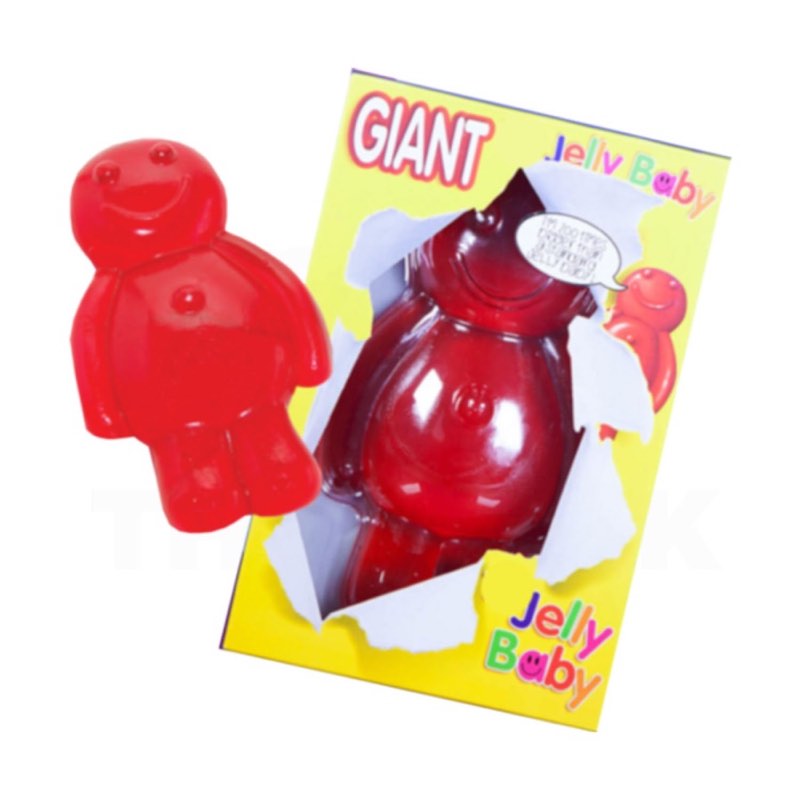
- For the soft contrast, the 800 g Giant Jelly Baby Box at £11.99 is the obvious move — same broad family, dramatically different scale and softness, and the colour is selected at random so the bowl gets variety you did not have to plan.
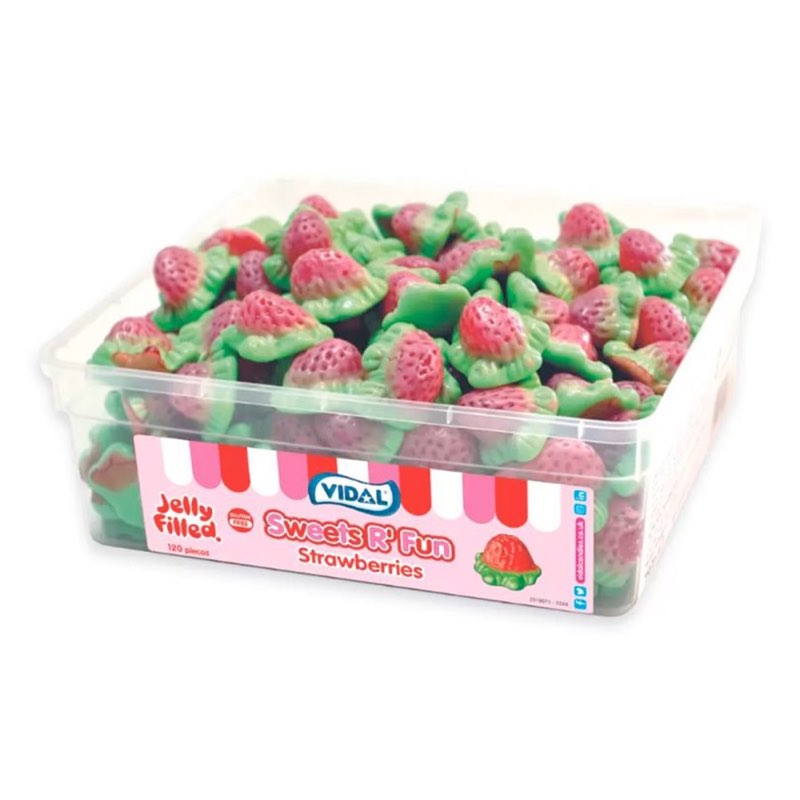
- For a different mouthfeel, the Vidal Jelly Filled Strawberries Tub at £7.99 gives you a filled centre rather than a solid one, which changes the whole rhythm of the bite.
- For the small, quick reset, the Shades by Niko The Originals Bag at £1.99 is cheap enough to include without thinking about it.
- For a ring shape that sits well against a solid moulded one, Haribo Friendship Rings 480g at £8.99 give you a hollow centre and a generous bag.
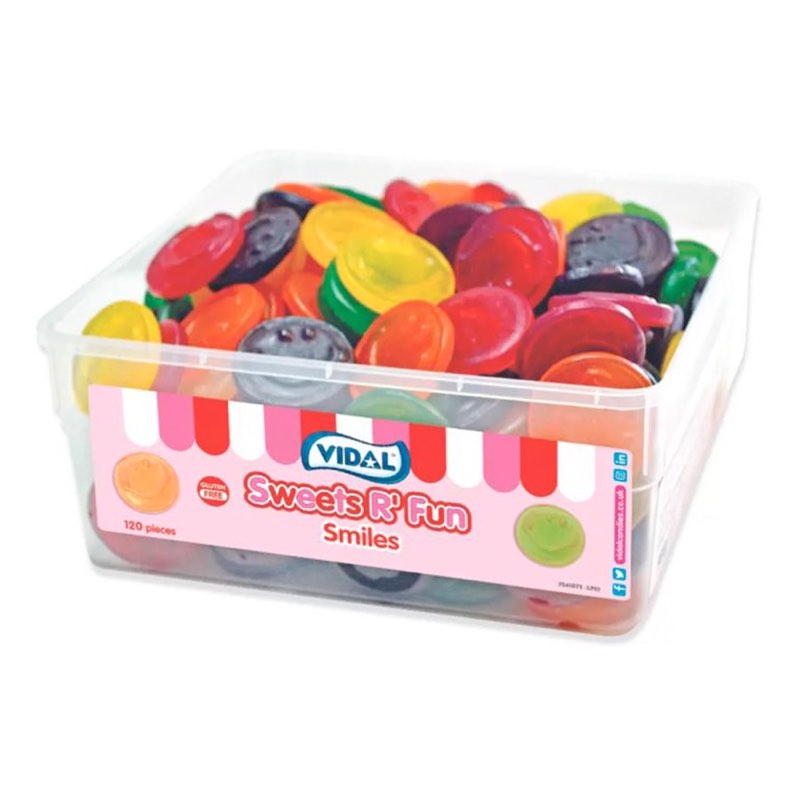
- And for a genuine smile-shaped crowd-pleaser to round the set out, the Vidal Happy Smiles Tub at £7.99 keeps the novelty-shape theme running without repeating the format.
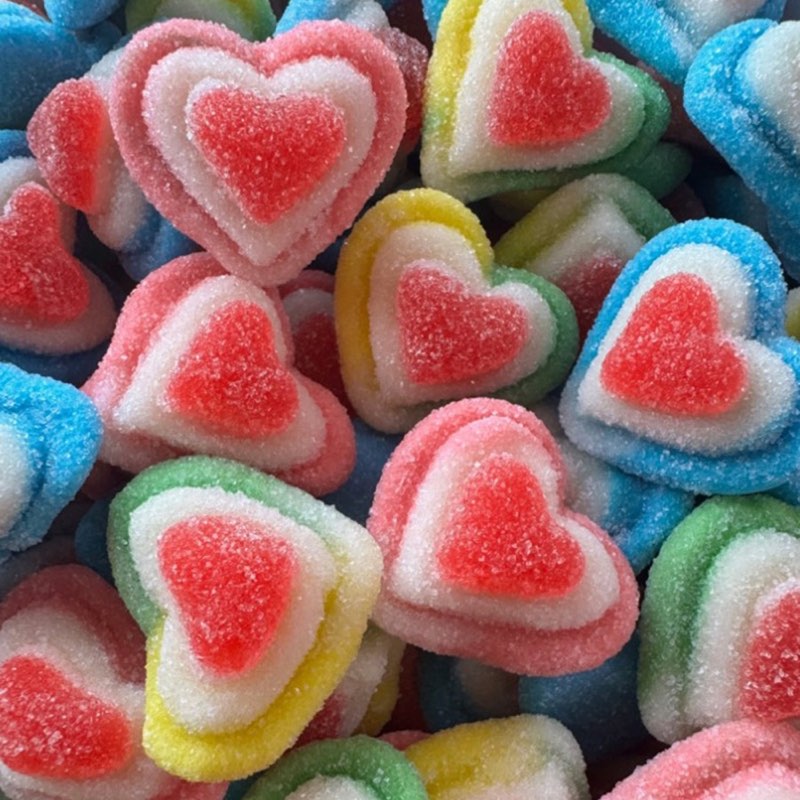
- If the bowl is for an occasion that wants a softer visual register than a foot, Vidal 3D Triple Hearts at the same £5.49 are the counterweight — a moulded shape from the same maker, aimed squarely in the opposite direction, and a useful thing to have in reserve for a table that is not meant to be ghoulish.
If you would rather not assemble it yourself, our pick and mix range does the same job with the decisions already made, and the mixed pouches there are a reasonable way to discover which textures you gravitate towards before you start buying single lines by the kilo.
One assembly note worth having. If you are making up bowls or bags in advance, keep firm jellies and anything sugar-coated apart until the last moment. Coated sweets shed onto tacky surfaces and the result is a chicken foot wearing a thin grey dusting of somebody else's sugar. Separate containers until serving, combined at the table, is the whole trick.
Occasions where the shape is the point
Halloween and anything ghoulish. This is the obvious one. A bowl of orange feet reads as appropriately grim from across a room and needs no explanation, and orange is already the colour of the season. Sit them next to the filled brains and you have a table that does the theme without anybody having to buy a single plastic decoration.
Children's parties for the seven-and-up bracket. Younger children go for colour; slightly older ones go for anything faintly gross, and stay loyal to it for several years. These land precisely in that window. Put them in a clear jar rather than an opaque bowl so the shape is visible before anyone reaches in.
Film nights and long gaming sessions. Covered at length above, and the short version is that the format, the pacing and the lack of coating all point the same way.
Stalls, fêtes and fundraisers. Novelty shapes sell themselves at a table where you cannot talk to everyone who walks past. The 2 kg size at £28.99 exists for exactly this, and works out at the lowest unit price in the range.
Gifts and hampers. A single line of something odd makes a better small gift than a generic assortment, because it is a specific choice rather than a default one. Decant into a clip-top jar, add one contrasting line, and you have something that looks considered. Pair with a strong second line from candy and chocolate if you want the hamper to span more than one category.
Everyday jar-on-the-side. Worth mentioning because it is the most common use and the least discussed. A 250 g bag decanted into a lidded jar is a fortnight or so of small daily treats for one person, and the long chew makes a small portion feel like a proper one.
Sizes, prices and what you actually get for the money
The standard bag is 250 g at £5.49, which is £2.20 per 100 g. That is the try-it price. What happens above it is more interesting than the headline, and it is worth reading the last column of this table before you decide.
| Size | Price | Per 100 g | What the step up costs |
|---|---|---|---|
| 250 g | £5.49 | £2.20 | — |
| 500 g | £9.99 | £2.00 | +250 g for £4.50 |
| 750 g | £12.99 | £1.73 | +250 g for £3.00 |
| 1 kg | £16.49 | £1.65 | +250 g for £3.50 |
| 2 kg | £28.99 | £1.45 | +1 kg for £12.50 |
The sweet spot in that table is the 750 g. Going from 500 g to 750 g adds a quarter of a kilo for £3.00, which is the cheapest 250 g of chicken feet available anywhere in the range — cheaper than the step before it and cheaper than the step after it. If you already know you want more than half a kilo, there is very little reason to stop at 500 g.
At the top, the 2 kg at £28.99 brings you to £1.45 per 100 g, a third off the unit price of the small bag. That is a genuine saving but it is also eight times the standard bag, and two kilos of anything needs a reason behind it — a party, a stall, a school event, a jar you are committing to refilling for months. Buy it because you have the occasion, not because the per-kilo figure is attractive in isolation.
For portioning, think in handfuls. A 25 g portion is a small after-dinner treat and a 50 g portion is what you would have been handed across a counter. On that basis the 250 g bag is ten small portions or five counter-sized ones; the 1 kg is forty small or twenty large; the 2 kg is eighty or forty. For a party, the rough planning figure most people land on is 40 to 60 g of sweets per guest across a whole table of several lines, which puts a single 750 g bag at somewhere between twelve and eighteen people's worth as part of a wider spread.
Keeping them in good condition
Firm jellies are among the more forgiving things in a sweet cupboard, but they have two enemies and both are easy to manage.
The first is warmth. Heat softens a moulded jelly, and a softened jelly loses the very thing that makes this one worth buying — the resistance in the first bite and the distinct difference between the toes and the heel. Keep them out of direct sun, off a windowsill, and away from the top of anything that gives off heat. A cool cupboard is ideal. A fridge is not necessary and is arguably counterproductive, because chilled jellies come out harder than intended and then sweat when they warm back up.
The second is air. Left open, jellies dry at the surface and the outside goes leathery while the inside stays soft, which is an odd and unsatisfying combination. Decant into an airtight tub or a jar with a proper seal as soon as you open the bag. If you have bought 1 kg or 2 kg, split it: keep a working jar of a few hundred grams and leave the rest sealed, rather than opening into one enormous container that you then have to work through before it dries.
Do not store them touching anything sugar-coated, fizzy or powdered. The tack on the jelly surface will lift powder off its neighbours, and you will end up with both lines slightly wrong. Separate containers, always.
Choosing between the sizes
Buy 250 g if you have never had these, if you are testing them on somebody else, or if you want a single jar's worth for the desk. Nothing about the range punishes you for starting here.
Buy 500 g if you have a specific occasion with a handful of people, or if you already know you like them and you want a bowl that lasts more than one evening.
Buy 750 g if you have any intention of going past half a kilo at all. As the table shows, this is the best-value step in the range and it is not close.
Buy 1 kg if these are going into a standing jar you refill, or if you are catering a party where this is one of two or three main lines.
Buy 2 kg if you are running a stall, a fête, a wedding table or a very large event — or if you are splitting the order with somebody else, which is the most sensible way for a household to reach the bottom unit price without committing to two kilos alone.
Finding your way around from here
This line sits on four shelves, and each one leads somewhere different. It is on our jellies alongside the other moulded and cut lines, on the fruit flavour shelf with the largest group of products in the shop, on the Vidal maker page with the rest of that range, and on the loose sweets shelf where everything sold by weight lives. If you are browsing rather than buying something specific, the loose sweets shelf is the right place to start, because that is where the novelty shapes cluster.
From there, the two useful sideways steps are by texture and by maker. By texture, the gummy and jelly shelves overlap heavily and are worth reading together. By maker, the brand pages let you see a whole range's house style at once, which is genuinely informative — makers have consistent preferences about firmness and flavour intensity, and once you have found one whose style suits you, the fastest way to find your next three purchases is to read their shelf rather than to search by flavour.
If none of that is what you are after, the full sweet shop is the top of the tree and everything is reachable from it.
Questions people actually ask about these
How firm are they compared to a normal jelly sweet?
Firmer than a standard soft gummy and noticeably more resistant than a jelly baby, but not hard. The first bite meets real resistance before it gives, and the chew that follows is a working one rather than a quick one. If your benchmark is a foam or a mallow, these will feel like a substantial step up in firmness. If your benchmark is a fruit pastille, these are in similar territory, though the thinner toes give way faster than the body does.
Are they suitable for young children?
Sweets are a treat rather than everyday food, and whole gummies and small hard sweets are a choking risk for young children, so they should be supervised while eating them. For very young children, cutting a moulded sweet of this shape into pieces is the sensible approach. Older children manage them without issue and tend to eat them toe by toe anyway.
I have an allergy — what should I check?
Check the manufacturer's packaging on arrival before eating. That is the only reliable source for allergen information on any line we sell, and it travels with the product itself, so it is always current for the batch you have been sent.
Is it the same sweet in the bigger bags, or a different size of sweet?
Same sweet. The size options on this page are quantities of the identical product, not different mouldings. A 2 kg bag is simply eight times the sweets of the 250 g bag, which is why the per-100 g figures in the table are a straight comparison rather than an approximation.
What flavour are they, exactly?
They are listed as fruit, which is the flavour family rather than a single named fruit. In practice that means a rounded, middle-of-the-palate fruit note that builds through the chew and fades slowly rather than a sharp, identifiable single-fruit hit. We do not list a more specific flavour than the one on the pack.
Will they stick together in the bag?
They press together a little under their own weight, as all moulded jellies do, and separate again with a shake. Warmth makes it more likely, so how you store them matters more than how they were packed. Keep them cool and in an airtight tub and you will not have a problem; leave the bag open on a sunny worktop for a week and you might.
How many sweets are in a 250 g bag?
We do not publish a piece count, because loose sweets are sold by weight rather than by number and the count varies between batches. Think in weight instead: 250 g is roughly five counter-sized 50 g portions or ten small 25 g ones, which is the more useful way to plan a bowl or a party anyway.
Are these too odd for a children's party, or is that the point?
That is the point. Slightly grim shapes are reliably the first bowl emptied at any party for children above about seven, and the reaction to them is part of what people remember. If you are worried, do what most people do: put out one bowl of these and two bowls of something conventional, and let the table sort itself out.
Do they work in a pick and mix, or are they better on their own?
Both, but they do different jobs. On their own they are an anchor — one shape, one colour, one pace, and no rummaging. In a mix they are the piece that gives the bowl its visual interest, and you need less of them than you would think. If you are assembling a mix, treat them as roughly a fifth of it and build softer, smaller lines around them.
What goes best alongside them?
Something soft and something small. The soft contrast stops the bowl feeling uniformly chewy, and the small item gives people something quick to take between the slower ones. A giant jelly baby and a small fruit chew cover both jobs. What does not work well is a second firm moulded jelly of similar size, because the two lines then compete for the same role and the bowl reads as one thing rather than two.
Can I buy them as a gift without it looking like an afterthought?
Yes, if you decant. The presentation trick is a clip-top glass jar and a single contrasting line rather than a bag handed over as it arrived. A jar of one deliberately odd sweet reads as a choice; a mixed bag reads as a default. It is the same sweets either way, and the difference is entirely in the container.
Are they in stock?
Yes, this line is in stock at all five sizes at the time of writing, and the stock position shown on this page is the one to trust rather than anything written in the description.
The short version
A firm, orange, one-piece jelly in a shape that gets a reaction, sold by weight from £5.49 for 250 g up to £28.99 for 2 kg. The chew is long enough to pace a film night, the surface is clean enough not to wreck a controller, and the shape does the work that packaging does elsewhere. Buy the small bag to find out whether you like it, and if you do, skip straight past 500 g to the 750 g, because that is where the range is cheapest. Then put it in a clear jar, because the whole point of a sweet shaped like a chicken foot is that somebody sees it before they eat it.
More from Vidal
More jelly sweets
More fruit sweets
Where this sits
Vidal Chicken Feet appears on these shelves. Browse them, or jump to something nearby.
You might also like