Home / Loose Sweets / Giant Jelly Baby Box 800g (Colour selected at random)
Giant Candy Co · 800g
Read the full guide
Giant Jelly Baby Box 800g (Colour selected at random)
£11.99
✔ In stock — ready to ship
Fresh stock
Free over £20
Same-day dispatch
Secure checkout
Most sweets are bought to be one of several things on a table. This one is bought to be the thing everything else is arranged around. An 800 g jelly baby is not a bag you open and graze from — it is a centrepiece, and the sensible way to shop for it is to decide what is going around it before you decide anything else. So that is where this page starts: not with the sweet, but with the spread.
The basic build is simple. You want the giant in the middle, on a board or a plate rather than in a bowl, because a bowl hides it and the whole point is that people see it and react. Then you want three or four supporting lines in smaller bowls set around it, chosen so that no two of them do the same job. One should be small and scatterable, one should be chewy, one should be sharp, and one should be something with a different shape language entirely — rings, ribbons, slices, anything that is not another soft fruit jelly. Get that spread of jobs right and a table of five things feels like ten.
The full guide to Giant Jelly Baby Box 800g (Colour selected at random)
5,498 words on how it eats, who it suits, how to serve it and what to put beside it.
Start with the bowl it goes in the middle of
For the scatterable role, a bag of Taveners Fruit Pastilles at £5.49 is the obvious pick, because pastilles are small, they sit flat, and they fill the gaps between bowls without asking for attention. They are also the closest thing on the table to a neutral: fruit-flavoured, familiar, and unlikely to be the thing anyone objects to. Scatter a handful directly onto the board around the base of the giant and the whole arrangement stops looking like a single sweet on an empty plate.
For chew, Barratt Fruit Salad Chews — also £5.49 — bring a completely different mouthfeel into the mix. A jelly gives way and dissolves; a chew resists, then sticks, then keeps going. Having both on a table means people can pick according to how much work they want to do, and it stops the spread reading as one texture in five colours. If you want the same chew idea in a smaller, cheaper unit for a child's party bag rather than the main table, a Swizzels Sour Shooting Stars Gums Squashies 100g bag at £1.29 does the job at a fraction of the outlay.
The sharp slot is where you get the most contrast for the least money. A giant jelly baby is sweet and mellow from first bite to last; put something with a sour edge next to it and both taste more of themselves. Barnett's Mega Sour Fruits Candy Bags 104g at £3.99 is the straightforward answer if you want the sourness obvious and up front. If you would rather it be a note than a shout, Dulce Plus Sour Strawberry Rings at £5.49 give you a ring shape, a strawberry flavour and a gentler sour coating, which is easier to put in front of a mixed-age room.
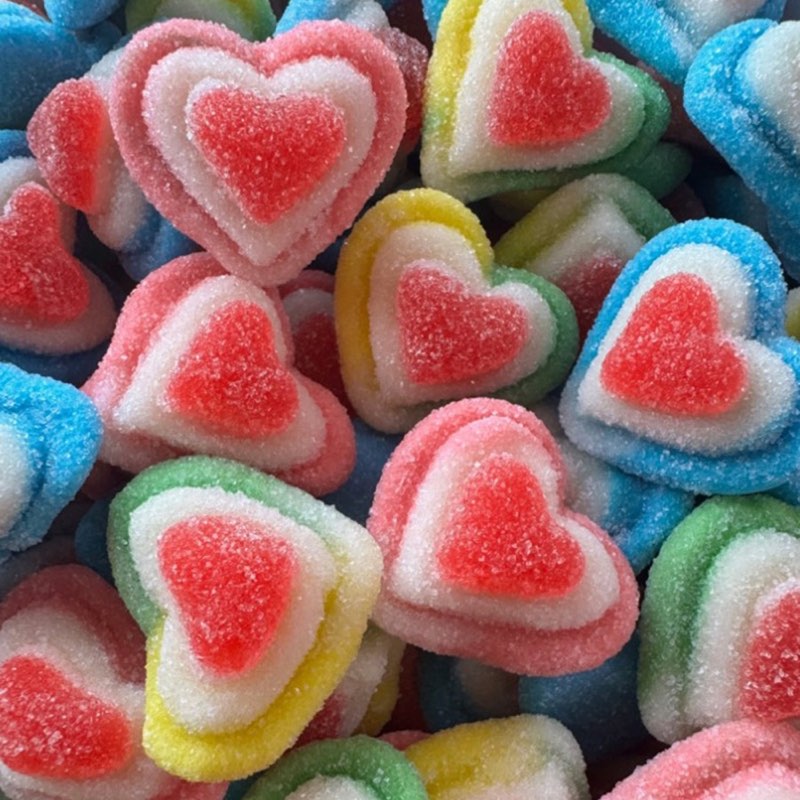
The fourth bowl is the shape bowl, and this is the one people forget. Haribo Friendship Rings 480g at £8.99 is a genuinely large bag of a sweet built in a ring, which reads as a pattern on a table rather than as a pile. Vidal 3D Triple Hearts at £5.49 do something similar with a raised, layered heart shape that catches light from the side. Either one sitting next to a single enormous jelly baby gives the eye somewhere else to go, and the giant benefits from the comparison — a big thing looks bigger when there are small, detailed things beside it.
If you would rather build the whole thing by hand and pick every component yourself, the Pick & Mix range is set up for exactly that, and the giant works as the anchor purchase you build a bag around rather than something you drop into the bag itself. Plenty of shoppers do it the other way round — they come for the mix, see the giant, and it becomes the reason the table has a shape at all.
One more combination worth naming, because it is the cheapest upgrade on this list. Shades by Niko The Originals Bag is £1.99, which makes it the kind of thing you add without thinking about it, and a couple of small, inexpensive bags scattered through a spread does more for the look of a table than one more expensive item would. Sweets on a table are a visual problem as much as a flavour problem, and small units solve visual problems.
What actually turns up in the box
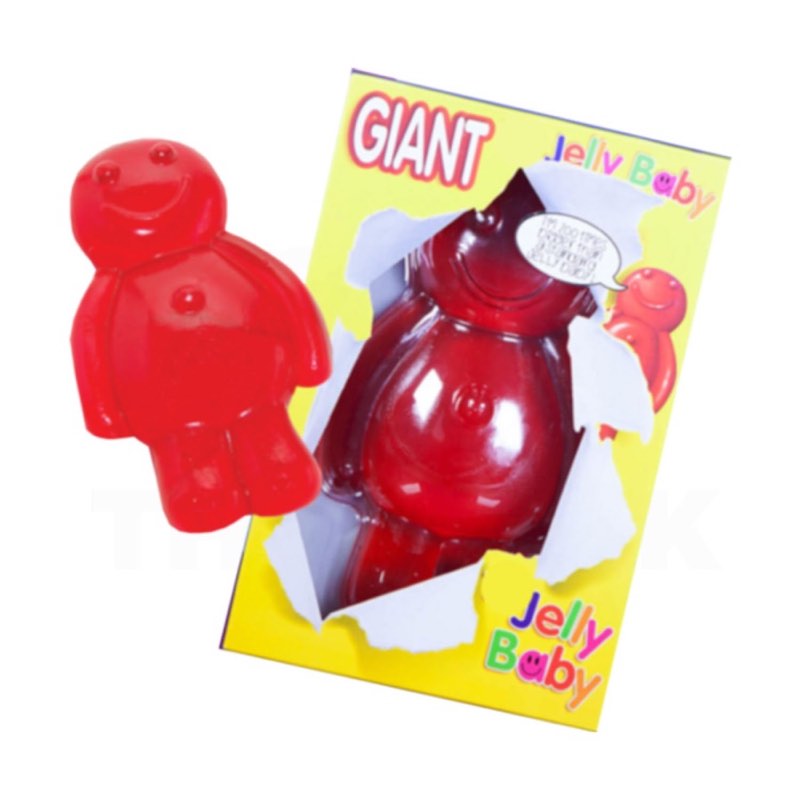
It arrives as a box, and inside the box is 800 g of jelly baby — a familiar shape scaled up to a size that changes what it is for. That is the whole trick of the Giant Candy Co line, and it is worth being clear about what that means in practice, because the difference between a normal jelly baby and this is not really a difference of degree. A normal one is a mouthful. This is an object. You do not put it in your pocket. You put it down somewhere and people walk over to look at it.
The listing title carries an important caveat and we want it in front of you before you buy rather than after: colour selected at random. Our catalogue records the colour for this line as Multi Coloured, which is to say the line runs across a spread of colours, but you do not get to choose which one lands in your box. If you are buying for a themed table and the colour matters to you — a particular birthday scheme, a particular set of balloons — that is the single most important sentence on this page. Buy it because you want a giant jelly baby, not because you want a specific shade of one. Plenty of people order it precisely because the reveal is part of the fun, and opening the box in front of the person it is for turns the randomness into a small event rather than a disappointment.
The flavour is listed simply as fruit, and the sweet type as jelly. That is the factual picture in full, and we are not going to dress it up with detail we cannot stand behind. What we can tell you about is the experience of the thing, which is where the interest actually lies.
Picking it up, cutting it, eating it
The first impression is weight. Eight hundred grams is not far off a bag of sugar, and a jelly at that weight has a density that your hands are not expecting from something shaped like a sweet. You lift it with two hands the first time, out of caution, and then you realise one is enough and you feel slightly silly. It has give — press a thumb into it and the surface yields, then pushes back, the same way a normal jelly baby does under a fingernail, just on a scale where you can watch it happen.
The surface reads as slightly matte rather than glassy, and it picks up light along the curves of the head and the rounded body while going deeper in colour in the folds. Photographed, it looks like a prop. Handed to someone, it stops being a prop about four seconds in, when they squeeze it.
Nobody eats 800 g of jelly in one sitting, and nothing about this product expects you to. The way it actually gets eaten is cut. A large kitchen knife works better than a small one, and a wet blade works better than a dry one — run the knife under the cold tap between cuts and it stops dragging. Slice across the body rather than trying to saw down through the head, and you will get thick discs that come away cleanly. Each disc can then be quartered into pieces about the size of a normal sweet, which is the point at which the giant stops being a spectacle and becomes something a room can share.
Eaten in those pieces, the texture is the familiar one: an initial firmness at the surface, then a softer, slower chew underneath, then the whole thing going pliable and warm in the mouth and releasing its fruit flavour steadily rather than all at once. Because a cut piece has exposed faces rather than a sealed skin all the way round, freshly cut pieces feel a touch softer and more yielding than the outside of the uncut giant does — which is a small argument for cutting it shortly before you serve it rather than the night before.
The flavour arrives gently. This is not a sweet that announces itself on contact. It builds across the first few seconds of chewing, sits at a steady fruit note through the middle of the mouthful, and fades without leaving much of a coating behind. That gentleness is exactly why it works as a centrepiece in a mixed room: it is the safe, generous thing in the middle, and the sharper, louder sweets around it are the ones doing the provoking.
What £11.99 for 800 g actually works out at
Novelty items have a reputation for being priced on the novelty rather than on the contents, so it is worth doing the arithmetic properly rather than assuming either way. At £11.99 for 800 g, this works out at £1.50 per 100 g. That is the number to carry around, and it is the number to compare against everything else you are thinking of putting on the same table.
Here is the same figure broken into the units people actually think in.
| Unit | What you get | What it costs |
|---|---|---|
| Per 100 g | A generous adult portion | £1.50 |
| Per 50 g piece | A paper-bag-sized handful | 75p |
| Per 25 g piece | A child's portion or a party-bag share | About 37p |
| Whole box | 800 g | £11.99 |
Read the box as portions and it changes shape completely. At 50 g a head — which is a real handful, not a token — an 800 g giant gives you sixteen servings. At 25 g, which is the right size when the giant is one of several things on a table rather than the only thing, you get thirty-two. Thirty-two shares for £11.99 is about 37p a person, and there is very little you can put in front of thirty-two people for 37p each that they will talk about afterwards.
That is the real argument for this product, and it is worth stating plainly because it cuts against the instinct. The instinct says a novelty giant is the expensive option. The maths says a single £11.99 purchase that feeds a room and provides the photograph is often cheaper than assembling the same quantity out of standard bags — and considerably cheaper than buying a separate decoration on top of the sweets.
Compare it across the shelf and the picture stays sensible. A Sweetzone Orange & Lemon Slices Tub 800g is £7.99 for the same 800 g, which is £1.00 per 100 g — cheaper per gram, and that is what you would expect, because it is a straightforward tub of loose sweets rather than a single moulded object. You are paying roughly £4 more for the giant, and what that £4 buys is the centrepiece effect, the reveal, and the fact that it needs no presentation beyond a board. Whether that is worth £4 to you depends entirely on the occasion, and we would rather you made that call with the numbers in front of you.
Run the same comparison against the standard bag prices on the loose shelf and the giant holds up better than you might guess. A great many of our loose lines sit at £5.49 a bag, which is where you will find Kingsway Black & Raspberry Berries among others. Two of those bags gets you to roughly the price of the giant, and gets you two flavours and two textures — a better result if you want variety, a worse result if you want an event. The honest summary is that the giant is not the value buy per gram and it is not meant to be; it is the value buy per unit of attention.
Planning quantities for a room
If you are catering rather than snacking, the planning number is 25 g to 50 g of sweets per person per hour across the whole table, not per item. So a room of twenty people at an afternoon party will get through something in the region of 500 g to 1 kg of sweets in total, spread across everything you put out. A single 800 g giant plus two or three supporting bags is therefore a properly catered table for twenty, with leftovers, rather than a table that runs dry an hour in.
Scale it down and the same logic works for a family of four across a fortnight. Cut a 100 g disc on a Friday, keep the rest wrapped, and the box becomes eight weekends of a shared treat rather than one afternoon of excess. That is the pattern we would actually recommend for a household buying it for themselves, and it is the one that makes the £11.99 feel like a sensible line in a weekly shop rather than a splurge.
Where the money goes if you buy badly
The two ways to waste money on a product like this are both avoidable. The first is buying it for a table where nobody wanted a spectacle, so it sits uncut next to bowls that people actually eat from — that is 800 g of jelly doing decorative work you could have done with a balloon. The second is cutting the whole thing up in advance and leaving it out all day, so the cut faces dry and the last third gets left. Cut what you expect to be eaten, keep the rest whole and wrapped, and the box goes the distance. Almost all the waste we hear about comes from over-cutting, not from over-buying.
Sending it to somebody: hampers, letterboxes and care parcels
The second thing this box is genuinely good at is being given away, and it is good at it for a reason that has nothing to do with flavour. A giant sweet is legible. The person opening it understands the joke immediately, they do not have to read anything, and they do not have to pretend. That is a rare quality in a gift and it is why a novelty line like this survives when far more sophisticated products do not.
For a hamper, the giant solves the hardest problem in hamper building, which is height and mass. Most hampers are assembled out of small, flat, similar-sized items and end up looking like a shopping basket with tissue paper in it. One large object in the centre gives the whole thing a structure: you build around it, you pack the small items into the gaps at the sides, and the lid closes on something that looks composed rather than collected. If you are assembling one, put the giant in first and everything else second — the other way round never works.
The supporting items in a sweet hamper should cover different formats so the recipient has a reason to keep going back. A tub gives you something that lives on a shelf and gets dipped into for weeks, which is where the other 800 g tub on the site earns its place. A large sharing bag gives you the middle of the hamper, which is what the 480 g bag of friendship rings is sized for. And a couple of small, cheap bags fill the corners and stop anything rattling. Three tiers of size, one of them enormous, and the hamper reads as deliberate.
Letterbox treats are the one gift format this product cannot do, and it would be dishonest not to say so. An 800 g boxed giant is not going through a letterbox and is not pretending to. If what you actually want is something small and flat to post to a friend having a bad week, buy small and buy several — a £1.29 bag of squashies and a couple of other slim bags in a padded envelope does that job better than any giant ever will. Use the giant when you can hand it over, or when you are sending a parcel that is going to need a courier anyway.
Teacher gifts are a slightly different calculation, and the giant is unusually well suited to them for one specific reason: it is obviously for sharing. A box of chocolates given to a teacher becomes a small awkwardness about whether to bring it to the staff room. An 800 g jelly baby is so plainly a communal object that it removes the question entirely. It goes on the staff room table, somebody cuts it up at break, and thirty people have a piece. If you are buying for the end of a school year and want it to feel generous rather than perfunctory, this is a stronger choice than its price suggests.
Care parcels — for a student, for someone in a new flat, for a friend working away — want one anchor item and several small ones, which is the hamper logic again on a smaller budget. The giant is the anchor. Around it, cheap and characterful beats expensive and worthy: a £1.99 bag of the Niko originals and a bag of chews do more for morale than a single premium item would. And because the giant needs cutting, it gives the recipient something to do with other people, which is the actual point of a care parcel sent to somebody who does not know many people yet.
Two practical notes on giving it. First, wrap the box rather than the sweet — the box is the protection and the surprise, and a giant jelly handed over bare has nowhere to go. Second, if the gift is for a child, hand it to the adult. That is not a safety warning so much as a logistics one: somebody with a knife needs to be in charge of it, and it is better if that is agreed in advance rather than negotiated at a party.
Gifting it for the colour you did not choose
Because the colour is selected at random, a gift built around this box should never be built around a colour scheme. If you are wrapping it for a themed party, choose wrapping and ribbon that work against any colour — brown paper and string, plain white, or a print busy enough that it does not clash. It sounds like a small thing, but it is the difference between the reveal being funny and the reveal being slightly flat because the pink one turned up for a green-themed table.
Where fruit jellies sit, and what pairs against them
Fruit is the broadest flavour family we stock — there are 161 lines under fruit-flavoured sweets — and that breadth is exactly why a plain fruit jelly is such a useful thing to own. It is the baseline against which everything else reads. Put a sour sweet next to it and the sour is sharper. Put a chew next to it and the chew feels more substantial. Put a foam or a mallow next to it and the difference in density is immediately obvious. A giant fruit jelly is, in effect, a reference point that people can eat.
Within the fruit family, the useful distinction for building a table is between the soft, rounded flavours and the bright, acidic ones. This giant sits firmly in the first group. To bring the second group in, you want something citrus or berry-forward with an edge — the strawberry ring format of the Dulce Plus rings handles the berry side, and the orange and lemon slices tub handles the citrus side. With one from each group plus the giant, a table covers the whole fruit spectrum without anybody having to think about it.
The other axis is texture, and this is where the jelly shelf is worth browsing properly. There are 27 lines on it, and they are not interchangeable: a pastille, a berry, a ring and a giant all behave differently in the mouth despite being nominally the same category. If you already know you like jellies and you are trying to widen the range at home rather than buy the same thing again, that shelf is the one to work through. The broader jelly and gummy aisle pulls in the firmer gummy textures alongside it, which is where you go if you want more chew and more resistance than a classic jelly gives.
Parties, film nights, and tables that need a focal point
A children's birthday party is the obvious use and the one it is best at. The giant gets carried in, it gets the reaction, and then it gets cut and distributed, which means it functions as both decoration and catering — two budget lines collapsed into one £11.99 purchase. Cut it after the reaction, not before, and keep the pieces going into paper bags or onto plates rather than back into a communal bowl.
For a film night it works differently, and honestly it works less well as a giant. Nobody wants to be the person sawing at an 800 g jelly baby in the dark. If film nights are your main use, cut a disc before you start, put it in a bowl in pieces, and keep the rest in the box. The advantage over a bag is that you control the portion in advance, which is the whole problem with sweets in front of a screen.
Office and staff-room tables are the underrated use. A giant that needs cutting creates a small event in a way that an open bag never does, and it lasts: 800 g in a shared kitchen will go over several days rather than a single afternoon, so the goodwill is spread out. Leave the knife with it and a note about helping yourself.
For seasonal tables — Christmas, Easter, a summer fête — the giant is the item that makes the table look planned. Around it, the useful addition is something that reads as traditional rather than modern, and the retro sweets shelf is where you find that. Old-fashioned shapes and a giant novelty sitting together is a combination that works on every age group in the room at once, which is not true of many sweet tables.
For a stall or fête, the giant is better used as the prize or the draw than as stock. Put it on the table as the thing that gets people to come over, sell the bags, and raffle the giant at the end. One box does more footfall work than £11.99 of anything else you could put on a trestle table.
Keeping it well once the box is open
An uncut giant is easy: leave it in its box, keep the box somewhere cool, dry and out of direct sunlight, and it will keep perfectly well until you want it. Warmth is the enemy, not because of anything dramatic, but because a large jelly left near a radiator or in a sunny window goes softer and tackier and loses the clean edge it has when it is cool. A cupboard away from the oven is all it needs.
Once it is cut, the rules change. Every cut face is an exposed surface, and exposed surfaces dry and firm up over a day or two. The fix is to press the cut face against the inside of the box or against a sheet of greaseproof paper, wrap the whole thing snugly, and keep it in an airtight container. Done properly, the remainder eats almost as well a week later as it did on the day. Done badly — left open on a plate under a tea towel — the outer millimetre goes leathery and the last portions are noticeably worse than the first.
Do not refrigerate it. A cold jelly goes firm and rubbery and the flavour flattens out; you lose the soft, yielding chew that is the whole reason to buy a jelly in the first place. If you have refrigerated it by accident, bring it back to room temperature for an hour before serving and most of it comes back.
If you are storing cut pieces alongside other sweets, keep them separate. Jellies pick up flavour and moisture from anything strongly aromatic sitting next to them in a tub, which is why a well-organised sweet cupboard keeps jellies in one container and chews and chocolate in others. This matters more than people expect if you have built a mix out of several lines from our loose sweets shelf and intend it to last.
One size, and how to buy more than one
There is only one version of this: one size, 800 g, £11.99. There is no smaller box to test the water with and no larger box to trade up to, so the only real decision is how many you want. It is in stock as this page is written.
Two boxes is a more common order than you might think, for two reasons. If you are catering for a genuinely large group — a class, a club, a hall — 1.6 kg across two boxes gives you sixty-plus portions and two separate focal points, which lets you put one at each end of a long table rather than making everybody queue at the middle. And because the colour is selected at random, ordering two gives you a decent chance of two different colours turning up, which looks considerably better side by side than one box on its own. It is not a guarantee, and we will not pretend it is, but it is a reasonable bet and the outcome is good either way.
If you are unsure whether a giant is the right shape of purchase at all, the alternative worth considering is spending the same money across three standard bags from the full shop — more variety, more flavours, no spectacle. That is a perfectly good way to spend £12 on sweets. It is just a different purchase, and we would rather you bought the right one than the impressive one.
Finding this and its neighbours on the site
This box lives on three shelves, and each one is a different route to something you might prefer. It is listed under the 356 lines we sell loose, which is the broadest of the three and the place to go if you are assembling a spread rather than buying a single item. It sits on the jelly shelf with the other 27 jelly lines, and under fruit with the other 161 fruit-flavoured products.
From there, the wider navigation is worth knowing. Candy & Chocolate is the route to everything on the harder and richer side of the shop, which is where you go when you want to balance a jelly-heavy table with something that is not a jelly at all. our pick and mix range is for building your own bag rather than buying by line. And browsing everything we stock in one list is often the fastest way to find a specific brand if you already know what you are after.
Among the individual products nearby, a few are worth flagging by what they do rather than what they are. Three-layer heart gummies bring a sculpted shape to a table of round things. Chewy fruit salad squares bring the chew. A bag of fruit pastilles brings the small, scatterable filler. The mega sour fruits bags bring the sharp edge. Between the giant and those four, a table has everything it needs and nothing doing a job another item is already doing.
Questions people ask before ordering
Can I choose the colour?
No — and this is the one thing we want you to be certain about before you order. The listing states plainly that the colour is selected at random, and our catalogue records this line as multi-coloured because it spans a range of colours rather than because every box contains several. If a specific colour is essential to your plans, this is not the right product for you. If you are buying it for the size and the reaction, the colour is genuinely part of the fun.
How many people will 800 g feed?
At 50 g a head, which is a proper handful, you get sixteen servings. At 25 g a head, which is the right size when there are other sweets on the table, you get thirty-two. For planning a party, work on 25 g to 50 g of sweets per person per hour across everything you put out, not per item — so one giant plus two or three supporting bags comfortably covers a room of twenty for an afternoon.
How do I cut it?
A large knife, run under the cold tap between cuts so the blade does not drag. Slice across the body into thick discs, then quarter each disc. A wet blade and a steady hand gets you clean pieces without tearing. Cut only what you expect people to eat at that sitting and keep the rest whole — cut faces dry out, whole ones do not.
Is it suitable for vegetarians or vegans?
Our supplier has not provided a diet listing for this line, so we do not make one. We only state a diet tag when the supplier has given us one, and for this product they have not. If that matters to you, check the manufacturer's packaging when the box arrives before anyone eats any of it.
What flavour is it?
It is listed as fruit, and that is as specific as the information we hold goes. We are not going to guess at a more precise flavour than our own product data supports. If you want a product where the flavour is named precisely, the orange and lemon slices tub or the strawberry rings are both clearer on that front.
Is it safe for young children?
Sweets are a treat, and they should be treated as one. Whole gummies and small hard sweets are a choking risk for young children and children should be supervised while eating them. With a giant, the practical point is that an adult should be doing the cutting and deciding the piece size — do not hand a child a piece bigger than they can manage comfortably.
I have an allergy. What should I do?
Check the manufacturer's packaging on arrival, before eating anything. We do not list ingredient or allergen information for this line on the website, and we will not summarise or paraphrase it, because the packaging that arrives with your order is the only version of that information we would want you relying on.
How long will it keep?
Uncut and in its box, somewhere cool and dry away from sunlight and radiators, it keeps well and there is no rush to eat it. Once cut, wrap the cut faces against the box or greaseproof paper and keep it airtight — done properly you will barely notice the difference a week later. Do not put it in the fridge; cold makes a jelly firm and rubbery and dulls the flavour.
Is it worth it compared to a normal bag of sweets?
Per gram, no — at £1.50 per 100 g it sits above the loose tubs, and the 800 g Sweetzone tub at £7.99 gives you the same weight for less. Per occasion, often yes, because the giant is the decoration and the catering at the same time and it gives you the photograph. Buy it when you want an event. Buy bags when you want variety.
Can I put it in a pick and mix bag?
Not really — it is a single 800 g object, so it does not divide into a mix the way loose sweets do. What people do instead is buy a mix and buy the giant alongside it as the centrepiece. The mix goes in bowls, the giant goes on the board, and the two jobs stay separate.
Does it need refrigerating in summer?
No. It wants cool, not cold. In a warm spell, move it to the coolest cupboard in the house rather than the fridge — somewhere away from the oven and out of any window that gets afternoon sun. A jelly that has been sitting somewhere warm goes tacky on the surface and is harder to cut cleanly, which is the main practical consequence.
Can I order more than one?
Yes, and for a large group it is often the better plan: two boxes gives you 1.6 kg, two focal points for a long table, and a fair chance of two different colours turning up, since the colour is random. There is only the one size at £11.99, so ordering multiples is the only way to scale this particular line up.
The short version
An 800 g jelly baby at £11.99 is a centrepiece first and a bag of sweets second, and it is worth buying when you want a table to have a middle. The colour is out of your hands, so buy it for the size rather than the shade. Cut it wet, cut only what you will serve, keep the rest wrapped, and it will do a room of twenty with room to spare — or a household of four across a couple of months of weekends. Build three or four smaller bowls around it, make sure none of them is doing the same job as another, and you have a spread that looks considered rather than assembled. And if the spectacle is not what you are after, the same money spread across the loose shelf will buy you more variety and less drama, which on the right day is the better purchase.
More jelly sweets
More fruit sweets


More loose sweets sweets
Where this sits
Giant Jelly Baby Box 800g (Colour selected at random) appears on these shelves. Browse them, or jump to something nearby.
You might also like