
Home / Loose Sweets / Kingsway Jelly Eyeballs
Kingsway · 250g
Read the full guide
Kingsway Jelly Eyeballs
£5.49
✔ In stock — ready to ship
Fresh stock
Free over £20
Same-day dispatch
Secure checkout
There are sweets you buy because you fancy them and sweets you buy because an occasion is coming and something on the table has to do a job. Kingsway Jelly Eyeballs are firmly in the second group, and it is worth going through the occasions properly, because the reasons differ more than you would expect and the quantity you need changes with each one.
Halloween, obviously. This is the season these were made for and it is the reason most baskets contain them in October. What makes them useful rather than merely appropriate is that they carry the theme entirely through shape, so you do not have to compromise on flavour to get there. A bowl of eyeballs reads across a room instantly, needs no label, and works whether the room is decorated or not. At £5.49 for 250 g, a single bag is enough to make one bowl do the work of a whole table's worth of atmosphere.
The full guide to Kingsway Jelly Eyeballs
5,011 words on how it eats, who it suits, how to serve it and what to put beside it.
When a bag of eyeballs is exactly the right thing to own
Children's parties, well outside October. The reliable truth about children somewhere north of about six is that faintly grim is funny, and funny beats pretty every time. An eyeball is the acceptable face of grim — it is a cartoon, not a horror — which makes it the party sweet that gets a reaction without upsetting anyone. Put them in a clear jar, not an opaque bowl, so the shape is visible before anybody reaches in.
Film nights, particularly the ones with a theme. If somebody has put on something spooky, a bowl of these on the coffee table is the cheapest set dressing available and the only bit anyone eats. They work just as well for a film that is not spooky at all, of course, but the thematic fit is a nice free extra.
Gifts, hampers and parcels. This is the biggest single use and it has a whole section of its own below, because getting it right is more about presentation than about the sweets.
School fêtes, fundraisers and stalls. Novelty shapes sell themselves at a table where you cannot pitch to everybody who walks past. The 2 kg option at £28.99 exists for precisely this kind of day, and brings the unit price down to a level that makes a tombola or a guess-the-jar viable.
Office desks and staff rooms. Slightly underrated. A communal jar of something that makes people laugh gets talked about in a way that a tin of biscuits does not. If you are the person who keeps the shared jar stocked, a novelty shape is a cheap way to be memorable about it.
Baking and decorating. Not the primary use, but a real one. Eyeball-shaped sweets on top of a traybake, a cupcake or a biscuit do a job no icing pen does as quickly, and you only need a handful, so a 250 g bag covers a lot of baking.
Out of the bag: shape, colour and the first look
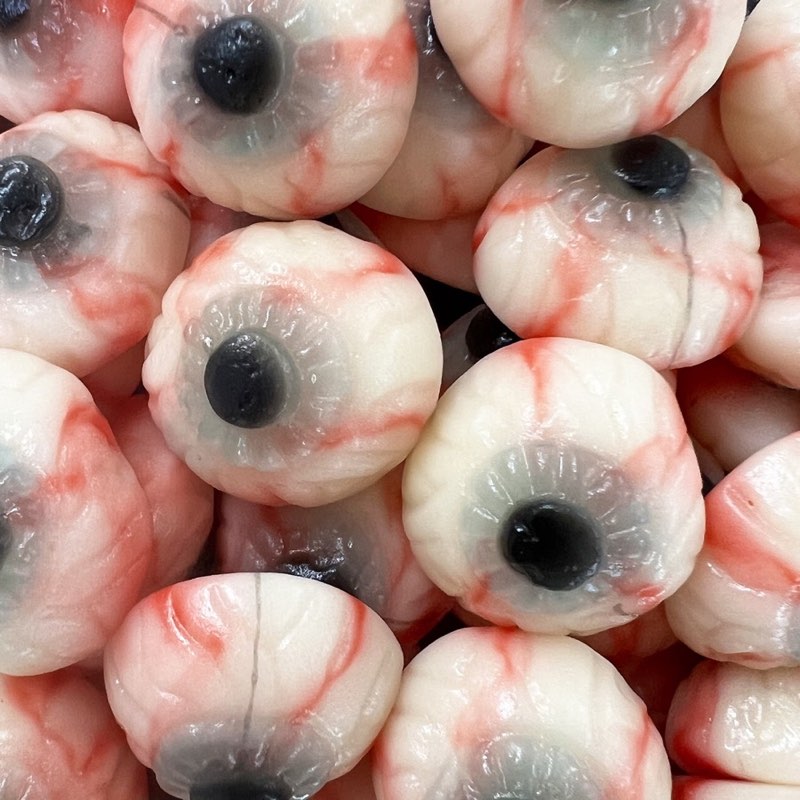
The appeal here is immediate and entirely visual. Each sweet is a rounded jelly made up as an eye — a pale outer sphere, a ring of colour, a dark centre — and the pack lists the line as multi-coloured, so the irises vary across the bag rather than all coming out the same shade. That variation is what makes a heap of them look like a crowd rather than a batch, and it is the reason they hold attention in a jar for longer than a single-colour sweet does.
They are classed both as jelly and as jelly and gummy, which tells you where they sit on the firmness scale: a proper moulded jelly with some structure to it, rather than a soft mallow or a foam. The roundness matters for how they behave in a container — spheres pack and pour differently from flat shapes, they settle into a level surface in a jar, and they roll, which is charming in a bowl and briefly annoying on a worktop.
In the hand they have the honest weight of a solid jelly. There is a slight surface tack, as there is on anything moulded, enough to keep them from skittering off a plate but not enough to make them cling to each other in the bag under normal storage. Pick a few up and they separate cleanly.
The bite, and how the fruit note arrives
First contact meets real resistance. This is not a sweet that collapses — the teeth press, the jelly holds for a moment, and then it gives. What follows is a proper chew with some work in it, the sort that occupies a mouth for a while rather than disappearing in a second or two.
Because they are round rather than flat, the bite is also more even than it is on a moulded shape with thick and thin parts. Every direction you bite from meets roughly the same thickness, so there is no soft edge and no stubborn centre. Some people take one in a single bite and some take two; both work, and a single-bite eyeball is a more satisfying thing than it has any right to be.
The flavour is listed simply as fruit, which is the family rather than a named single fruit, and it behaves the way fruit jellies at this firmness do. It does not land on first contact — it needs the chew to start before it develops, arrives across the middle of the mouthful, and then tails away gradually rather than stopping. That slow fade is what makes a jelly moreish. A sweet that finishes abruptly tells you it is over; this one does not, and a 250 g bag disappears accordingly.
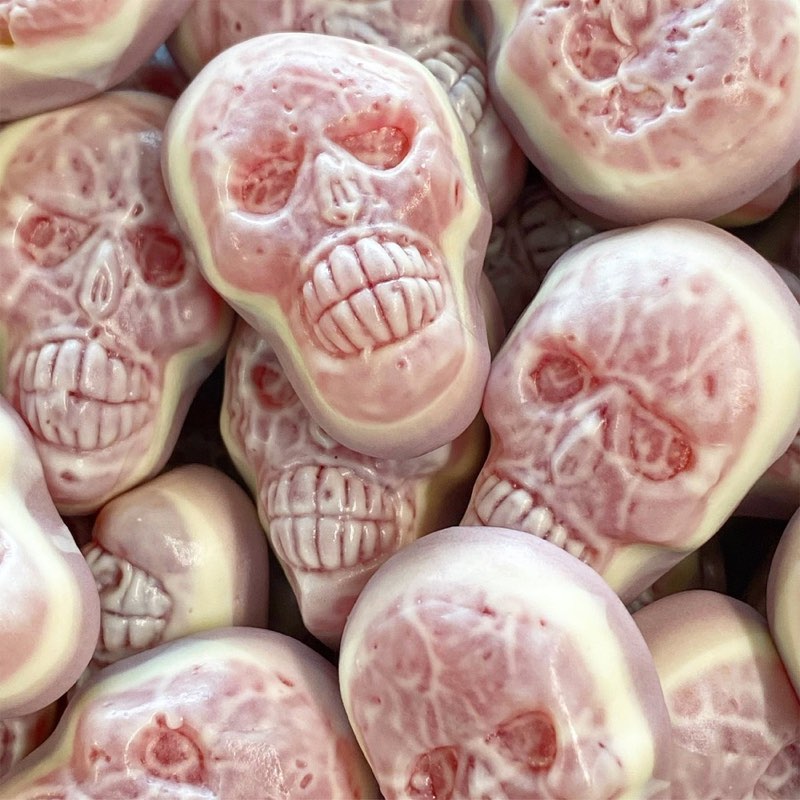
Worth saying what it is not. There is no sour edge, no fizz and no heat. If that is what you came for, BUBS Big Sour Skulls at £7.50 keep the ghoulish shape and add the sourness, and Dulce Plus Sour Strawberry Rings at £5.49 are the straightforward sour ring if the shape does not matter to you.
Who ends up enjoying these most
Children above about six, without question — the age at which slightly gruesome becomes funny rather than frightening, and stays funny for several years. Below that it varies by child, and a clear jar is the honest test: if the shape gets a laugh, you are fine.
Adults who like a chew. The firmness here is genuinely adult-friendly, and the novelty does not get in the way of that. A lot of grown-up sweet buyers want something that lasts more than a moment, and moulded jellies answer that far better than soft gums do.
Anybody assembling something for somebody else — which is to say, anybody who needs a sweet to be a talking point rather than just a snack. That is the whole gifting case, and it follows.
Less suited to: anyone who wants soft. If softness is the requirement — small children, or simply a preference — Pumpkin & Ghost Marshmallows at £5.49 keep the seasonal shapes and swap the firm chew for a light foam, which is the better answer for a mixed-age table.
Giving them away: hampers, letterboxes, staff rooms and parcels
A striking amount of the confectionery bought in this country is bought for somebody else, and almost none of the writing about sweets treats that seriously. It deserves treating seriously, because the difference between a good edible gift and a slightly embarrassing one has almost nothing to do with the sweets and almost everything to do with how they are presented and chosen.
The principle: one specific thing beats one generic assortment
This is the rule that governs everything else in this section. A mixed bag of assorted sweets handed over as a gift reads as a default — the thing you picked up because you had to pick up something. A jar of one deliberately odd sweet reads as a choice. It says you thought about it, even if you thought about it for about eleven seconds, and it gives the person something to react to.
Novelty shapes are unusually good at this because the joke does the work that a ribbon would otherwise have to do. You are not giving somebody sweets; you are giving them a jar of eyeballs, which is a different and considerably funnier object. The cost is identical.
Hampers: the role a jelly plays in a mixed basket
A hamper needs range or it reads as a pile. The usual failure is that everything in it is the same register — all chocolate, all savoury, all posh — and the eye slides over it. What a firm novelty jelly brings to a basket is a change of register: bright where the rest is muted, funny where the rest is serious, and chewy where the rest is snappable.
Practically, 250 g is the right hamper quantity. It fills a decent jar, it does not dominate the basket, and it sits comfortably under the price of the centrepiece item. If you are building several hampers at once — which is when most people find themselves reading a page like this — the maths gets much better higher up the size ladder: one 1 kg bag at £16.49 fills four 250 g jars for less than the cost of three separate small bags.
For a second line in the same basket, keep the registers different. Kingsway Dolly Mixture at £5.49 is the traditional counterweight — soft, pastel and old-fashioned against something bright and daft — and the two together tell a nicer story than either alone. If the hamper wants a premium-feeling single item instead, the 800 g Giant Jelly Baby Box at £11.99 is a substantial centrepiece and the colour is selected at random, which makes each basket slightly different without any work from you.
Letterbox treats and posted parcels
Posting sweets is its own discipline. Three things matter and the sweets themselves are only one of them.
- Durability. Firm jellies travel better than most confectionery. They do not melt in a warm van, they do not shatter like a hard sweet, and they do not crush like a mallow. On robustness alone this is one of the better things you can put in a parcel.
- Flatness. If the parcel needs to go through a letterbox, the limiting factor is depth, and spheres are the worst possible shape for that — they stack into a lump. Decant into a flat pouch or a shallow rigid container, lay the sweets in a single layer rather than a heap, and measure the finished thickness against the letterbox before you seal anything. Check the dimensions and postage rules yourself rather than assuming; they vary and they change.
- Temperature. A parcel can sit in a warm vehicle for a day. Firm jellies handle that far better than chocolate, but they will still soften, so pack them so they are not pressed together under weight.
For a posted parcel that needs more than one item, small and light beats large and impressive. The Fini Mini Mochis Bag at £1.35 and the Crazy Jo Peelablezz Jumbo Banana Gummy 136g at £2.99 are both cheap, distinctive and small enough not to fight for space, which is exactly what a parcel wants.
Teacher gifts, and why the novelty option is the safer one
End of term produces a great deal of near-identical giving, and the received wisdom is to play it safe. The received wisdom is wrong, and the reason is arithmetic: a teacher at the end of a term receives a lot of safe gifts, and the safe gifts blur. Something specific and slightly silly is remembered, and it costs no more.
A jar of eyeballs, labelled in a child's handwriting, is a better end-of-term gift than another box of the same chocolates, and it has the additional virtue of being something the child chose and can explain. If the class is doing a collection rather than individual gifts, a 1 kg bag split into small jars is the efficient version of the same idea, and it comes in comfortably below what individual gifts would cost.
One practical note: a staff room is a shared space with unknown dietary requirements around it, so leave the manufacturer's packaging with the gift rather than decanting and discarding it. Anyone who needs to check an allergen can then do so before eating, which is what should happen with any confectionery gift regardless of what it is.
Care parcels and cheering somebody up
Care parcels are the use where novelty matters most, because the point of the parcel is not the contents — it is the evidence that somebody went to some trouble. An unusual sweet is disproportionately effective at conveying that, far more than an expensive but obvious one.
The formula that works: one thing to eat now, one thing to eat later, and one thing that is an activity rather than a snack. These cover the first, something soft covers the second, and Fuji Candy DIY Handmade Ramen Kit Box 20g at £2.99 covers the third — a make-it-yourself novelty that gives the recipient something to do rather than just something to consume. Three items, under a tenner, and considerably more thought showing than a large box of one thing.
Presentation: the part that actually changes the gift
Everything above depends on this. Sweets handed over in the bag they arrived in read as a transfer. The same sweets in a clip-top glass jar read as a present. It takes a minute and costs whatever the jar costs, and it is the single highest-return thing you can do to an edible gift.
Three things that help: fill a tall narrow jar rather than a wide one, because a column of colour shows better than a scatter; write a label by hand rather than printing one; and do not mix two lines in the same jar unless they genuinely look good together, because a jar of one thing looks deliberate and a jar of two looks like leftovers. If you want variety, use two jars.
The shop with the jars behind the counter
Sweets like these have a specific cultural address. They are not supermarket sweets and they were never designed to be. They belong to the corner shop and the seaside sweet shop — the counter with a row of jars behind it, a scoop, a set of scales and a paper bag — and understanding that setting explains almost everything about why the product looks the way it does.
Why the shape is the advertising
In a shop that sells sweets loose from jars, there is no packaging to do any selling. No printed box, no character on the front, no advertising behind it. What there is, is a jar, and inside the jar is either something a customer points at or something they do not. That is the entire commercial pressure on the design, and it is why the traditional loose-sweet range is so full of shapes that would look bizarre on a supermarket shelf: false teeth, fried eggs, milk bottles, cola bottles, babies, bones, brains, fangs and eyeballs.
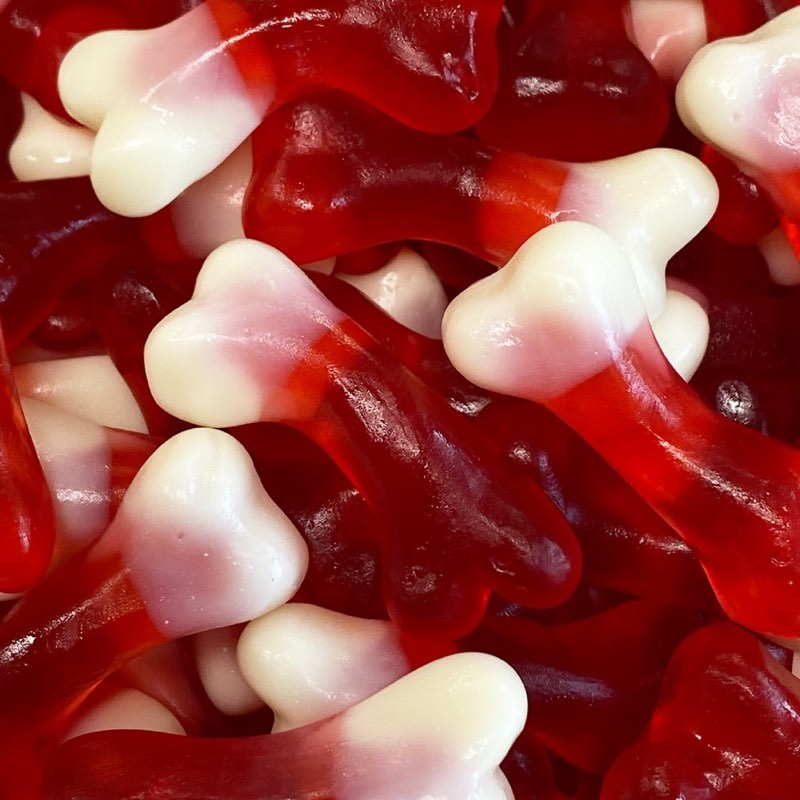
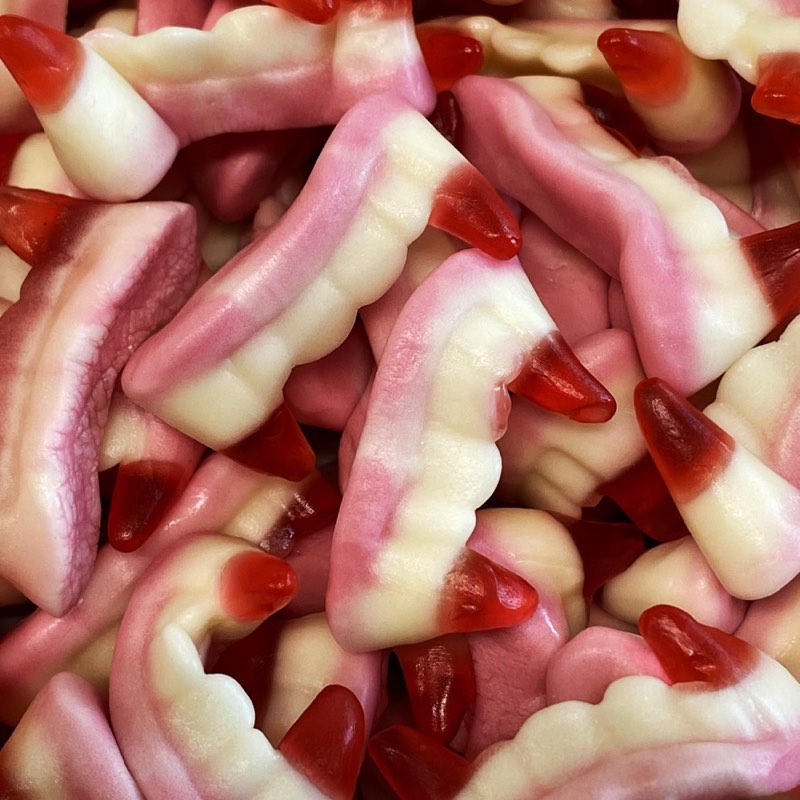
You can still read that logic straight off the shelf today. Kingsway Gummy Bones at £5.49, Kingsway Mini Teeth Fangs at £5.49 and Kingsway Witches Heads at £5.49 are all the same instinct at work — a shape strange enough to be pointed at, in a format sold by weight. They are designed to be noticed across a counter, and they still are.
The seaside version of the same shop
The seaside sweet shop is the corner shop with the volume turned up. More jars, brighter, larger quantities, and an audience on holiday with loose change and no shopping list. That combination pushed the format towards the spectacular — bigger sweets, stranger shapes, more colour — and produced a lot of the range that still fills the loose shelves now.
What is genuinely interesting is how little the format has changed. The mechanism is identical: sell by weight, let the customer choose the quantity, and make the product itself do the advertising. A modern range that runs from a 250 g bag to a 2 kg one is the scoop and the scales reimplemented, and it survives because it does something a fixed pre-packed bag cannot — it lets a customer spend £5.49 to try something or £28.99 to supply a stall, and get the identical sweet either way.
The pick and mix inheritance
The other thing the counter gave us is the mixed bag, and it is a better idea than it is usually given credit for. A mixed bag is not just variety; it is a way of taking a small risk. You put in three things you know and one you do not, and if the new one is wrong you have lost about forty pence. That is how most people's sweet preferences were actually formed, and it is why our pick and mix pouches remain the most sensible way to explore a shelf of hundreds of lines without committing to any of them.
The shelf where all of this lives is the loose sweets shelf, which runs to well over three hundred lines and is far and away the most rewarding part of the shop to browse without a plan. That is where the novelty shapes cluster, because that is the only format in which they ever made commercial sense.
Why the tradition is worth buying into rather than just remembering
One caution about nostalgia, honestly meant. Sweets bought on memory alone often disappoint, because what people remember is usually the occasion rather than the confection — the walk to the shop, the coins, the paper bag. The way round it is to buy the small size first and judge the sweet on its own merits today. At £5.49 for 250 g that is an inexpensive test, and if it lands you can scale up afterwards at a better unit price than you paid the first time.
Reading the fruit note
Fruit is the broadest flavour family in the shop and by some distance the largest — the fruit flavour shelf carries over a hundred and sixty lines — so saying a sweet is fruit-flavoured narrows things less than it might appear. What is useful is knowing where within that family a line sits, and that comes down to two axes: intensity and texture.
On intensity, these are moderate. The note is rounded rather than pointed, it sits in the middle of the palate, and it does not spike at the front or hang at the back. That is deliberate in a sweet aimed at a shared bowl — assertive flavours are tiring in quantity and rounded ones are not, which is why the most-eaten sweet at any party is almost never the most interesting one.
On texture, these are at the firmer end. That combination — moderate intensity, firm chew — is the single most useful profile to have in a mix, because it neither dominates nor disappears. It is the line that makes the rest of the bowl work.
For comparisons within the family: Taveners Fruit Pastilles at £5.49 are firmer again and a fair benchmark if you want to know what one step up feels like. Barratt Jelly Love Hearts at the same price are a softer jelly at similar intensity, which is the useful comparison in the other direction. And across the jelly and gummy shelf — ninety-six lines and the busiest part of the range — you will find most of the ground between them covered.
Putting a mix together around them
These work as an anchor line rather than as filler. The shape carries the bowl, the firmness sets the pace, and the multi-coloured irises give you variety without needing a second colourway alongside.
Build outwards by varying texture first, flavour second. The most common mistake in home pick-and-mix is assembling five fruit flavours in five near-identical textures and then wondering why the bowl feels monotonous. Vary how things eat and the flavours look after themselves.
- For softness: a foam or mallow line lifts the volume of the bowl and gives people something light between the chews.
- For a different silhouette: Haribo Friendship Rings 480g at £8.99 are a hollow ring against a solid sphere, which is about as different as two jellies get, and it is a generous bag.
- For a traditional note: dolly mixture or similar small assorted pieces give the bowl a scattering of small items, which stops it reading as five big things.
- For fizz: Kingsway Vegan Fizzy Tongue Painting Dummies at £5.49 or the Kingsway Vegan Fizzy Bubblegum Tongue Painting Dummies at the same price add the one register nothing else here covers.
Proportions: treat the anchor as roughly a third of the mix and let the other three share the rest. Any more than that and the bowl reads as one product with garnish.
One assembly rule worth keeping. Do not store firm jellies touching anything sugar-coated or fizzy. The tack on a jelly surface lifts powder off its neighbours, and both lines end up slightly wrong. Separate containers until serving, combined at the table.
Sizes, unit prices and what to plan for
The standard bag is 250 g at £5.49, or £2.20 per 100 g. The ladder above it is where the decisions are, and the right-hand column is the one to read.
| Size | Price | Per 100 g | Cost of stepping up |
|---|---|---|---|
| 250 g | £5.49 | £2.20 | — |
| 500 g | £9.99 | £2.00 | +250 g for £4.50 |
| 750 g | £12.99 | £1.73 | +250 g for £3.00 |
| 1 kg | £16.49 | £1.65 | +250 g for £3.50 |
| 2 kg | £28.99 | £1.45 | +1 kg for £12.50 |
The 750 g is the value pick and it is not close. That step adds a quarter of a kilo for £3.00, against £4.50 for the step below and £3.50 for the step above — it is the cheapest additional 250 g anywhere in the range. If you are going past half a kilo for any reason, carry on to 750 g rather than stopping at 500 g.
The 2 kg at £28.99 brings you to £1.45 per 100 g, a third below the small-bag rate. That is a real saving, but it is eight bags' worth, and it needs a reason behind it: a stall, a fête, a wedding table, a set of hampers, or an arrangement with somebody else to split it. Buying it purely because the per-kilo figure looks good is how two kilos of sweets end up in a cupboard for a year.
For portioning, think in handfuls rather than pieces. A 25 g portion is a small treat; 50 g is what you would once have been handed across a counter in a paper bag. On that basis the 250 g bag is ten small portions or five counter-sized ones, the 1 kg is forty or twenty, and the 2 kg is eighty or forty. For hampers, 250 g fills a decent jar, so a 1 kg bag makes four gifts and a 2 kg bag makes eight.
For a party, the rough planning figure is 40 to 60 g of sweets per guest across the whole table of several lines. Twenty guests and four lines on the table means somewhere around 250 g to 300 g of each — which is to say, one standard bag of each does a party of twenty comfortably.
Keeping them right
Firm jellies are among the easier things to store, but there are two things that spoil them and both are avoidable.
Heat. Warmth softens a moulded jelly and takes away the resistance in the first bite, which is most of what you are buying here. Keep them out of direct sun, off windowsills and away from anything that gives off heat. A cool, dry cupboard is all that is needed. A fridge is unnecessary and slightly counterproductive — chilled jellies come out too hard and then sweat as they warm back up.
Air. Left open, a jelly dries at the surface while staying soft inside, which is an unsatisfying combination. Decant into an airtight tub or a properly sealing jar as soon as the bag is open. If you have bought 1 kg or more, split it into a working jar and a sealed reserve rather than opening everything at once.
Also worth doing: keep them apart from strongly flavoured neighbours, and do not pack a jar so tightly that the sweets at the bottom are compressed under the weight of the rest. Fill loosely and top up.
Which size to order
250 g — first purchase, a single jar, one bowl at a small gathering, or one hamper. This is the try-before-you-commit size and there is no penalty for starting here.
500 g — a specific occasion with a handful of people, or a household that will get through it within a month or so.
750 g — the best-value step in the ladder. The right pick for a party, a class treat, or three hampers with a bit left over.
1 kg — four hampers, a standing jar you refill, or one of two or three main lines on a big table.
2 kg — stalls, fêtes, weddings, large fundraisers, or eight hampers. Also the sensible size to split with somebody else if you both want the bottom unit price without two kilos each.
Where this sits, and what is nearby
This line appears on five shelves, and each is a different route into the range. It is on our jelly sweets with the other moulded and cut lines, on the broader jelly and gummy shelf, on the fruit flavour shelf, on the loose sweets shelf with everything sold by weight, and on the Kingsway range, which runs to seventy-five lines and is worth a browse in its own right if the house style here suits you — the shape-led approach and the consistent £5.49 price point run right through it.
For a different house style to compare against, everything from Haribo is the obvious counterpoint and instructive side by side. If the table needs bars and boxes as well as scoops, the candy and chocolate shelves are the place to look. And the full shop sits above all of it if you would rather browse without narrowing down first.
Things shoppers ask before ordering
How firm are they?
Firm. They are a proper moulded jelly — the first bite meets genuine resistance before it gives, and the chew that follows takes a while. Softer than a fruit pastille, noticeably firmer than a soft gummy, and a long way firmer than any foam or mallow.
Are they too scary for young children?
Rarely, in practice. An eyeball sweet reads as a cartoon rather than as anything genuinely gruesome, and most children above about six find it funny. Below that it varies, so a clear jar and a first reaction is the honest test. Separately, sweets are a treat rather than everyday food, and whole gummies and small hard sweets are a choking risk for young children who should be supervised while eating them.
What flavour are they?
They are listed as fruit, which is the flavour family rather than a single named fruit. In the mouth that means a rounded, moderate fruit note that develops through the chew and fades slowly. We do not list anything more specific than what appears on the pack.
Do the different coloured ones taste different?
The line carries one flavour listing across the bag, so the colour variation is visual rather than a set of separate flavours. That is useful at a shared bowl, because nobody has a reason to dig for a particular colour and leave the rest behind.
Where do I find allergen information before anyone eats these?
Check the manufacturer's packaging when the order arrives, before eating. That is the only reliable source for allergen information, and it is the one that travels with the batch you have actually been sent, so it is always current.
Will they survive being posted?
Better than most confectionery. Firm jellies do not melt like chocolate, shatter like a hard sweet or crush like a mallow. The limiting factor for a letterbox parcel is depth rather than durability, since round sweets stack into a lump — lay them flat in a single layer and measure the finished thickness yourself against the letterbox and the postage rules before sealing.
How many are in a bag?
We do not publish a piece count, because loose sweets are sold by weight and the count varies between batches. Weight is the more useful planning unit anyway: 250 g is about five counter-sized 50 g portions or ten small 25 g ones.
Is the sweet the same in the larger sizes?
Yes. Every size on this page is the same product weighed out differently, not a different moulding, so the per-100 g figures in the table are a direct comparison.
How many jars will a kilo fill?
Four, if you are working in 250 g jars, which is the usual size for a hamper or a gift. That is why the 1 kg at £16.49 is the natural choice for anyone making up several presents at once — it works out considerably cheaper than four separate small bags.
Can I use them on a cake?
Yes, and they are one of the better sweets for it because the shape does all the work and the firmness means they hold their form on top of a bake rather than slumping. You need very few, so a 250 g bag goes a long way in a kitchen.
Are they only a Halloween product?
No. The shape has an obvious seasonal home but nothing about the flavour or the format is seasonal, and they go down just as well at a birthday party in June. Plenty of people keep a standing jar of them purely because it makes visitors laugh.
Is the whole size range available at the moment?
Yes, this line is in stock across the sizes at the time of writing. The stock indicator on the page is the one to trust rather than anything written in the description.
In short
A firm, multi-coloured, fruit-flavoured moulded jelly in the one shape that guarantees a reaction, sold loose from £5.49 for 250 g up to £28.99 for 2 kg. It is a party bowl, a hamper filler, a parcel item and a very good end-of-term gift, and it belongs to a tradition of counter sweets designed to be pointed at through glass. Buy the 250 g to see whether the chew suits you, put it in a tall clear jar rather than leaving it in the bag, and if you are making up more than one gift, go to the 750 g — that is where the ladder is cheapest and the difference is genuinely worth having.
More from Kingsway
More jelly & gummy sweets
More fruit sweets

Where this sits
Kingsway Jelly Eyeballs appears on these shelves. Browse them, or jump to something nearby.
You might also like