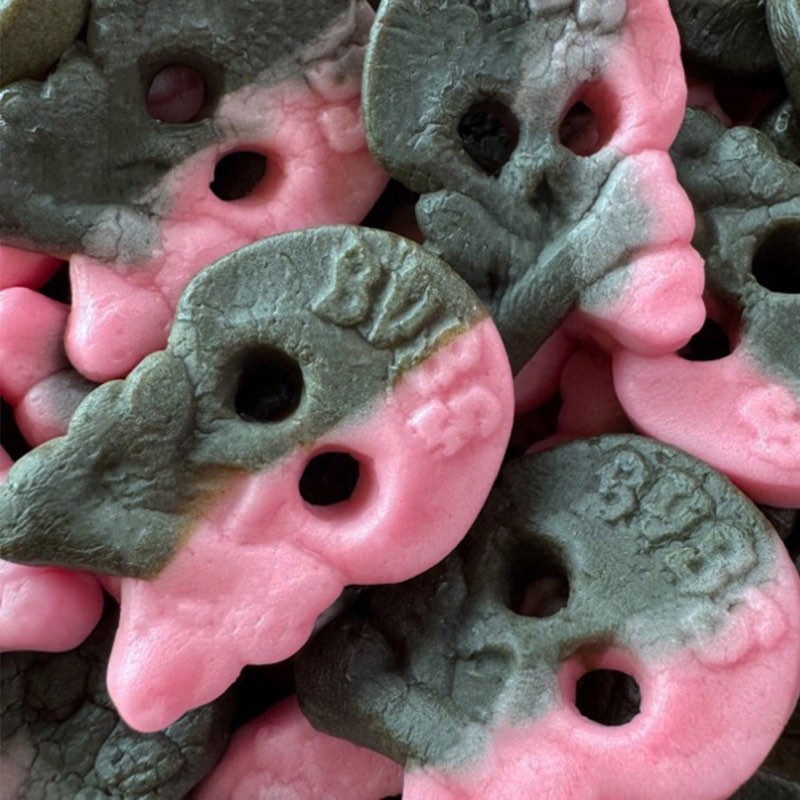
Home / Loose Sweets / BUBS Big Sour Skulls
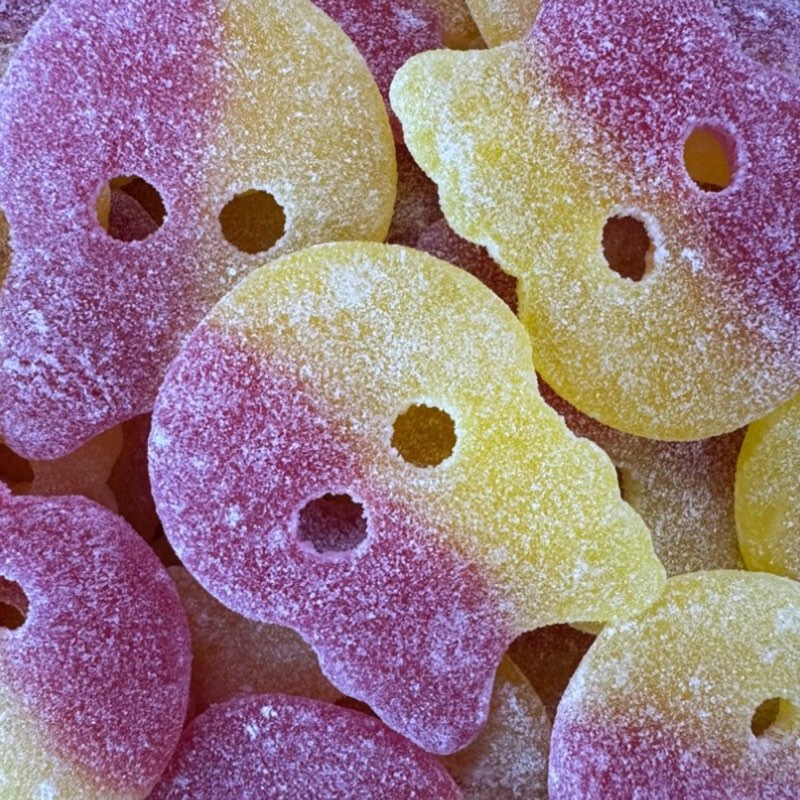
BUBS · 250g
Read the full guide
BUBS Big Sour Skulls
£7.50
✔ In stock — ready to ship
Fresh stock
Free over £20
Same-day dispatch
Secure checkout
Most shoppers land on a bag of BUBS Big Sour Skulls with two practical questions before any of the romance: how much am I getting, and is the bigger bag worth the jump? So let us start there rather than at the end. The standard bag is 250 g for £7.50, which works out at £3.00 per 100 g. That is the entry price, the one you pay when you want to find out whether this line suits you before you commit a shelf to it.
The interesting part is what happens above that. The 500 g bag is £9.99, so the second 250 g costs you £2.49 — roughly a pound per 100 g of extra sweets, against the £3.00 per 100 g you paid for the first. In practical terms, doubling the bag costs a third again, not double. That is the single most useful number on this page, and it is the reason a lot of people who came for the small bag leave with the middle one.
The full guide to BUBS Big Sour Skulls
7,100 words on how it eats, who it suits, how to serve it and what to put beside it.
Working out what £7.50 of skulls actually buys
| Size | Price | Price per 100 g | Step up from the size below |
|---|---|---|---|
| 250 g | £7.50 | £3.00 | — |
| 500 g | £9.99 | £2.00 | +250 g for £2.49 |
| 750 g | £12.99 | £1.73 | +250 g for £3.00 |
| 1 kg | £16.49 | £1.65 | +250 g for £3.50 |
| 2 kg | £28.99 | £1.45 | +1 kg for £12.50 |
Read down that final column and the shape of the range becomes obvious. The saving is steepest at the first step and then flattens out: 250 g to 500 g is the bargain, 500 g to 750 g and 750 g to 1 kg are steady and sensible, and the 2 kg is a different kind of purchase altogether. At £28.99 for two kilos you are at £1.45 per 100 g, less than half the unit price of the small bag, but you are also committing to a quantity that needs a plan behind it — a party, a stall, a school fête tuck box, a wedding table, a shop-at-home pick and mix that you are going to be refilling for weeks.
Portioning is where those numbers turn into something you can picture. Think in 25 g and 50 g handfuls, because that is roughly how sour sweets get eaten: not steadily, but in bursts. On 25 g portions the 250 g bag gives you ten sittings, which is a fortnight of small after-dinner treats for one person or a week for two. On 50 g portions — the size you would tip into a paper bag at a counter — it gives you five. Scale that up and the 1 kg bag is twenty 50 g portions, and the 2 kg bag is forty, which is the number to hold in your head if you are catering rather than snacking.
That 50 g figure is also the honest planning unit for a party. Sour sweets are not a bottomless bowl item, because the sour coating naturally paces people; most guests take a couple, go away, and come back later rather than grazing continuously. Fifty grams a head over an afternoon is generous without being wasteful. Twenty guests, one kilo. Forty guests, two kilos. If skulls are one bowl among four or five on the table, halve it, because the mix does the work and no single sweet has to carry the whole event.
One more piece of value arithmetic worth doing before you choose. If you are buying for a mix rather than for skulls alone, compare the per-100 g price here against the other things going in the bag. Plenty of our loose lines sit at £5.49 for their standard bag — Haribo Giant Strawbs among them — so skulls are a premium item in that company, and you treat them accordingly: as the flavour spike in a mix, not as the filler. Buy the filler in bulk and the spike in the size you will actually finish, and the whole bag costs less than if you bought everything at the same scale.
What lands in the bag
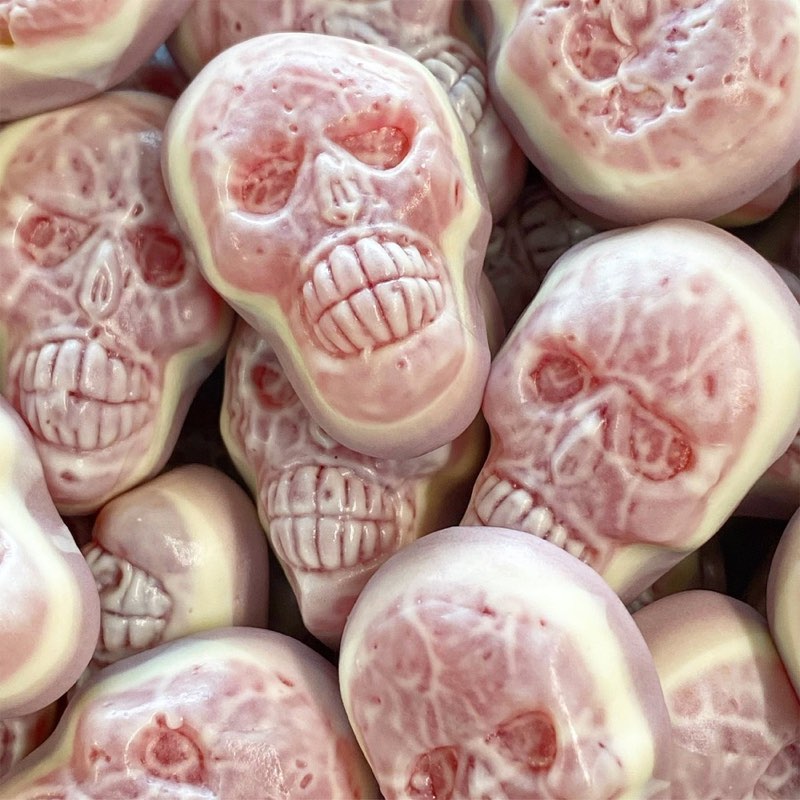
Open it and you get exactly what the name promises, which is not always a given in sweets. These are big skulls — the size is the point of the line, and it is the first thing your hand registers when you reach in. They are red, and they come in as a jelly and gummy sweet with a fruit flavour and a sour finish. Our supplier lists this line as vegan and vegetarian. That is the whole factual picture, and it is enough, because the interesting things about this sweet are all things you experience rather than things you read off a label.
The skull shape is doing more work than decoration. A skull has a broad cranium, two deep eye sockets, a bridge, and a narrower jaw, which means a single piece has thick regions and thin regions and hollows that hold onto surface coating. You feel that before you taste it: pinch one between finger and thumb and the resistance is not uniform. The dome gives slowly. The jaw gives faster. The sockets are where the sour sits, because a recessed shape catches and keeps a coating that a smooth bead would shed in the bag.
Tip a handful into a bowl and they do not lie flat the way rings or belts do. They stack at angles, catching light on the domes and going dark in the hollows, and the bowl reads as texture rather than as a flat sheet of colour. It is a small thing, but it is the reason skulls photograph well on a party table and the reason they hold their own visually next to flatter, shinier sweets. Put them beside something glossy like Vidal Rainbow Belts and the contrast between matte, sour-dusted surfaces and slick ribbons is half the appeal of the display.
Weight in the hand is the other first impression. A big gummy has heft, and heft changes how you eat: you take two, not eight, and you know you have taken them. Small sweets disappear by the fistful without registering. These register. That is worth knowing whether you are rationing a bag across a week or working out how far two kilos will stretch at a stall.
Eating one: the walkthrough
The first second is the coating. Sour hits the tip and the sides of the tongue before you have properly closed your teeth, and with a big piece there is simply more surface area arriving at once than you get from a small sweet, so the opening is sharper than the same sourness on a smaller shape would be. This is a line for people who want the sour to announce itself rather than creep up.
The second second is the bite. Because of the shape, where you bite changes what you get. Take the jaw end and you get through it quickly and the sour stays dominant. Take the cranium and you are chewing properly, and the fruit flavour underneath has time to come up and meet the sourness rather than trailing behind it. Regular eaters of this sort of sweet work this out without thinking about it and start biting one way on purpose. It is one of the quiet pleasures of a shaped gummy over a uniform one.
The middle of the experience is chew. A big gummy takes real work, and that work is the reason the flavour lasts: you are not swallowing after two compressions, you are moving the piece around, and each movement releases a little more. The sour edge fades first, being a surface phenomenon, and what is left in the last stretch is the fruit character, rounder and calmer than the opening. That arc — sharp, then broad, then sweet — is the whole design of a sour gummy, and a big piece gives you more of each phase.
The finish is clean rather than clinging. Once the piece is gone, the sourness leaves fairly promptly, which is precisely why people eat these in twos and threes rather than singly. If the finish hung around, one would be enough. Because it resets, you go again. Worth knowing when you are deciding between the 250 g and the 500 g bag, and worth knowing when you put a bowl out and wonder why it emptied faster than the toffees next to it.
A note on pacing for anyone new to sour sweets: they are more enjoyable slowly. Rushing three in a row flattens the top end of the flavour because your palate is still busy from the last one. Leaving thirty seconds between pieces gets you the full opening every time. Sweets are a treat, and this is a treat that rewards being treated like one.
The engineering behind the chew
Everything that makes a big sour gummy good or bad happens in the texture, and texture in confectionery is engineered, not accidental. You can taste the decisions. This section is about what those decisions are and why they matter more on a skull than on almost any other shape — no recipe talk, because we do not hold verified formulation data for this line and will not guess at it, but plenty about geometry, cure and surface, which are the parts you can actually feel.
Why the shape dictates the chew
A gummy is a solid with a consistent make-up throughout, so the only way to vary how it eats is to vary its dimensions. A thin sheet gives instantly. A thick block resists. A shape that is both — which is exactly what a skull is — gives you a piece with a built-in sequence. The bite starts in the thin zone and finishes in the thick one, so a single sweet has a beginning, a middle and an end rather than a single uniform squash.
That is why shaped gummies of this size feel more substantial than round ones of the same weight. A sphere presents the same resistance from every direction; you learn it in the first bite and there are no surprises after that. A skull has at least three distinct densities of experience depending on where your molars land. Multiply that across a handful and you get variety from a single product, which matters enormously when you are eating more than one.
The moulding depth problem
Deep detail in a mould is hard to achieve at scale. The deeper the eye socket and the sharper the jaw line, the harder it is to get a clean release and the more likely you are to end up with rounded, blurry pieces where the detail has slumped. When a shaped gummy comes out of the bag with its features still legible — sockets that are genuinely recessed rather than dimpled, an edge to the jaw — that is a manufacturing win, and it directly affects how the sweet eats, because those recesses are what hold the sour coating in place.
You can test this yourself with any bag of shaped gummies. Look at how much definition survives from mould to mouth. Sweets with crisp detail almost always deliver a sharper sour opening than soft-featured ones, not because they are coated more heavily but because the coating has somewhere to sit and stays there instead of rubbing off into the bottom of the bag. It is the same reason a textured crisp carries more seasoning than a smooth one.
Cure time and why patience shows up in the bite
Gummies are not finished when they leave the mould. They spend time firming up, and how long they are given is one of the biggest levers on the final texture. Rush it and you get a piece that is slack in the middle and dents under a fingernail. Give it time and you get a gummy with a spring to it — one that compresses under the tooth and pushes back rather than simply collapsing.
That springiness is what people mean when they say a gummy is "good quality" without being able to say why. It is the difference between a sweet you chew and a sweet you mush. On a large piece it matters twice over, because there is more material in the middle to go wrong. A big sweet with a slack centre is a disappointment in a way that a small one never quite is, since with a small one you are through it before the middle has a chance to let you down.
The surface: where sour actually lives
Sourness in this category is overwhelmingly a surface property, not a through-and-through one. That single fact explains most of what you notice. It explains why the first moment is the sharpest. It explains why the flavour softens as you chew into the piece. It explains why the bottom of the bag has loose dust in it, and why the last few skulls sometimes taste sharper than the first if that dust has migrated. And it explains why the sour fades long before the sweet does.
It also explains a design tension that anyone making a big sour sweet has to resolve. Surface area does not grow as fast as volume: make a sweet twice as wide and you get roughly four times the surface but eight times the mass. So a big sour sweet is naturally less sour per mouthful than a small one unless the shape fights back. A skull fights back, because all those hollows and undercuts add surface without adding much mass. The sockets are, in a real sense, sourness delivery systems. This is the kind of thing that sounds like over-thinking until you eat a large, smooth, sour sweet and notice how muted the opening is by comparison.
How texture changes with temperature
Gummies are noticeably temperature-sensitive and a big one shows it most. Cool, they are firmer, the bite is more of a snap, and the sour reads sharper because the piece takes longer to break down and keeps delivering surface for longer. Warm, they are softer, more yielding, and the fruit flavour comes forward faster because you get through the piece quicker. Neither is wrong. A bag left in a cold room for an hour before a film is a genuinely different and, for some people, better eating experience than the same bag at summer room temperature.
The inverse is worth knowing too. On a hot day, a bowl of big gummies on a table will soften and start to stick to one another, and the coating will begin to dissolve where pieces touch. That is not spoilage, it is physics, and the fix is a cooler spot rather than a smaller bowl. Put them out in the shade, keep the bowl off a sunny windowsill, and refill from the bag rather than leaving the whole two kilos exposed for six hours.
What the texture asks of you
All of the above adds up to a sweet with opinions. It wants to be eaten slowly enough to get through its own sequence. It wants to be stored somewhere stable so the coating stays where it was put. It wants a bowl rather than a heap, so the pieces are not pressed together. And it rewards the eater who notices the difference between a jaw bite and a cranium bite. If you like sweets you can pay attention to, this is one. If you want something you can eat a hundred of without thinking, our jelly and gummy sweets shelf has ninety-six lines and plenty of them are built for exactly that instead.
The mix-builder's view: how skulls behave in company
Anyone who builds pick and mix bags seriously — for a party, a stall, a hamper, or just a Friday — learns quickly that sweets have social behaviour. Some dominate. Some disappear. Some ruin their neighbours. Skulls are a strong personality in a bag and need to be placed with that in mind.
The dominance problem
A sour coated sweet is the loudest thing in most bags. Put too many in and everything else starts tasting like a recovery from the last skull rather than a flavour in its own right. The working ratio most people arrive at is somewhere around one in six to one in eight pieces — enough that a skull turns up often enough to be exciting, rare enough that it stays exciting. Build a bag that is a third skulls and by the halfway point your palate has stopped registering the sour at all, which is a waste of the most expensive thing in the bag.
Coating transfer: the thing nobody warns you about
Loose sour coating moves. In a sealed bag, over hours, it works its way onto everything it touches. That is fine or even good next to another fruit sweet. It is less good next to something creamy, chocolatey or delicate, where a dusting of sour lands as a mistake rather than a bonus. So the rule is simple: sour-coated pieces go with other robust, fruit-forward pieces, and anything soft-flavoured goes in a different bag or a different layer.
If you are making up bags to hand out, layer rather than tumble. A scoop of the mild things, then the skulls, then more mild things on top. The coating still travels, but far less of it, and the bag opens with something gentle rather than with the sharpest thing you own. On a self-serve table, give skulls their own bowl and their own tongs for the same reason, and put them at the end of the run rather than the start so people build a bag and then decide how much sour they want on top.
Texture contrast is the point
The best mixes are built on texture first and flavour second, which is the opposite of how most people shop. A bag of six different fruit gummies is monotonous no matter how different the flavours are, because your jaw is doing the same job every time. A bag with one big chew, one soft foam, one crisp fizzy tablet and one long belt is interesting even if half of them taste vaguely of strawberry.
Skulls occupy the "big chew" slot, and they occupy it firmly, so build outward from there. For the soft slot, BUBS Sour Foam Romb Tutti Frutti at £7.50 is the natural partner — same brand, same sour register, completely different mouthfeel, so the two read as a pair rather than as duplicates. For the crisp, pressed slot, Swizzels Love Hearts at £5.49 break instead of chewing and reset the palate between the heavier pieces. For the long, tearable slot, those rainbow belts again, or a novelty like the Crazy Jo Peelablezz Jumbo Banana Gummy 136g, which at £2.99 gives the bag something to do as well as something to taste.
The pacing slot
Every good mix needs at least one calm item — something you reach for after a sour piece to bring your mouth back to neutral. Taveners American Hard Gums at £5.49 do this job about as well as anything we stock, because they are firm, unhurried and quiet, and they last long enough to properly reset the run. Barratt Jelly Love Hearts, also £5.49, play a similar role in a softer register and have the advantage of being small, so they slot into the gaps between the big pieces instead of competing for space.
Volume planning for a mix
Weight planning gets confusing when pieces vary this much in size, so use rough bag counts rather than grams per sweet. A 100 g pick and mix bag is a satisfying handful for one person. The 250 g bag of skulls at £7.50 therefore seeds about two and a half bags if skulls are the whole bag, or around fifteen to twenty bags if they are the one-in-six accent they should be. The 1 kg at £16.49 is the size to buy if you are making up bags for a class, a stall or a party of twenty and you want skulls in every single one.
The one rule worth breaking
Everything above says keep sour away from mild. There is one exception worth trying: a single skull in an otherwise entirely gentle bag, as a surprise. It works because it is unexpected, and because one piece does not transfer enough coating to spoil the rest. Whole bags of contrast are exhausting; one moment of contrast is a good joke. If you are assembling gifts, that is a better use of an expensive sweet than filling a bag with them.
The fruit and the red
The flavour here is listed simply as fruit, and the colour is red, and that combination sets expectations before anyone tastes anything. Red fruit sweets in this country carry a whole set of associations — the berry end of the spectrum, bright rather than mellow, forward rather than subtle. Red is the colour people reach for first out of a mixed bowl, which is a well-worn observation among anyone who has ever put out a mixed bag and watched what is left at the end.
Fruit as a flavour family behaves particularly well under a sour coating. Sourness and fruit flavours belong together in a way that sourness and, say, caramel or cream simply do not — the sharp opening reads as part of the fruit rather than as an addition to it, so the whole thing tastes like one idea instead of two stacked on top of each other. That is why the sour category is so overwhelmingly fruit-flavoured, and why a sour fruit gummy needs no justifying while a sour toffee would.
If fruit is the direction you want to explore, the fruit-flavoured sweets shelf runs to 161 lines and covers everything from soft jellies to hard boiled sweets. Within it, the ones that sit closest to these skulls in spirit are the other big, chewable fruit pieces — Kingsway Apple Rings at £5.49 being the obvious one, since apple sits on the sharp side of the fruit family and rings give you a similar amount of chew for a lot less money per 100 g.
For a red-on-red table, or a mix built around one colour, the fruit shelf gives you plenty to work with, and the giant strawbs mentioned earlier are the natural anchor. For contrast, go yellow or green rather than another red, because two similar reds next to each other look like a mistake while red and green looks like a decision.
Building a spread around a bag of skulls
A single bag of skulls is a snack. Two or three well-chosen things around it is a table, and a table is what most people are actually shopping for when they buy a kilo of anything. Here is how to build outward without ending up with six bags of the same idea.
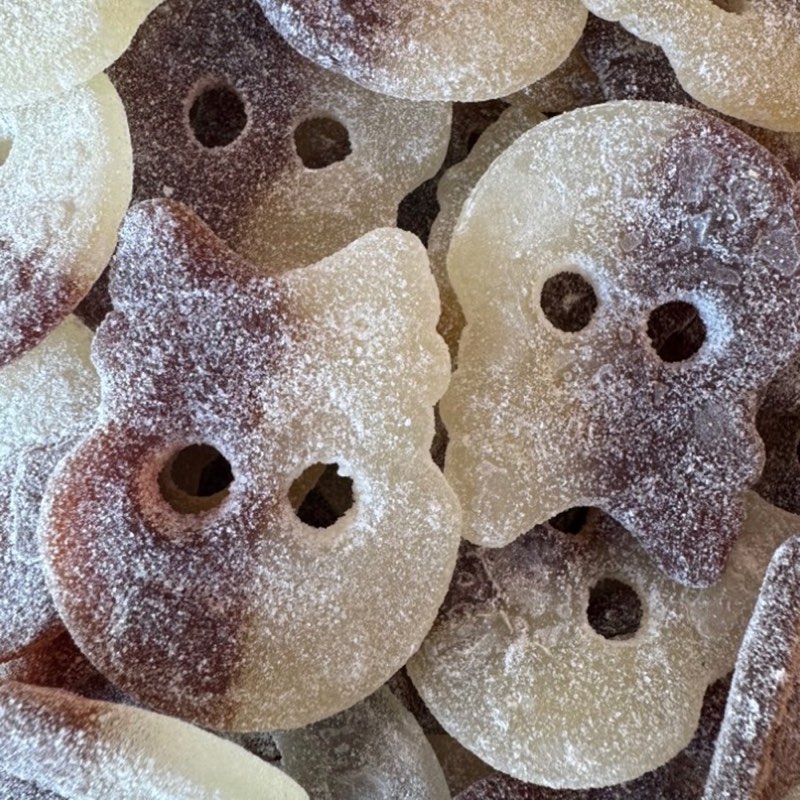
Start with the brand, because the easiest coherent spread is a single-maker one and there are eight lines on the full BUBS shelf to draw from. The BUBS Raspberry Liquorice Skulls at £7.50 are the closest relative — same shape, same price, a completely different flavour direction — and putting the two side by side in separate bowls is an instant talking point, since they look like siblings and taste like strangers. BUBS Cool Cola Skulls, also £7.50, take the same shape into cola territory, which tends to be the one that converts people who say they do not like sour sweets.
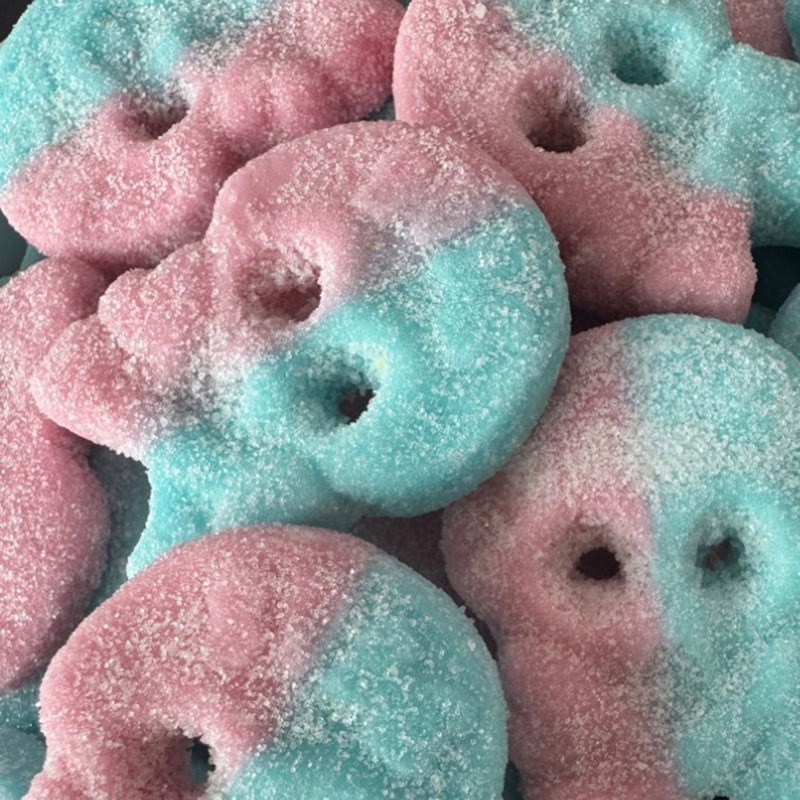
For a younger table, BUBS Dizzy Bubblegum Skulls at £7.50 are the friendliest of the skull shapes on flavour, and they make the skull theme feel playful rather than intense. BUBS Cool Fruity Pear Minis, same price again, are the size counterweight — small pieces to balance a bowl of big ones, which keeps a mixed table from being all mouthfuls. And BUBS Wild Strawberry & Pomegranate Ovals at £7.50 bring a smooth-shaped, berry-leaning option into the group, which matters visually as much as it does on flavour.
Then widen out. A spread needs at least one thing that is not a gummy at all, or the whole table eats the same. A £2.50 pack of Drumstick Chew Bars is the cheapest way to add a genuinely different chew and it comes pre-portioned into ten, so it doubles as a going-home handout. The £1.35 Fini Mini Mochis Bag adds a soft, squashy texture that nothing else on the table will be doing. And the Fuji Candy DIY Handmade Ramen Kit Box 20g at £2.99 is an activity rather than a snack, which is exactly what you want on a children's table halfway through the afternoon when everyone has eaten and nobody has anything to do.
Put a budget on it and the shape of a good order appears quickly. Around twenty-five pounds gets you a 500 g bag of skulls, two of the £5.49 loose lines and a couple of the small novelty items — enough for a table of a dozen with leftovers. Around forty pounds gets you the 1 kg of skulls plus four supporting lines, which covers twenty-odd guests comfortably. Beyond that you are into the 2 kg bag and you are catering, at which point buy fewer different lines in bigger quantities rather than more lines in small ones.
Who these are for, and when
The obvious audience is people who already like sour sweets and want the format done at scale. If someone in your house reaches past everything else in a mixed bowl to find the sour ones, this is a straightforward purchase and you can skip to choosing a size.
The less obvious audience is people building for a group with mixed tastes. A bowl of big sour skulls does a specific job at a gathering: it gives the confident eaters something to be confident about, it gives teenagers something that is not aimed at small children, and it gives the whole table a focal point. It is not the sweet everyone eats most of. It is the sweet everyone talks about, and those are different roles.
They suit older children and adults more than very young children, for the simple reason that a big piece takes real chewing and the sour opening is genuinely sharp. Small hard sweets and whole gummies are a choking risk for young children and should always be supervised. If you are catering for a range of ages, put something smaller and gentler alongside — the pear minis mentioned above, or the jelly love hearts — so nobody is stuck with the piece that is hardest work.
Timing matters more with sour sweets than with most. They work well in the afternoon and evening, as a distinct treat rather than as background grazing, and they work particularly well when people are doing something else — watching, playing, travelling — because the sour spike cuts through a distracted palate in a way that a mild sweet does not. They work less well at the end of a heavy meal, when everyone's palate is already tired and the sharpness lands as too much rather than as a lift.
One practical note for gifting: because our supplier lists this line as suitable for both vegetarians and vegans, it is an easier sweet to hand over than many gummies when you are not certain of someone's preferences. Always let the recipient check the manufacturer's packaging on arrival before eating, especially if allergies are a consideration — the pack in the box is the authority, not the page.
Occasions this earns its place at
Halloween is the one everybody thinks of, and fairly, since a bowl of big red skulls needs no styling whatsoever to look the part. What is worth adding is that skulls are the rare seasonal-looking sweet that does not look ridiculous in March, because the shape reads as a bit of attitude rather than as a costume. You can put these out in June and nobody thinks you are clearing out leftovers.
Film nights suit them well. A sour sweet holds attention through a slow second act better than a mild one, and the size means a bowl lasts through a whole film rather than vanishing in the trailers. Pair with something quiet so there is an alternative when the sour gets to be too much — hard gums are ideal here for exactly the reasons set out earlier.
Birthday tables and teenage parties are where the 1 kg and 2 kg bags earn their keep. Decant into several bowls rather than one big one, spaced around the room, because one bowl creates a queue and four bowls create a party. Keep the refill bag somewhere cool and out of sight, and top up rather than putting everything out at the start; a half-empty bowl late in the afternoon looks worse than a small bowl that keeps getting refilled.
For hampers and gift boxes, skulls work best as the centrepiece with quieter things around them. The 250 g bag at £7.50 is the right size for a box that is going to one household — enough to feel generous, not so much that it dominates the parcel. Add a couple of the small-format items and something pre-portioned, and you have a box that reads as considered rather than as a pile of bags.
Market stalls, school fairs and fundraisers are the case for the 2 kg. At £1.45 per 100 g you have room to bag up at a sensible price and still make the maths work, and skulls are a good stall item because they are visible from a distance and they photograph well on a table. Bag them up in advance in 100 g portions rather than serving loose on the day, and you will move through a queue four times as fast.
Finally, the everyday occasion, which is the one that actually accounts for most sweets sold: a Friday, a long drive, a bad week. For that, buy the size you will finish in a fortnight rather than the one with the best unit price, because a big bag that goes soft in a cupboard is a worse deal than a small bag you enjoy.
Choosing between the five sizes
Five sizes is a lot of choice, so here is the short version, framed by what you are doing rather than by price alone.
- 250 g at £7.50 — the trial size, and the right gift size. Buy this if you have not had this line before, or if it is going in a box for one household.
- 500 g at £9.99 — the best-value step in the whole range, since the second 250 g costs only £2.49. Buy this if you already know you like them, or if you are feeding a small gathering.
- 750 g at £12.99 — the awkward middle, and genuinely useful for one specific case: when 500 g is not quite enough for your guest count but a kilo will leave you with a lot of leftovers.
- 1 kg at £16.49 — the party size. Twenty 50 g portions, £1.65 per 100 g, and enough to fill several bowls at once.
- 2 kg at £28.99 — the catering and stall size at £1.45 per 100 g. Only buy this with a plan and somewhere cool to keep the unopened remainder.
The trap to avoid is buying on unit price alone. The 2 kg is less than half the price per 100 g of the 250 g, which is genuinely a strong saving, but only if you get through it in reasonable time. Gummies are at their best when they are fresh and springy, and a bag that sits open for two months has lost the thing you paid a premium for. If in doubt, buy one size up from what you think you need, not three.
If you are torn between a bigger bag of skulls and a smaller bag plus something else, take the something else. Variety beats volume on almost every table. The difference between the 750 g and the 1 kg is £3.50, which is more than enough to add a whole additional £2.99 line to the order and make the spread noticeably more interesting.
Keeping them right
Gummies are not fragile, but they are responsive, and a big sour-coated piece is the most responsive of the lot. Three things affect them: warmth, moisture in the air, and air itself.
Warmth softens them and makes them stick to one another. That is reversible — move them somewhere cooler and they firm back up — but repeated softening and firming leaves pieces fused into clumps, and prising those apart takes the coating with it. So the first rule is a stable cool spot rather than a cold one: a cupboard away from the oven and away from a sunny window beats the top of the fridge, which gets warm from the back.
Humidity is what attacks the coating. A sour dusting is the whole opening act of this sweet, and damp air dulls it — the surface goes from matte and grippy to slightly slick, and the first-second sharpness softens noticeably. Keep the bag sealed between sittings. If you have decanted into a jar, make sure the lid actually seals rather than just sitting on top; a decorative jar with a loose lid looks lovely and will cost you the sour edge within a week.
Air dries them, which is the opposite problem and takes longer to show up. A bag left open for weeks gives you pieces that are firmer, chewier and a bit leathery at the edges. Some people genuinely prefer that, in the same way some people prefer a slightly stale marshmallow, but it is not what the line is meant to be.
For the bigger bags, the sensible routine is to split on arrival. Decant what you will get through in a couple of weeks into a sealed jar or tub and leave the rest sealed in the original bag somewhere cool. That way you are only ever exposing a fraction to the air. For a party, take this further and bag up portions the night before — it protects the remainder, it speeds up serving, and it stops one enthusiastic guest emptying the bowl in the first half hour.
One last point on refrigeration: chilling is fine as a deliberate short-term choice for a firmer bite, but the fridge is a damp environment and long storage in there will dull the coating. Cool the bowl for an hour before guests arrive, not the bag for a month.
Where this sits on the site
These skulls live on several shelves at once, and which one you browse from depends on what you are shopping for. If you came for a specific maker, there are eight lines on the brand shelf. If you came for a texture, the jelly and gummy shelf is where the ninety-six comparable lines live. If you came for a diet requirement, our supplier lists this line as vegan and vegetarian, so it appears on both of those shelves — thirty-seven lines on the sweets our supplier lists as vegan shelf and sixty-nine on the vegetarian shelf. As ever, check the manufacturer's packaging when it arrives rather than relying on a category page alone.
By format, this is a loose sweet, which is the biggest part of what we do — our loose sweets counter runs to 356 lines, and it is the shelf to browse if you are building a mix rather than buying a single product. If you would rather start from the mix itself, our pick and mix range is organised around exactly that job. And if you want to see the whole catalogue at once rather than filtering down, everything we stock is the place to start.
Two nearby brand shelves are worth a look while you are here. The Kingsway range is where a lot of our better-value loose lines sit, which makes it the natural companion shelf when skulls are the expensive accent in a mix. The Haribo shelf covers the most familiar gummy shapes, so it is the obvious place to find the crowd-pleaser that balances a bolder sweet. And if your table needs something that is not a chew at all, the candy and chocolate hub is the fastest route to a different course entirely.
For anyone navigating by browsing rather than searching: the loose sweets aisle and the fruit shelf overlap heavily, so if you are hunting for a specific flavour direction it is usually quicker to start from flavour and narrow by type than the other way round.
Questions we get asked
How sour are they, really?
Sharp at the opening and moderate after that. The first second, when the coating meets your tongue, is the most intense part, and because these are big pieces there is more coating arriving at once than you would get from a small sour sweet. After that the sourness fades as you chew into the piece and the fruit flavour takes over. If you enjoy sour sweets, this sits comfortably in the territory you expect. If you are unsure, buy the 250 g bag at £7.50 first rather than committing to a kilo.
Are they suitable for vegetarians or vegans?
Our supplier lists this line as both vegetarian and vegan. We pass that on exactly as it is given to us and we do not extend it beyond what the supplier states. When the bag arrives, check the manufacturer's packaging before eating — the pack in your hand is the authority on this, and anyone with allergies or strict dietary requirements should always read it first.
Which size should I buy for a party of twenty?
The 1 kg bag at £16.49, if skulls are one of several bowls on the table. That gives you twenty 50 g portions, which is generous when there are other sweets available. If skulls are the only thing you are putting out, or if you know your guests are sour-sweet enthusiasts, step up to the 2 kg at £28.99 and keep the remainder sealed as a refill rather than tipping it all out at the start.
Is the bigger bag actually better value?
Yes, and the biggest single jump is the first one. The 250 g works out at £3.00 per 100 g and the 500 g at £2.00 per 100 g, so the second 250 g effectively costs a third of what the first did. After that the savings continue but more gently: £1.73 per 100 g at 750 g, £1.65 at 1 kg and £1.45 at 2 kg. The caveat is freshness — a bag you finish is better value than a bag you half-finish.
Will they stick together in the bag?
They can if they get warm, which is a property of large gummies rather than a fault. Kept somewhere cool and stable they stay separate. If a bag has been in a warm room and the pieces have started to cling, an hour somewhere cooler firms them up again and they separate with a gentle shake. Avoid repeated warming and cooling, since that is what turns clinging into genuine clumping.
Do they lose their sourness over time?
The coating dulls if the bag is left open or stored somewhere humid, because the sour is a surface layer rather than something distributed through the piece. Sealed properly and kept somewhere dry, it holds up well. If you have decanted into a jar, make sure the lid seals rather than simply resting on top — that is the most common reason a bag that started sharp ends up tasting flat.
What goes well with them in a pick and mix?
Something soft, something crisp and something calm. A foam-textured sweet gives contrast without clashing, a pressed sweet that snaps resets your palate between the heavy pieces, and a firm, quiet gum gives people somewhere to go when the sour is too much. Keep sour-coated pieces away from anything mild or creamy in the same bag, because loose coating travels and lands on its neighbours over a few hours.
Are they too much for young children?
They are aimed more at older children and adults, both because the sour opening is sharp and because a big piece takes real chewing. Small hard sweets and whole gummies are a choking risk for young children and should always be supervised. If you are catering for a wide age range, put something smaller and gentler alongside so the youngest guests have an easier option and nobody feels left out of the bowl.
Can I buy a mixed bag of different skull flavours?
Not as a single product, but you can build it yourself. Several skull-shaped lines from the same maker sit at the same £7.50 for 250 g, so ordering two or three and combining them in one bowl costs no more per gram than buying one and gives you a considerably more interesting table. The raspberry liquorice and cola versions are the two that differ most from this one on flavour while looking like part of the same set.
How long will an opened bag last?
Longer than most people think, provided it is sealed between sittings and kept somewhere cool and dry. The change you will notice first is not spoilage but texture and coating: pieces gradually firm up as they lose moisture to the air, and the sour edge softens if the storage is damp. For the 1 kg and 2 kg bags, split the contents on arrival and only keep out what you will get through in a couple of weeks.
Do you sell them loose by the scoop?
This particular line is sold in sealed bags at the sizes listed, but it belongs firmly to the loose sweets side of what we do, and the loose shelf is where you will find the other 356 lines that mix well with it. If you are assembling your own selection, buying two or three bags across different textures and combining them at home works out better than it sounds, especially when you are buying the cheaper supporting lines at their larger sizes.
What if I want the shape but not the sourness?
Stay with the shape and change the flavour direction. The bubblegum version of the skull is the gentlest introduction for someone who likes the look but not the sharp opening, and the cola one is the usual choice for adults who want character without the sour hit. Both are the same £7.50 for 250 g, so swapping costs nothing, and putting one sour and one mild skull bowl side by side is the easiest way to keep a mixed group happy.
In short
A big sour skull is a sweet with structure: a sharp opening that lives on the surface, a long chew underneath it, and a fruit finish that arrives once the sourness has done its work. The shape is not decoration — the hollows are what hold the coating and the varying thickness is what gives a single piece a beginning, middle and end. Buy the 250 g at £7.50 to find out whether it is for you, the 500 g at £9.99 if you already know it is, and the kilo or the two kilos only when you have a room full of people or a stall to fill. Keep the bag sealed, keep it somewhere cool, and put something quiet in the bowl next to it.
More from BUBS
More jelly & gummy sweets
More fruit sweets
Where this sits
BUBS Big Sour Skulls appears on these shelves. Browse them, or jump to something nearby.
You might also like