Home / Loose Sweets / Kingsway Vegan Fizzy Tongue Painting Dummies

Kingsway · 250g
Read the full guide
Kingsway Vegan Fizzy Tongue Painting Dummies
£5.49
✔ In stock — ready to ship
Fresh stock
Free over £20
Same-day dispatch
Secure checkout
Most people do not buy one line of loose sweets. They buy three or four and tip them together, and the whole thing either works or it does not — and whether it works has very little to do with whether each sweet is good on its own. So the useful place to begin with fizzy dummies is not the sweet itself but the bag it is going into, because these are a component sweet. They are built to sit alongside other things.
Here is what they contribute. A dummy is a large, slow, fizzy, chewy piece: it takes a while to get through, it has a sharp fizzy opening, and it is visually the biggest thing in most bowls. That makes it an anchor in mix terms — the sweet people notice first and reach for deliberately rather than by accident. A mix wants one or two anchors and then a supporting cast. Put in four anchors and you have a bag where every sweet is competing for the same job; put in none and you have a bag nobody remembers.
The full guide to Kingsway Vegan Fizzy Tongue Painting Dummies
5,571 words on how it eats, who it suits, how to serve it and what to put beside it.
Start with the bag you are going to build
The supporting cast wants to do three things the dummy cannot. First, something small and fast, because a bag made entirely of big pieces is tiring and hard to graze from. Second, something with no fizz at all, to give the mouth somewhere to go between the sharp pieces. Third, something with a completely different texture — hard, powdery or brittle rather than chewy — because texture variety is what stops a mix reading as one sweet in five costumes.
For the fast small piece, Swizzels Love Hearts at £5.49 are as efficient as it gets: tiny, quick, and they carry a fizz of their own without the chew, so they extend the fizzy character of the bag without adding another long sweet. For the calm, unfizzed rest stop, Barratt Fruit Salad Chews at the same £5.49 are the obvious call — a chew in the same fruit territory with none of the sharpness, so they read as relief rather than as a different subject.
For hard texture, Taveners American Hard Gums at £5.49 do the job properly. A firm gum has to be worked and sits in the mouth for minutes, which slows the whole bag down and stops it being emptied in one sitting. And if you want the bag to have a genuine peak — a sweet that makes people pull a face and hand the bag to someone else — Barnett's Mega Sour Fruits Candy Bags at £3.99 go several steps beyond the fizz here, which is exactly why they work in small quantity and badly in large.
Those four plus the dummies is a complete bag: one anchor, one fast piece, one soft rest, one hard rest, one spike. Build that and you have something better than any of the five alone. If you would rather not assemble it yourself, our pick and mix pouches arrive already balanced, and if you want to see the whole palette before deciding, there are 356 lines sold loose to work across.
What actually lands in the bag
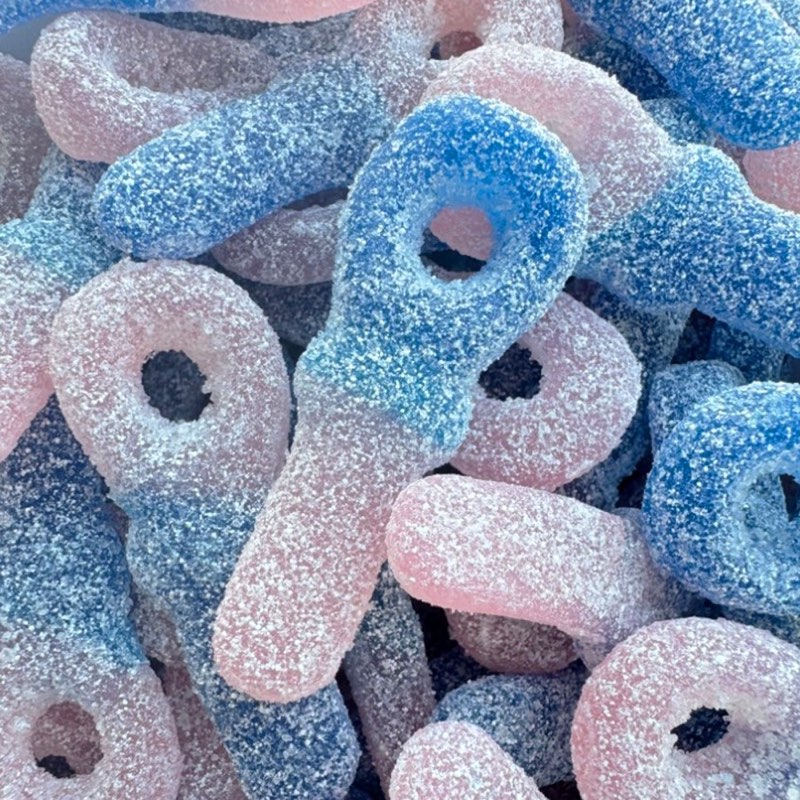
A tongue painting dummy is a big sweet. Not a novelty-size showpiece, but noticeably larger than the jelly and gum lines it usually sits next to — moulded into the dummy shape, with the teat, the shield and the ring all defined well enough that the form reads instantly from across a table. The blue is deep rather than pastel, the kind of blue that does not occur anywhere in the fruit bowl and therefore signals straight away that this is a sweet rather than a fruit sweet pretending otherwise.
The surface is where the fizz lives. Run a finger over one and it is faintly rough, a dry granular coating sitting on a smooth body underneath, and some of it will come off on your fingers and the inside of the bag. That is normal and it is also the single most useful thing to understand about this sweet: the fizz is a surface layer, not something distributed through the piece. Everything that happens in the first few seconds is that coating, and everything after is the chew underneath.
The opening is sharp and it is immediate — there is no build. The coating hits wet tongue and goes off at once, and for two or three seconds the sharpness is the whole experience, sitting along the sides of the tongue and drawing the mouth in. It is a proper fizz rather than a token one, but it is a long way short of the specialist sour lines: it makes you notice, it does not make you wince. Children who find dedicated sour sweets unbearable generally handle this comfortably.
Then the fizz runs out — and it does run out, because there is only so much of it on the surface — and the sweet changes character completely. What is left is a dense, slightly resistant chew that takes real effort, and this is the long part of the experience. It works properly between the teeth, holds its shape for a surprising number of chews, and gives up its fruit flavour slowly as it breaks down. The contrast between the three-second opening and the minute-long middle is the whole design of the sweet.
The fruit underneath is a mixed, general sweet-shop fruit rather than a single identifiable one. It is rounder and gentler than the fizz suggests, and it only really becomes apparent once the coating has gone, which is why people who eat one of these quickly tend to remember it as sharp and people who eat one slowly remember it as fruity. Both are right about their own halves of it.
And then there is the part the name promises. Your tongue takes the colour. That is the whole point of a tongue painting sweet, it works exactly as advertised, and it lasts a good while after the sweet has gone — long enough to be shown to somebody, which is the entire social function. If you are eating one before a meeting, a photograph or a school assembly, that is worth knowing in advance.
The counter this sweet comes from
There is a particular kind of British shop that this sweet belongs to, and it is worth describing properly because it explains the design. Not the supermarket aisle and not the modern import shelf, but the small shop with the sweets kept low down — the corner shop near the school, the newsagent with a rack by the till, and above all the seaside sweet shop with the open trays and the plastic scoops and the tongs you were not quite tall enough to reach.
Those shops had economics that shaped everything on their shelves. The customer was often a child with a small, fixed amount of money and a strong preference for getting the most visible sweet per coin. That produced a whole category of confectionery optimised for looking like good value: big pieces, bold single colours, strong shapes, and an effect you could show somebody. Subtlety was worthless in that context. A sweet that quietly tasted lovely lost every time to a sweet that turned your tongue blue.
The seaside version of this shop intensified everything. Holiday money is different money — it gets spent on things that would never survive a week at home, and it gets spent on souvenirs of a feeling rather than on food. So the seaside counter leaned hard into spectacle: enormous formats, aggressive colours, novelty moulds, and anything that produced a visible result. Shapes that made people laugh sold better than shapes that looked elegant. A dummy is a joke about being a baby, aimed squarely at children who have recently stopped being one, and it is exactly the kind of thing that counter existed to sell.
The fizz belongs to the same tradition. British sweet shops developed an enormous appetite for fizzy coatings, and the reason is partly mechanical: a coating is cheap to apply, it hits instantly, it makes a familiar sweet feel like an event, and it gives a sweet an obvious talking point. Half the shelf in those shops was the same handful of base formats with a sharp coating added, and it worked, because a sharp coating turns eating into something that happens to you rather than something you do.
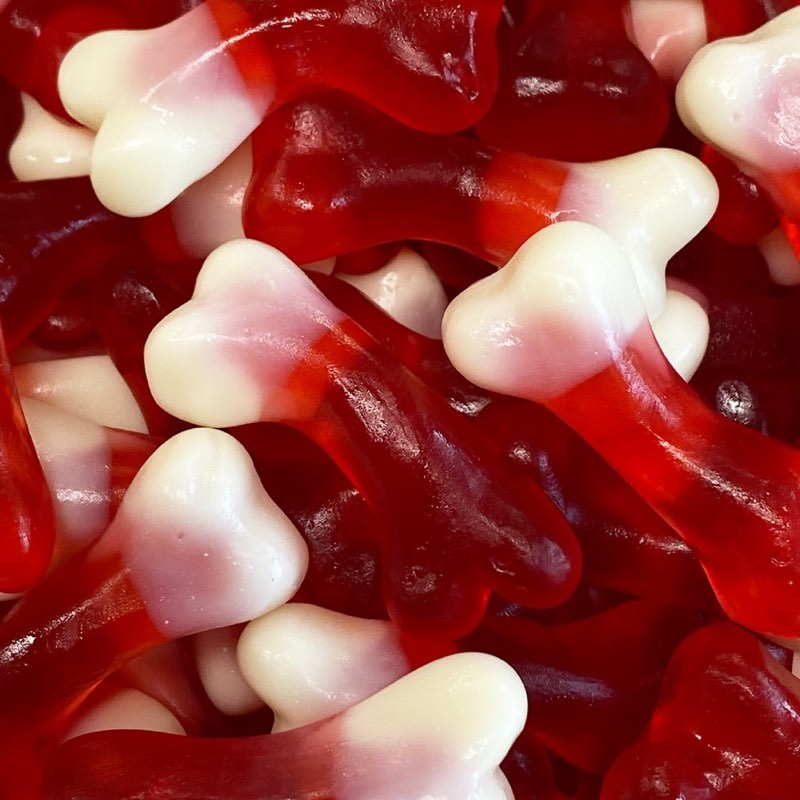
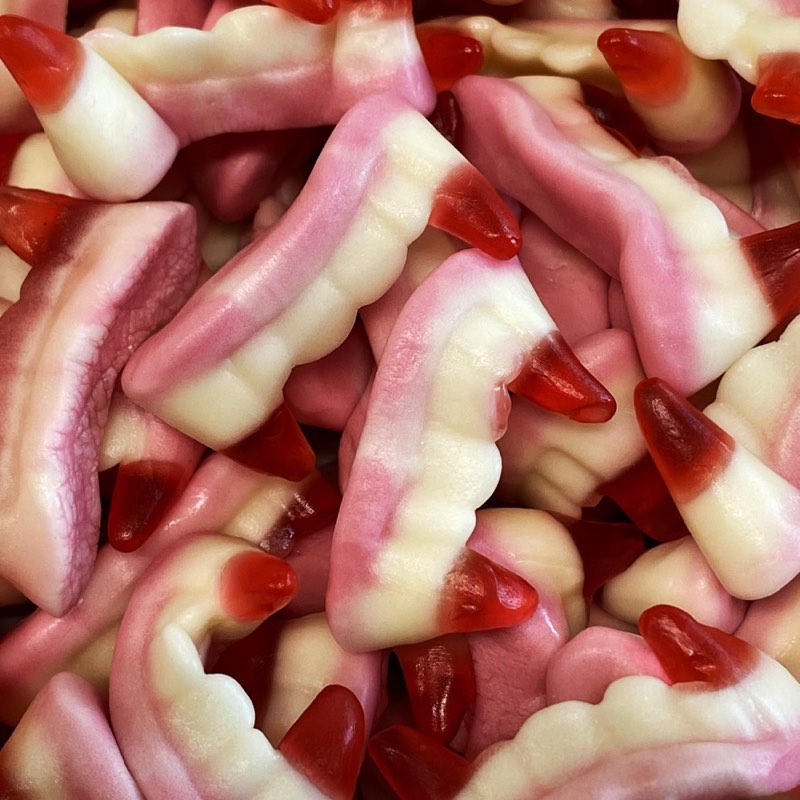
What is striking is how little the successful shapes have changed. The mould catalogue of that counter — dummies, teeth, bones, eyeballs, cola bottles, milk bottles, rings — survives essentially intact. Look across the Kingsway range and you are looking at that catalogue: Kingsway Mini Teeth Fangs at £5.49 are the same joke aimed at the same audience, and Kingsway Gummy Bones at £5.49 work on the identical principle that a recognisable object in sweet form outsells an abstract shape every time.
The other survival is the paper bag itself. Loose sweets bought by weight, mixed to your own specification, handed over in a bag that goes soft in your pocket — that is a distinctly British retail habit and it is why the loose sweets shelf is the biggest part of this shop rather than a curiosity in the corner. Buying sweets by the bag and buying sweets by the packet are genuinely different activities, and this sweet is designed for the first one.
Where a modern line like this differs from its ancestors is in what it tells you about itself. The old counter told you nothing: no flavour description, no supplier information, no diet tags, just a tray and a price per quarter. This one arrives with information attached — our supplier lists this line as vegan and vegetarian — which is a change in the paperwork rather than a change in the sweet. The seaside counter's instincts are all still here. It has just filled in some forms.
Who it suits, and when
This is a sweet for people who want an effect. That is not a criticism — plenty of confectionery is bought for how it tastes, and some is bought for what it does, and the second category is perfectly respectable. If somebody has asked for a sweet that turns their tongue blue, nothing else on the shelf will substitute, and a beautifully made mild fudge will be received as a disappointment.
It suits the middle ground on sourness particularly well, and that is a bigger group than the counter usually admits. There is a large population of sweet eaters who find plain jellies boring and find dedicated sour sweets genuinely unpleasant, and they are badly served by a shelf that mostly offers those two options. A fizz that is sharp for three seconds and then becomes a fruit chew sits exactly in that gap.
It suits anyone who wants a sweet to last. Because the chew is dense, one dummy occupies a real stretch of time, and that matters more than people expect — on a car journey, in a cinema, during a long train leg, a sweet that lasts is worth several that do not. If you are buying to ration rather than to pile into a bowl, big chewy pieces are the right format.
And it suits households that need to check labels. Our supplier lists this line as both vegan and vegetarian, which is genuinely useful when you are catering for a mixed group and do not want to interrogate everyone about what they eat. That tag is why it belongs on our vegan-tagged sweets shelf and among the vegetarian-tagged lines, and it is worth knowing that those two shelves are a good deal smaller than the shop as a whole, so a line that sits on both is doing useful work in a party spread. As always, anyone with an allergy should check the manufacturer's packaging when the order arrives before eating.
Who it does not suit: very small children, because a large whole chewy sweet is a choking risk and needs supervision and sitting down; anyone who dislikes a sharp coating on the tongue, since the coating is not optional; and anyone who wants something discreet, because the colour is not a side effect but the main feature. Sweets are a treat rather than everyday food, and a big chewy one is a treat you notice.
Reading a fruit flavour that does not name its fruit
The flavour listed here is simply fruit, and that vagueness is a deliberate confectionery tradition rather than an oversight. A great deal of the British sweet counter runs on generalised fruit — a broad, red-and-yellow, sweet-shop fruit impression that does not correspond to anything you could pick. It is worth understanding why, because it changes how you use these in a mix.
A named single fruit is a commitment. It has to be recognisably that fruit or it fails, and people have strong opinions about which ones they like. Generalised fruit has no such problem: it is broadly pleasant, it is nobody's least favourite, and it sits happily next to almost anything. For a big shareable sweet aimed at a whole room, that is exactly the right choice. You are not trying to delight one person; you are trying to avoid a bowl anyone refuses.
The fizz complicates it further, and interestingly. A fizzy coating does not just add sharpness — it suppresses your perception of the flavour underneath while it is present. For the first seconds you are mostly tasting sharpness, and the fruit only registers once the coating has cleared. The practical result is a sweet that seems to change flavour halfway through, which is a large part of why a long chew like this holds attention better than a short one.
If you want to taste around the fruit family properly, the shop makes it easy. The fruit-flavoured shelf runs to 161 lines, which is the largest flavour grouping we have, and it spans everything from soft jellies to hard boilings. Vidal Rainbow Belts at £5.49 take the fruit direction and stretch it into a flat belt that eats completely differently, and Candy Realms Tutti Frutti Tubes at £7.99 for 780 g give you a large tub of mixed fruit at a low cost per gram if you need volume rather than novelty.
For the fizzy side of the family, the fizzy shelf collects 41 lines that share the coating trick, and comparing two of them side by side is the quickest way to calibrate your own tolerance. Kingsway Fizzy Strawberries at £5.49 apply the same idea to a softer body and a named fruit, so the fizz reads sharper against the gentler base. At the far end, BUBS Big Sour Skulls at £7.50 are a genuinely different proposition — a proper sour rather than a fizz — and having one of each in the house settles most family arguments about what counts as sour.
Within the chewy family, the chewy sweets shelf is where the texture peers live, and Drumstick Chew Bars at £2.50 for ten are the cheapest way to add serious chew time to a bag without adding more fizz.
Sending them to somebody
Loose sweets make better gifts than they get credit for, and this line in particular has properties that suit posting and giving. It is worth going through them properly, because the difference between a good sweet gift and an awkward one is mostly logistics.
Start with durability. Chewy sweets travel well. They do not shatter like a boiling, they do not melt like chocolate, they do not crumble like a fudge, and they do not lose their character if the parcel sits in a warm hallway for a day. The fizz coating is the only thing that suffers, and only in damp conditions. For anything that is going into the post, a robust chewy sweet is a far safer bet than something delicate, and the 250 g bag at £5.49 is a sensible unit for a single-item gift.
Then size and shape. Loose sweets pack flat and mould to a box in a way that rigid items do not, which makes them useful as the filler in a hamper — the thing that goes around the awkward gaps rather than the thing that has to be accommodated. For a letterbox parcel, where depth is the constraint that catches everyone out, a flattened bag of chewy sweets is one of the few genuinely satisfying things that fits. Pair it with something slim and the whole parcel stays under the depth limit.
The diet tag matters a great deal here too. A gift you are unsure about is a gift you hesitate over, and food gifts are the worst offenders. Knowing that our supplier lists this line as vegan and vegetarian removes one whole category of doubt when you are sending sweets to someone whose habits you only half know — a colleague, a new neighbour, a friend's household. It does not remove allergen questions, and you should tell the recipient to check the packaging themselves, but it settles the most common one.
For a teacher gift at the end of term, sweets are an honest choice, and a mixed bag assembled yourself reads as more thoughtful than a single packet. The end-of-term staffroom is a shared space, so quantity and variety beat elegance: 500 g of two or three lines split into bags does more good than one small premium item. For a care parcel — a student, someone working away, someone unwell enough to be bored but well enough to eat sweets — the criteria are different again. Long-lasting pieces win, because the whole point is to have something to do. A dense chew is better value in that context than anything that disappears in seconds.
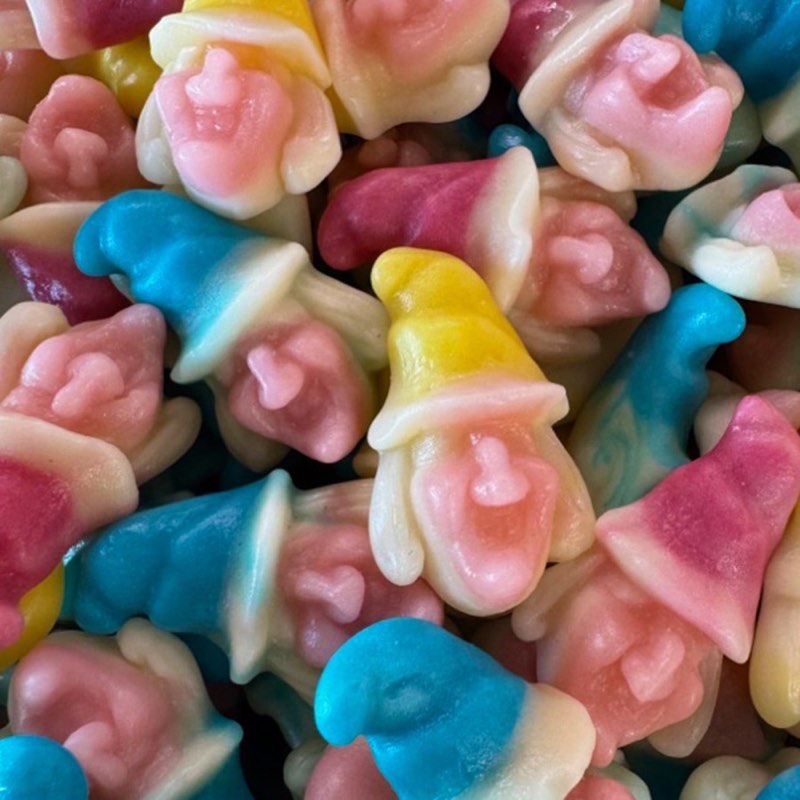
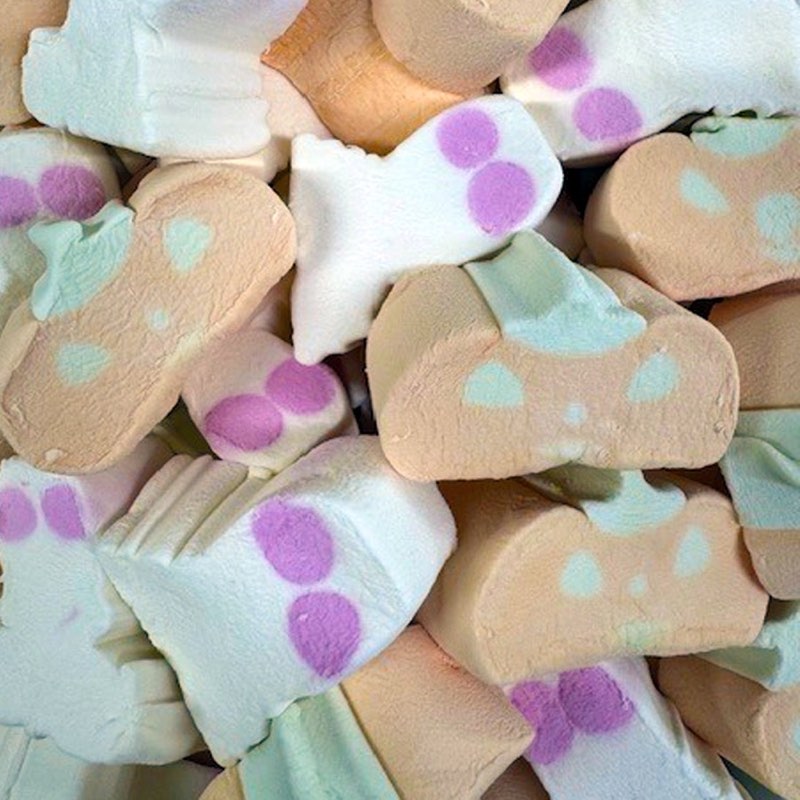
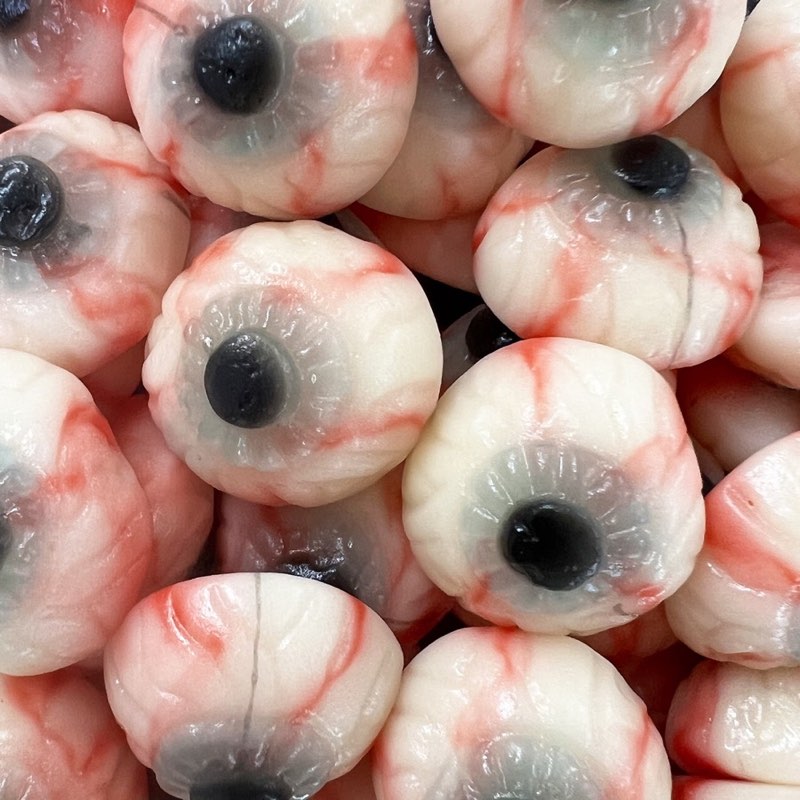
For a themed hamper, this sweet pulls in a specific direction, and the shop supports it. A novelty-shape hamper built around recognisable moulded forms is an easy, genuinely funny gift: Kingsway Jelly Eyeballs at £5.49 and Kingsway Witches Heads at the same price extend the joke, and Pumpkin & Ghost Marshmallows at £5.49 add a soft texture so the whole box is not one long chew. Build it around a colour or a theme rather than around what you personally like, and it reads as designed.
Two practical notes. Buy one size up from what you think you need, because gift bags always end up smaller than intended once they are split. And if the parcel is going a distance in warm weather, add nothing chocolate to the box — the wider candy and chocolate aisle is full of things that are better handed over in person than posted in July.
Parties, journeys and the sweets people talk about
At a children's party these do a specific job that no ordinary jelly does: they produce a shared event. Everyone shows everyone their tongue, there is a certain amount of shrieking, and a photograph gets taken. That is worth planning for rather than being surprised by. Put them out early, before anyone is wearing anything they need to keep clean, and put them somewhere with a hard floor rather than a carpet.
For older children and teenagers the appeal shifts from the colour to the sourness, and a fizz is the right level for a mixed group of that age. A genuine sour will split the room into people who love it and people who quietly do not eat it; a fizz keeps everyone in the game. If you want a dare element, add one small bag of something properly sour as a separate bowl rather than mixing it in, so people opt in.
Car journeys and long travel days are where the format earns its keep. One large chewy sweet lasts, occupies hands and mouth, and does not need unwrapping — and unlike anything chocolate it survives a hot car. The coating is the only caveat: it comes off on fingers, so this is a sweet for a journey with a packet of wipes rather than one with a pale upholstery and no plan.
For a sweet table at a bigger event — a birthday, a school fair, a christening — the blue is unusually useful, because there is very little naturally blue food and a blue bowl anchors a colour scheme immediately. Sit it next to something pale and something bright and the table reads as arranged. For the stall version of the same thing, buy a large size, split into paper bags at home and price per bag, which is faster on the day than weighing anything.
Film nights, sleepovers and gaming sessions all suit a long chew for the same reason: they are long events and you want sweets that pace themselves. A bowl of small fast sweets is gone before the first act ends. A bowl of dummies is still there at the credits.
The maths on £5.49
The standard bag is 250 g for £5.49 — £2.20 per 100 g. That is the middle of the road for our loose range, where a great many lines sit at exactly this price for this weight, so you can treat £5.49 as the baseline against which everything else on the shelf is cheap or dear.
| Size | Price | Per 100 g | What the step costs |
|---|---|---|---|
| 250 g | £5.49 | £2.20 | — |
| 500 g | £9.99 | £2.00 | +250 g for £4.50 |
| 750 g | £12.99 | £1.73 | +250 g for £3.00 |
| 1 kg | £16.49 | £1.65 | +250 g for £3.50 |
| 2 kg | £28.99 | £1.45 | +1 kg for £12.50 |
The column to read is the last one. The first step up is the weakest value in the range — £4.50 for another quarter kilo, only 99p less than buying a second small bag outright. The second step is the good one: £3.00 for another 250 g, which pulls the unit price down from £2.00 to £1.73. If you are going past the small bag at all, going to 750 g rather than stopping at 500 g is the decision that actually saves money.
Beyond that it flattens. The kilo at £16.49 is £1.65 per 100 g, a modest improvement, and the 2 kg at £28.99 gets you to £1.45 — a third off the small-bag rate, but two kilos of one sweet is a commitment. For a household it is too much; for a stall, a fête or a large party where these are the anchor line, it is the right call.
Portioning is easier with this format than with most, because the pieces are big enough to count. Think in pieces rather than grams for planning: a handful is two or three, a generous party serving is four or five, and one is a perfectly reasonable single treat given how long it lasts. In grams, 25 g is a small serving and 50 g a full one, which makes the 250 g bag five generous servings or ten modest ones, and the 750 g bag fifteen generous ones.
If you are building a mix rather than buying these alone, the arithmetic changes shape. Buy your bulk and filler lines in the larger sizes where the per-gram price is low, and buy your anchor and spike lines small, because you need far less of them. A bag that is one-fifth dummies and four-fifths supporting sweets costs much less than five equal bags and eats considerably better.
Keeping the fizz
Everything about storing this sweet comes down to protecting the coating, because the coating is what will change first. It is a dry surface layer and it responds to damp air by going tacky and then by disappearing into the body of the sweet. A bag left open in a steamy kitchen loses its fizz noticeably within days, and what you are left with is a perfectly decent fruit chew with none of the character you paid for.
So: keep it sealed, keep it dry, and keep it away from the kettle, the hob and the bathroom. An airtight tub is better than a clipped bag, and pressing the air out before sealing is better still. A cool, dark cupboard is the right home. Avoid the fridge — it is a damp environment once the bag comes out and warms up, and condensation is precisely what ruins a fizzy coating.
Heat is the second problem and it affects the body rather than the surface. Chewy sweets soften considerably when warm, and warm pieces pressed together in a bag will fuse into a block. They will still be fine to eat, but you will be prising them apart. If you have left a bag in a car or on a sunny shelf, half an hour somewhere cool firms them up again and they separate far more easily.
For the larger sizes, split on arrival. Decant a week or two's worth into a smaller tub and leave the rest sealed. The mistake people make with a 1 kg or 2 kg bag is opening it repeatedly over months, which exposes the whole quantity to air every time and leaves the bottom half in worse condition than the top. Splitting also means you can put out a full bowl without committing the entire bag to a warm room for an evening.
On a table, refill a shallow bowl rather than filling a deep one. Pieces at the bottom of a deep bowl carry the weight of everything above them and will stick together over a long party, and the loose coating that comes off collects at the bottom where nobody eats it.
Which size to order
First time, take the 250 g at £5.49. Fizzy coatings are the single most divisive thing on the sweet counter after liquorice, and a quarter kilo is the right amount to find out where your household sits.
For a regular household supply, 500 g at £9.99 is the standing size. It is not the best value step but it is the practical one — enough to last a few weeks in a tub without turning into a catering problem.
For a party or an event, go to 750 g at £12.99. That is the sharpest value in the ladder at £1.73 per 100 g, and fifteen generous servings covers most children's parties when these are the anchor among three or four bowls.
The 1 kg at £16.49 suits a large gathering or somebody splitting bags for gifts. The 2 kg at £28.99 is a trade quantity for a stall or a fair — best value per gram by a distance, and only sensible if you have somewhere cool and airtight to keep it and a firm plan for using it.
If you cannot decide between this and its sibling, note that they are the same price at every size, so mixing two 250 g bags costs exactly the same as one 500 g bag of either and gives you two flavours and two colours instead of one.
Where to go next on the site
This line sits on an unusually large number of shelves, which is a good thing when you are browsing. It is on everything of theirs we carry — 75 products, which is one of the deepest single-brand shelves here and worth a scroll if the moulded-shape style appeals. It is on the chewy and fizzy type shelves, which are the two texture routes into it. And it sits on both diet shelves, which is the fastest way to build a spread for a mixed household.
The closest single product to this one is the bubblegum version of the same dummy, also £5.49 for 250 g — same format, same fizz, same tongue-painting trick, but a pink piece and a bubblegum flavour instead of a blue one and a general fruit. If you are buying for more than one person, having both on the table is the easy answer, because bubblegum and fruit divide a room fairly evenly.
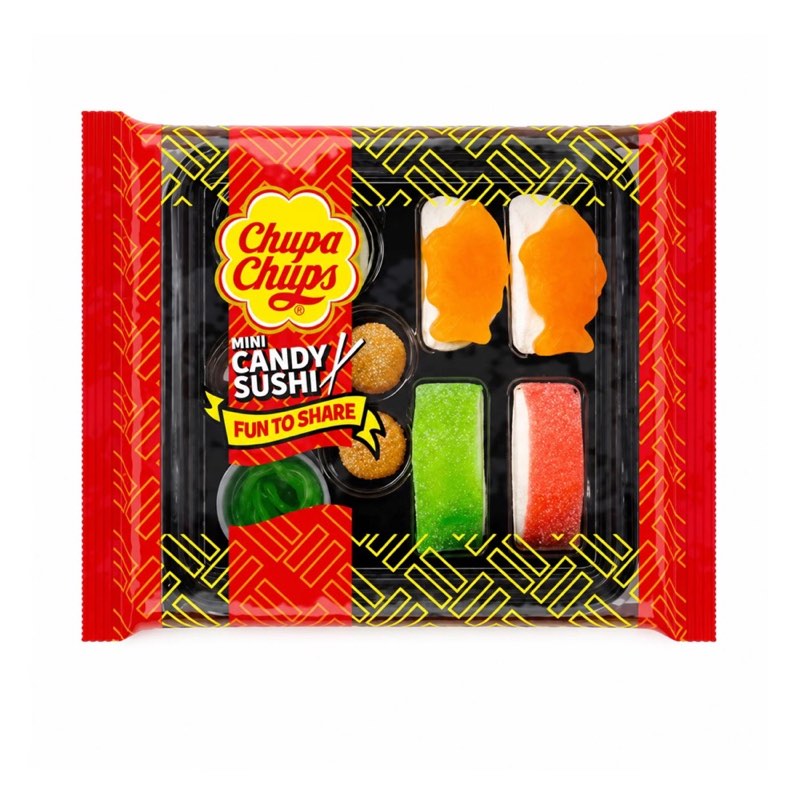
Further afield, the Haribo shelf is where to look for the widely familiar formats that make a mix feel safe, and the Chupa Chups Mini Candy Sushi Tray at £2.99 is the opposite instinct — a small novelty presentation piece that makes a gift box look considered. For everything at once, the full shop is the widest view we have.
Questions people ask before buying
How sour are they, really?
Fizzy rather than sour, and the difference matters. The fizz sits on the surface as a dry coating, so it hits immediately, peaks within two or three seconds and then clears completely, leaving a fruit chew behind. It is sharp enough to be the point of the sweet but a long way short of the dedicated sour lines, which keep going and are genuinely uncomfortable for some people. Most children who refuse proper sour sweets are fine with a fizz like this.
Does it really turn your tongue blue?
Yes — that is what a tongue painting sweet is for, and it works as advertised. The colour transfers while you are chewing and stays visible for a while afterwards, comfortably long enough to show somebody, which is the entire social purpose. It fades on its own. Worth timing sensibly if there are school photographs, a performance or anything formal that afternoon, and worth noting that it is not a subtle effect.
Are they suitable for vegans?
Our supplier lists this line as vegan and vegetarian, and that is the basis on which it appears on both of those shelves. We pass on the supplier's tagging rather than making our own assessment, so if it matters to you, check the manufacturer's packaging when the order arrives to confirm. That is good practice with any food gift in any case, particularly if there are allergies in the household.
How many pieces are in a 250 g bag?
We do not count them, and the number varies because moulded weights are not identical piece to piece — so we would rather not quote a figure we cannot stand behind. What we can say usefully is that these are large pieces, noticeably bigger than a standard jelly, so 250 g is fewer sweets than the same weight of small gums but each one lasts considerably longer. For planning, count four or five as a generous party serving.
Will they stick together in the bag?
They can if they get warm. Chewy sweets soften in heat and pressed-together pieces will fuse, which is annoying rather than serious — half an hour somewhere cool firms them up and they come apart. Storing the bag sealed in a cool cupboard away from the kettle and the hob prevents it. In the larger sizes the problem is worse simply because of the weight pressing down, which is another reason to split a kilo bag on arrival.
Which size gives the best value?
The 750 g at £12.99, working out at £1.73 per 100 g. The step from 250 g to 500 g costs £4.50 and barely moves the unit price, but the next £3.00 buys another 250 g and drops it properly. Above that the gains are small — £1.65 per 100 g at a kilo, £1.45 at two kilos — so the biggest bags only make sense if you genuinely have an event or a stall to feed.
What goes well with them in a mix?
Something small and fast, something soft and unfizzed, and something hard that takes time. The dummy is a big slow anchor, so the rest of the bag should supply contrast rather than more of the same. Avoid stacking several fizzy lines together, because the coatings compete and the bag ends up tasting like one long sharp note instead of a sequence. One fizz, one spike, and the rest quiet is the reliable ratio.
Can I post them as a gift?
They travel better than most sweets. Chewy pieces do not shatter, melt or crumble, and a flattened bag fits a letterbox parcel where a rigid item will not. The coating is the only vulnerable part and it only suffers in damp conditions, so seal the bag inside the parcel rather than relying on the outer packaging. Avoid sending anything chocolate in the same box in warm weather.
Do they contain any allergens?
We do not publish ingredient or allergen information for this line, because we do not hold verified data for it and guessing would be worse than useless. The manufacturer's packaging is the authority, so check it when the order arrives and before anyone eats any — particularly if you are buying for a party, a classroom or anyone else's children, where you cannot ask everybody individually.
Are they too big for young children?
They are a large whole chewy sweet, which is a choking risk for young children — so supervise, have them sit down to eat, and consider cutting a piece for the smallest. Older children manage them without difficulty and generally prefer the size, since a big sweet is the point. As with everything on this counter, they are a treat rather than a snack, and one large piece goes a long way because the chew lasts.
What is the difference between this and the bubblegum one?
Colour and flavour, nothing else. This one is blue with a general fruit flavour; the other is pink with bubblegum. Same brand, same dummy mould, same fizzy coating, same £5.49 for 250 g and the same ladder above it. Fruit is the safer choice for a mixed room because almost nobody dislikes it, while bubblegum is more divisive and has a stronger pull for the people who do like it. Buying one of each costs no more than a 500 g bag of either.
Last word
A fizzy tongue painting dummy is a corner-shop sweet in the proper sense: a big obvious shape, a sharp opening that announces itself, a long chew underneath, and an effect you can show somebody. It is built to be one line in a bag rather than the whole bag, so buy it as the anchor and put quieter things around it. Our supplier lists it as vegan and vegetarian, which makes it an easy call for mixed households and for gifts where you only half know the recipient's habits. Take the 250 g at £5.49 to start, step to 750 g at £12.99 when you are feeding a room, and keep the bag sealed somewhere cool so the fizz is still there when you open it.
More from Kingsway
More chewy sweets
More fruit sweets

Where this sits
Kingsway Vegan Fizzy Tongue Painting Dummies appears on these shelves. Browse them, or jump to something nearby.
You might also like