Home / Loose Sweets / Vidal Rainbow Belts

Vidal · 250g
Read the full guide
Vidal Rainbow Belts
£5.49
✔ In stock — ready to ship
Fresh stock
Free over £20
Same-day dispatch
Secure checkout
Most product pages leave the money until the end. This one starts there, because the sizing on this particular line is where the interesting decision is, and because a multi-coloured belt is the sort of sweet people buy in quantity rather than one bag at a time.
The bag in front of you is 250g at £5.49. That is £2.20 per 100g. Every other size runs cheaper, and the drop is steeper than most shoppers assume.
The full guide to Vidal Rainbow Belts
5,221 words on how it eats, who it suits, how to serve it and what to put beside it.
Start with the arithmetic
| Size | Price | Cost per 100g | What you save against 250g bags |
|---|---|---|---|
| 250g | £5.49 | £2.20 | — |
| 500g | £9.99 | £2.00 | 99p, against two 250g bags at £10.98 |
| 750g | £12.99 | £1.73 | £3.48, against three at £16.47 |
| 1kg | £16.49 | £1.65 | £5.47, against four at £21.96 |
| 2kg | £28.99 | £1.45 | £14.93, against eight at £43.92 |
The single most useful way to read that table is to look at what each step up actually costs you in cash for the extra sweets. Going from 250g to 500g costs £4.50 for an additional 250g — which is to say the second quarter-kilo costs you less than the first one did. Going from 500g to 1kg costs £6.50 for another 500g, or £1.30 per 100g on the extra alone. And the jump from 1kg to 2kg costs £12.50 for another kilo, at £1.25 per 100g. Once you are past the first bag, the marginal sweets get cheap quickly.
Now translate that into people. A generous adult helping of belts — enough to feel like a proper serving in a bowl, not a token — is roughly 40g. A child's helping at a party, alongside other things on the table, is nearer 25g. So:
- 250g at £5.49 is about six adult helpings, or ten children's portions, at roughly 88p and 55p a head respectively.
- 500g at £9.99 covers a dozen adults or twenty children, at 83p and 50p.
- 1kg at £16.49 does twenty-five adult helpings or forty children's, at 66p and 41p.
- 2kg at £28.99 gets you fifty adult helpings or eighty children's, at 58p and 36p.
Those per-head numbers are the ones worth quoting to yourself when you are standing over a spreadsheet for a school fair or a christening. Sweets are one of the very few things on a party budget that get materially cheaper per person the more people you invite, and a 2kg bag at £1.45 per 100g is about as far as that logic goes on a loose line.
There is a limit, though, and it is not financial. Buy more than you will finish in a couple of months and the saving is theoretical, because a bag that spends eight weeks being opened and reclosed does not stay in the condition it arrived in. The right size is the one that matches how fast you actually eat, and for most households that is the 500g rather than the kilo.
What comes out of the bag
Colour is the whole first impression here, and it is worth being precise about what that does. Our listing records this line as multi-coloured, and a heap of multi-coloured belts behaves completely differently in a bowl from a heap of single-colour ones. A bowl of red sweets reads as one object — a red mass. A bowl of multi-coloured belts reads as a hundred individual things, because your eye keeps finding edges. That is why a relatively small quantity of these fills a table visually, and it is why they photograph better than almost anything else on the loose counter.
In the hand, the belt is a flat strip with real length to it — long enough to hang, fold, drape and dangle. It has a matte surface with a faint grip to it rather than a slick shine, which is the coating that puts this line on our fizzy sweets shelf and our sour shelf at the same time.
Eating one is a sequence rather than a single event. First comes the coating, which lands on the tongue as a sharp, prickling lift — enough to make the mouth water, not enough to make anybody pull a face. It is a waking-up sourness, the kind designed for a sweet you will eat several of, rather than the aggressive sort that exists to be filmed. Then the chew takes over: dense, springy, with genuine resistance before it gives. That is the character that files it under jellies and gummies, though it eats nothing like a moulded gummy. A moulded sweet is one bite and gone. A belt is a strip you work through, and the format alone doubles or trebles how long a given weight of sweet lasts.
The flavour is listed simply as fruit. We are not going to invent a line-up for you, and we would rather say plainly that the listing gives a fruit flavour and leave it at that than guess at which fruits and in which order. What can be said honestly is how a multi-fruit belt behaves in the eating: the sour coating comes first and is broadly consistent across the strip, and the fruit character sits underneath it, arriving as the chew warms up and lasting well past the point where the fizz has gone. The finish is clean rather than clinging. It does not coat the teeth and it does not leave the dry, chalky afterfeel that some heavily coated sour sweets do, which is precisely why people eat four in a row without noticing.
A note on temperature, because it changes the sweet more than most people expect. Cold from a cool cupboard, the chew is firmer, the belt snaps rather than stretches, and the sour reads sharper because you are working harder to get at what is underneath. Warm from a summer table, it stretches, softens, and the fruit comes forward while the fizz feels gentler. If a bowl of these tastes milder at the end of a July afternoon than it did at the start, that is the reason, and it is not a fault.
The shopper this bag is really for
Three sorts of people buy multi-coloured belts by the bag, and only one of them is a child.
The first is anybody assembling something for somebody else — a hamper, a jar, a party bag, a parcel going in the post. Belts are the workhorse of that job, for reasons we will get into properly below. The second is the mixer, building a bowl or a jar out of six lines and needing something that provides length and colour spread rather than another round sweet. The third is the household buying sweets as a standing item, where the thing that matters is that everybody in the house will eat them. Multi-coloured beats single-flavour on that last point almost every time, because nobody has to be the person who does not like strawberry.
What all three have in common is that they are buying belts for a job, not for a craving. This is a useful, structural sweet — the one that makes other things work. It is rarely the most exciting thing in a bowl and it is very often the thing without which the bowl would not look right.
Our supplier lists this line as vegetarian, which matters more than usual on a gift or a shared table, where you want something you can put down without a conversation about it. Everything carrying that supplier tag sits together on our vegetarian-tagged shelf. We pass the tag on exactly as it is given to us and we do not stretch it any further than that.
Sending sweets to people: hampers, letterboxes, teachers and parcels
Sweets are a strange gift. They are cheap enough that they cannot carry the weight of a serious occasion, and they are personal enough that they land better than most things of the same price. Get the format right and a £10 bag of sweets is a better present than a £25 candle, because it will be used, it will be shared, and nobody has to find a shelf for it. Get the format wrong and you have sent somebody a bag of melted disappointment. Belts are one of the safest formats in the shop for this, and it is worth going through why, piece by piece.
They survive the journey. This is the first and largest consideration and the one most people skip. Chocolate is a gamble from April to October. Anything hard and shell-coated can crack. Anything powdery leaks. A belt has no shell to break, nothing to run, and nothing to escape a bag. It can be squashed and it will be fine — squashed belts separate again and are indistinguishable from unsquashed ones. That resilience is why they turn up so often in posted parcels and so rarely in complaints.
They fill a space honestly. Hampers have a structural problem: the gaps. A hamper with four good things in it and visible air between them looks mean, no matter how good the four things are. Traditionally that gap is filled with shredded paper, which is filler and everybody knows it. Belts fill the same space and are a present. A 250g bag distributed around a medium hamper does the work of a handful of paper and adds £5.49 of actual gift. For a larger basket, the 500g at £9.99 is the right call, and the per-gram saving means you are filling more space for less than twice the money.
They work through a letterbox. The letterbox gift is now a category of its own, and the constraint is depth, not weight. A 250g bag of belts flattens. That is not true of a tub, a jar, a box of chocolates or anything moulded in a rigid tray. If you are sending something that must go through a standard letterplate without a card being left, a flat bag of belts is one of the few sweets that genuinely complies. The Vidal Strawberry Belts at the same £5.49 flatten identically, and two flat bags side by side make a more interesting letterbox parcel than one bag of anything.
They are a safe choice for somebody whose tastes you do not know. This is the teacher-gift problem, the secret-Santa problem and the new-colleague problem all at once. You are buying for somebody whose preferences you genuinely cannot guess, and the failure modes are strong opinions: liquorice, mint, aniseed, coffee, anything alcoholic. A multi-coloured fruit belt has no strong opinion attached to it. It is not challenging, it is not niche, it does not require the recipient to like a specific thing. If you have to pick one sweet for a stranger, pick this category.
They divide. A gifted bag of belts can be shared out in a staffroom, split between siblings, or put into a bowl for visitors without anybody having to cut anything or fetch a plate. A box of chocolates with twelve pieces creates a small social negotiation. A bag of belts does not. For a care parcel going to somebody in a shared house, a hall of residence or a ward day room, that divisibility is most of the point.
They decant well. A bag is a bag. A jar of belts, with the colours packed against the glass, is a present. If you are gifting rather than posting, this is the single highest-return thing you can do: tip 500g into a decent clip-top jar and you have turned a £9.99 bag into something that looks like it cost three times that. Fill the jar properly — a half-empty jar looks worse than no jar at all, which is exactly why 500g rather than 250g is the right buy for this purpose.
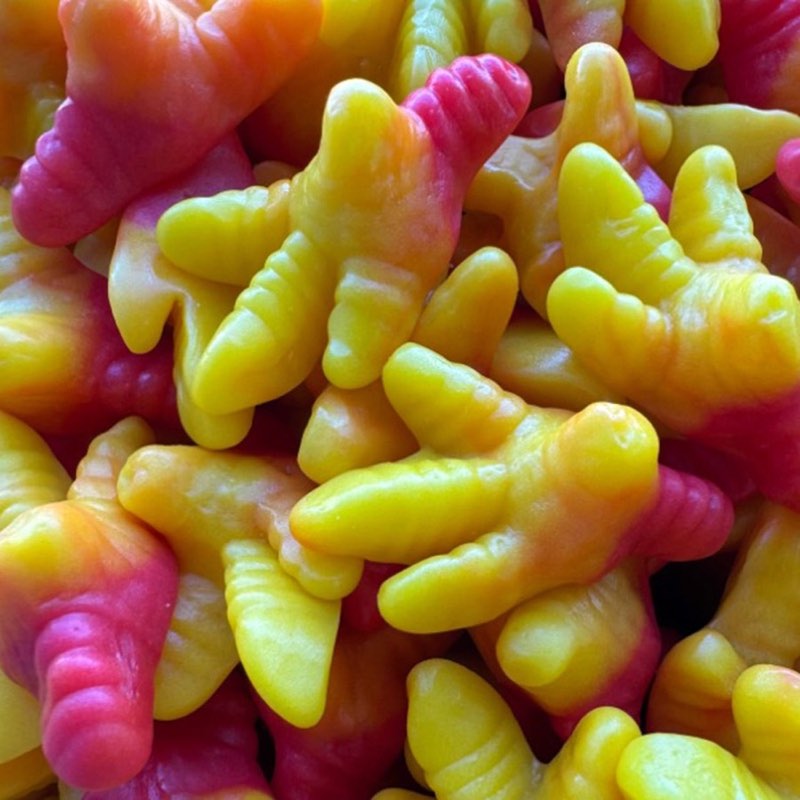
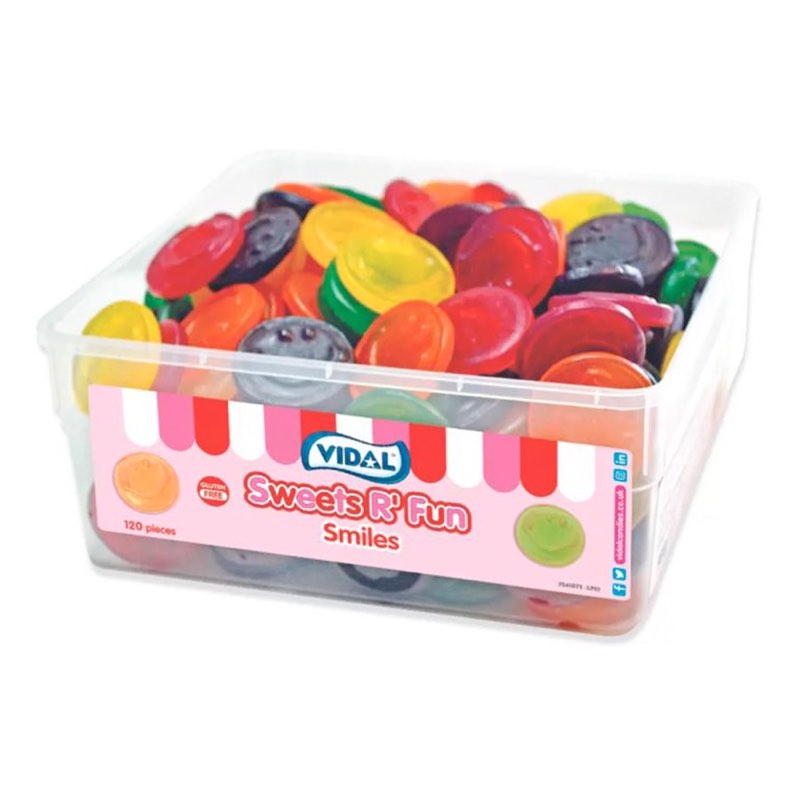
They pair well with a centrepiece. The best sweet gifts are one showy thing plus volume around it. The Vidal Happy Smiles tub at £7.99 arrives already presented and makes an obvious centrepiece, with belts packed around it to fill the basket. For a gift with a bit of humour in it, Vidal Chicken Feet at £5.49 are the sort of thing that gets photographed and sent to a group chat, which is a legitimate objective for a present. For something softer in intent, Vidal 3D Triple Hearts, also £5.49, carry the occasion in the shape without you having to write anything on the card.
Match the size to the relationship. This sounds glib but it is the practical rule. A 250g bag at £5.49 is a thank-you, a stocking filler, a hamper component, a thing you hand over at the school gate. A 500g at £9.99 is a present in its own right, especially decanted. A 1kg at £16.49 is a joint present for a household or a staffroom. The 2kg at £28.99 is not a present at all — it is stock, for whoever is running the table.
One honest caution. Sweets are a treat rather than everyday food, and if you are sending them to a household you do not know well, it is worth a word on the card about that. Small hard sweets and whole gummies are a choking risk for young children and want supervision. And if there is any chance of an allergy at the other end, tell the recipient to check the manufacturer's packaging on the bag when it arrives, before anybody eats anything. That is the sensible thing to say with any posted food, and it costs nothing to say it.
What a belt does in a mixed bag
Ask anybody who builds pick-and-mix for a living what the hardest part is, and they will not say flavour. They will say shape. A mix that tastes varied but looks uniform is a bad mix, because people eat with their eyes first and a bag of identically sized spheres reads as one thing however many flavours are in it. Belts exist to solve that, and understanding exactly how they behave next to other sweets is the difference between a bag that looks assembled and a bag that looks tipped out of a machine.
They are the only common format with length. Almost everything else on a loose counter is a ball, a bear, a bottle, a ring, a cube or a disc — all of which settle into a heap. A belt does not settle. It drapes, it loops, it hangs over the rim, it runs diagonally through a bag. Put six of them into a 400g mix and the whole thing gains structure. Take them out and it collapses back into gravel. This is a real and reproducible effect, and it is why belts are in almost every professionally built mix you will ever buy.
They spread colour instead of concentrating it. A single-colour sweet contributes one block of colour to the bowl, and beyond a certain quantity it dominates. A multi-coloured belt contributes a spread. This means you can use a lot of them without the mix reading as one hue — the opposite of what happens if you use a lot of one bright single-colour line. If you are building a rainbow-themed bowl for a birthday, these do most of the job on their own.
They set the pace of the bag. Every mix has an eating speed, and it is set by the slowest item people actually reach for. A bag of foam sweets and jellies is gone in ten minutes. Add belts and the same bag lasts an hour, because a belt takes time and the person eating it is occupied while they do. For a film, a car journey or a long afternoon, that pacing is the point. If you want a mix that disappears quickly — a buffet at the end of a party, say — belts are the wrong core and you should build around softer, faster formats.
They do not bully their neighbours. This is the quiet virtue. Some sweets cannot share a bag: mint and aniseed transfer their character to everything within a sealed container, and strongly perfumed lines do the same over a few days. A fruit belt with a mild sour coating transfers almost nothing. You can put it in with anything. That makes it the safe base layer of a mix in a way that a liquorice line never is.
What to build around them. A good mixed bag has four jobs filled: the length, the sharp one, the soft one and the chew. Belts cover the first outright. For the sharp one, Barnett's Mega Sour Fruits Candy Bags 104g at £3.99 bring real bite without straying out of the fruit conversation, and Park Lane Sour Blackcurrant Rings at £5.49 add a darker, deeper fruit note that most mixes are missing entirely. For the soft one, Barratt Jelly Love Hearts, also £5.49, are gentle, small and easy to scatter. For the long chew, Taveners American Hard Gums at £5.49 give you a firm gum that slows the bag down further still.
Adding a note that is not fruit. Almost every mix is built entirely out of fruit, and the result is that by the third handful everything tastes the same. One non-fruit line fixes this. BUBS Cool Cola Skulls at £7.50 are the usual answer — cola sits alongside fruit without competing, and it resets the palate between handfuls. Drumstick Chew Bars in a 10 pack at £2.50 do a similar job in a different register, and they come wrapped, which is handy if the mix is going into individual party bags.
The novelty slot. If the mix is for children, one item that is more of an activity than a sweet raises the whole thing considerably. The Fuji Candy DIY Handmade Ramen Kit 20g at £2.99 is the kind of thing that gets opened first and talked about afterwards, and at that price it is a cheap way to make a bag memorable.
Proportions that work. For a 1kg mixed jar, a sensible split is around 30% belts, 25% soft jellies, 20% chews, 15% sour, and 10% novelty or wrapped items. You can move those numbers a long way before the jar stops working, but the two failure modes are consistent: too much sour and nobody finishes it; not enough length and it looks like animal feed.
If you would rather not do any of this yourself, our pick and mix section has jars and platters already built, and the loose sweets counter — 356 lines — is where you go to do it properly from scratch.
The fruit family, and where a mixed-fruit belt sits in it
Our listing gives this one a fruit flavour rather than naming individual fruits, and it sits on the fruit flavour shelf with 160 other lines. That shelf is enormous for a reason: fruit is the default setting of confectionery, and almost everything else is a variation on it.
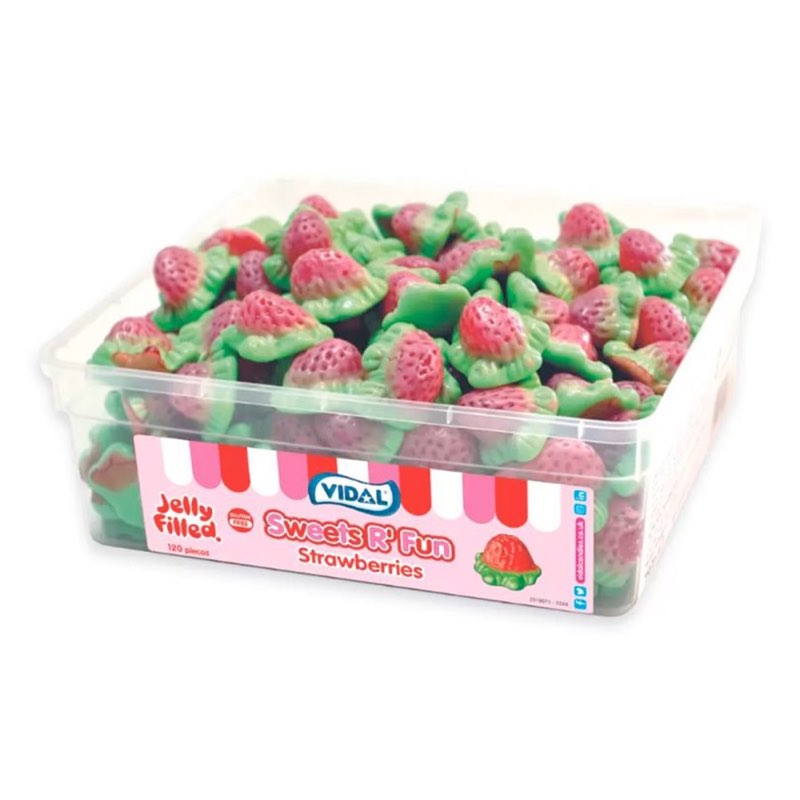
It helps to think of fruit sweets in four registers rather than by named fruit. There is the bright register — high, sharp, usually paired with a sour or fizzy surface, which is where these belts sit. There is the round register, deeper and jammier, which is what you get from denser uncoated formats like Vidal Jelly Filled Strawberries in a tub at £7.99, where the filled centre softens the delivery considerably. There is the green register — apple, pear, lime — tart and cutting, best represented here by Vidal Apple Belts at £5.49, which are the same format in a single sharp note. And there is the confected register, where the flavour is not pretending to be a fruit at all but a fruit sweet you remember, which is most of what the retro counter trades in.
A mixed-fruit line is useful precisely because it covers several of those registers in one product. Buying one mixed line plus one deliberately different line gets you further than buying three named fruits that all land in the same register. If you want a bowl with genuine range, put these next to Haribo Giant Strawbs at £5.49 — dense, moulded, no sour coating, a completely different pace — or Kingsway Fizzy Strawberries, also £5.49, which give you the fizz in a small bite-sized shape rather than a long strip.
Occasions where the colour does the work
Some sweets need a theme built around them. This one supplies its own. A bowl of multi-coloured belts is already a decoration, which means it earns a place on tables where a plain bowl of sweets would look like an afterthought.
Children's parties are the obvious case, and belts behave well at them in ways that have nothing to do with taste. They do not melt onto a tablecloth. They do not fuse into a single block. They can be handled and put back without ruining the bowl. They can be torn into shorter lengths for smaller children. And 250g looks like considerably more than 250g when it is spread across two small bowls rather than piled into one — worth knowing, because children take from whichever bowl is closest and a single bowl empties in one visit.
For birthdays with a rainbow or a bright colour theme, these are close to essential and a lot cheaper than the coordinated decorations people usually buy. For a christening, baby shower or anything with a soft palette, they are the wrong sweet entirely — the colours are loud and they will fight the table.
For film nights, belts have one specific advantage that gets overlooked: they are silent. No wrapper, no crunch, no rustling tub. You can eat one through quiet dialogue without anybody turning round. Very few sweets manage that.
For Halloween, the colour is too cheerful on its own, but belts work well as a component — draped around something stranger. Vidal Jelly Filled Brains at £7.99 handle the centrepiece brief and belts fill the platter around them.
For school fairs, stalls and fundraisers, the 2kg at £28.99 is the format. At £1.45 per 100g you can bag up 40g portions costing 58p each and price them sensibly with a proper margin left for the cause. Belts also bag up more neatly than round sweets, which matters when you are filling two hundred bags the night before.
Keeping a bag in good condition
Three things preserve belts: cool, dry, sealed. The first two matter more than people think, and the third is the one that actually gets forgotten.
Warmth is the common problem, and it does not take much — a sunlit shelf or the cupboard above a radiator is enough. Warm belts soften and lean into each other, so that pulling one out brings its neighbours. Nothing is wrong with them; they are just harder to serve and less pleasant to handle. Half an hour somewhere cool firms them up and they separate cleanly.
Damp is the subtler issue and the one that specifically affects a fizzy, sour-coated sweet. The coating is a surface, and surfaces take up moisture from the air. A bag left open in a kitchen full of steam loses its prickle within a day or two. The belt underneath is unchanged; what has gone is the sharp opening, leaving a plain chewy fruit strip. That is the real reason the last few belts in a bag often taste flatter than the first few, and it is entirely avoidable.
So clip the bag, or tip it into something with a proper seal. A clip-top jar is ideal and looks better on a shelf. A freezer bag with the air pressed out is the cheap version and works nearly as well. Do not use the fridge: the temperature is fine but the humidity in there is not, and the coating suffers for it.
If you have bought 1kg or 2kg, split it. Keep a working jar out and leave the rest sealed, so you are only ever exposing a fraction of it to the room. And do not store belts in the same container as mint, aniseed or anything else with a strong character — those transfer through the air inside a sealed jar and will take over a fruit sweet within a week.
Which size, honestly
The belts are identical across all five sizes. Nothing changes but the quantity and the price per gram, so the decision is purely about your rate of consumption and what you are doing with them.
Buy the 250g at £5.49 if you are trying the line, filling one slot in a hamper, sending something flat through a letterbox, or buying several different flavours rather than a lot of one. Buy the 500g at £9.99 if you are gifting a filled jar, feeding a household steadily, or catering a small party — this is the size most people should be buying most of the time, and the 99p it saves against two smaller bags is the least of the reasons. Buy the 1kg at £16.49 for a proper party, a large jar with top-ups, or a shared office. Buy the 2kg at £28.99 only if you are running a stall or a fair, where £1.45 per 100g makes the maths work and the volume will move in a day.
The wider Vidal range runs to nineteen lines with us, and belts are only the entry point. The tubs present better as gifts, the filled shapes bring a second texture, and the novelty lines exist for tables that need a talking point rather than another bowl of fruit.
Finding your way round the rest of the shop
This product is filed under several headings at once, and you probably arrived through whichever one matched what you were after. The chew puts it on the jelly and gummy shelf. The coating puts it on both the fizzy and sour shelves. The format and the counter it comes from put it on our retro shelf, alongside the lines that still taste like a self-serve sweet bin. The flavour puts it on the fruit shelf, and the supplier tag puts it with the vegetarian-listed lines.
If you are browsing rather than hunting for something specific, the complete range is the widest door, and the candy and chocolate section is the one to use if you want chocolate in the same order as your loose sweets. For shopping by maker rather than by type, the Kingsway shelf is where a lot of the traditional counter lines sit, and the Haribo shelf covers most of what people mean when they say gummy.
Things people ask before ordering
Which fruits are in the mix?
Our listing records the flavour as fruit and the colour as multi-coloured, and we are not going to guess beyond that. What we can tell you honestly is that it eats as a mixed-fruit belt with a sour, fizzy coating over a firm chew, and that the fruit character is the part that lasts once the fizz has gone. If the exact line-up matters to you, the manufacturer's packaging on the bag is the place to check when it arrives.
How sour is it?
Moderate. It is on our sour shelf and the first contact with the tongue genuinely prickles, but this is a sweet designed to be eaten repeatedly, which means it has to stop short of unpleasant. Anybody who finds extreme sour lines uncomfortable will be fine here. Anybody actively looking for something punishing should keep browsing the sour shelf for something built for that job.
Is this a good present on its own?
The 250g on its own is a small thank-you rather than a present. The 500g decanted into a jar is a proper gift and looks like it cost more than £9.99. If you want it to stand alone, spend the extra and fill something glass — presentation is doing most of the work at this price point.
Will it survive the post?
Better than most sweets. There is nothing to melt and nothing to shatter, and squashing does no lasting harm — belts separate again and are none the worse. A sealed bag in a padded envelope is fine. In high summer, send the 250g rather than a kilo, since a smaller quantity is less likely to compress into a single block in a warm sorting office.
Will it fit through a letterbox?
A 250g bag flattens well and is one of the few sweet formats that reliably does. Tubs, jars and rigid trays do not. If the delivery depends on going through a standard letterplate, a flat bag is the right shape and a tub is not.
Is it vegetarian?
Our supplier lists this line as vegetarian, and we pass that on exactly as given. We do not extend it to a vegan claim and would not make one. Everything with that supplier tag is gathered on one shelf on the site if you want to browse by it.
How much do I need for twenty children?
If belts are one item among several on a table, 500g is comfortable — that is twenty 25g portions with a little spare. If belts are the only sweet, go to 1kg. Running out costs more in atmosphere than the £6.50 difference costs in money, and leftovers keep perfectly well if they are sealed.
Do they stick together?
They can, in a warm room, because the strips lie flat against each other and soften. They come apart with patience and the sweet itself is unaffected. Keeping the bag somewhere cool prevents it almost entirely, and chilling a clumped bag for half an hour makes it easy to separate.
Are they all right for young children?
Sweets are a treat rather than everyday food, and chewy sweets eaten quickly are worth supervising — small hard sweets and whole gummies are a choking risk for young children. With belts the sensible approach is to tear them into shorter lengths for smaller children rather than handing over a full strip. If there are allergies in the house, check the manufacturer's packaging when your order arrives before anybody eats anything.
What should I put with them in a mixed jar?
Fill four roles: the length, the sharp one, the soft one and something that is not fruit. Belts cover the length. A proper sour line covers the second, a soft jelly the third, and one cola or chew line stops the whole jar tasting like a single note by the third handful. Four lines chosen that way beat eight chosen at random.
How long does an open bag stay at its best?
Sealed and kept cool, weeks without a noticeable change. The limiting factor is the coating rather than the chew — exposed to damp air it loses its fizz within a couple of days while the belt underneath stays exactly as it was. A clip or a sealed jar is all it takes.
Is the 2kg worth it for a household?
Almost never. The price per gram is excellent, but 2kg takes a normal household months, and a bag that is opened and reclosed over months loses its coating long before it runs out. The 2kg is for stalls, fairs and events. For a home, the 500g is the right answer and the 1kg is the ceiling.
In short
A long, flat, multi-coloured strip with a sharp fizzy opening over a firm fruit chew, at £5.49 for 250g and down to £1.45 per 100g at 2kg. It is the most useful sweet in the shop for jobs rather than cravings — filling a hamper, going flat through a letterbox, giving a mixed jar some structure, feeding a room of twenty without anybody objecting to the flavour. Our supplier lists it as vegetarian. Buy the 500g if you are gifting it, the 250g if you are posting it, and keep whatever you buy sealed and out of the sun.
More from Vidal

More jelly & gummy sweets

More fruit sweets



Where this sits
Vidal Rainbow Belts appears on these shelves. Browse them, or jump to something nearby.
You might also like