Home / Loose Sweets / Vidal Happy Smiles Tub
Vidal · 900g
Read the full guide
Vidal Happy Smiles Tub
£7.99
✔ In stock — ready to ship
Fresh stock
Free over £20
Same-day dispatch
Secure checkout
Start with the number that actually decides whether this tub belongs in your cupboard. The Vidal Happy Smiles Tub is £7.99 for 900g. Divide one into the other and you land just under nine-tenths of a penny per gram, which is the sort of figure that means nothing until you turn it into something you can hold. So turn it into a handful. A comfortable adult handful of small jelly pieces sits at roughly 30g. At this price, that handful costs you about 27p. A child's handful, nearer 20g, costs about 18p. A generous scoop into a paper bag at 100g comes in a shade under 89p.
Those are the numbers worth carrying around, because they are the ones that change decisions. Most people buy sweets by the bag without ever working out what a portion costs, and then feel vaguely uneasy about whether they overspent. Here the arithmetic is unusually clean. Nine hundred grams divided into 100g bags gives you nine bags. Divided into 50g party portions it gives you eighteen. Divided into the small 25g handfuls you might drop into a lunchbox or a party bag, it gives you thirty-six — and at 22p a go, thirty-six of anything for £7.99 is the kind of maths that makes a tub look sensible rather than indulgent.
The full guide to Vidal Happy Smiles Tub
6,289 words on how it eats, who it suits, how to serve it and what to put beside it.
Doing the sums on a 900g tub
The reason a big tub beats several small bags is not mysterious, but it is worth spelling out. Every small bag you buy carries its own share of packaging and its own share of handling. Buy the same weight of sweets four times over in small formats and you pay for that four times. Buy it once, in one tub, and you pay for it once. That is the entire economic argument for buying loose sweets in bulk, and it is why the tub formats on our loose sweets shelf tend to look startling next to the same brand's single bags. The saving is real, but it is only a saving if you actually get through the tub, which is why the portioning maths matters as much as the headline price.
So do the guest maths before you buy, not after. If you are catering a children's party and you want each child to leave with a bag of jellies alongside whatever else goes in, budget 25g to 40g a head. At 40g, a 900g tub covers twenty-two children with a little left in the bottom, and costs you about 36p a child. Even at a generous 50g a head you are covering eighteen and spending 44p each. Set that against buying individual bags for eighteen children and the difference is not marginal; it is the difference between the sweets being a line item and the sweets being an afterthought.
For a household rather than a party, the same tub behaves differently. Work on the assumption that a tub left open on a kitchen counter disappears roughly twice as fast as a tub kept in a cupboard, and that a tub decanted into a small jar with the bulk stored away lasts longest of all. If two adults take a 30g handful each on four evenings a week, you are using 240g a week and the tub runs about three and a half to four weeks. That is 27p a person per evening. It is one of the cheapest small pleasures in the house, and knowing the figure tends to make people feel better about it rather than worse.
There is one more calculation worth doing, and it is the one most shoppers skip: cost per piece. Small jelly shapes of this kind run to a great many pieces per kilo, and while we do not publish a piece count, you can establish your own in thirty seconds by weighing ten of them on a kitchen scale and dividing. Once you know roughly what a piece weighs, you know what a piece costs, and you can size a party bag or a film-night bowl by eye ever after. It sounds fussy. It takes one measurement, once, and then you never have to guess again — and if you buy tubs regularly it will quietly save you more than any single discount ever will.
The last thing to weigh is not money at all, it is shelf space. Nine hundred grams of jelly sweets is a proper container, not a pouch. Before you order, look at where it is going to live. A tub that has nowhere to sit ends up open on a worktop, and a tub open on a worktop is a tub that gets eaten in a fortnight regardless of how carefully you did the sums.
What lands when the lid comes off
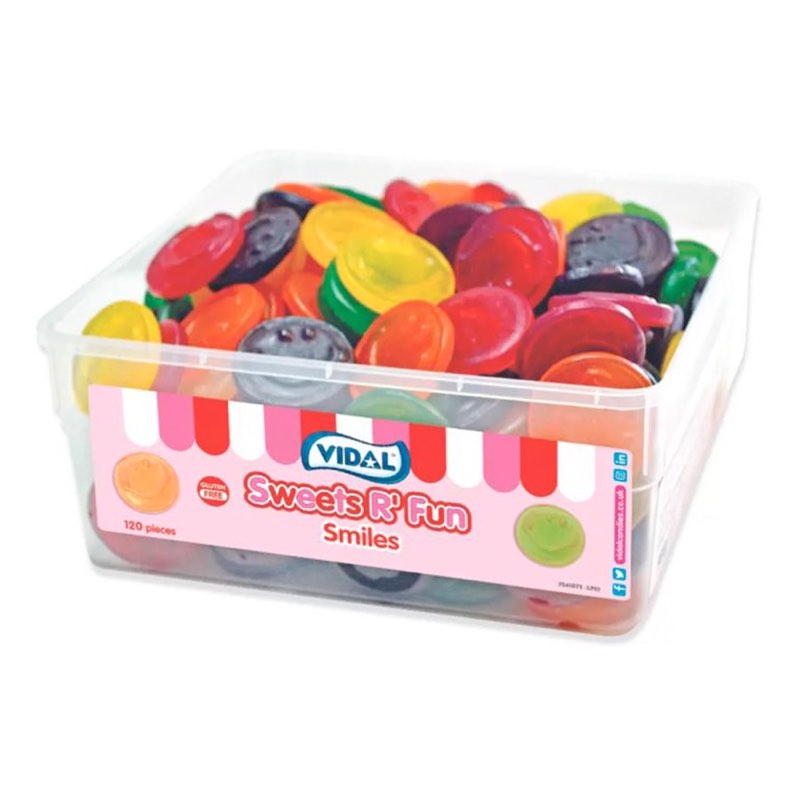
What you have here is a large tub of small smiling jelly shapes — the name tells you the shape and the shape is the point. Each piece is a little curved grin, and a tub of them poured into a bowl reads instantly as a crowd of tiny faces rather than as a bag of sweets. That is a surprisingly useful property. Most jelly sweets are abstract: rings, bears, bottles, cola shapes that you stop seeing after the first minute. A smile keeps announcing itself. Children pick them up and look at them before eating them, which is not something you can say about a fruit gum.
The tub itself is the standard large-format container we use across the loose range, and the first impression when the lid comes off is of volume. Nine hundred grams of small pieces fills more space than people expect, because small shapes pack loosely and leave air between them. Tip the tub gently and the contents move as a mass, with the faint dry rustle that tells you the pieces are separate rather than fused. That rustle is worth listening for: it is the single best indicator that a tub of jellies has been stored properly in transit.
Reach in and the individual piece is small enough to sit comfortably between finger and thumb without needing a grip. These are one-bite sweets for an adult and one-or-two-bite sweets for a child. Nothing about the format asks you to slow down, which is both the pleasure and the warning. If you want a sweet that rations itself, a big single piece does that job better. If you want a sweet that suits a bowl, a shared table and an unhurried evening, small shapes in quantity are exactly the right tool, and 900g of them is a very large tool indeed.
Grin, give and finish: how a smile eats
Hold one up to the light before you eat it. A small jelly shape has a character you can read from the outside: how much light passes through it, how glossy or matt the surface is, how sharply the moulded edges of the grin have held their definition. Pieces with crisp edges have been handled well; pieces that have softened at the edges have spent time somewhere warm. In a fresh tub you should be looking at well-defined shapes where the curve of the smile reads clearly from across a table.
The surface has a light dryness to it when you first pick a piece up, the fine dusting that keeps small jellies from welding themselves into a single block in a 900g container. That dust is doing a job. It is the reason you can pour rather than prise, and the reason a handful comes out as a handful rather than as a clump with three pieces hanging off it. You will find a little of it in the bottom of the tub as you get near the end, which is entirely normal and not a sign that anything has gone wrong.
Then the bite. Press a smile between your teeth and there is a moment of genuine resistance before it gives — not the instant collapse of a soft foam sweet, and not the long stubborn chew of something very firm, but a middle position where the piece pushes back for a beat and then yields cleanly. That first give is the most satisfying part of eating any moulded jelly, and small shapes deliver it more often per gram than large ones do, simply because you get more first bites out of the same weight. It is an underrated argument for small formats: you are buying more beginnings.
After the give, the chew settles into something springy rather than sticky. The piece breaks down in the mouth over a handful of chews, staying elastic almost to the end instead of turning to paste. You can feel it working against the molars. It is not a sweet that clings to the teeth in the way a toffee does, and it clears reasonably quickly once you have swallowed, which is precisely why a bowl of small jellies empties the way it does. Nothing lingers long enough to tell you to stop.
Flavour arrives in two stages. There is a quick sweetness in the first second, before the chew has really started, and then the fruit character builds through the middle of the chew as the piece breaks down and more of its surface meets the tongue. It peaks around the third or fourth chew and holds until you swallow, then falls away fairly fast and fairly cleanly. It is a short arc, not a long one, and short arcs are what make a sweet re-eatable. The tenth smile tastes very much like the first, which is both the appeal and the reason a 900g tub deserves a lid that closes properly.
Eaten one at a time and slowly, the flavours separate. Eaten by the handful — which is how most of this tub will actually be eaten — they blend into a general bright fruit impression with a strawberry lift through it. Both ways are legitimate. It is worth trying the slow way once, early in the tub, just so you know what you are eating for the next three weeks.
Who should have a tub of these in the house
This is a sweet for people who feed other people. If your kitchen regularly has more than two people in it — children, their friends, a partner's colleagues, a Sunday table — a 900g tub of small, cheerful, uncomplicated jellies is one of the most useful things you can keep in a cupboard. It suits everybody, it needs no explanation, and it does not require anyone to like sour things, or liquorice, or chocolate, all of which reliably split a room.
It suits parents doing party bags particularly well, and not only for the money. A smile-shaped sweet photographs well, looks deliberate in a bag or a cone, and reads as a choice rather than as whatever was on offer. Thirty-six small bags out of one tub is a party's worth of favours with the tub still warm from the delivery box.
It suits anyone running a sweet table at an event — a christening, a birthday, an office Christmas afternoon — because small uniform shapes are what make a jar look full and generous. Large sweets in a jar look sparse. Small ones look abundant. That is a genuinely useful thing to know when you are trying to make a table look like more than it cost.
It suits classrooms, clubs and teams, where a tub with a lid that goes back on is worth more than any number of individual packets. And it suits the ordinary household evening, where what you want is not a project but a bowl. If, on the other hand, you are shopping for one person who eats sweets rarely, 900g is more commitment than you need; a smaller bag from elsewhere in jelly and gummy sweets will serve you better and go stale less.
One honest caveat, and it applies to every whole gummy we sell: small moulded sweets are a choking risk for very young children and should be supervised. Sweets are a treat, not a staple. And if anyone eating them has an allergy, check the manufacturer's packaging on arrival before anyone eats anything — the pack in your hands is always the authority.
The collector's habit: shapes that come and go
There is a particular kind of sweet shopper who does not really buy flavours at all. They buy shapes. They can tell you which novelty formats turned up last autumn, which ones vanished, and which ones came back a year later slightly different. If that sounds like a small obsession, consider how much of the confectionery aisle is built on it: the shape is the product, and the flavour is what makes the shape edible.
Moulded jellies are the natural home of this. A mould is a fixed cost that pays back over a run, so a maker with a broad range can afford to keep a long tail of shapes alive — some permanent, some seasonal, some that appear once and never return. That is why a brand's shape list is worth browsing the way you would browse a catalogue. Look at the spread on the full Vidal range and you can see the logic working: anatomical novelties, romantic shapes, food-mimic shapes, belts and laces that are not moulded at all. Smiles sit in the permanent, everybody-likes-it end of that spread — the shape you keep in the range because it never offends anyone and never needs a season to justify it.
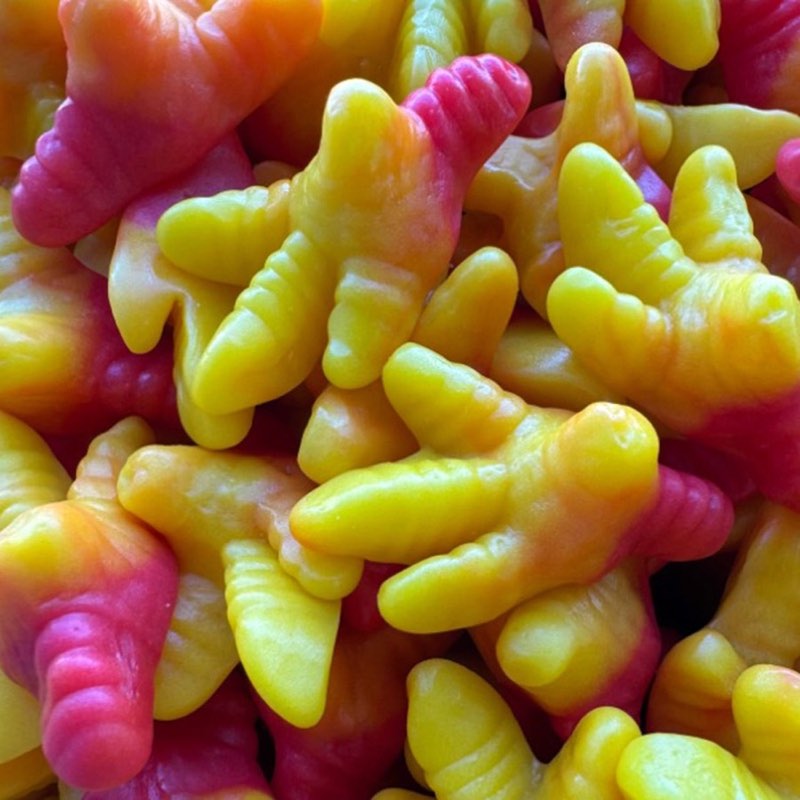
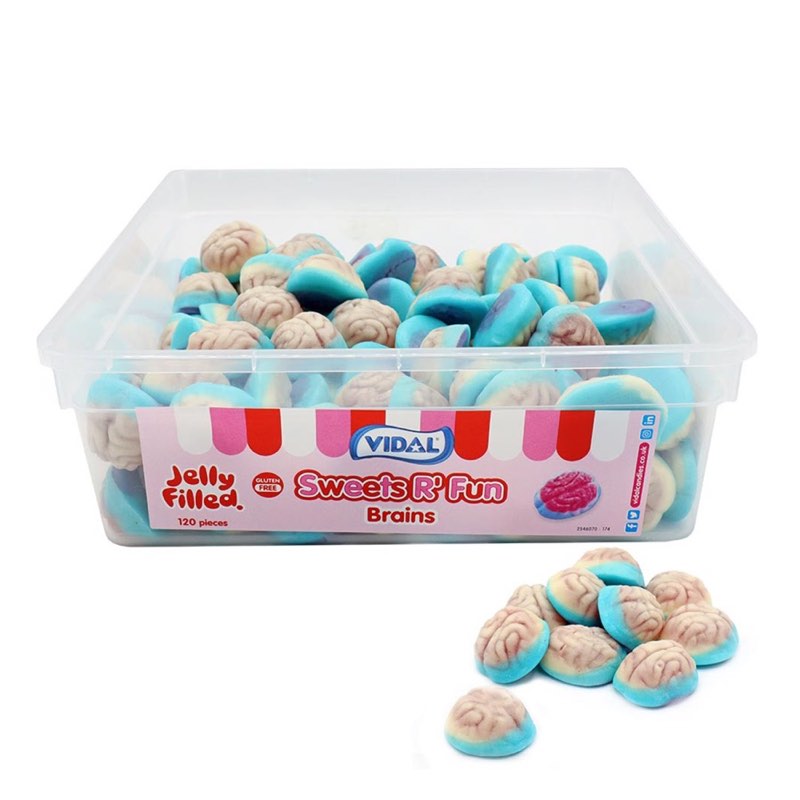
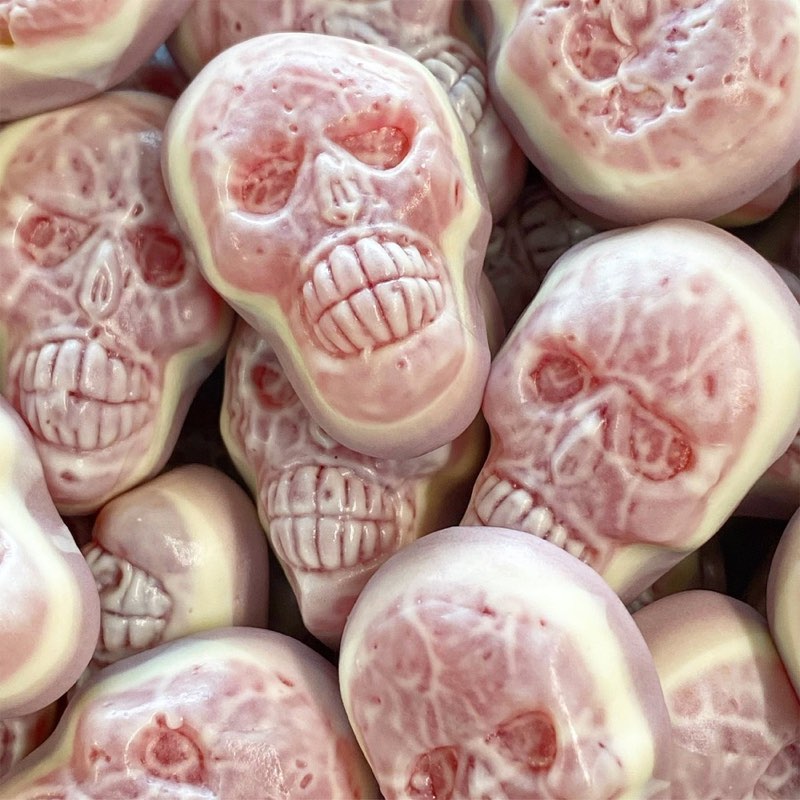
The collector's pleasure is in the contrast. A tub of smiles on its own is cheerful. A tub of smiles next to something faintly grotesque is a joke, and the joke is much better than either half. That is why Vidal Jelly Filled Brains at £7.99 is the single funniest thing you can put beside this tub on a Halloween table: identical price, identical format, completely opposite intent. The same trick works with Vidal Chicken Feet at £5.49, which is a shape that exists purely to make somebody at the table say "no". Put the smiles out first and the feet out second and you will get a reaction every time.
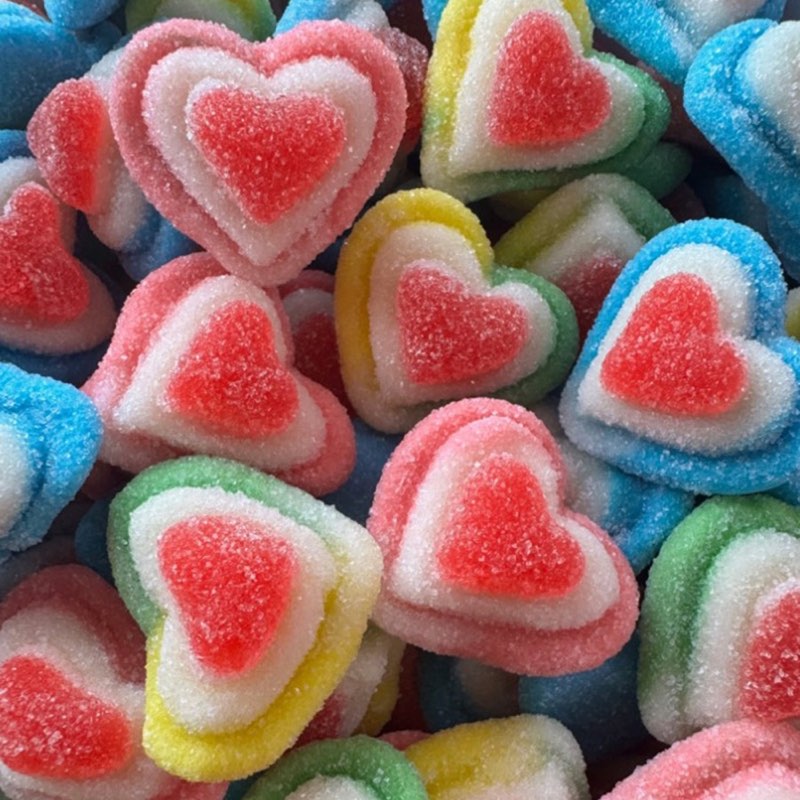
Seasonal shapes are the other half of the collecting habit, and they run on a calendar you can learn. Hearts appear in the new year and disappear by spring — Vidal 3D Triple Hearts at £5.49 is the obvious example, and it is a shape that looks entirely wrong in October and entirely right in February. Skulls and anatomical novelties climb in autumn; BUBS Big Sour Skulls at £7.50 is the sour counterpart to the Vidal novelty shapes and belongs to that same seasonal rhythm. Romantic shapes from other makers, like Barratt Jelly Love Hearts, hold their own small corner of the year. A shape-led shopper stocks up when the shape is in front of them, because there is no guarantee it will be there in three months.
Then there are the formats that are not shapes at all but structures. Filled sweets are a category of their own — Kingsway Filled Whales at £5.49 is a good illustration of a moulded outer built around a soft centre, and it eats nothing like a solid piece. Peelable formats are another: the Crazy Jo Peelablezz Jumbo Banana Gummy at £2.99 is a single large sweet designed to be pulled apart in strands rather than bitten, which turns eating into a small activity. And there are kits, which are the outer edge of novelty confectionery entirely: the Fuji Candy DIY Handmade Ferris Wheel Kit Box at £2.99 is 20g of sweet and about twenty minutes of assembly, which is a ratio no ordinary sweet can offer.
If you enjoy that side of things, the way to shop is by shape and format rather than by flavour, and the site is built to let you. Work through the whole shop when you have time to browse properly, and use the format shelves rather than the flavour ones. A tub of smiles is the baseline the oddities play against — the straight man in the act. Every collection needs one.
Reading the flavour: bright fruit with a strawberry lift
The fact pack gives two flavour notes for this tub: fruit and strawberry. Those are broader descriptions than a single-flavour sweet would carry, and they tell you what kind of eating experience to expect rather than an exact profile, which is the honest way to describe a mixed bag of shapes.
"Fruit" as a confectionery flavour family is not a vague label, it is a specific tradition. It means the bright, high, immediately recognisable fruit notes that the British sweet counter has run on for generations — the register where you know within half a second that you are eating a fruit sweet even if you could not name which fruit. It is a flavour family built for clarity rather than complexity. It arrives fast, it reads clean, and it does not ask you to think. That is exactly what you want in a sweet that will be eaten by the handful by people who are also talking, watching something, or supervising a room full of children. If you like the family, everything filed under fruit across the shop runs to a hundred and sixty-odd lines, and it is the broadest single flavour shelf we keep.
Strawberry is the other note, and it is the one that does the emotional work. Strawberry in sweets is not a literal transcription of the fruit and never has been — it is its own flavour, recognisable anywhere, slightly rounder and creamier than raspberry and much softer than cherry. It sits low and warm against the brighter fruit notes rather than fighting them, which is why strawberry is the flavour makers reach for when they want a mix to feel friendly. In a tub meant for a wide audience, it is the note that stops the whole thing reading as sharp.
Where strawberry goes next is worth knowing if you find it is the note you keep picking out. The strawberry shelf holds seventy-odd lines, and the format changes the flavour more than people expect. The same strawberry note in a long chewy belt eats slowly and stays with you — Vidal Strawberry Belts at £5.49 is the direct comparison from the same maker, and it is a completely different pace of eating from a moulded shape. Put it against a sour treatment like Dulce Plus Sour Strawberry Rings at £5.49 and the same fruit reads sharper and shorter. Three strawberries, three experiences.
For the general fruit family, the comparison worth making is with the older British style. Taveners Fruit Jellies at £5.49 sit in the traditional end of the fruit jelly tradition and eat more sedately than a modern moulded gummy. Alongside them, something like Haribo Friendship Rings 480g at £8.99 shows how the same fruit register behaves when it is wrapped around a different texture. Putting two or three styles of fruit jelly side by side on the same table is the cheapest tasting exercise in confectionery and it genuinely teaches you what you like.
Building a mix that the smiles anchor
A good pick and mix is not a pile of favourites. It is a structure, and it needs a base. This tub is a base — mild, sweet, universally acceptable, small enough to fill gaps, and cheap enough per gram that you can be generous with it. Build outwards from it and you will end up with a mix that people actually finish, rather than a bowl where everything interesting has been picked out and a sad layer of the boring thing is left at the bottom.
The rule that makes mixes work is contrast on three axes: texture, intensity and size. Get all three and a bowl stays interesting for an hour. Get none and it is background noise after ten minutes.
- Texture contrast. Against a springy moulded jelly you want at least one chew that behaves differently. Vidal Rainbow Belts at £5.49 give you a flat, long, pull-apart chew that slows people down between handfuls. For something softer again, a £1.35 bag of Fini Mini Mochis brings a yielding, pillowy bite that is nothing like a gummy and costs almost nothing to add.
- Intensity contrast. A mix of sweet things only tastes sweeter as it goes on. One sour line resets the palate and makes the mild things taste mild again. A small handful of sour rings or sour skulls scattered through is plenty; you are seasoning, not rebalancing.
- Size contrast. Small shapes everywhere makes for a uniform bowl. One large or structural piece per serving gives the eye somewhere to land and gives people something to talk about — a filled shape, a peelable, or an ice-pop format like Vidal Gummi Ice Pops at £5.49, which reads as a different object entirely next to a smile.
Proportions matter as much as the choices. For a bowl meant to last an evening, work to roughly half base, a quarter secondary chew, and a quarter split between the sour note and the statement pieces. For a party bag, the ratio shifts: more base, one statement piece per bag, and the sour line only if you know the children. Sour sweets in a party bag are a gamble, and it is not your gamble to take with somebody else's child.
If you would rather not assemble it yourself, our pick and mix section does the structural work for you, and the ready-made jars and platters there are built on the same logic. But a mix you have built around a tub you already own will always be cheaper, and you get to decide what the base is.
Occasions this tub was made for
Children's parties are the obvious home, and the reason is the shape as much as the price. A smile is legible to a four-year-old in a way that a cola bottle is not. Set the tub out in a bowl with a scoop and small paper bags and you have a self-service sweet station that needs no supervision beyond keeping an eye on the volume, and 900g is enough to keep it looking full for the whole afternoon rather than dwindling to a sad handful by the time the cake comes out.
Class parties, end-of-term treats and sports club presentations are the same problem at a slightly larger scale, and a tub answers them better than bags do because you control the portion. Twenty-five grams a head out of a tub looks like a proper treat when it goes in a bag. Trying to split three retail bags twenty-two ways looks like exactly what it is.
Film nights are the household version. Two people, one bowl, small pieces that do not require attention or a plate — this is the sweet-counter equivalent of popcorn, and it behaves the same way. Pour a set amount into the bowl and leave the tub in the kitchen. Everyone who has ever sat down with the whole tub knows why.
For gifting and hampers, the tub is a base rather than a centrepiece. It is not a giftable object on its own — it is too big and too plain for that — but decanted into a jar with a ribbon, or split into three smaller jars alongside something more decorative, it fills out a hamper beautifully and cheaply. The trick with hampers is that the expensive item sets the tone and the cheap bulk item sets the volume, and this tub is the best-value volume in the jelly range.
Seasonal tables benefit from it for the same reason. Halloween is the standout, because the contrast between the cheerful shape and the ghoulish ones is the whole joke — the brains and the chicken feet need something innocent to sit next to. Christmas buffets use it as the non-chocolate option, which matters more than people think once the chocolate fatigue sets in around teatime. And the summer table, where it sits alongside the ice-pop shapes and the belts, is where small fruit jellies are at their most natural.
Decanting, scooping and keeping control of the tub
The practical business of getting 900g of sweets from a tub into people is worth five minutes of planning. The single most useful thing you can own here is a set of kitchen scales and, ideally, a small scoop. Weigh one scoop of the smiles once and write the number down. If your scoop holds 40g, then every subsequent decision — a party bag, a film-night bowl, a jar for a hamper — becomes one scoop, two scoops, three, with no guessing and no drift.
For party bags, fill by weight rather than by eye. Eye-filling drifts upwards as you get bored, which is how people run out at bag nineteen of twenty-two. For a self-service station, put out half the tub and refill, rather than putting all of it out at once; a bowl that gets topped up looks generous all afternoon, while a bowl that starts enormous and ends empty looks like it ran out.
For the household, the most effective portion control is physical rather than moral. Decant a week's worth into a small jar on the counter and put the tub itself somewhere inconvenient — a high shelf, the back of a cupboard, anywhere that requires a decision. The sweets are just as available; they are simply no longer in your hand before you have thought about it. This works far better than resolving to eat less of something that is sitting open next to the kettle.
If you are running a jar on a table for a longer event, keep a lid or a cloth over it between waves of people. It is not only about the sweets drying at the surface; an open jar is an invitation, and a covered jar that somebody has to open gets sampled rather than emptied.
Keeping 900g in good condition
Jelly sweets have two enemies and neither of them is time. The first is warmth. Heat softens moulded shapes, rounds off the crisp edges of the smile, and encourages pieces to settle against each other into a mass. A tub left on a sunny windowsill or on top of a fridge will be noticeably different in a week. Keep it somewhere cool and dark and it will hold its shape for as long as you are realistically going to take to eat it.
The second enemy is air, and specifically the moisture in it. Left open, small jellies dry at the surface and go firmer and chewier than they should be. This is not dangerous and some people genuinely prefer it, but it is not what the maker intended. The answer is the one the format already gives you: put the lid back on properly, every time. A tub with a lid is a better storage container than almost any bag you could decant into, which is another quiet argument for buying the large format in the first place.
Do not refrigerate them. A fridge is cool but it is also humid, and cold makes a springy jelly hard and unpleasant. If your house is genuinely hot, a cool cupboard on an internal wall beats the fridge every time. Freezing is worse again and changes the texture permanently.
If you have decanted into jars, keep the jars small and fill them full. A half-empty large jar has a lot of air in it, and air is the thing you are trying to keep away from the sweets. Glass, ceramic or plastic makes no real difference; a seal does. And when you are down to the last couple of hundred grams, that is the moment to tip the remainder into a jar the right size rather than leaving them rattling around the bottom of a large tub.
Finally, whatever the packaging says about dates, trust your eyes and the rustle. Pieces that pour freely and hold their moulded edges are in good order. Pieces that have gone tacky and clump together have been warm at some point. Everything about long-term storage is really about keeping them away from heat.
One size, and what that settles
This line comes in a single option: one size, 900g, £7.99. There is no smaller bag and no larger catering pack to weigh up, which makes the decision simpler than it is on most of our jelly lines. You are choosing whether you want a tub at all, not which tub.
That framing is useful. If 900g is more than your household will get through in a month or so, the better move is not a different size of this product but a different product — a smaller format of something similar from the wider jelly range, bought more often. If 900g is about right or slightly less than you need, then buying two tubs at once is a genuinely sensible move for a party, because two tubs of the same thing let you keep one sealed while the first is open, and a sealed tub keeps indefinitely better than a half-used one.
For events, work backwards from the guest count and the per-head weight rather than from the number of tubs. At 40g a head, one tub covers twenty-two; at 25g a head it covers thirty-six. Anything over those numbers and you are buying two, and it is much better to know that before the morning of the party than at four o'clock on the day. The tub is currently in stock, which is the other half of that planning — but for a fixed-date event it is always worth ordering well ahead rather than assuming.
Where this sits on the site, and what sits beside it
Everything we sell is reachable a few different ways, and it is worth knowing which route suits what you are doing. If you are shopping by format — tubs, bags, bulk — then loose sweets by the tub is the shelf to start from, and with three hundred and fifty-odd lines it is the largest part of the shop by some distance. That is where this tub lives and where its closest competitors on price per gram are.
If you are shopping by texture, the ninety-odd lines under jelly and gummy sweets are the right filter, and it will show you the moulded shapes, the belts, the filled formats and the foam-backed pieces together so you can compare them properly. If you are shopping by flavour, the fruit and strawberry shelves narrow things down across every texture at once, which is the better route when you know what you want to taste but not what you want to chew.
Brand shelves are the fourth route and the one shape-led shoppers use most. Alongside Vidal's own shelf, the Kingsway shelf is where the traditional British formats and the filled shapes cluster, and Haribo's own shelf covers the mixed tubs and the single-shape bags that most people know best. Between those three you have most of the jelly counter covered.
Beyond jellies, candy and chocolate is where you go for the other half of a buffet table — the chocolate lines, the boxed sweets and the hard candy that balance out a spread built on gummies. A table that is all jelly is a table that gets tiring. One chocolate line and one hard sweet alongside this tub is usually all the variety a party actually needs.
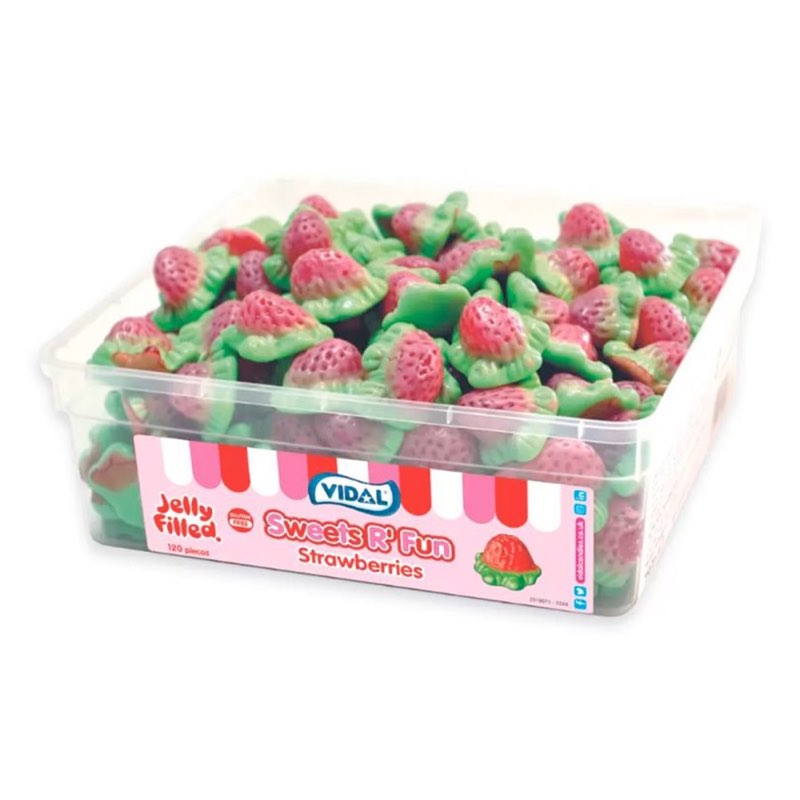
And if you want the direct family comparison, the two sibling tubs at the same £7.99 price are the ones to look at: the Vidal Jelly Filled Strawberries Tub, which takes the strawberry note and puts it into a filled format, and the brains tub, which takes the same tub size into novelty territory. Same maker, same price, three quite different tables.
Questions we get asked about this tub
How many sweets are in a 900g tub?
We do not publish a piece count, because piece weights vary between production runs and any number we gave you would be an estimate dressed up as a fact. What we can tell you is how to find out in your own kitchen in under a minute: weigh ten pieces on a kitchen scale, divide by ten, and you have the average piece weight for your tub. Divide 900 by that figure and you have your count. Most people find the number higher than they guessed, because small moulded shapes pack loosely and a full tub looks smaller than it is.
Is £7.99 good value compared with buying bags?
Per gram, yes, and by a clear margin. £7.99 for 900g works out at roughly 89p per 100g, or about 27p for a 30g handful. Most single retail bags of jelly sweets sit well above that per 100g, because you are paying for packaging and handling on every bag rather than once. The caveat is real though: bulk is only value if you eat it. If a 900g tub would sit in your cupboard for six months, a smaller bag bought more often is the better buy even at a worse rate.
How many children will one tub cover for party bags?
At 25g a head — a proper handful in a small bag — one tub covers thirty-six children, at about 22p each. At a more generous 40g a head it covers twenty-two, at about 36p each. If you are catering for more than twenty-two and want to be generous, order two. For a mixed party bag where the sweets are one item among several, 25g is plenty and you will have some left over for the household afterwards.
What does "fruit and strawberry" actually mean for the taste?
Those are the flavour notes listed for this line in our catalogue, and they describe a bright, clearly readable fruit character with a rounder strawberry note sitting through it. In practice that means a sweet that tastes immediately of fruit rather than asking you to work out what it is, with a softer, friendlier note rather than a sharp one. It is a broad, crowd-pleasing profile rather than a single-fruit sweet, which is exactly what you want when you are feeding a room of people with different tastes.
Are these sour?
No. Nothing in the product name or the flavour notes indicates a sour treatment, and this line sits in the sweet rather than the sour half of the jelly counter. If you want sourness on the table, buy it separately and scatter it through — a small proportion of a sour line does more for a mix than making the whole bowl sharp. Sour skulls and sour rings both do that job well and both are stocked.
Will they arrive stuck together?
They should not. Small moulded jellies are handled so that they pour freely, and a tub that has been kept cool travels well. If a tub has been somewhere warm in transit you may find some pieces sitting against one another; a firm shake with the lid on usually separates them, and a few hours somewhere cool restores the texture. Genuinely fused blocks are not normal and are worth telling us about rather than putting up with.
Can I use this tub to refill a sweet jar at an event?
That is one of the things it is best at. A 900g tub with a lid is a better refill container than a bag, because you can close it between waves of people and the sweets in reserve stay in the condition the ones in the jar were in when you started. Put out half, keep half sealed, and top up. A jar that keeps getting refilled looks generous for the whole event; a jar filled once looks like it is running out from the moment people start.
How should I store the tub once it is open?
Lid on, somewhere cool and dark, away from radiators, hobs and direct sun. That is the whole of it. Do not put jelly sweets in the fridge — the cold makes them hard and the humidity works against them — and do not freeze them at all. If you decant into jars, use jars small enough to fill properly, because a half-empty container is mostly air and air is what dries the surface of a jelly.
Is this suitable for vegetarians or vegans?
We do not hold verified dietary information for this line, so we cannot tell you either way, and we would rather say so than guess. Our supplier has not given us dietary tags for this product. The manufacturer's own packaging on the tub is the authority, and it will arrive with you before anyone eats anything — check it there. The same goes for allergens: if anyone in the house has an allergy, read the packaging on arrival rather than relying on any description on a website.
Are they safe for young children?
Whole gummy sweets and small hard sweets are a choking risk for young children and should always be eaten with an adult present. That applies to every moulded jelly we sell, not just this one. Sweets are a treat rather than a regular part of a child's diet, and portioning them out into small bags rather than leaving a tub open is both the safer and the saner approach at a party.
What goes best alongside this on a table?
Something with a different chew and something with a different intensity. A belt or a lace slows people down between handfuls; a soft, yielding format like a mochi gives the bowl a completely different texture; and one sour line scattered through resets the palate. If the table is for a crowd, add one chocolate item too — an all-jelly spread gets tiring after an hour in a way that a mixed one does not.
Can I order two tubs for a big event?
Yes, and for anything over about twenty-two guests at a generous portion it is the sensible move. The advantage of two tubs over one very large bag is that you can keep the second sealed until you need it, which means the sweets you put out in the second half of an event are in the same condition as the ones you put out in the first. For a fixed-date event, order in good time rather than close to the day.
The short version
Nine hundred grams of small, cheerful, easy-going fruit jellies for £7.99, which is about 89p per 100g and about 27p a handful. It is the base layer of a good pick and mix, the workhorse of a party bag run, and the thing you put on a Halloween table so that the horrible shapes have something to be horrible next to. It asks nothing of you, it suits nearly everybody, and it comes with a lid — which, when you are buying sweets by the kilo, turns out to matter more than almost anything else.
More from Vidal
More jelly & gummy sweets
More fruit sweets


Where this sits
Vidal Happy Smiles Tub appears on these shelves. Browse them, or jump to something nearby.
You might also like