Home / Loose Sweets / Vidal Jelly Filled Strawberries Tub
Vidal · 780g
Read the full guide
Vidal Jelly Filled Strawberries Tub
£7.99
✔ In stock — ready to ship
Fresh stock
Free over £20
Same-day dispatch
Secure checkout
Some sweets are bought for a cupboard and some are bought for an occasion, and this one is overwhelmingly the second sort. A 780g tub of strawberry-shaped filled gummies is too much for one person's evening and exactly right for a room, a table or a parcel, which is why it tends to leave the shop in the hands of somebody who has a date in mind.
The single most common destination is the sweet table — the trestle at the back of a wedding reception, the side table at a christening, the corner of a sixtieth birthday party where the buffet has run out but nobody wants to go home yet. Filled strawberries work there because they read as a proper sweet rather than a filler. The shape is recognisable from across a room, it photographs well in a jar, and it does not need explaining to anybody. Put it in a jar with a scoop and it will empty faster than anything sharper or stranger next to it.
The full guide to Vidal Jelly Filled Strawberries Tub
5,666 words on how it eats, who it suits, how to serve it and what to put beside it.
Where a tub of filled strawberries actually ends up
The second destination is the classroom or the staff room. End of term, end of a project, the week somebody retires — a tub with a lid that goes back on is the most practical thing you can carry into a shared workplace, because it survives being opened and reclosed twenty times over three days. Tubs are the correct format for any situation where the eating is going to happen in waves rather than all at once.
The third is the family Christmas, where filled strawberries occupy a very specific slot: the non-chocolate option. By the twenty-seventh, every chocolate box in the house is down to the coffee creams and the room has had enough richness. A bright fruit jelly is the thing people reach for then, and having a tub in the cupboard from mid-December is a small act of planning that pays off precisely once but pays off properly.
Then there are the quieter occasions, which matter more than the big ones because they happen more often. A long drive where you need something in the door pocket. A week of revision where an eighteen-year-old needs a jar on the desk. A Sunday where the weather has collapsed and four children are indoors. A bowl on the counter when a neighbour comes round. Sweets are a treat rather than a daily staple, but the value of a big tub is that it is ready for the occasion you did not know was coming.
And finally — the one this page will spend the most time on — the parcel. Filled strawberries are unusually good at being sent to people, and that deserves its own section rather than a line.
The gift that posts well
Sending sweets to somebody is one of the oldest small kindnesses there is, and it is having a considerable revival, mostly because it solves a problem that flowers and chocolate do not. Flowers are lovely and dead by Thursday. Chocolate is lovely and melts in June, and half the people you might send it to are avoiding it for one reason or another. Sweets sit in the gap: they travel at room temperature, they keep, they are cheerful, and they cost about what a card and a stamp used to cost.
What makes this particular tub good for gifting is the combination of shape and volume. Seven hundred and eighty grams is enough to split several ways, which is the key to almost every good sweet gift. Buy one tub at £7.99 and you can make three generous jars out of it at roughly £2.66 of sweets apiece, or six small ones at about £1.33 each. Nobody who receives a jar of hand-portioned sweets is doing that arithmetic, which is rather the point.
For a hamper, a tub is bulk rather than centrepiece, and that is a compliment. Hampers work on a simple structure: one or two items that set the tone, and enough volume around them that the basket looks full rather than apologetic. Decant filled strawberries into a jar or a cellophane bag with a ribbon, sit it beside something more decorative, and you have solved the volume problem for under eight pounds. If the hamper wants a second sweet with a different silhouette, Vidal 3D Triple Hearts at £5.49 is the obvious partner for anything romantic, and Vidal Rainbow Belts at the same price bring a long flat shape that fills the awkward gaps around jars better than any round thing can.
For a letterbox treat — the flat parcel that goes through a door without anybody having to be in — the constraint is depth rather than weight. Small moulded shapes decanted into a flat bag are one of the few sweets that genuinely fit, where a boxed chocolate assortment never will. Split a tub into two or three flat packs and you have several months of small posted kindnesses out of a single purchase, which is a better use of £7.99 than almost anything else on a sweet counter.
For a teacher gift, the calculus is different again, and it is worth thinking about honestly. Teachers receive a great deal at the end of term and most of it is either wine or a mug. A jar of good sweets for the staff room is one of the few gifts that is actually used, because it gets shared rather than taken home and quietly re-gifted. The shareable format is the whole point: one tub split into jars for three or four staff rooms costs less than one bottle and reaches thirty people instead of one.
For a care parcel — a student in their first term, somebody recovering at home, a friend who has had a bad month — sweets do a job that more serious gifts cannot. They are small enough not to create an obligation, which matters more than people admit. A big gift asks to be thanked; a bag of sweets just gets eaten. If you are building a parcel, mix formats rather than sending one thing: a portion of filled strawberries for the familiar comfort of the shape, plus something that requires doing rather than only eating. The Zed Candy Double Dares Jelly Beans Game at £2.99 is exactly that kind of addition, because it turns a parcel into an activity that somebody has to rope a flatmate into.
Two practical notes on sending sweets. First, put them somewhere cool before you pack them and pack them into something rigid — a jar, a tin, a small box — rather than trusting a padded envelope not to be sat on. Second, if you are sending to somebody whose household you do not know inside out, send the sweets in their original tub or include the manufacturer's packaging, so that anyone with an allergy can check the pack themselves rather than taking your word for it. That is the responsible way to post food to anybody, and it costs you nothing but a second's thought.
What you are opening
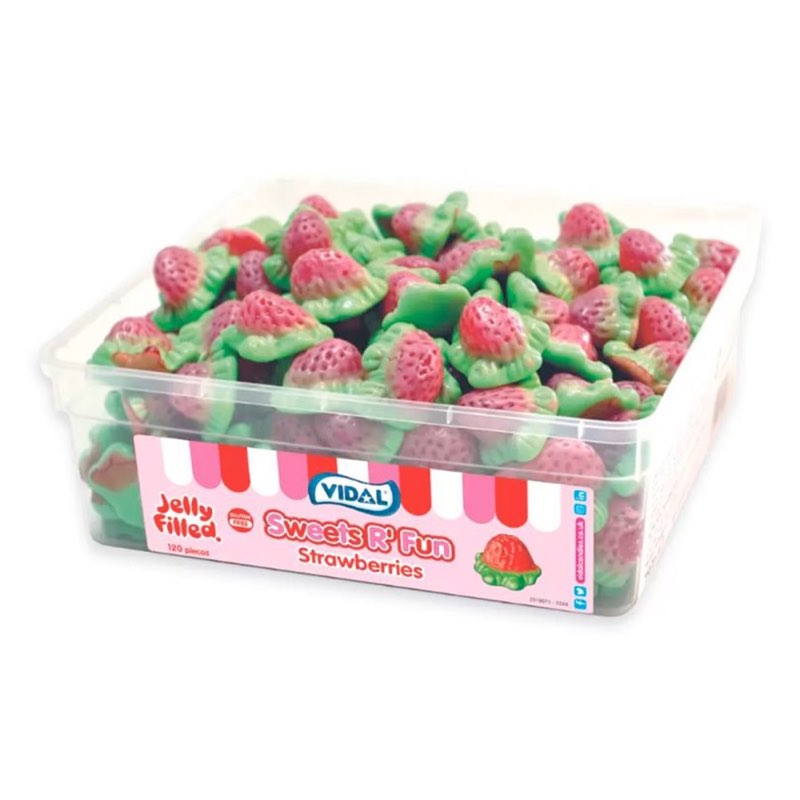
This is a large tub of strawberry-shaped gummies with a soft centre inside a firmer outer — the name says jelly filled, and that is a description of the construction rather than a claim about what is in it. Each piece is moulded to look like a strawberry, which puts it in the small group of sweets that are deliberately imitating a real object rather than inventing a shape.
The tub is a solid, lidded container rather than a bag, and 780g of moulded shapes gives you a proper weight in the hand when you pick it up off the doorstep. Take the lid off and the pieces should be separate and pourable, with the faint dry sound of shapes moving against each other. That sound is the quickest test of whether a tub has been kept cool on its way to you.
Individual pieces are the size of a small real strawberry rather than a large one — a comfortable one-bite sweet for an adult, a two-bite for a child. The moulding is the thing to look at first. On a well-kept tub the tapering shape and the textured surface that suggests a strawberry's skin are clearly defined, and the pieces stand up on a table rather than slumping. Definition is the honest indicator of condition in any moulded sweet, and it is worth two seconds of looking before you tip a tub into a jar for a party.
The outside, then the middle
A filled sweet eats in two acts, and the pleasure is entirely in the gap between them.
Act one is the outer. Bite down and there is a definite wall to get through — firmer than a plain gummy of the same size needs to be, because it is doing structural work as well as flavour work. That first resistance lasts a beat longer than you expect. Your teeth meet it, push, and for a moment nothing happens.
Act two is the give. The wall yields and the centre moves — softer, looser and more mobile than the outside, spreading across the tongue rather than being chewed. That contrast between a firm shell and a soft middle is the entire reason filled formats exist, and it is why a filled sweet feels like a small event where a solid one feels like a snack. Anyone who has bitten into one knows the sensation and anyone who has not should try it once before deciding whether they like filled sweets, because it is genuinely not the same experience as eating a solid jelly.
After the give, the two textures finish at different speeds. The centre is gone almost immediately; the outer carries on for several chews, springy rather than sticky, breaking down cleanly and clearing the mouth without leaving a coating. So the arc is: resistance, release, a quick flood, then a chew that outlasts it. The whole thing takes eight or ten seconds and then wants repeating, which is the standard hazard of a very good small sweet.
Flavour follows the same staging. There is a first impression from the outer surface within a second, then a more concentrated hit when the centre releases, then a fade through the remaining chew. It is a more dramatic flavour curve than a plain jelly can manage — a peak in the middle rather than a plateau — and it is the reason filled sweets read as more intense than their solid equivalents even when they are not.
One practical consequence worth knowing: filled sweets are best eaten whole rather than nibbled. Half a filled sweet is just a piece of the outer, and the whole point escapes. Tell children this once and they will be slightly disappointed and then agree with you.
Corner shops, seafronts, and the sweet that looks like a fruit
Fruit-shaped sweets are one of the oldest ideas in British confectionery, and they persist for a reason that has nothing to do with taste. A sweet moulded to look like a strawberry is making a small joke about itself — it knows it is not a strawberry, you know it is not a strawberry, and the shape is the setup. That joke is the whole aesthetic of the traditional British sweet shop, and once you notice it you see it everywhere on the counter: sweets shaped like teeth, like shrimps, like bottles of pop, like fried eggs, like things nobody would ever want to eat.
The corner shop was where most people met this. A row of jars behind or above the counter, a set of scales, and a shopkeeper who tipped a scoop into a paper bag and then added one more because you were small. What that system produced was a culture of mixing — you were never buying one sweet, you were buying five sweets, one scoop of each, and the choosing took longer than the eating. That is the ancestor of the modern pick and mix, and it is why ready-made pick and mix still feels more like a proper purchase than a single bag does.
The seaside sweet shop took the same idea and made it a holiday. Seafront shops ran on volume, on spectacle and on the fact that nobody is counting on holiday: bigger jars, brighter shapes, rock, fudge, and the long flat formats you could carry along a promenade while eating. That last category is why belts and pencils and laces are still such a large part of any sweet shop's range. Vidal Strawberry Pencil Bites at £5.49 are a direct descendant of the promenade sweet — a shape designed to be eaten walking — and Vidal Strawberry Belts at the same price are the full-length version of the same idea.
The traditional counter also had a firm idea of what a "proper" sweet was, and it was not always a gummy. The older British sweet is denser and chewier, with more resistance and a slower release: Taveners Fruit Pastilles at £5.49 sit squarely in that tradition, and eating one next to a modern filled gummy is the fastest lesson in how the counter has changed. The pastille makes you work. The filled strawberry does the work for you. Both are good; they come from different decades of the same shop.
And then there are the genuinely old-fashioned oddities that have survived on charm alone. Barratt Jelly Spogs at £5.49 carry a name that means nothing to anyone under fifty and everything to anyone over it, which is exactly the sort of thing that keeps a traditional sweet in the range for another generation. Meanwhile the seaside novelty instinct is alive and well in tubs like the Swizzels Teeth N Toothbrush Tub at £8.99, which is a joke shop premise sold as confectionery and would have looked entirely at home in a Blackpool window at any point in the last fifty years.
The fizzy strawberry is the other seafront survivor worth knowing. Take the same fruit shape, give it a sharp dusted coating, and you have a sweet that hits harder and disappears faster — Kingsway Fizzy Strawberries at £5.49 are the direct counterpart to this tub and the single best comparison to make if you want to understand what a coating does to a shape you already know. Same fruit, same silhouette, entirely different pace.
What all of this adds up to is a way of shopping, not just a bit of history. The traditional counter taught people to buy by shape and by weight rather than by brand, and the shop is still arranged that way if you want to use it. Work along our loose sweets range the way you would have worked along a row of jars, and you will end up with a better mix than any algorithm would have given you.
Strawberry in its most literal costume
The flavour notes for this tub are fruit and strawberry, and in a strawberry-shaped sweet the second one is doing almost all the work. What is interesting is how the shape changes the way you taste it.
Sweet-shop strawberry has never been a transcription of the real fruit and has never pretended to be. It is its own flavour — rounder than raspberry, softer and less sharp than cherry, with a warmth to it that makes it read as friendly. It is probably the single most recognisable flavour on the British sweet counter, and it carries a lot of association with it. When it turns up in a sweet that is also shaped like a strawberry, the effect compounds: your eyes tell you strawberry before your tongue does, and the flavour arrives already confirmed. Confectioners have understood this for a very long time, which is why fruit-shaped sweets almost always carry the flavour of the fruit they imitate.
The filled construction changes it again. Because the centre releases in a rush rather than gradually, the strawberry note peaks rather than plateaus, which makes it read as more concentrated than the same flavour in a solid jelly. It is the same reason a filled chocolate tastes stronger than a solid one of equivalent weight.
If strawberry is a flavour you actively chase, it is worth exploring by texture. There are seventy-eight strawberry lines on the site and they do not all taste the same, because the carrier changes everything. Sharpened up, as in Dulce Plus Sour Strawberry Rings at £5.49, the note reads brighter and shorter. Paired with something darker, as in BUBS Wild Strawberry & Pomegranate Ovals at £7.50, it becomes deeper and less obviously sweet. In a long chewy format it lasts longer and tastes milder. Four strawberries, four sweets.
The broader fruit note is the supporting cast: the bright, immediately legible fruit register that most of the British counter runs on. If that is your general preference, the fruit flavour shelf holds a hundred and sixty-odd lines across every texture we sell, and it is the best place to start if you know you want fruit but do not yet know what you want to chew. For a completely different treatment of fruit flavour in a hard-shelled format, Skittles at £6.99 make an instructive contrast with a soft filled gummy — the same broad flavour family delivered through a crunch instead of a give.
What our supplier tells us about diet, and what we cannot tell you
This is worth being precise about, because precision is the only useful thing anybody can offer on this subject. Our supplier lists this line as dairy free and as gluten free. That is the information we have been given and we pass it on as given, without adding anything to it.
What we will not do is extrapolate. We will not tell you the line is suitable for any other dietary requirement, because our supplier has not told us that and guessing about food is not something a shop should do. We do not hold verified ingredient information for this product, so any question that begins "does it contain" is one we will answer honestly with "check the pack".
And that is the important part: the manufacturer's own packaging on the tub is the authority, always, over anything written on any website including this one. It arrives with you before anybody eats anything, so read it when it gets there. If anyone in your household has an allergy, that reading is not optional — it is the step that actually protects them.
Because the supplier tags exist for this line, it does appear on two of our filtered shelves. The gluten free shelf gathers fifty-four lines that our suppliers have tagged that way, and the dairy free shelf holds fifty-one. Both are useful starting points if you are shopping for a household with a requirement, but they are starting points, not answers. The pack in your hand ends the conversation.
Who this tub suits
It suits people who like a sweet with an event in it. If the thing you enjoy about confectionery is the moment of a texture changing — the shell giving, the middle going — a filled format is what you want, and a tub of it is a better way to buy it than a bag.
It suits mixed rooms, because there is nothing challenging here. No sourness to negotiate, no liquorice, no strong flavour that half the table will refuse, and a shape that a four-year-old reads instantly. That is a rarer combination than it sounds.
It suits anyone buying for other people, for all the reasons in the gifting section: it splits well, it travels well, and it looks like more effort than it costs.
It does not suit somebody who wants a long occupying chew — filled sweets are over relatively quickly, and the dense traditional pastilles or a long belt will keep you busier. It also does not suit somebody who nibbles rather than bites, for the reason given earlier: half a filled sweet is a waste of a filled sweet. And 780g is a lot for one person who eats sweets occasionally; a small bag from elsewhere in gummy sweets will serve that shopper better and go stale less.
The standard sensible notes: sweets are a treat, not everyday food; whole gummy sweets are a choking risk for young children and should be eaten with an adult present; and anyone with an allergy should check the manufacturer's packaging on arrival.
Mixing around a filled shape
A filled sweet is a feature piece rather than a base. It is too interesting to make up the bulk of a bowl — a mix that is all filled shapes gets samey fast, because the two-stage bite stops being a surprise after the fifth one. Use it as one of three or four components and it stays remarkable.
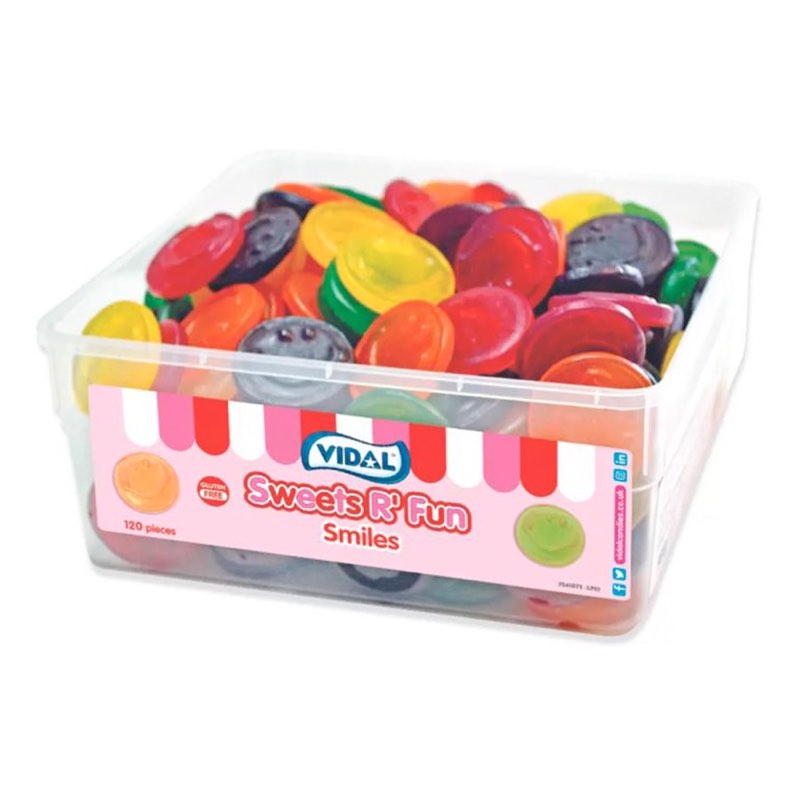
- Give it a plain partner. A simple, mild moulded jelly makes the filled shape feel dramatic by contrast. The Vidal Happy Smiles Tub at the same £7.99 is the natural partner from the same maker — a solid, mild, cheerful shape that sets the filled one off perfectly, and at 900g it is the cheaper of the two per gram, so it is the sensible thing to make up volume with.
- Give it a textural opposite. Something with a crunch or a shell changes the mouthfeel entirely — a hard-coated sweet next to a soft-centred one is the strongest contrast available on a sweet table.
- Give it one sharp note. A small proportion of something sour resets the palate between filled pieces and makes the third one taste like the first.
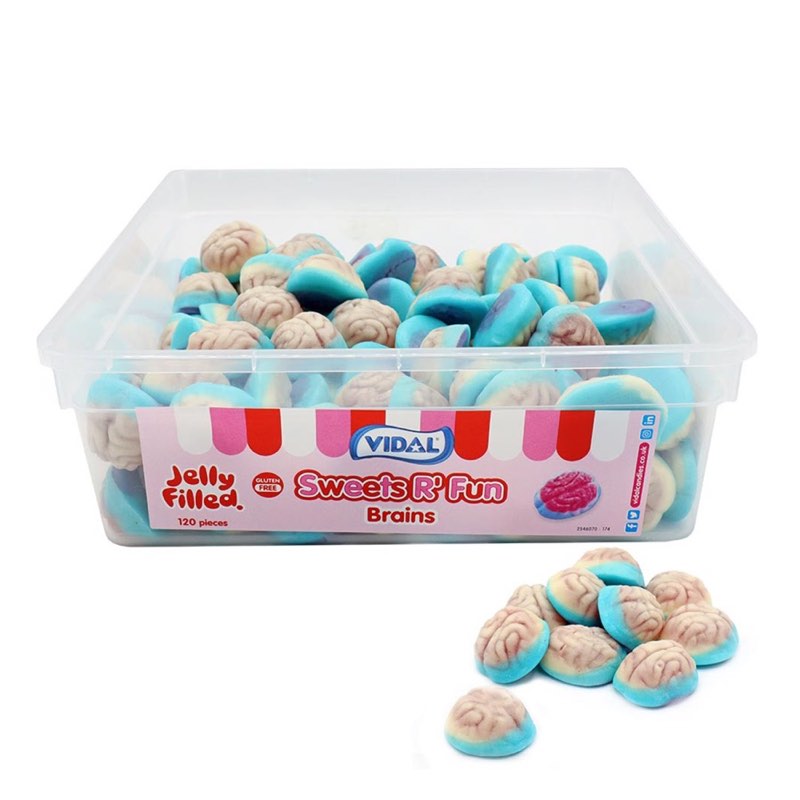
- Give it a shape joke. If the table is for children or for Halloween, contrast the pretty shape with an ugly one. Vidal Jelly Filled Brains at £7.99 is the same construction in the least appetising silhouette the maker could devise, and the pair of them together is far funnier than either alone. Vidal Chicken Feet at £5.49 takes the same joke further than most people expect.
- Give it an animal. For a children's table specifically, a recognisable creature shape earns its place — Haribo Terrific Turtles at £5.49 do that job and bring a different chew with them.
For proportions, a good party bowl runs roughly a third filled strawberries, a third mild base, and a third split between the sharp line and the novelty shapes. For a hamper or a gift jar, invert it: make the filled shape the majority, because a gift should be the good thing rather than the sensible thing.
£7.99 for 780g: the numbers you will actually use
Seven hundred and eighty grams at £7.99 works out at roughly £1.02 per 100g, or about a penny a gram — a figure that happens to be unusually easy to do arithmetic with. A 30g handful is about 31p. A 25g party-bag portion is about 26p. A 50g scoop is about 51p.
Split by portion, the tub gives you thirty-one bags at 25g, twenty-six at 30g, nineteen at 40g and fifteen at 50g. For gift jars, three jars of 260g each cost £2.66 in sweets; six jars of 130g cost £1.33 each. For a self-service bowl at an event served in 20g scoops, you get thirty-nine servings at about 20p each.
Against the alternatives, the interesting comparison is with the same maker's other tubs rather than with other brands. This is the mid-weight tub in the range at the same price as the 900g solid one, and the difference in price per gram is the price of the filling — you are paying a premium of a few pence per 100g for a construction that takes more work to make. Whether that is worth it depends entirely on whether you want the two-stage bite. For a gift, it usually is. For bulk volume on a fête stall, the solid shape is the better buy.
One thing worth saying plainly about tub buying in general: a tub is only good value if it gets eaten. Nine hundred grams of anything left in a cupboard for a year is worse value than a small bag eaten in an evening. Buy the size that matches the occasion you actually have, not the size with the best per-gram figure.
Looking after a filled sweet
Filled formats are a little more demanding than solid ones, and it is worth knowing why. The outer and the centre behave differently when conditions change, and a piece that has been warm can end up with a softened wall that no longer holds its shape properly against the middle. That is the failure mode to avoid, and it is entirely preventable.
Keep the tub cool and dark. Not the windowsill, not the top of the fridge, not the cupboard directly above the oven — those three account for most of the sweets that arrive in good order and go downhill in a fortnight. A cool internal cupboard is all it takes.
Keep the lid on. Air dries the outer surface of a gummy and firms it up, and on a filled sweet that means a shell that is tougher than it should be against a centre that has not changed. The lid is the single most useful feature of the format and it costs nothing to use it.
Do not refrigerate and do not freeze. Cold makes the outer hard and unpleasant to bite, humidity works against the surface, and freezing changes the texture for good. If your house is genuinely hot in summer, the coolest internal cupboard in the house beats the fridge every time.
If you decant into jars for gifts, fill them properly full and use a lid or a good seal rather than only a ribbon. A half-full jar with a decorative cover looks charming and dries its contents faster than the tub would have done. And do the decanting close to when you are giving them rather than three weeks ahead.
One size, and the two-tub question
This line comes in one option: a single 780g tub at £7.99. There is no smaller bag and no catering size, so the only real decision is how many you need, and it is currently in stock.
For events, work from head count and portion. Under nineteen guests at a generous 40g: one tub. Up to thirty-one at a party-bag 25g: one tub, with nothing spare. Beyond that, two. The advantage of two identical tubs over a tub plus a different line is that the second stays sealed while the first is open, so the sweets you put out at nine o'clock are in the same condition as the ones you put out at six.
For gifting runs — a set of teacher gifts, a row of Christmas jars — the maths is different and more forgiving. One tub makes three good jars or six small ones. If you are doing eight or ten jars, two tubs of two different shapes will look far better than three tubs of the same thing, because a gift jar with two silhouettes in it reads as chosen rather than scooped. That is the cheapest upgrade available to anybody making sweet gifts and it costs nothing but a second purchase you were probably making anyway.
Where it sits, and what sits beside it
Four routes will get you to anything on the site, and each suits a different kind of shopper. If you know you want bulk, tubs and bulk bags is the shelf with three hundred and fifty-odd lines on it and the natural home of every tub we sell. If you know you want the firmer, springier style of sweet, the seventeen lines filed as gummy are the tightest filter for that texture.
If you are shopping by flavour, the fruit and strawberry shelves cut across every texture at once. If you are shopping for a dietary requirement, the two supplier-tagged shelves narrow things sensibly, with the caveat above about always checking the pack itself.
Brand shelves are the fastest route if you already know what you like: the rest of the Vidal line-up runs to nineteen products and is where the tubs, the belts and the novelty shapes all sit together, while the Kingsway brand page and Haribo's section cover most of the rest of the traditional counter between them.
If a table needs balancing with something that is not a jelly, chocolate and boxed candy is where the other half of a spread lives. And when you would rather browse than search, everything we stock is worth an unhurried scroll — the best pairings on any sweet table tend to be the ones nobody went looking for.
Questions worth answering before you order
What does "jelly filled" mean here?
It describes the construction of the sweet, not a recipe. Each piece has a firmer outer shaped like a strawberry and a softer, more mobile centre inside it, so biting one gives you a moment of resistance followed by a release. That two-stage bite is the whole appeal of the format. We do not publish ingredient information for this line, so if what you want to know is what the centre is made of, the manufacturer's packaging on the tub is the place to look.
Is the centre liquid?
It is softer and looser than the outer rather than free-running. In practice that means the piece holds its shape in a jar or a bag without leaking, but yields noticeably when you bite it. It is not a sweet that will make a mess in a party bag, which is one reason filled shapes travel and post as well as they do.
How many pieces are in a 780g tub?
We do not publish a piece count, because piece weights vary between production runs and any figure we quoted would be a guess presented as a fact. If you need to know for planning, weigh ten pieces on a kitchen scale, divide by ten for the average, and divide 780 by that. It takes under a minute and gives you a number you can actually rely on for bagging a party.
Is this good value at £7.99?
It works out at roughly £1.02 per 100g, or about 31p for a 30g handful. That is a middling figure for a tub, and the reason is the construction: a filled sweet takes more making than a solid one, and the price reflects it. If what you want is maximum volume for a stall or a fête, a solid moulded shape will stretch further. If what you want is a sweet with a moment in it, this is the one to buy.
Can I post these to somebody?
They are one of the better sweets for posting. They keep at room temperature, they do not melt, and they hold their shape. Pack them into something rigid rather than a padded envelope, keep them cool before you send them, and include the manufacturer's packaging if the recipient's household is not one you know well — anyone with an allergy needs to be able to read the pack themselves rather than relying on a note from you.
Are these sour or fizzy?
No. This line sits in the plain sweet half of the counter with no sour or fizzy treatment. If you want the same strawberry shape with a sharp coating, a fizzy strawberry is the direct alternative and reads completely differently — sharper on arrival and shorter overall. Buying one of each and putting both on the table is the better answer for a mixed crowd than trying to pick between them.
Our supplier says gluten free and dairy free — can I rely on that?
That is the information our supplier has given us for this line, and we pass it on exactly as given without adding to it. We do not hold verified ingredient data ourselves, so we cannot confirm or extend it, and we will not tell you the product is suitable for any requirement our supplier has not tagged. The manufacturer's packaging on the tub is the authority and it will be with you before anyone eats anything. If there is an allergy in the household, read it on arrival.
Will they arrive stuck together?
They should pour freely. Moulded gummies are handled so that pieces stay separate, and a tub kept cool in transit travels well. Some settling is normal. If pieces have fused or the strawberry shapes have lost their definition, the tub has been somewhere warm and that is worth raising with us rather than living with.
How long does an open tub keep?
Longer than most households take to eat it, provided the lid goes back on each time. The enemy is dry air firming up the outside of the sweet, not time. Keep it cool, keep it closed, keep it out of the sun, and the texture holds. Whatever date is on the packaging is the one that governs; the storage advice here is about keeping it at its best, not about safety.
Are they suitable for a children's party?
Very much so — mild, recognisable, not sour, and a shape that small children identify immediately. The practical advice is to portion into bags rather than leaving a tub open, which controls both the pace and the quantity. And as with every whole gummy sweet, small children should be supervised while eating them, because whole sweets of this size are a choking risk for the very young.
What is the best thing to put with them in a gift jar?
One other silhouette, and something with a different length of chew. A long flat format like a belt or a pencil fills gaps and looks deliberate; a plain mild shape adds volume cheaply. Two shapes in a jar look chosen. One shape looks scooped. It is the cheapest possible upgrade to a homemade sweet gift.
Should I buy this or the solid strawberry-flavoured options?
It depends on what you are buying for. Filled shapes are better as gifts and better as the interesting element on a table, because the two-stage bite is genuinely more memorable. Solid shapes are better for bulk, for stalls and for filling a bowl that needs to last, because you get more sweet per pound. Most people running a real event end up buying one of each, and that is usually the right call.
In short
Seven hundred and eighty grams of strawberry-shaped filled gummies for £7.99 — about a penny a gram and about 31p a handful. It is a sweet with a moment built into it, which is what makes it worth giving to somebody rather than only eating yourself: split it into jars, post it flat, put it in a hamper, or tip it into a bowl at the back of a party and let the shape do the talking. Keep the lid on, keep it cool, and read the pack when it arrives.
More from Vidal

More gummy sweets
More fruit sweets


Where this sits
Vidal Jelly Filled Strawberries Tub appears on these shelves. Browse them, or jump to something nearby.
You might also like