Home / Loose Sweets / Zed Candy Double Dares Jelly Beans Game 100g
Zed Candy · 100g
Read the full guide
Zed Candy Double Dares Jelly Beans Game 100g
£2.99
✔ In stock — ready to ship
Fresh stock
Free over £20
Same-day dispatch
Secure checkout
Most sweets are eaten. This one is played, and that changes when you buy it. A 100g box of jelly beans sold as a game at £2.99 is not really competing with the other bags on the shelf — it is competing with a pack of cards, a quiz app and whatever else gets pulled out when a room full of people has run out of things to say. Judged on that footing it does rather well, because it costs less than a round of anything and it gives a table a shape.
The classic occasion is the long evening with nowhere to go. Six people, a sofa, everyone slightly bored of talking about work. A bean game takes roughly nine seconds to explain and then runs itself, and the reason it works is that it requires nothing: no board, no pieces, no scoring you have to remember, no phone. You open the box, you agree who goes first, and the game is on. Nobody has to fetch anything from a cupboard and nobody has to read three pages of rules while everyone else waits.
The full guide to Zed Candy Double Dares Jelly Beans Game 100g
5,057 words on how it eats, who it suits, how to serve it and what to put beside it.
The evenings a dare game is actually for
Sleepovers and the older-children birthday
Dare games are the natural currency of a sleepover, and a bean game is the mildest possible version of one — the stakes are a sweet, not a forfeit, and nobody ends up embarrassed. For a birthday where the children are old enough to sit still for ten minutes, it is a genuinely useful item to have in reserve for the flat point in the afternoon when the cake is gone and the party games have run out. It is also cheap enough to buy several of and give one to each child to take home, which is a better party bag filler than most things at this price because it does something rather than just being eaten in the car.
As with any small sweets, this is a treat rather than a snack, and small round sweets need supervision with young children — a bean game suits an age group that can sit at a table and take a turn, not toddlers. Worth saying plainly because it is the main reason to think about who is in the room before you open it.
Adults, and the fact that this works better than it should
There is a slightly sheepish truth about dare-style bean games, which is that adults play them more enthusiastically than children do. Children treat it as a game. Adults treat it as a challenge, and within two rounds someone is competitive about it. Put one of these on a table at a house party, a Christmas afternoon, a hen do, a stag do, or any gathering where a group of adults has been sitting in the same chairs for three hours, and it will do more work than the £2.99 suggests.
Small gifts and stocking-sized presents
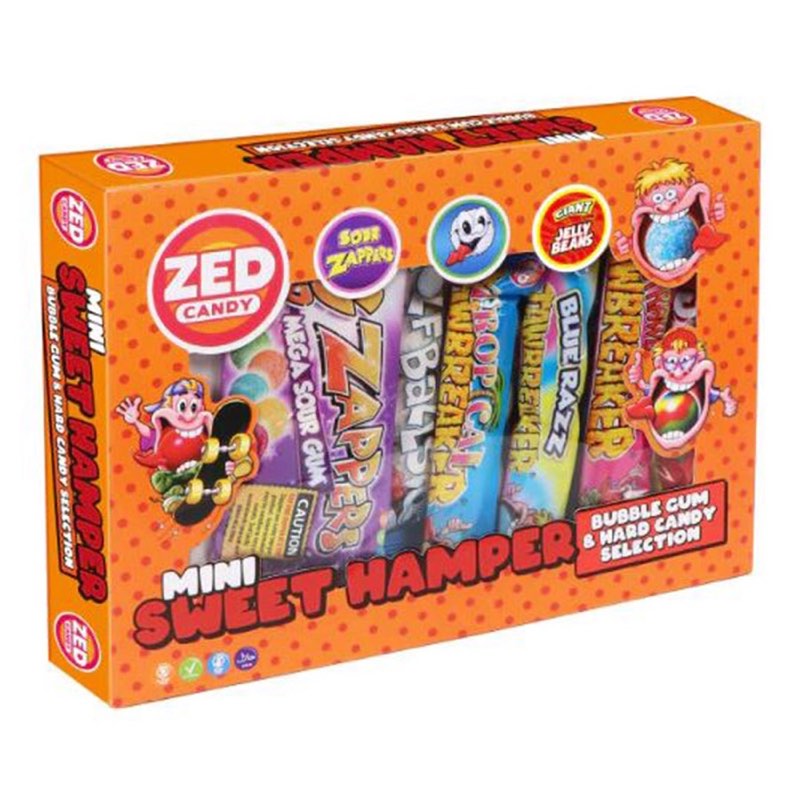
At this price it slots straight into the gap that is genuinely hard to fill: the present that costs under three pounds and is not obviously filler. A secret santa with a low cap, a stocking, a going-away card, a thank-you for someone who has looked after a cat — a game that happens to be sweets reads as thought rather than as a last-minute grab. If you want a second small item to go with it from the same maker, the Zed Candy Mini Sweet Gift Hamper in orange, also £2.99, pairs neatly and takes the total to a sensible six pounds without either half looking like padding.
Journeys
Trains, long car journeys, the two hours in an airport. A boxed game that fits in a coat pocket and needs nothing but two people and a flat-ish surface is worth remembering. Beans do not melt, do not leak and do not dust, so the box survives a bag far better than most confectionery. The only real constraint is that you need to be able to see what you are doing, which rules out the back seat after dark.
What comes out of the box
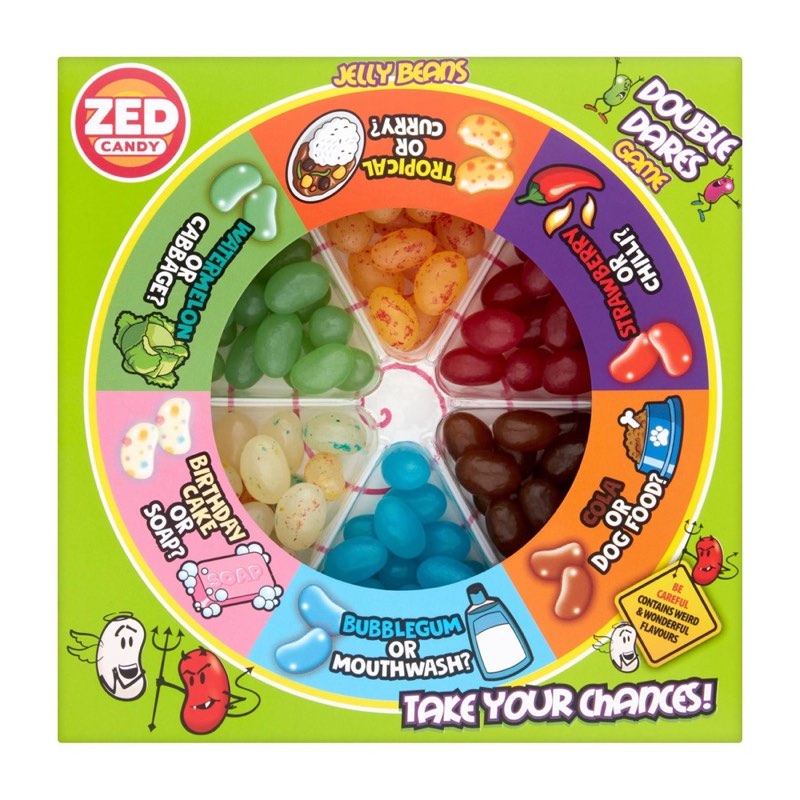
Small, hard-shelled beans in a spread of colours — the pack is described as multi coloured and it looks it. Beans of this type have a firm shell over a softer centre, and the eating experience has two distinct stages because of that. The shell cracks. The centre chews. The whole thing is over in about twenty seconds, which is precisely why the format suits a game: a turn has to be short enough that the person after you does not get bored waiting.
In the hand a bean is light and smooth with a faint gloss. Tip a few into a palm and they run about rather than sitting still, which is a small practical point that matters more than it sounds — beans roll, and a spilled bowl of beans goes under the sofa in a way that a spilled bowl of chews does not. Serve them in something with sides.
Size-wise these are proper mouthfuls rather than the tiny pellets some bean assortments run to. One is a sweet. Three is a handful. The 100g box is not enormous and it is not meant to be — it is a game's worth, not an evening's grazing, and buying it expecting a party-sized quantity is the one way to be disappointed by it.
Our supplier lists this line as vegetarian, gluten free and dairy free. That is the supplier's description of the line rather than ours, and as with everything on the site, anyone with an allergy should read the manufacturer's packaging on arrival before eating — the pack in your hand is the only thing that can answer an allergen question properly.
How to play it, and how to host it well
This is the part most people actually want, so here it is properly.
First: read the pack
The box is sold as a game and carries its own instructions. Read them before you invent anything, because the pack's own rules are the ones the sweets were designed around, and they will be shorter and cleverer than whatever you make up at the table. Everything below is about hosting — how to run the thing so it lands — rather than a substitute for the instructions on the box.
The three rules that make any dare game work
Having watched a lot of games like this go well and a lot of them fizzle, the difference nearly always comes down to three things.
- Set the stake before you start. Not the sweets — the social stake. Is the loser doing the washing up, choosing the next film, or nothing at all? "Nothing at all" is a perfectly good answer and often the right one, but decide it out loud, because a game with an undeclared stake goes flat halfway through when someone asks "wait, what are we actually playing for?"
- Everyone plays or nobody does. One person sitting out and commenting kills a dare game stone dead. If someone genuinely does not want to eat the sweets, give them the referee job — a real role with real authority — rather than letting them spectate.
- Keep the rounds short and stop early. The game is at its best in the first ten minutes and declines sharply after that. Stop while people still want another round. A box that gets put away with beans left in it will come out again next week; a box played to the bitter end will not.
Five ways to run it
Assuming the pack's own rules are the default, these are the variations that reliably work with a boxed bean game and a group of people.
- Straight rounds. Everyone takes a turn in order, and you go round until someone drops out or the box runs low. Simplest, fastest, best for a group who have never played before.
- Two-player knockout. Pairs face off, winner stays on. This suits a bigger group because only two people are ever on the spot at once and everyone else gets to watch, which is where most of the entertainment actually lives.
- Question forfeits. Pair it with a quiz or a trivia app. Get one wrong, take a bean. This is the version that works best with adults who claim they are too old for a dare game, because the dare arrives as a consequence rather than as the point.
- The tasting panel. Not a dare at all. Everyone tries one of each flavour, writes down what they think it is, and you compare notes. Genuinely interesting, and far harder than people expect — see the flavour section below for why.
- Last bean standing. Deal the beans out evenly, and players eat one per round until someone folds. Turns the whole box into a single long game and is the only variation that reliably uses the entire 100g in one sitting.
Refereeing, and the bit hosts forget
Two practical bits of hosting. First, have water on the table. Not for anything dramatic — simply because a game where people are eating strongly flavoured sweets in quick succession goes better when there is something to rinse with between rounds, and a palate that has had four beans in five minutes stops being able to tell one from another. Second, have a second bowl of something plain and boring nearby. It sounds like a small thing; it is not. The plain bowl is what people reach for when they want to keep sitting at the table without taking another turn, and it keeps the group together after the game itself has finished.
For that second bowl, cheap and unremarkable is exactly right. Barratt Jelly Spogs at £5.49 are the sort of thing that does this job without stealing any attention, and our loose sweets shelf — 356 lines of it — is where to go if you want to pick the filler yourself rather than take a recommendation.
Which sweet counter a bean game belongs to
Jelly beans have had at least three lives in British sweet shops, and a boxed dare game is the third of them. Understanding the first two explains why this one feels the way it does.
Beans as counter sweets
The first life is the oldest and the plainest: beans in a jar, weighed out, mixed by colour, sold as one line among forty. In that context a jelly bean was never a special sweet. It was a cheap, hard-wearing, brightly coloured filler that a shop could keep for months and that children could buy a quarter of with whatever was in their pocket. The colours were broad rather than specific — a red bean, a yellow bean — and nobody expected the red one to taste convincingly of anything in particular. It tasted red. That was the deal and everyone was happy with it.
That era of sweet counter has not entirely gone; it lives on in the jars and the weigh-out shelves, and you can still buy sweets that way. An Aniseed Balls sweet jar at £16.99 is about as direct a survival of that world as we stock — a single flavour, a big jar, no concept attached to it at all — and it is worth looking at simply as a contrast to how a boxed game presents itself.
Beans as a flavour showcase
The second life is the one most people under fifty grew up with: the bean as a precision instrument. At some point in the last few decades the trade worked out that a small hard-shelled bean is an unusually good vehicle for a specific, identifiable flavour — better than a jelly, better than a chew — because the shell keeps the flavour sealed until the moment of eating and the size means you get the whole impression in one go rather than across a long chew. Once that was established, beans stopped being generic and started being named. Not red: watermelon. Not brown: cola.
That is the tradition this box belongs to. All four flavours here — bubblegum, cola, strawberry and watermelon — are named, specific, recognisable notes rather than colours with a bit of sweetness behind them, and the whole premise of a dare or guessing game depends on that. You cannot build a game around beans that all taste vaguely of sugar. You can absolutely build one around beans that each taste unmistakably of something.
Beans as a game, and the generation that made it one
The third life is recent and it came from somewhere specific: the internet. Dare games, challenge videos and the whole genre of "watch someone's face while they eat something" made a boxed bean game into a format rather than a novelty. For anyone who grew up watching that, a bean game on a table is instantly legible — they know what it is, they know roughly how it goes, and they do not need the rules explained. For anyone who did not, it takes one round to click.
That split is worth knowing about if you are buying this for a mixed-age gathering, because it determines who explains it to whom. The teenagers in the room will run the game. The adults will claim not to want to play and then be the most competitive people at the table. The very old and the very young will watch, and watching is genuinely half the fun, which is why the two-player knockout version above works so well at a family gathering.
It also explains the price. A boxed game at £2.99 exists because it is an impulse item — the thing someone adds to a basket while buying something else, or grabs on the way to a party. Sitting it next to the more traditional lines in the candy and chocolate section makes that contrast obvious: one shelf sells sweets, this box sells about twenty minutes of something to do.
Pacing a film night, and why beans suit a controller
Away from the game entirely, a box of beans has a second life as a screen snack, and it is better at that job than most of the shelf for three specific reasons.
Pacing
A sweet that takes twenty seconds sets a rhythm. Crisps and popcorn have no rhythm at all — the hand goes back and forth without the brain being involved, and a bowl is gone before the opening credits are over. Beans impose a pause. You take one, it occupies you, and there is a natural gap before the next. Over a two-hour film that difference is enormous: a 100g box of beans can genuinely last most of a film, where 100g of anything loose and soft would not survive the first act.
For gaming the same logic applies more sharply, because your hands are busy. A snack you eat one at a time between rounds fits the structure of a game far better than something that needs continuous grazing, and beans are about the right size to take without looking away from the screen.
Mess, hands and controllers
This is the practical one. Hard-shelled beans leave nothing on your fingers. No powder, no grease, no sugar dust, no colour transfer onto a pale sofa or a light-coloured controller. Of everything we sell, the hard-shelled formats are the ones you can eat with a keyboard in front of you without regretting it afterwards, and that is a real consideration for anyone who has ever tried to eat something coated while playing.
The one mess risk is rolling. Beans that hit the floor travel. A bowl with high sides, placed on a table rather than balanced on a sofa arm, solves it entirely and is worth doing before you start rather than after.
Shareability, and the one-bowl problem
A 100g box is a two-person snack, or a four-person nibble. It is not enough for a room, and the honest advice is not to pretend otherwise. If this is going on the table at a film night with six people, treat it as the interesting item and put something with volume next to it. Skittles at £6.99 do the hard-shelled bulk job in exactly the same eating style, so the table stays coherent rather than becoming a jumble of formats, and Haribo Happy Cola Bottles at £5.49 bring a soft texture in to break up an evening of nothing but shells.
There is also a sharing dynamic specific to a game box that is worth planning around. Once a box has been played with, some people stop treating it as food — the game frame sticks. If you want the beans eaten normally afterwards, tip the remainder into a bowl once the game is over. It sounds trivial. It genuinely changes whether the rest of the box gets finished.
Four flavours, and how each one reads
Four named flavours, each pulling in a different direction, which is a well-judged spread for a game — enough variety that a round has some suspense, not so many that nobody can tell what they have got.
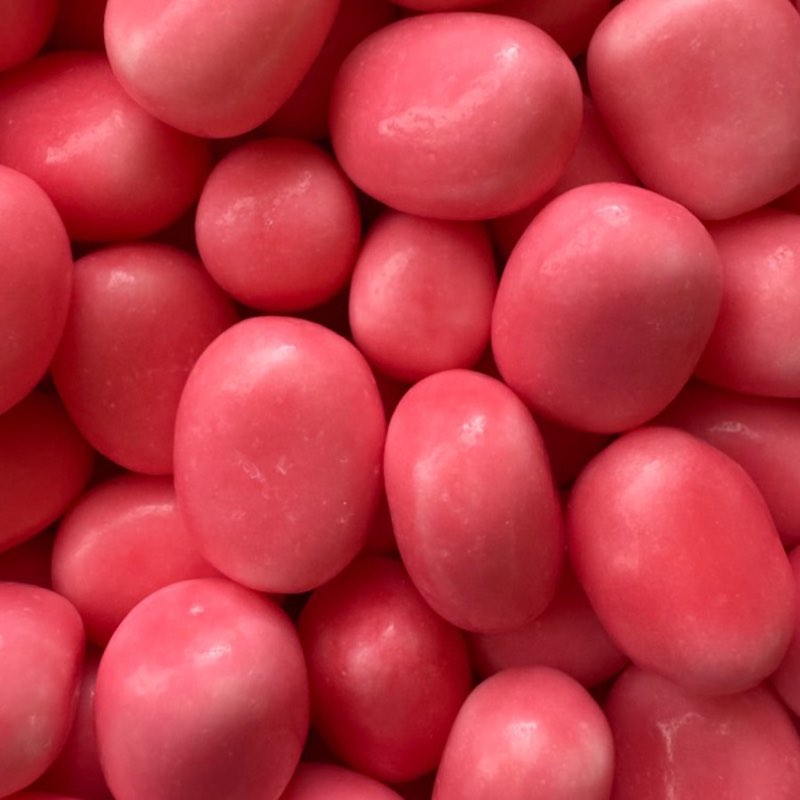
Bubblegum is the odd one out and the most divisive. It is the only flavour of the four that is not pretending to be a fruit or a drink — it is a flavour of a sweet, self-referential and instantly recognisable, and people either love it or want it out of the bag. In a game that divisiveness is an asset. A bubblegum bean is a genuine outcome, not a neutral one. If bubblegum is the note you actually want, the fourteen bubblegum lines on the site are all in one place, and Hubba Bubba Mega Long Strawberry Bubblegum at £1.59 is the cheapest way to get it in its proper form.
Cola is the one that behaves least like a fruit. Cola as a confectionery note is built around a dark, slightly spiced, slightly citrus character that reads as a drink rather than an ingredient, and it has a bitterness at the back that none of the other three have. That makes it the palate-resetting bean of the four, and it is why a cola bean eaten after a strawberry one tastes stronger than a cola bean eaten first. Everything cola-flavoured we stock runs to 22 lines, and BUBS Cool Cola Skulls at £7.50 take the same note somewhere considerably less sweet if you want to see how far it can be pushed.
Strawberry is the safe one and the most familiar. Confectionery strawberry sits closer to jam than to fresh fruit, and in a hard-shelled bean it arrives in a single burst rather than building. In a dare game it is usually the bean people hope for. If you want it in a format where it lasts longer, the Vidal Jelly Filled Strawberries tub at £7.99 is the soft, filled, slow version of the same idea, and Kingsway Fizzy Strawberries at £5.49 are the sharp one. The full strawberry shelf runs to 78 lines, which tells you something about how dominant that one note is across the whole trade.
Watermelon is the most interesting technically. Real watermelon is mostly water and its flavour is extremely faint, so confectionery watermelon is almost entirely a construction — a green-ish, cucumber-adjacent freshness sitting over a light sweetness, with a rind note that some versions include and some do not. It is the flavour most people fail to identify blind, which makes it the best bean to build a tasting round around. Only eight watermelon lines sit on the site, which makes it one of the rarer notes we carry.
Try the tasting-panel variation with these four and you will find that bubblegum and cola are named correctly almost every time, strawberry most of the time, and watermelon far less often than anyone expects. That is not a flaw in the sweets. It is what happens when you take a flavour built mostly from freshness and remove the colour cue by shutting your eyes.
Building a table around a game box
The box is the event. Everything else on the table is there to keep people sitting down.
The volume item should be cheap, plain and in a big bowl — the Skittles and the Jelly Spogs mentioned above both do this. The contrast item should be a different texture entirely, so that people who have had enough shells have somewhere to go; the cola bottles cover that, and Briquette at £5.49 is the more unusual choice for anyone who wants one thing on the table that needs explaining. The chocolate item matters more than people think, because a table of nothing but fruit sweets gets monotonous fast — Glisten Chocolate Mini Eggs at £7.99 do that job in a shareable, bowl-friendly shape rather than as a bar that has to be broken up.
If you would rather assemble the whole spread yourself in exactly the proportions you want, our Pick & Mix is the better route than buying five bags and hoping the balance works out, and the full shop is browsable end to end if you have no idea where to start.
One warning worth giving: do not put a second dare-style game on the same table. Two games compete, both get half-played, and neither lands. One game, several ordinary bowls.
What £2.99 for 100g actually buys
£2.99 for 100g works out at £2.99 per 100g — the box is exactly the round number, which makes the sum unusually easy. That is not cheap measured purely by weight, and it would be a strange thing to buy if you simply wanted beans to eat.
| Measure | Figure |
|---|---|
| Price | £2.99 |
| Weight | 100g |
| Per 100g | £2.99 |
| Named flavours | 4 |
| Realistic number of players | 2 to 4 |
| Sensible number of rounds | enough for one sitting, not two |
But weight is the wrong measure here, and pretending otherwise does nobody any favours. You are buying a game. Compare it to the things it actually competes with — a pack of cards, a bottle of something, a cinema ticket, an hour of anything — and £2.99 for twenty minutes of a room laughing is a good trade. Compare it to 100g of loose beans by weight and it is not. Both statements are true; which one matters depends entirely on why you are buying it.
For a party bag or a small gift the sum is different again: £2.99 is roughly the price point where a present stops looking like filler, and a game at that price reads as more thoughtful than a bag of sweets at the same money, because the recipient gets to do something with it.
If you are buying several — for party bags, for a classroom, for stockings — the maths is straightforward and there is no bulk format to make it cheaper, so budget on the flat price per box.
Keeping beans in the condition they arrived in
Hard-shelled beans are among the least demanding things in the shop, which is part of why they suit a box that might sit in a cupboard until the next time people come round.
Keep them dry. This is the only rule that really matters. The shell is what keeps a bean crisp, and damp is what dulls it. A sealed box in a dry cupboard will be exactly as good in a month as it is today.
Keep them out of direct sun. Not because they will melt — they will not — but because bright light fades colour over time, and a bean game where the colours have gone dull is a less useful game.
Do not refrigerate. Fridges are damp. A cold bean also releases its flavour more slowly, which blunts exactly the quick, sharp hit that makes the format work.
Reseal after playing. Once a box is open, fold it shut or tip the remainder into a lidded tub. Beans left open in a bowl overnight go slightly tacky on the surface and lose the clean shell crack.
Do not decant into a jar and forget which is which. Trivial but real: half the point of this box is that it is a game with its own rules printed on it. Keep the packaging with the sweets.
One size, and the other box in the range
This comes in a single size: the 100g box at £2.99. There is no larger version and no multipack, so the only decision is how many boxes you want.
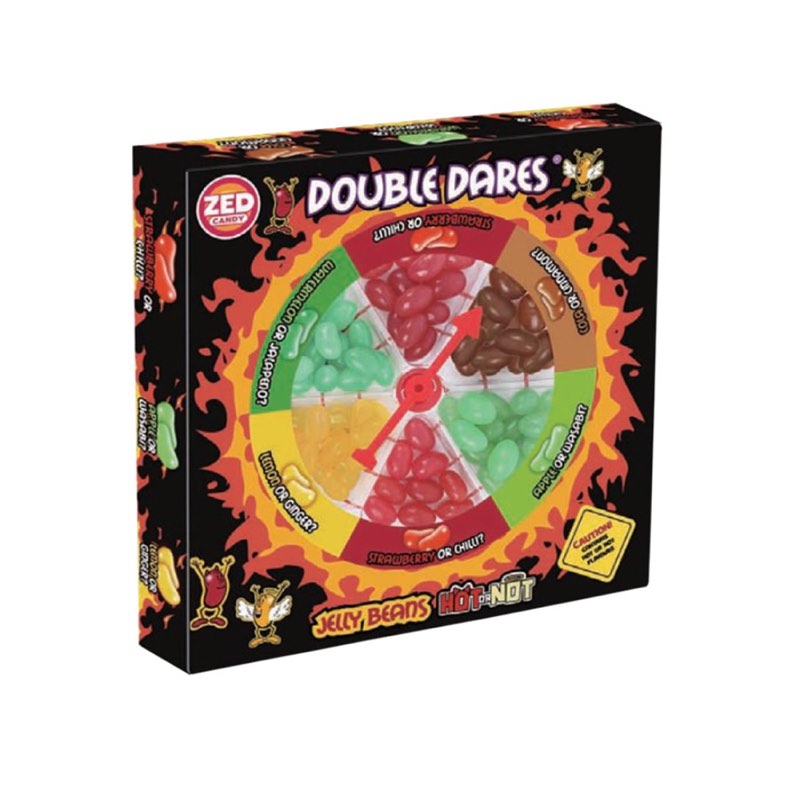
There is, however, a second game in the range, and it is the obvious thing to buy alongside. The Hot or Not version of Double Dares is the same 100g at the same £2.99, which makes buying both the sensible move for anyone planning an evening rather than a single round — two games at six pounds gives you a second act when the first one has run its course, and the fact that they are priced identically means there is no reason to agonise over which to pick first.
Beyond that the range is small. The mini gift hamper linked earlier is the other Zed Candy line we carry, and it is a different proposition entirely — sweets to eat rather than a game to play — which makes it a good partner rather than a competitor if you are putting a small gift together.
Where this sits on the site
This one is filed in more places than most, because it ticks several boxes at once. It sits on the loose sweets shelf linked further up, which is the biggest shelf we run. It also sits on three diet shelves on the strength of what the supplier tells us about the line — the vegetarian shelf at 69 lines, the gluten free shelf at 54, and the dairy free shelf at 51. Those shelves are built from supplier descriptions and are a starting point for narrowing a search, not a substitute for reading the pack when it arrives.
Then there are the four flavour shelves, all linked in the flavour section above — bubblegum, cola, strawberry and watermelon — each of which is a different route into the rest of the shop depending on which bean you end up liking most. The pick and mix and candy and chocolate hubs, also linked above, are the two broadest places to carry on browsing from here.
Questions people ask before buying a game box
How many people can play with one box?
Two to four comfortably. A hundred grams is a game's worth, not a party's worth, and stretching it across six people means everyone gets a couple of turns and then it is over. For a bigger group, buy two boxes, or use the knockout format where only two people are playing at any moment and the rest are watching — watching is most of the entertainment anyway.
What are the actual rules?
They are printed on the pack, and they are the rules the sweets were designed around, so start there. The variations described further up this page are ways of hosting and extending the game once you know the basic version, not replacements for it. Read the box first, play one round as written, then improvise.
Which flavours are in it?
Four: bubblegum, cola, strawberry and watermelon. That is a deliberately contrasting set — one sweet-shop flavour, one drink flavour, one jammy fruit and one fresh fruit — which is what gives a round some actual suspense. A game built on four similar flavours would not work.
Is it suitable for children?
It suits children old enough to sit at a table and take a turn. Sweets are a treat, and small hard sweets need adult supervision with young children, so it is not a toddler item. For a birthday where the children are a bit older it works well, and at £2.99 it is cheap enough to hand out as a take-home rather than keeping one box for the whole group.
Is it vegetarian?
Our supplier lists this line as vegetarian, and also as gluten free and dairy free. That is the supplier's description and it is why the product appears on those three shelves. We would always say the same thing regardless of the line: check the manufacturer's packaging when it arrives, because the pack is the authoritative source and it is the one you can read for yourself.
Can I use it as a party bag filler?
It is one of the better options at this price, precisely because it does something. A bag of sweets gets eaten in the car home; a game gets taken indoors and played. If you are buying several, budget on the flat price per box, since there is no multipack.
How long does a box last?
As a game, one sitting. As a screen snack eaten normally, a 100g box of beans will last two people most of a film, because the twenty-second eating time per bean paces you in a way that crisps or popcorn never do. Which of those two lifespans you get depends entirely on how you use it.
Will it stain hands or furniture?
Hard-shelled beans leave nothing on dry fingers, which is why they are one of the few sweets you can eat with a controller or a keyboard in front of you. The shell only starts releasing colour once it is wet, so the risk is a bean that has been in someone's mouth and then put down, not a bean straight from the box. Use a bowl with sides — the real hazard is that beans roll.
Does it need to be played as a dare game?
Not at all. The tasting-panel version, where everyone tries each flavour blind and writes down what they think it is, is genuinely more interesting for a lot of groups and involves no dares whatsoever. Watermelon in particular is far harder to identify than people expect once the colour cue is removed.
Is there a bigger size?
No. One size, 100g, £2.99. If you want more, buy more boxes — or buy the other game in the range alongside it, which is the same weight at the same price and gives you a second round of something different.
How should I store an opened box?
Fold it shut and keep it somewhere dry. Damp is the only real enemy of a hard-shelled bean; it dulls the shell and takes the crack out of it. Do not put beans in the fridge, and keep the packaging with the sweets so the rules do not get separated from the game.
What should I put on the table alongside it?
Something cheap in a big bowl to give the table volume, something soft to break up a run of hard shells, and water. And only one game per table — two dare games in the same evening means both get half-played and neither one lands.
In short
A 100g box of named-flavour jelly beans sold as a game, for £2.99, and worth judging on what it does rather than what it weighs. Read the rules on the pack, set the stake out loud before you start, play fewer rounds than you think you want, and put a boring bowl of something next to it so people stay at the table afterwards. Buy the second game in the range at the same time if the evening needs more than one act.
More from Zed Candy
More bubblegum sweets


More loose sweets sweets


Where this sits
Zed Candy Double Dares Jelly Beans Game 100g appears on these shelves. Browse them, or jump to something nearby.
You might also like