Home / Loose Sweets / Swizzels Pigs Mugs Tub 576g
Swizzels · 576g
Read the full guide
Swizzels Pigs Mugs Tub 576g
£8.99
✔ In stock — ready to ship
Fresh stock
Free over £20
Same-day dispatch
Secure checkout
Price per gram is the first thing a regular sweet buyer checks and the last thing a product page usually tells them, so let us get it out of the way. The Swizzels Pigs Mugs Tub is £8.99 for 576g. That is a whisker over one and a half pence a gram, or about £1.56 per 100g. A 30g handful costs roughly 47p. A 25g party-bag portion is about 39p. A properly generous 50g scoop into a paper cone comes to about 78p.
Held up against a dense jelly tub, that per-gram figure looks high, and it is worth understanding why before you decide anything on the strength of it. Foam-backed sweets are light. They are mostly structure and air by volume, which means a gram of foam occupies considerably more space than a gram of solid moulded gummy. Pour 576g of these into a jar and then pour 576g of a dense jelly into the same jar, and the pigs will fill it higher. When you are filling a display jar, bagging party favours or putting a bowl on a table, what you are actually buying is bulk and visual volume, not mass — and on that measure a foam tub is a great deal better value than the scale suggests.
The full guide to Swizzels Pigs Mugs Tub 576g
5,728 words on how it eats, who it suits, how to serve it and what to put beside it.
£8.99 for 576g, and what that actually buys
So run the numbers the way you will actually use them. Five hundred and seventy-six grams splits neatly: twenty-three bags at 25g, nineteen at 30g, fourteen at 40g, eleven at 50g. If you are doing party bags for a class of thirty, one tub at 20g a head covers twenty-eight and you will want a second. For a table of a dozen adults at an event, one tub is comfortable. For a household of two working through a bowl a few evenings a week, you are looking at a tub that lasts two to three weeks.
The other calculation worth making is per piece rather than per gram, and with a foam sweet the answer flatters the product considerably. Foam shapes of this kind are light individually, so a single tub holds a great many of them. Weigh ten on a kitchen scale, divide, and you will have your own piece count in under a minute — it will almost certainly be higher than your guess, because the eye reads volume and the scale reads mass, and foam is the one sweet category where those two disagree sharply.
Where this tub earns its money is in the jobs where you need the bowl to look full. A sweet table that looks mean is a sweet table that cost you the same as one that looks generous, and the difference is usually density rather than spend. If you have £9 to spend and a jar to fill, the light sweet fills it. If you have £9 to spend and a hungry family, the dense sweet feeds them longer. Both are legitimate purchases; they are just different purchases, and it is worth knowing which one you are making before the money leaves your account.
One more practical figure. Spread over an event, 576g served in 15g scoops from a bowl with a small spoon — which is how most self-service sweet stations end up working in practice — gives you thirty-eight servings at about 23p each. That is the cheapest per-head treat on most buffet tables by a distance, and it is the one people remember, because a pig face is more memorable than a mince pie.
A tubful of small snouted faces
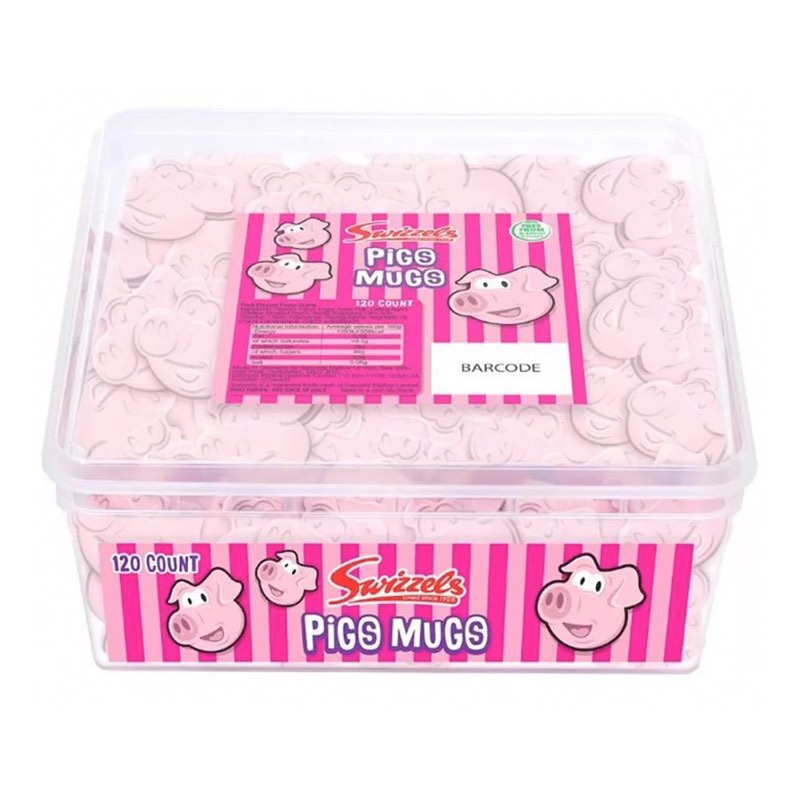
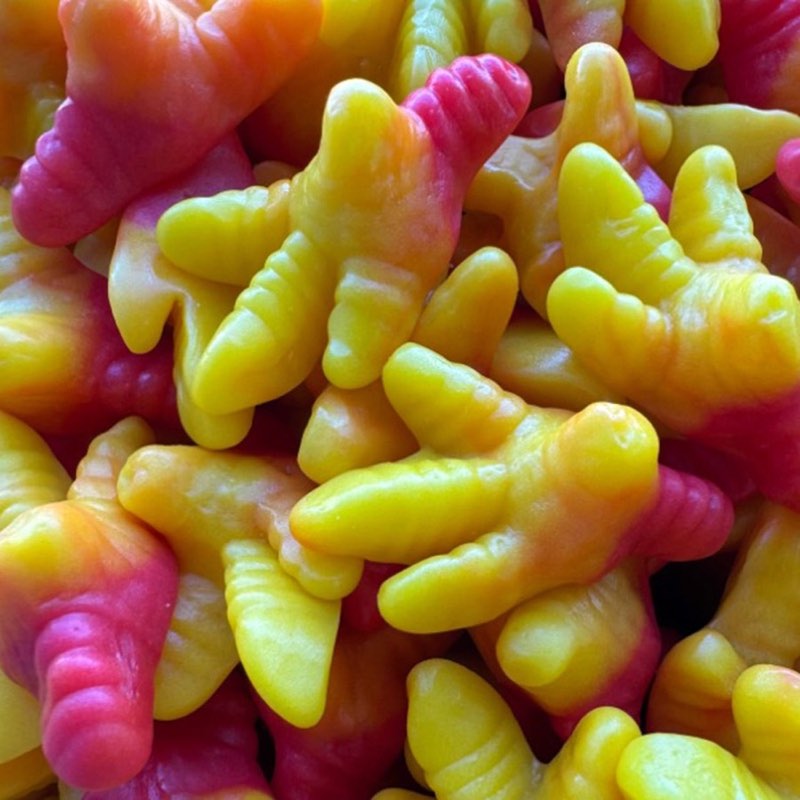
The product is what the name says: a tub of little pig faces. "Mugs" here is the old English sense of the word — a face, a phizog, the thing you pull when somebody photographs you. Each sweet is a moulded snouted face, and the run of them poured out together reads as a crowd, which is the same trick that makes any face-shaped sweet more fun than an abstract one. Nobody ever held up a cola bottle and made it talk.
Open the tub and the first thing that strikes you is how much of it there is. Because the pieces are light, 576g fills the container generously, and tipping it gives you a soft tumbling sound rather than the hard rattle of dense jellies. That soft sound is your first clue about texture, before you have touched anything — foam-backed sweets announce themselves acoustically.
Pick one up and the second clue arrives. It weighs almost nothing between finger and thumb, and it compresses very slightly under light pressure and springs back. A dense gummy does not do that. This is a sweet with give built into it before you have even put it in your mouth, and that structural softness is the whole reason the format exists and the whole reason children love it.
The moulding on a face-shaped sweet is worth a look before you eat it, because it tells you how the tub has been treated. Crisp snouts and clearly defined features mean the pieces have stayed cool. Features that have gone soft and rounded, or pieces that have pressed flat against one another, have spent time somewhere warm. A fresh tub should give you faces you can actually read from arm's length.
Two layers, two textures, one bite
This line is listed under both foam and gummy, and that is not a filing error — it is the point. A sweet of this construction gives you two distinct textures in a single piece, and learning to notice the join is most of the pleasure.
The foam element is airy and yielding. Press it and it dents; release and it mostly recovers. In the mouth it collapses almost immediately, more like a very soft marshmallow than like anything you would chew. It carries very little resistance and a great deal of surface area, which means it delivers flavour fast — faster than a dense sweet can, because there is simply more of it touching your tongue in the first second.
The gummy element behaves in the opposite way. It is firmer, springier, and it holds on through several chews after the foam has gone. So the arc of eating one of these is unusually clearly staged: a soft first collapse, a quick wash of flavour, and then a chew that lasts a few beats longer than the flavour does. That staggered finish is very characteristic of foam-backed sweets and is the reason people eat them in fast succession. The chew ends after the taste does, so your hand is already moving before your mouth has finished.
Surface texture is different from a plain jelly too. Foam sweets tend to feel slightly drier and softer to the touch, with less of the dusting you find on moulded gummies, because they are less prone to sticking to one another in the first place. This is one of the practical advantages of the format: a tub of foam sweets pours cleanly almost to the end, and rarely arrives as a block.
Flavour, when it comes, comes early and leaves clean. There is no long tail, nothing coating the palate the way chocolate does, and very little of the residual sweetness that a hard candy leaves behind. You can eat six of these and still taste the sixth clearly. Whether that is a feature or a hazard depends entirely on where you have left the lid.
Eaten one at a time — which, in fairness, nobody does — the individual flavour notes separate reasonably well. Eaten by the handful they merge into a general bright fruit wash with a strawberry warmth running through it. Try the slow way once so you know what is in there, then eat them the normal way for the rest of the tub.
Which sweet counter this belongs to
Every sweet belongs to an era, whether or not it was made in that era. Some sweets read as 1970s corner shop, some read as 1990s newsagent, some read as things that could only have been invented after social media existed. The pig face belongs squarely to the old British sweet counter — the glass-fronted cabinet, the quarter-pound paper bag, the row of jars you looked up at from below because you were seven and the counter was at chin height.
What marks a sweet as belonging to that era is not flavour, it is the relationship between the sweet and the money. Counter sweets were priced to be affordable by a child holding their own coins. That single constraint shaped everything: the pieces were small, they were sold by weight rather than in sealed packs, the range was broad so that a child could agonise over choices, and the shapes were designed to be recognisable from behind glass at three feet. A face reads from three feet. So does a bottle, a tooth, a shrimp, a crocodile. Abstract shapes do not, which is exactly why the traditional counter is full of animals and objects and almost empty of geometry.
Foam sweets sit right at the heart of that tradition for a practical reason as much as a sentimental one. A light sweet gave the shopkeeper a generous-looking scoop and gave the child a bag that looked big for the money. Everyone in the transaction was happy. That commercial logic is centuries older than any brand on our shelves, and it is still visible in a modern tub: look at what 576g of foam does to a jar compared with what 576g of anything else does, and you are looking at the same trick that the quarter-pound bag ran on.
The Swizzels shelf is a good place to see how deep that counter tradition runs in a single maker's range. Look at Swizzels Teeth N Toothbrush Tub, which is the same 576g tub at the same £8.99 and the same slightly daft object-shaped premise — teeth instead of pig faces, and a format that only makes sense in the counter tradition of selling children the mildly ridiculous. Or the Swizzels Giant Milk Bottles Tub at £9.99, where the shape is a milk bottle of a kind that most people buying it have never had delivered to their doorstep, and which survives precisely because the shape has outlived the object.
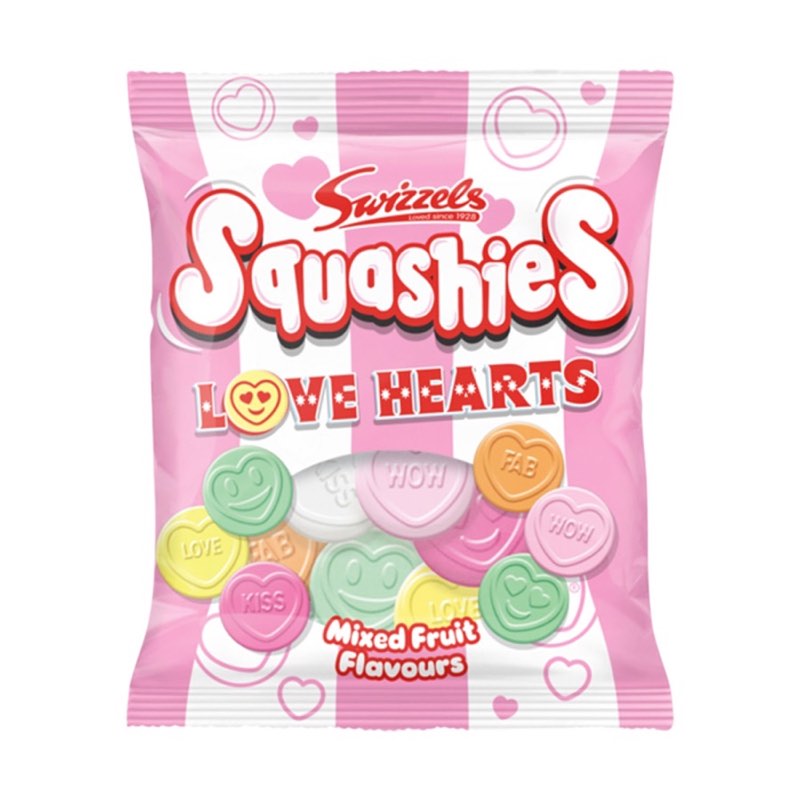
The same logic explains why the small hanging bags still exist alongside the tubs. Squashies Love Hearts in mixed fruit at £1.25 for 120g is the pocket-money format updated for a world with barcodes: still cheap, still impulse-sized, still a shape you would recognise from across a shop. It is the direct descendant of the quarter-pound bag and it is priced to do the same job.
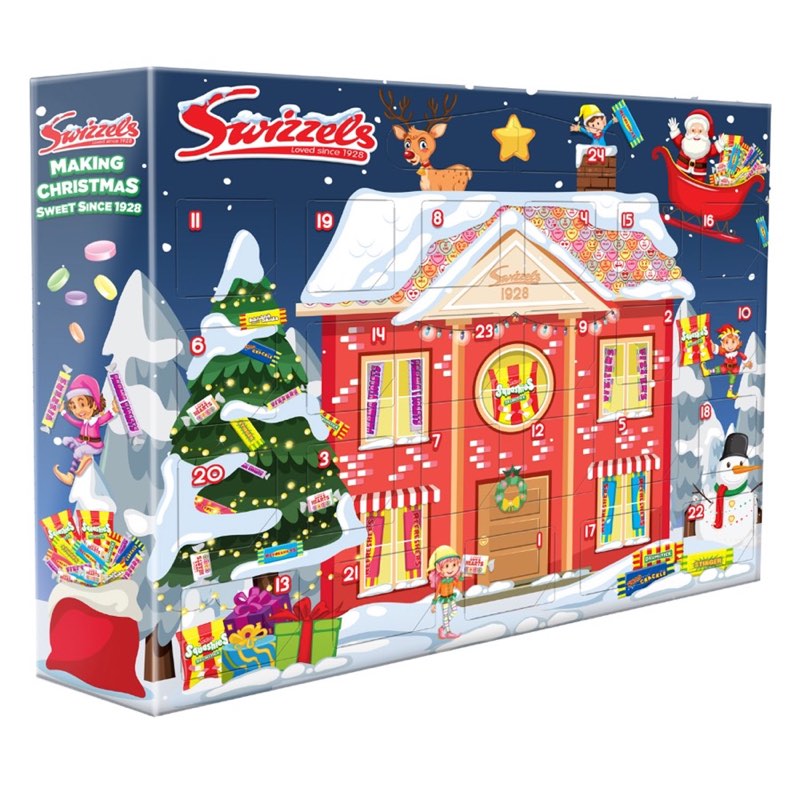
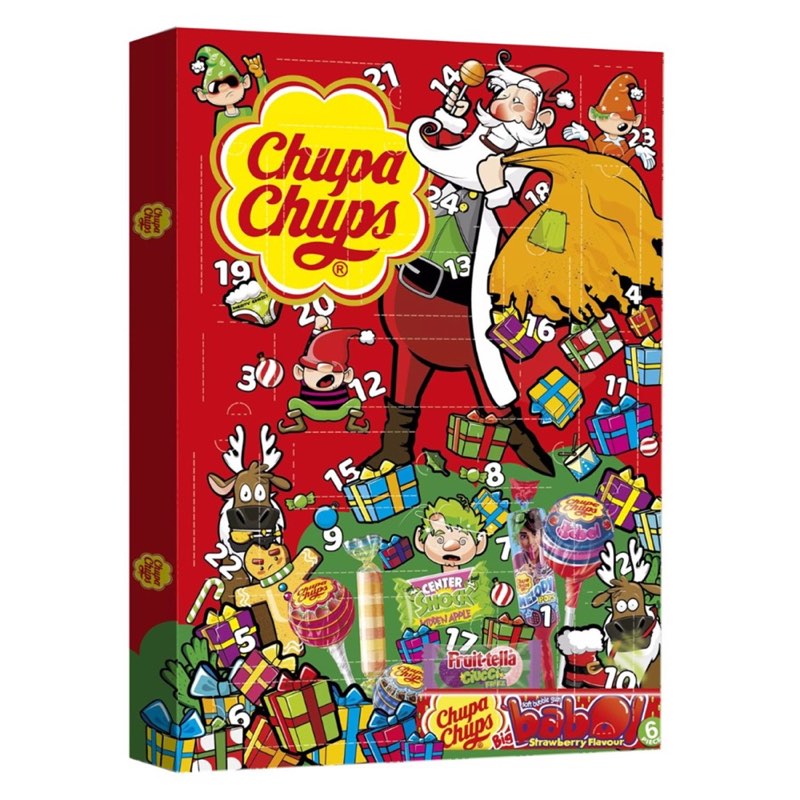
Nostalgia in confectionery is not only about the past, though, and it is worth being honest about that. A lot of what people call nostalgia is really recognition — the pleasure of a shape you already know. That is why seasonal formats sell so hard on familiarity: the Swizzels Sweet Shop Advent Calendar at £8.99 works because it puts a row of already-known shapes behind twenty-four doors, and the Chupa Chups Advent Calendar at the same £8.99 does the same job with a different set of familiar objects. Neither is selling you a new experience. Both are selling you the experience you already have, on a schedule.
Buy this tub for a room with three generations in it and you will see the effect directly. The adults will tell a story about a shop. The children will simply eat the pigs, and in thirty years they will tell a story about this afternoon. That is how the counter tradition actually propagates, and it has very little to do with anything printed on a label.
Who this tub is really for
It is for people feeding mixed ages. That is the clearest use case and the one where nothing else in the jelly range does the job as well. A foam sweet is soft, mild and easy, which makes it acceptable to small children, to older people who would rather not work at a chew, and to everybody in between. Hard sweets exclude people. Sour sweets exclude people. Soft foam excludes almost nobody.
It is for anyone running a jar, a stall or a table where appearance matters as much as quantity — school fêtes, church halls, office receptions, wedding sweet tables. The volume-per-pound advantage of a light sweet is exactly what you want when the jar has to look full at four in the afternoon as well as at eleven in the morning.
It is for the parent who wants the party bag to have a shape in it that gets a reaction. A pig face gets a reaction. And it is for the household that likes to have something in the cupboard that is not chocolate — a non-chocolate default matters more than people realise by about the third week of December.
It is not the tub for you if what you want is a long, substantial chew that occupies you for a while. Foam-backed sweets are quick by design. If you want a sweet that makes you slow down, the dense moulded end of the counter serves you better, and the Vidal Jelly Filled Strawberries Tub at £7.99 is the obvious tub-sized alternative for someone who wants more resistance per piece.
The usual sensible notes apply and are worth repeating rather than burying: sweets are a treat rather than everyday food; whole gummy sweets and small hard sweets are a choking risk for young children and should be eaten with an adult present; and if anyone in the house has an allergy, read the manufacturer's packaging on the tub when it arrives, before anyone eats anything. That packaging is always the authority, whatever any website says.
Plotting this on the sour-to-sweet line
Think of the sweet counter as a single line running from flat sweet at one end to genuinely eye-watering at the other, with four or five recognisable stops along the way. Knowing where a product sits on that line is more useful than knowing its flavour, because sourness governs how fast people eat, how long a bowl lasts, and who at the table will and will not touch it.
Stop one is plain sweet: no acid edge at all, nothing to make you blink. Stop two is a gentle fruit tartness, the natural-tasting bit of sharpness that stops a fruit sweet tasting flat. Stop three is a noticeable sour coating that hits first and fades within a couple of seconds. Stop four is sustained sour, where the sharpness stays through the whole chew. Stop five is the specialist end, where sourness is the product and flavour is a passenger.
A foam-backed fruit sweet like this one lives at the first and second stops. There is nothing in the format or the flavour notes to suggest a sour treatment, and the soft construction works against it anyway: an acid coating needs a firm surface to sit on and a foam surface is the wrong host. So treat this tub as your sweet anchor. It is the thing that everything sharper gets measured against, and the thing people reach for when they want a break from sharp.
That makes it structurally useful. A table of sour sweets is exhausting within twenty minutes; a table of sweet sweets is dull within thirty. A table with an obvious mild anchor and two or three graded sour options is a table people keep coming back to for an hour, because they can self-select and then swap. You are building a menu, not a pile.
Here is how to grade upwards from this tub without overshooting. For a first step into gentle sharpness, BUBS Wild Strawberry & Pomegranate Ovals at £7.50 offer a fruit profile with more edge to it than a plain foam sweet while staying comfortably eatable by the handful. For a clear, obvious sour hit that announces itself and then gets out of the way, sour strawberry rings from Dulce Plus at £5.49 are the natural next stop, and they keep the strawberry note so the two sit together rather than clashing.
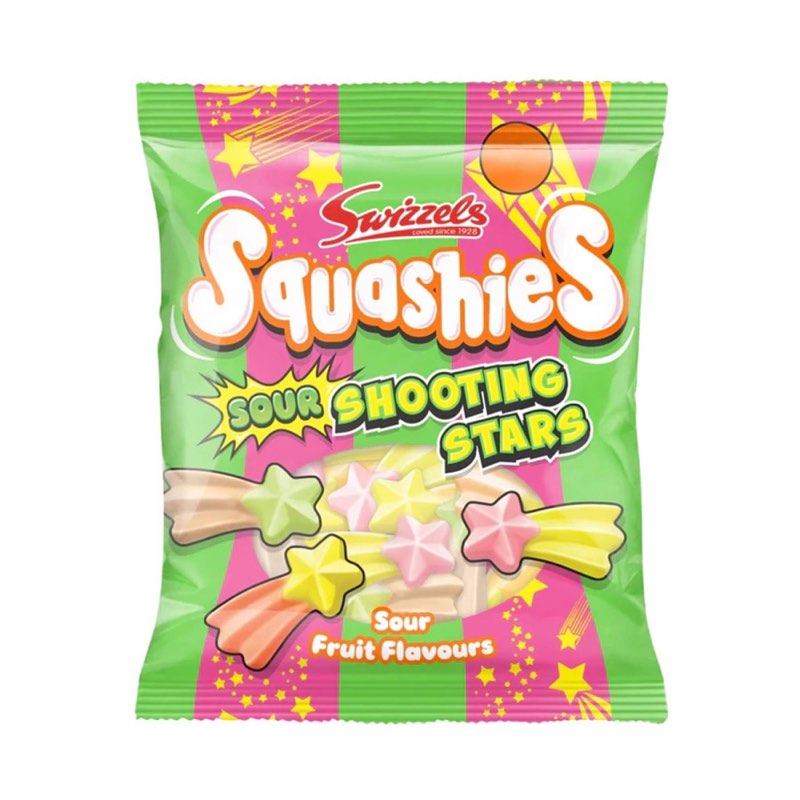
Step up again and you reach the properly sour end from the same maker as the pigs: Swizzels Sour Shooting Stars Gums Squashies at £1.29 for 100g is a cheap way to add a sharp line to a table without committing to a tub of it, which is exactly the right way to buy sour sweets for a mixed crowd. Buy the mild thing in bulk and the sharp thing in small bags. Do it the other way round and you will be eating sour sweets yourself until March.
Texture changes perceived sourness too, which is the part most people miss. The same level of acid reads sharper on a firm, dry-surfaced sweet than on a soft, moist one, because the coating hits the tongue all at once instead of being released gradually. That is why a hard-shelled piece like Nerds Gummy Clusters at £2.49 reads as brighter and more insistent than its flavour alone would suggest, and why the soft, yielding Fini Mini Mochis at £1.35 read as mild almost regardless of what is inside them. If you want a table that feels varied, vary the texture as well as the acid, and you will get twice the effect for the same spend.
Fruit and strawberry, filtered through foam
Two flavour notes are listed for this line: fruit and strawberry. In a foam-backed sweet those notes behave differently from how they would in a dense jelly, and it is worth knowing how before you decide whether this is the profile you want.
The broad fruit family is the backbone of the British sweet counter — bright, immediately readable, not trying to be a literal fruit. It is a flavour register built for speed of recognition, and foam is the ideal carrier for it because foam releases everything at once. There is no slow build here. The fruit arrives in the first moment, which suits a sweet that is going to be eaten quickly and in company. If that family is what you are after generally, fruit-flavoured lines run to a hundred and sixty-odd products across the shop and cover every texture we stock.
Strawberry is the second note and the one that gives the tub its character. Sweet-shop strawberry is its own thing, distinct from the fruit and much older than any modern product using it: rounder than raspberry, softer than cherry, with a slight creaminess that makes it read as comforting rather than bright. In foam, that creaminess is amplified, because the airy texture is already reading as soft. Strawberry and foam is one of confectionery's genuinely well-matched pairings, and it is a pairing the counter has leaned on for as long as foam sweets have been made.
If strawberry is the note you keep chasing, the seventy-odd lines under everything strawberry are worth working through by texture rather than by brand. The same note in a dense filled jelly, in a sour ring, in a foam piece and in a chewy oval gives you four genuinely different experiences, and most people discover they have a strong preference for one of the four without ever having tested it.
For the fruit side, a useful contrast is a precision product like a 70g bag of Jelly Belly's twenty-flavour mix at £2.40, where the whole design intent is that each piece tastes of one specific identifiable thing. Put that next to a foam tub and you can taste the difference between the two philosophies of fruit flavouring: one aims at recognition of a category, the other at recognition of an individual fruit. Neither is better. They are answering different questions, and a good sweet table has both on it.
Building a bowl with pigs at the base
Use this tub as the volume layer. It fills a bowl, it fills a jar, it fills a bag, and because it is light and mild it can make up half the mix without dominating the eating. Then add on three axes, and add deliberately.
- Add resistance. The one thing foam cannot give you is a long chew, so bring in something that pushes back. Kingsway Crocodiles at £5.49 are the traditional answer, with a firmer, longer-working bite that makes the foam feel even lighter by contrast.
- Add sharpness, sparingly. One sour line in a bowl of four is plenty. Two is a bowl that only sour fans will finish.
- Add a statement piece. Every good mix has one thing per serving that makes people look. A structural or oddly shaped piece does that — the £5.49 line we stock simply as Briquette is a good candidate for the role purely because nobody at the table will know what it is until they ask.
- Add something to do. For children's tables, a small activity beats another flavour every time. A Fuji Candy build-it-yourself kit box at £2.99 is 20g of sweet and a quarter of an hour of occupation, which is a ratio worth paying for at a party.
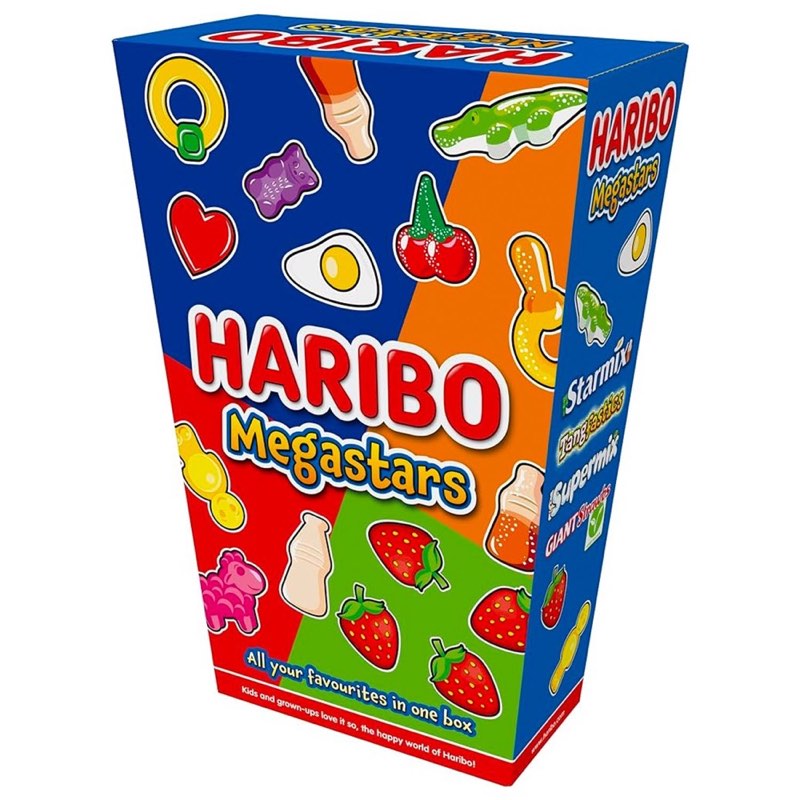
For a larger spread, a big mixed box takes the assembly work off you entirely — an 800g Haribo Megastars gift box at £6.99 brings a lot of variety in one purchase and pairs sensibly with a single-shape tub, because the box supplies the range and the tub supplies the depth. If you would rather not build anything at all, the pick and mix jars are assembled on exactly these principles and will save you the arithmetic.
Proportion rule of thumb for a party table: half foam base, a quarter firm chew, an eighth sour, an eighth statement pieces. For a household bowl, drop the statement pieces and push the firm chew up — you are eating over weeks, not performing for a room.
Where a tub like this earns its place
Fêtes and fundraisers first, because that is where the volume-per-pound maths bites hardest. A stall selling scoops needs a sweet that looks like a lot for the money, and a light foam sweet is the classic choice for exactly that reason. You can run thirty-eight fifteen-gram scoops out of one tub.
Children's parties second. The shape does the work here — a bowl of faces gets picked over and talked about in a way that a bowl of rings does not — and the softness means you are not handing very small children something they have to fight.
Christmas tables third, and this is an underrated one. By Boxing Day afternoon everybody in the house has had enough chocolate and nobody will admit it. A tub of mild fruit foam is the thing that quietly disappears in those two days between Christmas and the new year, because it is the only thing on the table that is not rich.
Hampers and gift builds fourth. On its own a tub is not a gift — it is a container of sweets, and it looks like one. Decanted into two or three jars with a ribbon, it becomes the bulk that makes a hamper look full while something smaller and more decorative sets the tone. That is how hampers are actually built, and anyone who tells you otherwise has never filled one.
And film nights, quiz nights, long car journeys, and the back of the cupboard for when somebody's friends turn up unannounced. A tub with a lid and a mild sweet inside it is the most flexible thing on the sweet counter, which is a dull virtue that becomes a real one about four times a year.
Scooping, bagging and running the tub down
Light sweets behave differently in the hand from dense ones, and if you are portioning by eye you will consistently under-fill. A 25g bag of foam looks like more than a 25g bag of jelly, so people stop filling sooner. Weigh the first two bags, look at them, and then trust your eye for the rest — you only need to recalibrate once.
A wide scoop works better than a deep one here. Deep scoops crush the pieces at the bottom, and foam sweets that have been compressed do not fully recover. If you are running a self-service jar, use a wide-mouthed jar and a shallow scoop and the pieces will keep their shape until the end.
Do not put out the whole tub at once at an event. Half out, half sealed. This is partly about appearances and partly about condition: foam sweets left open to the air for several hours will firm up at the surface, and the second half of your event deserves the same product as the first.
For the household, the simplest control is the one that works: decant a jar's worth, put the tub somewhere that requires a small effort to reach, and let the friction do the work. A tub left open beside the kettle will be gone in nine days regardless of anybody's intentions, and nobody ever regretted having to stand on a chair.
Foam keeps differently — here is how
The failure mode of a foam sweet is not melting, it is drying. Left uncovered, the airy structure loses moisture and firms up, and a piece that should collapse softly ends up chewy and slightly tough. It is perfectly edible in that state, and a minority of people actively prefer it, but it is not the sweet the maker designed. The fix is trivial: the lid, on, every time.
Heat is the second problem and it works differently on foam than on jelly. Warm jellies go tacky and clump; warm foam goes limp and loses the definition of its moulding, so your crisp pig faces become vague pig faces. A cool, dark cupboard away from ovens, radiators and sunny windows keeps the shapes sharp for as long as you will realistically take to eat them.
Do not refrigerate. Fridges are humid, and a humid environment does to foam roughly the opposite of what dry air does — it softens the structure until pieces begin to slump against each other. Do not freeze either; the texture does not come back.
If you are decanting, fill your jars properly full. A jar that is one-third sweets and two-thirds air will dry its contents faster than a tub with the lid on, which is the small irony of decanting into something prettier. And when you are down to the last couple of hundred grams, move them into a smaller container rather than letting them rattle about in a large one.
One tub, one price, no decisions
This line is sold in a single option: one size, 576g, £8.99. There is nothing to weigh up on format, which means the only question is quantity. It is in stock at the time of writing, though for a fixed-date event it is always worth ordering early rather than assuming.
The quantity question answers itself once you have a head count. Under fourteen guests at a generous 40g each: one tub. Between fourteen and twenty-eight at 20 to 25g each for party bags: one tub, tightly. Above that: two. Two tubs of the same line beats one tub plus an unrelated bag for an event, because a matched pair lets you keep the second sealed and the second half of the party gets sweets in the same condition as the first.
If you want a second tub that is different rather than more of the same, the matched choice within the range is the other 576g tub at the same £8.99 — same maker, same format, same price, entirely different shape — which gives a table two distinct silhouettes for a predictable spend. That is a neater solution than pairing a tub with a random bag, and it makes the maths trivially easy.
Finding it again, and what sits nearby
There are four sensible routes to a product like this, and the one you pick should depend on what you actually know about what you want.
If you know the format, start from the loose sweets aisle — three hundred and fifty-odd lines, and the home of every tub and bulk bag we keep. If you know the texture, the thirty-odd lines under foam sweets are the tightest filter on the site for anyone who specifically wants the soft, airy, quick-collapsing style, and the seventeen lines under the gummy shelf cover the firmer side for comparison.
If you know the flavour but not the format, the fruit and strawberry shelves cut across every texture at once, which is the right approach when you know what you want to taste but are open about what you want to chew. And if you know the maker, the brand shelves are the fastest route of all — the Swizzels shelf alongside Kingsway's range and the Haribo shelf covers the bulk of the traditional counter between them.
For a table that needs more than jellies and foam, the candy and chocolate side of the shop supplies the balance — one chocolate line and one hard sweet alongside a foam tub is usually the whole variety a party needs. And when you simply want to look at everything, browse the full catalogue and filter from there; a lot of the best pairings are things you would never have searched for.
Worth knowing too: a good proportion of what we stock is sweets sold loose rather than in sealed retail packs, which is what makes building your own mix cheaper than buying a ready-made one. If you buy sweets more than a few times a year, that is the single most useful thing on this page.
Questions people ask before buying this one
Why is a 576g tub £8.99 when heavier tubs cost less?
Because foam sweets are light for their size. A gram of airy foam takes up much more room than a gram of dense jelly, so 576g of these fills a jar higher than 576g of a moulded gummy would. You are buying volume rather than mass. If your purpose is filling a display jar, bagging party favours or making a bowl look generous, that works in your favour. If your purpose is feeding several people for as long as possible, a denser tub gives you more chewing per pound.
How many party bags will one tub fill?
Twenty-three at 25g, nineteen at 30g, fourteen at a generous 40g. For a class of thirty you will want two tubs unless you are filling at 20g a head, where one covers twenty-eight. Weigh your first bag or two rather than filling by eye — light sweets look like more than they weigh, so eye-filling tends to run short rather than long.
What is the texture actually like?
Soft and airy first, then a springier chew. The foam part collapses almost at once in the mouth and releases flavour quickly; the gummy part carries on for a few chews after the flavour has faded. It is a quick sweet rather than a long one. If you want something that occupies you for a while, this is not it, and a dense moulded jelly will suit you better.
Are these sour?
No. Nothing in the name or the listed flavour notes points to a sour treatment, and the soft foam construction is not really suited to carrying a sour coating anyway. Treat this tub as the mild anchor on a table and buy sourness separately in small bags, scattered through the mix. That way the people who like sharp sweets get them and the people who do not are not stuck with a whole bowl they will not touch.
Will they be squashed when they arrive?
The tub is a rigid container and that is most of the protection. Foam sweets compress under pressure and mostly spring back, so some settling in transit is normal and not a fault. What you do not want is pieces that have been warm enough to lose the definition of their moulding — if the faces are vague rather than crisp, the tub has been somewhere hot, and that is worth telling us about.
How long will an open tub stay good?
Longer than you will take to eat it, provided the lid goes back on. The thing that spoils a foam sweet is air drying the surface until it firms up. Lid on, cool cupboard, out of the sun, and the texture holds. Left open on a counter for a week, you will notice a difference in the bite, though it will still be perfectly edible.
Can I put them in the fridge in hot weather?
Better not to. Fridges are humid as well as cold, and humidity softens the airy structure until the pieces start slumping into one another. A cool cupboard on an internal wall is a better answer in a hot house, and a cellar or a north-facing room is better still. Freezing changes the texture permanently, so avoid that entirely.
Are they suitable for vegetarians or vegans?
We do not hold verified dietary information for this line and our supplier has not provided dietary tags for it, so we cannot tell you either way and would rather say that plainly than guess. The manufacturer's own packaging on the tub is the authority. It will be in your hands before anyone eats anything, so read it there. The same applies to allergens — always check the packaging on arrival if anyone in the house has an allergy.
Are they all right for small children?
Whole gummy and foam sweets, like all small sweets, are a choking risk for young children and should be eaten with an adult present. Sweets are a treat rather than everyday food. The practical approach at a party is to portion into small bags rather than leaving a tub open, which both slows the room down and lets you keep track of who has had what.
What should I put beside them on a sweet table?
Something firmer to chew, one sharp line in a small quantity, and one piece per serving that makes people look up. A traditional firm jelly shape covers the first, a small bag of a sour line covers the second, and anything structurally unusual covers the third. Add one chocolate item if the table is going to be out for more than an hour, because an all-jelly spread gets tiring in a way a mixed one does not.
Is this a good tub for a fête or a fundraising stall?
It is one of the better ones, for the reason given above: light sweets fill a scoop generously and look like good value to the person buying. At 15g a scoop — which is what most stalls end up serving — one tub gives you around thirty-eight servings at roughly 23p each in stock cost. Pair it with one firmer line and one sharp line so the stall has a choice, and you will sell all three faster than you would sell any one of them alone.
To sum up
Five hundred and seventy-six grams of soft, light, face-shaped fruit foam for £8.99 — a sweet that belongs to the old glass-fronted counter and still behaves like it, filling a jar generously, pleasing every age in the room, and asking nothing of anybody's jaw. It is the mild end of the sour-to-sweet line and the right thing to build a table around rather than the right thing to build a table out of. Put something firm beside it, put something sharp beside that, and keep the lid on between rounds.
More from Swizzels
More foam sweets
More fruit sweets
Where this sits
Swizzels Pigs Mugs Tub 576g appears on these shelves. Browse them, or jump to something nearby.
You might also like