Home / Loose Sweets / Haribo Tangfastics Sweet Tub 1kg
Haribo · 1000g
Read the full guide
Haribo Tangfastics Sweet Tub 1kg
£11.99
✔ In stock — ready to ship
Fresh stock
Free over £20
Same-day dispatch
Secure checkout
Start with the arithmetic, because on a tub this size the arithmetic is the first thing most shoppers want and the last thing most product pages give them. The Haribo Tangfastics Sweet Tub is 1 kg for £11.99. That is £1.20 per 100 g, near enough, or a shade under 1.2p per gram. Hold that number in your head for a moment, because it is the figure everything else on this page gets measured against.
Now turn it into portions, which is how sweets are really bought even when they are priced by weight. Nobody eats a kilogram. People eat handfuls, and a handful of mixed fizzy and jelly pieces is somewhere between 25 g and 50 g depending on the size of the hand and the honesty of the person doing the scooping. At 25 g a sitting, a kilo tub is forty sittings. At 50 g — the size of a small paper bag at a counter, the amount you would tip into a bowl for one person during a film — it is twenty. At 100 g, which is a generous share-bowl serving for two people to pick at across an evening, it is ten.
The full guide to Haribo Tangfastics Sweet Tub 1kg
5,899 words on how it eats, who it suits, how to serve it and what to put beside it.
A kilo for £11.99 — what that actually works out at
| Portion | Servings from the 1 kg tub | Cost per serving | What that portion suits |
|---|---|---|---|
| 25 g | 40 | 30p | A small after-dinner treat, a lunchbox addition, a reward jar |
| 50 g | 20 | 60p | One person, one film; a counter-sized paper bag |
| 100 g | 10 | £1.20 | A share bowl for two across an evening |
| 150 g | 6 (with a little left) | £1.80 | A table bowl that four people graze from |
Those are useful numbers for planning a party. If you are catering a children's birthday and you want a sweet bowl that does not run dry, 50 g a head is the honest planning figure — generous enough that nobody feels rationed, small enough that you are not sweeping the remainder into the bin at nine o'clock. One kilo therefore covers twenty children, or ten if you want them to go back for seconds without anyone doing the maths. For a grown-up gathering, where the bowl competes with crisps and cheese and everything else on the table, 30 g a head is closer to the truth, and a kilo stretches to thirty.
Here is the part a shopkeeper ought to tell you rather than hide. We also stock the 400 g Tangfastics tub at £3.99, and if you put that through the same sum it comes out at just under £1.00 per 100 g. On pure pence-per-gram, the smaller tub is the better rate. Three of them would give you 1.2 kg for £11.97 — two pence less than this tub, and 200 g more sweets. So why does the kilo exist, and why do people keep buying it?
Three honest reasons. The first is that a kilo arrives as one object. One lid, one seal, one thing to carry, one thing to put on a table. Three separate tubs is three lids to lose, three part-used containers migrating to the backs of three different cupboards, and three opportunities for someone to leave one open. The second is presentation: a full kilo tub set down on a party table reads as abundance in a way that a row of small tubs does not, and if you are putting sweets out for people rather than eating them yourself, that matters. The third is simple friction — one line on the order, one item to find, one thing to reorder next time. If you want the absolute best rate per gram, buy the small tub repeatedly. If you want the sweets to arrive as a single, obvious, party-shaped object, buy this one. Both are defensible; only one of them is usually admitted.
Opening the lid: what a kilo of Tangfastics looks like
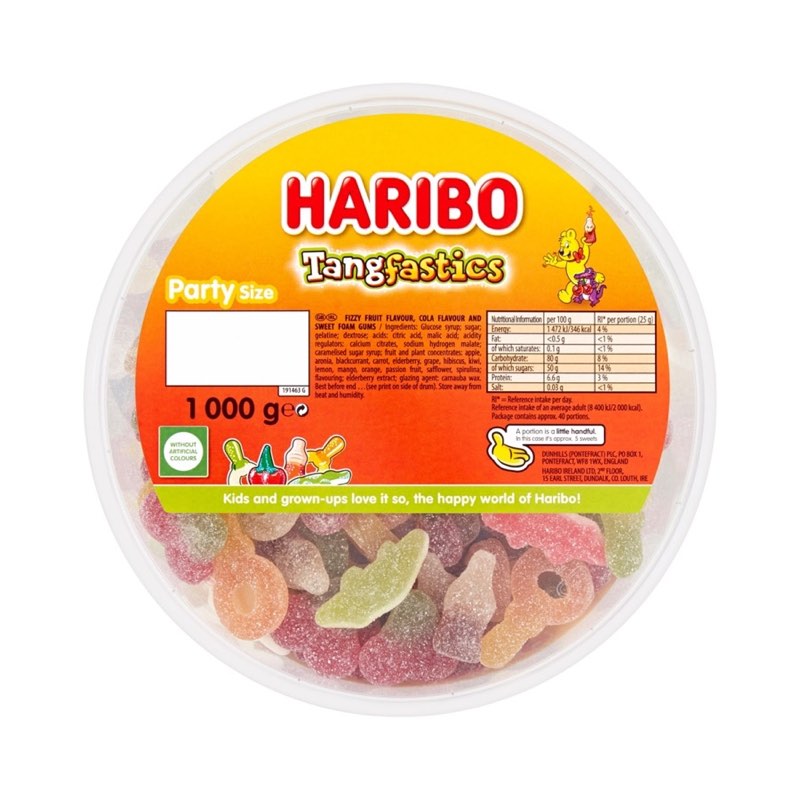
The first impression is bulk. A kilogram of light, air-filled sweets takes up far more space than a kilogram of anything dense, so the tub is broad and deep and it reads as a serious quantity the moment the lid comes off. The colour comes at you first — this is a multi-coloured mix, and the range across the top layer is wide enough that your eye does not land on any one shade. Reds, yellows, greens, oranges and the darker cola-coloured pieces all sit in the same scoop, and because the pieces are different shapes as well as different colours, the surface has texture rather than looking like a flat wash of confectionery.
The second impression is the frosted, matte finish across most of the mix. These are fizzy sweets, and fizzy sweets do not shine the way plain jellies do; they look powdery and slightly soft-edged under the light, and your fingertips come away faintly dusted when you dig in. That dusting is the tell. It is how you know before you have eaten anything that the first second of this sweet is going to be sharp.
The third impression is variety of build. The tub mixes three constructions from our shelves: fizzy pieces, foam pieces and jelly and gummy pieces. That is not a marketing distinction, it is a real difference in how each one behaves in the mouth. The jelly and gummy pieces are dense and springy and want proper chewing. The foam pieces are lighter, aerated and yielding — they compress under the teeth rather than resisting them, and they dissolve faster. Some pieces combine both in one sweet, a firm jelly body with a soft foam element, and those are the ones that give the mix its particular character: two textures arriving in sequence from a single sweet.
Pick one up and it is small — a thumb-joint's worth, the size that lets you eat three or four in a row without thinking about it. That is deliberate on the part of anyone designing a mix like this. Big sweets make you commit. Small sweets make you graze, and grazing is what turns a kilo tub into an empty kilo tub faster than anybody plans.
The eating: sharp first, sweet second, gone quickly
The sequence is consistent and it is worth describing properly, because it is the whole reason this style of sweet has the following it has.
Second one: sharpness. It arrives on the tip and sides of the tongue almost immediately, before any real flavour has registered. It is a physical sensation as much as a taste — a tightening at the back of the jaw, the involuntary narrowing of the eyes, the small reflexive rush of saliva. This is the part people either love or actively avoid, and there is very little middle ground. If you are the sort of person who eats three in a row to feel it properly, you already know. If you are the sort who winces, the sharpness is why.
Seconds two to four: the fruit and cola flavours come up underneath. The sharpness does not vanish, it steps back, and what was pure sensation resolves into something you can actually name. The fruit pieces read bright and simple — the flavours are broad, confident and recognisable rather than subtle, which is exactly right for a sweet designed to be eaten in handfuls. The cola pieces are a different register altogether: darker, rounder, faintly spiced, a flavour that has more in common with a drink than with fruit.
Seconds four to ten: the chew. This is where the different constructions separate. A dense jelly piece gives you a proper working chew, springy and slow, and the flavour stays with it the whole way. A foam piece is finished in half the time — it collapses, sweetens, and is gone. A combination piece does both in sequence: the soft part yields, the firm part holds on. If you take a random handful you get all three timings at once, which is why a handful of this mix feels busier in the mouth than a handful of any single-texture sweet.
The finish is clean and it does not linger long. That is a feature, not a shortcoming. Sweets with long finishes are the ones you eat two of; sweets with short, clean finishes are the ones that leave a small gap thirty seconds later that another sweet fits neatly into. This is a grazing mix. It is built to be eaten from a bowl over an hour, not savoured one piece at a time.
One practical note on eating them in quantity: the sharpness has a cumulative effect on the tongue and the roof of the mouth if you go hard at a big bowl for a sustained stretch. Most people self-regulate long before it becomes uncomfortable, and taking a break — a drink of water, twenty minutes away from the bowl — resets it entirely. It is worth knowing if you are putting a kilo in front of children who have not met a fizzy sweet in this quantity before, simply so the pacing does not surprise anyone.
Which sweet counter this belongs to
Every sweet carries a decade in it, and part of the pleasure of a shop like this one is recognising which decade you are holding. This mix belongs to the era when the sweet counter stopped being a row of glass jars behind the shopkeeper and became a wall of open plastic bins that you served yourself from with a scoop and a paper bag. That is a specific moment, and it changed what sweets were made to do.
The jar era had an in-built ceremony. You pointed, the shopkeeper reached up, twisted the lid, tipped sweets onto a brass scale, and the whole transaction had a weight and a slowness to it. Sweets built for that counter tended to be singular and long-lasting — something you would suck for ten minutes because you had gone to some trouble to obtain it. A boiled sweet, a large mint, a single toffee. The pleasure was in the duration.
The scoop-and-bag counter asked for something entirely different. Now you were assembling a bag yourself, choosing by eye and by colour, taking three of this and five of that, and the whole appeal was in the mixture rather than in any one piece. Sweets made for that counter had to be small enough to combine, bright enough to pick out of a bin, and interesting enough that you would want more than one. This mix is a direct descendant of that shelf. It is a bag of pick and mix that arrives pre-assembled, and the fact that we sell it beside our actual pick and mix section is not an accident — it is the same idea, sold two ways.
There is a second generational marker in the sharpness itself. The sour sweet as a mainstream category, rather than a novelty for the brave, is a relatively recent arrival on British counters. For a long time the standard sweet-shop flavour axis ran from sweet to very sweet, with a small sideline in things that were deliberately difficult — aniseed, liquorice, sharp lemon drops — that children were more or less dared into. Then sharpness stopped being a dare and became a default. A whole generation grew up treating a fizzy coating as the normal way for a fruit sweet to open, and if you gave them the same sweet without it they would find it flat.
That shift is the reason this particular tub carries such specific memory freight for people now in their twenties, thirties and forties. It was in circulation during the years when they had their own pocket money and made their own choices — which is the precise window in which a sweet gets fixed as yours rather than as something an adult bought you. Sweets you chose yourself at nine years old sit in memory differently from sweets you were handed, and this one was chosen, over and over, by a very large number of people.
Worth saying plainly: nostalgia is not the same as quality, and a sweet that carries a decade is not automatically a sweet you will enjoy now. Some of what you remember from that counter does not survive contact with an adult palate, and part of the fun of a big tub is discovering which parts hold up. The brightness holds up well. The sharpness holds up extremely well. What surprises people most often is the texture — the mix of firm chew and soft foam is more interesting than memory usually gives it credit for, because at nine you were eating for colour and sugar and did not notice the construction at all.
If you want to sit this in its wider family, the full Haribo range is the obvious place to browse: the same counter, the same era, a dozen different answers to the same question about what a small bright sweet should do. For the strand of that history that came through the old-fashioned British sweet houses rather than the continental ones, Kingsway's own shelf is where the more traditional shapes live.
Reading the sour scale — and where a tub like this sits on it
It helps to think of sourness in confectionery as a scale with four rough bands, because "sour" on a label covers an enormous range and shoppers get caught out at both ends.
Band one — a tang, not a sourness. A faint sharpening that lifts the fruit and stops it being cloying. You would not call these sweets sour if you were describing them to someone; you would call them fresh. Most quality fruit jellies live here without advertising it.
Band two — properly fizzy. A distinct sharp opening that you notice immediately and that fades within a few seconds into sweetness. It makes you blink; it does not make you stop. This is the band this tub sits in, and it is the most commercially sensible place to be, because almost everybody can eat a bowl of band two. Children can manage them. Adults who think they dislike sour sweets can usually manage them too. The sharpness is an event, not an ordeal.
Band three — seriously sour. A sustained assault that lasts long enough to be uncomfortable, where the first ten seconds are genuinely hard work and the reward is the sweetness underneath once you have got through it. Barnett's Mega Sour Fruits at £3.99 is a good, honest example of this band — a bag bought specifically for the intensity rather than in spite of it.
Band four — the challenge tier. Sweets whose entire proposition is whether you can keep them in your mouth. These are bought to be filmed, dared and survived. They are a category of entertainment as much as of confectionery.
Knowing the bands is what stops a party bowl going wrong. Put band four in an open bowl at a children's party and a third of the room will not touch it. Put band two in the same bowl and it empties. This tub is a band two mix, which is precisely why it works as a default: it is the sour sweet for people who have not decided whether they like sour sweets.
Building around a band two centre is straightforward. If you want to add range without alienating anyone, go outward in both directions at once. Downward, toward plain sweetness, something like Barratt Jelly Love Hearts at £5.49 gives you soft, unsharp, gentle pieces that the sour-averse will gravitate to — and having a visible safe option in the spread means nobody is stuck. Upward, a small bowl of something from band three lets the people who came for intensity find it without imposing it on the room. For a step up from here the practical route is through the fizzy shelf, where everything with a sharp opening is gathered in one place and you can compare by eye before committing a whole bowl to it. Buy the smallest bag of whatever you pick, taste it yourself, and only then decide whether it goes on the table.
The other axis worth building along is texture rather than intensity. A bowl in which every sweet is springy and chewy gets monotonous by the third handful, however good each individual piece is. Introduce something that shatters, something that dissolves, something that has to be sucked, and the whole spread stays interesting for twice as long. Sweetzone Fizzy Rings Tub 800g at £7.99 sits in the same fizzy band but in a single consistent ring format, which gives you a counterpoint of shape rather than a change of intensity — useful when you want two bowls that clearly differ without either one being harder work.
Cola and fruit: the two flavour families in the tub
This mix runs on two flavour families, and they behave very differently in a bowl.
Fruit is the volume family. Broad, bright, primary-coloured flavours built for immediate recognition rather than nuance — the kind where you know what you have got within half a second and are not asked to think about it. Bright fruit flavour is the backbone of nearly everything on our fruit-flavoured sweets shelf, and it earns that position because it is almost universally liked and because it mixes with everything. Fruit pieces are the ones people take three of without looking.
Cola is the interesting one. It is a flavour that does not exist in nature, that everybody recognises instantly, and that behaves in a mixed bowl more like a savoury note than a sweet one. It is darker and rounder than the fruit pieces and it has a faint spiced edge that cuts across everything around it. In practice cola pieces are the mix's palate cleanser — after four bright fruit sweets, a cola one resets your mouth and makes the next fruit sweet taste new again. That is why mixes that include cola pieces hold attention longer than mixes that do not, and it is why people who claim not to like cola sweets will still eat them out of a mixed bowl without noticing.
If the cola end is the part you like best, it is worth knowing we shelve it separately. Everything cola-flavoured we stock sits on one page, and it goes a good deal deeper than you would expect. Giant Cola Bottles at £5.49 are the direct route — the same flavour family, scaled up into a single large format with a much longer chew than anything in this tub. For a smaller test, a £1.25 bag of Happy-Cola is the cheapest way to find out whether the cola note is the bit you actually want. And for the same flavour handled in a completely different idiom — firmer, Scandinavian in style, and noticeably more grown-up in its sourness — BUBS Cool Cola Skulls at £7.50 are the comparison worth making. Putting a handful of each side by side is genuinely instructive: same named flavour, two entirely different interpretations of it.
Building a spread with the tub at the centre
A kilo is enough to be the foundation of a spread rather than a component of one, and the practical way to build is to treat this tub as the thing everybody eats and then add three or four bowls that do jobs it cannot.
The job it does: bright, sharp, small, multi-textured, universally acceptable. It is the bowl that empties first and the one you refill.
Job one to add — something soft and mild. Every gathering contains people who do not want sharpness, and they need somewhere to go. Vidal's foam jelly filled seashells, a 795 g tub at £7.99, are the natural fit: a foam-and-jelly build like some of the pieces here, but without the sharp opening, and in a distinctive shape that reads as a different bowl at a glance.
Job two to add — something big to chew. A spread made entirely of small pieces encourages constant grazing and empties alarmingly. One bowl of larger, slower sweets paces the room. Kingsway Crocodiles at £5.49 are the old-school answer — a large, properly chewy shape that takes a while to get through and that older guests in particular will recognise immediately.
Job three to add — something that is not a jelly at all. This is the one people forget. After twenty minutes of gummy textures, anything that behaves differently is a relief. Chupa Chups Soft & Chewy mini tubes at £1.49 are cheap enough to buy several of, come in their own small containers so they double as favours, and give you a soft chew rather than a springy one. Alternatively Briquette at £5.49 brings a firmer, more traditional sweet into the line-up for people who want something with more resistance.
Job four to add — a talking point. One item on the table that makes people pick it up and ask about it is worth more than two more bowls of good sweets. Crazy Jo's peelable jumbo banana gummy at £2.99 is that item — a 136 g novelty that does something no other sweet on the table does, and that children will queue for.
If you would rather assemble the whole spread yourself piece by piece rather than bowl by bowl, that is what our loose sweets shelf is for — 356 lines sold by weight, from which you can build exactly the mix you want in exactly the proportions you want. The tub is the shortcut; the loose shelf is the long way round, and the long way round gives you control.
Occasions this tub actually suits
Children's parties. The clearest use. A kilo covers twenty children at 50 g a head, the band two sharpness is manageable for almost all of them, and the multi-coloured mix means there is something for the child who only eats red ones. Put it in a wide shallow bowl rather than a deep one — depth makes children dig and makes the bowl look emptier than it is.
Film nights. This is the mix's natural habitat. Short, clean finishes and small pieces are exactly what you want when your attention is on a screen and your hand is doing the choosing. A 100 g bowl between two people lasts about a film; 150 g lasts a film with a sequel in mind.
Office and communal tins. A kilo tub is a good desk-drawer or kitchen-counter proposition because it seals properly between raids. It also lasts — at the rate an office actually eats sweets, a kilo is a fortnight, not an afternoon.
Sleepovers and school holidays. The pieces are small enough to distribute fairly, which matters more than adults remember. A tub that can be shared out into identical small bags prevents a great deal of trouble.
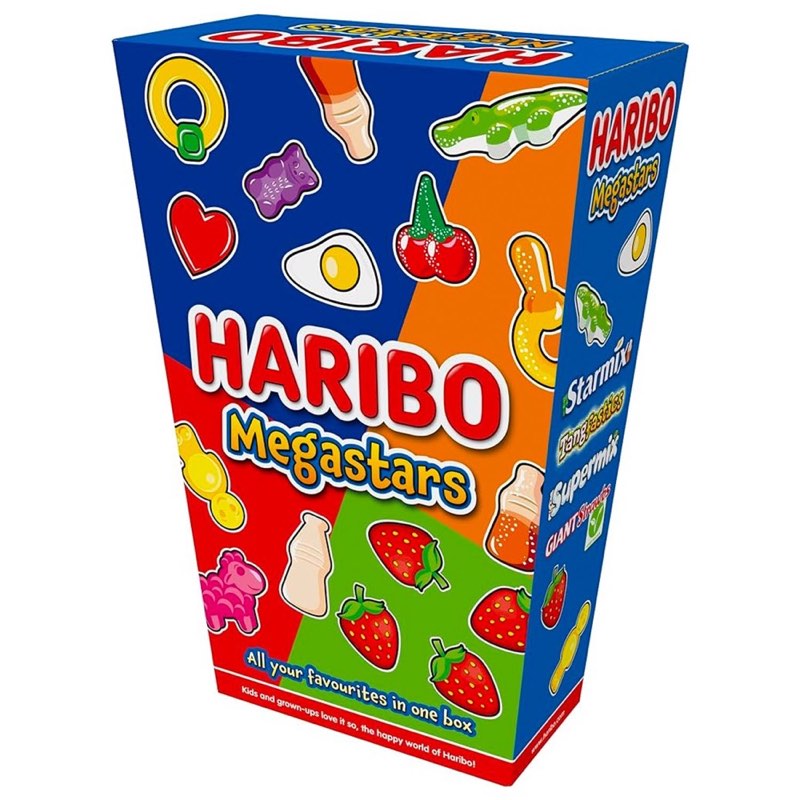
Hampers and gifts. A kilo tub is a substantial gift on its own and an anchor in a larger hamper. If you want the gift to look considered rather than bulk-bought, pair it with something in proper gift packaging: Haribo Megastars Gift Box 800g at £6.99 is presented as a box rather than a tub, and the two together — one for eating now, one for keeping nice — make a better parcel than two of either.
Stalls, fêtes and fundraisers. At £1.20 per 100 g your cost base is low enough to bag up into 100 g portions and sell them at a sensible margin, and twenty bags from one tub is a manageable amount of bagging for one evening's work.
Keeping a kilo in good condition
The enemies of a sweet like this are warmth, damp and air, in that order, and a kilo tub gives you a real advantage against all three provided you use it properly.
Warmth softens jellies and makes them stick to each other. A tub left in direct sun on a windowsill, or on top of a fridge where the motor heat rises, will end up as a partially fused block. It is still perfectly good — it just needs breaking up and it looks worse. Keep it somewhere cool, dry and dark: a cupboard, not a counter.
Damp is the specific problem for fizzy sweets. The sharp, frosted surface is the part that reacts to moisture in the air, and a tub left open in a humid kitchen will go tacky and lose some of its crispness at the first bite. This is the single biggest argument for keeping the lid on properly between servings rather than leaving it loose. Never decant into a bowl and then tip the leftovers back in — the bowl has been sitting in room air for hours and you will carry that moisture back into the tub.
Air is the slow one. It dries the jelly pieces over weeks until they are firmer than they should be. The tub seals well enough that this is a non-issue for normal use, but if you have opened it for a party and only used half, press the lid down properly rather than resting it on top.
Do not refrigerate them. Cold makes the jelly pieces hard and mutes the flavour, and worse, taking them out again causes condensation on the surface — which is the damp problem in concentrated form. If your house is very warm in summer, the coolest cupboard is still a better answer than the fridge.
One practical habit worth adopting with a kilo: decant a week's worth into a smaller container and keep the big tub shut. You open the small one twenty times and the big one once, which means the bulk of your sweets sees almost no air at all.
1 kg or 400 g: choosing your tub size
We list this tub in one size at £11.99, and we separately stock the smaller Tangfastics tub, so in practice you are choosing between two purchases rather than between options on a dropdown.
| Tub | Price | Per 100 g | 50 g servings | Best for |
|---|---|---|---|---|
| 400 g | £3.99 | ≈ £1.00 | 8 | Trying the line, one film night, a small gift, a lunchbox month |
| 1 kg | £11.99 | ≈ £1.20 | 20 | Parties, hampers, communal tins, bagging up for a stall |
The honest advice runs like this. If you have never bought this mix before, or you are buying for someone whose taste you are guessing at, buy the small tub. Four pounds is the right amount of money to risk on a guess, and if it turns out the sharpness is not for you, you have lost very little. If you are catering, gifting, or you already know this is the mix your household eats, buy the kilo — not because it is cheaper per gram, because it is not, but because one large sealed container is a genuinely better object to own than three small ones, and because running out halfway through a party costs more than the difference.
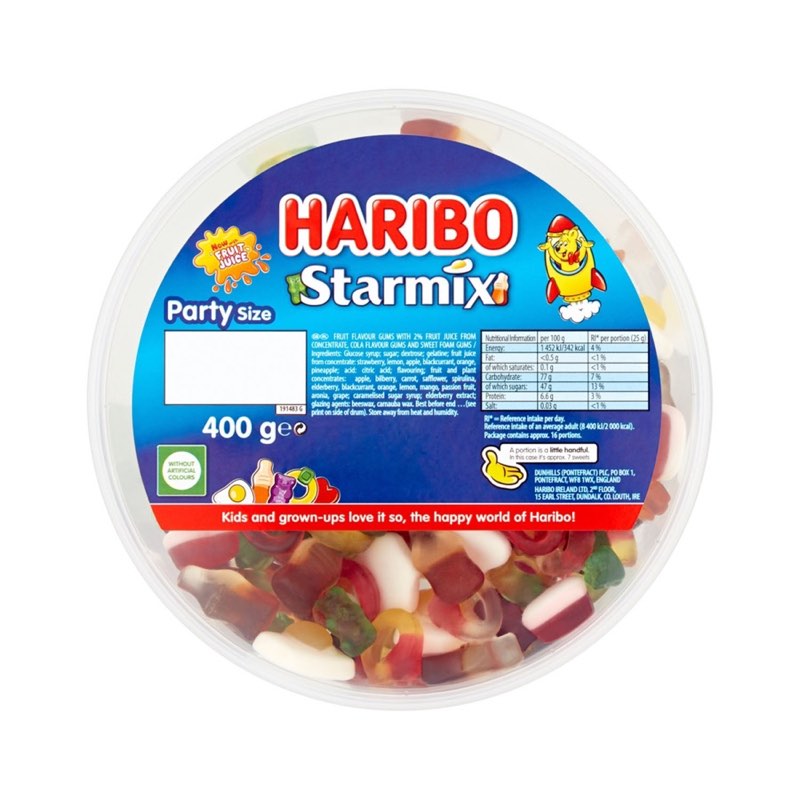
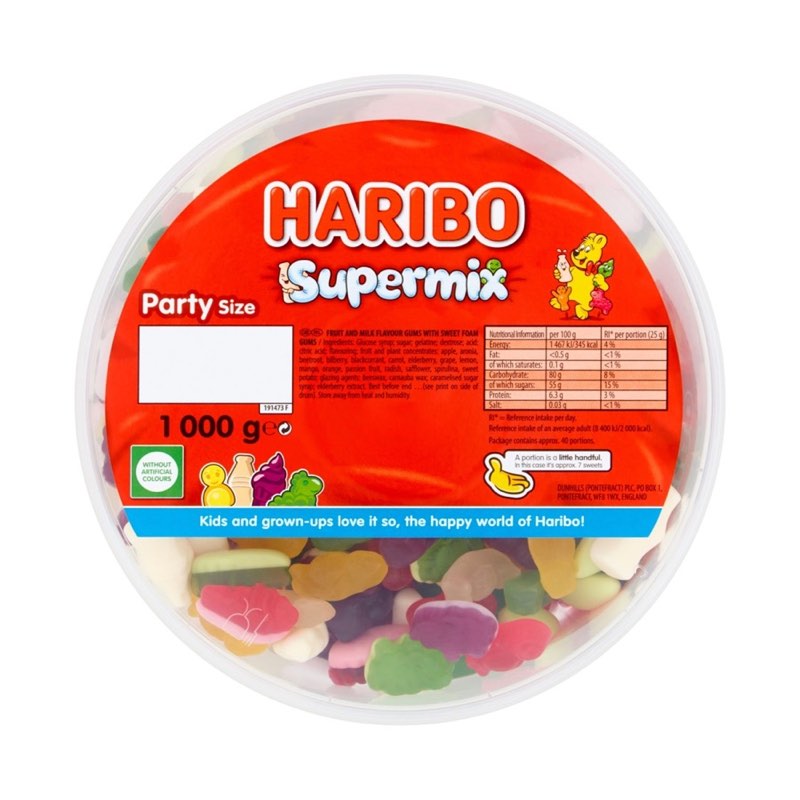
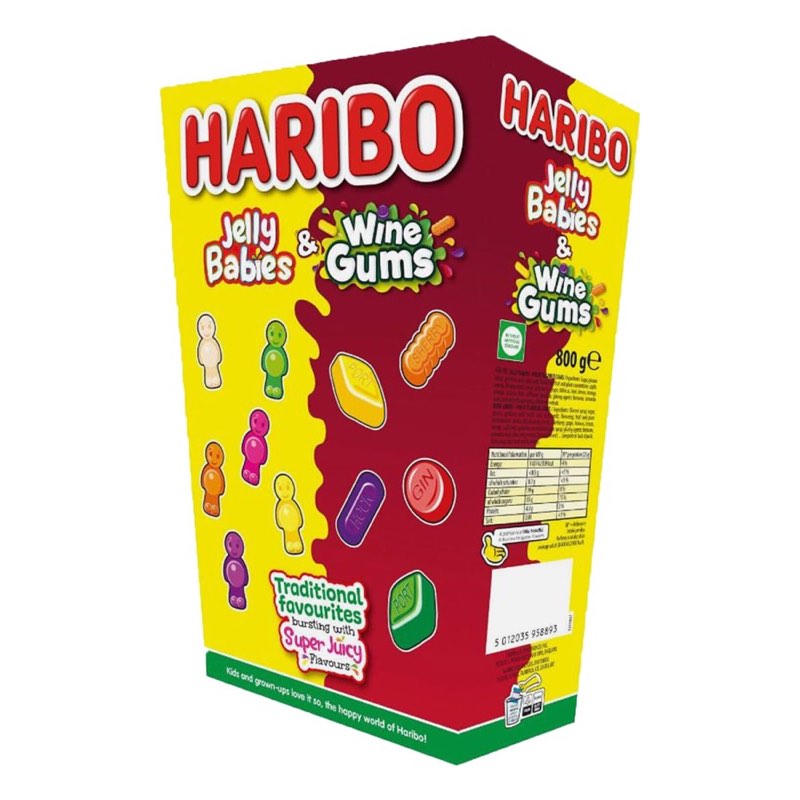
There is a third route worth mentioning, which is to change mix rather than size. Haribo Supermix Sweet Tub 1kg is the same weight at the same £11.99, so if you want a kilo but not a kilo of sharpness, that is the straight swap. The Starmix tub at £4.99 is the lower-commitment version of the same idea — a mixed tub built around variety rather than around a fizzy opening — and it is the one to reach for when you are feeding a room that includes people who genuinely dislike sour sweets. For a mix that comes presented as a gift rather than as a household tub, the 800 g jelly babies and wine gum gift box at £6.99 pairs two classic soft formats and arrives looking like a present.
Where to find this on the site — and what sits next to it
This tub is filed in several places at once, because it genuinely belongs in all of them, and knowing which door you came through tells you where to go next.
By brand, it sits with everything else we carry from the same maker on the Haribo shelf — 43 lines, which is deep enough that most people find something they did not know existed. By build, it appears on three type shelves: jelly and gummy sweets, our largest type category at 96 lines and the right shelf if the springy chew is what you are after; our fizzy sweets category at 41 lines, which is where to go if it is the sharp opening you want more of; and foam sweets at 33 lines, for the lighter, aerated texture. By flavour it sits on both the fruit and cola shelves, already linked above. And by format it belongs with the loose and by-weight sweets rather than the packaged bars and blocks.
If you want the widest possible view, browse everything we stock and filter down from there. If you are shopping for a spread that includes bars, blocks and boxed things alongside the jellies, the candy and chocolate side of the shop is where the non-jelly half of a party table comes from.
Questions we get asked about this tub
How many sweets are in a kilo?
We cannot give you a piece count, because the mix contains several different sizes and constructions and the number varies from tub to tub. What we can give you is weight, which is the figure that actually matters for planning: 1 kg, which is twenty 50 g servings or forty 25 g ones. If you need a fixed number of items — for party bags where every bag must match, say — weigh rather than count. Four 25 g bags per 100 g is a reliable planning rule and it takes the guesswork out entirely.
Is it too sour for young children?
For most children, no. This sits in the middle band of sharpness — a distinct sharp opening that fades within a few seconds rather than a sustained intensity. Children who already eat fizzy sweets will be entirely comfortable. Children who have never met one may pull a face at the first piece and then eat the rest of the bowl, which is the usual pattern. If you are not sure, start them with one or two rather than a full bowl. As with all sweets, this is a treat rather than an everyday food, and whole gummy pieces are a choking risk for young children, so small children should be supervised while eating them.
What is actually in it?
We do not publish an ingredients list on our product pages, because we would rather you read the manufacturer's own packaging than a second-hand copy of it that could be out of date. The full ingredient and allergen information is printed on the tub itself. If you have an allergy or a dietary requirement, please check that packaging when it arrives, before anyone eats anything — that is the only source we would trust, and the only one we would ask you to rely on.
Is the 1 kg better value than the 400 g?
Not on pence per gram, and we would rather say so. The kilo works out at roughly £1.20 per 100 g against roughly £1.00 for the smaller tub. What the kilo gives you is one sealed container instead of three, a quantity that looks like a party rather than a snack, and one item to reorder. Buy the kilo for the convenience and the presentation; buy the small tubs repeatedly if the unit price is what you are optimising for.
How long will it keep once opened?
Check the date on the tub for the definitive answer. In practical terms, kept cool, dry, dark and properly sealed, an opened tub stays in good condition for a long stretch — the failure mode is gradual drying and loss of crispness rather than anything sudden. The single biggest thing you can do is keep the lid pressed down properly between servings and never tip leftovers from a bowl back into the tub.
Can I use this for party bags?
Yes, and it is one of the better choices for it. The pieces are small and mixed, so every bag gets a spread of colours without you having to sort anything. Twenty 50 g bags or forty 25 g ones come out of a single tub. Bag them the day before rather than a week ahead, and seal them properly — small open bags left out overnight in a warm kitchen lose their crispness faster than the sealed tub does.
Which Haribo tub should I buy if some of the group hate sour sweets?
Start with the Starmix or Supermix tubs, which are built around variety rather than around a sharp opening, and add this one as a second bowl for the people who want it. That way the sour-averse are not picking their way round a bowl they cannot eat, and nobody has to negotiate. Two bowls solves more party problems than one perfect bowl ever does.
Do the cola pieces taste the same as the fruit ones?
No, and that difference is a large part of why the mix works. The fruit pieces are bright, immediate and simple. The cola pieces are darker and rounder with a faintly spiced edge, and they function as a reset between fruit pieces — which is why a bowl with both in holds your attention longer than a bowl of one flavour family. If you find yourself picking out only the cola ones, that is a known condition, and we shelve cola separately for exactly that reason.
Will it arrive in one piece in hot weather?
The tub is rigid and seals well, which protects the contents better than a bag would. In a genuine heatwave, jellies can soften in transit and settle into each other. If that happens, they are entirely fine to eat — leave the sealed tub somewhere cool for a few hours and then break the mass up with a spoon. It affects appearance rather than anything else.
Is this suitable for vegetarians or vegans?
Our supplier has not given us any dietary classification for this line, so we are not going to guess at one. The manufacturer's packaging carries whatever dietary information applies, and that is the source to use. If dietary suitability is essential for you, please check the tub when it arrives before serving it, and do not rely on anything we have said here.
What is the best way to serve a kilo at a party?
Do not put the whole kilo out. Fill two or three wide, shallow bowls with perhaps 200 g each and keep the sealed tub back for refills. Shallow bowls look fuller, encourage taking rather than digging, and spread the queue across the table instead of creating one bottleneck. Refilling twice also lets you slow things down late in the afternoon if the room is getting overexcited, which is a genuinely useful lever to have.
Can I mix it with loose sweets to make my own pick and mix?
Yes, and it is one of the cheaper ways to build a large spread. Use this tub as the bulk of it — it is already a multi-texture, multi-colour mix, so it does most of the work — and then buy smaller quantities of three or four loose lines to add shapes and textures it does not contain. A kilo of this plus 500 g of assorted loose sweets makes a table that looks like it came from a counter rather than from a supermarket.
The short version
A kilo of small, bright, sharp-opening sweets for £11.99, mixing firm jelly, soft foam and fizzy pieces across fruit and cola flavours, in a tub that seals and stacks. It is not the cheapest route to a kilo — buying the smaller tub repeatedly beats it on pence per gram — but it is the easiest, and for a party, a hamper or a household tin it is the shape of purchase that actually suits the job. The sharpness sits in the comfortable middle of the sour scale, which is why it works in a shared bowl when more extreme sweets do not. Keep it cool, keep it sealed, serve it shallow, and it will do exactly what you bought it for. Sweets are a treat rather than a staple, so serve them as one; check the manufacturer's packaging on arrival if anyone eating them has an allergy; and supervise young children, for whom whole gummy pieces are a choking risk.
More from Haribo
More jelly & gummy sweets
More fruit sweets


Where this sits
Haribo Tangfastics Sweet Tub 1kg appears on these shelves. Browse them, or jump to something nearby.
You might also like