Home / Loose Sweets / Haribo Megastars Gift Box 800g
Haribo · 800g
Read the full guide
Haribo Megastars Gift Box 800g
£6.99
✔ In stock — ready to ship
Fresh stock
Free over £20
Same-day dispatch
Secure checkout
There is a particular moment in a household when somebody says "we should get something in" and nobody wants to think about it for more than ninety seconds. Eight people are coming over on Saturday. There are children and there are adults and there is at least one person who will say they are not really bothered about sweets and then quietly work through a third of whatever is on the table. That moment is what an 800 g boxed assortment is built for. You buy one thing, you put it down, and the sweet question is settled.
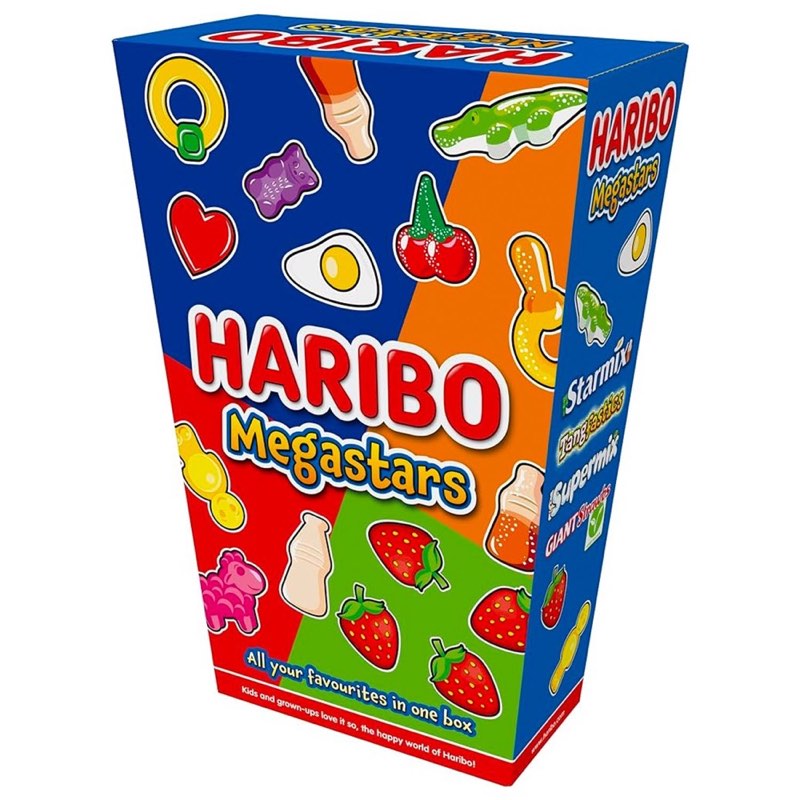
The Haribo Megastars Gift Box 800g costs £6.99 and holds 800 g, which is a lot of sweets in one go for a shade under seven pounds. It arrives as a box rather than a bag or a tub, which matters more than it sounds: a box sits flat on a table, it stays open once you have opened it, and it does not need decanting into a bowl before it looks like something you meant to serve. That last point is the whole practical case. Half the reason people over-buy for a gathering is that the format they bought in is not the format they can serve from.
The full guide to Haribo Megastars Gift Box 800g
6,835 words on how it eats, who it suits, how to serve it and what to put beside it.
The box you reach for when people are coming round
Our listing tells you what is inside in the honest terms we can stand behind. It is a multi-coloured assortment across two textures — foam and jelly and gummy — carrying cherry, cola, fruit, milk and strawberry flavours. Those five flavours and two textures are the shape of the thing. If you want to see how wide each of those runs across the shop, the cherry shelf and the our cola flavour shelf are both worth a look, and the foam sweets shelf will show you how small that category actually is compared with the jellies.
Occasions this earns its place at
A birthday party for primary-school children is the obvious one, and the box does the job well because it removes the need to portion in advance. You can put it out whole and let it be raided, or you can fill paper bags from it before anyone arrives and hand them out at the door. Eight hundred grams will fill sixteen fifty-gram party bags with nothing left over, or twenty forty-gram bags if the party is bigger and the sweets are one item among several. Working backwards from bags rather than forwards from a bowl is the single most useful habit in party sweet-buying.
Then there is the office. Not the formal office spread — the ordinary Thursday where somebody has finished a long piece of work and a box appears on the side. Boxed assortments are unusually good at this because they are anonymous in the right way. Nobody has to ask whose it is or whether they are allowed. A box of mixed sweets on a shared surface reads as an invitation in a way that a half-eaten bag does not. Eight hundred grams will see a team of ten through a whole afternoon and still be there on Friday morning.
Film nights and long weekend afternoons are the third use, and here the mix of textures earns its keep. Foam sweets eat slowly and quietly; jellies eat faster and with more chew. Having both in the same box means the bowl does not go stale in the mouth after twenty minutes the way a single-texture bag can. If you want to build that out properly, a second bowl of something firmer sitting alongside works well — Taveners Fruit Jellies at £5.49 give you a denser, more deliberate chew that contrasts with the foam, and they do not compete for the same flavour space.
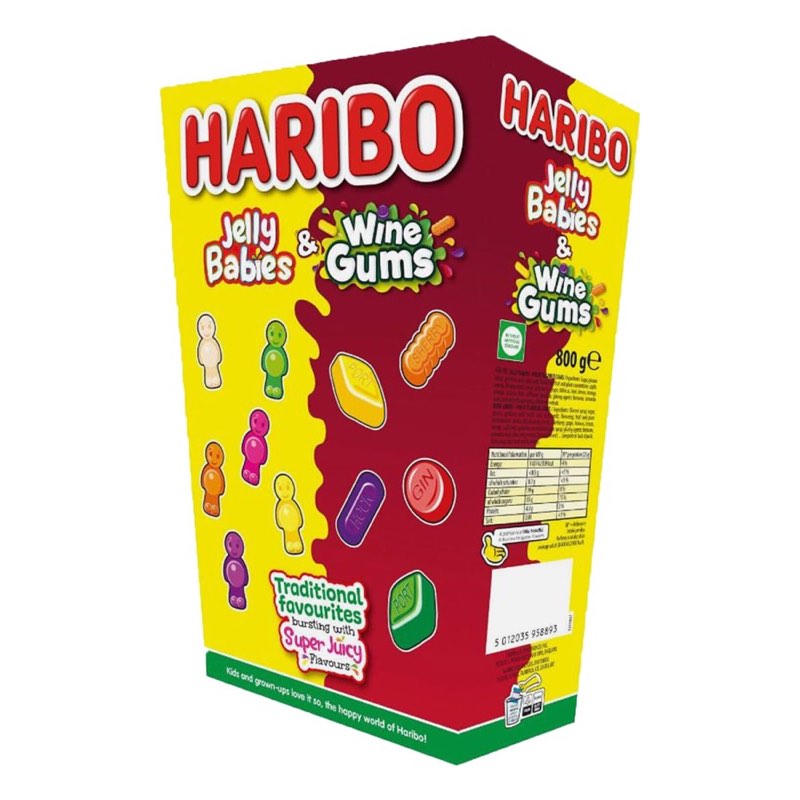
Gifting is the fourth, and it is written into the name. A gift box is a thing you can hand over without wrapping, which makes it useful for the category of present that needs to exist but does not need to be a production: a thank-you to the neighbour who took a parcel in, something for a teacher at the end of term, a get-well box, a first-day-in-the-new-flat box. At £6.99 it sits in the price band where a present is generous enough to mean something and small enough not to embarrass the person receiving it. If you want a second box so the pair look intentional, the Haribo Jelly Babies & Wine Gum Gift Box 800g is the same weight at the same £6.99, and the two together make an obvious matched set without looking like you bought two of the same thing.
Hampers are the fifth, and they are worth thinking about separately because hampers have a geometry problem. Bags slump, tubs dominate, and a box is the only sweet format that stacks. If you are building a hamper around a bottle and a few tins, an 800 g box lies flat in the base and gives everything above it a level floor to sit on. It is a small thing that makes an assembled hamper look considered rather than piled.
Finally, the seasonal table — Christmas afternoon, Easter Sunday, the long stretch between courses at a family lunch when the children have been sitting still for as long as they are going to. A box that can be opened at one o'clock and is still being picked at by five is doing something a bag of one kind of sweet cannot. That endurance, more than any single flavour in it, is the reason a mixed 800 g box keeps getting bought for these days.
Opening it: the first look
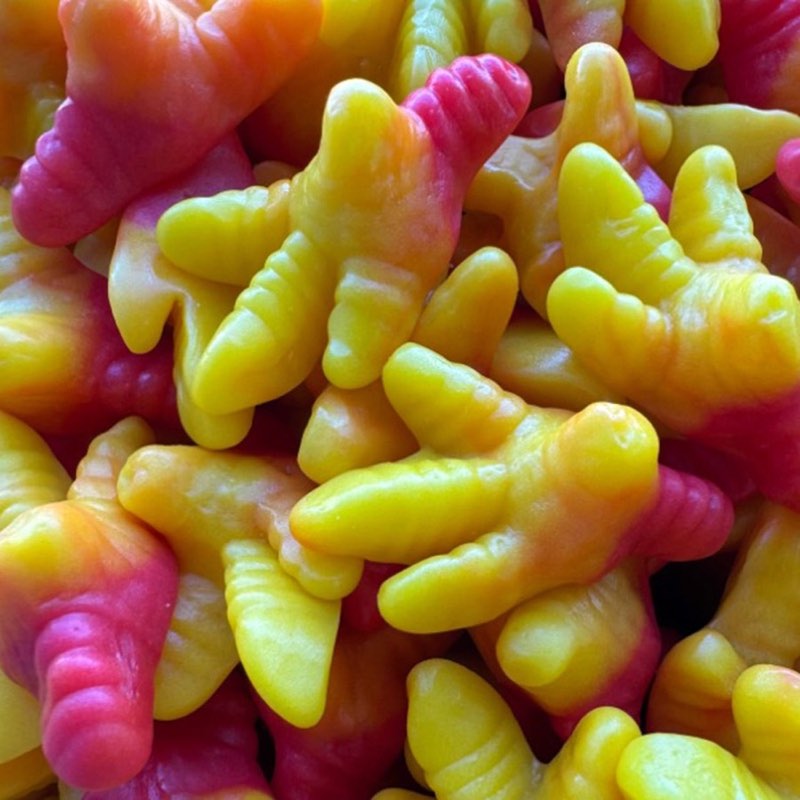
The first impression of any large mixed box is colour, and this one is listed as multi-coloured for a reason. Opening it you get a field of different shades rather than a tidy arrangement, because assorted sweets settle in transit and no two boxes look the same when the lid comes off. That randomness is part of the appeal. A box where everything is sorted into rows is a different kind of product, more formal and less fun to rummage in. This is a rummaging box.
The second impression is the two textures sitting together. Foam pieces read differently to the eye than jellies do — they are matte where jellies are glossy, and they sit higher and lighter in the box. You can usually tell which is which before you pick anything up, which is genuinely useful if you have a preference. Somebody who only wants the foam can find it; somebody who only wants the chew can leave the foam alone. In a household with more than one taste in it, that visible separation is worth more than it sounds.
The third impression is scale. Eight hundred grams looks like more than most people expect, because the two-texture mix is bulky. Foam sweets in particular take up far more room per gram than dense jellies, so this box occupies a bigger footprint on the table than an 800 g box of solid gums would. If you are working out whether one box is enough for your afternoon, err on the side of yes.
How it eats
Take a foam piece first. Foam sweets have a give to them that no other sweet format has — you press and it yields, then springs part of the way back, and when you bite it collapses rather than cuts. The eating experience is short and soft. There is very little work for the jaw, which is why foam is the texture that children with wobbly teeth and adults who do not want to commit to a chew both gravitate to. It also means foam sweets disappear quickly. You can eat four before you have thought about it.
The flavour on foam arrives differently too. Because the piece is aerated, the surface area is enormous and the flavour lands almost immediately and broadly across the tongue rather than building. Then it fades fast, because there is nothing dense left to keep releasing. The whole arc is perhaps eight seconds. That quick-on, quick-off shape is why foam works so well in a mixed box: it resets the palate between the slower pieces instead of layering on top of them.
Now a jelly. The gummy pieces in the box work on a longer clock. There is resistance at the first bite, then a chew that lasts, and the flavour comes up gradually through that chew rather than all at once. Where a foam sweet is over in eight seconds, a jelly is a twenty-to-thirty-second proposition. It occupies you. That is the difference that makes the mix work rather than just making it varied — the two textures are doing different jobs in the mouth, not the same job in different colours.
Eaten together, the pattern most people fall into without noticing is foam-foam-jelly, or jelly-then-foam as a chaser. The soft pieces are the ones you take absent-mindedly while talking; the chewy ones are the ones you take when you have decided to have a sweet. Over an afternoon of grazing that self-sorts, and it is quite common to reach the end of a box with the foam gone first. Worth knowing if foam is the part you care about.
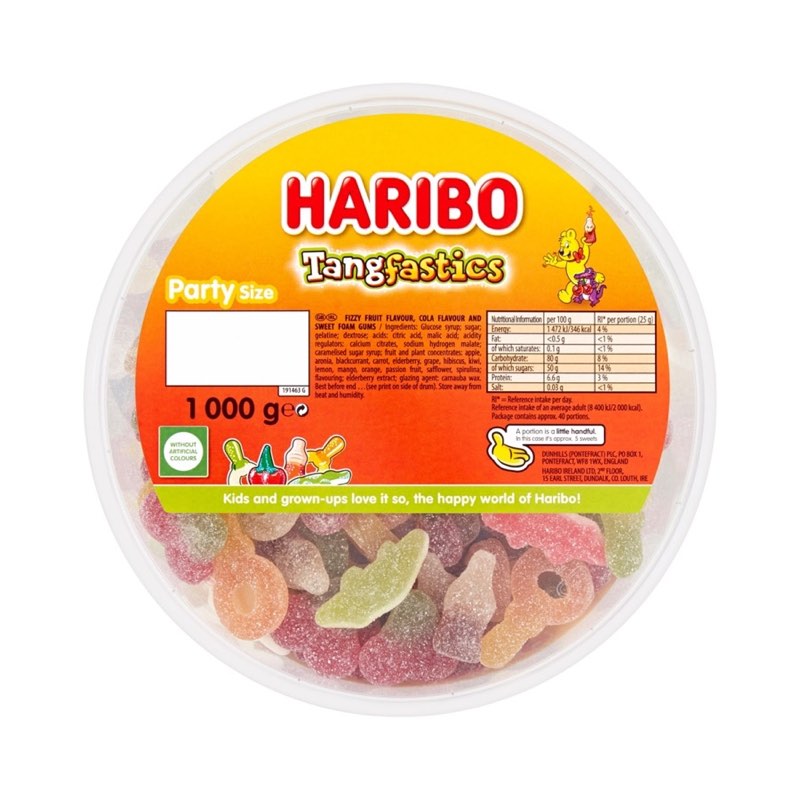
On sweetness: this is a mainstream sharing assortment, not a sour range and not a specialist confection. The register is straightforwardly sweet, front-loaded, and designed to be agreeable to a room rather than to impress one person. If you want the sharp end of the shelf in the same brand, Haribo Tangfastics Sweet Tub 1kg at £11.99 is the fizzy-coated counterpart and a completely different eating experience. Putting a small bowl of that next to this box gives a room two genuine poles to choose between.
Who this is actually for
The clearest fit is the person buying for a mixed group. Not for themselves, not for one child with a known favourite, but for a room where tastes are unknown and the safest move is breadth. Five flavours and two textures across 800 g covers a lot of ground. Somebody in the room will not like cola; somebody will not like the foam; the box does not care, because there is plenty else.
The second fit is the household that keeps a sweet drawer. If your kitchen has a designated place where the sweets live and it gets topped up rather than emptied, a big mixed box is a better restock than three small bags, because it gives whoever opens the drawer a choice. It also lasts. Eight hundred grams is several weeks of a modest sweet habit for one or two people.
The third fit is the gift-buyer on a budget who wants the present to look like a present. A £6.99 box has presence. It is not a bar and it is not a small bag; it reads as something chosen. For end-of-term, for a raffle prize, for the bottom of a Christmas stocking that needs one substantial thing in it, that presence does real work.
Who it is not for, honestly: the shopper hunting one specific flavour. If you want cola and only cola, a mixed box is the wrong buy and you will end up picking through it. Go straight to Haribo Giant Cola Bottles at £5.49, or for a small single-flavour bag, Haribo Happy-Cola 140g at £1.25 is the cheapest way in the shop to find out whether cola gummies are your thing at all. It is also not the buy for somebody who wants everything soft — the jelly half will be in the way.
Why boxed and shaped sweets get collected
There is a real collecting culture around confectionery, and it is worth understanding because it explains why a box like this gets bought by people who are not going to eat it immediately. Sweets are one of the few consumer goods where the packaging changes constantly, the runs are genuinely limited, and nobody at the manufacturer is treating any of it as collectible. That combination — high turnover, no official archive — is exactly the condition under which collectors appear.
The collecting instinct in sweets tends to split three ways. The first group collects formats: boxes, tins, tubs, the odd shapes that a line gets put into for a particular season and then never again. A gift box is squarely in this group, because boxes are the format most likely to be reworked. The second group collects shapes — the individual moulded forms that come and go from assortments without announcement. The third group collects the assortment itself: what was in the mix in a given year, what quietly dropped out, what got added.
Of those three, the shape collectors have the hardest job, because assortment contents are not documented anywhere reliable and they change without ceremony. A shape that was in a mix one year may simply not be in it the next, and there is no notice. This is why people who care about a particular shape buy the big box rather than the small bag: more pieces, better odds, and a real sample of what the current mix actually looks like rather than a handful.
Novelty formats sit alongside this and behave slightly differently. A novelty is bought for what it does as much as for what it tastes like, and the doing is usually a one-time event — a thing you open once, in company, for the reaction. Jelly Belly Bean Boozled Jelly Beans Box 45g at £2.99 is the clearest example we stock of that category: a small box whose entire point is the game around it rather than steady eating. Pairing a novelty like that with a large straightforward assortment is a well-worn move, because the novelty supplies the event and the big box supplies the actual sweets once the event is over.
Seasonal shapes are the other half of the collector's calendar, and they are the most frustrating part of it, because the window is short and once it closes the stock is gone rather than discounted. Anyone who has tried to buy a specific seasonal shape three weeks after the season knows the feeling. The practical lesson collectors learn early is that you buy the seasonal thing when you see it, and you buy the evergreen thing whenever you like. A box like this one is firmly evergreen, which makes it the stable item in a collection rather than the prize.
There is also a quieter kind of collecting that is really just preference-mapping. People who eat a lot of sweets build a private index of what they like — this texture, that flavour family, this size of piece — and they buy big mixed boxes specifically to test the edges of it. An 800 g assortment with five flavours and two textures is a good instrument for that. You find out, over a fortnight, which of the five you go back to and which you leave, and that tells you what to buy single-flavour next time. Half the point of a big mix is the information it gives you.
If you want to see the range of shapes and formats we carry in one place, the jelly and gummy sweets section is the largest on the site at ninety-six lines, and it is where most of the moulded novelty shapes end up. It is worth a slow scroll rather than a search, because the whole point of a shape collection is finding the thing you did not know existed.
Counter, kiosk and pier: where a box like this fits in British sweet habit
British sweet-buying has always had two distinct halves, and the tension between them explains a lot about why products look the way they do. On one side is the corner shop: loose sweets in jars, a scoop, a paper bag, and a transaction measured in pennies. On the other is the packaged shelf — bags, boxes, tubs, priced and sealed. Most of us grew up doing both, often in the same visit, and most of us still shop that way without thinking about it.
The loose tradition is the older one and the one people are more sentimental about, and for good reason. Buying by weight from a jar is a slower, more sociable transaction. You look, you choose, you watch it being weighed, and the quantity is exactly what you asked for. It also taught a generation what sweets actually cost per gram, which is a form of literacy that packaged shelves quietly removed. Our loose sweets shelf is by far the biggest part of the shop at three hundred and fifty-six lines, which tells you that appetite has not gone anywhere.
The seaside version of that tradition is its own thing again. Seaside sweet shops sold — still sell — in larger quantities than a corner shop ever did, because holiday buying is different buying. You are not getting a quarter to eat on the walk home; you are getting something to take back to the caravan, or to hand round on the beach, or to carry home as the thing you bring people. That is where the big tub and the big box found their natural home in British retail, and it is why the format still feels like holiday even when you buy it on a wet Tuesday in February.
A boxed 800 g assortment is the packaged shelf's answer to the seaside bag: a quantity that assumes sharing, in a format that survives being carried around. It is not trying to be a jar. It is trying to do what the jar's output did — arrive at a house with enough sweets in it for everybody — without needing a scoop and a set of scales. Seen that way, the gift box is not a modern invention so much as a repackaging of a very old habit.
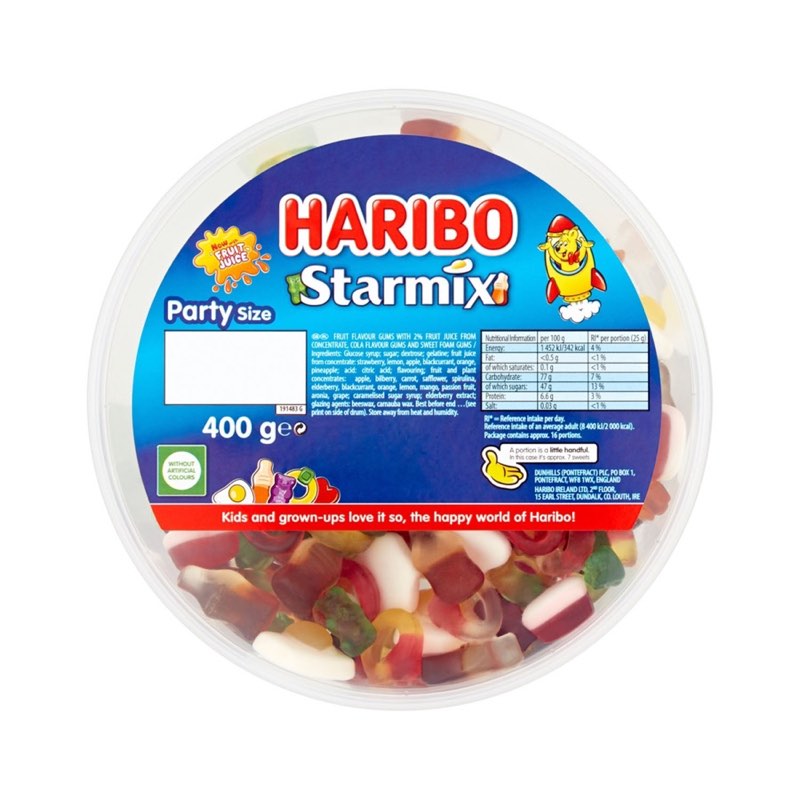
Tubs are the third format in this lineage and they sit somewhere between the two. A tub is a jar you own. It has the lid and the shape and the visual promise of the sweet-shop jar, but it lives on your own counter. Haribo Starmix Sweet Tub at £4.99 is the clearest illustration of that idea in the range, and it is the buy for somebody who wants the jar-on-the-side look rather than the box-on-the-table look. The choice between them is genuinely about where the sweets are going to live in your house.
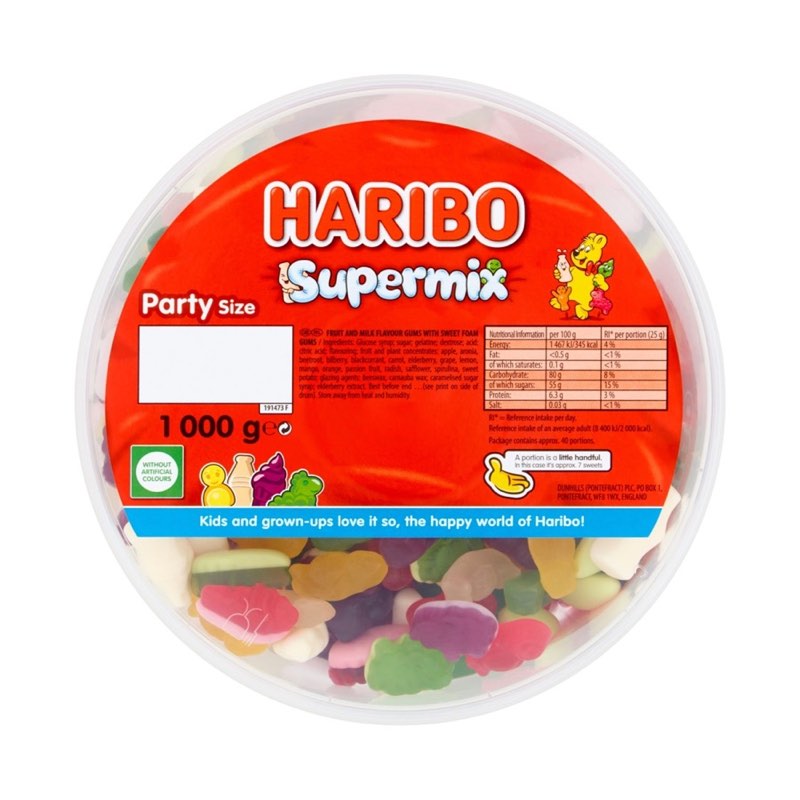
Scale that thinking up and you get the kilo tubs, which are the closest thing on a modern website to the wholesale end of the old sweet shop. Haribo Supermix Sweet Tub 1kg at £11.99 works out at about £1.20 per 100 g, and it is bought by the same people who would once have asked for a full jar. Those buyers are usually catering rather than snacking: a club, a stall, a classroom, a weekly top-up for a house with a lot of people in it.
The corner shop also gave us the pocket-money tier, and it has not disappeared either — it has just moved onto the shelf as small bags. Maoam Pinballs Bag 140g at £1.99 and Fini Mini Mochis Bag at £1.35 are the direct descendants of the ten-pence mix: one small thing, bought on its own, eaten on the way home. Keeping a few of those in the house alongside a big box is a sensible bit of stock management, because there are days when a whole box does not need opening.
The last piece of the tradition worth naming is the pick-and-mix counter, which is the corner shop and the seaside shop combined and which is still, for a lot of people, the best way to buy sweets full stop. You choose everything, you take exactly as much as you want of each thing, and the result is a bag that is yours. Our pick and mix exists for precisely that, and the honest comparison with a boxed assortment is this: the box is faster and cheaper per gram, the pick and mix is better. Which one you want depends entirely on whether you have twenty minutes and an opinion.
The five flavours, one at a time
Strawberry. The default sweet-shop flavour in Britain and the one most likely to go first in a mixed box. Strawberry in confectionery is not really a fruit note — it is its own established flavour, rounder and sweeter than the fruit itself, and everybody over the age of four recognises it instantly. It works in both textures here, but it is particularly at home on foam, where the softness and the mildness of the flavour fit each other. If it turns out to be the note you keep going back to, everything strawberry runs to seventy-eight lines across the shop, which is the second-largest flavour shelf we have.
Cola. The one genuinely savoury-adjacent flavour in the sweet-shop canon, and the reason mixed boxes work at all. Cola cuts through a run of fruit flavours and resets the mouth, which is why people who have had three strawberry pieces reach for a cola one next without consciously deciding to. It is also the most divisive of the five — people who do not like cola sweets really do not — so expect it to be the flavour left behind in a room full of children and the flavour hunted out by adults.
Cherry. Darker and sharper than strawberry, with more of an edge at the end. Cherry is the flavour that stops a fruit mix reading as one flat note, because it lands lower and finishes with a small amount of bite. It suits the jelly texture better than the foam, since the longer chew gives the sharper end time to arrive. It is a smaller shelf here — twenty-one lines — which makes it one of the flavours people most often discover inside a mix rather than by buying it on purpose.
Fruit. The catch-all, and the largest flavour category we have at one hundred and sixty-one lines. In a mixed box "fruit" covers the general orange-lemon-apple-raspberry territory that does not get named individually. It is the connective tissue of the assortment: unremarkable on its own, essential to the whole. A box of only strawberry, cola and cherry would feel narrow in a way that is hard to articulate until you eat it. The general fruit-flavoured sweets shelf is the right place to browse if you are building a spread and want variety without picking a fight over specific flavours.
Milk. The odd one out, and the most interesting. Milk-flavoured sweets are a distinctly British taste — creamy, soft, low-acid, almost comforting — and they are the note that turns a fruit mix into a sweet-shop mix. There are only six milk-flavoured lines in the whole shop, so finding it inside an assortment is a genuine bonus rather than a given. It pairs particularly well with the foam texture, because both are working in the same soft, gentle register. If it is the one you love, milk-flavoured sweets is a short shelf and worth knowing about.
Building a table around it
A single box is a purchase. Three or four things chosen to sit next to each other is a spread, and a spread is what makes a party table look like somebody thought about it. The method is simple: start with this box as your broad base, then add items that do something the box does not.
The first gap to fill is sour. This assortment has no sour register at all, and a room will always contain two or three people who want it. A bowl of something genuinely sharp gives them somewhere to go and gives everybody else a dare. It also has a useful pacing effect — sour sweets slow people down, which means the table lasts longer.
The second gap is texture at the firm end. Both textures here are soft-to-chewy; nothing snaps, nothing crunches. Adding one firm item changes the feel of the whole table. Kingsway Crocodiles at £5.49 bring a denser, more substantial piece that takes real chewing, and the shape is big enough to read from across a table, which matters more on a party spread than people admit.
The third gap is a single striking item that is not a bulk sweet — the thing people pick up and comment on. BUBS Wild Strawberry & Pomegranate Ovals at £7.50 do that job, with a flavour pairing that is a step away from the standard sweet-shop palette and a shape that does not look like anything else on the table. You do not need much of it. One small bowl of something unfamiliar is enough to make the rest of the spread feel curated.
The fourth is a second soft item, if the crowd skews young. Vidal Foam Jelly Filled Seashells Tub 795g at £7.99 is almost the same weight as this box and works out at roughly £1.00 per 100 g, and the foam-plus-filling construction gives you a soft piece with something going on inside it. Two large soft items is not redundant if one of them has a centre and the other does not.
The fifth, for a table with adults on it, is something with a bit of nostalgia behind it. Barratt Jelly Love Hearts at £5.49 do that reliably, and they are the item most likely to start a conversation about what people bought as children. If you are catering a family party where three generations are in the room, one deliberately old-fashioned item is worth more than another modern one.
For a large gathering, a tub does the heavy lifting under all of this. Swizzels Pigs Mugs Tub 576g at £8.99 gives you a big refillable container that can be topped back up as bowls empty, which is the difference between a table that looks full all afternoon and one that looks picked-over by three o'clock. The trick with a long party is never to let a bowl get more than two-thirds empty before you refill it.
If you would rather assemble something entirely your own rather than buying four fixed lines, the candy and chocolate hub is the widest starting point on the site, and browse every sweet we stock will show you the lot if you prefer scrolling to filtering. Both are better for spread-building than the individual shelves, because the whole skill of a spread is contrast, and contrast is easier to spot when everything is next to each other.
What 800 g actually works out at
At £6.99 for 800 g, this box costs about 87p per 100 g. That is a useful anchor number to carry around the rest of the site, because it puts this firmly in the good-value half of the shelf for a branded mixed assortment. The same-price, same-weight gift box of jelly babies and wine gums lands at the identical rate, which makes buying one of each a straightforward decision rather than a value calculation.
| What you are buying | Weight | Price | Roughly per 100 g |
|---|---|---|---|
| This gift box | 800 g | £6.99 | 87p |
| Jelly babies and wine gums gift box | 800 g | £6.99 | 87p |
| Foam-and-jelly seashells tub | 795 g | £7.99 | £1.00 |
| Supermix kilo tub | 1 kg | £11.99 | £1.20 |
| Tangfastics kilo tub | 1 kg | £11.99 | £1.20 |
Read that table and the pattern is clear: the boxed 800 g format is the cheapest way into a branded mixed assortment on this site, and the kilo tubs cost more per gram in exchange for a container you can keep and a quantity that does not need replacing as often. Neither is wrong. You are choosing between price per gram and convenience of format, which is the choice almost every sweet purchase comes down to once you look at it properly.
Now the portions. Thinking in grams is abstract, so convert it into handfuls, which is how sweets actually leave a bowl:
- 25 g — a small after-dinner handful. This box gives you thirty-two of those, at about 22p each.
- 50 g — a proper party-bag portion or a generous helping into a bowl. Sixteen of those, at about 44p each.
- 100 g — a film-night portion for one person who intends to finish it. Eight of those, at 87p each.
- 40 g — the sensible size for a party bag that also has other things in it. Twenty of those.
Those numbers make the planning decisions for you. Sixteen children at a party: one box, one 50 g bag each, done. A household of four wanting a sweet three evenings a week at 25 g a head: this box is a fortnight and a bit. A film night for two with a bowl between you: two or three sittings out of the box and the rest goes back in the cupboard. Being able to say "this will last us about two weeks" before you buy is the main practical benefit of doing this arithmetic once.
One honest caveat on value. Big-box buying only saves money if the sweets get eaten. An 800 g box that goes stale at the back of a cupboard is more expensive than a £1.25 bag that gets finished. If you are genuinely a once-a-month sweet eater, the small-bag tier is better value for you regardless of what the per-gram maths says, and there is no shame in buying at the pocket-money end and enjoying all of it.
Keeping it in good condition
Sweets like this have three enemies, and none of them is time in the way people assume. The first is warmth. Both foam and jelly soften in heat and will start to stick to each other, which turns a loose box of individual pieces into a single mass you have to break apart. A cupboard away from the oven, the boiler and any sunny window solves it. Not the fridge — cold makes jellies hard and unpleasant, and it does the foam no favours either.
The second is air. Once the box is open the pieces begin to dry at the surface, slowly at first and then more noticeably. Jellies go leathery, foam goes stiff. Neither is dangerous, both are a shame. If you are not going to finish the box within a week or so, tip what is left into a tub or a sealable bag and squeeze the air out. This is the single highest-return habit in sweet storage and almost nobody does it.
The third is damp, which is the reverse problem and mostly affects anything with a sugared or coated surface. A humid kitchen will make coatings go tacky. Again, a sealed container fixes it. If you find yourself opening big boxes regularly, it is worth keeping one large lidded tub for exactly this purpose — decant on day one, keep the box for display if you like it, and stop thinking about it.
Practical routine for this box specifically: open it, use it for the occasion you bought it for, then decant the remainder the same evening. Eight hundred grams is usually more than one sitting, so plan for a remainder rather than being surprised by one. Kept sealed and cool, what is left will be in good condition for a long while, and you will not have that experience of finding a half-empty box in March and throwing it away.
Always check the manufacturer's packaging when the box arrives — the pack itself carries the definitive information on the product, including anything relevant to allergies, and it should be read before eating if anybody in your household needs to avoid something. Sweets are a treat rather than a staple. And as with any assortment, small hard sweets and whole gummies are a choking risk for young children, so they should be supervised while eating.
Sizes and what to buy instead
This line comes in one size only — 800 g at £6.99. There is no smaller taster box and no larger catering box of the same product, so the choice is not about size within the line but about which line you buy at the size you need. That makes the decision straightforward, and it is worth laying out the alternatives by what you are actually trying to do.
If you want less. Drop out of the box format entirely and into a small bag. A 140 g bag at £1.25 is the right scale for one person or one journey, and it lets you test whether the brand's texture suits you before committing to 800 g of it.
If you want more. Move up to a kilo tub. Both the Supermix kilo and the Tangfastics kilo sit at £11.99, and the tub format is easier to store and refill from than a box. Two of those and a box like this will cater a substantial party without you needing to think about it again.
If you want the same amount but a different mix. The matched 800 g box in the range is the direct swap at the same price.
If you want a single flavour at a similar price. The giant cola bottles at £5.49 are the obvious one, and they are a good example of why single-flavour buying and mixed-box buying suit different people rather than one being better.
If you want soft only. Skip the mixed box and go straight to the foam category, or consider Briquette at £5.49, which is a foam line running cola, peach and strawberry and comes in a ladder of sizes from 250 g up to 2 kg, so you can buy exactly the quantity you want rather than the quantity the box comes in.
Finding your way around from here
This product sits on nine shelves, and each of them is a different route back into the shop depending on what you are actually shopping for. If you are brand-loyal, the full Haribo range runs to forty-three lines and is the fastest way to see everything from the small bags up to the kilo tubs in one view. If you are shopping by how a sweet eats rather than who made it, the type shelves will serve you better.
The two type shelves this box lives on are worth understanding as a pair. The jelly and gummy shelf is our largest type category by some distance, which reflects how much of modern confectionery is built on that texture. The foam shelf, at thirty-three lines, is a tenth the size — foam is a smaller, more specialised corner and easier to browse exhaustively. If foam is your texture, you can realistically look at all of it in one sitting, which is not true of the jellies.
Flavour shelves are the third route, and they are the right one when you are shopping for somebody else with a known preference. The five flavour pages this product touches vary enormously in size, from one hundred and sixty-one lines down to six, and that spread itself is informative: it tells you which flavours are easy to buy for and which take hunting.
For broader browsing, the loose-sweets aisle is where most of the shop lives, and it is the page to start on if you have no particular target and want to see what is there. Two brand hubs worth bookmarking alongside the one above: the Kingsway shelf, which is strong on the larger traditional shapes, and the Haribo brand page if you want to come back to this maker specifically.
Questions people ask before buying this
How many sweets are actually in the box?
We do not publish a piece count, and we would rather not guess at one, because piece counts in a mixed assortment depend entirely on the balance of shapes in a given box and that balance varies. What we can tell you precisely is the weight: 800 g. If you need to plan by pieces rather than grams, work on the basis that mixed foam-and-jelly assortments tend to give you a substantial handful per 25 g, and use the portion table above to plan rather than counting.
Is this the same as buying a tub?
No, and the difference is mostly about format rather than contents. A box lies flat, serves straight from the packaging and stacks well in a hamper. A tub has a resealable lid, stands on a counter and is easier to refill from over weeks. If your sweets are going to be eaten at one event, the box is better. If they are going to live in your kitchen and be picked at, a tub like the Starmix or Supermix container will serve you longer.
Will there be a good mix, or will one type dominate?
It is an assortment, so the mix is set by the manufacturer and we do not control or adjust it. Boxes settle in transit, so what you see on opening is not necessarily representative of the balance — it is worth a gentle shake or a rummage before you judge. If a guaranteed balance matters to you, a pick and mix where you choose every component is the better route, and our pick and mix page exists for exactly that reason.
Is it suitable for a child's party?
It is a common choice for one, yes — the weight divides neatly into party bags and the mix covers a range of tastes. The only things to plan for are supervision and packaging. Small hard sweets and whole gummies are a choking risk for young children and should be eaten with an adult present. And because we cannot verify ingredient information for this line, anybody with an allergy in the group should read the manufacturer's packaging when it arrives, before any of it is handed out.
How long will it keep once I have opened it?
Longer than most people expect if you seal it, and not very long if you do not. The box is not resealable in any meaningful way, so once it is open the pieces are exposed to air and will start to dry at the surface over a week or two. Decanting the remainder into a lidded tub or a sealed bag on the day you open it is the whole answer. Keep it cool and out of direct sun and you will not have a problem.
Can I refrigerate it in hot weather?
We would not. Cold firms jellies up to the point where they lose the chew that makes them worth eating, and it takes the give out of foam. If your house is genuinely hot, the better answer is the coolest cupboard you have — an internal one, away from the oven and the hot-water tank — and a sealed container. If pieces have already stuck together from warmth, leaving the sealed container somewhere cool for a few hours will usually let you separate them without damage.
Is there a bigger version of this exact box?
No — this line is 800 g and one size. If you need more of the same thing, the straightforward answer is two boxes, which gives you 1.6 kg for £13.98. If you would rather have more sweets than more of this particular mix, the kilo tubs in the same brand are the better value per gram and give you a different assortment alongside this one, which is usually a better outcome on a big table anyway.
Does the gift box come ready to give, or do I need to wrap it?
It is sold as a gift box, which means the format itself is presentable — it is the kind of thing you can hand over as it is. Whether you wrap it is entirely up to the occasion. For a thank-you or an end-of-term present most people give it as it comes. For a birthday, a ribbon takes ten seconds and makes it read as a chosen present rather than a grabbed one. We do not add wrapping or personalisation at our end.
What goes well with it if I am putting a table together?
Three things it does not do itself: something sour, something firm, and something with a bit of novelty to it. The assortment is soft-to-chewy and sweet all the way through, so a sharp item and a dense item give people somewhere else to go. A single novelty item — one box of something with a game attached — supplies the moment everybody remembers. Beyond that, resist adding a fourth soft fruit item; it will not read as variety.
I only like the foam ones. Is this still worth buying?
Probably not, if that is a strong preference. Roughly half the eating experience here is the jelly side, and picking through 800 g for one texture is an expensive way to get a smaller quantity of what you want. You would do better on the foam shelf, where you can buy the texture directly and in the size you choose. Come back to the mixed box when you are buying for a group rather than for yourself.
Is it in stock?
Yes, this line is in stock at the time of writing at £6.99. Stock on assortments moves faster around the obvious points in the year — the run-up to Christmas, Easter week, and the end of the summer term — so if you are buying for a fixed date some way off, buying early is sensible. The box stores perfectly well for weeks if you keep it cool and sealed.
The short version
Eight hundred grams, £6.99, five flavours, two textures, one box that goes straight onto the table without any preparation. It is not a specialist buy and it is not trying to be — it is the assortment you get in when a room needs sweets and you do not want to make five decisions about it. About 87p per 100 g, sixteen party bags, or a fortnight of small handfuls for a household, depending on what you are doing with it. Decant what is left on the first evening, keep it cool, and check the manufacturer's packaging on arrival if allergies are a consideration in your house.
More from Haribo
More jelly & gummy sweets
More fruit sweets
Where this sits
Haribo Megastars Gift Box 800g appears on these shelves. Browse them, or jump to something nearby.
You might also like