Home / Loose Sweets / Haribo Starmix Sweet Tub
Haribo · 400g
Read the full guide
Haribo Starmix Sweet Tub
£4.99
✔ In stock — ready to ship
Fresh stock
Free over £20
Same-day dispatch
Secure checkout
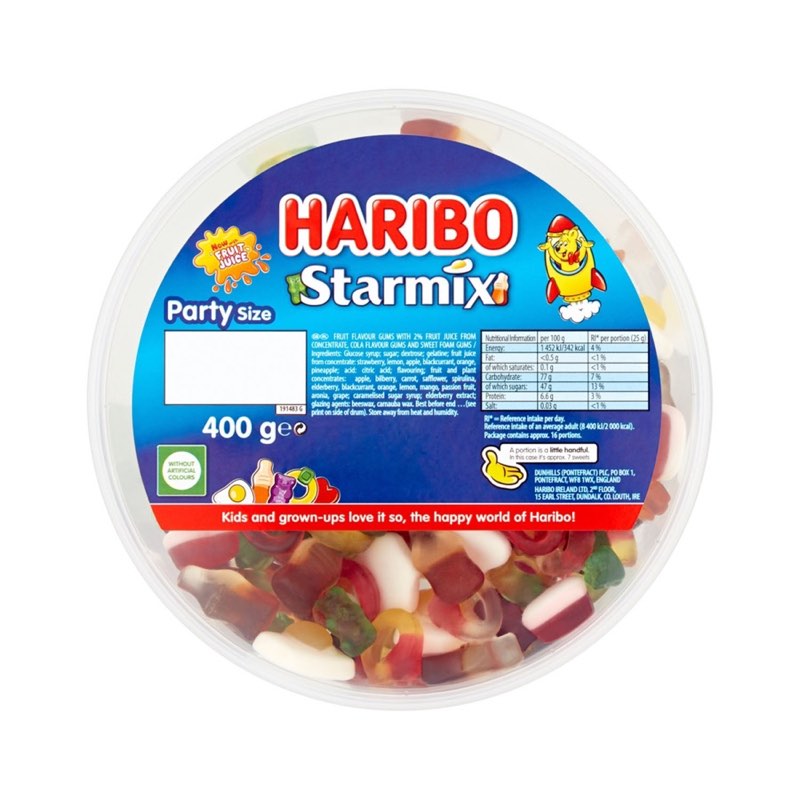
The first thing you notice about a tub of Starmix is that no two pieces in your hand are the same. Tip a handful out and you get a scatter of different shapes and different colours — the pack describes the colour simply as multi-coloured, which is the only honest way to describe a mix where the point is that nothing matches. Some pieces are pale and translucent, some are opaque, some are dark enough to read as brown-black under kitchen light. Laid out on a table they look less like a product and more like a small collection.
Weight in the hand is modest. These are individual small sweets rather than anything substantial, so a handful is a genuine handful — twenty-odd pieces rather than five or six. That changes how you eat them before you have even started. A big sweet is a decision; a small sweet is a reflex. You take one, and while you are still chewing it your hand has already gone back for the next. This is not an accident of manufacture, it is the entire commercial logic of a mixed tub, and it is worth knowing about yourself before you sit down with the lid off.
The full guide to Haribo Starmix Sweet Tub
5,855 words on how it eats, who it suits, how to serve it and what to put beside it.
Tipping out the first handful
The surface of the pieces tells you what to expect from the bite. Some have the slightly tacky, matt outside that goes with a firmer sweet; others look glossier. Run your thumb over a few and you can feel the difference before you taste it. There is a small amount of dusting between pieces, which is normal in any tub of mixed sweets and is what stops the whole lot arriving as one block — it is the reason you can pour from the tub rather than having to prise pieces apart.
The bite is where the mix earns its name. Press a piece between your teeth and it resists for a moment before giving, and the length of that moment varies genuinely from piece to piece. Some yield almost immediately and are gone in three or four chews. Others need working at and last twice as long. That variation is the whole experience: you never quite know how long the next one is going to take, and the jaw never settles into a rhythm. A tub of one single sweet, however good, becomes background noise after a dozen pieces. This does not, because it keeps interrupting itself.
Flavour arrives faster than you expect and leaves cleanly. There is a first hit within a second or two — sweet, then the specific flavour, whichever one you happen to have picked up — and it builds through the chew as the piece breaks down and more of it reaches the tongue. It peaks around the middle of the chew, holds while you finish, and then drops away fairly quickly once you have swallowed. Crucially, it does not coat. Unlike chocolate, which leaves a film that keeps releasing for half a minute, sweets of this kind clear the palate on their own, which is precisely why you can eat ten in a row and still taste the tenth. It is also why the tub empties faster than you meant it to.
Eaten slowly, one at a time, the individual flavours are distinct enough to identify. Eaten by the handful — which is how most of it gets eaten — they blur into a general sweet-and-fruity impression with the cola pieces standing out as the odd one. Both are legitimate ways to eat this. If you are the kind of person who sorts, you will sort. If you are not, the mix will present itself to you at random and that randomness is the point.
Cola and fruit: two flavour families in one tub
The pack lists two flavours here — cola and fruit — and understanding why that specific pair works is most of the story of why this particular mix has outlasted so many others.
Fruit, in sweet-shop terms, is not one flavour but a family: the bright, high-pitched, immediately recognisable notes that sit at the top of the register. They arrive fast, they are easy to identify, and they are the flavours almost everyone can name blindfold. In a mix they do the job of variety, because the difference between one fruit note and the next is obvious even to a distracted eater. They are also the flavours least likely to divide a room — there is no great constituency of people who dislike fruit sweets, which is why they make up the bulk of what we sell. Our fruit-flavoured shelf alone runs to 161 lines, which tells you how much of the sweet world is built on this one family.
Cola is the outlier, and its presence is what makes a mix a mix rather than a fruit assortment. Cola is not a fruit flavour at all: it is darker, rounder, faintly spiced and slightly savoury at the edges, with a sourness that reads as sharpness rather than as citrus. In a bowl of bright fruit notes, a cola piece functions almost as a full stop. It resets the palate, it breaks up the run of similar tastes, and it gives the eater a reason to keep reaching in rather than settling. The cola shelf here is much shorter — 22 cola lines against 161 fruit ones — and that ratio, roughly one in eight, is about the ratio you want in a mix too.
If you find you are picking out the cola pieces first, the direct answer is to buy them on their own. Haribo Giant Cola Bottles at £5.49 are the same brand and the same flavour at a larger piece size, so you get more of the chew per sweet and a longer run of the flavour. For a smaller, cheaper way to get the same note, Happy-Cola in a 140 g bag at £1.25 is the lowest-commitment cola purchase we carry and slips into a lunchbox or a coat pocket without any planning at all.
If it is the fruit end you keep going back to, the sharper version of that idea is worth a look. Barnett's Mega Sour Fruits at £3.99 for 104 g take the fruit family and push it hard into sour territory, which is an entirely different eating experience — slower, more deliberate, and impossible to eat by the handful. That is a feature rather than a fault if you want a tub to last.
Where a tub of mixed sweets sits in British sweet-shop culture
There is a specific piece of British retail furniture that explains this product better than any tasting note: the counter tub. Walk into a newsagent, a corner shop, a café, a chip shop, a hairdresser or a garage anywhere in this country and there is a reasonable chance of finding a plastic tub of mixed sweets somewhere near the till. It is a format that has survived every change in how we buy food, and it survives because it does something no packet does.
A tub is an open invitation. It is not sealed with a wrapper you have to commit to. You can take one, and taking one does not oblige you to take the rest. That made it the natural unit for the impulse purchase — the penny tray, the ten-pence mix, the handful weighed out into a paper bag while you decided what else you wanted. Generations of British children learned arithmetic standing at that counter, working out what they could get for the coins in their hand, and the shopkeepers who ran those counters knew exactly what they were doing by putting the tubs at child height.
The seaside version of the same story is more theatrical. Coastal sweet shops built their entire trade on the visual — walls of jars, towers of rock, a pick-and-mix bay you could walk along with a scoop, and everything as bright as possible so it read from the pavement. The mixed tub was the workhorse behind all that display. The rock was the photograph; the tubs were the turnover. If you have ever wondered why seaside shops carry so much of the same stock as your local newsagent, it is because both are running the same business underneath the decoration.
What the mixed tub really sold was choice without decision. That sounds like a small thing and it is not. Before the mix, buying sweets meant picking one kind and living with it, which for a child spending their own money was a genuinely stressful transaction. A mix removes the stress entirely: you get some of everything, so there is no wrong answer and nothing to regret. Every pick-and-mix bay, every assortment box and every tub of this kind is selling that relief as much as it is selling sugar. It is also why the format transferred so well to households — a bowl of one sweet asks something of your guests, and a bowl of a mix asks nothing.
The second thing the tub sold was permanence. Packets are eaten and gone; a tub sits somewhere. It goes on the counter, on the sideboard, on the shelf in the staffroom, and it becomes a fixture that gets topped up rather than a purchase that gets finished. That is a completely different relationship with a product, and it is the reason tubs get bought by people who would never buy the equivalent weight in bags. You are not buying sweets, you are stocking a position.
Britain's particular contribution to all this is the assortment as a default rather than a special occasion. In plenty of countries, mixed sweets are a party item and everyday sweets come one flavour to a packet. Here the mix is the normal way to buy — the tub, the pick-and-mix bag, the variety box under the tree — and single-flavour bags are almost the exception. You can see it in how our own shelves are shaped: the loose sweets counter runs 356 lines deep and a great deal of it exists to be combined rather than eaten alone.
The brand end of this is worth a sentence, because Haribo occupies an unusual position in the British sweet shop: it is a name that children and adults recognise equally, which very few confectionery brands manage. Most sweet brands are either nostalgic — bought by adults remembering — or current, bought by children and unknown to their parents. The 43 Haribo lines we stock sell across both groups at once, which is why a Haribo tub works on a table where the guests range from six to sixty and a more specialised line would not.
The nostalgic end of the same counter is where the older British names live. The Kingsway shelf is the clearest example we carry — the traditional British sweet-shop lines, the ones that came out of jars and paper bags rather than branded packets. Putting a modern mixed tub next to a few of those on the same table is the closest thing to recreating a proper old counter, and it is a trick worth knowing for a party where the age range is wide.
How the chew gets engineered, and why it matters in a mix
Chew is not an accident. It is the most carefully controlled property in this entire corner of confectionery, and in a mixed tub it is being controlled several different ways at once, on purpose.
Start with the simplest lever, which is size. A larger piece takes longer to break down for the obvious reason that there is more of it, but the relationship is not linear — a piece twice the weight takes noticeably more than twice as long to eat, because the jaw has to reduce it in stages and the middle is protected by the outside for most of that time. This is why the big cola bottles linked above are a genuinely different experience from small cola pieces of identical make-up. Size alone changes the timing of the whole event.
Then thickness, which is different from size. A thin, flat piece and a thick, chunky piece of the same weight eat nothing alike. The thin one is compressed flat almost immediately and the flavour floods out in one go; the thick one resists, deforms, and releases gradually. Confectioners use this deliberately to give an assortment its range: a mix with pieces of varying thickness will feel varied even if everything in it is otherwise the same.
Surface finish is the third lever and the one people never think about. A matt, slightly dry outside grips the tongue and the teeth, which makes a piece feel firmer than it actually is and slows the first stage of the chew. A smooth, glossy outside slides, and the same piece will feel softer and be through the first stage faster. You can test this on yourself with any mixed tub: the pieces that feel most substantial are very often the ones with the least slippery outside rather than the ones with the most material in them.
The fourth and least visible lever is time. Sweets of this kind are not finished when they come out of the mould; they are finished after a period of controlled drying and settling, and the length of that period is what sets the final firmness more than almost anything else. Short settling gives a soft, quick-yielding sweet. Longer settling gives a firmer, longer-lasting chew. The same shape coming off the same line can be made noticeably firmer or softer purely by changing how long it sits before it is packed. It is the single biggest reason two superficially identical sweets from different makers eat completely differently.
Temperature and humidity in your kitchen then do a slow version of the same thing after you have bought it, which is why an open tub left out for three weeks eats firmer at the end than it did at the start. That is not staleness and it is not a fault; it is the same drying process continuing at room temperature. Some people prefer it. If you are one of them, leave the lid off deliberately for a day or two and you have your own firmness control.
Now apply all of that to a mix rather than a single sweet, and you can see what the maker is actually doing. The point of an assortment is not just several flavours, it is several chew lengths in one container. Your jaw is asked to do a short job, then a long one, then a medium one, in an order you cannot predict. That unpredictability is what keeps a tub interesting past the first twenty pieces, and it is measurably more important to how long people keep eating than flavour variety is. A mix of five flavours with identical texture gets boring quickly. A mix of two flavours with genuinely different textures does not.
It is also why texture is the thing to think about when you are combining products yourself. If you put out three bowls of sweets that all chew for the same length of time, the table feels flat no matter how different they taste. Put out one that yields instantly, one that needs working, and one that has to be sucked rather than chewed, and the same guests stay at the table longer. BUBS Banana and Caramel Foam Sweets at £7.50 are the clearest illustration we stock of the light end of that range — a foam texture collapses under almost no pressure and is gone in a moment, which is about as far from a firm chew as confectionery gets.
At the other extreme is the sweet that refuses to be chewed at all. The Candy Realms pumpkin light pop at £1.49 is a lollipop, so it is on a completely different clock — minutes rather than seconds — and that is the third texture category a well-planned table wants. One of each and you have covered the whole range of how a sweet can behave in the mouth.
Who this is for
This is the tub for households that want one thing on the shelf that everybody will eat. If you are catering for a range of ages, a range of tastes and a range of enthusiasm levels, a recognised mix removes every argument. Children know it, adults know it, and nobody has to be persuaded to try a sweet they have not seen before.
It is also the right purchase for anyone who keeps sweets at work, in a car, in a classroom drawer or behind a counter. The tub format is the whole point there: it is refillable by hand, it does not spill the way a torn bag does, it stacks, and it survives being knocked over. A 400 g tub is a size that fits in a drawer, which a kilo tub does not.
If you are buying for one person with a specific taste, this is probably not the efficient choice. Someone who only wants the cola pieces is paying for seven-eighths of a tub they will eat second, and they would be better served by a single-flavour bag. Someone who wants sour rather than sweet, or soft rather than chewy, will be happier with a line chosen for that property. A mix is a compromise by design, and the person it suits least is the person who knows exactly what they want.
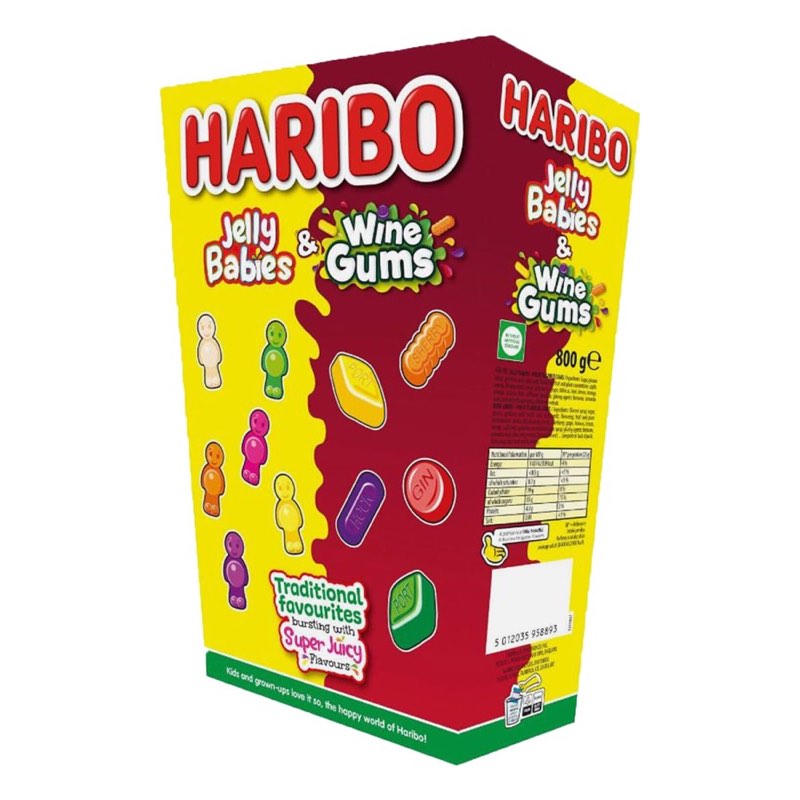
And if what you want is a present rather than a supply, a tub is honest but plain. The gift-box format exists for that job: the Megastars gift box at £6.99 for 800 g and the jelly babies and wine gum box at the same £6.99 both present far better under a tree or on a hospital bedside table, and both work out cheaper per 100 g than this tub does, which is not what most people expect from gift packaging.
Building a table, a bag or a bowl around it
The easiest way to think about a spread is in jobs rather than in products. You want a base, a contrast, a sharp thing, a slow thing and something with a bit of theatre. A mixed tub like this is the base — the bowl that never empties, the one people go back to without thinking, the one that stops any of the others having to carry the event.
For the contrast, go to a different texture rather than a different flavour. Barratt Fruit Salad Chews at £5.49 are the classic British answer: a proper chew that has to be worked at, in a flavour family that everyone over thirty recognises immediately and everyone under thirty finds interesting. Put them next to a soft mix and both taste better for the company.
For the sharp thing, you want something that resets the palate between handfuls. The Bean Boozled box at £2.99 does that job and adds a game to the table at the same time, which is worth more at a children's party than any amount of extra weight. It is a small box at a small price, so it is a cheap addition to a spread rather than a second main item.
For the slow thing, lollipops and anything sucked rather than chewed will pace a room in a way nothing else does — a child with a lolly is occupied for ten minutes rather than ten seconds. The pumpkin light pop linked above is one option; there are others across the shelves.
For theatre, novelty formats earn their place. The Chupa Chups mini candy sushi tray at £2.99 is the one we would reach for first, because it looks like something other than sweets and that is exactly what a table of bowls needs in the middle of it. The soft and chewy fruity mini tubes at £1.49 for 130 g are the cheap version of the same trick — individual tubes are easy to hand out, easy to count and easy to put one of at each place setting.
If you are scaling up to a big table, the useful move is to buy one large tub of something as the volume and keep this as the variety. The Candy Realms tutti frutti tubes tub at £7.99 for 780 g is the obvious partner — nearly twice the weight for three pounds more, so it does the bulk work while the mix does the interest. That is a much cheaper way to fill a table than buying three mixes.
For a traditional British angle, put a few older lines alongside. Barratt Jelly Babies at £5.49 and Briquette at the same £5.49 both come from the old counter tradition rather than the branded-packet one, and a bowl of each next to a modern mix makes the difference between the two eras obvious in a way that is genuinely interesting to eat through.
One planning note. Put the mix in the widest, shallowest bowl you have. Mixed sweets in a deep bowl get eaten from the top layer only and the bottom third goes untouched, which is how people end up thinking a tub went further than it did. Spread them out and the whole lot gets eaten.
Occasions this actually gets bought for
Birthday parties are the obvious one, and the tub does two jobs there: it fills the table bowls and it fills the take-home bags. Because it is a mix, every bag gets a variety without you having to portion five different products into thirty bags, which is the single most tedious job in party preparation. Scoop and go.
Film nights and long evenings in are the domestic use, and the tub format matters again — a lid means you can stop, which a torn-open bag does not really allow. Put out a bowl, keep the tub closed, and the evening does not turn into the whole 400 g.
Car journeys and days out are where the recognisable mix beats anything more specialised. Everyone in the car will eat it, which is not a small consideration three hours into a drive. The same logic applies to a caravan, a tent, a boat and a waiting room.
Workplaces and classrooms run on tubs. A tub on a desk is a social object — it gets shared, it gets topped up, it gets commented on — and a mix is the only safe choice when you do not know the preferences of everyone who will reach into it.
Christmas and other seasonal tables use this as the filler between the showpieces. Buy the impressive thing for the centre and the mix for the bowls around it. Our candy and chocolate section is where most people find the centrepiece, and this is what goes around it.
Fundraising, fêtes and stalls are the volume use, and here you would buy up rather than across — see the size comparison below, because at stall scale the kilo tubs change the arithmetic considerably.
What £4.99 buys, and how it compares
This tub is 400 g for £4.99, which works out at £1.25 per 100 g. That is the number to carry into every comparison below.
| Product | Weight | Price | Per 100 g |
|---|---|---|---|
| Starmix tub (this page) | 400 g | £4.99 | £1.25 |
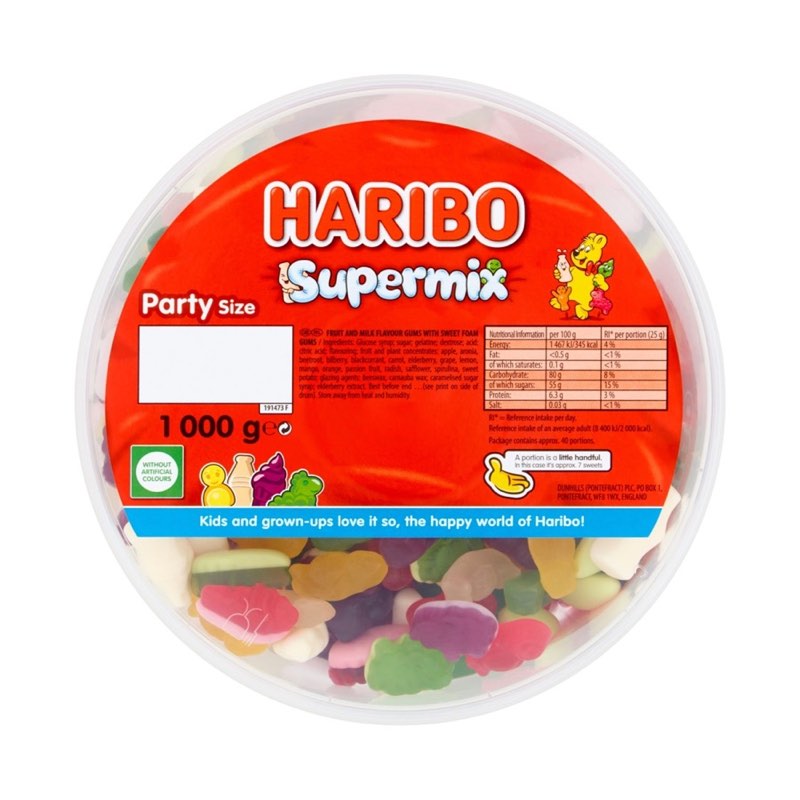
| Supermix tub | 1 kg | £11.99 | £1.20 |
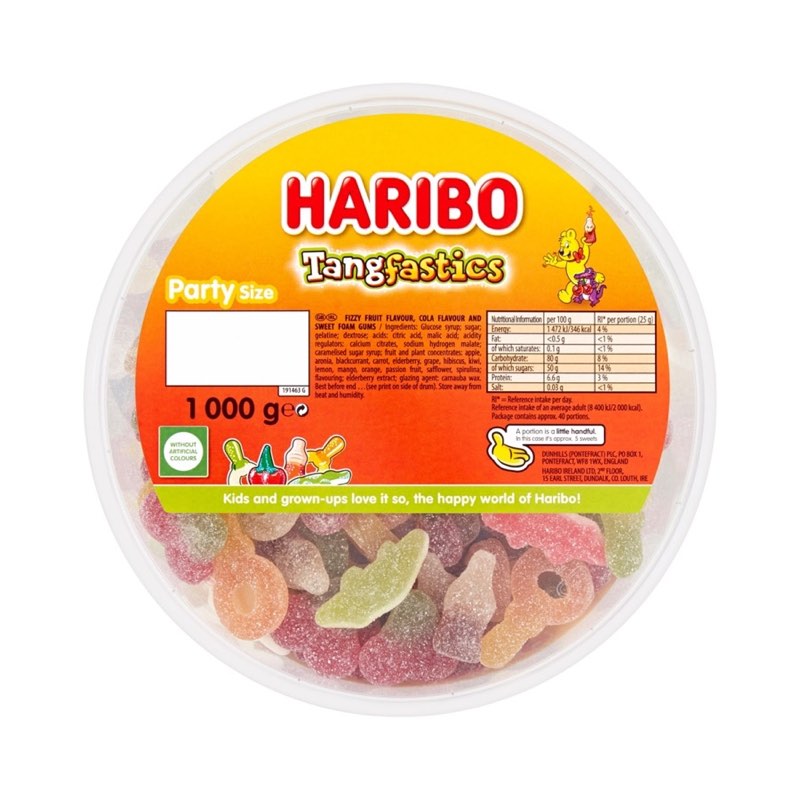
| Tangfastics tub | 1 kg | £11.99 | £1.20 |
| Megastars gift box | 800 g | £6.99 | £0.87 |
| Jelly babies & wine gum gift box | 800 g | £6.99 | £0.87 |
| Happy-Cola bag | 140 g | £1.25 | £0.89 |
The honest reading of that table is that this tub is priced for its size rather than for its brand. The kilo tubs are only five pence per 100 g cheaper, so if you know you want a kilo of Haribo in the house, the Supermix tub at £11.99 gets you two and a half times the weight for two and a half times the price — no penalty, no real discount either. The decision between them is about how much you want, not about value.
The gift boxes are the surprise. At £0.87 per 100 g they are the cheapest weight on this list by some distance, which runs against the usual assumption that presentation costs money. If you are buying purely on quantity and do not mind the box, they are the better buy. If you want something refillable that lives on a shelf, the tub is the format you actually want and the small premium is what you are paying for it.
On portions, think in 30 g and 60 g. Thirty grams is a decent handful — a generous single serving, the sort of amount that goes in a small paper bag or a cupped hand. Sixty grams is a party portion for one guest across an afternoon. On that basis this tub is roughly thirteen handfuls or six to seven party portions, which is a household week or one small gathering.
Scale that up for catering. Twenty guests at 60 g each is 1.2 kg, so three of these tubs or one kilo tub plus one of these. Thirty children's take-home bags at 40 g each is also around 1.2 kg. If you are running a stall and selling by the scoop, work in kilos from the start and treat this size as the top-up rather than the stock.
Compared with the wider shelf, £1.25 per 100 g sits comfortably in the middle. Plenty of our loose lines land at £5.49 for a standard bag, specialist and imported lines run higher — the BUBS foam sweets at £7.50 are an example — and the very cheapest per gram tends to be the big tubs and boxes. Buying a mix at mid price and bulking the table with something cheaper per gram is almost always the most efficient way to cater.
Keeping a tub in good condition
The tub itself does most of the work, which is the main practical argument for buying this format rather than a bag. It is rigid, it has a proper lid, and it does not let air in around a fold the way a clipped bag does. Keep it closed between servings and it will hold condition for a long time in a normal kitchen cupboard.
The enemy is air, and specifically the drying effect of repeatedly opening it in a warm room. As covered in the texture section above, sweets of this kind continue to firm up slowly as they lose moisture, so a tub that is opened twenty times a day will be noticeably chewier at the bottom than it was at the top. If you like them soft, keep the lid on properly and do not decant into an open bowl until you are ready to serve. If you like them firmer, do the opposite deliberately.
Warmth is the other factor. In a hot room, sweets of this kind soften and the pieces start to stick to one another, which is annoying rather than damaging — a tub that has gone tacky will usually loosen up again once it cools, and a gentle shake separates the pieces. Avoid the windowsill, the top of the fridge and anywhere above a radiator, and you will not meet the problem.
Do not refrigerate. Cold makes them hard work to chew and introduces condensation when they come back out, which makes the outside tacky. A cool, dry cupboard is better in every respect.
If you decant into jars for a table, only fill what you will serve. Sweets left out in an open jar overnight will be a different texture in the morning, and the rest of the tub should stay sealed until it is needed. This is the same advice as for any loose sweet, and it is the single easiest thing to get right.
One size here — and what to do if you want more
This listing is sold in a single size, the 400 g tub at £4.99, so there is no variant decision to make on this page. The real decision is a sideways one: if 400 g is not enough, do you buy several of these, or do you go up to a kilo of something else?
Buy several of these if you specifically want this mix and you want the smaller tubs for practical reasons — one for the kitchen, one for the car, one for the desk. Three separate 400 g tubs are far more useful than one 1.2 kg container if they are going to live in three different places.
Go up to a kilo if it is all going in one bowl. The Tangfastics kilo tub at £11.99 is the obvious step up if you want the sour end rather than the sweet end, and the Supermix kilo tub linked above is the step up if you want more of the same broad idea. Both are cheaper per gram and both are a serious quantity.
Mix formats rather than repeating one if the tub is for a crowd. One 400 g tub plus one 800 g gift box costs £11.98 and gives you 1.2 kg across two different assortments — more variety than 1.2 kg of one thing, for essentially the same money as the kilo tub. For a party table that is the better arrangement almost every time.
Where to go next on the site
This product sits on four shelves. The widest is the loose counter linked earlier, which is where everything sold by weight rather than in a branded pack lives. The brand shelf collects the 43 Haribo lines we carry in one place and is the quickest way to see the whole range side by side rather than meeting it one product at a time.
The two flavour shelves are the ones worth exploring if you are shopping by taste rather than by name — the fruit shelf is one of the biggest on the site and the cola shelf is one of the most focused, and between them they cover most of what is in this tub.
From the top, the complete range is there for open-ended browsing, and the pick and mix section is where to go if you would rather choose the contents yourself than accept somebody else's assortment. That is the direct alternative to a ready-made mix, and for a party where you know your guests' tastes it is usually the better answer.
Common questions
How many sweets are in the tub?
We do not publish a piece count. Mixed sweets are sold by weight rather than by number, and because the pieces vary in size, two tubs of the same weight will not hold the same quantity. The figure to plan with is the 400 g on the label. For portioning, 30 g is a generous handful and 60 g is a party serving per guest, which puts this tub at roughly thirteen handfuls.
Is this the same as the Haribo mixes sold in bags?
This listing is the tub format at 400 g for £4.99. What a tub gives you over a bag is a proper lid, a container that stands up, and something you can keep topping up rather than finishing. What a bag gives you is usually a lower price per gram. If the container matters to you — a desk, a counter, a shelf — buy the tub; if only the contents matter, compare the per-100 g figures in the table above.
Can I get this in a bigger size?
Not on this page — this listing is a single 400 g size. For a larger quantity, the kilo tubs linked above are the nearest equivalents at £11.99 each, and the 800 g gift boxes at £6.99 are the cheapest way to add weight if you do not mind the box. Buying two different formats is usually better for a party than two of the same.
Is it suitable for vegetarians or vegans?
We do not hold verified dietary information for this line, so we cannot tell you, and we would rather say so than guess. Anyone with a dietary requirement should check the manufacturer's packaging when the order arrives. The same applies to allergies: check the pack itself before anything is eaten or shared out.
Are these all right for small children?
Sweets are a treat rather than a food. Whole gummies and small sweets of any kind are a choking risk for young children, so they should be supervised while eating them. If anyone in the household has an allergy, check the manufacturer's packaging on arrival before the tub is opened or shared.
Why do some pieces feel firmer than others?
That is the mix working as intended. As set out in the texture section above, piece size, thickness, surface finish and how long a sweet has settled before packing all change how long it takes to chew, and an assortment deliberately includes pieces at different points on that range. It is also normal for a tub to firm up slightly over time once it has been opened, particularly in a dry room.
Which pieces run out first?
In most households, the cola ones. Cola is the odd flavour out in a mostly fruit mix, and that is precisely what makes people pick it. If that happens at your table, the Giant Cola Bottles and the small Happy-Cola bag linked earlier are both straightforward ways to top up the flavour that goes first, and adding a bag of one of them to a tub of this is a common order for exactly that reason.
Can I refill the tub with other sweets?
Yes, and plenty of people do — it is one of the better sweet containers you will get for free with a purchase. A rigid tub with a proper lid keeps loose sweets in much better condition than a folded bag. Keep different types separate if you can, because softer sweets pressed against firmer ones for a week will start to take on their character.
How long does an open tub stay good?
Go by the date printed on the packaging rather than a general rule. What you control is the conditions: lid on, cool cupboard, out of direct sun, not in the fridge. Kept that way a tub holds its texture well; left open on a warm windowsill it will be noticeably firmer within a fortnight. That change is drying rather than spoiling, but it does alter the eating.
What should I serve alongside it at a party?
Something with a different chew length and something sharp. The mix-building section above sets it out in detail, but the short version is one soft item, one proper chew, one sour item and one lollipop, and you have covered every way a sweet can behave. Colour variety matters less than texture variety, though a multi-coloured mix like this one gives you plenty of the former anyway.
Is a tub a reasonable gift on its own?
It is a good practical gift and a plain-looking one. If presentation matters, the 800 g gift boxes linked above look considerably better for £2 more and hold twice the weight. If you want something more personal, a self-assembled mix from the pick and mix section lets you choose every component, which reads as more thought than any box does.
Does it travel well?
Better than most things we sell. A rigid tub with a lid survives a rucksack, a glovebox and a suitcase far better than a bag, and sweets of this kind are not fragile. The only real risk is heat — a tub left in a car on a hot day will go tacky inside. It generally recovers once it cools, and a shake separates the pieces again.
The short version
A 400 g tub of a mixed, multi-coloured Haribo assortment at £4.99, running on two flavour families — fruit and cola — and, more importantly, on several different chew lengths in the same container. It is the bowl everyone will eat from, the tub that lives on a shelf and gets topped up, and the safest thing to put in front of a room full of people whose tastes you do not know. Buy it as the base of a table and spend your interesting money on the things you put next to it.
More from Haribo
More fruit sweets
More loose sweets sweets
Where this sits
Haribo Starmix Sweet Tub appears on these shelves. Browse them, or jump to something nearby.
You might also like