
Home / Loose Sweets / Chupa Chups Mini Candy Sushi Tray 100g
Chupa Chups · 100g
Read the full guide
Chupa Chups Mini Candy Sushi Tray 100g
£2.99
✔ In stock — ready to ship
Fresh stock
Free over £20
Same-day dispatch
Secure checkout
There is a particular shopper this product was made for, and it is worth describing them properly, because if you recognise yourself in the description you can stop reading and add it to the basket.
The first is the person buying a small present for a child who has everything. Not a birthday present — a Saturday present, a reward, a something-for-the-journey. The whole appeal of the Chupa Chups Mini Candy Sushi Tray at £2.99 for 100 g is that it is an object rather than a bag. A bag of sweets gets eaten. A tray of sweets got up as sushi gets looked at first, shown to someone, photographed by a parent, and then eaten. That extra ten minutes of attention is what you are actually paying the extra pound for.
The full guide to Chupa Chups Mini Candy Sushi Tray 100g
5,282 words on how it eats, who it suits, how to serve it and what to put beside it.
Who buys a tray of candy sushi, and why
The second is the host who needs one thing on the table that starts a conversation. Every good spread has an anchor — the item people point at. It does not have to be the nicest thing on the table and it usually is not the thing that runs out first. It has to be the thing that makes the table look considered. A tray of multi-coloured chewy sweets arranged as sushi does that job in a way that a bowl, however generously filled, cannot.
The third is the person shopping for a themed occasion and running out of ideas. Film nights with a particular cuisine attached, a Japanese-themed birthday, a class party, a leaving do for someone who is moving abroad. Themed food is usually either expensive or a nuisance to make. This is neither, and it does the theming work on its own.
The fourth, and the largest group in practice, is the curious adult. Someone who walked past this and could not quite leave it. That is a completely legitimate reason to buy sweets and we would never talk anyone out of it. At £2.99 the curiosity is cheap, and what you get for it is a genuinely well-made novelty rather than a joke that stops being funny once it is open.
Who it is not for: anyone buying on volume. This is a 100 g tray at £2.99, which is £2.99 per 100 g, and that is not the rate you want if you are filling bowls for thirty people. If volume is the job, the loose bags do it far better — Haribo Gold Bears at £5.49 is the obvious workhorse, and one bag of those will out-feed four of these trays for less money. Buy the tray for what it is: presentation, not provisions.
What actually turns up
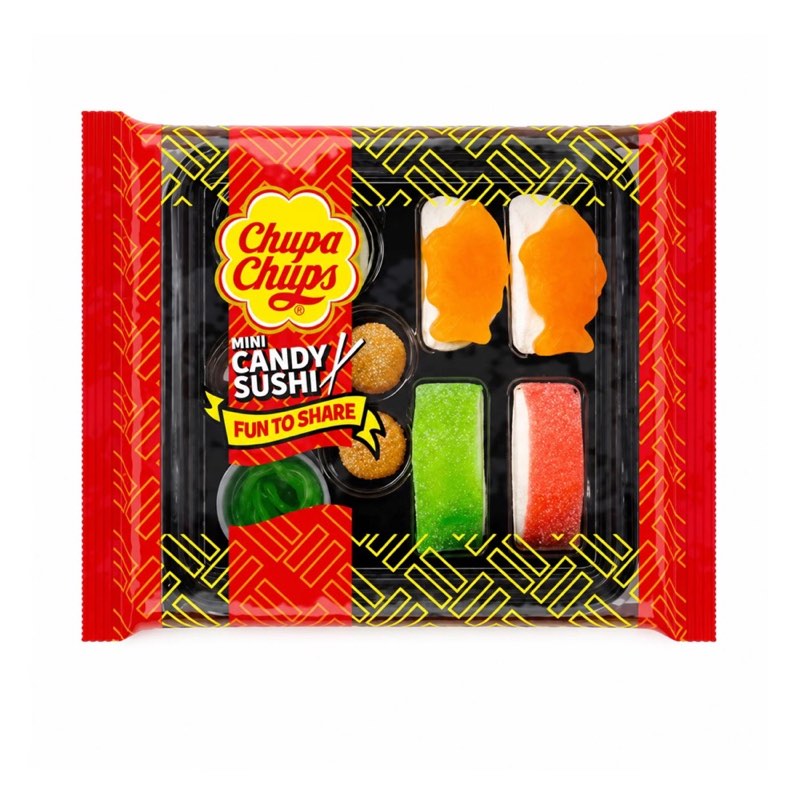
A tray, 100 g, holding small chewy sweets in a multi-coloured assortment, styled after sushi. That is the honest description, and it is worth being plain about the scale of it before anything else: mini is in the name and it is doing real work. These are small pieces presented neatly in a tray, not a dinner-sized spread. Anyone expecting a platter will be briefly disappointed and then won over, because the smallness is exactly what makes the presentation work — a small thing made carefully reads as craft, where the same thing at twice the size would read as a gimmick.
The sushi conceit is carried entirely by shape, arrangement and colour, and the fact pack tells us the pieces are chewy in type, fruit in flavour and multi coloured. That combination is the whole trick. Chewy sweets can be formed and layered in ways that a hard sweet cannot, colour does the rest of the storytelling, and the tray holds the arrangement in place so it still looks like the idea when it arrives rather than after you have laid it out yourself.
We are not going to enumerate exactly which sushi shapes are in your tray, because we do not hold a verified piece breakdown for this line and we would rather not have you counting against a list we made up. What we can tell you is the format, the weight, the type and the colour as our supplier records them, and that the packaging in front of you is the authority on everything else.
In the hand the tray is light — 100 g is not much, and it is spread across a footprint rather than stacked — so handle it flat. This is a product that is much better carried in a bag than in a pocket.
Eating it
The pieces are chewy, which sets the whole eating experience before any flavour arrives. Chewy sweets work on a slow release: the first bite is resistant, then the piece yields and starts to deform rather than break, and the flavour comes out gradually as it warms and works against the teeth. Nothing about a chew is fast, and that is the point.
The first thing you notice is that the resistance is shorter than a proper toffee and longer than a gummy. That is the middle ground chews occupy, and it is why they are such a popular format for children and such a durable one for a table: they last long enough to feel like something, without the jaw ache or the fillings risk of a serious toffee.
The fruit flavour arrives early on a chew, because the surface is already yielding by the time you have bitten twice, and it builds rather than peaks. By the third or fourth chew you are at the top of the flavour, and from there it tails off slowly over the rest of the piece. That long tail is why one chew satisfies where one gummy does not.
Because the assortment is multi-coloured, the eating is also a sorting exercise, and everybody does it. People eat the colour they like first. This is universal, it happens with every mixed bag of sweets ever sold, and with a tray it is more visible than usual because the arrangement gets disrupted as it goes. Expect a tray to look distinctly picked-over before it is half gone, and take your photographs early.
The finish is clean enough. Chews leave less coating than a sour-dusted sweet and less residue than anything with a sugar shell, though like all chews they will find their way into the grooves of your teeth, which is worth knowing before you hand a tray to a child in the back of a car.
How it looks, and why that is the product
This is a line where presentation is not the packaging around the product — it is the product. Strip the tray and the arrangement away and you have a handful of chewy fruit sweets, which is a fine thing but not a £2.99-per-100-g thing. Understanding what the presentation is doing tells you how to use it.
Start with colour. A multi-coloured assortment does something no single-colour sweet can: it reads as abundance at a glance. The eye counts variety before it counts quantity, which is why a small tray of many colours looks more generous than a larger bowl of one colour. Any shop window, any party table, any child's plate works on this principle. If you are laying out a spread on a budget, the single most effective move is not to buy more, it is to buy more colours, and to put them where they can be seen against each other.
Then arrangement. Almost all confectionery is sold in a jumble — poured into a bag, scooped into a tub, tipped into a bowl. A tray of arranged pieces is unusual enough on a sweet shelf that it registers as effort. That is why this photographs so much better than its price suggests. Grid and row arrangements are what food stylists reach for when they want something to look deliberate, and this arrives pre-styled.
Then borrowed form, which is the cleverest part. Sushi is one of the most visually codified foods in the world — everybody recognises the shapes instantly, even people who have never eaten it. Borrowing that form means the product gets recognition for free. You do not have to explain what it is meant to be. That instant read is the entire reason novelty confectionery imitates recognisable objects rather than inventing new shapes, and it is why it works on a table with people of every age around it.
How to use that practically. If you are styling a table: put the tray on a flat surface at the front where the arrangement can be seen from above, because an arranged product loses everything the moment it is at eye level or pushed to the back. Give it a bit of empty space around it rather than crowding it — arranged things need air. Put plain, dark or neutral items next to it and bright colour will do the rest; a tray of colour against a plain background always reads better than a tray of colour against more colour.
If you are filling a jar rather than laying a table, this is not your line, and it is worth saying so clearly. Small arranged pieces lose their entire point in a jar — they become an unreadable jumble behind glass. Jars want either one bold colour or large, distinct shapes. For that job, Candy Realms Tutti Frutti Tubes Tub 780g at £7.99 is the far better buy — big soft tubes, plenty of them, and they read clearly through glass at a distance.
If you are photographing it — for a party, a shop, a child's birthday, or simply because you are going to — light it from the side rather than the front, because arranged food needs shadow to show its depth, and shoot it from directly above. A flat-lay of an arranged tray is one of the few food photographs that is genuinely hard to get wrong.
Building a table around the colour
Once you accept that this is a presentation piece, the buying strategy follows: surround it with things that make the colour count.
The first rule is contrast of format, not more of the same. Put something long next to something small, something matte next to something glossy. Drumstick Chew Bars (10 Pack) at £2.50 are a good companion for exactly this reason — they are bars rather than pieces, they lie in a different direction, and at ten in a pack they give you a second cheap item that reads as plenty.
The second is one dense block of a single colour to anchor the eye. Mixed colour everywhere becomes noise. Maoam Stripes at £5.49 give you a neat, uniform, stacked item that calms the table down, and they are chews too, which keeps the texture consistent for anyone eating rather than looking.
The third is something classic that everyone recognises, so nobody at the table feels the spread is all novelty. Barratt Fruit Salad Chews at £5.49 are the obvious pick, sitting in the same chewy-and-fruity territory and costing much less per gram, and Taveners American Hard Gums at the same price bring in a firmer, glossier texture that looks quite different in a dish.
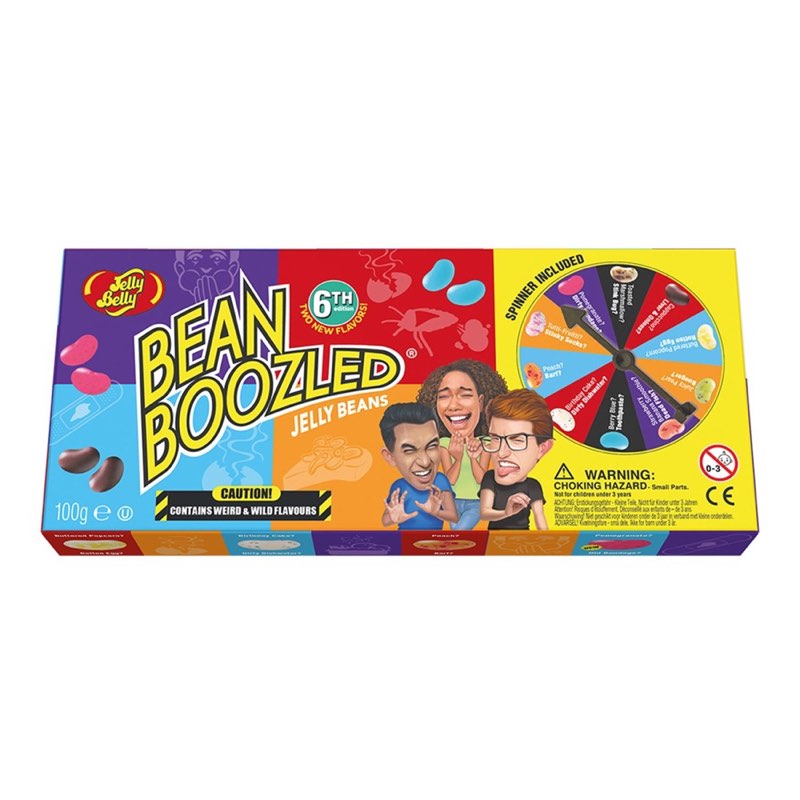
The fourth is one element of risk, if the crowd will take it. Jelly Belly Bean Boozled Jelly Beans Box 45g at £2.99 is the classic dare item and it sits at the identical price point to this tray, which makes the pair a natural two-for-under-six-pounds novelty corner. If you would rather the risk were about intensity than surprise, Barnett's Mega Sour Fruits Candy Bags 104g at £3.99 do it with sourness instead.
The fifth is the volume item, which should be the cheapest per gram thing on the table and the thing you buy most of. Gold bears or another big familiar bag do this. The mistake people make is buying five novelty items and no volume: the table looks wonderful and everyone is still hungry.
Keep the tray away from anything sticky or dusty, both on the table and in the cupboard. Sugar-coated and sour-dusted sweets shed, and the dust will settle on an arranged tray and take the neatness off it. On a table, that means keeping the sour fruits bag in its own dish at the other end.
How a fruit flavour gets built
The fact pack lists the flavour here simply as fruit, which is the industry's most modest description for what is actually a considerable piece of craft. It is worth unpacking how a recognisable fruit note gets constructed in a sweet, because it explains why some fruit sweets taste exactly right and others taste like a colour.
The first thing to understand is that a sweet is never trying to taste like the fruit. It is trying to taste like your memory of the fruit, which is a different and much more achievable target. Real fruit is inconsistent, watery, often sour, and different every week of the year. A sweet has to hit the same note every time, in a format with no juice in it and a sugar level nothing in nature comes close to. So confectioners do not copy a fruit; they build a caricature of it, exaggerating the two or three characteristics your brain uses to identify it and leaving out everything else.
Those identifying characteristics are usually a top note, a body and an acid level. The top note is the bright, volatile part you smell before you taste — it does most of the identification work, and it is why holding your nose makes almost every fruit sweet taste like generic sweetness. The body is the rounder, heavier part underneath that gives it weight and tells you whether you are dealing with a berry or a citrus or a stone fruit. And the acid level is what makes it read as fresh rather than flat; without acidity, even a perfectly built fruit note tastes cooked and dull.
Different fruits need those three dials set very differently. Citrus lives almost entirely in the top note and needs high acidity. Berries need much more body and less brightness, which is why a strawberry sweet that is too bright reads as artificial while a pear or a peach can get away with far more. Tropical fruits need a heavier, rounder base and a little funk in the background to be convincing. Apple is the trickiest of the lot, because apple identity is mostly crunch and freshness — neither of which a chew can provide — so apple sweets lean hard on sharpness to compensate, which is exactly why so many of the extreme sour lines on our shelves are apple-flavoured.
Then there is the question of the format, which changes everything, and this is where a chew specifically matters. Flavour release depends on how fast the sweet breaks down in the mouth. A hard sweet dissolves slowly from the outside and gives you a long, even, low-intensity flavour. A gummy is bouncy and releases in bursts as it is compressed. A chew deforms progressively and warms as you work it, which releases flavour on a rising curve — quiet, then building, then a long slow tail.
That rising curve is why chews are such a good home for fruit flavours and why a fruit chew feels more "juicy" than a fruit hard sweet with an identical flavour in it. The build-up mimics what happens when you bite real fruit: a rush that arrives just after the bite rather than on it. It is also why a chew can carry a subtler flavour than a hard sweet can, because it has time to make its case.
The last piece is colour, which is not a garnish but part of the flavour system. Tasting is substantially a matter of expectation, and colour sets the expectation before anything reaches the tongue. The same flavour in two different colours will be described differently by most people, confidently and sincerely. In a multi-coloured assortment this is doing constant quiet work — each colour primes you for a particular fruit, and the flavour then confirms it. That is why mixed assortments feel more varied than they may measurably be, and it is a genuine part of the enjoyment rather than a trick to resent.
Occasions it suits
Children's parties. As a centrepiece rather than a supply. One tray on the table for everyone to look at, and cheap volume in bowls around it. Whole small sweets and chews should always be eaten sitting down and with an adult about — small hard sweets and whole gummies are a choking risk for young children, and supervision is simply sensible.
Themed evenings. The most obvious use and the one it does best. It theme-dresses a table for three pounds, and it does not require you to cook anything or explain the joke.
Film nights. Good, with a caveat: it is a looking product as much as an eating one, and in a dark room nobody can see it. Open it before the lights go down, or save it for something else.
Gifts and stockings. Excellent. It is flat, it is boxed, it is inexpensive, and it has instant appeal on being opened, which is exactly the profile you want for a small gift. Pair it with something conventional so the gift has both a surprise and a safe bet in it.
Class treats and end-of-term. Works well as the one shared object in a bag of otherwise ordinary sweets, though check the room's arrangements about food from outside first.
Hampers. Only if the tray can lie flat and undisturbed, and only near the top. It is not a product that survives being packed under weight, and a crushed tray of arranged sweets is worse than no tray at all.
Serving it on the day
A few practical things make the difference between a tray that lands and a tray that gets lost, and none of them cost anything.
Do not decant it. This is the one rule that matters. The instinct with any sweet is to tip it into a nice bowl, and here that throws away everything you paid for. Serve it in the tray it came in, on a plate or a small board if you want it to look deliberate, and let the arrangement do its work.
Put it out late. Volume items should be on the table before anyone arrives, so nobody walks into an empty spread. The novelty piece should go out when there are people in the room to see it, because an arranged tray that has sat for an hour has already been picked at by whoever was in the kitchen, and it never looks the same twice.
Give it its own level. A cake stand, an upturned dish, a chopping board — anything that raises it half an inch above the rest of the table will pull the eye straight to it. Arranged food wants to be seen from above, and a flat table full of bowls makes that hard.
Have something beside it people can take handfuls of, so nobody feels they are demolishing the display. This is the real function of the cheap volume bag: it protects the centrepiece. A bowl of chews next to the tray means people take one piece from the tray out of curiosity and then eat properly from the bowl, which is exactly the behaviour you want. A ten-pack of chew bars at £2.50 is the least fussy way to do that, because bars can be handed out rather than scooped.
Tongs or cocktail sticks if it is a grown-up table and more than a handful of people. Small arranged pieces get handled a lot when everyone is choosing, and a stick in a dish beside the tray solves that without making a point of it.
Leftovers. Whatever is left goes into a lidded tub the same evening, not back in the tray with the lid balanced on top. Once the arrangement has gone there is nothing to preserve, and the pieces keep far better sealed. They are perfectly good chews for a week afterwards — they have simply stopped being a centrepiece. If you want more of that texture to see the week out, our chewy shelf is the place to restock from.
What 100 g at £2.99 really means
The unit price is £2.99 per 100 g. Held against the loose lines on this page, that is at the expensive end: the standard bags of Kingsway Assorted Fruit Chews and similar sit at £5.49 for a full bag of sweets, and a 780 g tub is £7.99. Per gram, this tray is not competitive and it is not meant to be.
| Item | Price | What you are buying it for |
|---|---|---|
| This tray, 100 g | £2.99 | Presentation, theme, novelty |
| Theatre box, 120 g | £2.25 | A portion for one, in the hand |
| Standard loose bag | £5.49 | Volume and variety for a bowl |
| Large tub, 780 g | £7.99 | Filling jars and feeding crowds |
Read that table as four different jobs rather than four prices. Nobody should buy the tray to feed people and nobody should buy the tub to style a table. The mistake is comparing them on the same axis. Mike & Ike Mega Mix Sour Theatre Box 120g at £2.25 is instructive here: it is cheaper and heavier than this tray, and it is a completely different purchase — a box for one person to hold in a cinema, with no presentation value at all once it is open.
For portioning, treat 100 g of small chewy pieces as a shared item for four to six people who are also eating other things, or a generous single sitting for one person who is not. At a children's party assume everyone will take two pieces from the tray to try it and then go to the bowls, which means one tray covers a surprising number of children as a taster and none of them as a supply.
The value verdict is simple. If the tray does its job — gets looked at, gets talked about, makes the table — then £2.99 is cheap for a centrepiece, cheaper than flowers, balloons or anything else you would buy to make a table look like an occasion. If it goes straight into a bowl with everything else, you have overpaid for chewy fruit sweets. The difference is entirely in how you use it.
Keeping the tray in good order
Chews have two enemies and the tray adds a third.
Heat is the first. Warm chews soften, and soft chews stick to each other and to the tray. A tray left in a sunny window or a hot car will arrive at the table as a single mass, and no amount of patience separates it neatly. Keep it in a cupboard at normal room temperature.
Air is the second. Once opened, chews dry out and harden at the surface. That is a slower problem than softening but it does take the pleasure out of them. Keep the tray sealed until you want it, and once open, cover it or move the remainder into a tub with a lid.
Pressure is the third and the one specific to this format. The tray protects the arrangement only if nothing is on top of it. Shop it home on the top of the bag, store it on a shelf rather than in a drawer where things slide, and lay it flat. Standing an arranged tray on its edge undoes it.
Do not refrigerate. Cold makes chews hard and unpleasant to bite and does nothing useful for them, and bringing them back out brings moisture to the surface, which makes them tacky. A cool cupboard is the right answer.
As with everything on our shelves, the manufacturer's packaging is the authority on the product once it arrives. We do not publish ingredient, nutrition or allergen information for this line because we do not hold verified data for it — please check the pack before eating, and take particular care if anyone eating has an allergy. Sweets are a treat rather than everyday food, and small children should be supervised while eating them.
One size, and what to buy alongside it
This comes in a single option: one tray, 100 g, £2.99, in stock. There is no larger tray and no multipack, so the only decision is how many trays you want — and for most uses the answer is one, because a second identical tray adds nothing to a table that the first has not already done. Presentation pieces do not stack.
Where the second purchase should go instead is into a different format at a different price. If you want more of the same eating experience for less money, stay in chews: the fruit salad chew bag at £5.49 is the direct like-for-like in a much bigger quantity. If you want more of the same visual interest, buy a different novelty rather than a second tray — the Bean Boozled box at £2.99 is the natural partner, identical in price and completely different in what it does to a room.
And if you want more of the same colour for a table, the cheapest route is a big mixed bag rather than another arranged item. A bag of gold bears or an assorted fruit chew bag at £5.49 will each give you far more colour per pound than a second tray would.
Where to find it and what is next to it
This tray sits on three of our shelves at once, which tells you something about how to shop for it. It is on Loose Sweets, our biggest shelf at 356 lines and the place where most of the individual packs and trays end up. It is on Chewy, which runs to 78 lines and is the shelf to browse if the texture is what you are after rather than the presentation. And it is on Fruit, our 161-line flavour shelf, which is the right starting point if you are buying for someone whose only stated preference is fruit.
Those three shelves are genuinely different routes to different baskets, and it is worth using the one that matches how you are actually shopping. Texture-first shopping produces very different results from flavour-first shopping, and both produce better results than brand-first shopping for a table.
Beyond them, the hubs worth knowing are the full catalogue of everything we sell for open-ended browsing, Pick & Mix for building a weighed bag by hand, Candy & Chocolate for bars and boxes, Jelly & Gummy if you want bounce rather than chew, and Retro for the old-fashioned jar lines that a novelty tray sits so nicely against on a table.
That last contrast is worth pursuing deliberately. A table with one very modern novelty item and several very traditional ones looks far more interesting than a table of all one or all the other. Put this tray next to a dish of traditional hard gums and the two flatter each other; put it next to four other novelties and it disappears into the noise.
Questions we get about this tray
Does it actually taste of sushi?
No, and it is not meant to. The sushi part is the shape, the arrangement and the colour. The flavour is fruit and the texture is chewy, as our supplier records them. Think of it as fruit chews wearing a costume — the joke is visual, and the eating is straightforwardly a fruit sweet.
How many pieces are in the tray?
We do not hold a verified piece count for this line, so we will not quote one. The weight is 100 g and the pieces are described as mini, so expect a neat arrangement of small pieces rather than a large platter. For planning, treat it as a shared taster for four to six people alongside other things.
Is it suitable for a young child?
Children are the main audience for the idea, but small whole sweets and chews are a choking risk for young children, so they should be eaten sitting down and with an adult present. We would also point you at the packaging, which is the only reliable source on what is in it — please check it before anyone eats, especially where there is an allergy in the house.
Will it survive being posted or carried in a bag?
Carried flat, on top rather than underneath, yes. Posted, it is more of a gamble than a flat sealed pack would be, because the whole value is in an arrangement that pressure disturbs. If you are posting it, pack it flat, pack it near the top, and pad around it rather than on it.
Is it good value at £2.99?
For 100 g of sweets, no — that is £2.99 per 100 g and our loose bags beat it comfortably. For a table centrepiece that needs no work and no explanation, yes, easily. It depends entirely on which of those two things you are buying. If you need to feed people, buy a bag as well and let the tray be the decoration.
What is the difference between chewy and gummy?
Chewy sweets deform and soften as you work them, releasing flavour on a rising curve with a long tail. Gummies are bouncier and more elastic, resisting and then springing back, releasing flavour in shorter bursts. Chews last longer in the mouth and generally feel more substantial. If you would rather have the bounce, our jelly and gummy shelf is the one to browse.
Can I use it in a pick and mix bag?
You can, but you would be throwing away what you paid for. The arrangement is the product, and it does not survive being tipped into a bag with everything else. If a mixed bag is what you want, build one properly and keep the tray separate as the thing on the table beside it.
How do I keep it looking neat until the party?
Leave it sealed, keep it flat, keep it cool, and put nothing on top of it. Heat is the real enemy — warm chews stick together and take the definition off the arrangement. A cupboard shelf away from sunlight and the hob will keep it exactly as it arrived.
What goes with it on a table?
Something long and cheap for contrast of shape, something uniform for the eye to rest on, one classic that everyone recognises, and a big bag of volume so people can actually eat. Chew bars, stripes, fruit salad chews and a large bag of bears will cover all four jobs for well under fifteen pounds.
Is there a bigger tray?
No. This line comes in one size only — the 100 g tray at £2.99. If you need more for a crowd, the right move is a large tub or a standard loose bag alongside it rather than multiple trays, because a second tray adds volume without adding any of the visual effect you bought the first one for.
Will adults eat it or is it just for children?
Adults eat it, reliably and slightly sheepishly, which is a good part of why it works on a table. The novelty gives grown-ups permission to pick at something they would not put in a bowl for themselves, and the chews themselves are perfectly ordinary good fruit sweets underneath the costume.
Which colour tastes of what?
We do not publish a colour-to-flavour key for this line because we do not hold a verified one, and guessing would be worse than useless when people plan around these things. What our supplier does record is that the assortment is multi-coloured and the flavour family is fruit. The pack will tell you the rest.
To sum up
A 100 g tray at £2.99 that is bought with the eyes and eaten with the teeth, and which is excellent value for the first of those and poor value for the second. Buy it as the thing on the table that people point at, give it flat space and a bit of room to be seen, keep it cool and unsquashed until the day, and put the volume somewhere else in the budget. Used that way it is one of the most effective three pounds you can spend on making an ordinary table look like an occasion.
More chewy sweets
More fruit sweets

More loose sweets sweets
Where this sits
Chupa Chups Mini Candy Sushi Tray 100g appears on these shelves. Browse them, or jump to something nearby.
You might also like