Home / Loose Sweets / Solid Milk Chocolate Pumpkins
Hancocks · 250g
Read the full guide
Solid Milk Chocolate Pumpkins
£6.49
✔ In stock — ready to ship
Fresh stock
Free over £20
Same-day dispatch
Secure checkout
Let us start with the part most pages leave until the end, because with Solid Milk Chocolate Pumpkins the price ladder is genuinely the most interesting thing on the listing. There are five weights, they do not step up evenly, and if you buy the obvious one you will almost certainly pay more than you needed to. Here is the whole range laid out.
Read the right-hand column twice, because it is not the shape you expect. The jump from 500 g to 750 g costs fifty pence for an extra quarter of a kilo. That is the single most useful fact on this page. If you were about to buy the 500 g bag, buy the 750 g instead — you get half again as much chocolate for the price of a newspaper, and your price per 100 g falls from £2.50 to £1.73 in the process. There is no version of that decision where the 500 g wins.
The full guide to Solid Milk Chocolate Pumpkins
5,511 words on how it eats, who it suits, how to serve it and what to put beside it.
Five sizes, and only two of them are the sensible buy
| Size | Price | Price per 100 g | What the step up from the size below costs |
|---|---|---|---|
| 250 g | £6.49 | £2.60 | — |
| 500 g | £12.49 | £2.50 | +250 g for £6.00 |
| 750 g | £12.99 | £1.73 | +250 g for £0.50 |
| 1 kg | £24.99 | £2.50 | +250 g for £12.00 |
| 2 kg | £28.99 | £1.45 | +1 kg for £4.00 |
The 1 kg behaves the opposite way. At £24.99 it costs twelve pounds more than the 750 g for a single extra 250 g, which pushes the unit price back up to £2.50 per 100 g — worse value than the 750 g by a wide margin. If you need somewhere between 750 g and 2 kg, the honest advice is to buy two 750 g bags at £25.98 and get 1.5 kg rather than one kilo for a penny less. We would rather tell you that than quietly sell you the round number.
At the top, the 2 kg at £28.99 is the best value in the range at £1.45 per 100 g — a whole extra kilo over the 1 kg bag for four pounds. That is a bulk price and it needs a bulk plan behind it: a party, a stall, a school event, a big hamper build, a shop-at-home sweet counter. For anyone catering rather than snacking, it is the size to take.
So the short version of the ladder is: 250 g at £6.49 to try them, 750 g at £12.99 for any normal household quantity, 2 kg at £28.99 if you are catering, and skip the two sizes in between unless you have a specific reason. Very few sweet listings have an answer that clean.
How far each bag actually goes
Weight is abstract until you turn it into servings, so here is the same range expressed as portions. Solid chocolate is denser than jelly, and a little goes further than people expect — a 25 g portion of solid chocolate is a proper handful, not a token.
| Size | 25 g portions | 50 g portions | Roughly suits |
|---|---|---|---|
| 250 g | 10 | 5 | One household for a couple of weeks, or a small gift |
| 500 g | 20 | 10 | A family through a month of small treats |
| 750 g | 30 | 15 | A party bowl for fifteen, or three modest hamper fills |
| 1 kg | 40 | 20 | A classroom, a stall, a large gathering |
| 2 kg | 80 | 40 | Catering, events, a season's worth of gift bags |
For party planning, 50 g a head is the number to use when chocolate is one of several things on the table and 75 g when it is the only sweet you are putting out. Chocolate gets eaten faster than sour sweets and slower than jellies — people take two or three, stop, and come back later once the first lot has gone. That makes it one of the easier things to cater for, because the consumption is steady rather than spiky.
For gift bags, work in 40 g to 60 g units. At the bottom of that range the 750 g bag gives you roughly eighteen small bags; the 2 kg gives you close to fifty. If you are filling party bags for a children's party or favours for a table, that is the arithmetic that matters, and the 2 kg is the size that makes it affordable — at £1.45 per 100 g, a 50 g favour costs you about 73p in chocolate.
One more way of thinking about the 250 g bag specifically: at £6.49 it is a present on its own. It sits in the price band where you can hand somebody a bag of chocolate without it being either awkwardly cheap or an event, and it needs no further purchase to work. That, rather than value per gram, is what the small size is for.
What you are opening
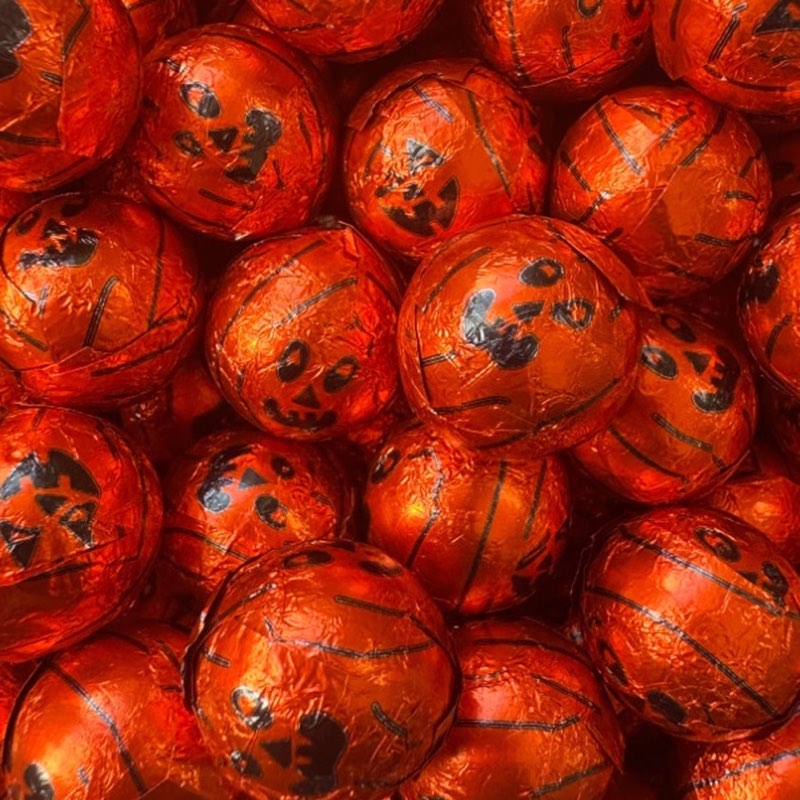
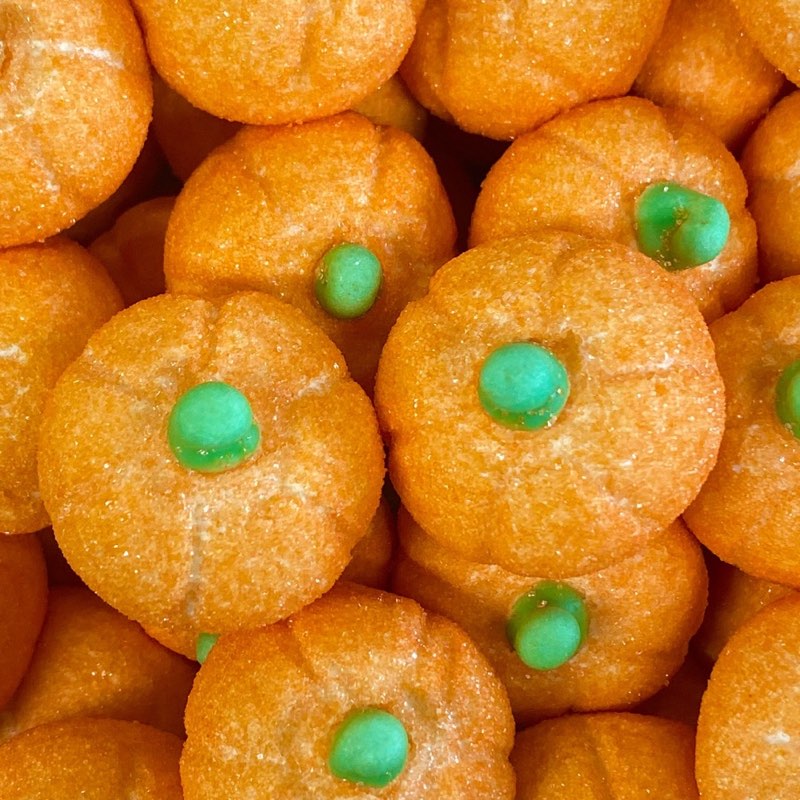
These are solid milk chocolate in a pumpkin shape, listed simply as brown — which is the sort of plain description that turns out to be exactly right. There is no colouring, no shell, no foil-bright spectrum. What you get is a bag of small chocolate objects in a single honest shade, and the interest comes from the moulding rather than from the palette.
The word that does the heavy lifting in the name is solid. There is no hollow middle, no filling, no centre to bite through into. That changes the whole character of the sweet. A hollow chocolate shape is mostly air and shatters; a filled one is a two-stage experience where the shell is a delivery system for whatever is inside. A solid moulded piece is just chocolate, all the way down, and it eats slowly and evenly from the first bite to the last.
The pumpkin moulding gives each piece ridges — that is what a pumpkin shape is — and ridges do something genuinely useful on a solid chocolate. They give your teeth a purchase point, so the first bite goes cleanly through a groove rather than skidding off a smooth dome. They also catch the light, which is why a bowl of these reads as more interesting than a bowl of plain chocolate buttons despite being the same single colour.
The way a solid moulded chocolate eats
Pick one up and the first thing you notice is that it is cool. Solid chocolate holds temperature, and a piece that has been sitting in a cupboard feels properly cold against your fingers for the first few seconds. Then it starts to give. Hold one for half a minute and the surface goes slightly tacky where your fingertips have been; that is the honest reason solid chocolate is a bowl sweet rather than a pocket sweet.
The bite is the good bit. A solid moulded piece snaps rather than crumbles, and because it is a small shape, one bite usually takes you through it entirely rather than leaving a broken half to manage. The snap is short and the melt that follows is long — you are still tasting it for a good while after the chewing has finished, which is the opposite of how a jelly or a crunchy sour behaves and is why chocolate is the slow, closing item on a mixed table rather than the opening one.
Milk chocolate as a flavour family sits in the middle of everything: sweet, round, creamy in impression, and with none of the bitterness or the fruit acidity that makes other things on a sweet table demand attention. That neutrality is not a criticism. It is the reason chocolate works as the resting point in a spread — after something sharp, something sour or something aggressively fruity, a piece of plain milk chocolate resets your mouth and makes the next sour piece taste as sharp as the first one did.
There is also a pacing effect worth knowing. Because the melt is long, most people naturally take a single piece and wait rather than taking three at once. A bowl of solid chocolate shapes empties more slowly than a bowl of anything chewy, which is exactly what you want from something you have bought 750 g of.
Who buys these, and when
The pumpkin shape puts an obvious date in most people's heads, and the autumn and Halloween crowd is certainly the biggest single group buying them. But the more interesting buyers are the ones who have noticed that a seasonal shape in a plain chocolate is useful well beyond its season, because nothing about a small moulded pumpkin tastes seasonal. It is chocolate. The shape is decoration, and decoration can be borrowed.
So alongside the Halloween table buyers, these get bought by people filling hampers, people who run stalls and school events, people assembling gift bags, and — more than you would think — people who want a bowl of chocolate on a desk or a counter that looks a bit more considered than a bag of buttons. Anybody who has ever put out a bowl of generic chocolate and watched it go unnoticed knows the difference a shape makes.
They also suit the mixed-age household better than most chocolate lines, because there is nothing challenging about them. No sourness, no fizz, no heat, no unusual texture. Everyone from a grandparent to a seven-year-old knows what to do with a small chocolate pumpkin. When you are buying one thing that has to please a whole room, that matters more than being interesting.
The one group they suit less well is anybody wanting a chocolate with some complexity to it. If that is what you are after, the filled and premium end of our shelves is a better place to look — Lindt Lindor Strawberries & Cream Truffles 200g at £8.29 and Ferrero Rocher Milk Chocolate Pralines 42 Pieces 525g at £23.99 are both built around a centre and a multi-layer experience, which is a different purchase entirely and priced accordingly.
Sending chocolate to people: hampers, letterboxes, staffrooms and parcels
A great deal of confectionery is bought to be given rather than eaten by the buyer, and solid moulded chocolate is unusually well suited to the job. It is worth setting out why, because once you see the logic you will start using these for occasions that have nothing to do with pumpkins.
Start with the practical case. Solid chocolate travels better than almost anything else in the category. It does not crumble like a wafer, it does not go sticky like a chew, it does not leak like a filled shell if one gets cracked, and it does not shed sugar dust over everything else in the box. If a piece does break, you have two pieces of chocolate rather than a mess. For anything that is going to be posted, handled by three different people, and left on a doormat, that resilience is the whole game.
Then the presentation case. Small moulded shapes look deliberate in a way that a slab or a handful of loose chocolates does not. Tip 200 g of these into a cellophane bag with a ribbon and it reads as a made thing rather than a bought thing, which is a disproportionate amount of goodwill for very little effort. That is why they turn up so often in teacher gifts and thank-you parcels: the effort-to-impression ratio is extremely favourable.
For hampers, use them as the filler that also happens to be the most-eaten item. Every hamper needs something to occupy the gaps between the big-ticket pieces, and most people reach for shredded paper. Chocolate shapes do the same structural job — they settle into the spaces, they keep taller items upright — and unlike paper, they get eaten. A 750 g bag at £12.99 will fill the gaps in two or three decent hampers, which is a far better use of thirteen pounds than more packaging.
For letterbox treats, the constraint is depth rather than weight, and small solid shapes are one of the few chocolate formats that lie flat. A hundred grams or so spread in a single layer in a shallow box goes through most letterboxes without needing anyone to be home. Pair them with something equally flat if you want variety — Glisten Chocolate Mini Eggs at £7.99 are the obvious companion, small and shell-coated where these are plain and moulded, and the two together fill a flat box with no wasted depth.
For staffroom and teacher gifts, the winning move is quantity divided into small identical bags rather than one large present. Nobody wants to be the person who gave a single teacher a two-kilo bag. Forty 50 g bags out of a 2 kg purchase, on the other hand, covers an entire school's worth of thank-yous at about 73p each, and every one of them looks like it was put together on purpose. This is the single best argument for the 2 kg size and it has nothing to do with anyone eating two kilos of chocolate.
For care parcels — students, people in hospital, someone who has had a hard month, family a long way away — the thing that makes chocolate work is that it needs no equipment, no fridge and no explanation. It survives the journey, it can be eaten one piece at a time over weeks, and it does not go stale the day after opening the way a biscuit does. Add one thing with a bit of novelty to it so the parcel has a joke in it as well as a kindness: Miskets Chicken Drumstick Box 50g at £1.99 is a small boxed novelty that costs almost nothing to include, and Meiji Chocorooms Chocolate Biscuits Box 40g at £1.69 adds a second chocolate format in a box that will not get crushed.
One honest warning about posting chocolate: heat. Between roughly May and September, anything chocolate that spends a day in a van or an afternoon on a doorstep can soften and reset with a pale bloom on the surface. It is still perfectly good chocolate and it still tastes the same, but it will not look like the thing you packed. If you are sending in warm weather, post early in the week so it is not sitting in a depot over a weekend, and tell the recipient it is coming so it does not sit outside.
Finally, on budgets: gifting is where the odd price ladder on this listing pays off most. If you are making up bags, the difference between buying at £2.50 per 100 g and £1.45 per 100 g is the difference between fifteen gifts and twenty-six for the same money. Work out the total weight you need first, then buy backwards from the table above, and use the full shop to fill the rest of the parcel once the chocolate is decided.
How a pumpkin behaves inside a pick-and-mix bag
Building a good mix is a craft, and it is mostly about how things behave in company rather than how good they are on their own. Solid chocolate shapes are one of the most useful components you can put in a bag, and also one of the easiest to get wrong. Here is what actually happens when you put these in with everything else.
The first thing they do is stabilise the texture. Most mixes are overwhelmingly soft — jellies, gummies, foams, chews — and a bag of nothing but soft things is oddly boring to eat, because your mouth is doing the same job every time. A hard, snapping component changes that. It does not need to be a large proportion, either; roughly one part in five is enough to make the whole bag feel more varied than it is.
The second thing they do is close the flavour loop. Sour and fruit components in a mix compete with each other and escalate. Chocolate does not compete with anything; it sits underneath. That means it acts as a full stop. People eat two sharp things and then a chocolate, and the chocolate resets them for the next two. Without a reset, most people stop eating a sour-heavy mix sooner than they would have done. Put chocolate in and the same bag lasts longer and gets finished.
The third thing, and the one to watch, is that chocolate is the only component that can damage the others. If a mix gets warm, chocolate is what softens first, and softened chocolate transfers onto everything it is touching. A jelly with a chocolate smear on it is not ruined but it is not what anybody wanted. The fix is mechanical, not complicated: keep chocolate to the top third of a bag or a separate compartment, do not leave a mixed bag in a car or on a sunny shelf, and if you are making bags in advance in warm weather, bag the chocolate separately and combine at the last moment.
On proportions, a reliable starting recipe for a 1 kg mix is roughly 200 g of solid chocolate, 400 g of assorted jellies, 200 g of something chewy, 100 g of something sour and 100 g of a novelty or retro line to give people something to talk about. That ratio gives you a mix where every handful is different and nothing dominates. You can build exactly that from our pick and mix pages, choosing the components by weight rather than buying a full bag of each.
For the jelly portion of that recipe, jellies and gummies is the shelf to browse, and Hannah's Animals at £5.49 is a good default because animal shapes and pumpkin shapes sit well together visually — both are moulded figures, so the bag looks like a coherent collection rather than a jumble. For the chewy portion, Chewing Nuts at £7.99 is a long-standing loose-sweet line that brings a genuinely different mouthfeel to the bag, and for the retro slot, the retro shelf will give you something that at least one person at the table will recognise and make a noise about.
There is one more mixing consideration that only applies to shaped chocolate: shapes fight each other. If you put pumpkins in with another distinctive moulded chocolate, neither reads clearly and the bag looks muddled. Milk Chocolate Sprouts at £6.99 are a good example — a lovely thing in their own right and a direct clash here, because two different moulded chocolate vegetables in one bag is a joke that does not land twice. Pick one shaped chocolate per mix and let the rest of the bag be plainer. If you want a second chocolate component, go for a different format entirely: Chocolate Ice Cups 1kg at £5.49 are a cup rather than a figure, which contrasts instead of competing, and the kilo price makes them cheap to build volume with.
Last practical note on mixing: put the chocolate in last when you are filling a bag, and pour the soft things in first. The soft components cushion, the hard chocolate settles on top, and everything survives the journey home. It sounds trivial. It is the difference between a mix that looks good when it is opened and one that does not.
Chocolate as the quiet flavour on a sweet table
The pack lists a single flavour here — chocolate — and there is more to say about that than a one-word flavour usually deserves, because chocolate plays a structural role that no fruit flavour does.
Every other flavour family on a sweet table is competitive. Put strawberry next to blackcurrant and they argue. Put lemon next to cola and they argue. Put anything sour next to anything at all and the sour wins for the next thirty seconds. Chocolate is the only common sweet flavour that does not enter the argument — it arrives, it fills your mouth completely, and it leaves cleanly. That is why it is always the last thing on the table to be finished at a party and the first thing people reach for when they cannot decide.
Milk chocolate specifically is the most neutral version of that. It is sweeter and rounder than dark, without the bitterness that makes dark chocolate a statement rather than a default. On a table of assorted sweets aimed at a mixed group, milk is nearly always the right call, and the plainness that makes it unremarkable on its own is exactly what makes it indispensable in company.
If you want to give chocolate a second register on the same table without leaving the family, the move is to add a chocolate that is doing something structurally different rather than a different cocoa strength. A shell-coated chocolate, a chocolate in a cup, a chocolate with a biscuit in it — these read as different items to the people eating them even though the flavour note is shared. Browse the chocolate sweets shelf and pick by format, not by flavour, and you will end up with a better table.
Halloween tables, autumn spreads and the rest of the year
The pumpkin shape has one obvious home and several less obvious ones. On a Halloween table, these do the job that a seasonal shape should: they set the theme without anybody having to decorate anything. A bowl of small chocolate pumpkins reads as Halloween from across a room, which means the rest of your table can be ordinary sweets and the spread still looks planned.
They are also a good trick-or-treat item if you are handing things out, though bear in mind chocolate on a doorstep in a bowl on a cold night is fine, and chocolate in a warm hallway is less so. If you are handing out over a couple of hours, keep the reserve stock somewhere cool and refill the bowl rather than putting two kilos out at once.
Beyond October, the pumpkin works through the whole of autumn — harvest events, bonfire night tables, school fairs and the run-up to Christmas, where a pumpkin reads more as "autumn" than as "Halloween" once the date has passed. Anyone running a stall will tell you that seasonal shapes sell right through the season they belong to and then fall off a cliff, so the buying advice is straightforward: buy the quantity you need for the season, not for the year.
Out of season entirely, they are simply small solid chocolates, and nobody eating one from a mixed bowl in March will think twice about it. This is the genuine advantage of a plain-coloured moulded chocolate over a brightly-printed seasonal item: there is no packaging shouting a date at anyone. If you have half a bag left in November, put it in the candy and chocolate department style of mixed bowl with everything else and it will disappear without comment.
For a children's party at any time of year, the shape is a small piece of theatre that costs nothing. Children notice shapes. A bowl of moulded figures gets picked at; a bowl of plain chocolate discs mostly does not. That observation alone is why shaped chocolate exists.
Storing chocolate so it still looks like chocolate
Chocolate has two enemies and they are heat and smell. Get both right and a bag of these will be in the same condition in three months as it was on the day it arrived.
Heat is the obvious one. Somewhere cool, dark and steady is what you want — a cupboard away from the oven, the kettle, the radiator and any window that gets direct sun. Steadiness matters as much as the temperature itself: chocolate that warms and cools repeatedly develops a pale, dusty-looking surface. That bloom is cosmetic rather than a fault and it does not mean anything has gone wrong, but it does mean your gift bags will not look like gift bags, so it is worth avoiding.
Smell is the one people forget. Chocolate picks up odours from whatever is stored near it with remarkable efficiency. Keep it away from onions, garlic, coffee, strong cheese, spices and cleaning products. If you have decanted it into a jar, use one with a proper seal rather than a decorative lid.
Do not put it in the fridge unless you genuinely have nowhere cool, and if you must, seal it properly first and let it come back to room temperature in the sealed container before opening — otherwise condensation forms on the cold surface and you get a sticky, sugary bloom that is much more visible than the heat kind. Freezing is not worth it for a bag of small solid shapes.
For the 2 kg bag specifically, do not keep the whole thing open. Split it into two or three sealed containers on the day it arrives and only have one in circulation. Every time you open a bag you let in a little warm, damp air, and doing that forty times to the same two kilos is how a bulk buy ends up looking tired. And as always, the date on the manufacturer's packaging is the one to go by, so keep the bag itself even if you decant.
Matching the size to the job
The table near the top tells you which sizes are good value. This section tells you which one to actually put in your basket, because those are different questions.
- Buying to try them — 250 g at £6.49. Ten small portions is plenty to find out whether these are a fixture in your house, and it is a size you can give away if they are not.
- A small present on its own — 250 g. This is the right weight to hand over as a standalone gift without either party feeling odd about it.
- A household through a season — 750 g at £12.99, every time. The 500 g is fifty pence cheaper for a third less chocolate, which is not a decision anyone should make on purpose.
- Two or three hampers — 750 g. Roughly 250 g per hamper fills the gaps and leaves a visible layer of chocolate at the top.
- A party for fifteen to twenty — 750 g if chocolate is one of several bowls; 2 kg if it is the main event or you are also doing gift bags.
- Gift bags, favours or a stall — 2 kg at £28.99. At £1.45 per 100 g this is where the arithmetic works, and it is the only size that makes forty 50 g bags affordable.
- Somewhere between 750 g and 2 kg — two 750 g bags at £25.98 for 1.5 kg, rather than the 1 kg at £24.99. Same money, half a kilo more chocolate.
All five sizes are the same sweet, so there is no quality decision hiding inside the size decision — only a quantity one. That is worth saying because on some listings the larger sizes are a different format or a different pack, and here they are not.
Finding this and what sits next to it
These appear on three shelves. The broadest is our loose sweets shelf, which is the largest collection on the site and the right starting point if you are building volume for an event. Then there is the chocolate type shelf, which groups things by what they are, and everything we tag as chocolate-flavoured, which is a slightly different set — it catches items that taste of chocolate without being solid chocolate, which is a useful distinction when you are trying to fill a specific slot in a mix.
Nearby, the shelves worth knowing are the pick and mix pages if you want to buy by weight rather than by bag, and the retro and jelly shelves for the components that go around a chocolate item on a table. If you are in browsing mode rather than shopping mode, building a mix by weight is the most enjoyable way to use the site, because you end up with a bag nobody else has.
If you came here from a search and want to widen out rather than narrow down, Mr Beast Feastables 2 Creamy Chocolate Hazelnut Cups 40g at £1.99 is the kind of thing that turns up next to these — a small branded chocolate format at pocket-money money — and our chocolate selection will show you the rest of that neighbourhood in one screen.
Questions people ask before buying these
Which size should I buy?
For most households, the 750 g at £12.99. It costs fifty pence more than the 500 g and gives you 250 g more chocolate, which makes the 500 g very hard to justify. If you are catering or filling gift bags, go straight to the 2 kg at £28.99, which is the best price per 100 g in the range at £1.45. Avoid the 1 kg unless you specifically need exactly a kilo — two 750 g bags cost a penny more and give you half a kilo extra.
Are they hollow or solid?
Solid — it is in the name, and it is the main thing that distinguishes them from a lot of seasonal moulded chocolate. There is no hollow centre and nothing filled inside. They snap when you bite them and melt slowly rather than shattering, which makes them better for a bowl that has to last an evening.
How big is each pumpkin?
We do not publish an individual piece size or a count per bag, so we will not guess. The useful planning number is the weight, and a 25 g portion of solid chocolate is a generous handful of small shapes. If an exact piece count matters for your event, plan by weight per head instead — 50 g a head is a reliable figure for a party.
Are they only for Halloween?
Not at all. The shape suits Halloween and autumn obviously well, but these are plain brown solid milk chocolate with no seasonal printing on them, so they disappear happily into a mixed bowl at any time of year. Plenty of people buy them simply as small moulded chocolates that look more considered than buttons.
Will they survive being posted?
Solid chocolate travels better than most confectionery — no filling to leak, no wafer to crumble, no stickiness. Heat is the only real risk. Between late spring and early autumn, post early in the week so nothing sits in a depot over the weekend, and warn the recipient so the parcel is not left on a doorstep in the sun. A softened piece is still fine to eat; it just will not look its best.
Can I use them in a pick and mix bag?
Yes, and they are one of the more useful components to include. Chocolate adds a hard, snapping texture to a bag that is otherwise mostly soft, and it resets your palate between sharper items. Keep it to roughly a fifth of the bag, put it in last so it sits on top, and keep the bag out of the heat.
How should I store them?
Cool, dark, dry, sealed, and away from anything strong-smelling — chocolate absorbs odours readily. Avoid repeated warming and cooling, which causes a pale bloom on the surface. The fridge is a last resort and only if the bag is sealed first. For the 2 kg, split it into two or three containers on arrival rather than opening the whole thing.
What has gone wrong if they look pale or dusty?
Almost certainly nothing. A pale, chalky-looking surface on chocolate is usually the result of temperature swings during storage or transit. It affects appearance rather than anything else, and the chocolate still eats exactly as it should. If it matters for a gift, keep the stock somewhere with a steady temperature and split the bag on arrival.
What else should I put with them in a hamper?
Something with a different format so the hamper does not read as one note. A shell-coated chocolate, a boxed novelty and one non-chocolate item is a solid three-part structure. These are the filler that also gets eaten — use them to occupy the gaps and hold taller items upright instead of packing paper.
Is there a bulk or catering option?
The 2 kg at £28.99 is the catering size and it is priced accordingly at £1.45 per 100 g. That is roughly eighty 25 g portions or forty 50 g gift bags. For anything larger than one event, two 2 kg bags will still work out better than any combination of the smaller sizes.
Are they in stock?
Yes, listed as in stock across the range at the time of writing. Seasonal shapes do sell through in the run-up to the end of October, so if you need a specific size for a date, ordering ahead is sensible rather than optimistic.
What is the cheapest way to get chocolate onto a party table?
Buy the biggest size that your event genuinely needs, and pad the table with volume from cheaper shelves rather than buying more chocolate. A 750 g bag of these as the chocolate component, plus a kilo of jellies built by weight, covers a large room for well under thirty pounds and looks far more generous than the same money spent on one category. Those mini eggs are a useful second chocolate if you want two formats, and browsing everything we stock by price is the fastest way to fill the rest of the table.
In short
Plain, solid, brown milk chocolate in a pumpkin mould, sold from £6.49 for 250 g up to £28.99 for 2 kg. The shape is the reason to buy them and the plainness is the reason they keep working after the season has passed — they travel well, they post well, they fill a hamper, and they behave themselves in a mixed bag. Take the 750 g if you are buying for a house, take the 2 kg if you are buying for a room, and do not let the 1 kg tempt you on the way past.
More chocolate sweets
More chocolate sweets
More loose sweets sweets
Where this sits
Solid Milk Chocolate Pumpkins appears on these shelves. Browse them, or jump to something nearby.
You might also like