Home / Loose Sweets / Mr Beast Feastables 2 Creamy Peanut Butter Cups 40g
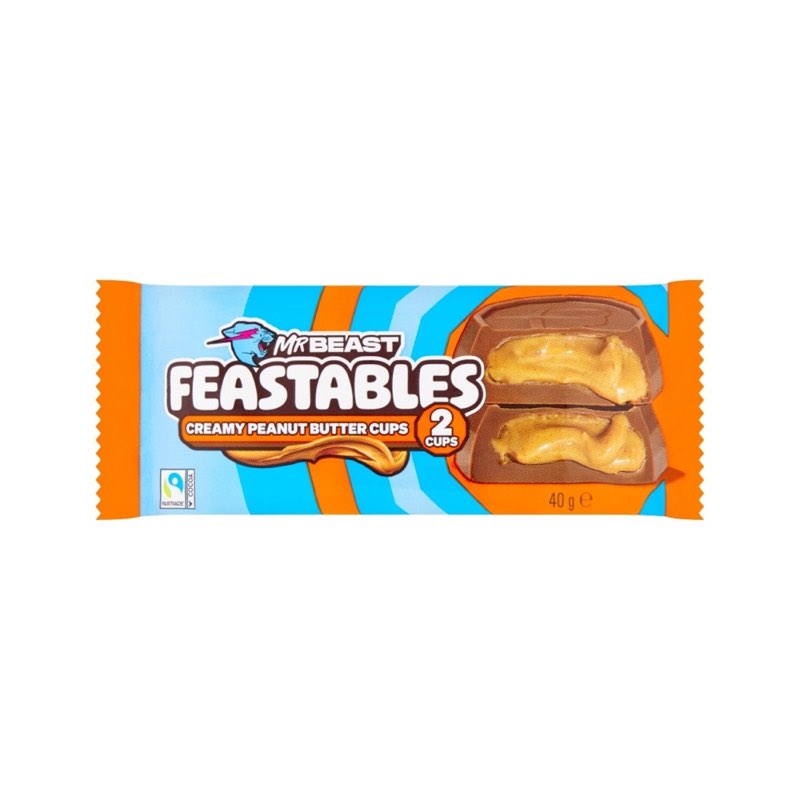
Mr Beast · 40g
Read the full guide
Mr Beast Feastables 2 Creamy Peanut Butter Cups 40g
£1.99
✔ In stock — ready to ship
Fresh stock
Free over £20
Same-day dispatch
Secure checkout
A pack of two cups is a very specific piece of design, and the moments it suits are equally specific. The first and most obvious is the one-each moment. Two people, one small pack, no negotiation, no cutting, no awkward business of working out who gets the bigger half. That sounds trivial until you have tried to split a large bar between a child and a sibling and watched the whole afternoon turn into a border dispute. Two cups, two hands, done. It is the reason this format sells steadily to parents doing the school run, to couples putting one pack in with a coffee order, and to anyone who has learned that fairness is easier to buy than to referee.
The second moment is the small treat with a hard edge on it. Some sweets are open-ended — a bag you dip into, a tub that stays on the table, a pick and mix pot that quietly keeps going. This is not that. A 40g pack with two pieces in it has a defined end, and for a lot of shoppers that is the entire appeal. If you want something sweet after lunch but do not want to have started something, a sealed pack with a fixed number of pieces settles the matter for you. You eat the two, the wrapper is empty, and there is no third piece sitting there making a case for itself.
The full guide to Mr Beast Feastables 2 Creamy Peanut Butter Cups 40g
7,009 words on how it eats, who it suits, how to serve it and what to put beside it.
The moments a two-cup pack is built for
Then there is the lunchbox and the packed bag. Anything that goes into a rucksack has to survive being sat on, forgotten about for four hours, and rediscovered at the bottom under a water bottle. A small, flat, sealed pack does that far better than anything loose, and better than most boxed things, which get crushed at the corners. It is also a portion that a parent can send out of the house without doing arithmetic. You know exactly what is in the bag because it is printed on the front: two cups, forty grams, and that is the whole story.
Travel is the next one. Car journeys, coach trips, train tables, airport gates — the eternal problem with sweets on the move is that most formats are either messy or noisy or both. Chocolate in a cup shape is quiet, it is self-contained, and each piece comes out whole rather than in fragments. For a driver handing something backwards over a shoulder, a two-piece pack is exactly the right amount of thing to hand over: enough to buy twenty minutes of peace, not so much that you are dealing with a sugar-slicked back seat by the time you reach the services.
Office and desk use deserves a mention because it is a quietly large part of what this format does. Anyone who keeps a drawer stocked knows the failure mode of buying a big bag: it becomes a communal resource, it goes stale, and it changes the relationship between you and your afternoon. Individual small packs do not have that problem. One pack is one occasion. A handful of these in a drawer means five afternoons covered rather than one big bag that is mysteriously gone by Wednesday. The same logic applies to staffroom tins, glove boxes, and the tray of odds and ends by the front door.
The gift-adjacent moments matter too. These are too small to be a present on their own, but they are an excellent component. They go into party bags, advent-style drawers, stocking toes, hamper gaps, Easter baskets and the little tins people assemble for teachers and neighbours. In all those contexts the job is to be recognisable, individually sealed and inexpensive — three things a two-cup pack at £1.99 does without effort. If you are filling a larger gift and need a bulk item alongside it, our loose sweets shelf runs to 356 lines and is where the volume usually comes from.
Finally, the impulse moment, which is honest enough to admit. Sometimes there is no occasion. Someone is at the counter, has spent eleven pounds on other things, and adds a small chocolate pack because it is small and because it is there. That is a legitimate use of a two-cup pack and it is roughly what the format was invented for. The price point sits in the range where the decision does not require thought, and the size sits in the range where the decision does not require guilt.
What is actually in your hand
Open the outer pack and you have two moulded cups, brown, sitting flat. The pack is 40g in total, so each cup is a solid 20g object — noticeably more substantial than the small foil-wrapped individual chocolates people are used to from tins and boxes, and about the size that fills a cupped palm when you hold one on its own. That weight is the first thing regular chocolate eaters comment on. It has heft. It does not feel like a token.
The shape is the classic cup: a broad flat top, sloped sides that taper down slightly, and a flat base. Held up to the light you can see the ridging on the flank that the mould leaves — vertical fluting, evenly spaced, which is a functional feature as much as a decorative one because it stiffens a wide, shallow piece of chocolate against snapping in transit. The top face is smooth and takes a dull shine. The colour throughout is a plain brown with no decoration, no printing and no contrast layer visible from the outside.
Pick one up and it is cool to the touch for the first second, which is a property of chocolate rather than of storage temperature — it draws heat out of your fingers as it begins to soften. Hold it for more than about thirty seconds and you will start to leave fingerprints on the flat face. That is worth knowing before you hand one to a small child in a clean jumper, and it is the reason these are better eaten within a minute of opening rather than carried around in a warm hand.
The two cups sit side by side rather than stacked, which keeps them flat and makes the pack easy to slide into a pocket, a card, a lunch bag or the side compartment of a rucksack. There is no tray, no inner foil to wrestle with, no plastic clamshell. It is a small, thin, flat thing, and that is exactly what makes it travel well. Unopened, it takes up no meaningful space on a shelf; opened, there is a single wrapper to bin and nothing else.
The listing carries one product image and the stock position is straightforward: this is in stock and there is a single size, at £1.99. Nothing about the format asks you to make a decision beyond whether you want one pack or several, which is refreshing in a category where a lot of lines come in three weights and two flavours and leave you standing in front of a shelf doing sums.
How it eats, from first bite to last trace
The eating experience of a filled cup is genuinely different from that of a solid chocolate, and it is worth walking through because it is the whole reason this shape exists rather than a flat square.
The first bite meets the shell. A cup's outer wall is firm and it gives with a short, quiet break rather than a snap — there is not enough thickness for a dramatic crack, and the curve of the wall means the piece fails cleanly at the point of pressure instead of shattering across the whole face. You register it as a resistance that yields, and then, immediately afterwards, as a change in texture as your teeth pass from the firm outer into the soft interior. That transition, from firm to yielding within a single bite, is the signature of the format. It is the reason people who find plain chocolate a bit monotonous tend to like cups.
Then the flavours arrive, and they arrive in order rather than all at once. Chocolate is the first thing you taste because it is what your teeth meet first and because it starts melting on contact. It sits in the sweet, mellow part of the range rather than the dark and bitter part — this is a soft-edged chocolate note, not a challenging one. It reads as comfortable. It does not demand anything of you.
The peanut butter flavour comes in about a beat later and from a different direction. Where the chocolate note is round and sweet, the peanut butter note is savoury-leaning, warm and slightly toasted, and it has a salt-adjacent quality that pushes back against all that sweetness. This is the pairing doing its job. Sweet on its own flattens out after a few seconds; sweet with something savoury underneath it keeps having somewhere to go. It is the same principle as salted caramel, and it is why chocolate-and-peanut-butter is one of the few flavour combinations that works at any age, at any time of day, in any country you take it to.
Texture in the middle stretch is the other half of the appeal. The word on the pack is creamy, and that describes the interior's behaviour accurately: it does not crumble, it does not set into a paste that sticks to the roof of your mouth, and it does not run. It yields and then smooths out. Because the interior softens faster than the shell, you get a brief moment where you are chewing two different consistencies at once, and then they merge into one. That merge is the most satisfying second of eating a cup.
The finish is long, and it is coating rather than clean. Chocolate leaves a film on the tongue and palate that carries on releasing flavour for half a minute or more after you have swallowed, and the peanut butter note rides on top of that film and stays even longer, because a savoury-leaning flavour of that kind is unusually persistent. Practically, that means two things. First, one cup goes a long way; you are still tasting it well after it is gone. Second, do not eat these immediately before something you want to taste properly. They are a full stop, not a comma.
Temperature changes the whole reading, and you have more control over it than you might think. Cold from a fridge or a winter car, the shell is harder, the break is sharper, and the interior firms up so the contrast between the two textures is at its most pronounced — but the flavours take longer to arrive and come through slightly muted. Warm from a pocket or a sunny windowsill, the shell softens towards a squash rather than a break, the interior goes properly molten, and both flavours arrive instantly and read sweeter and blurrier. Room temperature is the middle setting and is what the format is designed around. If you have a preference, it is worth knowing that you can arrange it with twenty minutes in or out of the fridge.
Catering with cups: the party planner's arithmetic
If you have ever laid out a table for thirty people, you will know that party catering is not really about taste. It is about quantities, timings and the running order in which things disappear. Individually packed chocolate occupies a very particular position in that system, and it is worth spelling out how to use it properly rather than just putting a bowl of it out and hoping.
Start with what runs out first. There is a reliable order to how a sweet table empties, and it holds across birthdays, christenings, office leaving dos and village hall events. Chocolate goes first, almost always. After that, sour and fizzy things go second, because they are the ones people try out of curiosity and then keep coming back to. Fruit chews and jellies hold the middle. Anything minty, anything liquorice and anything aniseed sits there until the end and then gets taken home in a napkin by one delighted person. Plan accordingly: the chocolate element of your table needs to be roughly twice the quantity your instinct tells you, and everything else needs to be less.
Individual packs solve the pacing problem. A bowl of loose chocolate disappears in one raid, usually within ten minutes of the table opening, because the first five people through take a handful each. Sealed individual packs cannot be handled that way. People take one pack, not a fistful, because a pack reads as a unit and taking three of them in front of other people feels like taking three. That single social fact is the reason caterers use individually wrapped items at the front of a table and loose items further along. If you want your chocolate to still be there at the ninety-minute mark, buy it in packs.
Quantities. For a children's party with a tea, one two-cup pack per child is generous as the chocolate component, because there will be cake as well and most of them will not finish what is in front of them. For a teenagers' gathering, assume every pack put out will be eaten and buy on that basis. For an adult event where the sweets are a side attraction to a buffet, count on roughly one pack for every two people attending — adults take less than you expect from a sweet table and take it later in the evening rather than at the start.
Timing is the part most people get wrong. Do not put chocolate out at the beginning. Chocolate is the item most affected by a warm room, and a table that has been standing under lights for two hours will have soft, fingerprinted, sad-looking chocolate on it. Hold it back, keep it somewhere cool, and bring it out in the second half when the savoury food has gone and people have started circling back to the table. The other advantage of a late release is that it re-energises a room; a new item appearing is a small event in itself.
Table architecture. A good sweet table has three tiers of item: a bulk base, a mid-level variety, and one or two things that look expensive. Your bulk base is the cheap-per-kilo loose item that fills bowls and makes the table look generous — something like a 1kg bag of Chocolate Ice Cups at £5.49 does that job at a sensible cost and stays in theme. Your variety layer is where individually packed items like these cups live, sitting in a shallow tray or a basket where people can take one. Your centrepiece is the thing that signals effort: a 42-piece box of Ferrero Rocher pralines at £23.99 photographs well and reads as the expensive item even though, per head, it is not the biggest line on your bill.
Buy in pairs of flavours. Caterers learn early that two versions of the same thing outperform one version by more than double. People who would take one pack will take one of each if there are two. It costs you nothing in complexity because the format, price and shelf life are identical. On this listing that means pairing these with the chocolate hazelnut cups at the same £1.99 — same brand, same 40g two-cup format, different flavour in the middle. Put both out in the same basket and watch people take one of each.
Allow for the take-home. At any party with children, a proportion of what is on the table leaves in pockets and party bags rather than being eaten on site. Sealed packs are the only items that survive this journey intact, which means they are the ones parents encourage. Budget an extra fifteen or twenty per cent on your individually packed lines for this reason alone, and consider whether you want to formalise it by simply putting one in each bag at the start.
Seasonal tables need a shape theme. If you are catering around a date rather than a person, the moulded shapes do the work that decoration would otherwise have to. A table at Easter with Glisten Chocolate Mini Eggs on it, or an autumn one with solid milk chocolate pumpkins at £6.49, or a Christmas spread anchored by milk chocolate sprouts, will look planned rather than assembled. Unseasonal items like a plain cup pack then sit happily alongside as the everyday option for anyone who does not want a novelty shape.
Labelling and the packaging question. One practical advantage of sealed packs at a catered event is that the manufacturer's own packaging comes with the product, so any guest who wants to read it can. Keep a couple of unopened packs aside rather than decanting everything into bowls, and anyone who asks about a product has the actual pack in their hand. This is the sensible habit to build regardless of what you are serving, and it costs nothing.
Screen snacks: pacing, mess and the business of sharing
The second life of a small chocolate pack is in front of a screen, and it is a different set of requirements from a party. Here nobody is being catered for, the lights are down, and the main question is whether the snack fits around what is happening on the screen rather than competing with it.
Start with noise, because it is the one most people never think about until it ruins something. A quiet snack is one that does not have a crinkly wrapper, does not crunch loudly, and does not need to be excavated from a bag. A two-cup pack fails only the first of those and only once — there is a single opening event at the start and then silence. Compare that with a big bag that gets rustled every ninety seconds for two hours and you can see why film-night regulars gravitate to individually packed items. If you are watching something with dialogue that matters, open everything during the trailers.
Then pacing. The fundamental problem with screen snacking is that you eat without noticing, and a big open bag will be gone before the first act is over, leaving you with ninety minutes and nothing. Two cups cannot be eaten absent-mindedly. They are two discrete events, and you will notice both. That makes this format a rationing device as much as a snack: a lot of people buy two packs deliberately, eat one at the start and hold the second for the point in the film where they need something to do with their hands.
Mess is the next criterion, and chocolate has a mixed record. On the good side, a cup is dry, it comes out of the wrapper whole, and there is nothing to spill. On the bad side, chocolate transfers to fingers and fingers transfer to controllers, remotes, upholstery and light-coloured throws. The manageable version of this is to eat the pack in one go and then wipe your hands, rather than holding half a cup while you play. For gaming specifically, where your hands are on a controller continuously and you cannot pause a multiplayer match to wash them, the rule that works is between rounds, not during them.
Shareability is where a two-piece pack shows its hand. Two is the sharing number. One pack covers a pair on a sofa, and when there are more of you it scales cleanly — four people, two packs, one each, no bowl needed, no double-dipping, no one taking the last piece. Compare that with a pick and mix pot, which is a genuinely communal format and a better one when you all want variety, or with a large bar, which requires an act of division. If your regular film night is two people, this pack is exactly sized. If it is six, you are better off with a shared bowl of something loose, and you will find the range for that on our pick and mix shelves.
There is a whole sub-category of screen snacking that is about contrast rather than quantity, and it is worth exploiting. One strong, sweet, rich item alongside one plain, dry, salty one will keep you interested far longer than twice as much of either. Chocolate cups next to a savoury snack is the classic pairing, but there is a sweet-side version too: something crisp and biscuity to break up the softness. A £1.69 box of Meiji Chocorooms is exactly that — the same 40g scale, but a biscuit component under the chocolate, so the texture changes every time you swap between the two.
Long sessions need a different plan from short ones. A two-hour film is one pack of something rich. A six-hour gaming session or a box-set marathon is a different animal, and rich chocolate eaten continuously stops being enjoyable somewhere around hour two. The way through is to move down the intensity scale as the night goes on: start with chocolate, move to fruit chews and jellies, finish on something sour that wakes your palate back up. That is genuinely how people who do this regularly organise it, and it is why our jelly and gummy range sells alongside chocolate rather than instead of it.
One more practical note for gamers: keep the pack sealed until you want it. Chocolate left open next to a warm machine for three hours is not the same product it was when you opened it, and a soft, slumped cup in an opened wrapper is a poor reward at the end of a long run. The sealed pack is a timer as much as a container. Open it when you have earned it.
For anyone assembling a proper screen-night box for a group, the trick is one item per texture rather than one item per person. Something soft, something chewy, something crisp, something sour. Chocolate is the soft, and these cups are a tidy way to include it without committing to a bowl. Chewy is covered by something like Chewing Nuts at £7.99, which has a chew under its chocolate and lasts considerably longer per piece. Once you have your four textures, quantity is a detail.
Chocolate and peanut butter: the two flavours on this pack
The pack lists two flavours, chocolate and peanut butter, and they do quite different jobs. Understanding how each behaves helps you decide what to put it next to.
Chocolate is the base note and the social one. It is the flavour that needs no introduction anywhere in the world, that nobody has to be persuaded to try, and that acts as a common denominator on any mixed table. In confectionery terms it is a broad, low, sweet flavour with a long finish, and it fills the bottom of a flavour arrangement the way a bass line fills the bottom of a piece of music. That is why almost every mixed spread has a chocolate element in it, and why a table without one feels thin no matter how much is on it. If you want to see the breadth of what sits in this family, everything filed under chocolate as a flavour runs to 32 lines, from moulded novelties through to boxed pralines.
Peanut butter is the counterweight, and it is a much less common note on a sweet shelf than chocolate is. Its character is warm, toasted and savoury-leaning, and the key thing about it is that it is not sweet on its own terms. That is precisely why it pairs so well: it gives a sweet chocolate somewhere to push against, and it stops a rich mouthful from becoming one-dimensional halfway through. It is also a persistent flavour — it stays on the palate noticeably longer than fruit notes do — which makes it a strong finisher and a poor opener on a mixed plate.
The two together produce the effect people actually buy this combination for, which is length. A plain sweet chocolate peaks quickly and fades; a chocolate with a savoury partner arrives, peaks, and then carries on developing as the savoury note comes up underneath. That is a lot of value from one 20g piece, and it is why the combination has stayed popular across generations rather than coming and going like flavour fashions do.
On a mixed table, a savoury-leaning chocolate sits best at the end of a run rather than the start. Put sharp and fruity things first, chewy things in the middle, and this sort of thing last. If you are the sort of person who plans a sweet plate the way you would plan a cheese board, the direction of travel is from bright to deep, and these belong at the deep end alongside boxed chocolate like Lindt Lindor Strawberries & Cream truffles, 200g at £8.29, which brings a fruit note into the same rich register.
Building a mix around a small chocolate pack
A two-cup pack is a component rather than a meal, and it improves considerably when you put it with the right things. Here is how we would build outwards from it.
The first companion should be a contrast in texture, not in flavour. Rich and soft wants something with resistance next to it. A chocolate-covered chew gives you that without leaving the chocolate family, and Hannah's Animals at £5.49 brings a soft, mallow-and-chocolate character in a small-piece format that mixes into a bowl well. The pieces are individual enough to be picked up one at a time, which is what you want in anything sitting alongside a packed item.
The second companion should be a bulk line, because mixes look mean without one. This is where per-kilo pricing matters more than novelty. A large bag of one plain thing costs less per piece than anything boxed and does the honest work of filling a bowl, and the loose chocolate lines are where most people go for it. Browse the chocolate shelf and its 38 lines if you want to compare the bulk options side by side before committing.
The third component is a shape or a novelty, and its job is purely visual. A bowl of brown chocolate is not a photograph. Put something with a recognisable silhouette in it and the whole arrangement reads as deliberate. The seasonal moulded lines do this cheaply, and even out of season they are useful — a Miskets Chicken Drumstick Box, also £1.99, sits at the same price point as these cups and brings a completely different shape and colour into the same small-pack tier.
The fourth is a palate-changer, and it should not be chocolate at all. Anything sharp, fizzy or fruit-led will reset your mouth between rich pieces and roughly double how much of the rich stuff people will eat before stopping. This is the one people leave out most often and the one that changes a mix the most. The sour and fizzy end of the range and the older-fashioned lines both work here; if you like the nostalgia angle, the retro shelf is the place to dig.
If you are building a mix as a gift rather than for a table, the ratio changes. Gifts want more variety and less volume: six or eight distinct items in small quantities beats two items in large quantities every time, because the pleasure of a gift mix is in the discovery rather than the weight. Individually packed items are disproportionately useful here because each one reads as a separate thing to find. Two or three different 40g packs, a couple of boxed items and a handful of loose lines makes a jar that looks considered.
And if you want the whole picture before you commit, the full range of everything we stock is the place to browse, or the Candy & Chocolate hub if you want to stay inside this general family and not get distracted by the rest of it.
Who this suits
The clearest fit is the person who wants a defined portion. That covers a lot of people for a lot of different reasons — someone who prefers a sealed pack to an open bag, someone buying for a child and wanting to know exactly what has gone in the lunch box, someone who simply finds that a small fixed amount is more satisfying than an open-ended one. This format answers all of those without the shopper having to explain themselves.
It also suits the two-person household, which is an under-served group in a shop full of kilo bags and 500g boxes. Lines sized for a party are wasted on two people, and the leftovers go soft in a cupboard. A pack with two pieces in it is sized for exactly the household it is bought by.
People buying for a mixed-age group will find it useful because chocolate is the least controversial thing on any sweet table. It needs no explaining to a child, it does not alarm a grandparent, and it does not require anyone to like sour or liquorice or anything else divisive. When you do not know who is coming, chocolate is what you buy.
It suits anyone shopping to a strict small budget, too. £1.99 is the range where a treat does not require a decision, and where adding two or three packs to a larger order does not meaningfully change the total. For people buying for a class, a club or a team, that predictability is the whole point — multiply by the number of children and you have your figure, with no weighing and no awkward last portion.
Who it suits less: anyone catering for a crowd from scratch. At this size, feeding twenty people means twenty packs, and you would spend less and present better with a bulk bag decanted into bowls. Use the small packs as the top tier of a table, not the base of one.
Price, portions and what you are getting for £1.99
The pack is £1.99 for 40g, and the useful way to read that is per piece rather than per gram: roughly a pound a cup. That is the price band that individually packed chocolate sits in generally, and what you are paying for over and above the chocolate itself is the packaging, the portioning and the convenience of something that arrives sealed and stays sealed until you want it.
Set against loose lines, the per-gram figure is plainly higher, and it should be. A kilo bag of loose chocolate will always beat a 40g pack on cost per gram because it has no individual packaging to pay for and no portioning done on your behalf. That comparison is worth doing consciously rather than by instinct, because the answer depends entirely on what you need. If you are filling bowls for thirty people, buy loose and save considerably. If you are putting one thing in a lunch bag every day for a fortnight, the packs are the sensible buy and the loose bag would be a slow disaster of staleness and over-serving.
For planning purposes: ten packs is twenty pieces and £19.90, which covers a small children's party comfortably as the chocolate element. Twenty packs is £39.80 and covers a class. Two packs a week is a fortnightly habit that costs under four pounds. These are not sums that need a spreadsheet, which is part of why the format persists.
On value in the softer sense — how satisfying £1.99 feels — the filled format does well because the interior extends the experience. A 20g solid piece of chocolate is one flavour for a short time. A 20g filled piece is two textures and two flavours arriving in sequence, and it occupies the mouth for noticeably longer. You are not buying more grams; you are buying more events per gram.
Compare it fairly, too, with what else £1.99 buys on this site. It buys one small sealed chocolate pack, or a fraction of a bulk bag, or about a twelfth of a large boxed praline assortment. All three are reasonable purchases for different jobs. The small pack's advantage is that nothing is wasted and nothing has to be stored.
Keeping it in good condition
Chocolate wants three things: cool, dark and dry, in that order of importance. Keep unopened packs somewhere that does not swing in temperature — a cupboard away from the oven, a drawer that is not above a radiator, a box in a hallway rather than a conservatory. Steady is more important than cold.
The fridge is a tempting solution in a hot week and it is a compromise rather than a fix. Cold chocolate that comes back out into a warm room draws moisture onto its surface, and once that happens the finish dulls. If you are going to refrigerate, keep the packs sealed and inside a closed container, and let them come back to room temperature before opening. The flavour will also be muted straight from cold, so give them twenty minutes on the counter before you eat them.
Heat is the real enemy for a filled cup specifically, because the interior softens at a lower temperature than the shell. A pack that has spent an afternoon in a car will often look intact from the outside and be structurally unsound when you bite into it. If a pack has gone soft, put it flat in a cool place and leave it alone — it will firm back up, though the surface may not be as glossy as it was.
Smell is the third consideration and the most overlooked. Chocolate picks up whatever is around it, which is why a pack stored next to coffee, spices or anything strongly scented will taste faintly of its neighbours. Keep it away from the strong-smelling end of a cupboard, or keep it in a tin of its own.
Once a pack is open there is no resealing it meaningfully, which is another argument for the format: the portion is the storage plan. Eat both cups or put the second in a small container and eat it the same day. Do not fold the wrapper over and leave it in a bag for a week.
One size, one decision
This line comes in a single size — the 40g two-cup pack at £1.99 — so the only real choice in front of you is how many to buy and whether to bring a second flavour in alongside. That is a mercy in a category where a lot of listings offer three weights and leave you comparing per-gram costs in the aisle.
The flavour decision is the more interesting one. Feastables' hazelnut pair is the same brand, the same two-cup 40g pack and the same £1.99, with a different filling flavour. If you are buying for one person who knows what they like, pick the one they like. If you are buying for a group, buy both — the cost is identical and the perceived variety is disproportionate.
If you are buying several packs for a single household, a reasonable split is two-thirds of whichever flavour is the known favourite and one-third of the other. That way the pile keeps its interest without anyone having to eat a flavour they did not want. For a party basket, an even split and let people choose.
Where this sits on the site, and what is next to it
This product lives with the chocolate lines, and there are two distinct routes into that part of the shop depending on how you think about sweets. If you sort by what a thing is, the 38-line chocolate type shelf is your route. If you sort by what a thing tastes of, the flavour listing is the better door, and it will pull in items that are not chocolates in the strict sense but carry the flavour.
Next door in both directions are the loose lines, which is where volume buying happens. The 356 loose lines cover everything sold by weight rather than by pack, and that is where a party table gets its base layer. If you are building rather than just buying one thing, start there and add small packs at the end.
Across the aisle, the jelly and gummy side is the natural contrast to chocolate and the thing people buy alongside it most often. Sour and fizzy sits beyond that. The older-fashioned lines sit in their own corner and pull a different crowd — people shopping for a memory as much as a flavour.
If you are new to the site and do not know where to start, the two useful entry points are the hub pages rather than the individual shelves, because they show you the shape of the range rather than dropping you into a list of 356 things. From there, narrow by type, then by flavour, then by price, which is roughly the order most people's decisions actually happen in.
Questions shoppers ask about this pack
How many cups are in a pack?
Two. The pack is 40g in total, so each cup is a 20g piece — a good deal more substantial than the small individually foiled chocolates you get in tins and boxes. That two-piece structure is the whole design of the product: it is a portion for one generous sitting or a clean split between two people, with no cutting and no argument about who got more.
What does it cost, and is there a bigger size?
£1.99 for the 40g pack, and this is the only size listed. There is no larger format on this line, so if you want more you buy more packs. That has the advantage of keeping the per-pack maths simple when you are catering: multiply the number of people by the number of packs each and you have your figure, with no weighing and no leftovers to store.
Is it in stock now?
Yes, this line is showing as in stock. Availability on small packed chocolate lines moves faster than on bulk loose lines because they get bought in multiples for parties and gift fills rather than one at a time, so if you have a date in mind it is worth ordering a little ahead rather than the week of the event.
What is the difference between this and the hazelnut version?
The flavour in the middle, and nothing else that matters to your decision. The hazelnut cups are the same brand, the same 40g two-cup format and the same £1.99, so the choice is purely about which flavour you or the person you are buying for prefers. For groups, most people buy both and let the basket sort itself out.
Will it survive a warm day in a bag?
Reasonably well, with limits. The sealed pack protects it from crushing and from picking up smells, and the cup shape is sturdier than a thin bar. What it cannot do is survive several hours in direct sun or a hot car, because the filling softens before the shell does and the piece loses its structure. Keep it in the shaded part of a bag and it will be fine for a normal day out.
Can I put these in party bags?
They are close to ideal for it. Each pack is sealed, flat, small enough not to dominate a bag, and priced so that multiplying by twenty does not cause a problem. Because the packaging stays intact, any parent who wants to read the manufacturer's own pack can do so, which is a sensible thing to preserve when you are handing food to other people's children.
How should I store a few packs at home?
Cool, dark, dry and steady. A cupboard away from the oven and off any sunny wall is fine; a drawer is better than a shelf if your kitchen gets warm. Avoid storing them next to strongly scented things, because chocolate takes on smells from around it. The fridge works in a heatwave but keep the packs sealed in a closed container and let them warm up before eating, or the flavour will read flat.
Is this suitable for young children?
Sweets of every kind are a treat rather than everyday food, and that applies here as much as anywhere. Small hard sweets and whole gummies are a choking risk for young children and should always be eaten under supervision. If anyone in your household has an allergy, check the manufacturer's own packaging when the order arrives and before anyone eats, as that packaging is the authoritative source for what is in the product.
What goes well with these on a sweet table?
Something with a different texture and something with a sharper flavour. A chocolate-covered chew gives you the texture contrast while staying in the same family, and anything sour or fruity resets the palate between rich pieces so people keep eating rather than stopping after two. A bulk loose line underneath the packed items gives the table volume without pushing the cost up.
Are they better warm or cold?
It depends what you want from them. Cold, the shell is firmer and the contrast between shell and filling is at its sharpest, but both flavours come through quieter. At room temperature the flavours arrive fully and the textures merge sooner. Warm, everything goes soft and sweet and the structure largely disappears. Room temperature is the setting the format is designed around, so that is the default we would suggest.
Can I use these in a hamper or a gift jar?
Yes, and they are especially useful as gap-fillers. A gift jar or hamper almost always ends up slightly under-packed, and flat sealed packs slide into the spaces around bigger items without disturbing the arrangement. Because each pack reads as a separate thing to discover, two or three different small packs do more for a gift than one larger item of the same total cost.
Do I need to buy the whole order in one go for a party?
No, but there is a practical argument for it. Buying your chocolate element and your bulk element together means everything arrives at once and you can lay the table out in one session rather than discovering a gap the night before. If you are ordering bulk lines anyway, adding the small packs to the same order is the simplest way to make sure your table has a top tier as well as a base.
In short
This is a small, sensible, two-piece chocolate pack that does a handful of jobs unusually well: it splits cleanly between two people, it survives a bag, it ends when it ends, and it sits at a price where nobody has to think twice. The filled-cup format gives you two textures and two flavours from a 20g piece, which is more happening per mouthful than a plain chocolate of the same weight, and the chocolate-and-peanut-butter pairing is one of the few that works for every age at the table.
Buy one if you want a treat with a defined end. Buy several if you are filling party bags, a lunch-box fortnight or a desk drawer. Buy both flavours if more than two people are involved, because variety at no extra cost is the easiest win in catering. And if you are building something larger around it, start with a bulk line, add a texture, add something sharp, and let this be the rich item at the top of the pile.
More chocolate sweets
More chocolate sweets
More loose sweets sweets

Where this sits
Mr Beast Feastables 2 Creamy Peanut Butter Cups 40g appears on these shelves. Browse them, or jump to something nearby.
You might also like