Home / Loose Sweets / Mr Beast Feastables 2 Creamy Chocolate Hazelnut Cups 40g
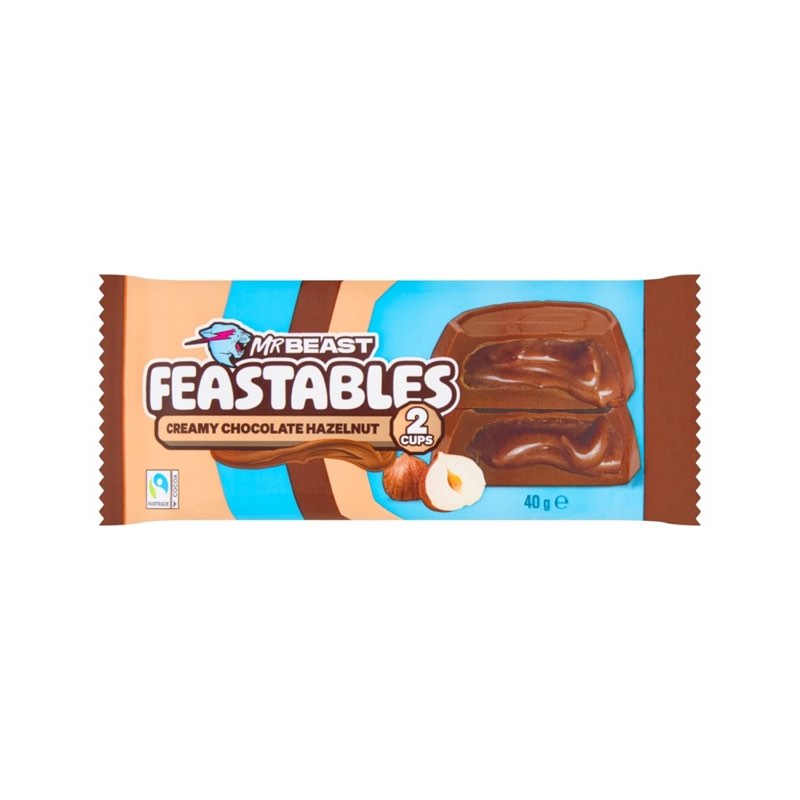
Mr Beast · 40g
Read the full guide
Mr Beast Feastables 2 Creamy Chocolate Hazelnut Cups 40g
£1.99
✔ In stock — ready to ship
Fresh stock
Free over £20
Same-day dispatch
Secure checkout
Some sweets are bought for a table. This one is bought for a pocket. A 40 g pack holding two chocolate cups at £1.99 is not a centrepiece and was never meant to be, and understanding that is the difference between being pleased with it and being puzzled by it. It belongs to a specific and rather under-appreciated category: the single-sitting treat that is finished in one go, shared between two people, or slipped into something bigger as the small surprise. So rather than starting with the chocolate, it makes more sense to start with the occasions, because that is where the format earns its place.
The first and most obvious is the lunchbox or the bag. Two cups is a portion with a natural end to it, which is exactly what you want in a packed lunch or a work bag. There is no half-eaten bar to wrap back up, no open bag to spill, and no decision to make about when to stop — the pack decides for you. A larger format in the same bag turns into an all-day nibble; this turns into a moment at one o'clock and then it is done.
The full guide to Mr Beast Feastables 2 Creamy Chocolate Hazelnut Cups 40g
6,805 words on how it eats, who it suits, how to serve it and what to put beside it.
The moments a two-cup pack is actually built for
The second is the two-person share, and it is the one the format is most literally designed for. Two cups split cleanly between two people with no negotiation and no knife. That sounds trivial until you have tried to divide a bar fairly between children, or split a box of chocolates without somebody ending up with the one nobody wanted. A pack of two is the most conflict-free confectionery unit there is. It works for a parent and a child in the car, for two colleagues at a desk, for a couple at the cinema, and for the last ten minutes of a train journey.
The third is the stocking, the advent pocket and the party bag — anywhere you need a small, self-contained, recognisably branded item that does not look like filler. At £1.99 it sits in the slot where you want something that reads as a proper item rather than as a handful of loose sweets. Party bags in particular benefit from one wrapped, sealed thing among the loose bits, because it gives the bag a focal point and it survives being carried home by a six-year-old. For the same reason it is a good advent-calendar filler if you are building your own — small enough to fit a numbered pouch, substantial enough to be worth opening.
The fourth is the trial purchase. When somebody wants to find out whether they like a line before they commit to a larger format, a sub-two-pound pack is the cheapest possible way to answer the question. That applies here in both directions: if you have never had these cups, this is how you discover whether the chocolate-and-hazelnut direction suits you, and if you have had them, this is the size you buy when you want them but do not want a lot of them. The nearest thing to a direct comparison in the shop is the peanut butter version at the same £1.99, which makes trying both in a single order a decision that costs less than four pounds.
The fifth is the add-on. Most sweet orders have a shape: a couple of big bags for the cupboard and then a gap where something small and interesting should go. This fills that gap without disturbing the total. Basket-builders are an unglamorous category but a genuinely useful one, and the products that do the job well are the ones that are cheap, small, and different in kind from whatever else is in the order. A pack of two chocolate cups alongside a kilo of loose sweets is a different experience, not more of the same.
The sixth is the desk drawer and the glovebox — the standby treat. A small sealed pack keeps its dignity in a drawer for weeks in a way that an opened bag never does. It is the thing you reach for on a bad afternoon, and because it is two cups rather than a bar, the reach does not turn into an afternoon-long grazing session.
The seventh, and the one people underrate, is the cinema and the film night. The theatre-box format exists for a reason: sweets at the cinema need to be quiet, unmessy and easy to eat in the dark. Cups qualify on all three counts. They are soft enough not to crunch, contained enough not to shed crumbs, and one-bite or two-bite items that require no attention. If you are stocking a film night properly, this is the chocolate element, and you would put something fruity or chewy alongside it rather than more chocolate.
What this format is not built for is catering. Two cups per pack means a party of twenty needs twenty packs, and at that point you are paying a small-pack price twenty times over. For volume, the maths points elsewhere entirely — a full kilo of chocolate ice cups at £5.49 is the obvious comparison, and the per-gram gap between the two is enormous. There is a section below that sets the numbers out plainly, because knowing when to buy small and when to buy big is most of what makes a sweet order a good one.
What is in your hand when it arrives
The pack is 40 g and holds two cups. That is the whole specification, and it tells you more than it appears to. Twenty grams a cup puts each one firmly in the two-bite category — bigger than a chocolate you would eat without noticing, smaller than something you would call a bar. It is the size that makes you stop and pay attention for about thirty seconds, which is the right amount of attention for a sweet that costs under two pounds.
Cups are one of the best formats in chocolate and one of the least discussed. The shape does something structural: a fluted wall, a flat base, and a filled middle. That geometry means the chocolate and the filling are always in the same proportion in every bite, unlike a bar with a layer in it, where the first bite is mostly chocolate and the middle is mostly filling. A cup is self-portioning. Every mouthful is the recipe as intended.
The fluting on the side is not only decoration either. Ridges give the chocolate more edges, and edges are where chocolate snaps and where it melts first against the tongue. A ridged wall breaks down faster and more evenly than a smooth slab of the same thickness, which is part of why cups feel softer and more immediate than their weight suggests.
The colour is brown, top to bottom, and there is no attempt at novelty in the look. That is a deliberate position rather than an oversight. A lot of what sits around this on the shelf is competing visually — shapes, colours, printed wrappers, seasonal moulds. A plain brown cup in a pack of two is making a different offer: it is asking to be judged on how it eats rather than on how it looks, and it is a useful counterweight on a table full of things that are shouting.
How a filled cup actually eats
The first thing that happens is the break. Bite into a cup and the outer shell gives way with a soft resistance rather than a clean snap, because the wall is thin and curved and the filling behind it has nowhere to go but sideways. You get the chocolate first, for maybe half a second, and then the filling arrives underneath it. That half-second gap is the entire architecture of a filled cup, and it is why cups taste more complex than the sum of their parts.
The filling is the creamy part, and creaminess in confectionery is a texture before it is a flavour. What it means in practice is that the filling is smoother and softer than the shell, that it coats the roof of the mouth rather than sitting on the tongue, and that it takes longer to clear than the chocolate does. A creamy filling stretches the experience out: the shell is gone within a few seconds, and the filling is still there afterwards, which is why a two-bite cup feels longer than a two-bite anything else.
The flavour arrives in the order you would expect. Chocolate leads, because it is the outside and because it dissolves first — that familiar, slightly bitter-edged sweetness that anchors everything. Hazelnut follows, and hazelnut is a distinctive thing to have in a chocolate: rounder and softer than the sharper roasted notes, with a warm, toasted, faintly biscuity quality that fills in the middle of the mouth rather than the front. The two are a long-established pairing for a reason, and there is more on why they work so well further down this page.
The finish is where chocolate behaves differently from sugar confectionery. Sugar sweets end when they are gone. Chocolate leaves a coating, and that coating carries the flavour on for a minute or more after you have swallowed. With a creamy filling the tail is longer still, because the smoother the texture the more of it stays behind. This is worth knowing for two reasons. First, it means one pack goes further than the weight suggests. Second, it means chocolate is a bad thing to put immediately before something delicate on a spread, because it occupies the palate for a good while.
Temperature changes the whole thing, and more dramatically than most people expect. Straight from a cold cupboard, the shell is firmer, the break is closer to a snap, and the filling is stiffer and reads as less sweet. At room temperature the shell yields softly and the filling is at its creamiest, which is the way these are best eaten. Warm, from a pocket or a bag on a summer day, the shell starts to give before you bite it and the whole thing becomes a slightly messier, softer, more intense experience. None of these is wrong, but if you have a preference it is worth knowing you can choose it: twenty minutes out of a cool cupboard is the difference between a firm cup and a soft one.
One practical observation about eating them: resist the urge to put a whole cup in at once. Twenty grams is just about a one-bite item for an adult, and eaten that way the shell and the filling arrive simultaneously and you lose the layered effect entirely. Two bites is how the format is meant to work, and it is a noticeably better experience for the sake of one extra second.
The collector's shelf: limited runs, seasonal shapes and formats that exist to be different
There is a way of shopping for sweets that has almost nothing to do with hunger, and anyone who has ever photographed a shelf of odd confectionery before eating any of it already knows what it is. Call it collecting. It is the impulse that makes people buy a sweet because of what it is rather than because of what it tastes like, and it is one of the strongest forces in the whole category.
Collecting in confectionery works differently from collecting anything else, because the objects are consumed. You cannot keep a chocolate cup on a shelf for five years. What you are collecting, then, is not the item but the experience of having had it — the pack opened, the shape seen, the thing tried before it disappeared from the shelf. That makes it a hunt rather than an accumulation, and it explains why the people who do it care so much about availability. The question is never just "is it good", it is "is it here now".
Three things drive that hunt, and it is worth separating them because they behave very differently.
The first is the seasonal shape, which is the most familiar and the most reliable. Seasonal confectionery is a genuinely strange phenomenon when you look at it directly: the same chocolate, moulded into a different form, appears and disappears on a schedule. Speckled chocolate mini eggs at £7.99 belong to spring. Solid chocolate pumpkins at £6.49 belong to autumn. Chocolate sprouts at £6.99 are the deadpan Christmas joke that has become a fixture of the season. The chocolate is not the point of any of them; the timing and the shape are. What you are buying is a marker that says which part of the year it is, and the collector's version of that is simply buying them all as they come round.
The second driver is the novelty format — the item whose whole proposition is that it is shaped like something it has no business being shaped like. A 50 g box of chicken drumstick sweets at £1.99 is a pure example: nobody buys that for the flavour profile. Chocorooms at £1.69, with their mushroom silhouette, are the same instinct executed with more elegance. A £5.49 bag of animal-shaped sweets is the version that has been on counters long enough to stop feeling like a novelty at all. Novelty formats are how a shelf becomes interesting rather than merely stocked, and they are almost always the items people pick up and turn over before deciding.
The third is the format variant, which is the quietest of the three and the one this product belongs to. A format variant is the same idea offered in a different flavour or a different pack, and collecting it means wanting the set rather than wanting one. Here that is a straightforward proposition: there are cups in a chocolate-and-hazelnut direction and there are cups in a peanut butter direction, also 40 g for £1.99. Two packs, two directions, identical format and price. If you like the format, the completist purchase is obvious and it costs less than a sandwich.
What makes a variant set satisfying, and what makes one frustrating, comes down to whether the differences are real. A set where each item is genuinely a different experience is worth collecting. A set where the difference is the colour of the wrapper is not, and shoppers work that out fast. The useful test is whether you could tell them apart blindfolded. Two fillings that behave differently in the mouth pass that test comfortably.
There is also a practical side to collecting that nobody mentions: you have to eat what you buy. The collector's failure mode is a cupboard of interesting things nobody has opened, slowly going past their dates while you wait for the right moment. Small formats are the cure for this. A 40 g pack can be bought on impulse, tried the same week and crossed off the list without anyone having to commit to 500 g of something they turned out not to love. This is the best argument for the small pack as a category: it lets you be curious cheaply and often, rather than expensively and rarely.
A last thought for anyone who shops this way. The most rewarding version of collecting is not chasing the rarest thing — it is building a shelf with range on it. One seasonal item, one novelty shape, one format variant, one thing you have loved for years and one thing you have never tried. That is a far more interesting cupboard than five variations on the same idea, and it costs no more. If you want to browse for exactly that kind of mix, the candy and chocolate shelf is where most of the boxed, packaged and shaped items live, and the retro shelf is where the long-running fixtures have settled.
Corner shops, seaside counters, and where a pound-and-change pack belongs
There is a whole grammar to buying sweets in Britain, and most of it was learned at a counter. The corner shop and the seaside sweet shop are the two places that taught it, and although a great deal of buying has moved online, the habits have not changed nearly as much as you would expect. Understanding those habits explains why a small pack at a sub-two-pound price is such a durable idea.
Start with the corner shop. The defining feature of the sweet section in a small shop is that it is organised by price rather than by type. There is the bottom shelf, where everything costs less than a pound and is bought in twos and threes. There is the middle, where single packs and bars sit at pocket-money prices. And there is the top, where the sharing bags and boxes live, bought by adults on a Friday. That vertical arrangement is not accidental: it maps directly onto how much money is in the buyer's hand, and children in particular shop it with total precision. Anyone who ever stood in front of a counter doing arithmetic with a fistful of coins learned this system without ever having it explained.
A £1.99 pack sits exactly in that middle band — above the incidental, below the shareable. It is the price of a deliberate small purchase: the thing you choose because you want it, not the thing you grab because it is cheap. Sweets at this price get considered. They are picked up, looked at, and put back or kept, which is why the format and the look matter so much at this point on the shelf.
The seaside sweet shop is a different institution with a different logic, and it is worth describing because it is the most distinctive confectionery environment in the country. A seaside shop is organised around spectacle rather than price. Jars floor to ceiling, scoops, weighed paper bags, rock in colours that exist nowhere in nature, fudge cut in slabs, and a counter you queue at rather than shelves you pick from. The whole experience is theatrical, and the buying is done by pointing.
Two things follow from that. First, weight replaces packaging: the standard unit of a seaside shop is a quarter, a scoop, a bag filled to a line, and the pleasure is in watching it filled. Second, the seaside shop is where people buy things they would never buy at home — the enormous lollipop, the bag of six flavours, the item bought entirely because it looked good in the jar. Holiday buying is permissive buying.
Where does a sealed two-cup pack sit in that world? Near the till, and not by accident. Every seaside and every corner shop has a small-format section by the counter, because that is where the last-second purchase happens — the thing added while you are already paying for something else. It is the same job that the add-on does in an online basket, and the same qualities make it work: small, cheap, sealed and different from whatever is in the bag already.
The wider British habit that both shops created is the idea of the mixed bag. This country's relationship with sweets is fundamentally a pick-and-mix relationship — a bit of this, a bit of that, several textures, one bag. That instinct is why an order here typically contains four or five very different things rather than a lot of one thing, and it is why a small chocolate pack is almost never bought alone. It arrives alongside something chewy, something sour and something from the retro end, because that is how the bag has always been built. The pick and mix section is the direct descendant of that counter, and the loose sweets range, at 356 lines, is the jars-along-the-wall part of the shop translated into a list.
There is one more piece of counter culture worth keeping: the idea that sweets are an occasion rather than a supply. The corner-shop purchase was a Saturday thing, the seaside bag was a holiday thing, and neither was a weekly grocery item. That framing is a more deliberate way to buy sweets than the bulk mindset, and it is another argument for the small pack. Buying 40 g when you want 40 g is a more honest transaction than buying a kilo and rationing it.
The traditional end of that culture is still well represented — the chewing nuts at £7.99 are the kind of line that has been sitting in jars on counters for as long as anyone can remember, and they eat nothing like a modern filled cup, which is precisely why having both in one order is more interesting than having two of either.
Chocolate and hazelnut: why the pairing has lasted
Chocolate and hazelnut is one of the small number of flavour pairings that has never needed defending. It turns up across an enormous range of confectionery, and it survives every fashion, which usually means something structural rather than something fashionable is going on.
The structural explanation is about what each one is missing. Chocolate on its own is intense and slightly one-directional — it arrives strongly and it occupies the same part of the palate from start to finish. Hazelnut is rounder, warmer and less sweet-tasting, sitting in the toasted, biscuity register rather than the confectionery one. Put them together and the hazelnut lengthens the chocolate, giving it somewhere to go after the first impact. It is the same trick that salt plays in caramel: a second flavour that is not competing for the same ground.
Texture matters as much as taste here. Hazelnut in a creamy filling brings a softness and a slight richness that a fruit filling never would. Where a fruit centre cuts through chocolate, a nut-toned centre agrees with it, and the result is a sweet that reads as smooth all the way through rather than as two contrasting things. That is what "creamy" is signalling on the front of a pack of this kind: not a flavour, a consistency.
If you like this direction, the family it belongs to is easy to map. A 42-piece box of pralines at £23.99 is the same territory taken to its most formal conclusion — a gift-box item at a gift-box price, where a 40 g pack is the everyday version of the idea. At the other end, our hazelnut flavour shelf, which is a tightly edited three lines, shows how uncommon this direction still is on a British sweet counter compared with fruit and mint.
For contrast rather than agreement, the move is to a fruit-and-cream direction. Strawberries and cream truffles at £8.29 for 200 g take the same smooth-filled approach and point it somewhere completely different, which makes the two genuinely interesting to eat in the same sitting. Put a nut-toned cup and a fruit-toned truffle side by side and each one makes the other more noticeable — a much better result than two chocolates from the same family, which tend to blur.
A note on serving order, since chocolate is the item most likely to be eaten at the wrong point in an evening: chocolate coats, and a coated palate flattens whatever comes next. If you are putting out a spread with several categories on it, chocolate belongs late rather than early. Lead with the light and sharp things, finish with the smooth and rich ones, and everything on the table gets tasted properly.
Who this is for
It is for anyone who wants a defined portion rather than an open bag. That is the single clearest fit. If you have ever opened a sharing bag intending to have a few, this format solves the problem by being over when it is over.
It is for people who like smooth, rich chocolate rather than fruity or sour sweets. There is no tang here, no fizz and no chew — it is entirely in the soft-and-rich register, and somebody who reaches for sour sweets will find it pleasant but unexciting.
It is for curious shoppers on a budget. Under two pounds is the price at which trying something costs nothing to speak of, and that is the right way to explore a shelf. The peanut butter sibling at £1.99 for 40 g means you can turn one experiment into two for under four pounds, and the comparison between the two is genuinely instructive.
It is for gift-builders and basket-fillers — stockings, advent pouches, party bags, hampers and the small gap at the bottom of an online order. Small sealed packs do a job in those contexts that loose sweets cannot.
It is not for catering, and it is not the right answer for a party table, where the per-gram cost makes no sense. It is also, as with any sweet, a treat rather than a staple. Keep young children supervised around whole sweets of any kind, since small pieces are a choking risk for the very small, and if anyone in the household manages an allergy, read the manufacturer's packaging on the pack when it arrives and before anyone eats from it — the wrapper you are holding is always the authority on what is inside it.
Building a spread around a small chocolate pack
The rule for using a small format in a larger spread is that it should be the item with the fewest pieces and the highest richness. Put two cups on a table alongside four bowls of loose sweets and they will be the first things to go, which is the correct outcome — you are using them as a highlight, not as a volume item.
If you are building a proper film-night or party spread, the shape to aim for is one rich item, one chewy item, one sour or fizzy item and one thing that is purely a talking point. This pack is the rich item. For the talking point, a novelty shape does it cheaply — the chicken drumstick box and the mushroom-shaped biscuits mentioned earlier both cost less than a large coffee and both get picked up and examined before they get eaten.
For volume chocolate underneath the highlight, the kilo of chocolate ice cups is the obvious base layer, since it gives you the same cup silhouette in bulk at a fraction of the per-gram cost, and having two sizes of the same shape on a table reads as deliberate rather than accidental. If you would rather the bulk item was a different shape entirely, animal-shaped sweets bring a lighter, bouncier texture that stops a table becoming uniformly rich.
For a seasonal table, swap the talking point for whatever the calendar offers: chocolate eggs in spring, pumpkins in October, sprouts in December. The pack of cups stays constant through all of them, which is a useful property in a spread — one item that always works means you only have to make one new decision per season.
For a hamper or a gift box, this is the small item that fills the gaps between the large ones. A hamper made entirely of big items looks sparse when the big items are unpacked; a few small sealed packs tucked between them give the whole thing density. The price point means you can use three or four of them without noticing the cost.
What £1.99 buys, and how that compares
There is one size here — the 40 g pack at £1.99 — so the buying decision is not about which variant but about how many and what to put them next to. The per-gram figure is the number worth having in front of you when you make that call.
At £1.99 for 40 g you are paying £4.98 per 100 g, or almost exactly £1 per cup. That is a small-format price, and it is what small formats cost everywhere. The value here is not in the weight; it is in the portion, the seal, the pocketability and the fact that you can try something for under two pounds.
Set against the neighbouring chocolate lines, the picture is clear:
| Line | Size | Price | Per 100 g | What it is for |
|---|---|---|---|---|
| These cups | 40 g | £1.99 | £4.98 | A portion, a pocket, a trial |
| Chocolate ice cups | 1 kg | £5.49 | £0.55 | Bulk for a table or a jar |
| Mushroom-shaped biscuits | 40 g | £1.69 | £4.23 | A novelty at the same scale |
| Chicken drumstick box | 50 g | £1.99 | £3.98 | A talking point, same price |
| Strawberries and cream truffles | 200 g | £8.29 | £4.15 | A box to put out or give |
| Praline box | 525 g | £23.99 | £4.57 | A formal gift |
Two things jump out of that table. The first is that the kilo of ice cups is in a completely different pricing universe — roughly a ninth of the per-gram cost — which is the whole case for buying bulk when you need volume. If you are filling a jar or catering a party, buying forty small packs instead would be an expensive mistake.
The second is that almost everything else in the small-and-medium bracket lands between about £4 and £5 per 100 g, whether it is a 40 g pack or a 525 g box. That is the going rate for packaged chocolate confectionery, and it means the choice between them is genuinely about what you want the item to do rather than about hunting for value. A £1.99 pack and a £23.99 box are not competing; one is a Tuesday and the other is a present.
On portioning, the arithmetic is as simple as it gets: two cups, at about 20 g each. One pack is one person's treat or two people's small share. Five packs is a modest party bag run. Twenty packs would be a party's worth and is the point at which you should stop and buy bulk instead. If you are budgeting a table, work in grams per head across the whole spread — around 50 g a head of sweets in total is a sensible starting figure — and use packs like this as the highlight within that, not as the bulk of it.
Keeping chocolate as it should be
Chocolate is the most temperature-sensitive thing in a sweet cupboard, and it is worth ten seconds of thought about where it goes.
The ideal is cool, dark, dry and stable — a cupboard away from the oven, the kettle, the window and any appliance that gives off heat. Stability matters as much as the temperature itself. Chocolate that is repeatedly warmed and cooled develops a pale, dusty-looking film on the surface and a slightly grainier feel on the tongue. That is a cosmetic and textural change caused by the temperature cycling, not a sign that anything has been done to it, but it does take some of the gloss and the snap away, and it is entirely avoidable by leaving the pack somewhere with a steady temperature.
The fridge is the common instinct and usually the wrong one. Cold chocolate is firmer and duller to taste, because the flavour does not release properly at low temperature, and more importantly, taking it out again brings condensation to the surface, which is the fastest route to that dull film. If your kitchen is genuinely hot in summer, the coolest cupboard in the house is a better answer than the fridge. If you must use the fridge, let the pack come back to room temperature in its wrapper before opening, so the moisture forms on the packaging rather than on the chocolate.
Keep it sealed until you want it. An unopened pack is doing its own storage work, which is one of the underrated virtues of the small format — there is no half-used bag to reseal and no jar to keep airtight. If you do open one and only eat a cup, wrap the second properly rather than leaving it in an open wrapper in a drawer, since chocolate picks up smells from its surroundings surprisingly readily.
Avoid the car, the windowsill, the top of the fridge and the bottom of a bag in summer. A warm cup is still perfectly good but it will have lost its shape and its snap, and once the shell has softened and reset it never quite comes back. And as always, go by the date printed on the manufacturer's packaging rather than by how it looks.
One size, and how to think about that
There is a single option here: 40 g at £1.99. There is no larger bag and no multipack, which removes the usual size calculation entirely and replaces it with a different question — how many packs, and what else goes in the order.
For one person trying them, one pack. For a household that already knows it likes them, two or three keeps a standby in the drawer without anything going stale. For a stocking or advent build, count the pouches and buy accordingly. For anything above roughly ten packs, stop and ask whether what you actually want is bulk chocolate, because at that point the per-gram cost is working against you and a large format will serve you better.
The one genuine variant decision available is flavour rather than size: this chocolate-and-hazelnut pack or the creamy peanut butter cups in the same 40 g format. They cost the same, they are built the same way, and they differ in the filling, which is the part that defines the experience. Buying one of each is the sensible move if you cannot decide, and it is also the cheapest side-by-side comparison in the whole chocolate section.
Where to go next on the site
This product is filed across four shelves, and each is a different way of narrowing the catalogue. The chocolate sweet-type shelf, which runs to 38 lines, is the one to browse if what you want is the format and the texture — everything there is chocolate confectionery rather than sugar confectionery. Our chocolate flavour listing with its 32 products approaches the same territory from the taste side, so it also picks up items that are chocolate-flavoured without being solid chocolate. The hazelnut flavour shelf is the smallest and the most specific — only three lines, which makes it a short and rewarding browse if that is the note you came for.
The broadest of the four is the loose sweets department, which is the weighed-out, bagged side of the shop rather than the packaged side, and where most of the volume buying happens.
Beyond the shelves, a few hubs are worth bookmarking. The complete product listing is the everything-at-once view for when you would rather scroll than filter. Candy and chocolate collects the boxed and packaged items, which is where small formats like this one live alongside the gift boxes. Our pick and mix pages are the place to start if you are building a bag rather than buying a single item. The jelly and gummy shelf is the natural contrast to a rich chocolate cup, and the place to find the bouncy, fruity items that balance a spread. And the retro section is where the long-standing counter classics have ended up.
If you are filling out an order around this pack, the neighbouring lines each do a distinct job. The kilo of ice cups is your volume chocolate. Animal-shaped sweets at £5.49 lighten a table. Speckled mini eggs, solid chocolate pumpkins and the £6.99 bag of sprouts moulded in milk chocolate cover spring, autumn and Christmas respectively. The 40 g Chocorooms box at £1.69 and the 50 g drumstick box are the small novelties that sit at the same price as this pack. Traditional chewing nuts bring the old-counter texture. And for the gift end, the 200 g box of strawberries and cream truffles or the 525 g praline box are the two obvious steps up.
Common questions about this pack
How many cups are in the pack?
Two, in a 40 g pack, which works out at roughly 20 g per cup. That is a two-bite size for most adults. It is a portion designed to be finished in one sitting or shared between two people, which is the main reason to choose this format over a larger bag — there is no leftover to reseal and no decision about when to stop.
Is this a good size for a party?
No, and it is the wrong tool for that job. Two cups per pack means catering for twenty people needs twenty packs at £1.99 each, which is an expensive way to fill a table. For volume, the kilo of chocolate ice cups at £5.49 works out at about a ninth of the cost per 100 g. Use this pack as a highlight in a party bag or a stocking rather than as the bulk of a spread.
What is the difference between this and the peanut butter version?
The filling, and nothing else that matters. Both are 40 g packs of two cups at £1.99, built the same way with the same shell and the same creamy style of centre. This one goes in a chocolate-and-hazelnut direction; the other goes in a peanut butter direction. Because everything else is matched, buying both is the cleanest possible side-by-side comparison and costs under four pounds.
How rich is it?
Firmly at the rich end. There is no tang, no fizz and no chew — it is smooth, soft and coating from start to finish, and the creamy filling makes the experience last longer in the mouth than the size suggests. If you usually reach for sour or fruity sweets you will find it pleasant but not exciting, and the fruit and jelly shelves will serve you better.
Will it melt in the post or in a bag?
Chocolate softens in heat, so a pack that has spent an afternoon in a warm car or a sunny bag can arrive with its shape altered and its snap gone. Nothing needs to be done about that beyond letting it cool and firm up again, though a shell that has softened and reset never quite recovers its original gloss. Keep it in a cool, dark, stable cupboard and it holds its condition without any effort.
Can I keep it in the fridge?
Better not to, as a default. Cold chocolate tastes duller, because the flavour does not release properly at low temperature, and moving it in and out of the fridge brings condensation to the surface, which leaves a pale, dusty-looking film and a slightly grainier texture. A cool cupboard is the better answer. If your kitchen is very warm and the fridge is the only option, let the pack return to room temperature in its wrapper before you open it.
Is it suitable for a lunchbox?
It is one of the better formats for it. The pack is sealed, it is a defined portion with a natural end, and there is no open bag to spill or reseal. It behaves best if the bag is not left somewhere warm all morning, since a softened cup is messier to eat. As with any sweet, treat it as an occasional addition rather than a daily fixture.
What goes well with it on a film night?
Something that is not chocolate. A spread made of several rich items flattens out fast, because chocolate coats the palate and stays there. Put something chewy or something sharp alongside it and both taste better. The order matters too — lead with the light and lively things and finish with the chocolate, rather than the other way round.
Why are cups better than a bar?
Because of the geometry. In a bar with a filling, the first bite is mostly outer chocolate and the middle is mostly filling, so no two mouthfuls are the same. A cup has a wall, a base and a centre in fixed proportion, so every bite gives you the same balance. The ridged sides also melt a little faster than a flat slab would, which is why cups feel softer and more immediate than their weight suggests.
Is it worth buying several?
Up to a point. Two or three packs keeps a standby in a drawer without anything sitting around too long, and small sealed packs store better than opened bags. Above roughly ten, the per-gram cost starts working against you and you would be better served by a bulk format. The exception is stockings, advent pouches and party bags, where the sealed pack is doing a job that loose sweets cannot do.
Does it need to be eaten straight away?
No — an unopened pack looks after itself in a cool, dark cupboard, which is one of the quiet advantages of the small format over a big bag. If you open it and eat only one cup, wrap the other properly rather than leaving it loose in a drawer, because chocolate picks up surrounding smells more readily than most sweets. Always go by the date printed on the manufacturer's packaging.
Is this a treat or an everyday thing?
A treat, and it is worth saying so plainly. Sweets of every kind are best enjoyed occasionally rather than as part of the daily shop, and the defined two-cup portion makes that easier to stick to than an open sharing bag does. Keep young children supervised around small whole sweets, which present a choking risk for the very small, and check the manufacturer's packaging on arrival if anyone in your household manages an allergy.
In short
Two creamy chocolate cups in a 40 g pack at £1.99 — a portion rather than a supply, and a good one. The cup format keeps every bite in the same proportion, the filling stretches the experience past what the weight suggests, and the price is low enough that trying it costs nothing to speak of. Buy it for a pocket, a lunchbox, a stocking or the gap at the bottom of an order, put the peanut butter version next to it if you want the pair, and reach for a bulk format instead the moment you are catering rather than snacking.
More chocolate sweets
More chocolate sweets
More loose sweets sweets
Where this sits
Mr Beast Feastables 2 Creamy Chocolate Hazelnut Cups 40g appears on these shelves. Browse them, or jump to something nearby.
You might also like