Home / Loose Sweets / Dals Chocolate Covered Bears
Dal's · 250g
Read the full guide
Dals Chocolate Covered Bears
£7.49
✔ In stock — ready to ship
Fresh stock
Free over £20
Same-day dispatch
Secure checkout
There is a clear type of shopper for a chocolate-covered foam sweet, and it is not the person browsing for something new. It is the person who already knows exactly what this is, has not seen one in a while, and puts a bag in the basket without reading the description. Foam sweets in chocolate are a known quantity — soft, light, brown, entirely unchallenging — and most of the people buying them are buying a thing they can already taste before it arrives.
The second group is the soft-sweet buyer, and they are more numerous than the rest of a sweet shop tends to acknowledge. Not everybody wants a jaw workout. Toffees are hard work, boiled sweets take a quarter of an hour, and sour lines are an acquired position. A foam bear asks nothing of your teeth at all. If you are shopping for someone who has learned to be careful with sticky and hard sweets — and that covers a lot of people at both ends of the age range — this category is where the safe choices live.
The full guide to Dals Chocolate Covered Bears
5,681 words on how it eats, who it suits, how to serve it and what to put beside it.
The people who keep buying these
Third are the people building a mixed table or a gift jar who need a brown item that is not a chocolate. That sounds like a technicality and it is a genuinely useful distinction. Solid chocolate on a table in a warm room is a liability; it softens, fingerprints and sulks. A foam sweet with a chocolate coating reads visually as chocolate, contributes the same colour to a display, and behaves far better over a long afternoon. Caterers work this out quickly.
Fourth are parents and grandparents buying for small children, because the combination of small size, soft texture and a familiar shape is about as uncontroversial as sweets get. A bear is a friendly silhouette. It needs no explaining, it provokes no negotiation, and children who will refuse anything green will take a brown bear without comment.
Fifth, and this is a real and steady trade, are the adults buying for themselves in a slightly sheepish way. Foam sweets are not sophisticated and nobody pretends otherwise. They are a comfort format — soft, sweet, light, gone quickly — and there is a large constituency of grown adults who keep a bag in a cupboard for exactly the evenings when nothing else will do. There is no need to justify it.
Sixth are the hosts and party-throwers who need a sweet that everybody in a mixed-age room will eat. Any group that spans from four-year-olds to grandparents has very few universally acceptable options. Chocolate is one. Foam is another. A chocolate-covered foam is both at once, which is why a bowl of these empties at a family gathering in a way that a bowl of anything sour or liquorice-flavoured will not.
Seventh, the pick and mix builder, for whom this is a structural component rather than a star. Every well-made mix needs one item that is soft, one that is chewy, one that is sharp and one that is chocolate. A chocolate foam collapses two of those four requirements into a single line, which makes it disproportionately efficient when you are assembling a jar and trying not to buy eight different bags.
Who they are less for: anyone who wants a long sitting from a sweet. These are quick. A foam bear is a few seconds of eating, not a few minutes, which makes them a poor choice for the car journey or the cinema where duration is the whole point. If you are buying to occupy someone, buy a chew. If you are buying something soft and easy that a lot of people will take from a bowl, buy these.
What arrives when you open the bag
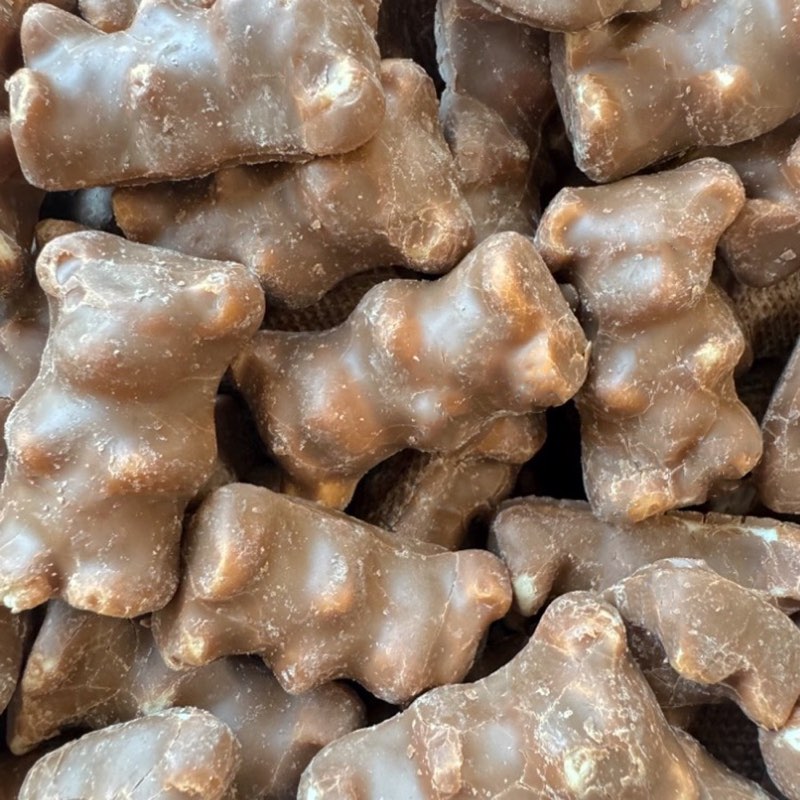
Small brown bears, loose in a bag, with the matte, slightly dusty-looking finish that a chocolate coating over a light interior always has. The listing gives the colour simply as brown, and that is honest: these are not decorated, not two-tone, not printed. What you get is a quantity of one shape in one colour, which is part of why they work so well as a mass item in a bowl.
They are light for their size, and that is the detail that catches people out the first time. Pick up a handful and the weight is noticeably less than the same handful of jellies or chocolates would be. That is the nature of a foam centre — most of the volume is air held in a structure, so the piece is large to the eye and small on the scales. The practical consequence is significant for anyone catering: a 250g bag of these looks like considerably more sweets than 250g of anything dense, and fills a bowl accordingly.
The coating gives them a firmer outside than a plain foam sweet, and you can feel it before you eat one. Press a bear between finger and thumb and there is a brief resistance from the shell before the centre gives way underneath. That is a two-stage structure, and it is the entire reason the coated version exists as a separate product from the uncoated one. It also means they hold their shape better in a bag than bare foam sweets, which tend to compress into a slab at the bottom.
The bear shape itself is doing work beyond decoration. A moulded animal has thicker and thinner sections — a body and limbs — and the thinner parts carry proportionally more coating relative to their volume. That means the ears and paws eat slightly differently from the middle: a fraction more shell, a fraction less centre. People who eat these carefully notice it. People who eat three at a time do not.
The surface will mark if handled in a warm hand for long, as any chocolate coating will, so these are better tipped into a bowl than passed around in fistfuls. In a cool room they stay clean and tidy for hours, which is more than can be said for solid chocolate in the same conditions.
The listing carries a single image, the line is in stock, and there are five weights from 250g at £7.49 up to 2kg at £28.99.
Eating one, from the outside in
The eating sequence here is short but unusually well defined, because two different materials are involved and they behave in opposite ways.
The first thing that happens is the shell breaking. A coating over a soft centre cannot resist for long — there is nothing solid underneath to press against — so instead of a snap you get a quiet crack and an immediate collapse. It is a small, satisfying event, and it is the reason a coated foam feels more considered than a plain one. You get a defined beginning to the mouthful rather than simply arriving in the middle of something soft.
Then the centre gives, and it gives completely. A foam sweet under pressure does not resist the way a jelly does; it compresses down to a fraction of its size in one movement, like pressing a sponge. There is no elastic spring-back, no second chew required. That single collapse is the signature of the category and the thing people either love or find faintly disappointing depending on what they were expecting.
What follows is the melt, which is quicker than you think. The compressed centre begins dissolving almost immediately because a foam has enormous internal surface area — all those air pockets are surfaces — and the more surface a sweet has, the faster it goes. A dense jelly of the same weight would still be in your mouth well after this has gone.
The chocolate note arrives at this point rather than at the start, which is the opposite of what happens with a solid chocolate. In a solid piece, the chocolate is the first and only thing. Here the shell is thin enough that it contributes texture before it contributes taste, and the flavour proper fills in once both materials have broken down together. The effect is a slightly delayed, rounded arrival rather than an immediate one.
The finish is short and clean, which is the practical advantage of a foam over a solid chocolate. There is no heavy film left coating the tongue, so the palate resets fast and the next sweet you eat tastes of itself. That is exactly why these work so well in a mixed bowl: they do not interfere with their neighbours. Eat a rich praline and the next four things you eat will be affected. Eat one of these and nothing downstream is compromised.
Temperature makes less difference than it does to solid chocolate, because the centre is the majority of the volume and it is not temperature-sensitive in the same way. A cold bear has a slightly crisper shell; a warm one has a softer one and will mark your fingers. Neither changes the eating much. If you are serving on a warm day, this is a far more forgiving item than anything solid.
Which counter this belongs to
Every sweet has an era attached to it, not because of when it was made but because of the kind of shop it makes you think of. Foam sweets belong firmly to the weighed-out, scooped-from-a-jar, paper-bag tradition, and putting a chocolate coating on one puts it squarely on a counter rather than in a packet.
Think about what that counter looked like. Sweets sold visibly and loose. A scoop. A scale. Paper bags in a stack. A row of jars where the contents were the advertising — no packaging design, no branding, just colour and shape seen through glass. In that environment, a sweet had to sell itself on appearance alone, and a small brown animal shape does that well: it is instantly legible from four feet away, it looks like more than it weighs, and it fills a jar attractively without any decoration.
Foam as a category carries an old-fashioned signal for a specific reason. It is a texture that modern confectionery has largely moved away from in favour of firmer, chewier, more elaborate formats. When most of a shelf is gummy, sour, filled, fizzy or layered, a plain soft foam reads as belonging to an earlier and gentler set of expectations. That is exactly why it sells to adults. They are not buying softness; they are buying the era that softness stands for.
Generational memory around sweets is unusually strong, and there is a decent explanation for it. Most of the sweets a person ever eats are eaten young, in situations with a lot of emotional weight attached — a reward, a holiday, a visit to a relative, the end of something difficult. Taste and smell attach to memory more directly than sight or sound do, so the flavours of childhood come back with more of their context intact than a photograph would carry. That is why an adult can eat something they have not had in twenty years and briefly locate the pavement outside the shop.
The interesting thing about that mechanism is that it does not require the sweet to be good. Nostalgia is not a quality judgement. Plenty of what sells strongly in this part of the shop is, by any modern standard, simple — and simplicity is the point. A sweet that has not been reformulated into something clever is a better memory anchor than one that has been improved, because the improvement is precisely what breaks the connection.
The shape matters to that memory too. Animal moulds are one of the oldest ideas in the trade because they solve a real problem: how do you make a small quantity of something into an object rather than a lump? A bear, a banana, a fish, a mouse — all of these turn a portion into a character, and children remember characters. Adults buying nostalgic sweets are often buying the shape more than anything else. If you want to see how wide that tradition runs, our retro shelf is largely built out of it.
The chocolate-coated version of a foam sweet occupies a slightly grander position on that imagined counter than the plain one. Coating something was, and still is, an additional process, so coated lines sat at a higher price and were the thing you chose when you had a little more to spend. That hierarchy persists in the pricing today, and it is why a coated foam costs more per kilo than a bare one.
Another strand of the same tradition is the chocolate-covered chew — same principle, different centre, and a considerably longer eating time. Chewing Nuts at £7.99 are the standard example of that branch and sit next to these in most people's memory of a counter even though they eat nothing alike. And for the plain, unadorned end of the same world, Briquette at £5.49 is about as traditional a loose line as we stock.
The last point about nostalgia is that it is mostly bought as a gift rather than for the buyer. People assembling a jar for a parent, a birthday hamper for someone turning a significant age, or a tin for a relative in hospital are all doing the same thing: choosing sweets as a form of message. That is worth knowing when you pick, because it changes the brief. You are not selecting what tastes best. You are selecting what will be recognised. The 356 lines on our loose sweets shelf are where most of that kind of shopping gets done, because weighed-out sweets are themselves part of the memory being reconstructed.
How a flavour gets built
The second thing worth understanding about a sweet like this is how a recognisable flavour is constructed at all — not what is in it, which is a question for the manufacturer's own packaging, but how the impression of a flavour is produced in your head. It is a more interesting process than most people assume, and it explains a lot about why some sweets read as convincing and others read as approximate.
Most of what you call taste is smell. The tongue detects a handful of basic qualities — sweet, sour, salt, bitter, savoury — and nothing else. Everything that makes chocolate taste like chocolate rather than like generic sweetness is aroma, detected at the back of the nose while you chew. That route, from the mouth up into the nasal cavity, is why food tastes flat when you have a cold and why holding your nose while eating turns almost anything into plain sweetness. Confectioners are therefore not really building tastes; they are building smells and then adding sweetness underneath them.
Recognition is a matter of a few key notes, not completeness. A real flavour contains hundreds of aromatic compounds. A confectionery version cannot and does not reproduce all of them; it identifies the handful your brain uses to make the identification and leads with those. This is why a sweet can be instantly recognisable as one flavour while tasting nothing like the real thing side by side. Your brain is doing pattern matching against a shortcut, and the shortcut works.
Colour does a surprising amount of the work. Studies of flavour perception consistently find that people identify flavours far less accurately when the colour is wrong or absent. Present the same thing in brown and people taste chocolate; present it colourless and identification rates collapse. Brown is one of the most decisive colours in the whole business, because there are relatively few brown flavours and the brain jumps to the most likely one immediately. A brown sweet is halfway to tasting of chocolate before it reaches your mouth.
Texture changes perceived intensity. The same flavour delivered in a hard sweet, a chew and a foam will read as three different strengths. Hard sweets release slowly and read as mild but long. Chews release steadily as they are worked. Foam releases everything almost at once, because of that huge internal surface area, so the flavour reads as immediate and strong, then stops. That is why foam sweets tend to be flavoured to a level that would be overwhelming in a boiled sweet — the format demands it.
Sweetness is a volume control, not a flavour. Raising sweetness makes everything else louder up to a point and then starts to mask it. This is why a very sweet product can taste less of its flavour than a moderately sweet one. It is also why a savoury or sharp counterpoint makes a sweet thing taste more of itself rather than less: the contrast gives the brain a reference point.
Temperature moves the whole picture. Aroma compounds are volatile, which means they lift more readily when warm. Anything eaten cold reads as quieter and cleaner; the same thing at room temperature reads as fuller. This is the single easiest variable to control at home and the one people most often ignore. If a sweet seems muted, it may simply be cold.
Coating versus centre is a design decision. In a two-part sweet the maker decides which element carries the flavour and which carries the texture. Here the shell carries the identity and the centre carries the structure, so the coating does the recognising and the foam does the eating. Reverse that arrangement and you get a completely different product from the same two materials.
Context sets expectations before the first bite. The shape, the shop, the bowl it is in and the sweets around it all prime what you expect, and expectation genuinely alters perception rather than merely reporting it. A brown bear on a table of Christmas items tastes more festive than the same bear from a bag in a car. That is not sentimentality, it is how the sense works, and it is a reasonable argument for putting some thought into presentation. A tray of Cadbury Dairy Milk Christmas Little Robins at £2.49 next to a bowl of these will change how both are read.
Comparison is how you actually taste. Nobody can describe a flavour in isolation with any precision; everybody can tell you which of two things is sweeter, stronger or cleaner. If you want to understand what you are eating, put two related items next to each other. The 32 lines filed under chocolate as a flavour are a ready-made flight for exactly that exercise, from moulded solids to coated centres.
The chocolate note on a coated foam
Chocolate on a coated sweet does a different job from chocolate in a bar, and it is worth separating the two in your head before deciding what to buy.
On a bar, the chocolate is the whole product and is experienced at full thickness, undiluted, for the entire time it is in your mouth. On a coated sweet, it is a thin layer sharing the mouthful with something else, so it reads as lighter, sweeter and less persistent. People who find solid chocolate too rich in quantity often find coated items much easier to eat several of, and that is the physics of the ratio rather than a difference in the coating itself.
It also makes coated items better neighbours on a table. Rich solid chocolate dominates whatever it is served with and coats the palate for a long time afterwards. A coated foam contributes the same recognisable note, then gets out of the way. If you are putting together a spread and want chocolate present without it flattening everything else, coated centres are the smarter choice, and the solid boxed items are better held back for the end.
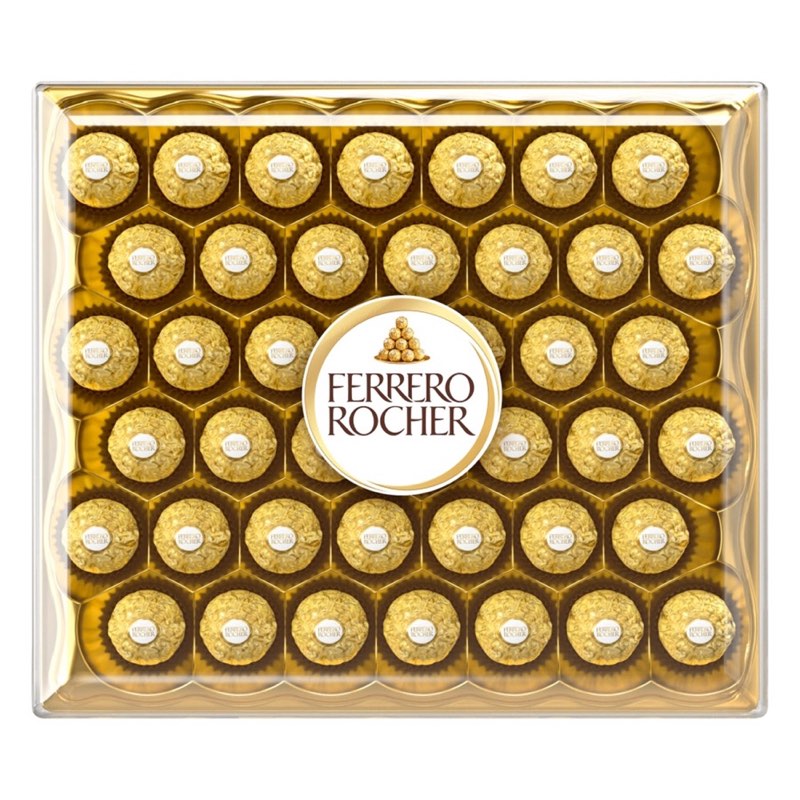
Where a solid line is what you actually want — as a centrepiece, or as the expensive item on a gift table — the boxed assortments are the ones that earn it. A 42-piece Ferrero Rocher box at £23.99 is the obvious example: it sits at the opposite end of the chocolate spectrum from a foam bear in every respect — weight, richness, duration and cost — and the two complement one another on a table precisely because they are so different.
Building a bowl or a mix around them
These are an easy component because they are soft, small, brown and neutral in finish. Almost nothing clashes with them. What follows is the order we would add things in if we were building a mix from scratch with this as the starting point.
Add a second foam first, but in a different colour and register, because foam is a texture people either want or do not and having two options keeps the foam-liking contingent at the table longer. BUBS Banana & Caramel Foam Sweets at £7.50 are the natural partner: same family, same softness, completely different colour and flavour direction. The 33 lines on our foam sweets shelf are where to look if you want a third.
Add a chew next, for duration. A bowl of exclusively soft sweets gets eaten too fast and leaves nothing to do; something that takes a while to work through slows the whole table down and makes the spread last. This is the single most effective addition to a mix that is heavy on soft items.
Add something in a strong single colour for the look of the thing. Brown is a quiet colour in bulk, and a mix built only from browns looks like a mistake rather than a decision. Barratt Bumper Bananas at £5.49 bring a block of yellow and a completely different silhouette, and they are in the same soft-textured family so nothing about the eating experience jars.
Add a bulk chocolate line if the mix needs filling out cheaply. Per-kilo, loose chocolate lines are where the value is, and a 1kg bag of Chocolate Ice Cups at £5.49 is the standard workhorse for this: unfussy, small-piece, and it pads out a jar without pushing the total up.
Add one thing that is technically not a sweet at all, if the mix is for adults or teenagers, because the change of category is refreshing. Crown Corn Cho chocolate-flavoured corn snack at £1.99 is a savoury-format item in a chocolate register, and it does something no confectionery line in the bowl will do.
Add a seasonal shape if there is a date involved. Glisten Chocolate Mini Eggs at £7.99 give you spring, and the Candy Realms Festive Mallow Stacker at £1.50 gives you a cheap winter centrepiece that is also, usefully, another soft item.
Finish with something from the same maker if you want the mix to have a thread running through it. Dals Coconut Chocolate Dots at £7.49 are the sibling line here — same brand, same price, same coated-centre idea in a smaller, differently textured format — and putting the two side by side gives a mix an internal logic that a random assortment lacks.
And if you want to see the whole mixing range at once rather than assembling it product by product, the pick and mix section is arranged for that job, while the jelly and gummy shelves are the obvious place to find the firmer textures that a foam-led bowl is missing.
Occasions these suit
Children's parties, obviously, where the soft texture and small size make them one of the least troublesome things on a table and the shape makes them instantly appealing without any explanation.
Family gatherings that span several generations, where the requirement is a sweet nobody objects to. This is a genuinely difficult brief and there are only a handful of lines that meet it. A soft chocolate-coated shape is one of them.
Gift jars and hampers, where a brown component is visually necessary to stop the whole thing looking like a bag of primary colours, and where a lightweight item lets you fill a large container without the weight and cost getting out of hand. Layering these with the same maker's coconut chocolate dots, also £7.49 gives a jar two brown layers of different sizes, which looks considerably more deliberate than one.
Warm-weather events, which is where coated foam quietly outperforms solid chocolate. An outdoor table in summer will destroy solid chocolate in an hour. These will still look like themselves at the end of the afternoon, which is why they are worth considering for a summer fête or a garden party.
Office tins and communal bowls, because they are light, quick to eat, non-messy and require no decision-making from the person taking one. Communal sweets should never be complicated.
Christmas tables, where brown is a base colour and where these can sit between the novelty shapes and the boxed items as the unfussy option. They also have the advantage of being cheap enough per bowl that you can afford a large one.
Weights, prices and how to choose
There are five sizes, and the price per kilo improves substantially as you move up. The most striking step is from 500g to 750g, where the increase in price is small relative to the increase in quantity.
| Size | Price | Who it suits |
|---|---|---|
| 250g | £7.49 | Trying the line, a small bowl, a single component in a gift jar |
| 500g | £11.99 | A household bag, or one bowl at a family gathering |
| 750g | £12.99 | The value step — a party bowl or a well-filled display jar |
| 1kg | £16.49 | A large party, a stall, or several jars at once |
| 2kg | £28.99 | Events, fundraisers and anyone bagging up to sell on |
Remember the bulk illusion when you are working out quantities. Because a foam centre is mostly air, a given weight of these occupies far more bowl than the same weight of jellies or solid chocolate. If you are used to buying dense sweets and you buy the same weight of these, you will have more than you expected rather than less. For a table, judge by the size of your bowls rather than by the number on the bag.
For per-head planning, these are a taken-in-handfuls sweet rather than a one-each sweet, because they are small and quick. That is the opposite of how you plan for a long chew. Budget generously and accept that a proportion of any bowl will go to two or three people who particularly like foam sweets and will keep coming back.
If you are buying for a single occasion and will not want them afterwards, buy the size that clears the event and no more; if you like them and will keep a cupboard bag, the 750g is the size that makes the most sense on cost.
Storing them properly
The enemy here is air, and the symptom is a foam that has gone firm and slightly leathery. Foam sweets have an enormous amount of surface exposed to whatever is around them, so an open bag deteriorates faster than almost any other format. Seal the bag properly or decant into an airtight container the day you open it.
Warmth is the second problem and it affects the coating rather than the centre. A warm bag will soften the shells and the bears will begin to stick to one another, and once a coated sweet has fused to its neighbour, separating them takes the coating off. Store somewhere cool and, importantly, store the bag flat and uncompressed so that the weight of the contents is not pressing the lower layers together.
Do not refrigerate unless you have to. Cold is not harmful but the swing back to room temperature brings moisture onto the coating and dulls it. If a hot week forces your hand, keep the bag sealed inside a closed container and bring it back up to room temperature before opening.
Keep them away from strong smells. A loose sweet has no individual wrapper, and a foam has a great deal of surface for picking things up. Coffee, spices and anything aromatic in the same cupboard will leave a mark on the flavour over a week or two.
For a display jar at an event, only put out what will be eaten that day and keep the rest sealed. A jar standing open in a warm room all afternoon will give you noticeably tougher sweets by evening.
Where to find these and what sits near them
This is a loose line sold by weight, so it lives with the rest of the weighed-out range rather than with the packaged ones. Within that, it files by texture under the 33 foam lines and by flavour under chocolate, and those are two genuinely different routes to related products — the texture shelf will show you soft sweets in every flavour, while the flavour shelf will show you chocolate in every texture.
The neighbouring shelves worth knowing about are the jelly and gummy lines, which is where you go for the firmer textures that a foam-heavy bowl needs, and the retro lines, which is where the rest of the counter-and-scoop tradition lives.
If you are browsing rather than buying something specific, the Candy & Chocolate hub gives you the categories laid out together, which is a better starting point than a list of hundreds of products. And everything we stock is there if you would rather filter the whole range yourself.
Questions we are asked about these
What does the coating do to the sweet underneath?
It gives you a defined beginning. A bare foam sweet has one texture throughout, so eating it is a single event; a coating adds a brief firm shell that cracks and collapses before the soft centre gives way. That two-stage structure is the whole reason the coated version exists as its own product, and it also helps the pieces hold their shape in a bag rather than compressing into a slab.
Are they very sweet?
They sit in the straightforwardly sweet part of the range rather than the sharp or bitter part, which is the nature of the format — a foam releases everything at once because of its huge internal surface area, so the impression is immediate and then gone. The finish is short and clean, which is why several can be eaten without the palate becoming overloaded in the way it would with solid chocolate.
How many will I get in a bag?
We do not publish a piece count, and it would not be a reliable guide anyway because a foam centre is mostly air, so weight and quantity are only loosely related. What is worth knowing is the opposite of the usual warning: a given weight of these fills far more bowl than the same weight of jellies or solid chocolate, so if you buy by weight out of habit you will have more than you expected.
Which size should I order?
250g at £7.49 to try them or to use as one component in a gift jar. 500g at £11.99 for a household bag. The 750g at £12.99 is the best value step and the right size for a party bowl or a filled display jar. 1kg at £16.49 covers a large party or several jars, and the 2kg at £28.99 is an event or fundraiser quantity.
Will they melt on a warm day?
Far less than solid chocolate will, which is one of the strongest practical arguments for this format at a summer event. The centre is unaffected by moderate warmth and only the thin coating responds, so what you get on a hot afternoon is slightly softer shells and a tendency for the pieces to stick together, rather than the slumped mess a bowl of solid chocolate becomes.
Are they suitable for small children?
The texture is among the easiest of any sweet, which is why this category sells so well for younger children. As with everything in the shop, sweets are a treat rather than everyday food. Small hard sweets and whole gummies are a choking risk for young children and should be eaten under supervision, and anyone with an allergy in the household should check the manufacturer's own packaging when the order arrives, before anybody eats.
Why have mine gone firm?
Almost certainly air. Foam sweets have a great deal of surface exposed and an open bag dries out faster than any other format we sell. Seal the bag properly or move them to an airtight container on the day you open it. Firm foam sweets are not spoiled, but the texture that makes the category worth buying is largely gone once they have dried.
What is the difference between these and the coconut dots?
Format and texture, rather than price — both are £7.49 at the smallest size and both come from the same maker with a coated-centre construction. The bears are a moulded animal shape with a soft foam centre; the coconut dots are smaller pieces in a different texture entirely. Buying both gives a mix an internal thread without the two lines competing for the same job in the bowl.
Do they work in a pick and mix?
Very well, and for a specific reason: they leave no coating on the palate. Rich solid chocolate affects everything eaten after it, whereas a foam centre clears quickly so the next sweet tastes of itself. That makes these one of the safest things to put in the middle of a varied bowl. Pair them with a chew for duration and something sharp for contrast.
Can I bag these up for a stall or party bags?
Yes, and the larger weights exist largely for that purpose. The practical advantages are that they are light, so a generous-looking bag costs little, and that they are soft enough not to be damaged by handling. Keep the bulk sealed and cool until the day, and bag up as late as you sensibly can so nothing sits in air longer than it needs to.
What should I serve alongside them?
Something that takes time to eat, because these are quick, and something with a sharper edge, because these are sweet and soft throughout. A chew covers the first, anything fizzy or fruity covers the second. Adding a second colour matters as much as adding a second flavour — a bowl of nothing but brown reads as an accident rather than a plan.
The short version
A soft chocolate-coated foam bear is one of the most useful things you can put in a mixed bowl. It is easy to eat, it suits every age in a room, it clears the palate rather than dominating it, and it stands up to a warm afternoon in a way that solid chocolate cannot. The shell gives you a defined bite, the centre disappears quickly, and the whole thing is over in a few seconds — which is either its charm or its limitation depending on what you wanted the sweet to do.
Buy 250g for £7.49 if you are trying them, 750g at £12.99 if you have a party or a display jar to fill, and put something chewy and something sharp on the table next to them — the mix-your-own shelves are the quickest way to find both in one go. If you are shopping for someone whose taste in sweets was formed at a counter with jars and a scoop, this is squarely the sort of thing they are hoping for.
More foam sweets
More chocolate sweets
More loose sweets sweets
Where this sits
Dals Chocolate Covered Bears appears on these shelves. Browse them, or jump to something nearby.
You might also like