Home / Loose Sweets / Crown Corn Cho Chocolate Flavoured Corn Snack 66g
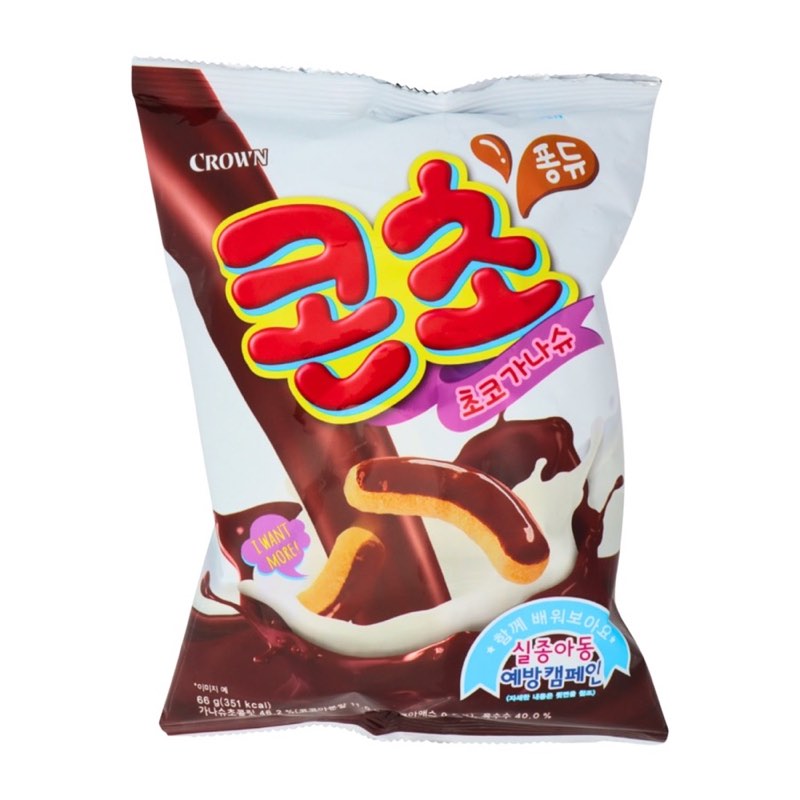
Crown · 66g
Read the full guide
Crown Corn Cho Chocolate Flavoured Corn Snack 66g
£1.99
✔ In stock — ready to ship
Fresh stock
Free over £20
Same-day dispatch
Secure checkout
Almost every sweet we stock can be placed somewhere on a single line. At one end is the acid hit — the sweets that make you pull a face, that make your jaw tighten just behind the ears, that people buy specifically for the reaction. At the other end is soft, round, unchallenging sweetness, the kind that asks nothing of you and can be eaten steadily for half an hour without your mouth ever objecting. Most of what people argue about in confectionery is really an argument about where on that line they like to live.
The Crown Corn Cho Chocolate Flavoured Corn Snack is interesting because it is not really on that line at all. It steps sideways off it. Sour has nothing to do with this product, and the sweetness is not the dominant sensation either — the format is. A corn snack is a savoury-shaped thing wearing a sweet flavour, and that combination sits in a category of its own that a lot of shoppers have never consciously thought about, even though they have eaten it their whole lives.
The full guide to Crown Corn Cho Chocolate Flavoured Corn Snack 66g
6,760 words on how it eats, who it suits, how to serve it and what to put beside it.
Where a chocolate-flavoured corn snack sits on the sour-to-sweet line
It is worth spelling out why that matters when you are choosing. The acid axis is a fatigue axis. Sour sweets are brilliant in short bursts and genuinely unpleasant in long ones; there is a hard ceiling on how many you want, and everybody who has worked through a bag of very sour sweets has hit the moment where the tongue simply refuses to continue. Sweet-only items have a different kind of ceiling, a cloying one — the point at which everything tastes the same and you want a glass of water. Both ceilings are real, and both arrive faster than people expect.
Snack-format items have a much higher ceiling, and that is the whole point of them. The reason a bowl of crisps disappears faster than a bowl of fudge is not that crisps taste better. It is that the crisp format — light, dry, crunchy, low in residue, eaten in quick repeated bites — does not build up in the mouth the way a chewy or a chocolate piece does. Each piece resets. Nothing coats. You can keep going, and you do keep going, and the bowl is empty before anyone has noticed they were eating.
Put a chocolate flavour on that format and you get something genuinely unusual: a chocolate experience without the chocolate ceiling. This is the reason this kind of product exists, and it is why, at £1.99 for a 66 g bag, it is not competing with the things it superficially resembles. It is not competing with a chocolate bar, because a bar is dense and finishing one is a decision. It is not competing with a bag of gummies, because gummies are wet and chewy and slow. It is competing with the bowl of something crunchy that sits in the middle of the table and quietly vanishes.
Now, the practical question: how do you build around something that sits off the main axis? The answer is that it is one of the most useful anchor items you can own precisely because it does not compete. Two sour sweets on the same table fight each other — the second one always tastes weaker, because the first one has already done the work on your palate. Two chocolate items on the same table blur into one. But a crunchy chocolate-flavoured snack next to a sour sweet is a genuine pairing, because they are operating on different parts of the mouth and neither is standing in the other's light.
If you want to make that concrete, think of a table in three zones. The acid zone is the reset button; you want it present but small, because too much of it burns everybody out. The rich zone is the reward; this is where the real chocolate sits, and it is expensive, so it is bought in small quantity and treated as a treat. The volume zone is where the eating actually happens, and it needs to be cheap, high-ceiling and mess-tolerant. This product is a volume-zone item that borrows its flavour identity from the rich zone, which is an unusually efficient trick — it lets a £1.99 bag carry a chocolate note across a whole table without you spending chocolate money on volume.
That is a genuinely different job from the one done by, say, a box of proper pralines. If you want the rich zone filled properly, the 42-piece Ferrero Rocher box at £23.99 is what that end of the market actually looks like, and it is twelve times the price of this bag. Nobody sensible fills a table with £23.99 boxes. You buy one of those to sit on a sideboard and be offered, and you fill the volume zone with something like this. The two are not rivals. They are different departments of the same evening.
The same logic holds going the other way. A kilo bag like Chocolate Ice Cups at £5.49 for a full kilo is a volume-zone item with a chocolate identity too, but it fills the zone with soft, cupped, spoonable pieces rather than crunch — which means if you are already buying that, this bag is not duplication, it is contrast. Crunch next to soft is the single most reliable texture pairing in confectionery, and it costs you two pounds to add it.
So: where does this land on the spectrum? Off it, deliberately, and that is its value. It is the item you add when the table is already sweet enough and still somehow boring. It is the item that people eat without deciding to. And at under two pounds it is close to the cheapest way to add a whole new texture to a spread rather than another variation on one you already have.
What comes out of the 66 gram bag
Let us be plain about what we can and cannot tell you, because it saves a question later. Our listing for this line records the name, the brand — Crown — the flavour as Chocolate, the weight at 66 g, and the price at £1.99. It comes in one size and it is in stock. What our listing does not hold is a breakdown of what is inside the bag beyond the name it is sold under, and we are not going to invent one for you. The manufacturer's own packaging is the place to read anything to do with what it is made from, and if you have allergies in the household, that packaging is the thing to check on arrival, before anyone opens anything.
What we can talk about with confidence is the format, and the format is the product. A 66 g bag of a corn snack is a light bag. That number does not sound like much next to the kilo bags elsewhere on the shelf, but snack formats are mostly air by volume — that is what makes them snacks — so 66 g fills a bag that looks considerably more generous in the hand than the figure suggests. If you have ever bought a bag of something crunchy and been surprised by how much came out into the bowl relative to the weight on the front, that is the same effect.
The practical consequence is portability. Sixty-six grams is nothing to carry. It goes into a coat pocket, a glovebox, the side pocket of a bag for a train, a picnic basket already full of heavier things. Weight matters more than people admit when choosing what to take somewhere; the thing that ends up eaten is very often the thing that was easiest to bring. A kilo tub is better value per hundred grams and it stays at home, which is a perfectly good reason to own both.
The other physical consideration is the bag itself. Snack bags are not resealable as a rule, and you should plan for that. This is an open-it-and-finish-it item, or an open-it-and-decant-it item. Neither is a problem so long as you know in advance — but a half-open snack bag left on a counter overnight is the classic way to turn a good product into a disappointing one, and that is entirely avoidable with a clip or a tub.
How it eats, from the first piece to the last
The pleasure of a corn snack is a pleasure of collapse. You bite, there is a moment of resistance, and then the piece gives way all at once rather than gradually. That single event — the sudden give — is the thing the format is built around, and it is the reason these products are eaten so much faster than their weight would suggest. Every piece is a small, complete mechanical event, and the brain enjoys repeating it.
Flavour on a snack format arrives from the outside in. That is a structural fact about how these things are made rather than a claim about any particular one: the flavour lives on the surface, which means it reaches your tongue immediately, before the piece has even broken. So the chocolate note here announces itself at first contact rather than building. That is the opposite of how a solid chocolate behaves, where you get texture first — the cool, slightly resistant surface, the softening — and flavour arrives as the piece warms and yields.
Practically, that front-loading means the first three pieces taste the strongest. The flavour does not fade exactly, but your perception of it settles down after the initial burst, which is why snack products of every kind are designed to be eaten in a rhythm rather than savoured one piece at a time. Savour a single corn snack and you will find there is not a great deal to savour; eat a handful over two minutes while talking, and the format does precisely what it was designed to do.
The finish is short and clean. This is worth knowing because it determines what you can put next to it. A long, coating finish — the kind you get from something rich and dense — occupies your mouth for a while afterwards and shuts down whatever you eat next. A short finish does not. You can go from a handful of this straight into something sharp, or straight into something entirely different, without the first thing arguing with the second. In a spread that is a structural advantage, and it is the reason snack items so often end up being the connective tissue of a table rather than its centrepiece.
Residue is the last sensory point and the most practical one. Any flavoured snack leaves something on the fingers. How much varies enormously by product and we cannot tell you exactly where this one lands, but plan as though it will: put a serviette down, keep it off pale upholstery, and do not hand the bag to a small child sitting on a light carpet unless you enjoy the consequences. This is not a criticism. Every good snack has a mess budget, and spending it knowingly is the whole trick.
Who reaches for this
The clearest fit is the person who wants a chocolate note without the commitment of chocolate. There is a specific craving — not for a bar, not for a truffle, not for anything you have to sit down with — that is satisfied entirely by something crunchy with a chocolate flavour on it. If you have ever wanted "something chocolatey" and found that an actual chocolate bar was somehow too much, this format is the answer to that, and at £1.99 it is a cheap answer.
It suits people buying for a mixed room. The hardest thing about laying out sweets for a group is that preferences are wildly divergent and strongly held. Sour is polarising. Liquorice is polarising. Coconut is polarising. A crunchy snack with a chocolate flavour is about as close to a universal donor as confectionery gets — it is unlikely to be anybody's single favourite thing on the table, and it is equally unlikely to be the thing somebody refuses.
It suits the grazer rather than the sitter. Some people eat sweets as an event: they sit down, they open something, they give it their attention. Others eat while doing something else, in small repeated handfuls, and barely register it. This is emphatically a product for the second group. If you are the sort of person who puts something in a bowl next to a laptop, this is exactly that thing.
It suits a small household. Sixty-six grams is one bowl. It is two people having a reasonable amount each, or one person having rather too much, and either way there is no leftover-management problem. A lot of confectionery buying goes wrong because the pack size is bigger than the occasion, and the remainder goes stale in a cupboard. This size is honest about being an evening rather than a fortnight.
Who it does not suit: anybody catering at scale. Buying ten of these to feed a party is a poor use of twenty pounds, and the right answer for numbers is always weight. Our loose sweets counter is set up for exactly that job, with hundreds of lines sold by weight rather than by packet, and a single well-chosen kilo will do more for a room than a pile of small bags ever does. It also does not suit anybody who specifically wants real chocolate; a flavoured snack is a different pleasure and pretending otherwise would only lead to disappointment. If chocolate proper is what you are after, our chocolate flavour shelf has thirty-two lines on it and most of them are a better fit for that particular craving.
A party planner's view: quantities, tables, timing, and what runs out first
Ask anybody who has laid on sweets for thirty people what they got wrong, and they will tell you the same two things. They bought too many different items and not enough of any of them, and everything was on the table at once so the good things went in the first twenty minutes. Both are solvable, and solving them is mostly arithmetic and sequencing rather than taste.
Start with the quantity question, because it is the one people get most wrong. The useful planning number for a sweets table is grams per head, not packets. For an event where sweets are a side attraction — a birthday with a proper meal, a wedding reception with a buffet, an office thing with other food — you are looking at roughly 50 to 80 g a head across the whole table. For an event where the sweets are the attraction, a children's party or a film night, that rises to 100 to 150 g a head, and for teenagers you may as well assume 150 g and stop pretending otherwise.
Run that against reality. Thirty adults at a reception, 60 g a head, is 1.8 kg of sweets total. This bag is 66 g. Nobody should be buying twenty-seven of these to hit that number — the maths says £53.73 and the sensible route to 1.8 kg costs a fraction of that. The correct role for a 66 g bag in a thirty-person plan is as one of three or four accent items sitting on top of a bulk base, not as the base itself. Buy your kilos for the base, and buy the small bags for variety.
Now the table layout. A sweets table has a geography, and the geography determines consumption more than the contents do. The item nearest the entrance goes first, always, regardless of what it is. The item at the far end, past the bend, goes last, and sometimes barely goes at all. This is completely reliable and you can use it. Put the thing you have the most of nearest the door. Put the expensive thing — the pralines, the good box — somewhere people have to walk to, because the walk makes it feel deliberate and slows down the rate at which it disappears.
Height matters too. A flat spread of bowls all at counter level reads as a single undifferentiated mass and people graze it without looking. Putting two or three things up on stands or upturned boxes creates a visual hierarchy, and the raised items get chosen consciously rather than grabbed. If you have one genuinely nice item — something like the Glisten Chocolate Mini Eggs at £7.99 or a foiled line such as the Luxury Milk Chocolate Foiled Mini Eggs 250 g at £8.99, both of which look considerably better in a bowl than their price suggests — raise it, and it will be treated as the centrepiece it is.
Then timing. This is the part almost nobody plans and it is where most of the improvement is available. Do not put everything out at the start. Sweets tables have a natural rhythm: an initial rush in the first fifteen minutes when people arrive and are nervous and want something to do with their hands, a long flat middle where consumption is slow and social, and a late surge when everybody has had a drink and stopped being careful.
Stock for three phases. In phase one, put out the volume items and nothing precious — this is when a £1.99 crunchy bag earns its keep, because the initial rush is indiscriminate and there is no point spending good money on it. In phase two, bring out the variety: this is the window where people actually taste things and notice what is good, and it is the right moment for the interesting items. In phase three, restock the volume and leave it. Nothing subtle survives the late surge, so do not waste anything subtle on it.
What runs out first? In order, with tedious reliability: anything chocolate, anything in a small quantity, anything at child height, anything that can be taken by the handful, and anything novel. Anything sour, anything liquorice, anything aniseed and anything hard and long-lasting goes last. This means that if you buy equal quantities across the board you will finish the evening with an empty chocolate bowl and a nearly full sour bowl, and you will feel you got the ratio wrong — because you did.
The fix is to buy in a ratio of roughly 3:2:1. Three parts chocolate-leaning and crunchy, two parts fruit-leaning and chewy, one part sharp or unusual. The one part of sharp is not a failure when it survives; its job is to exist so that the people who want it are served and so that everybody else's palate has somewhere to go. A table with no sharp note tastes flat by the end of the night even though nobody can say why.
Bowls, scoops and the practical kit. Use more, smaller bowls rather than fewer big ones, for two reasons. A small bowl that empties gets noticed and refilled; a big bowl that is half empty looks sad for an hour. And several small bowls of the same thing at different points on the table beats one big bowl in the middle, because it removes the queue and the reaching. Put a scoop or tongs in anything you would rather people did not handle directly, and put a small bin or bowl out for wrappers before anyone needs one — wrapper management is the single difference between a tidy table at midnight and a grim one.
The children's-party variant. Different rules apply. Portion into bags in advance rather than laying out a communal table; it removes the arguments, removes the fastest-eater problem entirely, and means you go home with an empty box instead of a mess. Reckon on 80 to 120 g a child in a party bag. Avoid anything requiring a decision — small children do not browse, they grab. And supervise: whole gummies and small hard sweets are a choking risk for young children, they should be eaten sitting down under an adult eye, and that is worth saying out loud to whoever is helping you rather than assuming.
Budget, honestly. A thirty-person table done well costs less than people fear. The base — 1.2 kg or so of something bought by weight — is the bulk of the spend and the bulk of the volume. Three or four accent bags at £1.99 to £2.49 each add the variety for under a tenner. One raised centrepiece item at £8 to £9 makes the whole thing look considered. That is a table under thirty pounds that reads as generous, and the mistake that pushes people to sixty is buying twelve small bags instead of two kilos and four small bags.
Chocolate as a flavour family, and how it behaves next to others
Chocolate is the dominant flavour family in confectionery and it is also the most tyrannical. Put it on a table and it sets the terms for everything else, because it has a long finish, it coats, and it is rich enough to make lighter flavours taste thin immediately afterwards. Understanding that is most of what you need to know about building around it.
The first rule is that chocolate does not go after things, it goes before them — or rather, whatever follows chocolate needs to be sharper than it otherwise would to register at all. This is why chocolate and fruit work in that order, and why fruit after chocolate needs to be a properly acidic fruit rather than a gentle one. Our fruit flavour shelf is the place to pull that contrast from, and the sharper end of it does the job better than the softer end.
The second rule is that chocolate and berry is the single most reliable pairing in the family, and specifically chocolate and strawberry. There is a reason that combination appears again and again across every price point. If you want it in its most polished form, Lindt Lindor Strawberries & Cream Truffles in the 200 g box at £8.29 is that pairing done as a single object rather than as two things on a plate. If you would rather assemble it yourself, our strawberry-flavoured selection gives you the other half and lets you choose the intensity.
The third rule is that chocolate flavour and chocolate itself are not the same family member and should not be treated as interchangeable. A flavoured snack sits closer to the biscuit-and-crunch side of the family than to the truffle side. If you are thinking in those terms, something like the Meiji Chocorooms box at £1.69 is a closer relative to this bag than any truffle is — both are small, boxed or bagged, under two pounds, and built on a crisp structure rather than a soft one. Two items in that neighbourhood on the same table complement each other far better than two truffles would.
The fourth rule is about temperature, and it is the one people forget. Actual chocolate has a narrow comfortable temperature range and a warm room ruins it. A chocolate-flavoured snack does not care. In August, in a marquee, in a car, on a beach, the flavoured item is the one that still works — which is a genuinely useful thing to know when you are planning anything outdoors between June and September.
Building a mix and a spread around it
If you want to assemble a proper selection rather than buy one bag, the most useful principle is to think in textures rather than flavours. Flavour variety is easy and people over-buy it; texture variety is harder and people under-buy it, and texture is what actually keeps a bowl interesting for an hour.
There are five textures worth covering. Crunch is what this bag brings. Chew is the long-burn texture that occupies somebody for a while. Melt is the rich, dissolving one. Hard is the slow, sucked, very long-lasting one. And soft-set — the fondant-and-cup family — sits between melt and chew and does a specific job of its own.
For melt at a sensible price, a kilo of the ice cups at £5.49 covers it in bulk. For something with more of a bite to it, Dals Chocolate Covered Bears at £7.49 put a chocolate coat over a shaped centre, which gives you two textures in one piece and is a genuinely efficient way to fill two slots with one purchase. For the character-and-shape slot — the thing children pick out first because of what it looks like rather than what it tastes of — Hannah's Animals at £5.49 is the obvious call, and shaped sweets always outperform their flavour on a children's table.
For a long-burn, high-commitment item that keeps one person occupied, Chewing Nuts at £7.99 sits at the more serious end of the loose-sweets range and is the kind of thing you buy when you want a jar's worth of something rather than an evening's worth. And for seasonal shape and colour — the thing that makes a table look like it belongs to a particular time of year rather than to no time at all — the Cadbury Dairy Milk Christmas Little Robins bag at £2.49 is in almost exactly the same price bracket as this one and does a job this one cannot.
If you would rather build the whole thing by hand and control the ratios yourself, that is what our Pick & Mix shelf is for. Buying by weight lets you decide that you want three parts crunch to one part sour rather than accepting whatever ratio a pre-made assortment has chosen for you, and for a table where you know your audience that control is worth more than the convenience of a ready-made bag.
A worked example, for a film night for four people, under fifteen pounds: this bag at £1.99 as the crunch and the chocolate note; a shaped line around £5.49 for the visual interest and the chew; a boxed item at £1.69 for the biscuit-crisp slot; and something sharp from the fruit end to reset the palate. Four textures, four rhythms, nothing duplicated, and change from a fifteen. That is a better-built spread than thirty pounds spent on three variations of the same rich thing.
Occasions it earns a place at
Film nights are the natural home. A film is roughly two hours and a sweets spread has a running time too; if everything is finished forty minutes in, the second half of the evening is quietly worse and nobody connects the two facts. A crunchy bag is a fast item, so put it out at the start during the settling-in period when people are talking and not really watching, and hold the slower things back for the middle.
Car journeys and travel suit it particularly well, because of weight and temperature tolerance. Sixty-six grams costs you nothing to carry, and unlike real chocolate it will not be ruined by an hour on a warm parcel shelf. The caveat is residue — a crunchy flavoured snack and a car interior are not natural friends, so decant into a tub and hand out portions rather than passing the bag around at seventy miles an hour.
Desk and study snacking is a real use case and it is worth being honest about the trade-off. The high ceiling that makes this format so easy to eat is precisely why a bag next to a keyboard disappears without being noticed. If that is what you want, excellent. If it is not, put a portion in a small bowl and put the bag somewhere else — the distance does more work than willpower does.
Hampers and gift boxes use small bags differently: as filler and as texture variety rather than as the gift itself. A hamper built only from expensive boxed items looks strangely sparse, because expensive things are small. Two or three £1.99 bags give a hamper the volume and the visual variety that make it read as generous, and they cost almost nothing against the total. Put the candy and chocolate range together with one or two items from elsewhere and the box fills out properly.
Buffets and office tables want items that survive being out for hours in a warm room, and this is one of them. Anything that melts is a liability on an office table in July; anything crunchy in an open bowl is fine for an afternoon, though it is worth knowing it will soften over a long day if the room is humid and that a bowl refreshed at lunchtime beats one put out at nine.
Portions, and what £1.99 actually buys
Here is the arithmetic, because it is genuinely useful rather than decorative. At £1.99 for 66 g, this works out at just over £3.01 per 100 g. That is the number to carry when you are comparing anything on the site, and it puts this bag firmly in the small-format bracket rather than the value bracket.
Compare honestly. A kilo of something at £5.49 is 55p per 100 g — that is roughly a fifth and a half of the price per gram. You are not being overcharged for the small bag; you are paying for the format, the portability, the fact that it is a single serving that does not need managing, and the fact that you can try something for two pounds rather than committing five or six. Both propositions are legitimate. They are just answers to different questions.
On portioning: treat 66 g as one generous bowl for one person, a comfortable share between two, or a small taster across three or four. If you are laying out a table, treat it as an accent rather than a base — one of several small bags providing variety on top of something bought by weight. And if you are building party bags for children, this is one bag per two to three children at most, not one each, because 66 g is a large portion for a small person on top of everything else in the bag.
The value question people should actually ask is not "is this cheap" but "is this the right size for the job". A 66 g bag for an evening for two is the right size and excellent value at £1.99. The same bag bought fifteen times to feed a party is the wrong size and poor value at £29.85. Nothing about the product has changed between those two sentences; only the job has.
Keeping it in good condition
Crunchy formats have exactly one enemy and it is moisture in the air. Crispness is a physical state, not a permanent property, and a bag left open in a humid kitchen will lose it within a day or two. That is the whole of the storage problem and the whole of the solution follows from it.
Before opening, keep it somewhere cool, dry and dark, away from the hob and away from a sunny windowsill. A cupboard is fine; a shelf above a kettle is not, because steam is the fastest route to a soft snack. Do not put a snack bag in the fridge — fridges are damp, and a cold bag brought back out into a warm room collects condensation on the inside, which is precisely the thing you were trying to avoid.
After opening, the honest advice is to finish it or decant it. If you are decanting, an airtight tub or a clip on a tightly folded bag will hold the texture for several days; a bag with the top loosely rolled over will not last one. Press the air out before sealing where you can. If you are laying a bowl out for an evening, pour what you need and leave the rest sealed rather than tipping the whole bag out at the start — an open bowl is losing crispness the entire time it sits there, and a refilled bowl always tastes better than a bowl that has been out for three hours.
Keep strong-smelling things away from it, in the cupboard and in the tub. Dry, porous snacks pick up odours from their surroundings more readily than most people expect, and a bag stored next to something aromatic will taste faintly of it. Store sweets with sweets.
And the general rule that applies to everything we sell: these are a treat, not a staple. Small hard sweets and whole gummies are a choking risk for young children, so keep little ones supervised while they eat. If anybody in the household has an allergy, read the manufacturer's own packaging when the order arrives, before anything is opened — that packaging is the authoritative source, and it is the only one we would ever point you to.
One size, and what that means when you order
There is no decision to make here, which is worth stating plainly. This line is listed in one size only — the 66 g bag at £1.99 — and it is currently in stock. There is no larger sharing format and no multipack of this particular line on our shelves, so if you want more of it, the answer is more bags rather than a bigger bag.
That has one real consequence for planning. Products that come in a large format let you scale up cheaply, because price per gram usually improves with size. A single-size line does not, so the cost of scaling this one is linear — five bags costs five times one bag, with no volume advantage. If you find yourself wanting several, that is usually a signal to look at whether a by-weight purchase would serve the same purpose better, and the by-weight shelves are where that comparison is easiest to make.
The flip side is that single-size lines are the least risky thing on any shelf. There is no wondering whether you should have bought the bigger one, no buyer's remorse about a tub you will not finish, and no decision paralysis. Two pounds, one bag, done.
Finding this and its neighbours on the site
This line lives on two shelves, and knowing which is which makes browsing a great deal faster. It sits in the loose sweets section, which is by some distance our largest at 356 lines and is where most of the range lives; and it sits under chocolate as a flavour, a tighter shelf of 32 lines that collects everything with a chocolate character regardless of format. If you came here looking for one particular thing and want to see what else is in the same register, the chocolate shelf is the more useful of the two, simply because it is small enough to read end to end.
From there, the hubs fan out. The full range of everything we stock is the widest view and the right starting point if you are browsing rather than hunting. The candy and chocolate hub narrows that to the sweet-and-chocolate side of the catalogue. Building your own mix by weight is the route to take when you know roughly what you want but not exactly which products, and it is generally the cheapest way to fill a table. And if you are chasing a flavour rather than a format, the flavour hubs — everything on the fruit side being the obvious counterweight to this one — are the fastest way to find contrast.
One practical browsing tip: the flavour shelves and the format shelves cut across each other, so the same product appears in more than one place. If you are stuck, start from flavour when you know the taste you want and start from format when you know the texture you want. Most people know the texture and search for the flavour, which is why they end up browsing for longer than they meant to.
Questions we get asked
How much is in the bag, really?
The declared weight is 66 g, and our listing shows one size at £1.99. Because snack formats are light for their volume, the bag looks more generous in the hand than 66 g sounds on paper — but it is still a small-format bag, and we would treat it as one good bowl for one person or a comfortable share between two rather than as something that stretches across a group.
Is this actual chocolate?
It is sold as a chocolate flavoured corn snack, and the name is the honest description of it. Treat it as a snack format carrying a chocolate flavour rather than as a chocolate product, because the eating experience is genuinely different — crunchy and quick rather than rich and slow. If what you want is chocolate proper, the chocolate shelf has plenty that will suit you better.
What is in it?
We do not publish ingredient information for this line, and we will not guess at it. The manufacturer's own packaging carries the full ingredient and allergen information, and that is the authoritative source. If you have an allergy in the household, read the pack when the order arrives and before anything is opened.
Will it melt if I post it or leave it in the car?
A flavoured snack does not behave like solid chocolate in the heat, which is one of the quiet advantages of this format. It will not go soft and shapeless on a warm parcel shelf the way a bar would. Humidity is the bigger risk to a crunchy product than temperature is, so the thing to protect it from is damp air rather than warmth.
Does the bag reseal?
Assume not, and plan around it. Snack bags in this format are generally not resealable. If you are not going to finish it in one sitting, decant into an airtight tub or fold the top tightly and use a clip. A bag left loosely open overnight in a kitchen will noticeably lose its crispness by the following day.
How many should I buy for a party?
Far fewer of these than you think, and more weight instead. Plan on roughly 50 to 80 g a head for an event where sweets are a side attraction, or 100 to 150 g a head where they are the main one. Use bulk bought by weight as the base and small bags like this one as accents for variety — two or three of them, not twenty.
Is it suitable for young children?
Sweets of any kind are a treat rather than an everyday food, and small children should be supervised while eating them — small hard sweets and whole gummies are a choking risk for the under-fives in particular. Beyond that general guidance, the manufacturer's packaging is where you should look for anything specific to this product.
What goes well with it on the same table?
Something soft and something sharp. The crunch here contrasts well with a soft-set or melting item, and the short clean finish means a sour or sharply fruity sweet after it still registers properly rather than being flattened. Avoid putting it next to another crunchy chocolate-flavoured item, as the two will read as duplicates rather than as variety.
Is there a bigger size or a multipack?
Not of this line. Our listing shows one size only, the 66 g bag at £1.99, and it is in stock. Because there is no larger format, buying more simply multiplies the price — so if you need real volume, it is usually better value to look at what we sell by weight rather than buying this bag repeatedly.
How long does it keep?
Unopened and stored somewhere cool, dry and dark, it keeps perfectly well until the date on the manufacturer's packaging, which is the date to go by. Once opened, texture rather than the date becomes the limiting factor: sealed properly it will stay crisp for several days, and left open in a humid kitchen it will soften within about a day.
Can I use it in a pick and mix?
Not in the by-weight sense — this is a sealed bag rather than a loose line, so it is not something we scoop. But it works very well alongside a mix you have built yourself, adding a crunch that most by-weight selections are short of. Build your mix for chew and chase, then add a bag of this for texture.
Where do I find things like this?
Two routes. If the chocolate note is what you are after, browse by chocolate flavour — it is a short enough shelf to read through properly. If it is the small-bag, under-£2.50 snack format you want, work across the whole catalogue with price in mind, and you will find a handful of near neighbours at similar money, of which the £1.69 boxed alternative is the closest on both counts.
In short
A £1.99, 66 g bag that does a job very few other things on the shelf do: it puts a chocolate note on the table in a crunchy, fast, high-ceiling format that does not compete with anything else you have laid out. It is not a substitute for real chocolate and it is not pretending to be. It is the accent item — the thing that adds a texture rather than another flavour, that costs almost nothing against a total, and that quietly disappears while everyone is talking about something else. Buy it as part of a spread rather than as the whole of one, keep it sealed and dry, and check the manufacturer's packaging when it arrives if allergies are a consideration in your household.
More chocolate sweets
More loose sweets sweets



Where this sits
Crown Corn Cho Chocolate Flavoured Corn Snack 66g appears on these shelves. Browse them, or jump to something nearby.
You might also like