Home / Loose Sweets / Ferrero Rocher Milk Chocolate Pralines 42 Pieces 525g
Ferrero Rocher · 525g
Read the full guide
Ferrero Rocher Milk Chocolate Pralines 42 Pieces 525g
£23.99
✔ In stock — ready to ship
Fresh stock
Free over £20
Same-day dispatch
Secure checkout
There is a particular kind of buyer who ends up on this page, and it is almost never someone shopping for themselves on a Tuesday. A forty-two piece box is a quantity decision before it is a taste decision. You are here because you have a number of people to feed, a table to fill, a hamper to weight properly, or a run of small gifts to make from one purchase. Ferrero Rocher Milk Chocolate Pralines 42 Pieces 525g at £23.99 is a catering-scale box wearing a gift-shop face, and knowing which of those two jobs you are buying it for changes everything about how you use it.
The clearest fit is the host who has somewhere between fifteen and twenty-five people arriving and wants one chocolate on the table that nobody has to be persuaded to take. Individually wrapped pralines solve the problem that defeats most party chocolate: the bowl that looks picked-over after twenty minutes. Because every piece here arrives sealed in its own foil and sits in its own pleated paper cup, the bowl never develops that shopworn look. The last piece presents exactly as well as the first. If you have ever watched a tray of loose chocolates go from elegant to sad in half an hour, you already understand why people pay a premium for wrapped.
The full guide to Ferrero Rocher Milk Chocolate Pralines 42 Pieces 525g
6,436 words on how it eats, who it suits, how to serve it and what to put beside it.
The shopper this box is actually built for
The second fit is the person breaking one box into many small gifts. Forty-two pieces divides cleanly in ways that matter in December and in the run-up to the end of a school or work year. Three pieces in a cellophane bag with a ribbon gives you fourteen gifts. Two pieces gives you twenty-one. Six pieces in a small box gives you seven more substantial ones. At 57p a piece, you are assembling a fourteen-gift run for the price of one mid-range bottle of wine, and every recipient gets something they recognise immediately.
The third fit is the hamper builder. Hampers live and die on weight and on visual anchor. A 525g box gives you both: it holds the base of a basket down, it fills a corner without needing padding behind it, and its gold catches the eye first in a photograph of a finished hamper. If you are assembling several hampers at once, this box is one of the few single items that can be split across three or four baskets and still look intentional in each.
Who it is not for, honestly: the shopper who wants variety. This is one chocolate, repeated forty-two times. That is a strength when you want consistency and a limitation when you want a spread. If you want range on a table, this box should be the anchor and not the whole of it — you will want something chewy, something fruity and something with a different format alongside, which is a build we will come back to further down the page.
What comes out of the wrapping
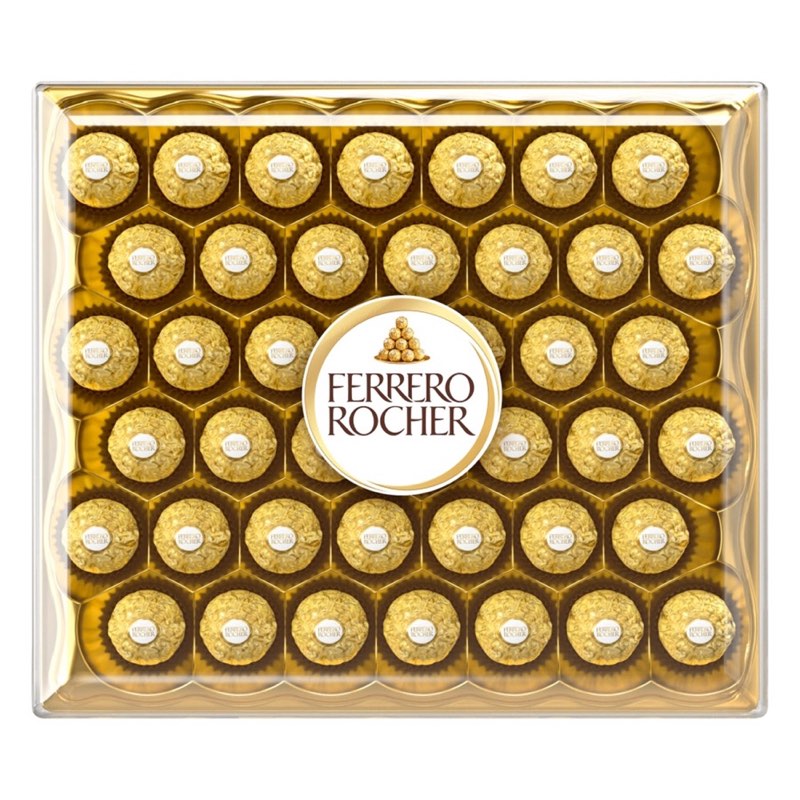
Open the outer packaging and the first thing you register is gold — a lot of it, in a grid. Forty-two foil-wrapped spheres sitting in a moulded tray, each one crowned with a small paper flag, each seated in a fluted brown cup. The geometry is doing a lot of the work here. Repeated identical objects in a tray read as abundance in a way that a heap of loose sweets never quite manages. It is the same trick a box of macarons or a tray of canapés uses: order signals care.
Lift one out and it has more heft than its size suggests. At 525g across 42 pieces, each praline is 12.5g — small enough to sit comfortably between finger and thumb, heavy enough that you notice it as an object rather than a crumb. That weight matters for how it gets eaten. A 12.5g chocolate is a two-bite piece for most adults and a three-bite piece for anyone being polite about it. It is not a single-pop sweet, and it is not a bar that needs breaking. It occupies the useful middle where one feels like a treat and two feels like a decision.
The foil is part of the product, not just protection. The small ritual of twisting it open, flattening the paper flag, and setting the crumpled gold down beside your glass is a big part of why this chocolate works at a party. It gives people something to do with their hands, and it gives the room a visible record of who has had how many, which — depending on your guests — is either a useful brake or a running joke. Either way, foil is why this box survives being left out for three hours in a way that an open tray of unwrapped chocolate does not.
How it eats, from first bite to finish
The exterior is not smooth. Where a moulded chocolate is glassy and uniform, this one is deliberately irregular — a craggy, textured outer surface that catches the light unevenly and gives the piece its slightly rustic look against the very polished packaging. That contrast between rough sphere and immaculate gold is a deliberate piece of design, and it is the reason the product photographs well even in the hands of someone with a phone and a kitchen window.
The first bite is about resistance. There is a distinct crack rather than a yield — the piece breaks rather than squashing, and it breaks in a way you can hear. Milk chocolate on its own does not do that; it has a soft, low snap and then melts. Here the snap is louder and lasts longer, with a granular texture in the first second that stops the mouthfeel from going immediately to smooth. That's the structural signature of the piece and it is what people are actually describing when they say this chocolate is "crunchy" rather than "creamy".
Then the milk chocolate arrives and does what milk chocolate does: it softens the edges, coats the palate and turns the whole thing from a crisp thing into a rounded one. The flavour is squarely in the sweet, dairy-forward half of the chocolate spectrum — cocoa is present but is not the loudest voice, and there is no bitterness to speak of. If your reference point for chocolate is a dark bar, this will read as sweet. If your reference point is a milk bar, this will read as familiar but richer, because the texture holds it in the mouth for longer than a flat piece of chocolate would.
The finish is where the two halves separate again. The chocolate leaves quickly, as milk chocolate does; the crisp element leaves a lingering, toasted sort of warmth that stays past the point where the sweetness has gone. That gap between the two is the reason a single piece rarely feels like enough and the reason two feels like the right number. It is also, practically, why this works after dinner: the finish is long enough to carry a coffee alongside it without either one flattening the other.
Temperature changes it substantially. Straight from a cold room, the chocolate is hard and the crack is sharp but the flavour stays shut; give it twenty minutes at room temperature and the chocolate softens, the milk notes open up, and the texture contrast reads as contrast rather than as uniform hardness. If you are serving these deliberately, take them out of wherever they have been stored a good half hour before anyone touches them. It is a free improvement.
A party planner's arithmetic: how many, how laid out, and what empties first
This is the section that earns the page. If you are buying forty-two of anything, you are planning something, and planning is a numbers game before it is a taste game.
Start with the head count, not the box. The honest planning figure for a wrapped praline at a drinks party or a family gathering is two per head over the course of the event. Not one — one is what people take when they are being polite and it produces leftovers you did not want. Not four — four is what a small number of enthusiasts take while everyone else takes none, and it produces an empty bowl at nine o'clock. Two per head across two to four hours is the figure that empties a bowl at roughly the pace you want it emptied.
| Guests | At 1 piece each | At 2 pieces each | At 3 pieces each | Boxes needed |
|---|---|---|---|---|
| 10 | 10 | 20 | 30 | 1 box, comfortably |
| 14 | 14 | 28 | 42 | 1 box, exactly at 3 each |
| 21 | 21 | 42 | 63 | 1 box at 2 each |
| 30 | 30 | 60 | 90 | 2 boxes |
| 42 | 42 | 84 | 126 | 1 box at 1 each; 2 for comfort |
| 60 | 60 | 120 | 180 | 3 boxes at 2 each |
Read that table and the sweet spot is obvious: this box is a twenty-one-person box. That is its natural size. Below fifteen guests you will have leftovers, which is fine but means you are buying a treat cupboard as well as a party. Above twenty-five you should be buying two and planning to put the second one out halfway through rather than doubling the first bowl at the start.
Timing is the part most people get wrong. Chocolate goes out too early. If a bowl of wrapped pralines is on the table when the first guest arrives, two things happen: the early arrivals eat them on an empty stomach and nobody eats them at the point in the evening when they actually want something sweet. The better sequence is to put savoury things out first, hold the chocolate back, and bring it out either when the main food clears or when the room's energy dips — usually somewhere between ninety minutes and two hours in. Wrapped chocolate is the only party food where holding it back costs you nothing, because it does not stale, dry out or look neglected while it waits.
Where you put the bowl decides how fast it goes. A bowl on a low coffee table in the middle of a seated group empties fast, because it is in reach of people who are not moving. The same bowl on a sideboard by the door empties slowly, because taking one requires a decision and a walk. If you want the box to last the evening, use two small bowls in low-traffic spots rather than one large bowl in the middle of everything. If you want them gone — say you are clearing a table at the end of a family Christmas — put everything in one bowl and push it into the centre.
What runs out first, and why it is rarely the expensive thing. Anyone who has catered a table more than twice knows the pattern. The first thing to go is whatever is smallest and easiest to take without commitment. Small unwrapped sweets vanish in the first hour. Wrapped chocolates go steadily throughout. Anything that needs a plate or a napkin goes last. This box sits firmly in the middle band, which is exactly what you want from your most expensive item — you do not want your £23.99 to disappear into the first twenty minutes.
Put practically: if you set out a bowl of these next to a bowl of something small and loose, the loose sweets will be finished long before the pralines are. Use that. Buy a cheap, high-volume line to absorb the first-hour rush and let the box hold the middle of the evening. The Chocolate Ice Cups 1kg at £5.49 are almost designed for this role — a kilo of small cups for a fraction of the box price, put out early and deliberately, so that the good stuff survives to the point in the night when people will actually appreciate it. The same logic works with Hannah's Animals at £5.49, which are small enough to be taken by the handful without anyone feeling they have made a choice.
Plan for the wrappers. This is the unglamorous half of wrapped chocolate. Forty-two pralines produce forty-two pieces of foil and forty-two paper cups, and unless you give people somewhere to put them, you will find them behind cushions for a week. Put a small empty bowl beside the full one. It takes four seconds to set up, guests use it without being told, and it is the single most useful thing you can do to make a wrapped chocolate work at scale.
Plan for the stragglers. A 42-piece box very rarely finishes at a party, and that is a feature. Whatever is left is still sealed, still fine, and still presentable — which is more than you can say for a half-eaten platter. Have a tin or a bag ready to sweep the remainder into at the end of the night, and you have effectively bought your next fortnight of after-dinner chocolates as part of the party budget.
If you are laying a table rather than filling a bowl. Forty-two pieces is a generous number for place settings. One at each place with a name card tucked under the paper flag covers a table of forty-two, or gives you doubles at a table of twenty-one. This is the cheapest table decoration that people actually want to take home, and unlike flowers or crackers it does a second job. On a long table, alternate a praline with a small foil-wrapped item down the centre — the Glisten Chocolate Mini Eggs at £7.99 do this well because they carry the same foil-gloss language at a smaller scale and a lower price per piece.
How a recognisable sweet note gets built — and why it matters here
Ask most people to describe a chocolate and they will give you one word. Ask a confectioner and you will get three: arrival, body and finish. Almost everything interesting about how sweets are designed lives in the gaps between those three, and once you can hear them separately you buy better.
Arrival is the first half-second. It is dominated by whatever dissolves fastest and by whatever is on the outside of the piece. That is why a sweet with a dusted or coated exterior tastes completely different for its first moment than the same sweet uncoated, and why the outside surface of a confection gets a disproportionate amount of design attention. In a chocolate, arrival is mostly sweetness and aroma; in a fruit sweet, it is mostly sharpness. The arrival is the thing you remember about a sweet you have only eaten once.
Body is the middle, and it is where texture does more work than flavour. This is the single most underrated fact about confectionery. Two sweets with an identical flavour profile will be described as entirely different products if one is chewy and one is crisp, because texture controls how long the flavour is held against the palate and how much of it is released at once. A hard sweet releases slowly over minutes; a soft chew releases in a rush over seconds; a chocolate releases on a curve tied to body temperature. Confectioners therefore pick a texture first and design a flavour that suits the release speed of that texture — not the other way round.
That is precisely what is going on in a praline like this one. The crisp element is not there to taste of something on its own; it is there to slow the chocolate down and to give the palate a second thing to pay attention to. Remove the texture contrast and you have a small ball of milk chocolate that eats in three seconds and leaves no impression. Keep it, and the same amount of chocolate occupies the mouth for four or five times as long. The perceived richness of a chocolate is far more about how long it stays than about how strong it is.
Finish is what is left after you swallow, and it is the part that decides whether you reach for a second. A short, clean finish invites repetition — that is why small fruit sweets get eaten in tens. A long, coating finish satisfies and stops — that is why a rich chocolate gets eaten in ones and twos. Neither is better. They are tools for different jobs, and a good spread on a table has both, because a table of nothing but long-finish chocolate stalls after one round and a table of nothing but short-finish sweets empties before the evening has started.
Recognisability is a separate craft problem again. When a sweet is meant to read as a specific thing — strawberry, cola, lemon, banana — the confectioner is not trying to reproduce the real fruit. They are reproducing the shared memory of that fruit, which is usually a simplified version with one or two dominant notes pushed forward and everything else stripped out. This is why a strawberry sweet does not taste like a strawberry from the garden but is instantly identifiable as strawberry to everyone in the room. Real fruit is complicated, variable and quiet. A sweet has to land its identity in under a second, across a whole population, at ambient temperature, through a texture. Simplification is not a failure of the craft; it is the craft.
Three other levers get pulled to make that identification stick. The first is colour, which primes the palate before anything reaches it — people asked to identify a flavour blind get it wrong far more often than people who can see the sweet, and the colour will frequently override what the tongue reports. The second is shape, which does the same job more slowly: a bottle shape, a bear shape, a heart shape all set expectations. The third is sweet-and-sharp balance, which controls how "real" a fruit note reads — too sweet and it collapses into generic sugariness, too sharp and it reads as sour rather than as fruit.
Once you can see those levers, a pick and mix stops being a random grab and becomes a build. You can deliberately put a long-finish chocolate next to a short-finish fruit sweet, a smooth texture next to a crisp one, a sweet note next to a sharp one, and the whole bowl will get eaten more evenly than a bowl of things that all do the same job. The Lindt Lindor Strawberries & Cream Truffles 200g at £8.29 are a neat illustration of the point next to this box: both are chocolates, both are wrapped, and they sit at opposite ends of the texture scale, so putting the two out together gives a room far more variety than the ingredient list would suggest.
Where milk chocolate sits as a flavour family
The pack lists a single flavour here, and it is the broadest one in confectionery: chocolate. It is worth saying what that actually means as a family, because "chocolate" covers more ground than any other word on a sweet shop shelf.
Milk chocolate, the register this box works in, is the sweet, low-contrast, dairy-led end. Its job is to be immediately agreeable. It is the flavour family with the widest acceptance across ages — there is essentially no adult or child audience that rejects it outright — which is why it is the default choice for anything that has to please a room rather than a person. The trade-off is that it rarely surprises anyone. Nobody has a strong opinion about milk chocolate; they simply eat it.
The family's great structural advantage is that it carries. Milk chocolate coats, encloses and binds other things better than almost any other confectionery medium, which is why so much of a sweet shop is chocolate-around-something rather than chocolate alone. That is the entire premise of a praline, and it is the premise of a huge amount of what sits near this box on our shelves. You can see the range of that idea in one scroll through the chocolate sweet-type shelf, which runs to thirty-eight lines and is mostly variations on the theme of chocolate wrapped around a texture.
Where milk chocolate struggles is against sharpness. Put a genuinely sour sweet immediately before a milk chocolate and the chocolate will read as flat and cloying, because the palate has been reset to expect acidity. The reverse order works fine. If you are building a run of things for people to eat in sequence — a tasting table, a film night lineup, a hamper someone will work through — put chocolate first and sharp things after, never the other way round.
Where it excels is against salt, bitterness and toast. Coffee is the obvious partner and the reason this box belongs at the end of a meal rather than the middle. Anything with a roasted or biscuit character works on the same principle, which is why the Meiji Chocorooms Chocolate Biscuits Box 40g at £1.69 is such a cheap way to add a second chocolate texture to a table without adding a second expensive box.
Building a spread around a box that only does one thing
Forty-two identical pieces is a strength for logistics and a weakness for interest. The fix is not to buy a second expensive box; it is to buy three or four cheap lines that each cover a gap this one leaves. Here is how we would build it in the shop.
Gap one: something to eat by the handful. Every table needs a high-volume, low-commitment item that absorbs the first rush. Small chocolate pieces are ideal because they keep the register of the table consistent. Milk Chocolate Sprouts at £6.99 do this with a bit of visual humour attached, and Solid Milk Chocolate Pumpkins at £6.49 do the same job when you want the shape to carry a season rather than a joke.
Gap two: something chewy. The praline is crisp then smooth. Nothing on that table has a chew, and a chew is what stops people getting palate-tired of chocolate. Chewing Nuts at £7.99 fill this precisely — a long-chew sweet that takes several minutes to get through, which slows a bowl down and gives the room something to do between drinks.
Gap three: something fruity and sharp. The single most common mistake on a Christmas or party table is that every item on it is sweet and brown. One fruit-led item resets everyone's palate and makes the chocolate taste better on the second round. Our Jelly & Gummy shelf is where to go for this, and it takes about a minute to pick something that contrasts rather than repeats.
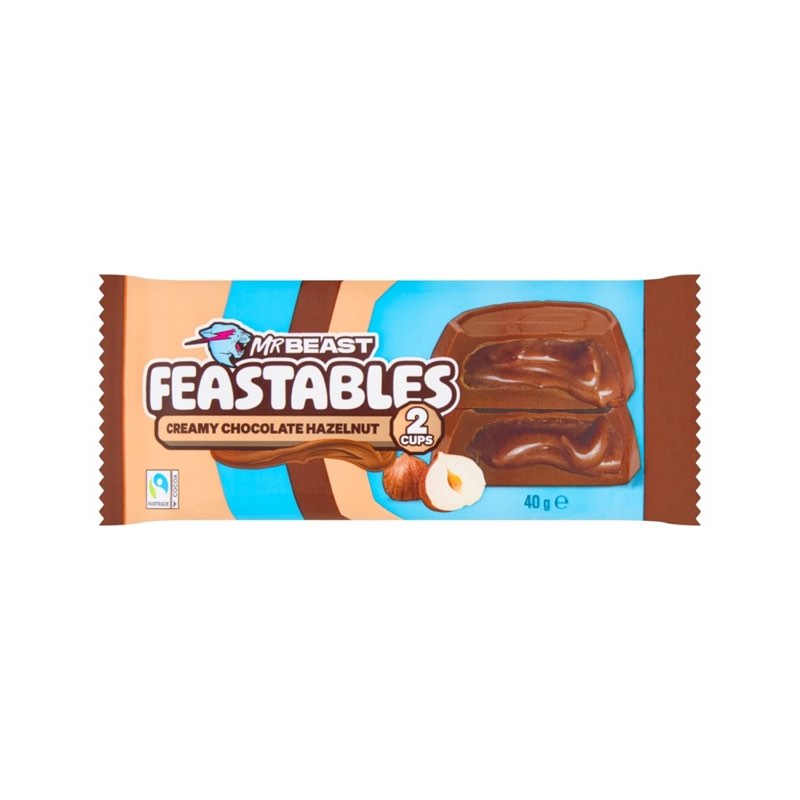
Gap four: something at pocket-money price for children. A £23.99 box is not what you want a six-year-old working through unsupervised. Give the younger end of the room their own thing. The Miskets Chicken Drumstick Box 50g at £1.99 and the Mr Beast Feastables 2 Creamy Chocolate Hazelnut Cups 40g at £1.99 are both small-format boxes at the same price, which makes them easy to buy in a matching set of six or eight so that nobody is comparing.
Put together, that is a table costing roughly forty-five pounds that serves a room of twenty-five properly and looks considered rather than assembled. The box is the anchor; everything else is doing a specific job around it. If you would rather build the supporting cast by weight instead of by packet, our Pick & Mix section lets you take small quantities of several lines instead of full bags of one.
Occasions this box was made for
Christmas, obviously — but think about which part of Christmas. The box is too good to be used as a stocking filler and too big to be used as a single gift for one person. Its real place is the table between Christmas Day lunch and the evening, when nobody wants another plate but everyone wants something small. Put it out at four o'clock and it will carry the room to seven.
The end-of-term or end-of-project gift run. Fourteen three-piece bags or twenty-one two-piece bags, made in an hour at a kitchen table, gets you through a class list, a department or a team. The unit economics here are genuinely good: 57p per piece means a three-piece gift costs you £1.71 before the bag and ribbon.
Weddings and large formal tables. One piece per place setting, with the name card tucked under the flag. Forty-two covers most function-room tables in one purchase, and the gold works with essentially every colour scheme anyone has ever chosen for a wedding.
The thank-you that has to look like something. There is a whole category of gift where the recipient needs to see immediately that you have spent properly — a neighbour who fed your cat, a colleague who covered for you, a host you are staying with. An intact 42-piece box does that work without a word of explanation.
Hampers, whether you are making one or six. As noted above, this is a weight-and-anchor item. Split across baskets it still reads as generous, because the pieces are individually finished. Round the hamper out with a small, visually different item — a foil line such as the foil-wrapped mini eggs is the usual move, since it keeps the shine and changes the shape.
Film nights and long evenings in. A slightly unusual recommendation, this one, but a sound one: wrapped chocolate is the best film-night sweet because it does not require you to look away from the screen twice. You take one, you unwrap it by feel, you are done. Loose sweets need a bowl, a hand and an eye.
What £23.99 buys, measured properly
Let us put the numbers down plainly, because a two-figure price on a sweet shop page deserves to be justified rather than assumed.
| Measure | Figure | What it means in practice |
|---|---|---|
| Box price | £23.99 | One size only — no smaller or larger option on this line |
| Weight | 525 g | Enough to anchor a hamper or fill a large bowl twice |
| Pieces | 42 | The planning number for everything below |
| Per piece | ≈ 57p | Cheaper than most single chocolates bought individually |
| Per 100 g | ≈ £4.57 | The figure to compare against other boxed chocolate |
| Weight per piece | 12.5 g | A two-bite chocolate; not a one-pop sweet |
| Cost per guest at 2 each | ≈ £1.14 | Twenty-one guests covered for the price of the box |
| Cost per three-piece gift | ≈ £1.71 | Fourteen gifts from one box, before wrapping |
The per-guest figure is the one worth sitting with. £1.14 a head to put a recognisable, individually wrapped chocolate in front of everyone at a gathering of twenty-one people is, by the standards of anything else you will buy for that party, cheap. The drinks will cost more per head. The savoury food will cost more per head. This is the item guests will comment on and it is not the item driving your budget.
The per-100g figure is where you compare honestly. At £4.57 per 100 g this is premium boxed chocolate pricing, several times the per-100g cost of the loose lines on our Loose Sweets shelf. You are paying for individual wrapping, for the tray, for the presentation and for the fact that it needs no explanation as a gift. If none of those things matter for your occasion — if you are filling a jar for a stall, for instance — then you should not be buying this box, and the honest answer is that the chocolate category as a whole has far better value per kilo elsewhere. If they do matter, this is a fair price for what it does.
One more piece of arithmetic that people find useful: a 525 g box is roughly the same weight as a large bag of loose sweets, but it occupies about three times the visual space because of the tray and the wrapping. For gifting and for table dressing, visual volume is what you are actually buying. For eating at home in front of the television, it is not, and the loose sweets counter will serve you better per pound.
Keeping it in good condition
Chocolate is the fussiest thing in a sweet shop and the one people treat most carelessly. Three rules cover almost everything.
Steady and cool beats cold. A cupboard in a room that stays reasonably even is better than a fridge. The problem with a fridge is not the cold itself; it is the move in and out of it. Every time chilled chocolate comes into a warm room, moisture condenses on the surface, and when it evaporates it leaves the surface dull and sometimes faintly grainy. A box that has been in and out of a fridge three times will not look like a gift any more.
Away from anything aromatic. Chocolate picks up smells with alarming efficiency. Do not store this next to coffee, spices, onions, scented candles or cleaning products. A closed box helps but does not solve it, especially over weeks. If you are buying in November for a December occasion, find it somewhere neutral and leave it there.
Flat, and not at the bottom. The tray protects the pieces from each other but not from twenty kilos of shopping. Store the box flat, on top of things rather than under them. The foil wrapping is forgiving of handling but the pleated paper cups crease permanently, and a creased cup is the difference between a box that looks bought and a box that looks found.
If it does get warm. Chocolate that has softened and re-set will often develop a pale bloom on the surface. That is a cosmetic change in the way the chocolate has crystallised, not a sign that anything has gone wrong with the sweet, but it does look tired and it does change the snap. Prevention is the only real fix, so if you are transporting this box anywhere in a warm car, put it in the footwell rather than the boot and keep it out of direct sun.
Size options — the short version
There is only one listing for this line and one price: one size, 42 pieces, 525 g, £23.99. There is no half-size box and no larger tray to trade up to, which simplifies the decision considerably. Your only real choice is how many boxes you need, and the guest table above answers that: one for up to about twenty-one people at two pieces each, two above thirty, three above sixty.
If the quantity is right but the price is more than you want to spend on a single item, the sensible move is not to hunt for a smaller version of this — it is to buy a cheaper chocolate in bulk and use this as the accent rather than the body. A kilo of the £5.49 tub of chocolate ice cups plus a handful of pralines gives a table both volume and a focal point for under a third of the cost of two boxes. That is the trade most experienced hosts end up making.
Finding it, and finding what sits beside it
On this site the box lives in three places, and each one is a useful doorway to something slightly different. It sits on the chocolate flavour shelf, which gathers everything that tastes of chocolate regardless of format — bars, coated sweets, filled pieces, novelties. It also sits on the sweet-type shelf for chocolate, which is organised the other way round, by what the sweet is rather than what it tastes of. And it appears among the loose and counter lines, which is where most of our volume-buying customers start.
From there, the useful neighbours are one click away. The full shop is the blunt instrument if you already know the name of what you want. If you do not, the hubs narrow things sensibly: the retro shelf for the older British lines people remember from a corner shop, jelly and gummy sweets for everything chewy and fruit-led, and build your own bag when you want several things in small amounts rather than one thing in quantity.
If you are shopping for a specific occasion rather than a specific sweet, the fastest route is usually to pick the anchor first — this box, or something like the £8.29 Lindor truffles — and then use the shelves to fill the gaps around it rather than browsing everything at once. And if you simply want to see the range, browse everything we stock and work backwards from what catches your eye.
Questions we get asked about this box
How many people will one box actually serve?
Plan on two pieces per person across an event and one box comfortably serves twenty-one people. If your gathering is smaller — ten or twelve — one box will leave you with a substantial amount left over, which is not a problem given the pieces are individually wrapped and will keep. Above twenty-five guests, buy two and hold the second one back rather than putting all eighty-four out at once. Putting everything out at the start is the fastest way to run short by mid-evening.
What does it work out at per chocolate?
£23.99 across 42 pieces is about 57p each, and 525 g at that price is about £4.57 per 100 g. That per-piece figure is the useful one when you are making small gifts: a three-piece bag costs you around £1.71 in chocolate, a two-piece bag around £1.14. The per-100 g figure is the one to use if you are comparing this against loose chocolate by weight, where you will find it sits at the premium end because of the individual wrapping and the tray.
Is there a smaller box available?
Not on this listing. This line is sold in one size only — 42 pieces at 525 g for £23.99 — with no smaller or larger variant to choose between. If the quantity is more than you need, the practical alternatives are to split one box into several small gifts, or to buy a lower-priced chocolate in volume and use a smaller number of pralines as an accent on the table rather than as the main event.
Will it survive being posted or carried in a car?
The tray and the individual foil give it more resilience than most boxed chocolate, and the pieces are robust objects rather than fragile shells. Heat is the real enemy rather than knocks. Keep the box out of direct sun and out of a hot boot, transport it flat, and store it somewhere cool and steady at the other end. Chocolate that has warmed and re-set is still perfectly fine to eat but can lose its gloss and its snap, which matters if it is going to be a gift.
Can I put it in the fridge?
You can, but we would generally advise against it unless your house is genuinely warm. The damage from refrigeration is usually done on the way out rather than on the way in: chilled chocolate brought into a warm room collects condensation, and when that dries it can leave the surface dull. A steady cool cupboard away from radiators and sunlight is better. If you do chill it, take it out at least half an hour before serving so the flavour has a chance to open up.
What should I put with it on a party table?
Three things it does not do itself. Something high-volume and cheap to absorb the first-hour rush, something chewy to change the texture, and something fruity and sharp to reset the palate between rounds. Chocolate ice cups or small chocolate shapes cover the first, a long-chew sweet covers the second, and anything from the jelly and gummy shelf covers the third. Build around the box rather than buying a second one, and the table will read as more generous for less money.
Is this suitable for children?
Sweets are a treat rather than everyday food, and that applies as much to a premium box as to a pocket-money bag. Small hard sweets and whole gummies are a choking risk for young children and should always be eaten under supervision. Anyone with an allergy in the household should check the manufacturer's own packaging when the box arrives and before anything is eaten — the printed pack is the authority on what is in the product, not a shop description.
When should I bring it out during an event?
Later than instinct suggests. Chocolate put out at the start gets eaten by early arrivals on an empty stomach and is gone before the point in the evening when the room actually wants something sweet. Hold it back until the savoury food has cleared or until the energy in the room dips — usually ninety minutes to two hours in. Because it is wrapped, waiting costs you nothing: it does not dry out, stale or look picked-over while it sits in the kitchen.
How do I stop it disappearing in the first ten minutes?
Two moves. First, split it between two or three small bowls placed away from where people are sitting, rather than one big bowl in the middle of a seated group — reaching distance is the single biggest factor in how fast a bowl empties. Second, put a cheaper, smaller sweet out alongside it in an obvious central position. Guests take the nearest easy thing first, and that absorbs the initial rush while the more expensive item lasts the evening.
Does it make sense for a hamper?
It is one of the better hamper anchors, for practical reasons rather than sentimental ones. It has enough weight at 525 g to hold the base of a basket steady, enough visual volume to fill a corner without padding, and it reads as a proper gift on sight. If you are making several hampers, one box can be split across three or four baskets and still look intentional in each, because every piece is individually finished rather than being part of a broken-up whole.
What is left over, and what do I do with it?
A 42-piece box very rarely finishes at a single event, and the leftovers are genuinely useful because nothing has been opened. Sweep whatever remains into a tin or a sealed bag at the end of the night and you have a fortnight of after-dinner chocolates. That is worth factoring into the price: the cost per guest looks different when a third of the box is still in the cupboard a week later, being eaten one at a time with coffee.
Is it in stock and how soon can I get it?
This line is currently showing as in stock on the site. If you are buying for a dated occasion — a wedding table, a Christmas gathering, an end-of-term run of gifts — order with a few days of margin rather than at the last moment, and if you need more than two boxes it is worth checking the listing again before you finalise your numbers, since a single popular box line can move quickly in the weeks before December.
The short version
This is a quantity purchase that happens to look like a gift, and it rewards being treated as one. Work out your head count, plan on two pieces each, hold the bowl back until the middle of the evening, split it across two spots rather than one, and buy something cheap and high-volume to take the first rush. Do those five things and £23.99 covers twenty-one people properly with chocolate left in the tin afterwards. Treat it as a bowl to be emptied at the start and it will be gone before anyone has finished their first drink — which is a shame, because the piece is at its best when someone has the time to notice the crack, the melt and the long finish that follows it.
More chocolate sweets
More chocolate sweets
More loose sweets sweets
Where this sits
Ferrero Rocher Milk Chocolate Pralines 42 Pieces 525g appears on these shelves. Browse them, or jump to something nearby.
You might also like