Home / Loose Sweets / Barratt Bumper Bananas
Barratt · 300g
Read the full guide
Barratt Bumper Bananas
£5.49
✔ In stock — ready to ship
Fresh stock
Free over £20
Same-day dispatch
Secure checkout
Before anything else, the arithmetic, because with a loose sweet sold across five weights the size you choose matters more than almost anything else about the purchase. Barratt Bumper Bananas run 250g at £5.49, 500g at £9.99, 750g at £12.99, 1kg at £18.99 and 2kg at £28.99. Written out like that the ladder looks orderly. Converted to a price per 100g, it is not.
Read the third column downwards and the anomaly is obvious. The rate falls as you go up — £2.20, £2.00, £1.73 — and then it goes back up again at the kilo, to £1.90, before dropping sharply to £1.45 at two kilos. The 750g is better value per gram than the 1kg above it. That is not a misprint on our part and it is not a trick; ladders on loose lines are built from round retail prices rather than from a formula, and every so often one of the rungs sits at an awkward height.
The full guide to Barratt Bumper Bananas
5,752 words on how it eats, who it suits, how to serve it and what to put beside it.
Five sizes, and the one on the ladder that does not behave itself
| Size | Price | Roughly per 100g |
|---|---|---|
| 250g | £5.49 | £2.20 |
| 500g | £9.99 | £2.00 |
| 750g | £12.99 | £1.73 |
| 1kg | £18.99 | £1.90 |
| 2kg | £28.99 | £1.45 |
The practical consequence is worth spelling out plainly, because it saves people money. If you were about to buy a kilo, buy 750g instead and you will pay six pounds less for only a quarter less sweet. If you genuinely need more than 750g, the next sensible step is not the kilo but the two-kilo, which is the cheapest rate on the whole ladder by a comfortable margin — and at £28.99 it costs only ten pounds more than the kilo for twice as much. The kilo rung is the one to walk past.
Now the portioning, which for a large-format sweet works differently to almost everything else on the site. Most confectionery portioning advice works in grams, because most sweets are small enough that a 30g handful is a handful. A bumper-sized piece is not like that. It is a sweet you count rather than weigh, because one of them is already a portion by any normal standard. Children given a single one do not usually ask for a second immediately; they are still working on the first.
That changes every calculation on the page. With a small sweet, 250g might vanish in one sitting between three people. With something this size, 250g is a genuinely useful quantity that goes further than the number suggests, because the eating rate is capped by the physical work of getting through each piece. If you are used to buying loose sweets by weight and finding they disappear faster than expected, a large-format line is the correction. You are paying more per 100g than for a small sweet, and getting more occasions out of it.
For party planning, count rather than weigh. Work out how many people, decide whether each gets one or two, and buy to that number with a margin. Overbuying on a large-format line is the more common mistake — people apply their small-sweet instincts, order a kilo, and find they have a cupboard full of them in March. A bag that is too big is not a disaster with a sweet that keeps, but it is money sitting in a cupboard doing nothing.
There is one more value angle specific to big soft sweets, and it is the one nobody mentions: they are light for their volume. Aerated confectionery contains a great deal of air by volume, so a bag of large foam pieces looks enormous relative to its weight. A 500g bag of these takes up considerably more space than 500g of a dense chewy sweet. If you are filling a jar, a display, a table centrepiece or a set of cones and what you actually need is visible volume rather than mass, this is one of the most cost-effective ways to fill space on the entire shelf. For display-led buying, that is a real and often overlooked advantage.
Against the rest of what we stock, £5.49 for the entry size is the standard loose-sweet price point here — it is the same headline figure as Barratt's jelly beans, the non-dusty milk bottles and the jelly spogs, all from the same maker and all on the same entry rung. Where those differ is in what you get for your money by volume rather than by weight, which brings us to what this sweet actually is.
The size in the hand is the whole proposition
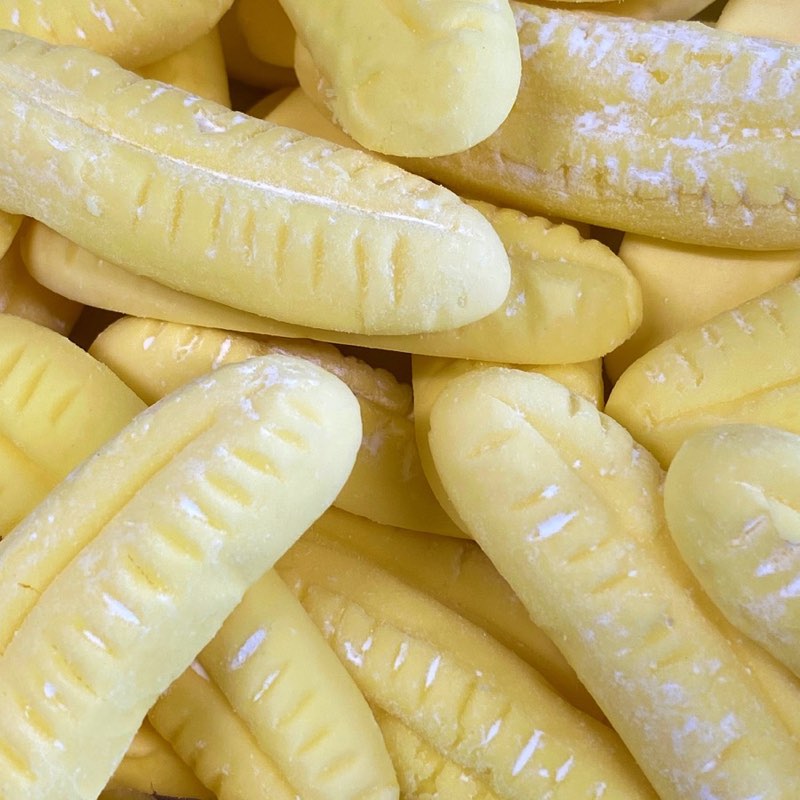
Pick one up and the first thing you register is that it does not fit the mental template for a sweet. It sits across the palm rather than in it. It has a length you notice, a heft that is much lower than its size predicts, and a give under the fingers that a hard sweet or a firm jelly never has. You can press it and watch it come back.
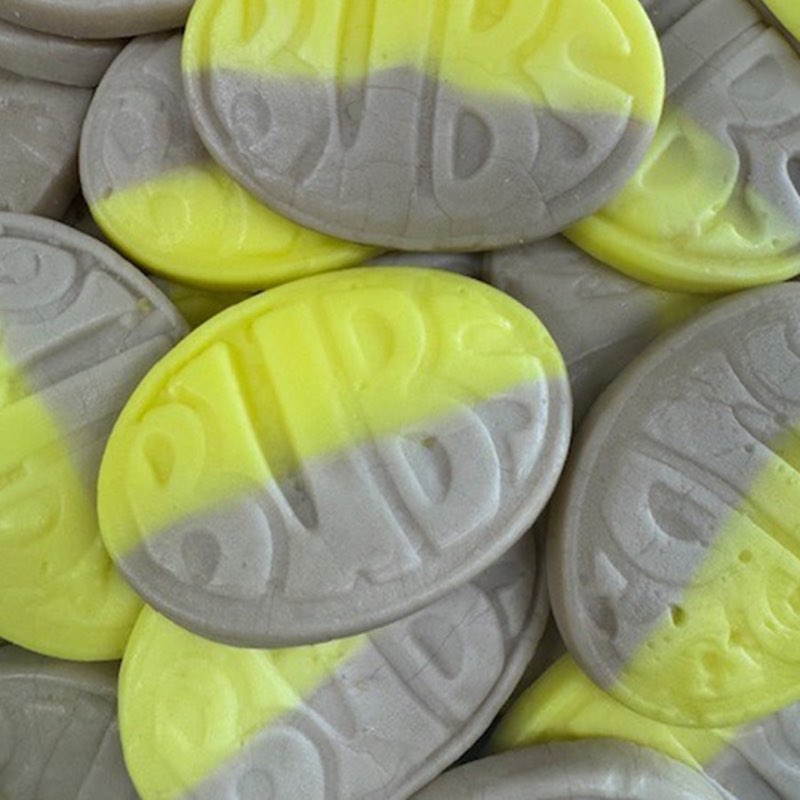
Yellow throughout, and shaped in the literal way that traditional British confectionery has always used — the name tells you the shape and the shape tells you the flavour. Nothing about the presentation is trying to be clever. This is a sweet from the counter tradition, which is why it sits on our retro shelf alongside eighty-eight other lines that have been doing exactly the same job for decades.
The scale is not incidental, and this is the thing worth understanding before you buy. A large soft sweet is not simply more of a small soft sweet. It eats differently, it is used differently, and it occupies a completely different role in a bag or a bowl. It is a one-piece event. You do not take a handful of these and graze; you take one and deal with it. That single fact drives everything else — who buys them, how they get served, how long a bag lasts, and how they behave next to other sweets.
There is a theatrical quality to the size too, and children respond to it in a way that is quite separate from taste. A sweet that is visibly bigger than a sweet ought to be is funny. It gets held up, compared, waved about and photographed before it gets eaten. That is worth something at a party, and it is the main reason large-format lines survive in a market where almost everything else has been getting smaller.
What happens between the first bite and the last of it
Eating something this size is a sequence rather than a moment, and the sequence is the interesting part.
The first bite is about compression. Your teeth meet almost no resistance at the surface, then meet the body of the piece, and it squashes before it parts. There is no snap and no crack — nothing brittle happens at any point. What you get instead is a slow yield, and if you bite gently and stop, the piece springs most of the way back. That rebound is the signature of a well-made aerated sweet and it is far more obvious at this scale than at any smaller one, simply because there is more material to do it.
The second thing you notice is that the outside and the inside are not quite the same. The exposed surface of any foam sweet sets slightly firmer than the interior, and on a piece this large there is a lot of interior. So the first bite gives you a thin, marginally drier outer layer, and then something softer and more open behind it. On a small piece the two are indistinguishable. On a bumper piece they are two distinct textures in one mouthful, and that contrast is much of the pleasure.
The flavour arrives on a long fuse. Banana is not an instant flavour in the way cherry or lemon is — it builds. On the first chew it is faint, on the third it is fully present, and on the sixth it is still there. With a large piece you are chewing for long enough to get the entire arc, from the first hint to the full rounded middle to the slow fade. A small foam sweet gives you the middle only, because it is gone before the rest can develop. This is the single biggest eating difference between large and small formats of the same sweet, and it is why some people who dislike banana in small sweets get on perfectly well with it in a large one.
The finish is mild and creamy rather than sharp, and it does not linger aggressively or dry the mouth out. It leaves no acid edge on the sides of the tongue. What it does leave is a slight coating sensation that makes the second piece less appealing than the first — which is a feature, not a fault. This is a sweet with a natural stopping point built into it.
Temperature makes a genuine difference here and it is worth exploiting. Cold, an aerated sweet firms up considerably and the chew becomes more substantial and slower; the flavour takes longer to emerge but lasts further. Warm, it goes softer and more yielding and the flavour arrives sooner. Neither is right, but they are noticeably different experiences from the same bag, and a big piece shows the difference far more clearly than a small one does. If you want the eating to last, keep the bag somewhere cool.
How a foam sweet gets its texture, and why size changes it
Foam is the most misunderstood category in the sweet shop, and the misunderstanding is usually that it is a soft version of a jelly. It is not. It is a different structure altogether, and once you know what that structure is, everything about how this sweet behaves becomes predictable.
The defining fact about any foam confection is that a large proportion of it, by volume, is air. Not flavouring, not colour, not anything you can taste — air, held in place by a set structure around it. That is what separates foam from every other texture on the shelf. A hard sweet is a solid. A jelly is a solid gel. A chew is a very stiff, very slow-moving semi-solid. A foam is a scaffold full of bubbles. Every characteristic that follows comes from that one structural fact.
Consider what it explains. It explains the low weight relative to size — air weighs nothing, so a piece the size of your palm can weigh very little. It explains the rebound, because a bubble structure compresses and re-expands in a way a solid cannot. It explains the fast flavour release, because the surface area inside a foam is enormous compared to a solid of the same size, and flavour reaches the tongue across all of that internal surface as the structure breaks down in the mouth. And it explains why foam sweets dry out rather than going sticky as they age: they have a huge internal surface exposed to the air, and moisture leaves it much faster than it leaves a dense sweet.
The texture that results is controlled by two variables that pull against each other. The first is how much air is worked in, which sets the density — more air gives a lighter, more melting piece; less air gives something closer to a chew. The second is how firmly the surrounding structure sets, which determines whether the bubbles hold their shape under pressure or collapse. A light aeration with a firm set gives you something that springs back. A heavy aeration with a soft set gives you something that flattens and stays flattened. Confectioners hit the balance they want and then keep it consistent, and the reason retro foam lines have lasted so long is that they hit a balance people like and then never moved it.
Now the part that actually matters for this particular product: scale changes perceived texture even when nothing about the formulation changes at all. Three reasons, and they compound.
First, surface-to-volume ratio. A small piece is nearly all surface; a large piece is mostly interior. Since the surface of a foam sets firmer than the middle, a small piece reads as relatively firm and a large piece reads as relatively soft — from the same material. This is not psychology; it is geometry.
Second, bite mechanics. When you close your teeth on something small, they pass straight through and out the other side in one movement, and you experience a single undifferentiated event. On something large, your teeth travel through the material and stop partway, so you feel the compression phase, the yield phase and the separation phase as three distinct things. More material means more time, and more time means more texture information reaches you.
Third, structural failure behaves differently at scale. A big piece of foam can tear rather than cut — you can pull it and watch it stretch and then part along a ragged edge, which is a completely different physical experience to biting. Children work this out immediately and play with it. A small piece simply does not offer that.
This is why arguing about whether large or small foam sweets are "better" is a category error. They are not the same product at different sizes. The material is common to both; the eating experience is not. If you want the long chew, the compression-and-rebound, the outer-and-inner contrast and the full flavour arc, you want scale. If you want something that melts away quickly, you want the opposite.
Texture contrast is also the thing that stops a bag being boring, which is the real argument for the foam category as a whole. Almost everything in a typical mixed bag is chewy or firm. Our foam sweets shelf runs to thirty-three lines against several hundred elsewhere, and that scarcity is precisely what makes a foam element valuable — it is the one texture in the bag that behaves differently in the mouth. The briquette line at £5.49 is the same broad texture family in a different shape and flavour direction, and the BUBS banana and caramel foam sweets at £7.50 take the aerated structure and pair the banana note with caramel rather than leaving it on its own.
The builder's view: what a big soft piece does to a mixed bag
Anyone who has assembled a proper pick and mix knows it is a composition rather than a collection, and the most common failure is a bag of ten things that all do the same job. The most valuable way to think about a large-format sweet is as a structural element in that composition, because it is the one component that changes the whole bag rather than adding to it.
A big piece functions as a landmark. Tip out a bag containing twenty small sweets and three large ones and the eye goes straight to the large ones every time. They organise the pile. They give people something to aim for and something to save. Without a landmark item, a mixed bag reads as undifferentiated rubble, however good the individual components are — and this is the mistake most home-built mixes make.
Landmarks also create sequence. When there is one obviously special item in a bag, people build an order of eating around it — some go straight for it, others save it for the end, and either way the bag becomes a small narrative instead of a handful. That effect is worth more to a party bag than an extra flavour would be.
There is a practical mechanical point too. Large soft pieces cushion. In a bag that is going to be carried in a pocket, a rucksack or a car door, big pieces of aerated sweet act as packing material around the fragile things, and anything brittle or dusted survives the journey considerably better for their presence. If you are building bags that will travel, put two or three big soft items in with the small stuff deliberately.
The counterweight — and every builder should know it — is that large pieces dominate weight, which is where mixed-bag economics get interesting. If you are filling a bag to a target weight, a handful of large items can account for a surprising share of it. With a light aerated sweet the effect is gentler than with a dense one, since air costs nothing on the scales, but it still means a bag with three big pieces has fewer slots left over than people expect. Build the small stuff first and add the landmarks last, or you will run out of room.
On what to put around it: the rule is to contrast on the axes the big piece does not cover. It is soft, so bring something firm. It is mild, so bring something sharp. It is one long flavour, so bring something short and vivid.
For firmness, the fried eggs at £5.49 are the natural partner — another shape-named classic with a completely different resistance under the tooth, and a two-tone look that sits well against a single-colour item. For a chew that takes real work, the Black Jack chews at £5.49 pull the bag in an entirely different flavour direction and slow everyone down. For something firmer again with a distinctive silhouette, the giant shrimps at £5.49 give you a second large-format item that is not a foam, and having two different kinds of big thing is better than having two of the same.
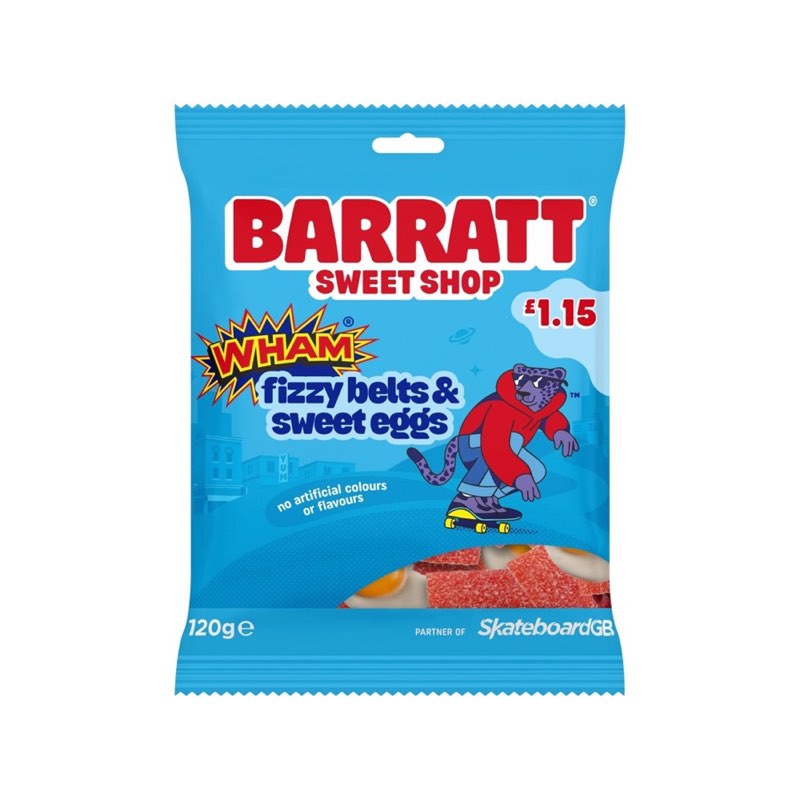
For the sharp, short, vivid element, the Wham fizzy belts and sweet eggs at £1.15 for 120g bring fizz into a bag that otherwise has none, for very little money. And for a dense, chewy, wrapped element that survives anything, a ten-pack of Wham chew bars at £2.50 or the drumstick chew bars, also ten for £2.50 are the cheapest way to add a completely different format to a spread — wrapped bars behave differently in a bag to loose sweets and give people something to pocket.
Two more worth knowing. The traditional salted caramel bon bons at £5.49 bring a dusted, slow-dissolving element that reads as much more grown-up than everything around it, which matters if adults are sharing the bowl. And the chocolate covered bears at £7.49 add the one thing a fruit-and-foam bag genuinely lacks, which is chocolate — a coated item in a bag of uncoated ones is an instant point of difference. If you would rather not assemble any of this yourself, our pick and mix section is built for exactly this job and lets you weigh out the proportions you want.
The builder's final rule: decide the bag's purpose before you fill it. A bag for a five-year-old wants soft, large and few. A bag for a car journey wants nothing dusted and nothing that melts. A bag for an adult evening can take sour, aniseed, liquorice and salt. The same components succeed in one bag and fail in another, and the big soft landmark item is one of the very few things that works in all three.
Banana, and why it divides people
Banana is the most polarising flavour in British confectionery and it is worth being honest about that before you buy 750g of it. People who like it tend to like it a great deal; people who do not will pick it out of a mixed bag and leave it on the side. There is very little middle ground, which is why our banana shelf is a compact six lines rather than the sprawl you get with the red fruits.
What it actually tastes of in a sweet is a rounded, creamy, slightly sweet-shop version of the fruit rather than anything that closely tracks a real banana. That gap is the whole reason for the division. Nobody complains that lemon sweets are not lemons, but banana sits close enough to be measured against the fruit and far enough away to lose the comparison. Taken on its own terms, as a confectionery flavour rather than as an imitation, it is one of the most comforting things on the shelf — soft-edged, warm, and completely without sharpness.
Its great structural virtue in a mix is that it does not fight. Banana sits underneath sharper flavours rather than competing with them, which is why it turns up so often as the mild element in assortments. Put it next to a sour item and it reads as relief. Put it next to cola and the two coexist happily. Put it next to another creamy flavour and you have made a bag with no contrast in it at all — that is the one pairing to avoid.
It also pairs unusually well with caramel and with chocolate, both of which run in the same warm, rounded register. If you want to explore that direction, the banana-and-caramel foam pairing mentioned earlier is the most direct version we stock.
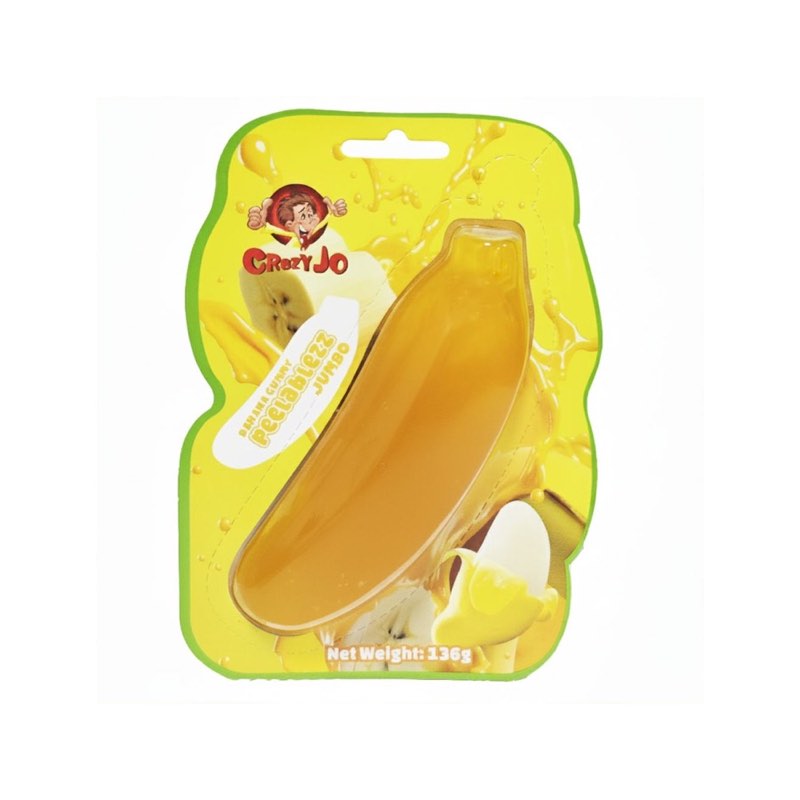
Within banana lines, format changes the flavour experience more than you would expect. The jumbo banana gummy at £2.99 for 136g puts the same flavour into a dense, peelable gummy structure, and the result reads much sweeter and more concentrated than the aerated version, because a gummy holds flavour in a solid mass and releases it slowly. Same flavour, genuinely different experience — and at under three pounds it is a cheap way to find out which structure you prefer before committing to a big bag of either.
Who buys the big ones
Parents buying for children are the core, and the reason is the one-piece-is-a-portion property. A single large sweet is a complete, obvious, unarguable treat. There is no negotiation about how many, no counting, and no pile of wrappers. You hand over one thing, it lasts a while, and it is finished. For anyone who has tried to administer a share bag to a determined seven-year-old, that is worth paying for.
Party and event buyers are the second group, and for them the appeal is visual. Large sweets fill cones, jars and table displays with far less weight than small ones, and they photograph well. A display built on small sweets needs serious quantity to look generous; a display with big pieces in it looks generous immediately.
The nostalgia buyer is the third, and it is a bigger constituency than people assume. Retro lines sell to adults buying a specific memory, and the large formats sell especially well into that because the size is itself part of the memory — sweets genuinely did feel enormous when you were small. The Barratt range runs to eleven lines here, most of them squarely in that territory.
Finally, the texture seeker. Some people simply prefer soft, and a substantial proportion of what is on sale is firm, chewy or hard. If you have spent years picking the soft ones out of mixed bags, a bag of nothing but large soft pieces is a straightforward pleasure and there is not much more to say about it.
Parties, displays, film nights and the hamper problem
Children's parties are the obvious home for this. One piece per child in a cone or bag, with smaller items around it, gives every bag a centrepiece at minimal cost. Portion the day before. As with all confectionery, sweets are a treat, whole sweets are a choking hazard for young children, and small children should be supervised while eating.
For sweet tables and displays, this line earns its place by volume. Tall jars in particular want items with presence — small sweets in a big jar read as a jar half full of grit, whereas a few dozen large pieces fill the same jar convincingly. If the table is going to be photographed, buy for volume and not for weight.
For film nights, the long chew is the point. A sweet that takes a while to get through paces itself against a two-hour film far better than something you can eat forty of without noticing. The absence of any acid edge helps too: nothing here will wear your mouth out an hour in.
For hampers and gifts, a loose bag on its own is not a present, but a large-format retro line is an excellent centrepiece for a homemade one, because the size does the visual work and the nostalgia does the sentimental work. Build around it with a couple of wrapped items and something dusted or chocolate-coated for contrast, and you have a hamper that cost very little and looks considered.
For Christmas and the seasonal table, a big yellow soft sweet is a useful counterweight to a spread that is otherwise all red, green and foil. The festive mallow stacker at £1.50 for 45g is a cheap seasonal companion in the same broad texture family if you want to keep the soft theme running through a winter table.
Keeping a big bag of foam in good condition
Foam has one specific vulnerability and it is the opposite of what most people expect. It does not go sticky; it goes dry. All that internal surface area means moisture leaves the structure quickly once it is exposed to air, and a bag left open will give you pieces that are firmer, chewier and less springy within days. They are perfectly fine to eat, but they are not the sweet you bought.
So the rule is simple and it matters more here than for almost any other category: seal it properly, every time. An airtight container is better than a bag clip, and a bag clip is much better than a fold. If you have bought one of the larger sizes, split it — keep a small working amount out and the rest sealed away, so you are opening the main quantity once a week instead of every day.
Keep it cool, dark and dry. Heat softens the structure and can cause pieces to settle into one another; strong light will fade colour over time; damp is the one condition that will make a foam surface tacky. A cupboard away from the oven is all that is needed. Do not refrigerate as a matter of routine — the cycling between cold and room temperature does the structure no favours — though a short chill before serving on a warm day is fine and makes the chew firmer.
If pieces have compressed against each other in the bag, spreading them out on a tray for an hour usually lets them recover most of their shape. They will not fully return if they have been squashed under weight for weeks, so store the bag where nothing heavy sits on top of it.
Check the manufacturer's packaging on arrival for storage and any information you need before eating, particularly if anyone in the household has an allergy. We do not restate pack information on our listings — read the packaging itself.
Picking your rung on the ladder
All five sizes are the same sweet, so this is purely a question of quantity and rate. Some guidance.
250g at £5.49 is the try-it size and the right first purchase for anyone unsure about banana. It is also the correct size for a household of two.
500g at £9.99 is the standard family bag — enough to last a few weeks of occasional treats without becoming a project, and it brings the rate down to a round £2.00 per 100g.
750g at £12.99 is the value sweet spot on this ladder at £1.73 per 100g, and it is the size to choose for a party of any real size. It is also, as set out at the top, better per gram than the kilo above it.
1kg at £18.99 is the rung to skip unless you specifically need a kilo in one bag and the 750g genuinely will not do. Two 750g bags would cost more, so the kilo is not irrational — it is simply the weakest rate between 500g and 2kg.
2kg at £28.99 is the best rate on the ladder at around £1.45 per 100g, and it is a serious quantity of a large-format sweet. This is event and display buying. If you are filling jars for a wedding table or stocking a stall, this is your rung; if you are buying for a house, it is almost certainly too much, and a bag that large will be open for a long time — decant and seal properly.
The line is in stock across the range at the time of writing.
Where to go next on the site
This listing sits on five shelves, and each is a different route through the catalogue. The loose sweets section, at three hundred and fifty-six lines, is the largest part of the shop and the right place to browse if you buy by weight. The soft and aerated category gathers the thirty-three lines that share this texture. The banana flavour listing holds the six lines we carry in this flavour, which is the fastest way to compare formats. The retro collection runs to eighty-nine lines of counter-tradition classics, and the Barratt shelf holds the eleven lines from this maker.
Beyond those, the whole catalogue is there for open browsing, the candy and chocolate shelf is where to go when the answer is not a fruit sweet, and the brand shelves for Kingsway and Haribo hold much of the rest of the shape-named classic tradition that this sweet belongs to.
If you are here to build rather than to buy one thing, work shelf by shelf rather than product by product: pick a texture from the foam list, a firmness from the jellies, something wrapped, and something coated, and you will have a better bag than any amount of browsing at random produces.
Things worth asking before you order
How big is one, really?
Big enough that it reads as a novelty rather than a sweet — it sits across the palm rather than in it, and it is a multi-bite item for an adult, never mind a child. That is the entire proposition of the line, and it is why the portioning advice on this page is to count pieces rather than weigh grams. If the size is not what you are after, the same flavour exists in the shop in denser, smaller formats.
Which size is actually the best value?
Per gram, the 2kg at around £1.45 per 100g, comfortably. But the more useful answer for most people is that the 750g at £12.99 beats the 1kg at £18.99 on rate — £1.73 against £1.90 per 100g. If you were going to buy a kilo, buy 750g and save six pounds, or jump straight to the 2kg if you genuinely need the quantity.
Is this the same as the small foam ones?
Same broad texture family, completely different eating experience. Scale changes how a foam sweet behaves in the mouth: a large piece gives you a firmer outer layer against a softer interior, a long compression-and-rebound chew, and the full arc of the flavour from first hint to fade. A small piece gives you the middle of that arc only, because it is gone too quickly for the rest.
Will they go hard if I leave the bag open?
Yes, and faster than you would expect — drying out is the specific weakness of aerated confectionery, because there is so much internal surface exposed to the air. Seal the bag properly after every use, ideally in an airtight container. If you bought one of the big sizes, decant a working portion and keep the rest sealed. Cool, dark and dry is all the storage this needs.
Are they too big for young children?
They are a large sweet, and as with all confectionery, sweets are a treat and whole sweets present a choking risk for young children, who should be supervised while eating. Many parents cut or tear large soft pieces into smaller ones for very young children, which is easy to do with this texture. Use your judgement about the child.
Do they work in a pick and mix, or are they too big?
They work extremely well, but as a landmark item rather than as filler — two or three in a bag rather than twenty. A big soft piece organises the bag visually, gives people something to save for last, and cushions anything fragile packed around it. Build the small components first and add the large ones at the end, or you will find you have run out of space.
What should I put with them for a party bag?
Contrast on the three axes this sweet does not cover. Something firm under the tooth, such as fried eggs or giant shrimps. Something fizzy or sharp, such as the Wham belts and eggs. And something wrapped or chocolate-coated, which behaves differently in a bag and survives being carried. That combination covers most preferences in a room of children.
Does banana suit everyone?
No, and it is worth being straightforward about it. Banana is the most divisive flavour on the shelf — people either reach for it or pick it out. If you do not already know how your household feels about it, buy the 250g first at £5.49 rather than committing to a large bag. It is one of the cheapest mistakes to avoid on the whole site.
Can I use these for a sweet table or jar display?
They are one of the best options for it. Aerated sweets are light for their volume, so they fill a tall jar convincingly for far less weight than a dense sweet would need. If you are buying for appearance, buy to fill the container rather than to hit a weight figure, and expect to need less on the scales than you think.
How long does a bag last once opened?
That depends on how well it is sealed rather than on the calendar. Kept airtight, cool and dark, a bag holds its texture well for a good while. Left open, it will begin to firm up within days. The practical answer is to treat the seal as the thing that matters and ignore everything else — always deferring to the storage guidance on the manufacturer's packaging.
Why is the kilo more expensive per gram than the 750g?
Because price ladders on loose lines are built from sensible-looking retail prices, not from a single rate, and occasionally a rung ends up out of step. We would rather point it out than let people walk into it. Buy the 750g or the 2kg, depending on how much you actually need.
To sum up
This is a large, soft, aerated banana sweet from the retro counter tradition, sold loose from 250g at £5.49 up to 2kg at £28.99. The size is not a gimmick attached to the product — it is the product. Scale changes how an aerated sweet eats, giving you a firmer outer layer against a soft interior, a long chew with real rebound, and the whole slow arc of the banana flavour rather than a snatch of its middle.
Buy it if you want one-piece portions rather than handfuls, if you are filling jars or cones and need volume rather than mass, or if soft is simply your preference. Buy the 250g first if banana is an open question in your house. Buy the 750g if it is not. Keep it sealed, keep it cool, and use it as the landmark in a mixed bag rather than the whole of one.
More from Barratt
More retro sweets
More banana sweets
Where this sits
Barratt Bumper Bananas appears on these shelves. Browse them, or jump to something nearby.
You might also like