
Home / Loose Sweets / Taveners Liquorice Allsorts
Kingsway · 250g
Read the full guide
Taveners Liquorice Allsorts
£5.49
✔ In stock — ready to ship
Fresh stock
Free over £20
Same-day dispatch
Secure checkout
There is no such thing as a general sweet shopper, and allsorts prove it better than almost anything else on the shelf. This is a product with a very specific set of buyers, each of whom wants it for a completely different reason, and if you can work out which of them you are, the rest of the decision — which size, what to put with it, whether to gift it or keep it — falls out almost automatically.
The person buying for someone older than them. This is the single biggest reason a bag of Taveners Liquorice Allsorts leaves a shop. Allsorts are a known quantity across generations in a way that very little modern confectionery is. If you are putting together something for a grandparent, an older neighbour, a retirement card or a hospital visit, you are looking for something that will be recognised rather than investigated, and this is that. Nobody has to be told what it is.
The full guide to Taveners Liquorice Allsorts
5,483 words on how it eats, who it suits, how to serve it and what to put beside it.
The people who actually buy allsorts
The liquorice loyalist. A smaller group, and an intense one. People who like liquorice like it seriously and are permanently underserved, because most of a sweet shop is fruit. For them the assortment is a slight compromise — they would often rather have the flavour undiluted — but it is the version everyone else at the table will also eat, which makes it the sociable choice.
The hamper builder. Anyone assembling a gift box wants variety of colour and shape within a single item, because it does the visual work of three items. Allsorts are multi-coloured by nature; that is the whole premise of the format. A 250g bag of them in a box looks like effort.
The nostalgic buying for themselves. A quiet, common purchase. Somebody remembers these from a tin on a sideboard and buys 250g to find out whether the memory holds up. It usually does, because the format was never built on novelty.
The host with a mixed-age room. Allsorts solve a specific catering problem: a table where the guests range from eight to eighty. Most sweets pick a side. This one does not, because the assortment contains enough variety that everyone finds something, and because the pieces are visually interesting enough that children will try them on looks alone.
The office orderer. Loose sweets by weight, in a tin, on a shared desk. The reason allsorts work here rather than a bag of chocolate is that they are divisive in a productive way — people have opinions about which shapes they like, and that is a better conversation than a silent biscuit tin.
The person who is not sure what they want. An assortment is the correct answer to indecision. You are buying variety rather than committing to one thing, which is exactly the right move when you are buying for someone whose tastes you do not know precisely.
Who it is genuinely not for: anyone buying purely on the strength of one flavour they love, because an assortment by definition dilutes. And anyone catering a young children's party where bright and sour do more work. In both cases there are better tools on the shelf, and we would rather point you at them than sell you the wrong bag.
Tipping the bag out: shapes, colours, and the first piece
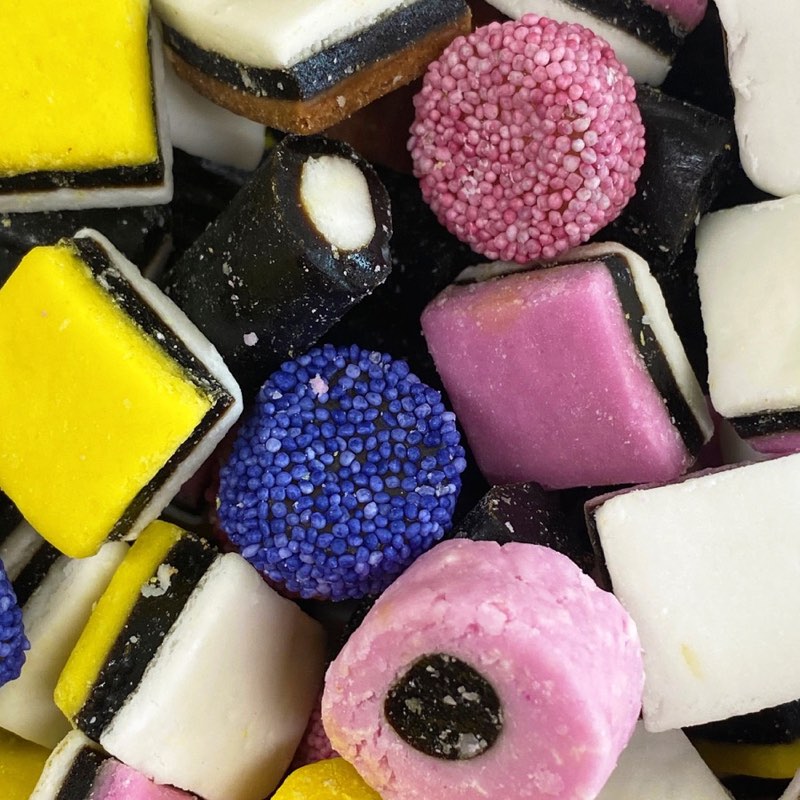
The defining thing about the allsorts format is that no two pieces in your hand are the same. This is a multi-coloured line — that is the colour description we hold for it — and the variety is structural rather than decorative. The format is an assortment of shapes as well as colours: layered pieces built in bands, round pieces, and small cylindrical ones, each of which eats slightly differently from the others. That is unusual. Almost every other sweet on a shelf is one shape repeated.
The immediate consequence is that eating allsorts is a sorting activity. People sort. They pick out the ones they like first, or they save them for last, or they eat them in an order. Put a bowl of these in front of six people and you will watch six different strategies emerge within a minute, which is entertainment you do not get from a bowl of identical sweets.
In the hand, the pieces are substantial — noticeably bigger and denser than a jelly sweet — and they have some weight to them. You hold three or four rather than a fistful. The surfaces vary: some pieces are smooth, some are textured, and the layered ones have defined edges that make them look, quite deliberately, like something constructed rather than moulded.
The bite is soft and yielding rather than springy. There is no snap and no bounce. You go in and the piece gives, and then you are into a dense, slightly heavy chew that takes a while to work through. Allsorts are not a fast sweet. One piece is a proper mouthful and occupies you for the best part of a minute.
Flavour-wise, the two families we hold for this line are liquorice and coconut, and they behave very differently in the mouth. The liquorice side arrives dark, deep and slightly savoury — it is the flavour that gives the format its name and its backbone, and it has a long, lingering finish that stays with you well after you have swallowed. The coconut side is the counterweight: lighter, sweeter, rounder, with a soft aromatic quality that sits on top rather than underneath. Alternating between them is the actual pleasure of the format. Neither flavour would carry a whole bag on its own, but each makes the other more interesting.
That alternation is also why an assortment goes further than you expect. Palate fatigue is what ends most sweet sessions — after fifteen minutes of the same flavour your mouth stops registering it and you stop enjoying it. An assortment resets the palate with every piece, which means you can work through allsorts steadily for an hour without the diminishing returns that set in with a single-flavour bag.
We do not publish ingredients or nutritional detail on this page, and we are not going to reconstruct them. The manufacturer's own packaging arrives with your order and carries all of it. Anyone with an allergy should read that packaging on arrival, before eating.
Sending sweets to people: hampers, letterboxes, staff rooms and care parcels
Sweets are one of the few gifts that almost nobody objects to receiving, and allsorts in particular are one of the few sweets that work as a gift for an adult without needing an apology attached. It is worth thinking about why, because it tells you how to use them.
A good small gift has to clear three bars. It has to be recognised — the recipient should know instantly what it is and that it is for them. It has to be consumable, so it does not become an object they are obliged to keep. And it has to be proportionate, so it reads as a kindness rather than as a debt. A 250g bag of allsorts at £5.49 clears all three cleanly, which is a harder trick than it sounds.
The hamper. The mistake most first-time hamper builders make is buying big. One large item looks like a single purchase in a box. Four smaller ones look like a considered collection. Loose sweets by weight are ideal here precisely because you control the quantity, so you can put 250g of four different things into a box for roughly £22 and end up with something that looks and feels far more generous than one £22 item ever would. Within that four, allsorts should be the visual anchor — the multi-coloured item that catches the eye when the lid comes off. Put something brown and adult next to it, something bright, and one oddity.
For the brown-and-adult slot, Bristow's Traditional Salted Caramel Bon Bons at the same £5.49 is the obvious pairing — a long, slow, savoury-edged chew that sits at the opposite end of the spectrum from a bright assortment and stops the box reading as a children's gift. For the traditional slot, Gray's Traditional Teacakes at £6.49 is the item most likely to produce an actual noise of recognition. And if the recipient is a liquorice person specifically, Taveners Liquorice Comfits at £5.49 doubles down in the same flavour direction with a completely different texture — small, hard and rattly against the soft density of an allsort.
The letterbox treat. This is the gift format that has quietly become the most useful one, because it removes the two things that ruin small presents: the delivery slot you have to be in for, and the packaging that costs more than the gift. Sweets by weight are close to ideal letterbox material. They are flat enough, they are not fragile, they do not melt at normal temperatures, and 250g is a real quantity rather than a token one. A single bag posted to someone having a bad week costs less than a decent card with a gift attached and lands considerably better.
Keep letterbox parcels to one or two bags. Three starts to be a package rather than a letter, and the point of the format is that it arrives without ceremony while the recipient is out.
The teacher gift, and the general thank-you. There is a specific etiquette problem with thanking someone professionally: too small looks perfunctory, too large creates awkwardness, and anything personal is a risk when you do not know them well. Sweets sidestep all of it. They are unambiguously a thank-you, they are shareable — which matters enormously in a staff room, because a shared tin makes the gesture bigger without making it more expensive — and they carry no implication of obligation. 500g at £9.99 is the right size for a staff room, because it is enough to put in a tin and leave out rather than something one person has to take home.
Allsorts are a particularly safe choice for this because they are divisive in the mildest possible way. Some people love liquorice, some do not, and the assortment format means the ones who do not still have things to eat. A tin that empties unevenly is fine; a tin nobody touches is not.
Care parcels. Whether it is a student, someone in hospital, someone who has moved away or someone going through it, a care parcel does a job that has almost nothing to do with the contents. It says: I thought about you and I did something about it. What you actually want in the box is a mix of the familiar and the frivolous. Allsorts cover the familiar. For the frivolous half, the novelty end of the shelf does better work than you would expect — Kingsway Jelly Eyeballs at £5.49 and Kingsway Gummy Bones at the same price are exactly the sort of thing that makes somebody laugh when they open a box, which is worth more than the sweets are.
Seasonal boxes. If you are building for a specific date rather than a general gift, the seasonal lines earn their place, because a seasonal shape dates the gift in a good way. Kingsway Witches Heads and Pumpkin & Ghost Marshmallows, both £5.49, do that job for late October, and pairing one of them with a year-round staple like allsorts stops the box being entirely gimmick.
A note on presentation. Loose sweets arrive in a bag, and a bag is not a gift. Decant. A jar, a tin, a cellophane bag with a ribbon, a paper cone — any of these turn 250g of sweets into a present in about ninety seconds. This is the single highest-return thing you can do when gifting sweets, and it costs almost nothing. Multi-coloured sweets in particular reward being visible: allsorts behind glass look considerably better than allsorts in a bag.
And a note on what not to claim. When you are gifting to someone whose requirements you do not know precisely, send the manufacturer's packaging with the sweets rather than decanting and binning it. If the recipient has an allergy, they need to be able to read it themselves before eating. That is worth the small loss of presentation.
The arithmetic: per gram, per handful, per guest
Loose sweets are one of the few things in a sweet shop where you can do real maths, because you are buying a weight rather than a package. It is worth doing, because the difference between the cheapest and dearest way to buy the same sweets here is about a third.
| Size | Price | Per 100g | Per gram | Saving vs 250g bags |
|---|---|---|---|---|
| 250g | £5.49 | £2.20 | 2.20p | — |
| 500g | £9.99 | £2.00 | 2.00p | 99p |
| 750g | £12.99 | £1.73 | 1.73p | £3.48 |
| 1kg | £16.49 | £1.65 | 1.65p | £5.47 |
| 2kg | £28.99 | £1.45 | 1.45p | £14.93 |
Read the shape of that ladder rather than just the bottom line. The steepest single improvement is the step from 500g to 750g, where the price per 100g falls by twenty-seven pence — more than any other step. After that the curve flattens hard: 750g to 1kg gains you only eight pence per 100g. The 2kg tier is genuinely the cheapest per gram, but it saves you only twenty pence per 100g over the 1kg while doubling both your outlay and your storage problem.
The practical conclusion is that 750g at £12.99 is the value tier for most people. It is where the curve stops rewarding you meaningfully for buying more, and it is still a quantity a household can get through in good condition.
Per handful. This is the unit people actually eat in, so it is the most useful one. Allsorts are substantial pieces — a comfortable adult handful is somewhere in the region of six to eight pieces, call it 40 to 50g, though that is an estimate from the format rather than a measured figure. At the 250g price that puts a handful at roughly 90p to £1.10. At the 2kg price it falls to around 60p to 70p. Put another way: the difference between buying small and buying big is about a third of a handful, every handful, forever.
Per guest. For catering, the working figure most people land on is 40 to 60g of sweets per adult across an evening where there is other food available, and rather more — perhaps 75g — where the sweets are the main event or where children are involved and it is a long afternoon. That gives you a straightforward planning table:
- 250g — four to six people for an evening, or one household bowl that lasts a weekend.
- 500g — eight to twelve people, or a staff-room tin that lasts a fortnight.
- 750g — a proper party of twelve to eighteen, and the best value on the ladder.
- 1kg — sixteen to twenty-five, or a household that has decided this is their sweet.
- 2kg — an event, a stall, a large family Christmas, or a school fair. Genuinely a lot of sweets.
Per gift. Different maths again, because here you are buying an impression rather than a quantity. A four-item hamper at 250g each runs to around £22 and looks substantial. A single 1kg bag at £16.49 costs less and looks like less, despite being more sweets. If the gift is the point, buy small and buy several. If the eating is the point, buy one and buy big. Almost every mistake people make buying sweets as presents comes from confusing those two objectives.
Against the alternatives. At 1.45p per gram on the top tier, loose sweets by weight are among the cheapest ways to put something enjoyable in front of a room. It is worth comparing against the sealed-bag end of the shop, where you are paying for the packaging and the convenience as much as the contents. The trade-off is real in both directions — a sealed bag needs no jar, no decanting and no storage discipline — but if you are filling a bowl rather than carrying one, buying by weight wins on price every time.
One caution on the big tiers. The saving on 2kg is only real if the last 500g is still in good condition when you get to it. Storage discipline, covered below, matters far more at that scale than it does with a single small bag, and a kilogram of sweets that has gone sticky is not a bargain at any price per gram.
Liquorice and coconut: what each side of the bag is doing
Two flavour families are listed for this line and they are close to opposites, which is the point.
Liquorice is the most polarising flavour in British confectionery and the only one that people volunteer an opinion about unprompted. It is dark and deep, with a distinctly savoury, almost herbal quality that sets it apart from every fruit and cream flavour on a shelf. It also has the longest finish of any common sweet flavour — it stays in the mouth well after the sweet has gone, which is why one liquorice piece registers more strongly than three of anything else. If you want the flavour concentrated rather than assorted, BUBS Raspberry Liquorice Skulls at £7.50 take it in a fruitier, softer direction, while Barratt Black Jack Chews at £5.49 give you the chewy, aniseed-leaning end of the same dark family.
Coconut is the counterweight and its job here is structural. It is light where liquorice is heavy, sweet where liquorice is savoury, and it has a soft aromatic character that clears the palate. Without it, an assortment built on liquorice alone would be a much narrower proposition. If coconut is what draws you rather than the liquorice, Dals Coconut Chocolate Dots at £7.49 and H&H Coconut Chips, also £7.49, are the two lines to look at, and they are very different from each other — one is a small confection, the other a chip format entirely.
The broader family this sits in is the traditional or old-fashioned flavour group: liquorice, aniseed, coconut, mint and the harder tablet sweets. Royale Army & Navy at £5.99 belongs firmly in that group and is the one that older guests reach for first at a mixed table.
If you want to browse by flavour rather than by product, there are two routes in, and they are not the same. Everything filed under liquorice as a flavour lists seven lines, while the coconut flavour listing holds six. Between them they cover most of what is in this bag.
Putting a bowl together around an assortment
An assortment is an unusual thing to build a spread around, because it is already doing the variety job. That changes the normal advice. With a single-flavour sweet you add variety around it. With allsorts you add contrast — things that are unlike the assortment in texture and pace rather than simply different in flavour.
Three contrasts are worth having. Something springy, because allsorts are soft and dense with no bounce at all, and a springy gum next to them is immediately refreshing. Something small and fast, because every piece in this bag is a slow minute-long mouthful and a table where nothing is quick feels heavy. Something bright, because although allsorts are multi-coloured, the palette is muted next to a proper fruit sweet.
Barratt Jelly Babies at £5.49 cover the springy and bright slots at once and are the single most universally accepted sweet you can put on a table — nobody has ever objected to them. Drumstick Chew Bars (10 Pack) at £2.50 do a different job again: ten individually wrapped bars, which means they can be handed out, taken home, or dropped into party bags without anybody weighing anything.
For a children's element, the novelty formats do more work than flavour does. Kingsway Vegan Fizzy Tongue Painting Dummies and Kingsway Vegan Fizzy Bubblegum Tongue Painting Dummies, both £5.49, are bought for what they do rather than how they taste, and at a mixed-age table they will be gone long before the allsorts are.
A workable five-part table: allsorts as the anchor, a jelly sweet for bounce and colour, a wrapped chew for handing out, one novelty for the children and one brown adult item for the grown-ups. That lands around £24 for 250g of each plus the wrapped pack, and covers a mixed room properly.
If you would rather assemble the whole thing as a single mixed order, the pick and mix section is built for exactly that. For the sealed and branded half of the shop, our candy and chocolate aisle is where to look, and the Haribo shelf is the obvious stop if springy fruit gums are the contrast you are after.
Occasions where an assortment beats a single flavour
The mixed-age room. Already covered, but it bears restating as a planning principle: the more varied your guests, the more an assortment earns its place. It is the only sweet that does not require you to guess.
The long afternoon. Christmas, a family birthday, a wake, any occasion where people are in a house for six hours rather than two. Slow, dense, varied sweets are exactly right for this, because people graze rather than eat. A bowl that gets picked at all afternoon should contain something that rewards picking.
The tin on the sideboard. A permanent fixture rather than an occasion. This is the classic home for allsorts and the reason many people have a fixed memory of them.
The car and the train. Good, with one caveat: these are proper mouthfuls, so they are a poor choice for eating while driving and a good one for a passenger. They do not melt and they do not shatter, which is more than can be said for most alternatives.
The stall or the fair. If you are running a tombola, a cake stall or a school fair, the 2kg tier at £28.99 and a scoop is a genuinely economical way to sell sweets by the cone, and the multi-coloured look does the display work for you.
Where they are the wrong call: a young children's party, where bright and sour and novelty win outright, and any occasion where you need something eaten quickly and neatly, because a minute-long chew is the opposite of that.
Keeping a bag of allsorts in good condition
Soft, dense sweets have one failure mode and it is stickiness. Warmth and air are what cause it, and both are easy to manage if you think about it on the day the bag arrives rather than three weeks later.
Cool, not cold. A cupboard away from the oven, the kettle and direct sun. Sunlight through a kitchen window will soften a jar of these in a single afternoon, which is the one real argument against the decorative glass jar on a sunny worktop. Somewhere shaded is better, even if it looks less good.
Sealed. Air is the slow problem. An open bag in a warm kitchen will change texture within a couple of weeks — the surfaces take on moisture and the pieces begin clinging to each other. Roll the bag down and clip it, or decant into an airtight container. A jar with a rubber seal beats a jar with a loose decorative lid, every time.
Never the fridge. Cold makes the chew unpleasantly firm, and condensation forms on the surfaces when they come back to room temperature, which leaves them stickier than they started. It actively makes the problem worse.
Split the big bags. At 1kg and especially 2kg, divide the bag on arrival. Keep a working quantity in a jar and the rest sealed and cool. A large bag that is repeatedly opened and left in a warm room will not hold condition to the last handful, and that is exactly where your bulk saving evaporates.
If they stick, put them somewhere properly cool for an hour and separate them by hand. Do not pull at a warm clump — the softer pieces will tear.
Keep the packaging. When you decant, keep the manufacturer's packaging with the container rather than binning it. It carries the information this page does not hold, and anyone in the household with an allergy should be able to check it before eating.
Matching the size to the job
The five sizes are not really five options, they are five different purposes, and choosing by purpose is faster than choosing by price.
- 250g, £5.49 — the gift unit and the trial unit. One bag in a hamper, one bag through a letterbox, or one bag to find out whether you still like them.
- 500g, £9.99 — the tin. Staff room, office desk, or a household jar you want to fill properly once.
- 750g, £12.99 — the value pick. The best step on the ladder and still a realistic quantity to finish in good condition. Buy this if you have no specific constraint.
- 1kg, £16.49 — the committed household or a decent-sized party.
- 2kg, £28.99 — events, stalls, fairs and very large gatherings. Cheapest per gram, but only if you store it properly.
The one genuinely common mistake is buying 1kg as a gift because it feels generous. It is more sweets for less money than four gift-sized bags, and it will look like less. Gifts are judged on presentation and variety, not on weight.
How this page connects to the rest of the shop
This line sits on six shelves, which is more than most, and each one is a different way of arriving at it. You can find it by how it is sold, by brand, by era, by format and by either of its two flavours. That sounds redundant until you are actually shopping, at which point it is the difference between finding what you want in ten seconds and giving up.
The distinction worth understanding is between format and flavour. The liquorice format shelf holds eight lines and gathers the things that are liquorice as a type of sweet. The flavour listing is a different set, because plenty of things carry the flavour without being that format. If you are shopping for a liquorice person, check both — they do not contain the same products.
Beyond that, the Kingsway shelf is the brand route in, and it is a big one. Our retro shelf runs to eighty-nine lines and is the right place to browse if you are buying on memory rather than on a specific product name. And if you want to see everything without any filter at all, the full list of everything we stock is there for it — worth a slow scroll if you are building a hamper and want to be surprised.
One browsing tip that saves time: if you are buying for someone else, start from the era or the flavour shelf rather than the brand shelf. People remember what a sweet tasted like and roughly when they ate it. They almost never remember who made it.
Questions worth answering
What is a liquorice allsort, exactly?
It is an assortment rather than a single sweet — the name is doing literal work. You get a mix of shapes and colours in the same bag: layered pieces built in bands, rounds, and small cylindrical ones, each eating slightly differently. The two flavour families we hold for the line are liquorice and coconut, and alternating between them is the point of the format. Every piece is a proper mouthful, soft and dense rather than springy.
I do not like liquorice. Is there anything here for me?
Possibly, and this is the honest answer rather than the sales one: an assortment contains variety, so there will be pieces that lead with the lighter, sweeter coconut side rather than the dark liquorice side. But liquorice is in the name and it is the backbone of the format, so if you actively dislike it you will be eating around a fair portion of the bag. If you are buying for a household where one person loves it and one does not, that is fine. If it is just for you and you do not like it, buy something else.
Which size should I buy for a hamper?
250g, and then buy three other things at 250g rather than one thing at a kilogram. Four small bags in a box read as a collection and cost around £22; a single 1kg bag costs less and looks like a single purchase. Gifts are judged on variety and presentation rather than on weight. Decant into a jar, a tin or a cellophane bag before it goes in the box, and keep the manufacturer's packaging in there with it.
Will they survive being posted?
They travel well. They are not fragile, they do not melt at normal temperatures, and 250g is flat enough to be a sensible letterbox parcel rather than something requiring a delivery slot. That combination makes sweets by weight one of the better small gifts you can send. Keep it to one or two bags — three starts to be a package, and the charm of the format is that it arrives quietly while the recipient is out.
How many guests will 1kg cover?
As a working figure, allow 40 to 60g of sweets per adult for an evening where there is other food, which puts 1kg at somewhere between sixteen and twenty-five people. Allow more — around 75g — if the sweets are the main event, if it is a long afternoon, or if children are involved. If the allsorts are the only thing on the table rather than one bowl among several, size up. For a party of twelve to eighteen, 750g at £12.99 is the efficient choice.
Are they suitable for young children?
Sweets are a treat. Whole soft pieces of this size are a choking risk for young children, so they should be supervised while eating and given a small amount rather than handed a bowl. That is the extent of what we will say about it. If anyone in the household has an allergy, read the manufacturer's packaging that arrives with your order before eating anything from it, every time.
What is the cheapest way to buy these?
2kg at £28.99 works out at 1.45p per gram, which is the lowest price per gram on the ladder and saves £14.93 against buying eight separate 250g bags. But the honest recommendation is 750g at £12.99, because that is where the value curve stops rewarding you meaningfully — the step from 500g to 750g saves twenty-seven pence per 100g, while every step after it saves far less. Buy 2kg only if you will genuinely get through it.
How do I stop them sticking together?
Cool and sealed. Keep them out of direct sunlight and away from the oven and kettle, and either clip the bag tightly shut or decant into an airtight container with a proper seal. Never refrigerate them — cold firms up the chew and then causes condensation when they warm back up, which leaves them stickier than before. If a clump does form, cool them for an hour and separate by hand rather than pulling at them warm.
Are they a good gift for a teacher?
They are one of the safer options, for a reason worth understanding: a shareable gift makes the gesture bigger without making it more expensive, and a staff room full of people will get through a tin far more happily than one person gets through a box. Allsorts also carry no awkwardness — they are unambiguously a thank-you and imply no obligation. 500g at £9.99 is about right for a staff room. Decant it into a tin first.
What else should go in a gift box with them?
Contrast rather than more of the same. Something brown and adult to stop the box reading as a children's gift, something traditional for recognition value, and one oddity for a laugh. Avoid putting two assortments in the same box — you lose the variety effect entirely, because the whole point of this product is that it is already the varied one. Three or four items of 250g each is the right shape for a box.
Why are there two liquorice shelves?
Because format and flavour are different things and people shop by both. One shelf gathers sweets that are liquorice as a type — the format itself. The other gathers everything carrying the flavour, including things in completely different formats. They overlap but they are not the same list, so if you are shopping for someone who genuinely loves the flavour, it is worth looking at both. Most of what you would want is on one or the other, not necessarily both.
Can I order a large quantity for an office or an event?
Yes — the ladder goes to 2kg at £28.99, which is a serious quantity of sweets and works out cheapest per gram. For an event, a stall or a school fair, that tier plus a scoop is an economical way to sell or serve by the cone, and the multi-coloured look does the display work for you. The one thing to plan for is storage: split the bag on arrival, keep a working quantity out and the rest sealed and cool.
To sum up
An assortment is the right answer whenever you are buying for someone other than yourself, or for a room rather than a person. It removes the guesswork, it gives people something to sort through, and it holds a mixed-age table together in a way a single flavour never does. Buy 250g if it is going in a box, 750g if it is going in a jar, and 2kg only if you have somewhere cool to keep it. Decant it, keep the packaging with it, and put something bright and springy in the bowl next door.
More from Kingsway


More retro sweets

More coconut sweets

Where this sits
Taveners Liquorice Allsorts appears on these shelves. Browse them, or jump to something nearby.
You might also like