
Home / Loose Sweets / Kingsway Giant Shrimps
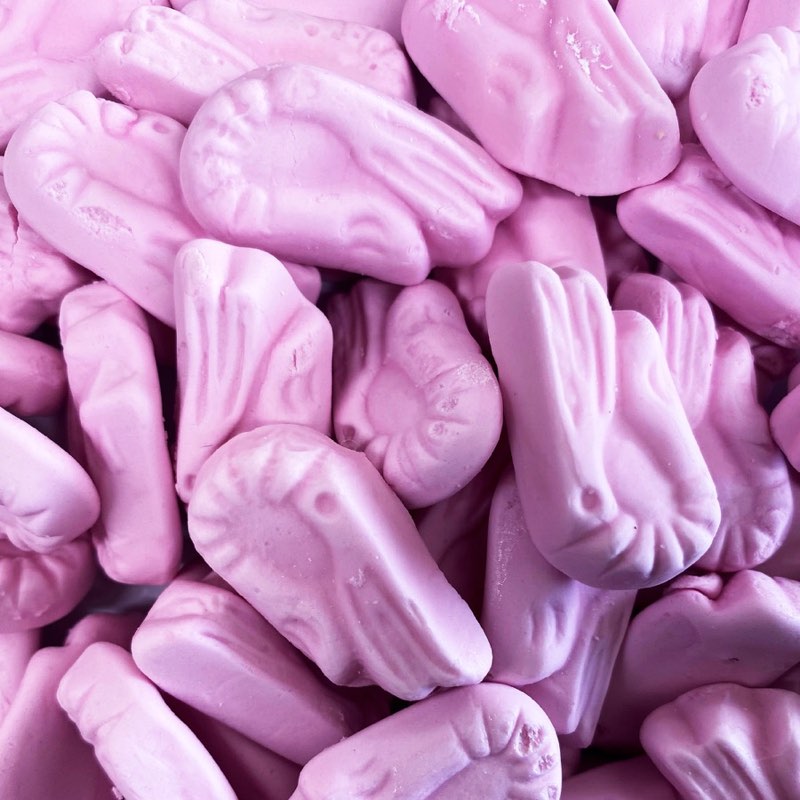
Kingsway · 250g
Read the full guide
Kingsway Giant Shrimps
£5.49
✔ In stock — ready to ship
Fresh stock
Free over £20
Same-day dispatch
Secure checkout
Some sweets are bought for a craving. These are almost always bought for an event. In our experience of what leaves the shelf and in what quantity, a bag of Kingsway Giant Shrimps is rarely a one-person purchase — it goes into something. A jar, a table, a cone, a party bag, a parcel. That shapes everything about how you should buy them, starting with the weight, which runs from a 250 g bag at £5.49 all the way up to 2 kg at £28.99.
This is the big one. Any celebration with a nostalgic theme — a significant birthday, an anniversary, a reunion, a village fete, a school fundraiser — ends up wanting a table of old-fashioned sweets, and pink foam shrimps are close to compulsory on it. They are instantly recognisable, they read as retro at a glance rather than needing explanation, and they are light enough that a generous-looking bowl costs very little to fill. A 500 g bag at £9.99 will make a serious-looking display, because foam takes up far more volume per gram than anything dense.
The full guide to Kingsway Giant Shrimps
5,410 words on how it eats, who it suits, how to serve it and what to put beside it.
The occasions these actually get bought for
The retro table
The visual point matters as much as the flavour one. A retro table needs to look abundant, and abundance is about volume rather than weight. Put a kilogram of small heavy sweets on a table and it looks like not very much; put a kilogram of foam shrimps out and it looks like a shop.
Sweet cones and party bags
The paper cone is the single most efficient sweet gift there is, and foam sweets are the ideal material for it — they fill a cone quickly, they show their shape through cellophane, and their pink stands out against almost anything you put alongside. For a children's party, one cone per child built around a handful of these plus two or three contrasting items looks handmade and costs a fraction of a pre-made bag. You will get a surprising number of cones out of the 1 kg option at £16.49.
Weddings, christenings and favours
Sweet tables at weddings have become standard, and the ones that work are built on a few things in quantity rather than many things in small amounts. Pink is a useful colour in that setting because it sits comfortably with almost every scheme people choose, and a large jar of these reads as decoration before anybody has eaten one. For favours, small bags of two or three with a ribbon are among the cheapest per-head options available, and they look considerably more thoughtful than something shop-bought.
The pick and mix for one
Not every occasion involves other people. A decent-sized bag of a single retro sweet, eaten slowly over a fortnight, is a perfectly good reason to buy, and the 250 g size exists precisely for that. It is the smallest quantity we sell and still a good deal more than a pocket bag.
Fundraisers, fetes and stalls
If you are selling rather than serving, the arithmetic changes completely and the larger weights become the obvious choice. Two kilograms at £28.99 works out at roughly £1.45 per hundred grams — a little over a third less than the 250 g rate — and a foam sweet is the best possible stall product because a bag looks enormous for very little cost. Anyone who has run a sweet stall for a school knows that perceived volume sells and weight does not.
Where they are the wrong choice
Worth saying. They are poor value as a small impulse treat if you only want a handful, since the smallest bag is a proper quantity. They are a weak choice for anything formal, being unashamedly a children's sweet in spirit. And they do not travel well loose in a bag or pocket — foam is the most easily squashed thing we sell, and a crushed shrimp is still edible but no longer a shrimp.
What a giant foam shrimp is like to eat
Pick one up and the first surprise is the weight, or rather the lack of it. A piece this size ought to feel like something and instead it feels like almost nothing. Foam sweets are mostly air by volume, which is why a 250 g bag looks like far more than 250 g and why a handful weighs less than you expect.
The shape is the second thing you notice. It is properly a shrimp — a curved body with a ridged back, a tapering tail, and enough detail to be recognisable rather than a vague blob. The moulding is what makes it a keeper as a sweet; a plain pink lozenge with the same flavour would have disappeared from the shelves long ago, because half the pleasure of a novelty shape is that it is a small picture of something.
Press one gently between finger and thumb and it gives, then springs back. That is the foam signature and it is unlike anything else on a sweet counter. Gums resist and stay compressed. Chews deform permanently. Foam recovers. It is genuinely satisfying to squeeze one, which is why children play with them before eating them and why an open bowl of these gets handled more than most.
The bite
There is no resistance to speak of. A foam sweet collapses immediately under the teeth, which is what makes them easy to eat for almost anybody — no work for the jaw, no long chew, nothing that needs effort. The piece compresses, then breaks down into something much smaller than it started as, and the volume you began with vanishes almost completely.
That disappearing act is the defining behaviour of the category and it has two consequences. First, foam sweets eat fast — much faster than their size suggests. You can get through a surprising number of large pieces in a short time because each one takes seconds. Second, they feel light to eat, which is a real psychological effect: a big pink shrimp feels like less of a commitment than a small dense sweet, and people take them more readily as a result.
The flavour arc
The raspberry arrives quickly and sits in the bright, high register rather than the deep one. It is present from the first moment, peaks early while the foam is still collapsing, and then clears fairly quickly — this is not a long-finish sweet, and the mouth is ready for the next thing within a few seconds. That quick clearing is precisely why they work in a mix: they never dominate what comes after them.
Taken two or three at a time, the effect is different from taking one. A single shrimp is a quick, light hit. Three together give you enough volume for the flavour to build and hold for longer, which some people much prefer. It is worth trying both before deciding how you feel about them.
Size in the hand
These are the giant version, and the scale is a large part of the appeal — a piece that fills a child's palm is an event in a way that a small one is not. For adults they are a two-bite sweet at most, and for younger children they are genuinely large, which is worth bearing in mind when you are portioning. Two of these look like a proper share; two of something small look like nothing.
Who ends up buying them
The person organising something. As covered above, this is overwhelmingly an event purchase, and the buyer is usually filling a jar, a table or a set of bags rather than a cupboard.
The retro shopper, who is buying a memory as much as a sweet, and for whom the specific shape matters more than the specific flavour. This group tends to buy several retro lines at once rather than one, and our retro sweets shelf — eighty-nine lines deep — is where that shopping happens.
Anybody buying for a mixed group including young children and older relatives. Foam is the most universally manageable texture we sell: nothing to crack a tooth on, no long chew, no sharpness to object to. That makes it a safe centrepiece when you do not know everybody's preferences.
People who want volume for money. Because foam is light, the visual value is unmatched — you cannot fill a big bowl more cheaply with anything else on our shelves.
Not for: anybody who wants a sweet to last, anybody who dislikes soft textures, and anybody buying a small treat for one, since the entry weight is a proper bag. For a slow, dense alternative at a similar price bracket, Bristow's Traditional Salted Caramel Bon Bons at £5.49 sit at the opposite end of the texture range entirely.
Making gifts out of loose sweets: cones, jars, favours and parcels
Buying loose sweets by weight opens up a kind of gift that pre-packed bags cannot match, and it is worth learning the small amount of craft involved, because the results look far more expensive than they are. The principle is simple: you are buying material, and the presentation is yours to decide.
The cone
A cellophane cone, a ribbon and three or four contrasting sweets is the most cost-effective handmade gift in existence. The technique matters more than the contents. Fill in layers rather than mixing, so the cone shows bands of colour through the wrapping — a layer of pink at the bottom, something dark in the middle, something small and bright at the top. A mixed cone looks like leftovers; a layered one looks designed.
These are the perfect base layer because they hold their shape and their colour is unmistakable through cellophane. For the contrasting bands, Haribo Fried Eggs at £5.49 bring a completely different shape and palette, and Barratt Bumper Bananas at the same £5.49 are another foam line that changes the colour without changing the texture — useful if you are building a cone for a young child and want everything soft.
The jar
A filled jar is the gift that looks most expensive relative to what it costs, and foam sweets are the best value way to fill one. A kilogram at £16.49 will fill a substantial jar with room to spare, and because foam occupies so much volume per gram, the jar looks packed rather than half-hearted.
Two rules. Fill past the shoulder — a jar filled to two-thirds always reads as depleted. And decide whether you are making a single-sweet jar or a mixed one before you start, because half-measures look accidental. A single-sweet jar of pink shrimps is a strong, simple, graphic object. A carefully mixed jar of three or four retro lines is a different and equally good thing. A jar with one handful each of nine different sweets is a jumble.
Favours and small bags
For weddings, christenings and parties, small bags of two or three sweets tied with ribbon are the cheapest per-head gift that still looks considered. Work out your numbers before you buy: at three shrimps per bag you will get a great many bags out of 500 g at £9.99, and the per-guest cost comes out at pennies.
For a favour, shape and colour do all the work, because nobody is eating them at the table — they are looking at them. That argues for items with a strong silhouette. Kingsway Gummy Bones at £5.49 and Kingsway Jelly Eyeballs at the same price are both strong shapes, though obviously suited to a particular kind of occasion rather than a wedding.
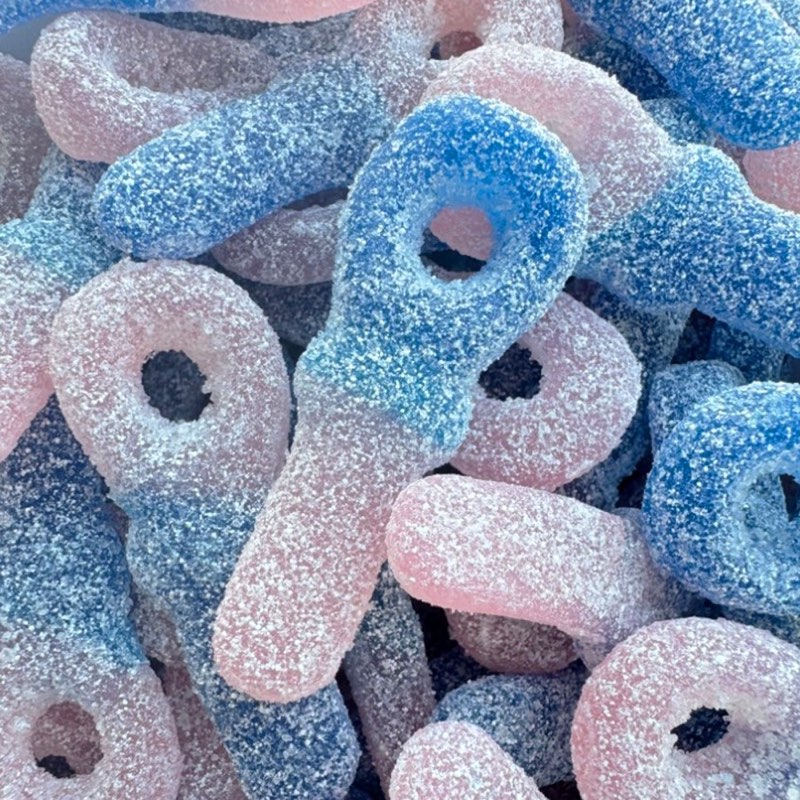
If the gift is for a child rather than a table, the two dummy-shaped lines from the same maker are worth knowing about, because a dummy is the one shape that never needs explaining to anybody under ten. The fizzy tongue-painting dummies at £5.49 sit at the same price per bag as these shrimps, so you can build a two-line cone without doing any arithmetic, and the bubblegum version of those dummies gives you a third component in the same format if a cone needs a bit more variety. Both are a good deal livelier than a foam shrimp, which is precisely why they work as the contrast layer rather than the base.
Seasonal and themed parcels
Building a parcel around a season is easier with shaped sweets than with anything else, because the shape does the theming for you and you do not need to explain anything. For an autumn or Halloween parcel, Kingsway Witches Heads at £5.49 and Pumpkin & Ghost Marshmallows are built for it, and the marshmallows in particular share this product's light texture so the parcel eats consistently. For a festive one, the Candy Realms Festive Mallow Stacker at £1.50 is the cheapest way to add a seasonal shape, and at that price it can go into every parcel you make.
Teacher and end-of-term gifts
The brief here is small, clearly a gift, and not so expensive that it becomes awkward. A modest jar or a decent cone hits it exactly. Our advice is to keep it to two or three sweets with a clear idea behind them rather than a large mixed bag — a retro theme, a single colour, or one nostalgic line the recipient has mentioned. A jar of pink shrimps and one other retro line reads as a choice; a kilo of assorted reads as a bulk buy.
Care parcels
For parcels going to students, hospitals or anybody having a rough stretch, foam sweets have one clear advantage and one clear drawback. The advantage is that they need nothing — no chewing effort, no unwrapping, no mess. The drawback is that they squash, so they need to go in the middle of a box surrounded by softer things, not at the edge under something heavy. Pair them with something that lasts longer, since a parcel of entirely fast sweets is over in an evening. Swizzels Drumstick Lollies at £5.49 are a good counterweight — a lolly is a slow format by definition and makes the parcel last days rather than hours.
Building it yourself versus buying it made
The honest comparison: building a gift yourself out of loose sweets costs perhaps half of what a ready-made equivalent does, takes twenty minutes, and looks better because you chose the combination. What you lose is convenience. If you have the evening, build it. If you do not, our pick and mix section is organised by occasion and will get you to something appropriate in a couple of clicks.
The penny tray, the paper bag and the weighing scales
There is a whole retail tradition behind buying sweets by weight, and it is worth understanding because it explains why a product like this exists in the form it does — big, cheap, soft and shaped like something silly.
Arithmetic at counter height
The defining experience of the old sweet counter was mental arithmetic under pressure. You had a fixed amount of money, an array of items at different prices, and a queue behind you. Children became extremely good at optimising this. The whole economy of the penny tray depended on items being priced low enough that the choice was genuinely combinatorial — how many of these, plus how many of those, to get closest to the total without going over.
Large foam sweets were always a strong play in that calculation, because they gave the most visible return. A tray of sweets where one item is physically three times the size of the others is a tray where that item gets chosen, regardless of taste. Size beats flavour in a child's value judgement almost every time, and a giant shape leaning against the side of a paper bag was proof of a good decision.
The paper bag itself
The white paper bag is not incidental. It is opaque, it crumples, it lets you feel shapes through it, and it made the purchase feel like a parcel rather than a transaction. A great deal of the affection people have for old-fashioned sweet shopping is really affection for that bag.
Buying loose online is the closest modern equivalent, and it keeps the important part — you are buying a quantity of a thing rather than a manufacturer's fixed pack. That is why our loose sweets shelf runs to three hundred and fifty-six lines: the by-weight tradition is the larger part of this shop, not a nostalgic corner of it.
The pier shop and the scales
Seaside sweet shops kept the weighing ritual going long after most high-street shops had moved to pre-packs, and the reason is that the ritual is entertainment. Watching a scoop go into a jar, seeing the needle move, hearing the shopkeeper ask whether that is enough — it slows the transaction down deliberately, and on a holiday afternoon slow is exactly what you want.
Novelty shapes flourished in that environment because a promenade shop is competing on spectacle rather than on price. Anything oversized, anything improbable, anything that looked funny in a bag did well. That is the tradition this product belongs to — not a flavour tradition, a shape tradition, which is why the shrimp has outlived a great many more sensible sweets.
What the shape tradition looks like now
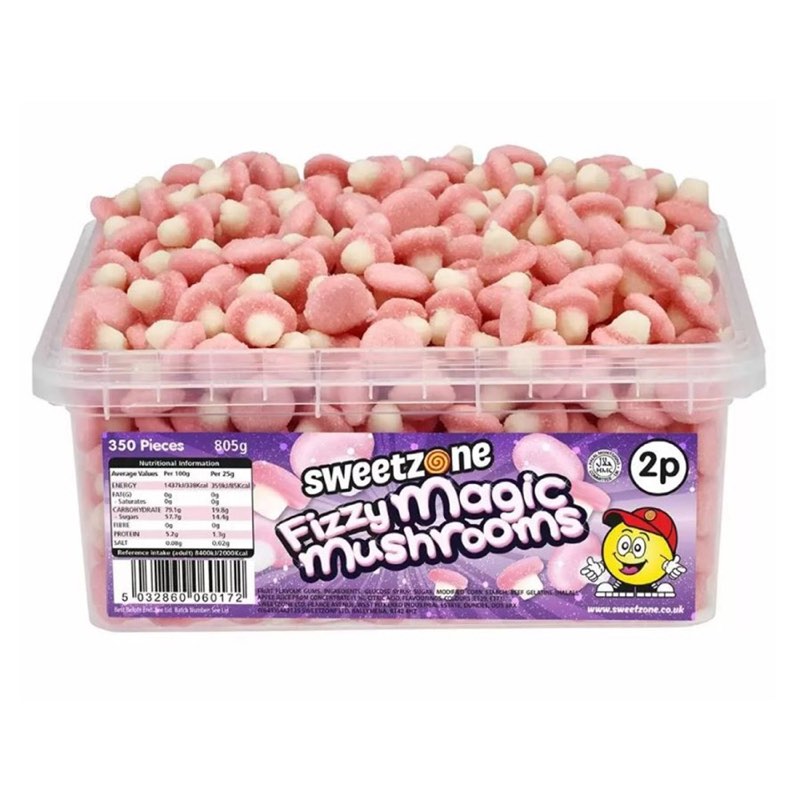
It is alive and well, and it is the most reliable thing in confectionery. People will always buy a sweet shaped like something. Our shelves carry the modern descendants: the Sweetzone Magic Mushroom tub at £7.99 for 805 g is the same instinct in a tub rather than a jar, Dals Chocolate Covered Bears at £7.49 put a shaped sweet inside a coating, and the whole Kingsway range of seventy-five lines is built largely on shapes rather than flavours. Scrolling that page is a reasonable approximation of standing in front of the old counter.
The one thing that has changed
Honesty about what you are buying. The old counter ran on mystery — you could not see what was in most jars from a child's height, prices were negotiable in practice, and what you got depended on the shopkeeper's mood and scoop technique. Buying by weight online removes all of that. You get a stated weight for a stated price, which is fairer and slightly less fun. The compensation is that you can buy two kilograms of one thing, which no child at a penny tray could ever have dreamed of.
Raspberry in a foam, and what it does next to other flavours
Raspberry is the flavour here, and it is a specific and useful thing in confectionery rather than a generic red. It sits on the bright side of the berry family — sharper and higher than the deeper, rounder berry notes — and it carries particularly well in light textures. That is not an accident of this product; it is why raspberry appears so often in foams and whips across the whole category. A heavy texture tends to blunt a bright flavour; a light one lets it through.
In practice, that means the flavour reads clean and immediate rather than rich. It arrives early, holds while the foam collapses, and clears quickly. If you are used to raspberry in denser sweets, this will seem lighter and quicker, and that is the texture talking rather than the flavour being weaker.
What it sits well beside
Bright berry notes pair well with three things: other fruit at a different pitch, anything creamy or mellow, and anything with a contrasting texture. They pair badly with strong sharp flavours, which simply bury them.
For the fruit-at-a-different-pitch option, Kingsway Blackberry & Raspberry Gums at £5.49 are the most direct comparison we stock — the same berry family in a gum rather than a foam, so you can taste exactly what texture does to a flavour. Put the two side by side and the difference is more instructive than any description.
For the mellow counterpart, BUBS Banana & Caramel Foam Sweets at £7.50 are the obvious neighbour: the same light texture, a completely different and much rounder flavour direction, and together they make a foam bowl that is not one-note. And for the texture contrast, anything dense will do — a bon bon or a coated item changes the mouthfeel entirely while the flavours stay in the same broad territory.
If raspberry is the thing you are shopping for rather than the shape, we have a raspberry shelf with sixteen lines on it, which is the efficient way to compare what the same flavour does across different formats.
Building a retro mix around them
A good retro mix is not simply a pile of old-fashioned sweets. It needs the same structure as any other spread: something light, something dense, something slow, something with a shape, and a bit of colour discipline.
These cover light and shaped in one purchase, which is efficient. What they cannot do is provide slowness or density, so those have to come from elsewhere.
For slow, a lolly is the strongest option — the Drumstick lollies occupy somebody for several minutes rather than several seconds, and in a mix of fast items that contrast is what stops everything disappearing at once. For dense, Briquette at £5.49 adds weight to a bowl that is otherwise mostly air, which matters more than it sounds: a bowl of pure foam feels insubstantial when you pick it up.
For another shape at the same price point, the fried eggs are the classic partner — different silhouette, different colours, same light-ish character, and they photograph beautifully next to pink. For a second foam that is not pink, the Bumper Bananas give you volume and a shape at no extra cost per gram.
On colour: pick two or three tones and stick to them. A retro mix in pink, yellow and white looks deliberate. The same sweets plus four more colours looks like a spilled drawer. This is the single easiest way to make a home-assembled mix look professional, and it costs nothing.
If you would rather browse by texture than by brand, our foam sweets shelf runs to thirty-three lines and is the fastest way to find everything that behaves like this one. And for the broader old-fashioned category, our eighty-nine old-fashioned lines are the place to build a themed table from scratch.
Choosing your weight: 250 g up to 2 kg
This is one of the few lines on the site where the size decision genuinely matters, because the price per hundred grams falls a long way as you go up the ladder.
| Size | Price | Roughly per 100 g | Who it suits |
|---|---|---|---|
| 250 g | £5.49 | about £2.20 | One person, or a single bowl on a table |
| 500 g | £9.99 | about £2.00 | A generous display bowl, or a batch of cones |
| 750 g | £12.99 | about £1.73 | A party table, or a jar with spare |
| 1 kg | £16.49 | about £1.65 | A filled jar, a favour run, a big table |
| 2 kg | £28.99 | about £1.45 | Stalls, fundraisers, large events |
Two comparisons worth having in front of you. Buying 500 g outright costs 99p less than buying two 250 g bags — a small but real saving. Buying 2 kg outright costs £3.99 less than buying two 1 kg bags, which is a more meaningful gap and the point at which the ladder genuinely rewards you.
The honest advice on which to choose: match the weight to the vessel, not to your enthusiasm. If you are filling one bowl, 250 g or 500 g is plenty, and remember that foam fills a bowl faster than anything dense would. If you are filling a jar, start at 750 g and go to a kilo if the jar is a proper one. Only go to 2 kg if you are running a stall or serving a genuinely large event, because foam sweets do not improve with keeping and a household will not get through two kilograms before the texture starts to change.
The other thing to weigh up is whether you would rather spend the same money on variety. Two kilograms of one sweet at £28.99 is a lot of one thing; five different lines at £5.49 each costs a shade less and makes a far more interesting table. For a stall, the single line wins. For a party, the variety wins almost every time.
Storing foam sweets so they stay springy
Foam is the most air-dependent texture in confectionery and it is the one that changes fastest once a bag is opened. This section matters more here than on most of our pages.
The enemy is exposure. Left open to the air, foam dries from the outside in — the surface firms up, the spring goes, and what was light and yielding becomes tough and slightly leathery. It is not unsafe, it is just no longer the thing you bought. This happens in days rather than weeks with a bag left open on a counter, which is why the single most useful thing you can do is decant into an airtight container the moment the bag is opened. A clip-top jar or a sealed tub will keep them as they should be for a great deal longer than a folded-over bag.
Damp is the opposite problem and it produces stickiness rather than toughness. In a humid kitchen an open bag will start to tack together at the surfaces. Again, airtight storage solves it.
Warmth softens and compresses. Foam sweets under any weight in a warm room will flatten and stay flattened — unlike a firm sweet, they do not recover their shape once they have been squashed while soft. So store them somewhere they are not under anything, in a container with a bit of headroom, and never at the bottom of a shopping bag.
Do not refrigerate. Cold makes foam firm and unpleasantly dense, and the damp of a fridge is exactly wrong for the texture. A cool, dry, dark cupboard is ideal.
If you are serving them at an event, put out what you need and keep the rest sealed. A bowl of foam sweets sitting out for a whole afternoon will be noticeably tougher by the end of it than it was at the start, and topping up from a sealed container keeps the last guests getting the same thing as the first.
For shelf life, go by the date on the packaging the order arrives in. Texture will tell you how well something has been stored, not how old it is.
Where these sit on the site
This line appears on more shelves than most, because it has a brand, a texture, an era and a flavour all worth filing under.
The main one is our by-weight section, three hundred and fifty-six lines deep, which is where everything sold by the bag rather than the pack lives. If you are building a mix or filling a jar, that is the page to work from. The Kingsway brand page gathers seventy-five lines from the same maker, which is the efficient route if you have decided you like how this one eats and want more in the same vein.
By character, the retro shelf holds eighty-nine old-fashioned lines and is the natural home for anybody building a nostalgic table. The foam shelf is narrower at thirty-three lines and is organised by texture rather than era — the right page if it is the lightness you are after rather than the nostalgia. And the raspberry shelf, sixteen lines, is for shopping by flavour across every format we carry.
Beyond those, the pick and mix pages are built around occasions rather than products, the Candy & Chocolate shelf covers the branded packaged side of the shop, the Haribo brand page is there if you shop by that maker, and the complete catalogue lists everything at once for anybody who would rather browse than filter.
Questions we get asked about these
How big is a giant shrimp?
Large enough to be a two-bite sweet for an adult and a genuine handful for a small child — the size is the point of the line rather than a detail. What surprises people more is the weight: because foam is mostly air, a piece this size weighs very little, and a 250 g bag looks like considerably more than 250 g when you tip it into a bowl. That is why they are such good value for filling a display.
What do they taste of?
Raspberry. It sits at the bright end of the berry range rather than the deep end, and the light texture lets it come through quickly and clearly. It arrives early, holds while the piece collapses, and then clears fairly fast, which is why they mix well with other things — they never linger long enough to interfere with whatever you eat next.
Which size should I buy?
Match it to the vessel. One bowl: 250 g or 500 g. A jar: 750 g or a kilo. A stall or a large event: 2 kg, where the rate drops to around £1.45 per hundred grams. For a household, we would steer you away from 2 kg — foam does not keep its texture indefinitely once opened, and you would enjoy five different smaller bags more than one enormous one.
Do they keep well?
Sealed, yes. Opened and left in the bag, not as well as you would like — foam dries from the surface inwards and loses its spring within days. Decant into an airtight tub as soon as you open a bag and they will stay springy for far longer. Keep them out of the fridge, out of the sun, and out from under anything heavy.
Is this suitable for young children?
Sweets are a treat and should be kept to that. Whole gummies and small hard sweets are a choking risk for young children and should be eaten under supervision — and while foam is one of the softer textures we sell, a piece this size is still substantial, so supervise younger children and consider breaking one in half for them.
What should I check when it arrives?
Check the packaging your order comes in. We do not restate ingredient, nutrition or allergen information on our product pages, because the packaging is the authoritative source and we would rather you read it than rely on anything written here. If you or anyone you are feeding has an allergy, check before eating. Also check that the bag is sealed and the pieces have not been compressed in transit.
Will they arrive squashed?
A little compression is normal — foam under its own weight in a sealed bag will flatten slightly, and the pieces usually recover once tipped out. What does not recover is anything crushed while warm, which is why we would not recommend leaving a parcel in a hot car or a sunny porch. If a bag arrives genuinely flattened, get in touch.
Are they suitable for a wedding sweet table?
Very much so, and they are one of the cheapest ways to make one look abundant. Pink works with most colour schemes, the shape reads clearly from a distance, and a kilo fills a large jar properly. For favours, small bags of two or three tied with ribbon come out at pennies per guest. Just keep the rest sealed until the morning of the event rather than filling jars the night before.
Can I mix sizes and lines in one order?
Yes — most of our by-weight lines are priced on the same ladder, so it is straightforward to build a themed selection out of several at 250 g or 500 g each rather than one large bag of a single sweet. For a party table, that is almost always the better choice, and it makes the table look considered rather than bulk-bought.
What else goes on a retro table with these?
Something slow, something dense and one more shape. A lolly covers slowness, a hard or chewy line covers density, and a second novelty shape in a different colour stops the table looking one-note. Then stop adding — a retro table with five well-chosen things on it looks better than one with twelve, because you can actually see what each thing is.
How many will I get in a bag?
We do not publish a piece count and would rather not estimate one, since the pieces vary. Weight is the reliable figure: 250 g at £5.49 up to 2 kg at £28.99. Because these are light for their size, a given weight goes further in terms of visible volume than almost anything else we stock, which is the main reason people choose foam for displays.
Are they too sweet for adults?
They are unapologetically a children's-counter sweet in spirit, and most adults buy them for nostalgia or for an event rather than as an everyday treat. Taken one or two at a time alongside something denser, they sit perfectly well on an adult table — particularly a retro-themed one, where the point is partly the memory rather than the flavour.
To finish
A big, light, unmistakably pink raspberry foam sold by weight from 250 g at £5.49 up to 2 kg at £28.99, bought far more often for a table, a jar or a cone than for a cupboard. It fills a bowl more cheaply than anything else we stock, it needs an airtight tub the moment you open it, and it wants something slow and something dense alongside it. Choose the weight to fit the vessel, not the enthusiasm.
More from Kingsway
More retro sweets
More raspberry sweets
Where this sits
Kingsway Giant Shrimps appears on these shelves. Browse them, or jump to something nearby.
You might also like