Home / Loose Sweets / Bristow's Traditional Salted Caramel Bon Bons
Bristows · 250g
Read the full guide
Bristow's Traditional Salted Caramel Bon Bons
£5.49
✔ In stock — ready to ship
Fresh stock
Free over £20
Same-day dispatch
Secure checkout
Some sweets are for eating and some are for putting somewhere. Bon bons are firmly the second kind. A 250g bag of Bristow's Traditional Salted Caramel Bon Bons is not really a bag at all in practice — it is the contents of a bowl, a jar, a tin, or a paper cone, and the question worth asking before you buy is which of those it is going to become. That changes what size you want and how you serve it, so it is the right place to start.
The bowl on the side. This is the most common fate and the one the format suits best. Bon bons are individually distinct, they do not need unwrapping, and they sit in a bowl without collapsing into each other if you have stored them properly. A shallow bowl of them on a kitchen worktop or a coffee table is the classic use. 250g fills a small bowl generously. If you want the bowl to stay full over a weekend rather than a day, you want more than 250g, which is the honest reason the larger sizes exist.
The full guide to Bristow's Traditional Salted Caramel Bon Bons
5,464 words on how it eats, who it suits, how to serve it and what to put beside it.
The occasions these earn their place at
The sweet jar. If you have a glass jar with a lid, this is the product to put in it. Brown sweets in a clear jar look considerably better than they have any right to, and a jar solves the two problems bon bons have — air and warmth — at the same time as making them into something decorative. A standard kitchen sweet jar takes somewhere between 500g and 1kg depending on shape, so if the jar is the plan, size up from the 250g.
The party table. Chewy sweets do a particular job on a table: they slow people down. A table of nothing but crunchy, fast-eating items empties alarmingly quickly, because nothing in the spread takes any time. Bon bons take time. They give guests something to work on between conversations, which is exactly what you want at a gathering where people are standing up and talking.
The office tin. A tin of these on a shared desk is a low-effort bit of goodwill and lasts far longer than a box of biscuits, because one is a portion and nobody takes three. 500g in a tin is roughly a fortnight in a normal office.
The hamper or the gift box. Loose sweets by weight are excellent hamper material because you control the quantity precisely. You can put 250g of four different things into a box and it looks abundant, where four sealed branded bags look like a trip to a petrol station. Salted caramel is a safe gifting flavour for adults in a way that sour or novelty formats are not — it reads as grown-up.
Christmas and the long afternoon. Anything chewy, slow and brown belongs on a winter table. These are a sideboard sweet: the thing that sits out from mid-afternoon onwards and gets picked at by whoever walks past. For a household table over a holiday week, 1kg is not excessive, and the price per gram at that size makes it the sensible tier.
The car. A qualified yes. Bon bons do not melt into a disaster the way chocolate does, but they do soften in a hot car and they will stick to each other. Decant a small handful into a tub for a journey rather than carrying the bag.
What you are actually getting
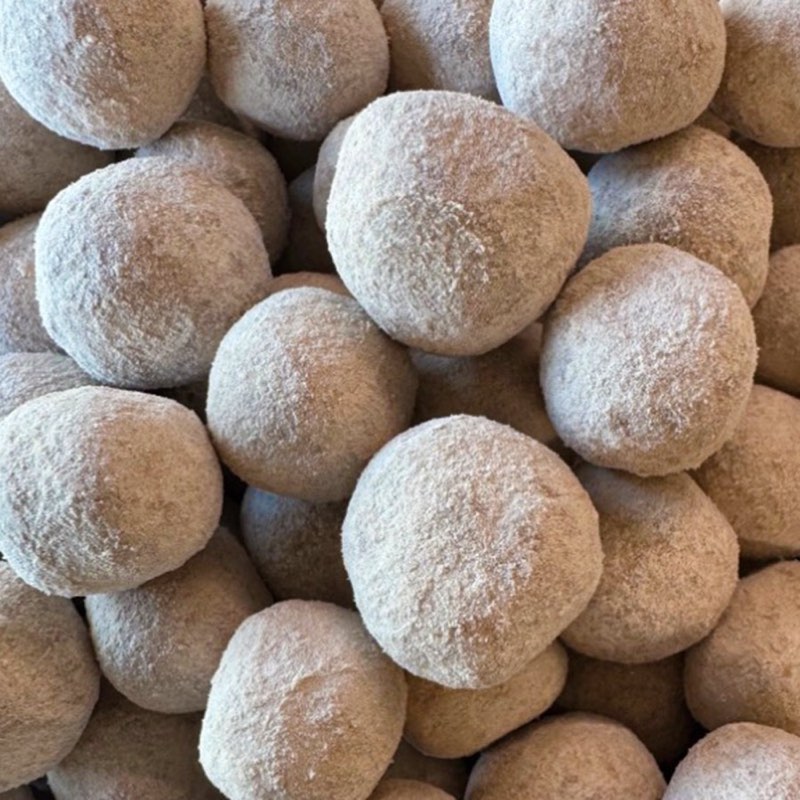
A bon bon is a small, roughly round chewy sweet with a fine loose coat on the outside, and the coat is doing something specific: it stops them welding themselves together in the bag. That is the design. Without it you would open the bag to find one large brick, which anyone who has left a bag of unwrapped chews in a warm room will recognise.
These are brown — that is the colour we hold for this line — which puts them at the caramel and toffee end of the visual spectrum rather than the bright end. In a bowl that matters more than you would think. A spread made entirely of brights looks like a children's party whether you meant it to or not. One brown element grounds it.
The size is comfortable. A bon bon is a one-mouthful sweet — bigger than a jelly bean, smaller than anything you would call a chunk — and you eat it in a single piece rather than biting it in half. In the hand, they are light for their bulk and slightly soft to squeeze, and the coat leaves a faint trace on your fingertips, which is the one genuine mess consideration with the format.
The bite is the interesting part and it happens in stages. There is a moment of resistance as the teeth go in, then a giving-way, then a long chew that takes real work. Bon bons are properly chewy — that is one of the three types we file them under, alongside retro and the bon bons format itself — and chewiness is the single property that determines how a sweet behaves socially. Chewy sweets are slow. Slow sweets last. That is why a 250g bag of chews goes further at a party than 250g of anything crunchy.
Flavour arrives more slowly than it does with a hard sweet, because the chewing has to release it. The first second or two is mild. Then, as the chew gets going, the toffee character — toffee being the flavour family we hold for this line — builds and broadens and fills the mouth properly, and the salted caramel character of the name gives it a savoury edge that stops the sweetness becoming flat. It is that edge that separates a salted caramel from a plain toffee: the sweetness has something pushing back against it, which makes the whole thing less cloying and, in practice, means you can eat several in a row without palate fatigue setting in. That is the flavour's real trick.
The finish is long. After you have swallowed, the flavour stays for a good while — longer than most fruit sweets manage — and this is a large part of why chewy toffee-family sweets feel so much more substantial than their weight suggests. One bon bon occupies you for perhaps a minute and then echoes for another minute after that.
We do not publish an ingredients list or any nutritional detail on this page, and we are not going to summarise one from memory. The manufacturer's own packaging arrives with your order and carries the full detail. If anyone eating them has an allergy, read that packaging on arrival, before eating, every time.
Which sweet counter this belongs to
Everybody who grew up in Britain has a sweet counter in their head, and it is not the same counter for everybody. Which one you carry around depends almost entirely on when you were nine years old, and it turns out to be a surprisingly precise dating tool. Ask somebody what a sweet shop looks like and the details they volunteer will place them within about a decade.
One version is the counter of the twisted paper bag. Sweets kept in tall jars, taken down one at a time, tipped onto a scale pan, poured into a small white paper bag and the corners twisted shut. The whole transaction is slow and slightly ceremonial, and you have to say out loud what you want, which as a child is the hard part. Bon bons belong to this counter absolutely. They are a jar sweet in the purest sense — loose, unwrapped, sold by weight, indistinguishable from each other, requiring a scoop and a scale.
Another version is the counter of the penny tray. A shallow open tray at child height, full of individually wrapped small things, where the maths is the entertainment: how many of the cheap ones can you get for what is in your hand. This is a different psychology entirely — it rewards counting rather than choosing — and it belongs to the wrapped chew rather than the jar sweet.
A third version is the newsagent wall: rows of branded bags at adult eye level, everything sealed, everything priced individually, nothing weighed. Efficient, but it removed the part of sweet shopping that children actually enjoyed, which was the negotiation.
What is interesting about loose sweets by weight is that they survived all three eras, and they survived by not changing. A bon bon today is doing exactly what a bon bon did on the jar counter: it is a small, soft, brown, chewy thing that comes in a quantity you chose rather than a quantity a factory chose for you. That continuity is most of what people mean when they call something retro, and it is why we file this line under the Retro shelf alongside eighty-nine others.
Generational memory does something else worth noticing: it is transitive. People buy these for children who have no nostalgia about them whatsoever, and the children accept them on their own merits, and thirty years later the children have the memory. Nobody experiences a sweet as retro the first time they eat it. Retro is a thing that happens afterwards, when the sweet stays the same and everything around it changes. So the practical effect of buying loose chewy sweets for a mixed-age household is that you are having two different experiences at the same table — recognition at one end and discovery at the other — and both of them are perfectly valid reasons to reach into the bowl.
The other honest observation about nostalgia sweets is that they are better than people expect. There is a general assumption that anything remembered fondly from childhood will disappoint on re-tasting, because the memory has inflated it. Chewy toffee-family sweets tend not to suffer from this, for the straightforward reason that the format was never really about novelty. The pleasure of a bon bon is textural and slow, and slow textural pleasures do not date. Something built on shock value — extreme sourness, a gimmick, a colour — dates immediately. Something built on a long chew does not.
If this particular counter is the one in your head, the neighbouring purchase is almost always a chew bar rather than another jar sweet, because both belong to the same shop even though they belong to different shelves in it. Barratt Black Jack Chews at £5.49 is the obvious companion, sold loose by weight at exactly the same price point, and it is the same chewy-slow format with a completely different flavour direction. Drumstick Chew Bars (10 Pack) at £2.50 is the wrapped version of the same instinct, and ten wrapped bars for two pounds fifty is the cheapest way to put a nostalgic chew in somebody's hand.
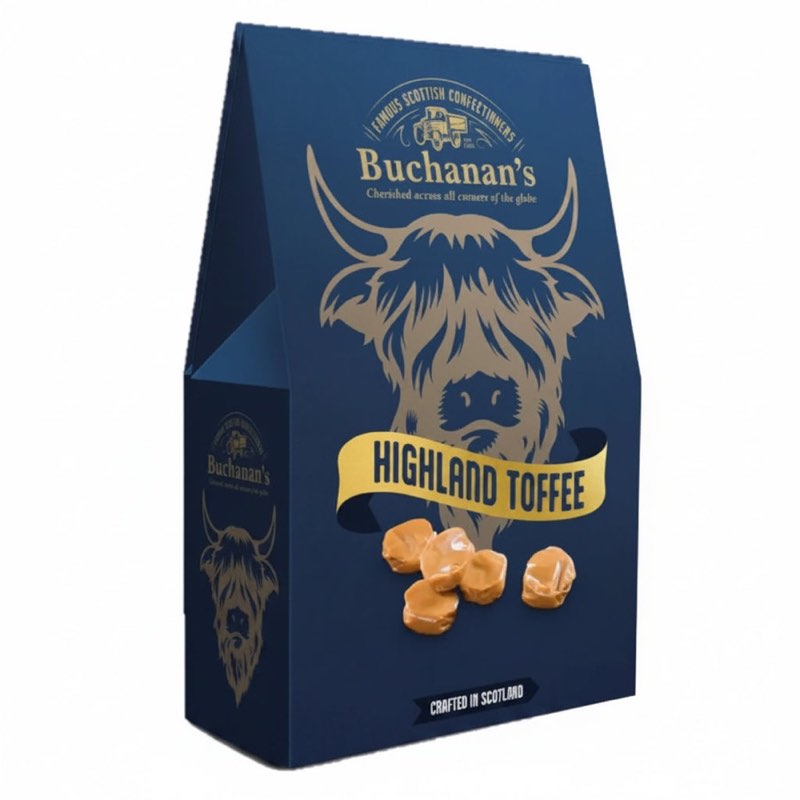
For the toffee corner specifically, Buchanan's Highland Toffee Carton 150g at £3.49 is the harder, more traditional expression of the same flavour family — a carton rather than a loose weight, and a considerably firmer eat — and having both on a table gives you the soft and hard ends of toffee side by side, which is a genuinely interesting comparison. Gray's Traditional Teacakes at £6.49 comes at the traditional counter from a different direction again, and is the item most likely to be recognised with an actual noise of recognition by anyone over forty.
Film night, controller in hand: pacing, mess and sharing
Snacking during films and games has rules, and almost nobody thinks about them until something goes wrong. Three things matter: how long a single unit occupies you, how much of it ends up on your hands, and whether you can eat it without taking your eyes off the screen. Bon bons score well on two of these and need a little management on the third.
Pacing. This is where chewy sweets are unbeatable. A chewy sweet takes a minute or more to get through, which means a bowl lasts. Crunchy sweets disappear in an evening because each one takes four seconds, so your hand goes back to the bowl fifteen times an hour. With chews, your hand goes back maybe five times. For a two-hour film, 250g between two people is comfortable and will not be finished, which is the correct outcome — the goal is for the bowl to outlast the film, not the other way around.
Eyes on the screen. Unwrapped loose sweets win outright here. You reach into a bowl, you take one, you eat it. No wrapper, no crackle, no fiddling in the dark, no small pile of wrappers accumulating on the arm of the sofa that you then have to deal with. Anyone who has tried to open an individually wrapped chew quietly during a tense scene knows why this matters. Wrapped sweets are for handing out; loose sweets are for watching things with.
Mess. This is the one to manage. The fine coat on the outside of a bon bon transfers to fingers, and chewy sweets leave a little tack behind. For a film that is nothing — you wipe your hands at the end. For gaming it matters more, because a controller or a keyboard does not forgive sticky fingers and cleaning one is a genuinely unpleasant job. The fix is simple and it is the same fix competitive snackers have used for years: put the sweets in a bowl on your non-dominant side, eat in deliberate breaks rather than continuously, and keep a cloth next to you. Or, better for gaming specifically, pick a sweet with no coat and no tack at all and save the bon bons for the film.
Sharing. Loose sweets are the most sociable format there is, because a bowl is communal in a way a bag is not. A bag has an owner. A bowl does not. If three people are watching something together, one bowl in the middle changes the dynamic entirely — nobody is rationing their own bag and nobody has to ask. The 500g at £9.99 is the right size for a regular film night household for exactly this reason: it refills the bowl three or four times.
The double bowl. The best film-night setup is two bowls with different textures, because palate fatigue is real and a single texture stops registering after forty minutes. Pair the chews with something completely different. Haribo Gold Bears at £5.49 is the obvious second bowl — the same price, the same loose format, but a firm springy bite and bright fruit character instead of a long brown chew. Taveners American Hard Gums, also £5.49, gives you a denser, harder, longer-lasting gum that is the slowest thing in this whole group, and a bowl of those will genuinely outlast a double feature.
For a longer session — a full day of gaming, a box-set afternoon — the consideration changes from pacing to volume, and the sensible move is to buy one larger bag rather than several small ones. 1kg at £16.49 is the tier where a group session stops being expensive.
The toffee family, and what to put next to it
Toffee is the flavour family we hold for this line, and it behaves differently from the others on a sweet table. Fruit flavours compete with each other — put four fruit sweets in one bowl and they blur into general sweetness. Toffee does not compete, it anchors. It is the one flavour family that improves the things around it by contrast, which is why almost every good mixed spread has something from this corner in it even when nobody planned it that way.
The family has a range. At the soft end sit chewy toffee sweets like these, where the pleasure is textural and the flavour builds slowly. In the middle sits fudge — softer still, and it breaks rather than chews. At the hard end sit the traditional toffees that need real commitment and occasionally a moment of concern about your fillings. A salted caramel sits in the soft end but with that savoury edge pulling it slightly sideways, which makes it the most food-adjacent flavour in the family and the one that adults reach for most readily.
The fudge comparison is worth making directly, because it is the closest thing we carry from the same maker. Bristows Vanilla Fudge is the same £5.49 and the same loose-by-weight format, but the eating experience is almost opposite: fudge yields and crumbles where a bon bon resists and chews. Having both in a hamper or on a table gives you the two poles of the soft brown-sweet world, and most people have a firm preference once they have tried them side by side.
For contrast rather than company, go bright and sharp. Vidal Strawberry Pencil Bites at £5.49 bring a completely different texture and a bright fruit direction, and the switch between a long brown chew and a bright red one is refreshing in a way that two brown sweets never are. Candy Realms Tutti Frutti Tubes Tub 780g at £7.99 is the volume answer to the same idea — 780g in a tub is a serious quantity for under eight pounds, and it is the cheapest way here to fill the bright half of a large spread.
For the bon bon format specifically, the direct sibling is the apple one. Kingsway Apple Bon Bons at exactly the same £5.49 is the same format, the same weight tier and the same chew, with the flavour taken to the sharp green end instead of the brown savoury end. Most people who buy bon bons regularly end up with both, because having two flavours of the same format in one bowl is more interesting than having one, and the shared texture holds the bowl together.
If you want the whole format in front of you, our bon bons shelf has nine lines on it, and it is a small enough shelf to read end to end in a minute. For the flavour direction rather than the format, the toffee flavour shelf gathers five lines, and for the texture, the Chewy shelf runs to seventy-eight, which is where you go when texture matters more to you than flavour does.
Building a spread around a brown chew
The rule for a good mixed bowl is one item per job, and there are four jobs: the anchor, the bright one, the volume one, and the odd one. Bon bons are the anchor — the slow, grounding, adult item that stops the spread being a children's party.
The bright one is whatever gives the bowl colour and sharpness, and a fruit gum or a fruit pencil covers it. The volume one is whatever you buy in bulk to make the bowl look full without spending much, and a large tub is usually the answer. The odd one is the item people pick up because they have not seen it before — Chupa Chups Mini Candy Sushi Tray 100g at £2.99 is exactly that: a 100g novelty tray that costs very little and does more conversational work than anything else on the table.
A four-part build for a household weekend might be 250g of these as the anchor, 250g of something bright, a tub for volume and one novelty, which lands somewhere around £22 and covers a table properly. Scale the anchor up rather than adding a fifth item if you need more — five items on a table is the point at which people stop trying things and just eat their favourite.
If you would rather build the whole thing by weight in one go, our Pick & Mix section is designed for that, and our loose sweets aisle is the 356-line list that everything by weight comes from. For the sealed and branded half of the shop, the Candy & Chocolate aisle is the place to look, and the Jelly & Gummy shelf is where the springy formats live if you want to balance a chewy bowl with a bouncy one.
Who this is for
It is for the adult who does not really want sweets but will eat a salted caramel. That is a real category of person and they are badly served by most of a sweet shop, because most of a sweet shop is bright, sour, or aimed at children. A brown chewy toffee-family sweet is the crossover product: it sits next to coffee, it works on a sideboard at a dinner, and nobody feels silly eating one.
It is for the household that wants one thing in a jar all the time rather than a rotating cast of bags. Bon bons are a good default jar sweet because the flavour is not fatiguing and the format keeps well.
It is for the person assembling a gift and looking for something that reads as considered. Loose sweets by weight in a box look like a choice. Branded bags look like a purchase.
It is for anyone catering a mixed-age gathering who has correctly worked out that a table of bright fruit sweets alone will leave the adults standing near the crisps.
It is less obviously for a children's party, where colour and novelty do more work than a long brown chew, and less obviously for a gaming session where the coat on your fingers becomes a nuisance. Neither is a reason not to buy it — just buy it for the right table.
The size maths, done properly
This line comes in five sizes and the price per gram falls steadily as you go up, so it is worth two minutes with the numbers before you add to basket.
| Size | Price | Roughly per 100g | Versus buying 250g bags |
|---|---|---|---|
| 250g | £5.49 | £2.20 | — |
| 500g | £9.99 | £2.00 | Saves 99p on two 250g |
| 750g | £12.99 | £1.73 | Saves £3.48 on three 250g |
| 1kg | £16.49 | £1.65 | Saves £5.47 on four 250g |
| 2kg | £28.99 | £1.45 | Saves £14.93 on eight 250g |
The shape of that curve is worth reading rather than just scanning. The biggest single jump in value is between 500g and 750g, where the per-100g price drops by twenty-seven pence — a bigger fall than any other step on the ladder. After 750g the curve flattens considerably: going from 750g to 1kg saves you only eight pence per 100g, and going from 1kg to 2kg saves twenty pence per 100g but doubles your outlay and your storage problem.
So the practical advice is this. If you are buying for a household bowl, 750g at £12.99 is the sweet spot on value and is still a quantity you can realistically get through before it goes past its best. Below that, 250g is the tasting size — buy it to find out whether you like them, not to stock a jar. 500g is the right call if you have a specific jar to fill and you know its capacity.
The 1kg and 2kg tiers are for events, offices, or households that already know this is their sweet. 2kg at £28.99 is genuinely good value at £1.45 per 100g, but be honest about whether you will get through two kilograms of chewy sweets, because the storage advice below matters far more at that scale than it does with a single 250g bag.
On portions: 250g of bon bons is roughly a good bowlful, and because chews are slow, it serves more people than the same weight of a fast-eating sweet would. For a gathering, a rough working figure is 40 to 60g per adult across an evening if there are other things on the table, which puts 250g at four to six people and 750g at a proper party. Adjust upwards if it is the only sweet out.
Storing chewy sweets so they stay separate
Everything that can go wrong with a bag of loose chews is a version of the same problem: they stick to each other. The coat on the outside is what keeps them apart, and warmth and moisture are what defeat it.
Keep them cool. Not cold — cool. A cupboard away from the oven, the kettle and the window. Direct sunlight through a kitchen window will soften a jar of chews in an afternoon, which is the one real argument against putting them in a decorative glass jar on a sunny worktop. If the jar is going somewhere sunny, accept that you will be prising them apart.
Keep them sealed. Air is the slower enemy. Left open, the outside of a chewy sweet gradually changes character and the coat absorbs moisture from the room, which is precisely when the sticking starts. Roll the bag down tight and clip it, or decant into a proper airtight container. A jar with a rubber seal is ideal. A jar with a loose decorative lid looks better and works worse.
Do not refrigerate. The fridge makes chews unpleasantly hard and then, when they come back to room temperature, condensation forms on the surface and makes them stickier than they were before. It is the worst of both outcomes. The freezer is worse still.
If they do stick together, the fix is to put the clump somewhere properly cool for an hour and then break it apart by hand. They will not be quite as neat as they were but they eat exactly the same. Do not try to separate a warm clump — you will simply tear them.
At 1kg and 2kg, split the bag on arrival. Put a working quantity in a jar and keep the rest sealed and cool. A 2kg bag repeatedly opened, half-emptied and left in a warm kitchen will not stay in good condition, and the value you gained on price you will lose on the last few hundred grams.
Keep the manufacturer's packaging with the sweets until they are finished, rather than throwing it away when you decant. It carries the detail we do not hold on this page, and anyone in the household with an allergy needs to be able to read it before eating.
Where to find this and what is next to it
This line sits on five shelves, which tells you something about how it can be found: by format, by texture, by era, by flavour and by the way it is sold. If you came in through the format, the neighbours are other bon bons. If you came in through the texture, the neighbours are seventy-eight other chewy lines with nothing else in common. If you came in through the era, you land among everything we file as retro, which is a much broader and more eccentric list.
The useful habit when browsing here is to pick the shelf that matches why you want it rather than what it is. Buying for a party? Go by texture, because you are balancing a table. Buying for a specific person? Go by flavour. Buying to fill a jar cheaply? Go straight to the by-weight side of the shop and sort by size, because that is where the price per gram falls. And if you want to see everything at once before narrowing down, the full sweet list is the unfiltered view.
Common questions
What exactly is a bon bon?
It is a small, roughly round chewy sweet with a fine loose coat on the outside. The coat is functional rather than decorative — it is what keeps them from sticking to each other in the bag. The eating experience is a soft initial give followed by a long, proper chew, which puts it in a different category from anything hard or crunchy. It is a one-mouthful sweet: you eat it whole rather than biting it in half.
Are these hard or chewy?
Chewy, and properly so. We file this line under chewy alongside seventy-seven others, and it behaves like a chew from the first bite — there is resistance, then a give, then a minute or so of work. If you are after a hard sweet in the same flavour direction, a traditional toffee carton is the firmer expression of the family and a completely different eating experience. If you want soft and crumbly instead, fudge is the answer.
Which size should I buy?
250g if you have not had them before — treat it as the tasting size rather than a stocking-up size. 500g if you have a jar to fill and know roughly what it holds. 750g at £12.99 is the best value on the ladder, with the steepest drop in price per gram of any step. 1kg and 2kg are event, office or committed-household quantities, and at those sizes the storage advice matters far more, so split the bag when it arrives.
How many people will 250g serve?
More than the same weight of a crunchy sweet would, because chews are slow and people take fewer of them. As a working figure for an evening gathering with other things on the table, allow 40 to 60g per adult, which puts 250g at somewhere between four and six people. If these are the only sweet out, or if it is a long afternoon rather than a couple of hours, size up — 750g is the realistic party quantity.
Will they stick together?
Not if they are kept cool and sealed. The coat on the outside exists specifically to stop it happening, and it does its job well at normal room temperature. What defeats it is warmth and air — a sunny worktop, a cupboard next to the oven, or a bag left open for a fortnight. If a clump does form, cool them for an hour and break it apart by hand. They eat exactly the same afterwards, they just look less tidy.
Can I put them straight into a sweet jar?
Yes, and it is the best home for them. A jar with a proper seal keeps air out, which is the main thing, and brown sweets look genuinely good behind glass. The one caveat is sunlight: a clear jar on a sunny worktop will soften the contents, so pick a spot out of direct light. A standard kitchen sweet jar takes somewhere between 500g and 1kg depending on its shape, so choose your size with the jar in mind.
Are they suitable for young children?
Sweets are a treat. Small sweets and whole chewy pieces are a choking risk for young children, so they should be supervised while eating them and given a small amount rather than handed a bowl. That is the whole of what we will say on the subject. If anyone in the household has an allergy, read the manufacturer's packaging that arrives with your order before eating, every time.
How do these compare with the apple bon bons?
Same format, same £5.49, same loose-by-weight sizing — the difference is entirely the flavour direction. This one sits in the toffee family with a savoury salted-caramel edge, which reads as adult and works on a sideboard. The apple version goes the other way, sharp and green and bright. Buying both and putting them in one bowl is a common move, because a shared texture with two flavours makes for a more interesting bowl than either on its own.
Do you stock anything else from the same maker?
One other line: the vanilla fudge at the same £5.49, also sold loose by weight. It is the natural companion rather than a substitute, because fudge and bon bons sit at opposite ends of the soft-brown-sweet world — one crumbles, the other chews. If you are building a hamper or a gift box and want two things from one maker that do not feel like the same thing twice, that is the pair.
Are they too messy for gaming?
They are the one format where we would actually say think twice. The outer coat transfers to your fingers and a chew leaves a little tack, and neither of those is welcome on a controller or a keyboard. For a film it is a non-issue — you wipe your hands at the end. For a long gaming session, either eat them in deliberate breaks with a cloth to hand, or pick something with no coat and no tack and save these for the sofa.
Can I mix sizes across different flavours?
Yes — each loose line is priced on its own size ladder, so you can take 250g of one thing and 750g of another with no penalty. For a spread, that is usually the smarter way to shop: buy the anchor flavour in a larger size because it is the one that gets eaten steadily, and buy the bright and novelty items small, because their job is variety rather than volume. Browse the whole shop if you want to see the full range of what is available by weight.
How long do they keep once opened?
Comfortably a few weeks in a sealed jar in a cool cupboard, and noticeably less than that in an open bag in a warm kitchen. The failure mode is not really spoilage, it is texture — the coat takes on moisture, the outside loses its separation and they begin clinging together. Seal them properly and the problem does not arise. At 1kg and above, split the bag on arrival and keep the bulk of it sealed away from the working jar.
In short
A brown, slow, salted-caramel chew sold by weight is one of the most useful things you can have in a cupboard. It anchors a mixed bowl, it suits adults who do not think of themselves as sweet eaters, it lasts through a film instead of vanishing in the first twenty minutes, and it looks right in a jar. Start at 250g if you are new to it, go to 750g at £12.99 if you already know, keep it cool and sealed, and give it a bowl of its own next to something bright.
More retro sweets

More toffee sweets
More loose sweets sweets
Where this sits
Bristow's Traditional Salted Caramel Bon Bons appears on these shelves. Browse them, or jump to something nearby.
You might also like