Home / Loose Sweets / Buchanan's Scottish Fudge Carton 150g
Buchanan's · 150g
Read the full guide
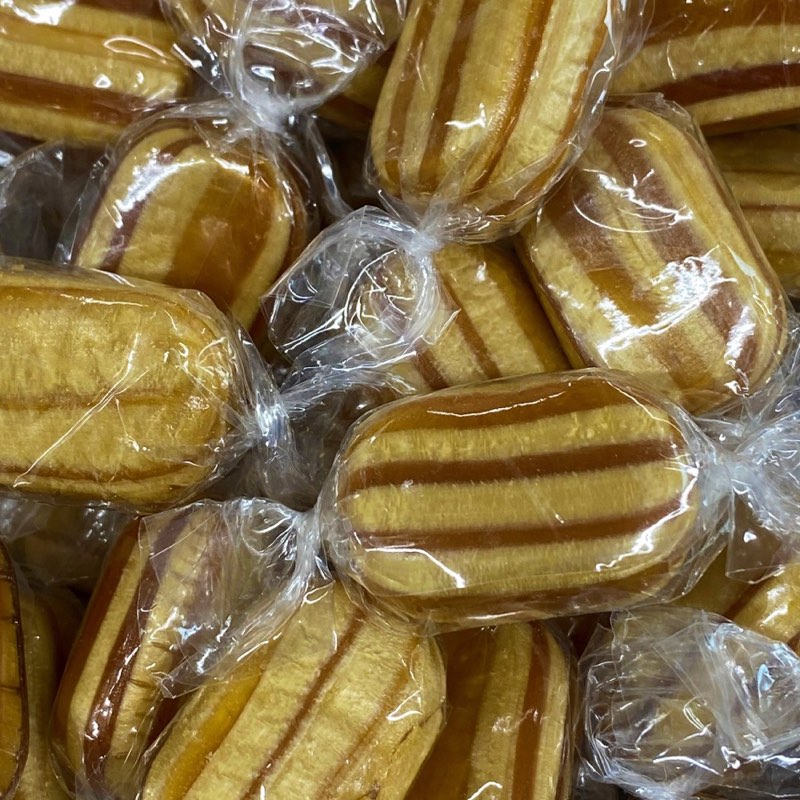
Buchanan's Scottish Fudge Carton 150g
£3.49
✔ In stock — ready to ship
Fresh stock
Free over £20
Same-day dispatch
Secure checkout
Most sweets get bought on their own and eaten on their own. A carton of fudge is different, because the moment you pick one up you tend to start thinking about what goes next to it. A 150 g carton is a component. It is the piece that anchors a tray, gives a hamper its weight, or sits in the middle of a mixed bag and quietly slows everybody down. So rather than opening with the usual tour of the product, it is more useful to start with the job it does in a group of sweets — because that is the job most people are actually buying it for.
Here is the practical shape of it. Fudge is a pacing sweet. Whatever else is on the table, the fudge is the thing people take one of, chew slowly, and then sit back from for a minute. That makes it the ideal counterweight to anything fast and sharp. If your spread is all gummies and fizz, everything gets eaten at the same speed and the bowl is empty in twenty minutes. Put a carton of Buchanan's Scottish Fudge in the middle and the rhythm changes: people take a piece, slow down, talk, and come back later. A 150 g carton spread across a table of five or six other lines is not a small contribution — it is the brake.
The full guide to Buchanan's Scottish Fudge Carton 150g
6,010 words on how it eats, who it suits, how to serve it and what to put beside it.
Start with the box, not the bag: building a spread around a 150 g carton
The simplest three-part build is fudge, something sour, and something jelly. For the sour corner, a bag of Barnett's Mega Sour Apple Candy Bags 104g at £3.99 does the job at almost exactly the same price point, so you are not lopsiding the budget; the contrast between a slow brown chew and a hard green sour hit is about as wide as a sweet table gets. For the jelly corner, Barratt Jelly Babies at £5.49 are the safe, everyone-eats-them option that stops a mixed tray from feeling like a dare. Three lines, three textures, three speeds, and roughly £13 on the table.
If you want to build wider than three, the honest way to do it is by texture rather than by flavour. Add a chew — Barratt Black Jack Chews at £5.49 bring a dark aniseed note that sits surprisingly well beside toffee-flavoured fudge, because both are sweets that reward slow eating. Add a boiled sweet — Taveners Mint Humbugs at £5.49 give the table something to suck rather than chew, and mint after fudge is one of the oldest and most reliable pairings in a British sweet shop. Then, if there is room, add a foam or a mallow for lightness: BUBS Banana & Caramel Foam Sweets at £7.50 pick up the caramel end of the flavour without repeating the density, and Bulgari Pumpkin Mallows at £5.49 are all air where the fudge is all weight.
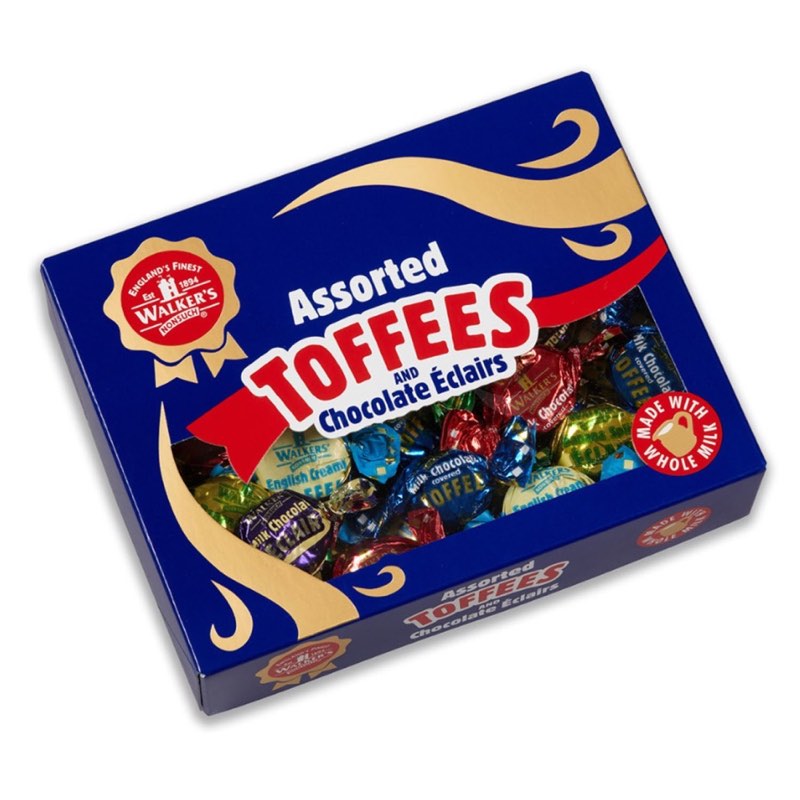
For a build that stays in one flavour family rather than spreading out, work along the brown-sugar end of the shelf. Bristow's Traditional Salted Caramel Bon Bons at £5.49 take the same register and make it chewier and saltier. Ross's Of Edinburgh Scottish Tablet at £5.49 is the closest neighbour of all — tablet and fudge are cousins, and having both on a table is a genuinely interesting comparison rather than a repetition, because they behave differently in the mouth. Finish with Walker's Nonsuch Assorted Toffee & Chocolate Eclairs Gift Box 350g at £5.99, which is already a gift box and so lifts the whole arrangement a grade without you having to do any wrapping. That is a four-line brown-sugar table for a little over £20, and it is a far more coherent thing than a random handful of bags.
One last build, for people who are making a bag rather than a table: if you are putting together a mixed pouch from our pick and mix range, treat fudge as the 20 per cent, not the 50 per cent. A carton this size is enough to seed five or six mixed bags with a couple of pieces each, and a couple of pieces is the right amount. Fudge is rich and slow; it is the thing you want to find in a bag, not the thing you want the bag to be made of.
What £3.49 and 150 g actually put in your hand
The numbers first, because they are the part people squint at. This is a 150 g carton at £3.49, which is £2.33 per 100 g. There is one size — the pack lists a single option, so there is no bigger box to talk yourself into and no smaller one to regret. That simplicity is part of the appeal of a carton format: you are not doing arithmetic at the shelf, you are just deciding yes or no.
A carton rather than a bag matters more than it sounds. A bag slumps, and its contents move around and press against each other. A carton holds its shape, stacks flat, and protects what is inside from being squashed in transit or at the bottom of a tote. For a sweet that is soft enough to take a fingerprint, that is not packaging fussiness — it is the difference between neat pieces and a corner of rubble. It also means the box can go straight into a hamper or a parcel without needing a second layer around it, which is the reason this format shows up in gift builds so often.
In the hand, 150 g of fudge is a carton you can hold comfortably in one palm — substantial, denser than it looks, and heavier than the equivalent volume of jellies or foam would be. Density is the thing to hold on to when you compare this against a bigger bag of something light. A 150 g carton of fudge and a 150 g bag of mallows are not the same purchase at all; the fudge is far fewer pieces and far more eating in each one.
How it eats
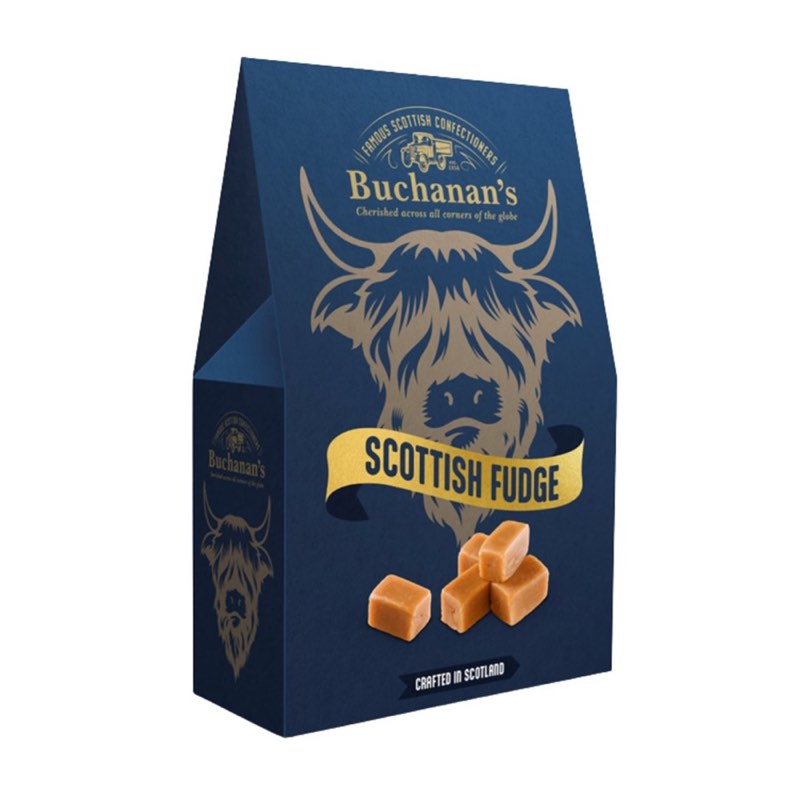
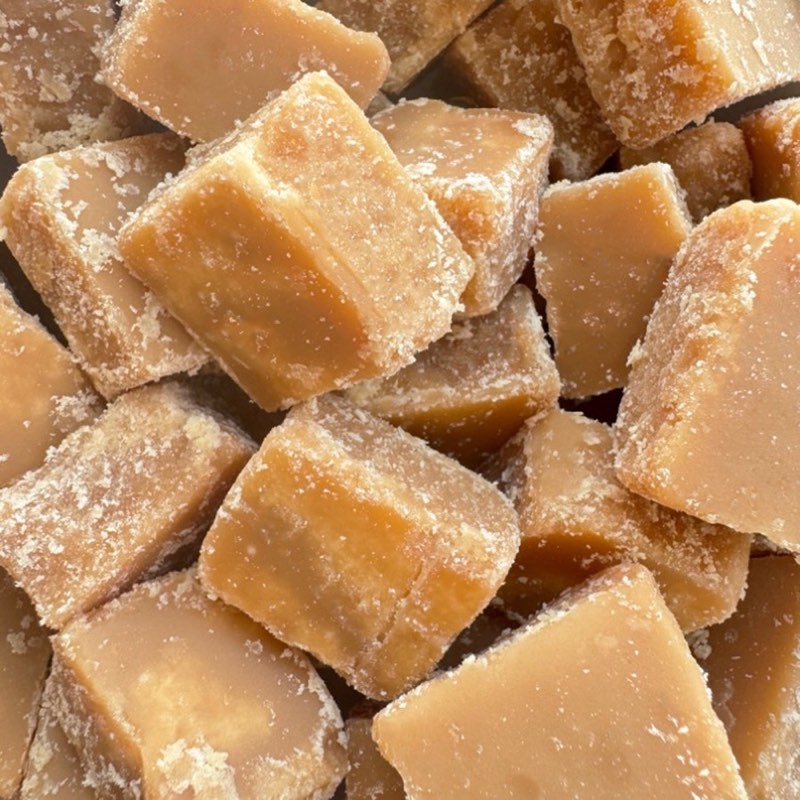
The colour in the pack is listed simply as brown, and that is honest — this is a warm, even, brown sweet, without the marbling or two-tone effect you get in some confectionery. It reads as brown on a plate, which is worth knowing if you are styling a table, because it will not fight with anything and it will not photograph as the bright thing. It is the calm colour in the arrangement.
The flavour listed is toffee, and toffee in a fudge behaves differently from toffee in a hard sweet. In a boiled toffee, the flavour arrives with the first crack and then stays put while you work through it. In a fudge, the piece gives under the teeth almost immediately, and the flavour opens up across the whole mouth at once rather than releasing slowly from one point. That is why fudge feels generous and why a small piece is usually enough — you get the entire flavour in the first second or two rather than being led through it.
The texture is the reason fudge has its own shelf rather than living with the toffees. It is a yielding sweet. It does not need to be bitten through so much as pressed, and it goes from solid to soft in the mouth faster than almost anything else in a sweet shop. There is no long chew and no jaw work; the piece is essentially gone by the time you have decided how much you like it. That short arc is exactly why fudge is best eaten in ones and twos with a pause between, and why it works so well next to sweets that take their time.
The finish is where toffee fudge earns its keep. The flavour does not vanish cleanly — it sits on the palate for a while afterwards in a way that makes a cup of tea or a black coffee taste noticeably different. That is a feature at the end of a meal and a slight nuisance if you are about to eat something delicate, so if you are planning a run of sweets in one sitting, put the fudge last rather than first.
Who reaches for this, and when
The clearest audience is the shopper buying for someone else. A carton of fudge is one of the few sweets that reads as a present without being a present — it can be handed over with no card, no wrapping and no occasion attached, and it still lands as a gesture rather than a snack. That is a genuinely useful property, and it explains why this format moves in the run-up to any point in the year when people owe each other small thank-yous.
The second audience is the slow eater. Not everyone wants a bag they will finish. Plenty of people want a box that sits in a cupboard and gets opened on a Sunday, with two pieces taken and the lid closed. A 150 g carton is close to a perfect size for that rhythm: big enough to last several sittings, small enough that it will not go stale waiting for you to remember it.
The third is the person building a tray for a group with a wide age range. Fudge is one of the few sweets that genuinely crosses generations without needing explanation. Sour gets refused by some adults; strong fizz gets refused by some children; a piece of toffee fudge gets taken by nearly everyone. If you are catering for a room with grandparents and grandchildren in it, this is the safe centre of the table, and you can build the more adventurous stuff around it from our loose sweets shelf.
The fourth is simply someone who wants a treat that is not a chocolate bar. That is a bigger group than it sounds. Fudge occupies a middle ground — richer than a jelly, less of a commitment than a bar, and eaten in pieces rather than in one go. When you want something sweet after dinner but not a whole dessert, a carton of this is the sensible cupboard answer.
The corner shop, the seafront and the sweet carton: where this belongs
British sweet-buying has always had two different homes, and a carton of fudge belongs squarely in one of them. The first home is the corner shop: the counter run of small bags and single bars, bought fast, eaten on the walk home, priced so that a child with pocket money can make a decision without help. The second home is the sweet shop proper — the seaside or market-town kind, with jars on shelves behind the counter, a scoop, a scale, and a paper bag folded shut at the top. Those two rooms sell sweets in completely different ways, and the formats that survive in each one look different as a result.
The corner-shop format is designed for immediacy. Bags are soft, cheap, and made to be opened within minutes of purchase. Nothing about them anticipates being carried home carefully or kept for a week. The sweet-shop format is the opposite: it assumes you are buying to take somewhere. The weighed bag, the boxed slab, the small carton — these exist because the shop knows you are walking out with something you intend to keep intact until you get where you are going. A carton of fudge is a direct descendant of that second tradition, and you can tell by the packaging logic alone.
The seafront sweet shop is where the format got its particular character. Coastal sweet shops sell to people who are having a day out, which changes everything about what stocks well. Holidaymakers buy to bring something back — for the neighbour who watered the plants, the colleague who covered the shift, the relative who could not come. That demand created a whole tier of British confectionery designed to survive a journey and to be handed to somebody: rock, tablet, toffee slabs, fudge cartons. These are not impulse sweets. They are take-home sweets, and they are built to be presentable at the other end of a long drive.
That is also why the carton, and not the bag, became the standard vessel for fudge in this tradition. A soft sweet that would be ruined by pressure needs a rigid box if it is going to be carried in a rucksack on a train. The box is doing real work. It is why these products sit at a slightly higher price per gram than a floppy bag of the same weight, and it is why they still look like something when they arrive rather than looking like something that has been sat on.
There is a third thread worth pulling, which is the sheer stubbornness of the traditional sweet shop as a format. Almost every other kind of specialist food shop on the British high street has had to modernise or die. Sweet shops largely did not. The jars stayed, the scoop stayed, the paper bag stayed, and the formats that sold in the 1970s are mostly the formats that sell now. You can argue about why — nostalgia is doing a lot of the work, and so is the fact that sweets are one of the few genuinely cheap pleasures left — but the practical effect is that a carton of fudge on a shelf today is doing exactly what a carton of fudge on a shelf did decades ago, and looks broadly the same doing it.
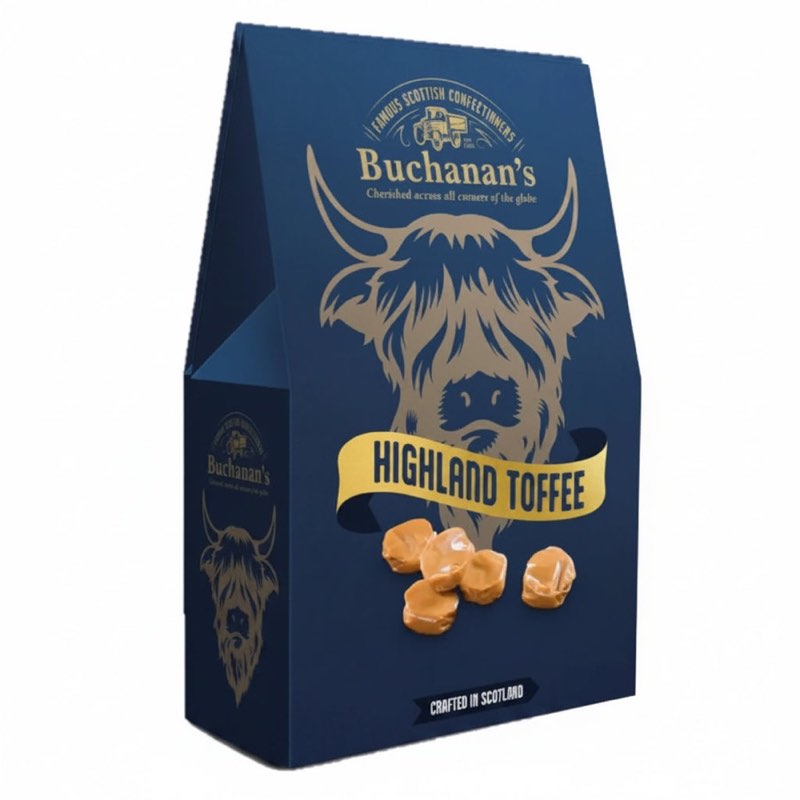
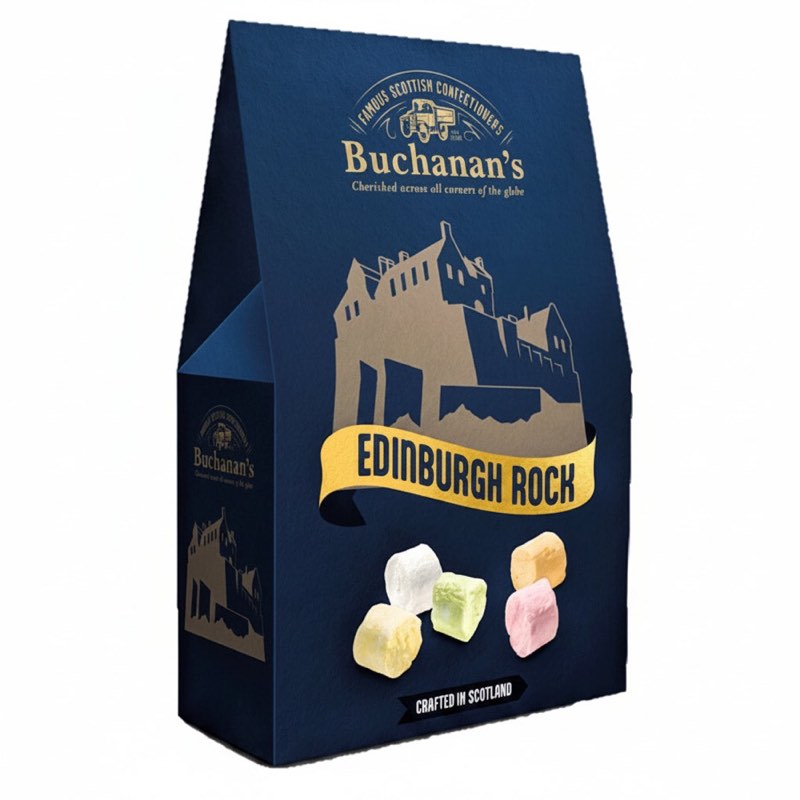
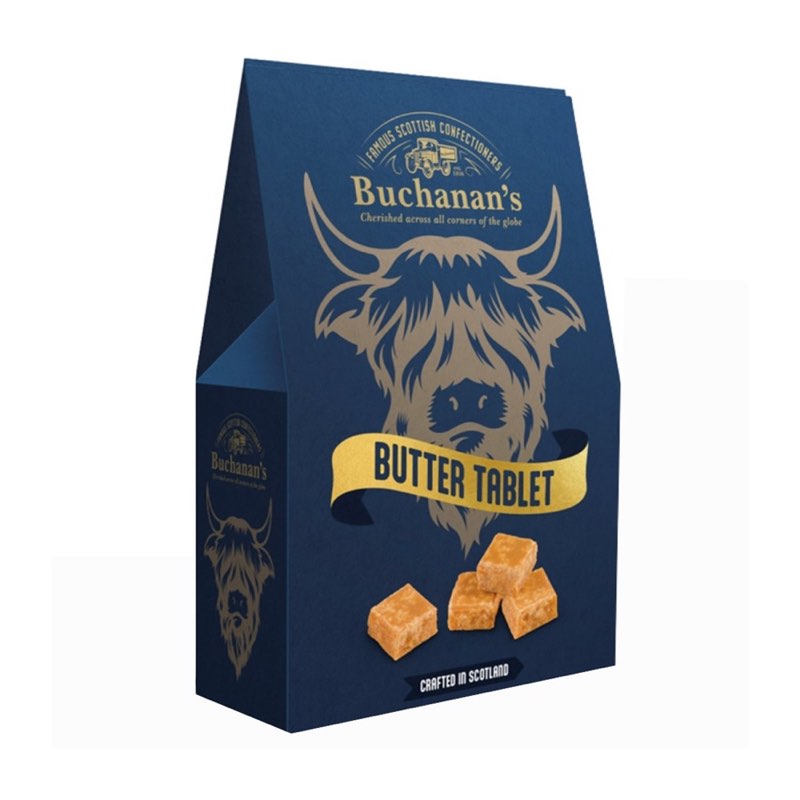
Where this shop fits into that is straightforward: we are the jar wall without the counter. The retro shelf exists precisely because the traditional formats did not go anywhere, and the point of stocking cartons alongside weighed loose sweets is that both halves of the tradition are worth keeping. You can build a paper-bag-style mix from the loose lines and then add a boxed line like this one for the part of the order that is going to someone else. The Edinburgh Rock carton at the same £3.49 and the Buchanan's Butter Tablet Carton 150g are the other two pillars of that same take-home tier, and the Buchanan's Highland Toffee Carton 150g completes the set. Put all four cartons side by side and you have a fair approximation of the boxed shelf in a proper sweet shop, at £13.96 for the lot.
The last thing to say about this tradition is about scoops and weights, because it explains the pricing you will see across the site. Loose sweets are priced by weight because that is what the scale on the counter implies; you decide how much you want and the price follows. Boxed sweets are priced by the box because you are also buying the box. Neither is a rip-off and neither is a bargain — they are two different contracts. If you want maximum sweets for money, buy loose and buy a lot. If you want something you can hand over, buy the carton. Most orders sensibly do both, and the full shop is laid out so you can.
Sending it to someone: hampers, letterbox parcels and the small thank-you
The second thing this carton is genuinely good at is being posted, packed and given. It is worth taking that seriously rather than treating it as an afterthought, because gifting is where a 150 g box outperforms a much larger bag, and understanding why will save you money on every parcel you build.
Start with hampers. The mistake most people make when assembling a hamper is filling it with things of similar weight and shape, which produces a box that looks flat and uninteresting when the lid comes off. A good hamper needs a floor, a middle and a top: heavy dense items at the bottom, mid-weight boxes in the middle, and light bright things on top. A fudge carton is a perfect middle item. It is rigid, so it supports whatever goes above it. It is dense, so it stops the box shifting in transit. And it is a flat-faced box, so its label faces the person opening the hamper rather than disappearing into the straw. Two or three cartons form a reliable structural layer that nothing else in the sweet aisle does as well.
Then the letterbox parcel, which is the format that has quietly taken over small gifting. The constraint is depth, not weight — a parcel has to be shallow enough to go through a standard letterbox, which rules out jars, tubs and anything tall. A carton lies flat. You can put two side by side in a shallow box with room for tissue and a card, and the whole thing goes through the door without anyone needing to be home. If you are building a letterbox treat for somebody, a fudge carton and a second carton from the fudge shelf is about the neatest £7 gift you can assemble, and it needs no wrapping skill whatsoever.
Teacher gifts are their own category with their own rules, and the rules are mostly about restraint. The thing you are trying to avoid is being the parent who gives something extravagant, or something that implies an obligation. A small boxed sweet is close to ideal: it is clearly a thank-you, it costs a recognisable and modest amount, it does not need to be kept, and it can be shared with the staff room if the recipient would rather not take it home. A carton at £3.49 hits the exact register — noticeably more considered than a bag of sweets, noticeably less loaded than anything with a ribbon on it. If you are buying several, buying four identical cartons is better than four different things, because it removes any question about who got the nicer one.
Care parcels — for a student, someone in hospital for a stretch, someone working away, someone having a hard month — have a different requirement again. What matters in a care parcel is that things last. Anything that has to be eaten immediately is a burden rather than a treat, because the recipient feels obliged to get through it. A boxed sweet that can be opened, partly eaten and closed again is the right shape for that. You are giving somebody six small moments rather than one large one, which is almost always the kinder version of a food gift.
For building a parcel that is more than one note, put the carton next to something that does the opposite job. Briquette at £5.49 is another of our traditional sweet-shop lines, and a bag that gets opened a few pieces at a time suits a care parcel perfectly. A candy and chocolate line adds a different texture and a different eating occasion. And if the parcel is going to somebody young, or to a household with children in it, something bright from the jelly and gummy sweets section stops the whole box reading as brown and serious.
A note on presentation, since it costs nothing. Cartons look better in even numbers and in a row than they do singly and at an angle. If you are building anything — hamper, parcel, tray at a wake or a christening — line the boxes up with the printed faces the same way round. It takes ten seconds and it is the difference between a box that looks assembled and a box that looks filled.
Finally, the practical shipping point. Sweets that are dense and rigid travel better than sweets that are soft and loose, and a carton needs less protective packing around it than a bag does. If you are posting a parcel yourself, every carton in the box is one less thing you have to wrap in bubble wrap. That is a small saving on materials and a real saving on time when you are doing twelve of them in December.
Toffee, and the family it belongs to
Toffee is the listed flavour here, and it is worth spending a moment on what that means across a sweet shop, because toffee is not one flavour — it is a family with a wide range inside it.
At one end sits hard toffee: the slab, the individually wrapped block, the sweet that has to be worked at. That version of toffee is about persistence. It lasts a long time, it dominates the mouth, and it is a deliberate commitment. At the other end sits soft toffee in fudge form, which is what you have here. Same broad flavour direction, completely different contract. The fudge version gives you the flavour immediately and asks nothing of your jaw. Between those two poles sit chews, éclairs, bon bons and caramels, each one a different compromise between flavour intensity and how long you have to work for it.
What the whole family shares is a deep, rounded, brown-sugar character that pairs with a very specific set of other flavours. Toffee goes with mint — hence the enduring popularity of a humbug next to a toffee on the same shelf. It goes with salt, which is the entire basis of the salted caramel category. It goes with chocolate, which is why toffee-and-chocolate combinations are a permanent fixture. And it goes, slightly unexpectedly, with sharp fruit — an apple sour eaten a minute after a piece of fudge tastes brighter than it would on its own, because the toffee has reset your palate downward.
What toffee does not go with is more toffee. This is the single most common mistake in building a sweet spread around it. Two toffee-family lines side by side do not double the pleasure; they cancel each other out, because the second one arrives on a palate that is already saturated. If you are stocking more than one line from the toffee flavour page, separate them on the table and put something sharp or minty in between.
Fudge as a category is small and specific. We keep all four fudge lines we stock together for exactly that reason — it is a short shelf, and the useful comparison is between the four of them rather than between fudge and everything else. If you are shopping the fudge shelf properly, the question is not whether you want fudge, it is which weight and which format you want it in.
Occasions this carton actually suits
Christmas is the obvious one, and the reason is structural rather than sentimental: December is when people need a lot of small, similar, modest gifts at once, and boxed sweets are the most efficient answer to that problem. A carton is the right size for a stocking, the right shape for a hamper, and the right price for a secret-santa cap. If you are buying at any volume for the season, buying the same carton several times is not lazy — it is the whole point.
Funerals and wakes are less discussed and just as real. There is a long, quiet British tradition of putting plain, comforting, unexciting sweets out at a gathering after a funeral, and fudge is squarely in that tradition. It is not celebratory, it does not require anyone to make a fuss about it, and it can be eaten one piece at a time by people who are not thinking about food. If you are the person organising that table, this is a more appropriate choice than anything bright or sour.
Christenings, small birthdays and family Sundays all want something in the middle of the table that anybody can take without asking. That is the fudge role again — the thing on the tray that needs no introduction. It works particularly well on a table that otherwise leans young, because it gives the adults something to reach for.
Long car journeys and train trips are the format's original home, given how much of this tradition grew up around people travelling. A carton in a bag does not burst, does not leak and does not melt into the lining. Two pieces every hour is a civilised way to get through four hours of motorway.
Office and workplace tins are the last obvious use. A box on a desk gets grazed all day; the advantage of a dense sweet is that it slows that grazing down. A 150 g carton will do a small team for an afternoon, where the same money in light sweets would be gone by eleven.
Portions, and what the price actually works out at
At £3.49 for 150 g, the honest unit price is £2.33 per 100 g. Fudge is a sweet you eat in small amounts, so the per-portion numbers matter more than the per-100 g number. Here is how it breaks down:
| Portion | Portions per carton | Cost per portion | What that portion is |
|---|---|---|---|
| 15 g | 10 | about 35p | A piece with a cup of tea |
| 25 g | 6 | about 58p | An after-dinner serving for one |
| 30 g | 5 | about 70p | A generous helping on a plate |
| 50 g | 3 | about £1.16 | A share for two |
| 75 g | 2 | about £1.75 | Half the box at a sitting |
Read that table and the sensible way to buy becomes clear. If you are treating this as a cupboard box for one person, you are buying roughly ten small occasions for £3.49 — about the price of a single coffee, spread across a fortnight. If you are putting it on a table for a group, think of it as three decent shares rather than as a big bag, and do not expect it to feed a party on its own.
Compared with the loose lines, this sits mid-range. Most of our weighed traditional sweets run at £5.49 for their standard bag, so the carton is a lower total spend but a higher price per gram — you are paying for the box, the format and the portability. That trade is worth it when the box is doing a job. It is not worth it when you just want a lot of sweets in a bowl, and in that case the right move is to buy weight from the loose-sweets aisle instead.
For gifting maths specifically: four cartons is £13.96, six is £20.94, and ten is £34.90. Those are useful numbers to have if you are doing a run of teacher gifts, a team, or a class list, because the per-gift cost stays flat and predictable — there is no bulk tier to chase and no decision to agonise over.
Keeping it in good condition
Fudge is one of the more weather-sensitive sweets in a shop, and a few basic habits make a real difference to how the last piece eats compared with the first.
Keep it cool and keep it dry. A cupboard away from the hob, the kettle and any window that gets direct sun is all it needs. The failure mode for soft sweets is not spoiling — it is texture change. Warmth makes fudge softer and stickier; a cold draught firms it up. Neither ruins it, but both change the experience, and a piece that has been sitting in a sunny car all afternoon will not eat the way it should.
Do not refrigerate it. This is the single most common mistake with fudge, and it is an understandable one — a fridge feels like the safe place for anything soft. But cold makes fudge hard and dulls the flavour, and moving it in and out of the fridge repeatedly is worse still, because condensation on the surface is what makes pieces stick together in a solid lump.
Keep it in its carton. The box is not just for the journey; it is the best storage the sweet will get. If you have opened it and want to close it properly, fold the inner packaging over before the lid rather than leaving the pieces exposed inside the box. If you have decanted the carton into a jar for display, that is fine, but keep the jar out of the light and do not expect it to hold as well as it would in the box.
If you are storing it next to other sweets, give it its own container. Soft sweets and strongly flavoured sweets both migrate — a fudge kept in a shared tub with aniseed or mint will pick up a hint of its neighbour within a few days. That is a problem across the whole site, not just here, and the rule is always the same: strong flavours get their own jar.
One size, four cartons: choosing within the range
This product comes in a single size, which makes the decision within the line simple — there is no larger box and no multipack to weigh up. The real choice is sideways, between this and the other cartons at the same price.
All four sit at £3.49 for 150 g, so price is not a tiebreaker and you can choose purely on what you feel like. The fudge is the softest and the quickest to eat; it is the one to pick if you want something immediate and comforting. The Highland Toffee carton is the one to pick if you want the same flavour direction with more work in it and a longer sitting. The Edinburgh Rock carton is the outlier of the group, and it is the most distinctive thing to give somebody who has had fudge and toffee a hundred times. The butter tablet carton is the closest relative to this one, and the pair of them together make the most natural two-box gift in the range.
If you cannot decide, buy two. At this price the difference between one carton and two is smaller than the effort of deliberating, and a matched pair is a better gift than a single box anyway.
Where to find this, and what sits near it
This carton lives on three shelves at once, and each one leads somewhere slightly different. It sits in our loose and traditional sweets section alongside the weighed lines, it sits on the short fudge shelf with the other three fudge products we carry, and it sits under toffee with the rest of the toffee-flavoured range. If you are shopping by texture, start with the fudge shelf. If you are shopping by flavour, start with toffee. If you are shopping by mood — old-fashioned, unfussy, comforting — start with our retro sweets section and work outwards.
From the wider site, the two hubs that connect most naturally are browse everything we stock for a full sweep, and build your own bag if you would rather make a mixed pouch than buy fixed formats. The other neighbourhood worth knowing about is the traditional end of the range, where a bag of Briquette at £5.49 sits with the rest of the old-fashioned weighed lines.
Questions people ask before they buy
How many pieces are in a 150 g carton?
We do not publish a piece count, because fudge is cut by weight rather than by number and the count varies between cartons. What we can tell you is the weight — 150 g — and that is the figure to plan with. If you think in 25 g servings, you have about six; if you think in 15 g pieces with a cup of tea, closer to ten. For catering, always plan by weight rather than by pieces, because it is the only number that holds steady.
Is this a gift box or just packaging?
It is a carton, which sits between the two. It is rigid, flat-faced and presentable enough to hand over as it is, which is why it works so well in hampers and letterbox parcels. It is not a ribboned presentation box with a window and an inner tray. If you want something that reads as a proper gift box on its own, the Walker's Nonsuch gift box is the format you are after.
Is it made in Scotland?
We cannot tell you that. "Scottish Fudge" is the manufacturer's own name for the product, and a product name is not a statement about where something is made. We only publish facts we hold — the brand, the weight, the price, the flavour and the format — and origin is not among them. If provenance matters to you, the packaging that arrives will carry the manufacturer's own information, and that is the authority to go by.
What is the difference between fudge and tablet?
They are close relatives with different characters. Fudge is the softer, more yielding of the two, and it gives way quickly in the mouth. Tablet is firmer and has a different bite to it. Neither is a substitute for the other, and if you like one it is genuinely worth trying the other — having the Ross's Of Edinburgh tablet at £5.49 alongside this carton is the easiest way to work out which camp you are in.
Will it survive being posted?
Better than most sweets. The rigid carton protects the contents from pressure, which is the main hazard in a parcel, and the box lies flat enough for letterbox deliveries. The thing to avoid is heat — a parcel left in a hot porch or a sunny car for a day will arrive softer than it left. Post it early in the week in warm weather, and it will be fine.
Can I put it in a pick and mix bag?
You can certainly add pieces of it to a mixed bag you build at home, and it is a good thing to add in small amounts — a couple of pieces per bag rather than a handful. It is sold as a sealed carton rather than by weight, so it is not part of the weighed selection itself; you would buy the box and then distribute it. If you want fudge as part of a weighed mix, look at what is currently on the loose sweets shelf instead.
Is it suitable for children?
Sweets are a treat rather than everyday food, and that applies here as everywhere. As a general point of care, small hard sweets and whole gummies are a choking risk for young children and should be eaten under supervision. Beyond that, anyone with an allergy should check the manufacturer's packaging when the order arrives, before eating — that packaging is the only reliable source for that information, and we would rather you read it than take our word for anything.
How long will an opened carton keep?
Treat the date on the manufacturer's packaging as the authority. In practice, the limiting factor once a carton is open is texture rather than anything else: kept cool, dry and closed, it will hold its character for a good while; left open in a warm kitchen it will change within days. Fold the inner packaging back over the pieces and put the lid on, and you will get far more consistent eating from the last piece than from a box that has been sitting open on the side.
What should I put with it for a party table?
Something sharp and something light. Sharp gives the table contrast — a sour line stops everything tasting the same after twenty minutes. Light gives it volume without cost, which is what mallows and foams are for. A workable three-line table is this carton, a sour bag, and a bowl of something airy like the pumpkin mallows at £5.49. Add a jelly line if there are children coming.
Is it worth buying more than one?
If it is for a gift run, yes — identical cartons make a cleaner set of gifts than a mixture, and four comes to £13.96. If it is for yourself, one is usually enough to start with, because fudge is rich and 150 g goes further than you expect. Buy a second only once you know you finish the first faster than you meant to.
Do you stock a bigger version?
Not of this line — the pack lists a single size. If you want more fudge-family sweets in one order, the answer is breadth rather than depth: add another carton from the range, or move sideways to the weighed traditional lines where the standard bags are larger. The butter tablet carton is the closest thing to buying more of the same.
What goes with it if I only want one more thing?
Mint. It is the oldest pairing with this flavour family and the most reliably good one. A bag of the mint humbugs at £5.49 next to a £3.49 carton is a genuinely complete two-line sweet offering for under £9, and the two do not compete with each other in the slightest.
The short version
A 150 g carton at £3.49 is a small, sensible, unflashy purchase that does two things very well: it slows a sweet table down, and it hands over neatly to somebody else. It is not the cheapest way to get sweets into a bowl, and it is not trying to be — the box, the density and the portability are what you are paying the extra per gram for. Buy it if you want a treat you will eat in pieces over a fortnight, or if you owe somebody a modest thank-you and would rather give them something they can open, share and close again. Buy weight from the loose sweets range if what you actually want is a full bowl.
More from Buchanan's
More fudge sweets
More toffee sweets
Where this sits
Buchanan's Scottish Fudge Carton 150g appears on these shelves. Browse them, or jump to something nearby.
You might also like