
Home / Loose Sweets / Ross's Of Edinburgh Scottish Tablet
Ross's · 250g
Read the full guide
Ross's Of Edinburgh Scottish Tablet
£5.49
✔ In stock — ready to ship
Fresh stock
Free over £20
Same-day dispatch
Secure checkout
There is a particular kind of afternoon that tablet was built for. The kettle has gone on, somebody has pulled a chair out, and nobody is in a hurry. You want something sweet, but you do not want a whole pudding, and you do not want to be chewing for ten minutes. You want two or three small pieces that give you everything at once and then let you get on with the conversation. That is the slot Ross's Of Edinburgh Scottish Tablet fills better than almost anything else on our shelves, and it is the reason we keep it in five different sizes rather than one.
Work out the occasion first and the rest of the decision gets easy. If you are buying for a tea tray — the kind you carry through to a front room where two or three people are sitting — the 250g bag at £5.49 is exactly right. Break it into small pieces, put them on a saucer, and you have enough for the afternoon without a half-eaten bag sitting about afterwards. If you are buying for a family who genuinely like it, the 500g at £9.99 stops you rationing. If it is going on a table where people help themselves all day, go to the 1kg at £16.49 and stop thinking about it.
The full guide to Ross's Of Edinburgh Scottish Tablet
7,366 words on how it eats, who it suits, how to serve it and what to put beside it.
The moments this one is made for
Tablet also behaves very well at the end of a meal, which is not true of every sweet we stock. A chewy sweet after a big dinner is hard work. A sour sweet clashes with whatever you have just eaten. Tablet does neither. A single small square alongside a coffee reads as a proper end to the meal — it is rich enough to feel like a course, small enough not to defeat anybody, and it does not need a plate or a spoon or anything washing up. If you have ever wished you had something to put out with coffee that was not a biscuit, this is the answer, and it is why we see people buying the larger sizes in December.
The other big occasion is the car. Long drives, coach trips, train journeys with a change in the middle: tablet travels better than nearly anything soft. It does not stick to itself in a bag the way some chews do, it does not need refrigerating, and because it is so rich you only want a couple of pieces at a time, so a 250g bag will see a family through a very long journey without anybody feeling sick. Break it up before you leave rather than trying to snap pieces off at seventy miles an hour, and put the pieces in something rigid rather than a soft bag at the bottom of a rucksack.
It works as a small gift, too, in a way that is genuinely useful. If you need something to hand over that is not flowers and not a bottle, a bag of tablet says more thought than a box of biscuits and costs less than most things you would buy in a hurry. The 250g at £5.49 is a perfectly respectable thank-you. The 500g at £9.99 is a proper present. And unlike chocolate, it does not care whether the person you are giving it to has a warm hallway.
What you are actually getting for your £5.49
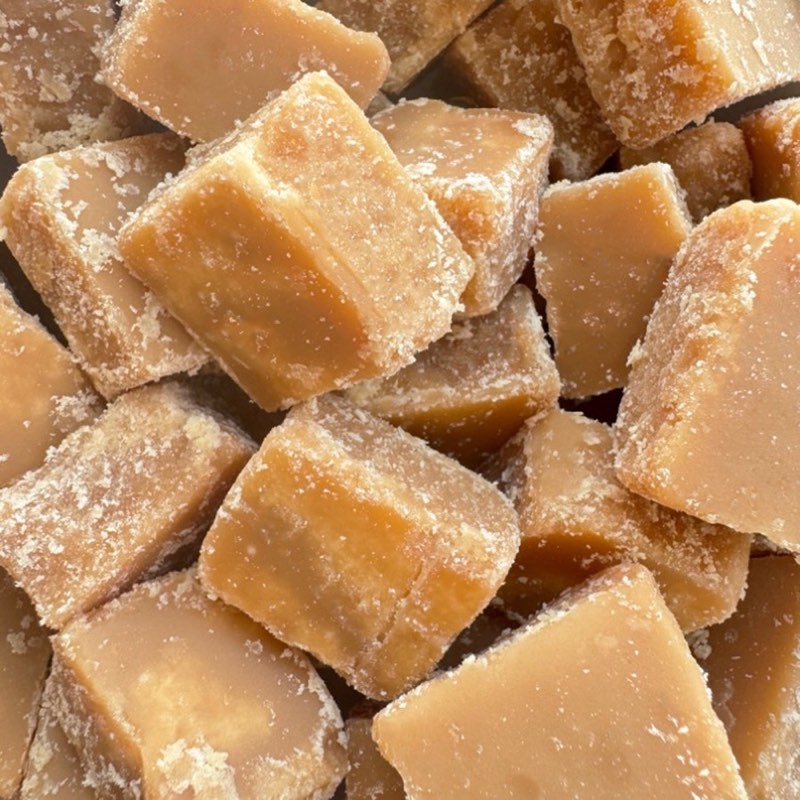
This is 250g of tablet, sold as a fudge-type sweet, in a cream flavour. That is the honest description, and it covers more ground than it sounds like it does. Tablet is not quite the same eating experience as a soft fudge, even though it sits on the same part of the shelf and we file it under the same heading. Fudge, at its most typical, is yielding — you press it and it gives. Tablet is firmer and more brittle, and it does not give under your thumb so much as resist and then break. That difference is the whole point of the sweet, and it is what people who love it are actually loving.
What arrives is a bag with a good weight to it. Two hundred and fifty grams of something this dense is a satisfying thing to hold — it is noticeably heavier than a 250g bag of jellies would be, because there is almost no air in it. Inside, the pieces are irregular. That is normal and it is not a fault. Tablet is a sweet that gets broken rather than moulded into identical shapes, so you will get some generous slabs, some neat squares, and a scattering of small shards and crumbs at the bottom of the bag. The shards are not a problem. They are the part you eat standing at the kitchen counter while you are putting the rest away.
If you have never bought it before and you are trying to guess how much 250g is: think of it as a decent-sized handful of pieces, enough to fill a small bowl generously, or enough for four people to have three or four pieces each with something to spare. It is not an enormous bag. It is not meant to be. Tablet is rich, and 250g of it goes further than 250g of almost anything else in the loose sweets range.
Hand, snap and melt — how it actually eats
Pick up a piece and the first thing you notice is that it is not soft. There is a slight give at the very edges if the bag has been somewhere warm, but the body of the piece is solid. Press it between finger and thumb and it does not squash; it either holds or it splits. That split is worth paying attention to, because it tells you what you are dealing with. A good piece of tablet breaks with a short, clean snap rather than tearing, and the broken face is not smooth and glassy — it has texture to it, a very slight graininess you can see and feel. That grain is the signature of the sweet.
The surface is matte rather than glossy, and it has a faint powderiness to it. Your fingers will come away very slightly dusted. This is normal, and it is one of the ways you can tell tablet from a softer fudge before you have even tasted it — fudge tends to leave your fingers a little greasy, tablet leaves them a little dry.
Now put a piece on your tongue and do nothing. That is the honest way to eat this. The first sensation is the edges going, almost immediately — the corners soften and start to dissolve before you have decided whether to chew. Then the body of the piece begins to break down, and the graininess you felt with your fingers becomes something you can feel on your tongue: very fine, not gritty exactly, more like the texture melts in stages rather than all at once. This staged melt is the whole experience. A soft fudge goes from solid to paste and then you chew the paste. Tablet goes from solid to sand to liquid, and each of those stages tastes slightly different.
The flavour is cream, and it arrives front-loaded. You get it immediately and at full strength — there is no build. It is a rounded, creamy sweetness with a warm edge to it, the kind of flavour that fills the whole mouth rather than sitting on one part of the tongue. Because it comes on so fast and so completely, the piece you eat feels bigger than it is. This is why people who have never had it before reach for a second piece straight away and then find they do not want a third for twenty minutes. That is not a criticism. It is how the sweet is supposed to work, and it is why a 250g bag lasts longer in a house than you would expect.
The finish is the best-kept secret of tablet. It does not stop abruptly. After the piece has gone, there is a coating sensation left behind — not sticky, not cloying, just a lingering warmth that sits with you for a minute or two. That is why it partners so well with something hot and slightly bitter. A cup of strong tea or a black coffee taken immediately afterwards cuts straight through that coating, resets your mouth, and makes the next piece taste as vivid as the first. Eaten on its own, three pieces in a row start to blur into each other. Eaten with tea, you can go through half a bag over an afternoon and every piece will land.
One practical note on temperature, because it changes the sweet more than people expect. Straight from a cool cupboard, tablet is at its most brittle and the melt is slowest and most staged — this is the version most people think of as the proper one. Left in a warm room for an hour, it softens at the edges, the snap goes slightly, and it eats more like a firm fudge. Neither is wrong. But if you have had a bag that felt disappointingly soft, try the next one from a cooler spot in the house and you will probably find it is the sweet you were expecting all along.
Who this is really for
Tablet has a very specific audience and it is worth being straight about it. This is a sweet for people who like sweetness delivered honestly and at full volume. If your favourite things on our shelves are sours, fizzy sweets, or anything with a sharp fruit edge, tablet is probably not going to be your everyday bag — you would be better served by something like the Barnett's Mega Sour Apple Candy Bags 104g, which are built to do the opposite job entirely at £3.99.
But if you are the sort of person who genuinely likes butterscotch, caramel, creamy toffee and old-fashioned creamy sweets — the family of flavours where the sweetness itself is the point rather than a carrier for something else — then this is close to the top of that category. It is also a sweet that tends to convert people. We have watched plenty of shoppers describe themselves as not really a fudge person, try a piece of tablet, and immediately understand that it is a different thing.
It suits older shoppers particularly well, and we do not mean that as a backhanded comment. Tablet requires no chewing, no jaw work and no dealing with anything sticky, which matters more than people who have never thought about it realise. It also suits anybody feeding a mixed-age room, because the texture is easy for almost everybody. Small children need watching with any firm sweet and tablet is no exception — break pieces down small for them rather than handing over a full slab, and stay in the room while they eat it.
It is a good choice for people who find most sweets unsatisfying. If you have ever eaten most of a bag of jellies and felt like nothing happened, tablet solves that. Three pieces is a proper thing to have eaten. You know you have had something.
And it is, quietly, one of the best things we sell for somebody who is buying for another person and does not know them very well. It is not divisive the way liquorice is. It is not a texture gamble the way foam sweets are. Almost everybody who likes sweet things at all gets on with tablet, which makes it the safe and generous option on a hamper list.
A collector's eye: runs, shapes and the sweets that do not come back
Anybody who has spent long enough buying sweets develops a collector's instinct, whether they admit it or not. You start noticing which lines change, which ones only appear for eight weeks a year, which ones quietly disappear and never return, and which ones have been exactly the same for as long as you have been paying attention. It is a real way of looking at a sweet shop, and it changes what you buy.
Tablet sits at the stable end of that spectrum, and that is genuinely part of its appeal. In a category full of seasonal shapes, novelty formats, limited-run flavours and one-off collaborations, this is a sweet that is defined almost entirely by what it is rather than by what it has been made to look like. There is no festive version with a shape moulded into it, no summer edition, no rotating flavour of the month. You buy tablet and you get tablet. For a shopper who has been burned by chasing a limited line and finding it gone, that reliability is worth something.
The interesting thing about collecting-minded shopping is that it works in two directions at once, and a well-stocked cupboard wants both. On one side you want the anchors: the lines you can buy in any month and know exactly what you are getting. Tablet is one. The Bristows Vanilla Fudge at £5.49 is another from the same corner of the shelf — a softer, more yielding take on the creamy-sweet idea, and a useful thing to have alongside tablet precisely because it does the same flavour family with a completely different texture.
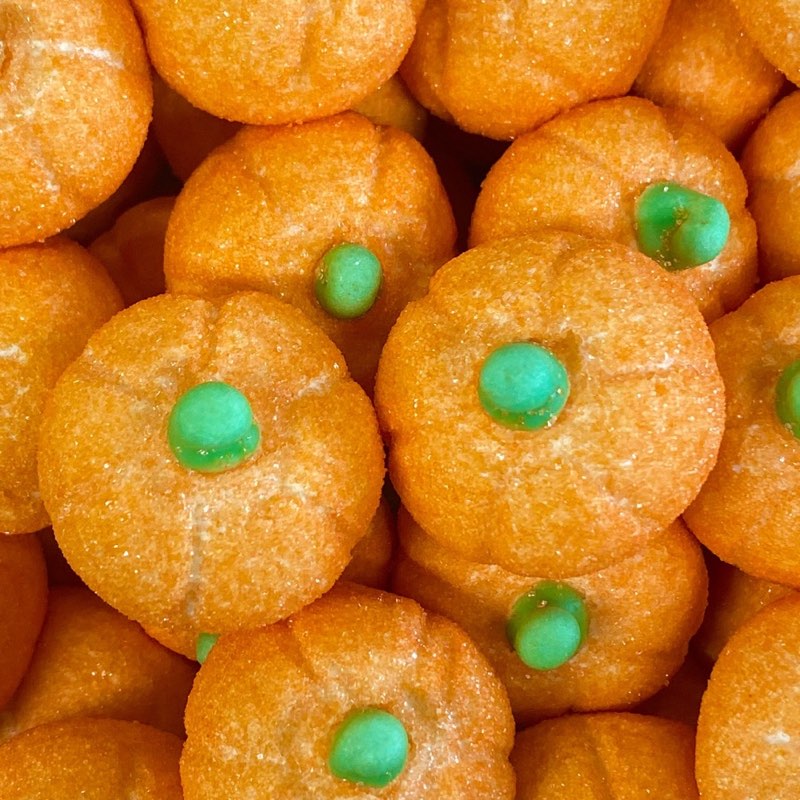
On the other side you want the things that will not be there in six weeks. Seasonal confectionery is the clearest example, and the format is usually the point rather than the flavour. The Cadbury Dairy Milk Christmas Little Robins Chocolate Bag 77g at £2.49 exists because of the shape and the season it is tied to; it is a different kind of purchase from a bag of tablet, and it is the kind of thing that is worth buying when you see it rather than assuming you can come back for it. The Bulgari Pumpkin Mallows at £5.49 work the same way — a moulded shape tied to a point in the calendar, which is exactly the sort of line a collector-minded shopper picks up on sight.
Novelty format is its own category of interest, separate from seasonality. Some sweets are bought because of the flavour and some are bought because of what the manufacturer has done with the shape, the packaging or the gimmick. The Candy Paradise Juicy Grenade Gummies at £1.39 are a novelty-shape line and priced to be an impulse pick-up rather than a considered buy. Briquette at £5.49 is a name and a format that make you look twice. Neither is trying to be a cupboard staple, and neither should be judged as one.
Where this matters practically is in how you build a standing order. The collector's mistake is to fill a cupboard entirely with interesting things and end up with nothing anybody actually wants on a Tuesday. The opposite mistake is to buy only the safe lines and never try anything. The sensible version is a base of two or three reliable weights — tablet in the 500g or 1kg size is a strong candidate — plus a rotating handful of whatever is currently on the shelf that will not be there next quarter. Browse the full range in one place with that split in mind and you will shop very differently than if you go looking for one thing.
Format matters within a single line, too, which is an underrated part of the collector's view. Tablet coming in five weights from 250g up to 2kg is not just a pricing ladder; it changes what the sweet is for. A 250g bag is a treat. A 2kg bag at £28.99 is a supply. The same product becomes a different purchase at a different size, and knowing which size you want is most of the skill in buying it.
The last collector's habit worth borrowing is keeping notes on what a household actually finishes. It sounds fussy. It is not. Most people buying sweets for a family are guessing, and guessing wrong in the same direction every time — they buy what they themselves like and then wonder why half of it is still there in March. One month of paying attention tells you whether your house is a tablet house, a chews house or a gummy house, and after that every order is easier. If yours turns out to be a chews house, the Barratt Black Jack Chews at £5.49 are the obvious next stop; if it turns out to be a jelly house, Barratt Jelly Babies at the same price are the classic.
Counter shops, weighed-out bags and where a sweet like this belongs
There is a whole culture of sweet-buying in this country that has almost nothing to do with supermarkets, and tablet belongs squarely inside it. It is the culture of the counter shop: a small place, a wall of jars behind the till, a set of scales, and somebody who tips sweets into a paper bag while you decide whether you also want something else. The seaside version of it is the same idea with more windows and a longer queue. Anybody who grew up near one of those shops knows the particular pleasure of the thing, and it is not really about the sweets. It is about being sold a specific amount of something by weight, in a bag, by a person.
Tablet fits that world because it is a by-weight sweet in its bones. It is not a countline. It is not a single portion in a wrapper designed to sit next to a till. It is a slab-format sweet that gets broken up and weighed out, which is why it sells here in 250g, 500g, 750g, 1kg and 2kg rather than in one standard bar. When you buy the 500g at £9.99 you are doing, more or less, what somebody at a counter shop would have done for you: asking for an amount rather than a unit.
The loose-sweet habit changes how you shop in a way worth understanding. When everything is sold by weight, you stop thinking in packets and start thinking in mixtures. You get a bit of this and a bit of that, and the pleasure is in the combination rather than in any single line. That is why our sweets sold loose by weight shelf is the biggest thing on the site by some distance, with 356 lines on it — it is the part of the shop that works like a counter shop, and it is where people spend the most time.
The counter-shop tradition also explains why certain textures keep showing up on those shelves decade after decade. A jar sweet has to survive being scooped, weighed, bagged and carried home without turning into a lump. It has to be eaten out of a bag with your fingers, often outdoors, often while walking. And it has to be worth buying a quarter of rather than a whole box. Tablet passes all three tests easily, which is why it has always sat comfortably in that kind of shop alongside chews, boiled sweets and toffee.
The same logic applies to its shelf-mates. Chews like the Black Jack chews at £5.49 are counter-shop sweets for exactly the same structural reasons — they weigh well, they bag well, they survive a pocket. Foam sweets such as the BUBS Banana & Caramel Foam Sweets at £7.50 are a more recent addition to that world but they behave the same way in a bag, and the banana-and-caramel pairing is a surprisingly close relative of tablet's creamy register.
Where tablet differs from the classic jar sweet is portion discipline. A bag of jellies from a counter shop gets eaten in one sitting on a bench. A bag of tablet does not, because the sweet will not let you. Three pieces and you are done for a while. This makes it the rare by-weight sweet that behaves like a cupboard staple rather than a day out — you buy it loose, but you eat it like something you keep.
The other thing that survives from counter-shop culture is the pick-and-mix instinct, which is just the loose-sweet habit formalised. Rather than one big bag of one thing, you build a bag of six things in small quantities. Our pick and mix section exists for exactly that, and tablet is an unusual and very good thing to put in one, because it is the only item in most mixes that is genuinely rich. Everything else in a typical bag is chewy or fruity; one or two pieces of tablet in among them gives the whole mix somewhere to land.
If you want to understand the older end of this world, the retro sweets shelf is the place to start. Those are the lines that have hung around because people kept asking for them, which is a more reliable signal than almost anything else in confectionery. Tablet's relationship to that shelf is close — it is a sweet that people buy because they already know what it is, not because something persuaded them to try it.
Cream, and the family of flavours it belongs to
The flavour listed here is cream, and it is worth spending a moment on what that means as a flavour family rather than as a word on a label. Cream, in confectionery terms, is the rich, rounded, creamy sweetness that sits at the centre of a whole group of sweets: fudge, toffee, butterscotch, caramel, creamy boiled sweets, and everything else that tastes warm rather than bright.
What defines the family is that the sweetness itself is the flavour. In a fruit sweet, sugar is the background and the fruit note is the event. In a cream-family sweet, there is no fruit note to hide behind — the sweetness has to carry the whole thing, and the quality of the experience comes down to texture and richness rather than to any sharp identifying flavour. That is why texture matters so much more in this category than in any other, and why tablet's staged, grainy melt is not a detail but the entire proposition.
Cream-family sweets have a few consistent behaviours that are useful to know. They pair extremely well with bitterness — tea, coffee, dark chocolate — because the bitterness resets your palate. They do not pair well with sourness, which fights them. They are strongly affected by temperature, tasting noticeably richer and rounder at room temperature than straight from somewhere cold. And they have a low ceiling per sitting: you want fewer pieces of a cream sweet than of a fruit sweet, and you want them more slowly.
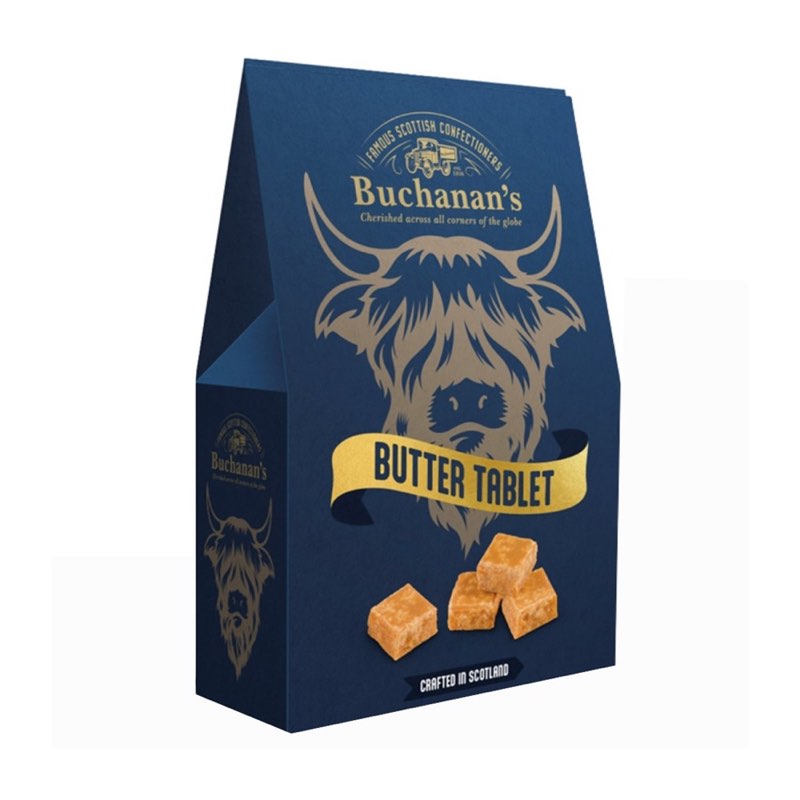
Within the family there is a real spread of textures, and that is where the useful comparisons live. Soft vanilla fudge like the Bristows line at £5.49 is the yielding end: it gives under the tooth, it melts as one mass rather than in stages, and it coats more heavily. Buchanan's Butter Tablet Carton 150g at £3.49 is the closest direct comparison we stock in terms of the eating experience, and at 150g in a carton rather than 250g in a bag it is the natural size to buy if you want to compare the two without committing to a full bag of each.
The caramel end of the family shows up in unexpected places on the site, which is worth knowing if the cream register is what you are chasing. The banana-and-caramel combination in the foam sweets at £7.50 is a good example — the caramel side of it belongs to this family even though the format could not be further from a slab of tablet.
If you want to taste the family properly, do it side by side rather than across different weeks. Put a piece of tablet and a piece of soft fudge on the same plate, eat them one after the other with a mouthful of tea in between, and the difference stops being abstract immediately. Most people find they have a strong preference they did not know they had.
Building a bag around it
Tablet is a superb anchor for a mixed bag and a poor filler, and getting that the right way round is the difference between a mix that works and one that gets picked over. Because it is the richest thing in most mixes, it should be the smallest component by weight and the most noticeable by effect. Roughly one part tablet to five or six parts everything else is about right.
The principle behind a good mix is contrast across three axes: texture, flavour register and intensity. Tablet covers one extreme of all three — it is the firm-then-melting texture, the cream register, and the high-intensity end. That means everything else you add should be doing something different, and the most common mistake is filling the rest of the bag with more soft, sweet, creamy things until the whole bag tastes the same.
For the fruit side, the Barratt jelly babies at £5.49 are the obvious and correct choice. They are soft, fruity, moderate in intensity and universally liked, which makes them the perfect bulk element — they fill the bag without competing with the tablet. If you want a firmer chew with more character, the Barratt chews in the same £5.49 bracket bring a long, worked texture that contrasts sharply with the instant melt of tablet.
For the sour element — and every good mix wants one, even a small one — the Mega Sour Apple bags at £3.99 do the job. A handful of these scattered through a mix acts like a palate reset button. You eat a piece of tablet, you eat a sour apple, and the next piece of tablet tastes new again. Do not overdo it; one sour to eight of everything else is plenty, because sours dominate a bag if you let them.
For a novelty element, which is worth including if children are involved, the grenade gummies at £1.39 are cheap enough to add without thinking about it, and the shape does the work. If you are building a seasonal mix, the pumpkin-shaped mallows at £5.49 add a soft, airy texture that no other component in the bag provides — mallow is the lightest thing you can put in a mix and it stops the whole bag feeling heavy.
For a chocolate element, which is optional but transforms a mix for a film night, the Little Robins bag at £2.49 gives you small individual chocolate pieces rather than something you have to break up. Chocolate and tablet together is a heavy combination, so keep both in small quantities and load the middle of the bag with fruit.
A worked example for a household mix, roughly 1kg total: 150g tablet, 300g jelly babies, 200g chews, 150g mallows, 100g sour apple, 100g of whatever novelty catches your eye. That bag has a low point, a high point, a sharp point and a soft point, and no two consecutive handfuls taste the same. Adjust the ratios once you know your house, but start there.
If you want to build this properly rather than guessing, work from the build-your-own section and lay the components out by texture before you decide on quantities. And if you want to go deeper on the rich end specifically, the fudge shelf is small — four lines — which makes it quick to work through and easy to find your favourite.
Parties, hampers and the December table
Tablet earns its place on a party table for one reason above all others: it is the thing adults go back to. Put out a spread of sweets at a family gathering and the fruit jellies disappear first, taken by children in handfuls. The tablet goes slowly, a piece at a time, to the people standing by the table with a drink. By the end of the evening both bowls are empty, but they emptied in completely different ways, and a table with only one of those two things on it feels incomplete.
For a party spread, the practical advice is to break it down further than you think you need to. Whole slabs on a table look generous but they do not get taken, because nobody wants to be the person who commits to a piece that size in front of other people. Break it to roughly thumbnail size and it vanishes. From a 500g bag at £9.99 you will get a very full bowl of party-sized pieces, which is plenty for fifteen or twenty people alongside other things.
For hampers, tablet is one of the strongest things you can include, and the reason is structural as much as culinary. It sits well, it does not need protecting from being squashed the way a mallow does, it does not melt in a warm room the way chocolate does, and it looks substantial in a box. A 250g bag is a good single component in a mixed hamper. If the hamper is the gift in itself, step up to 500g and let it be the centrepiece.
A well-built sweet hamper wants five or six things covering different registers, and tablet handles the rich slot completely. Around it, the 150g butter tablet carton is a neat second rich item at £3.49 because the carton format looks deliberate in a box. Add a classic bag for the fruit slot, something seasonal for interest, and one novelty item, and you have a hamper that reads as considered rather than assembled.
December is where the larger sizes justify themselves. If sweets are going to be on a table in your house from the middle of the month onwards, buying 250g at a time is a false economy in effort as much as in money — you will be re-buying it three times. The 1kg at £16.49 covers a normal household for the whole period. If you are the house where everybody ends up, the 2kg at £28.99 is not excessive. Seasonal lines such as the festive Cadbury bag come and go around it, but the tablet is the constant.
For a film night, keep the tablet off the main bowl. Put a small saucer of it next to whoever is drinking tea and fill the shared bowl with something lighter — this is where jelly babies or the banana and caramel foams earn their place, because you can eat those absent-mindedly for two hours and you cannot do that with tablet.
Sizes, price and what each weight is actually for
Five weights is more choice than most products on the site offer, and the price ladder is a real one rather than decoration. Here is how it works out.
| Size | Price | Roughly per 100g | What it suits |
|---|---|---|---|
| 250g | £5.49 | about £2.20 | A trial bag, a tea tray, a small gift, a journey |
| 500g | £9.99 | about £2.00 | A household that already knows it likes tablet |
| 750g | £12.99 | about £1.73 | A party table or a hamper centrepiece |
| 1kg | £16.49 | about £1.65 | A full festive period, or a big family |
| 2kg | £28.99 | about £1.45 | Events, a stall, or a serious standing supply |
The interesting jump is the first one. Going from 250g to 500g costs you £4.50 more and doubles what you get — the second 250g is effectively £4.50 rather than £5.49. That is the single best-value step on the ladder in proportional terms, and it is the one most people should take once they know they like it. After that the savings keep coming but more gently, and by the time you are at 2kg you are paying about a third less per 100g than at 250g.
On portioning: because a piece of tablet is small and rich, a portion is genuinely two or three pieces. Working roughly, 250g gives you somewhere around eight to ten servings of that size, which is why a 250g bag can cover an afternoon for a family of four with some left. Do the same sum on 1kg and you are looking at something in the region of thirty-five to forty servings — enough for a table that people graze at for a fortnight.
Compared with the rest of the shelf, £5.49 for 250g puts tablet in the same bracket as a lot of what we sell by weight. The vanilla fudge at the same £5.49, the chews and the jelly babies all sit on that price point. What differs is how far each goes. A 250g bag of jellies is a couple of sittings. A 250g bag of tablet, eaten properly, is a week. Cost per sitting, this is one of the better-value things in the by-weight range.
One honest caveat about the big sizes. Do not buy 2kg as your first purchase, however good the per-100g figure looks. Tablet is a sweet people feel strongly about in both directions, and £28.99 is a lot to discover you are in the second camp. Buy 250g, live with it for a fortnight, then scale up with confidence.
Keeping it right at home
Tablet is forgiving to store but it rewards a little care, and the two things that matter are air and warmth.
Air is the main one. Left open, tablet dries at the surface and goes progressively harder, until the snap becomes a chip and the melt loses its staged quality. The fix is simple: once the bag is open, get it into something genuinely airtight. A lidded tub is better than a clipped bag, and a clipped bag is much better than a folded-over one. If you do nothing else, do this.
Warmth is the second. A warm cupboard — above a boiler, near a cooker, on a sunny windowsill — will soften the pieces and let them fuse into a single mass at the bottom of the bag. It is still perfectly good to eat if that happens; you just have to break it apart, and the eating experience shifts towards fudge and away from tablet. A cool, dark cupboard away from any heat source keeps it at its best. A normal kitchen cupboard on an internal wall is fine.
Do not refrigerate it. It is a common instinct with anything that softens in warmth and it is the wrong one here. The fridge makes tablet unpleasantly hard, and worse, moving it in and out creates condensation on the surface, which makes it tacky. If your house is genuinely hot, the coolest cupboard you have is a better answer than the fridge.
Freezing is possible if you have bought 2kg and want to hold some back, and it works better than the fridge does. Break it into portions first, wrap each portion well, and let a portion come fully back to room temperature before opening it — opening it cold is what causes the surface moisture. Frozen and thawed properly, the texture holds up well enough that most people would not notice.
If you are storing several different sweets together, keep tablet in its own container. Cream-family sweets pick up other smells readily, and a bag of tablet stored next to anything strongly flavoured will start to taste of its neighbour within a week. This matters most if you keep your sweets in one big tub, which plenty of people do.
Which size should you actually buy?
If you have not had it before: 250g at £5.49. There is no sensible argument for anything else. It is enough to know properly whether you like it and small enough that finding out is cheap.
If you have had it and you liked it: 500g at £9.99. This is the size for a household where two or three people will eat it over a few weeks, and as noted it is the best proportional step on the ladder.
If you are buying for an event, a stall, a large family gathering or a hamper you are filling generously: 750g at £12.99 is the sensible middle, and 1kg at £16.49 is the one to choose if the event runs over more than a day or if the sweets are staying out on a table.
If you are buying for something genuinely large, or you have decided this is a standing item in your cupboard and you are tired of reordering: 2kg at £28.99, portioned into airtight tubs the day it arrives. The per-100g figure is by far the best on the ladder, but only if you actually get through it before it dries out, which is why the portioning matters.
And if you are torn between tablet and something softer, buy the smaller 150g carton alongside a 250g of this and settle it properly. Two small purchases that answer the question are better value than one large purchase that turns out to be the wrong texture.
Where to find it, and what sits next to it
On the site this lives in two places, and it is worth knowing both because they lead you in different directions.
The first is our fudge category, which is deliberately small — four lines in total. That makes it the fastest shelf on the site to work through, and if the creamy-rich register is what you are after, you can see the whole of it in one screen and pick.
The second is the main loose sweets department, which runs to 356 lines and is where most of the browsing on this site happens. Everything sold by weight sits there, which means tablet is shelved alongside chews, jellies, boiled sweets, foams and mallows rather than alongside other rich sweets. If you are building a mixed order, start there rather than in the narrow category.
From either of those, the natural next steps depend on what you are after. For the whole catalogue in one view, browse every line we stock. For building your own bag component by component, the mix-your-own pages are the right place. If you want chocolate alongside or instead, the candy and chocolate department covers the bars and bagged chocolate lines. If you want the fruity, chewy end to balance out an order, the jelly and gummy shelf is where the bulk of that lives. And for sweets that have been around long enough to be familiar, the older-style lines are gathered in one place.
Among the individual products nearby, a few are worth knowing about specifically. Briquette at £5.49 is another by-weight line at the same price point and an interesting one to add for contrast. The £1.39 novelty gummies are the cheapest thing in the group and an easy addition to any order. And the 104g sour apple bags at £3.99 are the one thing on this list that tastes nothing like tablet, which is exactly why they belong in the same basket.
Questions people ask before buying
Is tablet the same thing as fudge?
Not quite, although we shelve it under fudge because that is the closest category. The difference is texture. Fudge is soft and yielding — it gives when you press it and it melts as one mass. Tablet is firmer and more brittle; it snaps rather than squashing, and it breaks down in stages on the tongue with a fine graininess before it turns liquid. Most people who love one have a clear preference between them, so it is worth trying both rather than assuming they are interchangeable.
How many pieces are in a 250g bag?
We cannot give you an exact count, because the pieces are broken rather than moulded and every bag is different. Expect a mixture of larger slabs, medium squares and some small shards and crumbs. As a practical guide, 250g fills a small bowl generously and gives roughly eight to ten servings of two or three pieces each. If you need a specific number of identical pieces for a table setting, break it down yourself rather than relying on how it arrives.
Which size is best value?
Per 100g, the 2kg at £28.99 is the cheapest by a clear margin, working out at roughly £1.45 per 100g against about £2.20 at 250g. But the best proportional step is the first one: moving from 250g at £5.49 to 500g at £9.99 gets you the second 250g for effectively £4.50. If you already know you like it and you have somewhere airtight to keep it, 500g is the sensible default.
Will it survive being posted or carried in a bag?
Better than most soft sweets, yes. It is dense and firm, it does not stick to itself the way some chews do, and it does not need keeping cold. The realistic risk is not spoilage but breakage — larger slabs can crack into smaller pieces in transit. That does not affect how it eats at all, and given that you will be breaking it up anyway, most people never notice.
Why has my bag gone soft?
Almost always warmth. Tablet softens in a warm room and can fuse into a single mass at the bottom of the bag if it has been somewhere hot. It is still perfectly fine to eat — break it apart and carry on — but the texture shifts towards fudge and loses the snap. Move it to a cooler cupboard, give it a few hours, and it will firm back up. Avoid the fridge, which overcorrects and makes it hard and tacky.
Can I freeze it?
Yes, and it works better than refrigerating. This is mainly worth doing if you have bought 1kg or 2kg and want to hold some back. Break it into portions first and wrap each one well. The important part is thawing: let a portion come fully back to room temperature before you open the wrapping, because opening it while cold causes moisture to settle on the surface and makes it sticky.
Is it too rich to put in a pick and mix?
Not at all, but keep the proportion low. Roughly one part tablet to five or six parts everything else works well. It is the richest thing in most mixes, so it functions as a high point rather than as bulk — you want two or three pieces scattered through a bag, not a quarter of the bag. Build the rest out of something fruity and soft from the gummy and jelly range and the balance takes care of itself.
What should I drink with it?
Something hot and slightly bitter. Strong tea is the classic pairing and black coffee works just as well. The reason is practical rather than sentimental: tablet leaves a rich coating after each piece, and bitterness cuts through it and resets your mouth, so the next piece tastes as vivid as the first. Eaten with a cold sweet drink, three pieces in a row start to blur together. Eaten with tea, half a bag over an afternoon stays interesting.
Is it suitable for young children?
Sweets of any kind are a treat rather than everyday food, and firm sweets need sensible handling with small children. Break pieces down much smaller than you would for an adult, and stay in the room while they eat — small hard sweets and whole gummies are a choking risk for young children and should always be supervised. Beyond that, the texture is easy, since it melts rather than needing to be chewed.
I have an allergy — what should I do?
Check the manufacturer's packaging when your order arrives, before anybody eats anything. We do not publish ingredient or allergen details for this line on the site, so the pack that reaches you is the only source you should rely on. If anything on it does not match what you need, do not eat it and get in touch with us instead.
How does it compare to the Buchanan's carton we also sell?
They are the closest two products we stock in eating terms. The main differences are format and size: the Buchanan's carton is 150g at £3.49 and comes boxed rather than bagged, which makes it neater for a hamper or a gift and a smaller commitment for a first try. This bag is 250g at £5.49 and scales up through five sizes, so it is the one to buy once you know it is a regular for you.
What else should I add to the order?
It depends on what the rest of the bag is missing. For a fruity counterweight, the jelly babies at £5.49 are the safest choice for a mixed household. For a sharp element to break up the richness, the £3.99 sour apple bags do it in a small quantity. For a second rich item with a different texture, the soft vanilla fudge is the direct comparison. And if the order is for a party, add something light — the mallows at £5.49 are the airiest thing in the group.
The short version
Ross's Of Edinburgh Scottish Tablet is 250g of firm, cream-flavoured, fudge-family sweet for £5.49, with four larger sizes behind it if you get on with it. It snaps rather than squashes, it melts in stages rather than all at once, and it delivers everything it has in the first second rather than building. Two or three small pieces with a cup of tea is a proper treat, and a bag lasts longer in a house than its weight suggests. Buy the 250g to find out where you stand, keep it airtight and somewhere cool, and if it turns out to be your sort of thing, the 500g at £9.99 is the step that makes sense.
More fudge sweets
More loose sweets sweets


Where this sits
Ross's Of Edinburgh Scottish Tablet appears on these shelves. Browse them, or jump to something nearby.
You might also like