Home / Loose Sweets / Walker's Nonsuch Assorted Toffee & Chocolate Eclairs Gift Box 350g
Walkers · 350g
Read the full guide
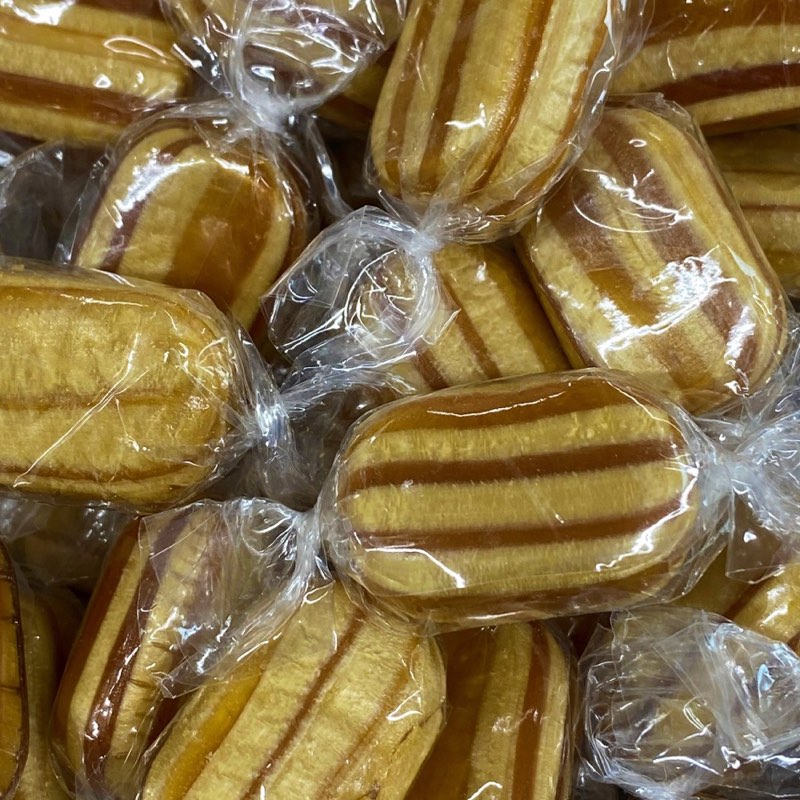
Walker's Nonsuch Assorted Toffee & Chocolate Eclairs Gift Box 350g
£5.99
✔ In stock — ready to ship
Fresh stock
Free over £20
Same-day dispatch
Secure checkout
A 350g box of assorted toffee and chocolate eclairs is, more often than not, bought for somebody else. That is the first thing to understand about this format. Bags get bought for households; boxes get bought for occasions. The box exists because handing someone a bag of sweets says one thing and handing them a box says another, and the difference costs about a pound.
The clearest occasion is the visit. You are going to somebody's house — a relative, a neighbour, an in-law, someone recovering from something — and you want to arrive with a thing in your hands. A box of toffee is one of the few items that works for this across every age and every household. It needs no refrigeration, it will not wilt like flowers, it does not require the recipient to like wine, and it can sit on a sideboard for weeks without becoming a problem. It is the default gift for good reasons.
The full guide to Walker's Nonsuch Assorted Toffee & Chocolate Eclairs Gift Box 350g
6,053 words on how it eats, who it suits, how to serve it and what to put beside it.
The occasions a box of toffee is bought for
The second is the thank-you. Teachers at the end of term, the person who fed the cat, the neighbour who took a parcel in, a colleague who covered a shift. These are gifts where getting the scale right matters more than getting the contents right. Too expensive and you have created an obligation; too cheap and you have made a gesture that reads as an afterthought. A £5.99 box at 350g sits precisely in the band where the gesture lands correctly — substantial in the hand, modest in cost.
The third is the hamper component. Nobody builds a hamper from one item, and the difficult part of hamper-building is the middle layer: the things that are not the centrepiece but are not filler either. A boxed assortment is a perfect middle-layer item because it has its own presentation, so it contributes structure to the basket rather than needing to be dressed up. It also stacks, which matters more than people expect when arranging a basket.
The fourth is the tin at Christmas — the communal bowl or tin that sits out from around the middle of December and is topped up until it is finally empty in January. Toffee is one of the classic tin components because it lasts, because it survives being handled, and because it is the thing people reach for in the late afternoon rather than after a meal. If you keep a Christmas tin, this is a natural input to it.
The fifth is the care parcel and the posted gift. Sweets travel better than almost any other edible present, and boxed toffee is among the most robust of all of them. Students, people working away, relatives in another country, someone in hospital for a stretch — a box of toffee posted is a reliable act of kindness that arrives intact.
The sixth is the long journey and the shared drive. Toffee is the traditional car sweet for the same reason it is the traditional walking sweet: one piece lasts a genuinely long time, and a driver who takes one is occupied for a good few miles rather than for thirty seconds. For a long motorway run, a box in the door pocket is worth more than a bag of anything quick.
The seventh is the plain, unremarkable domestic one: the box in the cupboard that gets opened after Sunday lunch. Toffee's natural moment is with tea in the afternoon rather than after dinner, and many households keep one going for exactly that hour. Bought for yourself it is a cupboard staple; bought for somebody else it is a present. It is the same box either way.
The eighth is the raffle, the tombola and the school fair prize table, where the requirement is items that look like gifts, cost little, and appeal to adults as well as children. Boxed sweets are the backbone of every prize table in the country for precisely those reasons. At this price you can put out a row of them.
What the box actually is
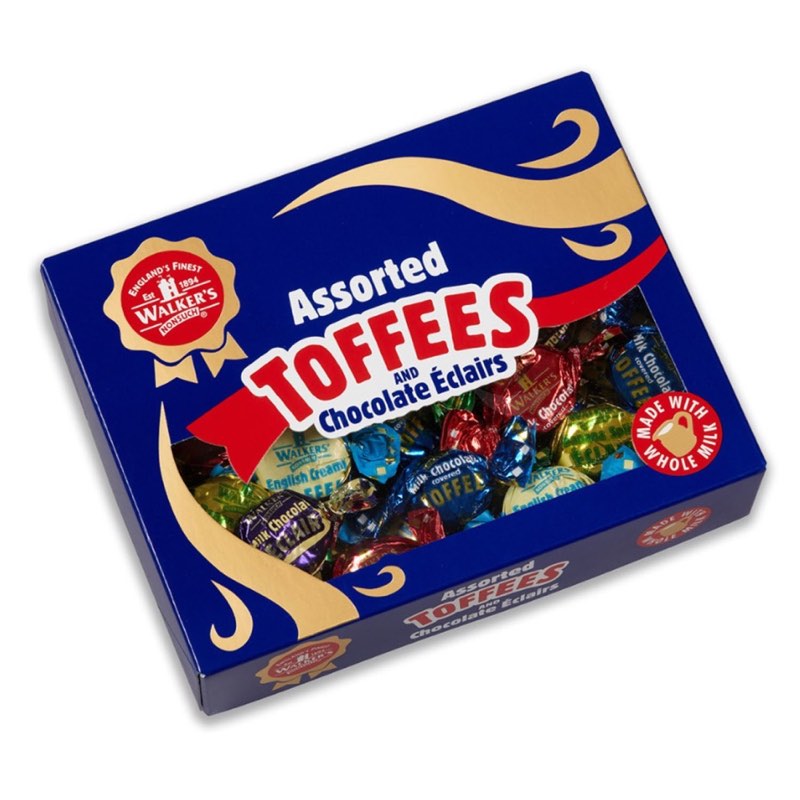
The listing is for a 350g gift box of assorted toffee and chocolate eclairs, priced at £5.99, in a single size. Two words in that description do the heavy lifting: assorted and gift box.
Assorted means you are not buying one thing repeatedly. That is a meaningful difference in the toffee category, because a box of a single variety is a commitment — if you do not care for it, you have 350g of something you do not care for. An assortment spreads the risk and, more usefully, makes the box work for a group rather than for one palate. On a table where five people will dip into it, variety is not a luxury, it is what makes the box get finished.
Gift box means the presentation is part of the product. You are paying a little for a container that is designed to be handed over rather than one designed to be sealed and stacked in a warehouse. That has practical consequences beyond appearances: a box holds its shape in a hamper, stands upright on a shelf, survives being wrapped, and can be given without any further effort on your part. A bag needs a basket around it before it becomes a gift. A box does not.
The colour on the listing is given as multi-coloured, which on a box of assorted pieces generally refers to the presentation rather than to the sweets themselves — an assortment shows as several colours where a single-variety box shows as one. From a gifting point of view this is an advantage: a box with visual variety reads as more generous than a uniform one, whatever the weight says.
At 350g this is a mid-sized box. It is not a token — that would be a hundred grams or so — and it is not the large format you buy for a household to work through over a month. It is the size that is comfortable to hand to somebody: big enough to feel like a proper gift, small enough not to embarrass them. Box sizes in the gift trade cluster around this weight for exactly that reason.
One image is listed, the line is in stock, and there is a single size at £5.99, so the only decision in front of you is how many to buy — which, if you are doing end-of-term thank-yous, is usually more than one.
How toffee eats, and why it takes its time
Toffee is the slowest thing in a sweet shop and that is its entire character. Everything about the eating experience follows from the fact that it does not want to be rushed.
The first stage is the decision. You put a piece in your mouth and, if you have any sense, you do not bite it. Toffee at room temperature is firm enough that biting it straight away is how people get into trouble, and the traditional approach is to let it sit and warm through for twenty or thirty seconds before applying any pressure. That initial pause is unique to the category; nothing else in confectionery asks you to wait before starting.
The second stage is the softening. Body heat changes toffee more dramatically than it changes any other sweet. What was a solid object becomes pliable, then properly chewy, then almost fluid at the edges. You can feel the change happening, and the transformation is a large part of why people like the category: you are not eating a fixed thing, you are eating something that becomes several different things in sequence.
The third stage is the chew proper, and it is real work. Toffee resists. It pushes back against the jaw, sticks to itself, and has to be moved around the mouth rather than simply processed. This is where the minutes go, and it is why one piece of toffee can occupy longer than a whole handful of jellies. For a long walk or a long drive, this duration is the entire point of the purchase.
The fourth stage is the flavour arc, which is unusually long. Toffee releases gradually rather than all at once — there is no burst — and the flavour builds as the piece breaks down rather than fading from an initial peak. That is the opposite of how a fruit sweet behaves, and it is why toffee is satisfying in a way that a much sweeter, faster sweet is not. It ends in a warm, deep, slightly buttery register that lingers.
A chocolate eclair behaves differently again, because the two-part construction changes the sequence. The outer layer eats as toffee, and then the centre arrives partway through with a change of both flavour and texture. It is the same trick as any filled sweet: the mouthful develops rather than continuing. On a table of plain toffees, the eclairs are usually the ones that go first, because a change in the middle is more interesting than a single note sustained.
Temperature is the variable that matters most, and it is under your control. Cold toffee is considerably harder — a box straight from a cold hallway in winter is a genuinely different product from the same box in a warm sitting room, and cold toffee is where dental accidents happen. Warm toffee is softer, faster to eat and stickier on the fingers. Room temperature, given a moment in the mouth before biting, is the setting the whole category is designed around.
The honest warning is the sticky one. Toffee adheres — to teeth, to fillings, to fingers if held too long. Anyone with dental work knows to be careful with this category and anyone who does not know will find out. That is not a fault of the sweet, it is the nature of a material that softens at mouth temperature and is meant to be worked. Eat it slowly, let it warm first, and it behaves.
Giving sweets properly: boxes, hampers, parcels and doorsteps
Sweets as a gift are an underrated form. They are cheap enough to give without creating an obligation, universal enough to give to almost anyone, and consumable, which means you are not adding to somebody's shelf of objects. But they are given badly more often than they are given well, and the difference is mostly in the thinking rather than the spending.
Match the format to the relationship. A loose bag is a familiar, casual gift — good for family, good for people you see often, wrong for a teacher or a new neighbour. A box is a step up in formality and is the correct register for a thank-you, a first visit or anything where you want the gesture to be unambiguous. A hamper is a statement and should be reserved for occasions that warrant one. This is not snobbery; it is the same instinct that tells you whether to send a text or a card.
Get the price signal right. Gifts have a range in which they land correctly, and it is narrower than people think. Under about three pounds a food gift reads as a token, which is fine if that is your intention. Between four and eight it reads as a proper small gift. Above fifteen it starts to carry weight and the recipient may feel they owe you something. A £5.99 box sits in the middle band, which is the most useful place for a gift to be, and it is the reason mid-sized boxed assortments dominate the thank-you trade.
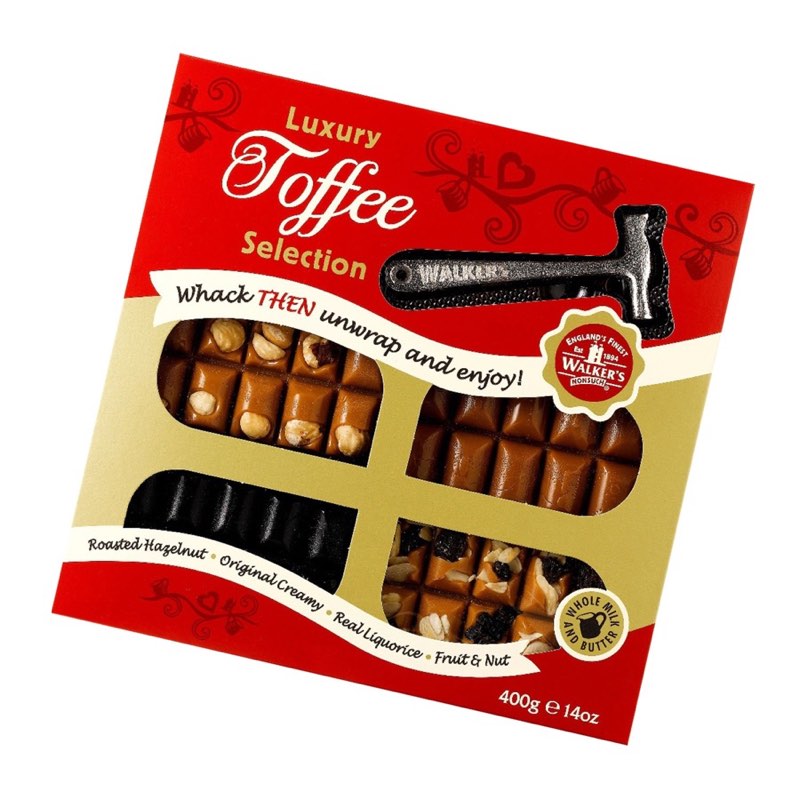
Build hampers in three layers. The centrepiece is one item that justifies the basket. The middle layer is two to four items with their own presentation, which give the hamper its structure and volume. The filler is small items tucked into gaps. Boxed assortments are middle-layer items par excellence. If you are building a toffee-and-traditional hamper, this box is a middle-layer piece and something like the 400g Walkers Toffee Hammer Selection at £6.49 can act as the centrepiece, with smaller bagged lines filling around them.
Think about the letterbox. A large proportion of gifts now get posted rather than handed over, and post has its own constraints: nothing fragile, nothing that melts, nothing that needs a signature if you can help it. Toffee is one of the best-behaved things you can put in the post. It does not shatter, it is not temperature-critical in the way chocolate is, and a box protects its contents from the crushing that a bag would suffer. If you are sending a parcel to a student or someone working away, boxed toffee should be your default.
Teacher gifts have their own rules. The two problems with end-of-term giving are cost multiplied by the number of teachers, and the near-certainty that several parents will give the same thing. The cost problem is solved by items in the five-to-seven pound band. The duplication problem is solved by choosing something slightly outside the obvious — a traditional toffee box rather than the same brand of chocolates everybody else has bought. It also has the practical advantage of keeping, which a teacher receiving fourteen gifts on the same afternoon will quietly appreciate.
Care parcels want a mix of registers. The mistake with a care parcel is sending one type of thing. The good ones contain something rich, something plain, something sharp and something that lasts. Toffee covers the lasting slot better than anything. Add something soft — BUBS Banana & Caramel Foam Sweets at £7.50 stay in the same caramel register while requiring no effort to eat — and something sharp to reset the palate, and you have a parcel that will be picked at over a fortnight rather than demolished in a sitting.
For a gift to someone older, weight the choice towards the traditional. This is the part of the shop where familiarity is the point and novelty is a liability. Toffees, mints, bon bons and chews are the reliable territory. Taveners Mint Humbugs at £5.49 and Bristow's Traditional Salted Caramel Bon Bons at £5.49 are both in the same price band as this box and both belong to the same tradition, so a pair of them makes a coherent gift rather than a random one.
Seasonal gifts benefit from one dated item. If a gift is being given at a particular time of year, include one item that obviously belongs to that season — it makes the whole parcel feel current rather than assembled from a cupboard. A bag of Cadbury Dairy Milk Christmas Little Robins at £2.49 does that for December at very little cost, and Bulgari Pumpkin Mallows at £5.49 do the same job in autumn.
Presentation is worth ten minutes. The difference between a gift that looks bought and one that looks chosen is almost entirely in the arrangement. Group items by colour, put the tallest at the back, and let one thing be visibly the centre. Boxed items help because they provide flat surfaces and right angles in a basket that is otherwise all bags and curves.
And keep one back for yourself. Anyone who does a run of Christmas or end-of-term gifts learns to buy one extra of whatever they are giving, because there is always one more person than the list said. A single-size line at a fixed price makes that easy to plan for: buy the number you need and add one.
Where a box of toffee sits in the British sweet-shop tradition
Toffee occupies a specific and slightly odd position in the British sweet counter. It is simultaneously a children's sweet and an old person's sweet, a seaside sweet and a Sunday-afternoon sweet, and it has managed to be all of these things at once for as long as anyone can remember.
Start with the seafront. Toffee is one of the pillars of the British seaside sweet shop, alongside rock, fudge and candy floss, and the reason is practical rather than sentimental. Seaside sweets have to survive being carried around in a pocket in the wind, have to be eaten while walking, and have to last long enough to justify the purchase for a family that is spending all day on a promenade. Toffee does all three. It does not melt in a pocket the way chocolate does, it needs no wrapper discipline, and one piece will see you from the pier to the car park.
The seaside shop's other characteristic is that it sells time as much as sugar. A child given a sweet that lasts ten minutes is a child who is not asking for another sweet for ten minutes, and every parent on a promenade understands this economy. Long-lasting formats have always sold at the coast for that reason, and toffee is the longest-lasting of the lot.
Then there is the corner shop, where toffee occupied the middle shelf rather than the low one. Toffee was rarely the cheapest thing on the counter because of what it is and how it is made, so it sat slightly above the penny lines: the thing you bought when you had a bit more than usual, or the thing an adult bought rather than a child. That positioning still shows in the pricing today, and it is why a toffee box reads as a slightly more grown-up purchase than a bag of jellies at the same weight.
The third setting is the domestic tin, which is arguably the most British confectionery institution of all. A tin on a sideboard, opened for visitors, refilled from whatever was bought most recently, containing a rotating cast of toffees, mints, bon bons and chews in various states of stickiness. The tin is a social object more than a food one: offering it is a form of hospitality, and it is why the sweets that live in tins are disproportionately the traditional ones. If you are stocking a tin, the traditional shelves are where you shop — our retro lines exist largely for that purpose.
The fourth is the walking sweet, which deserves its own mention. Britain has a long tradition of the sweet carried in a coat pocket on a walk — something hard or chewy that lasts a hill, does not need hands, and survives the weather. Toffee and mints are the two classics, and anyone who grew up walking with a relative will associate the flavour with cold air and a particular view. Briquette at £5.49 belongs to the same pocket tradition from the darker, more old-fashioned end of it.
The fifth is bonfire night and the autumn end of the year, which is toffee's natural season in a way that no other sweet quite matches. There is a whole strand of British autumn built around toffee in various forms, and the effect on sales is real: toffee sells in October and November the way chocolate sells in December.
Within all of that, a boxed assortment is the domesticated, sitting-room version of a counter tradition. The counter version was weighed out of a jar into a paper bag. The box is the same sweets arranged for a sideboard and for giving, which is why it costs a little more per gram than the loose equivalent and why it gets bought for different reasons. If you would rather have the counter version, our 356 weighed-out lines are where to find it.
The rest of the traditional counter is still there too, and it is worth knowing what belongs to it: chews, humbugs, bon bons, chocolate-covered chews and the various hard-boiled lines. Barratt Black Jack Chews at £5.49 and Chewing Nuts at £7.99 are both squarely in that world, and a tin containing them alongside toffee is a tin that would have looked the same on a sideboard in any decade you care to picture.
Toffee as a flavour, and what it sits with
The flavour listed for this line is toffee, and toffee is one of the few confectionery flavours that is also a texture — the word describes both what it tastes of and what it does in your mouth, which is why it is such a coherent category.
As a flavour it sits at the deep end of the range: warm, rounded, slightly burnt-sugar in character, with a long finish and no sharpness at all. It occupies the same register as caramel, fudge and butterscotch, and it fills the bass end of a mixed table the way chocolate does. A spread of bright fruit flavours with nothing deep in it feels incomplete, and a toffee item is one of the cheapest ways to fix that.
What it goes with is anything that provides contrast. Sharp fruit lines are the natural partner, because the tartness cuts a long sweet finish and resets the palate — a bowl of something like Barnett's Mega Sour Apple Candy Bags at £3.99 next to a toffee box is a genuinely well-designed pairing rather than a random one. Mint is the other traditional partner and works for the same reason: it clears what the toffee leaves behind.
What it goes with less well is more of the same. Two toffee items, a fudge and a caramel on one table is a table with one idea on it. If you are buying several things from this part of the shop, make one of them the depth and let the others provide the contrast. The toffee shelves are small and specialised for exactly this reason — you do not need many.
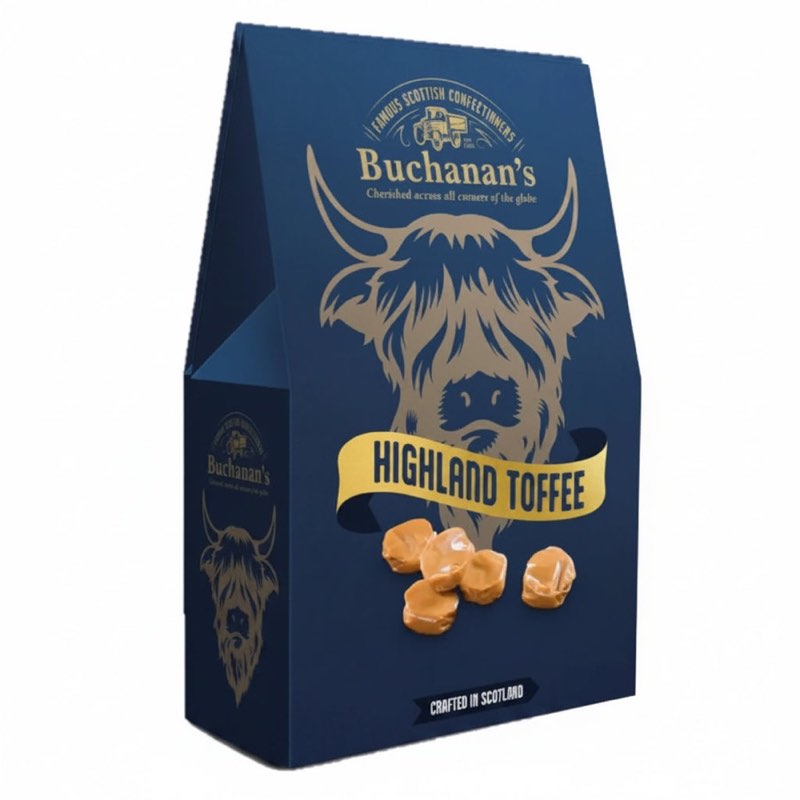
Within the family there is a real range of hardness, and it is worth knowing where things sit before buying for somebody whose teeth you care about. Boxed assortments tend to sit in the middle. Traditional slab and block formats sit at the hard end — the 150g Buchanan's Highland Toffee carton at £3.49 is the dense, serious end of the category. At the soft end are the caramels and filled items, where the chew is gentler and quicker.
Building a tin or a table around it
A box of assorted toffee is a strong base for a traditional spread, but it needs company. Here is the order we would add things in.
First, add a mint. This is the single most important addition and the one most often left out. Mint clears the palate after toffee more effectively than anything else, and a tin containing both will get eaten far more evenly than a tin containing only the sweet deep things. This is not a matter of taste; it is a matter of how the mouth works.
Second, add something sharp for the people who find toffee heavy going. Every group contains at least one, and a sour or tart line gives them somewhere to go while everyone else works through the toffee. It also has the effect of making the toffee taste better to everyone who tries both.
Third, add a soft item for anyone who cannot or does not want to chew. This is a real consideration when you are catering for older relatives or young children, both of whom may find a proper toffee more work than they want. Mallow and foam lines are the standard answer and they require nothing of the jaw at all.
Fourth, add a chocolate element, because a traditional tin without one looks incomplete and because chocolate is the flavour everybody reaches for first. Keep it modest; it will go quickly whatever you do.
Fifth, if the tin is for a household rather than a gift, add a bulk line underneath everything so that the good items are not gone in two days. Weighed-out lines are where the cost per gram is lowest, and a large bag of one plain thing quietly does most of the work while the boxed items get the attention.
Sixth, if you want the whole thing to look like a sweet shop rather than a cupboard, put everything into separate containers rather than one big bowl. Separation is what makes a spread read as deliberate. The pick and mix section is the fastest way to assemble enough distinct lines to make that work, and the jelly and gummy shelves are where most of the bright, quick items that balance a toffee-heavy table are found.
Seventh, if you are shopping specifically within this category, the six toffee lines we stock and the five listed under toffee as a flavour are small enough shelves to read end to end in a couple of minutes, which is a relief compared with the larger categories.
Who buys this
Gift-buyers, first and foremost — people who need a thing to hand over and want it to be the right size of gesture. This is the largest group by some distance for any boxed assortment.
Households that keep a tin, for whom a box is a top-up rather than a present. If that is you, buy on the basis of what is missing from the tin rather than what looks appealing, which usually means buying the mint or the sharp thing rather than more toffee.
Drivers and walkers, who are buying duration rather than flavour and who know that one piece of toffee covers more ground than a handful of anything else.
People shopping for older relatives, where the traditional lines are not a nostalgic affectation but simply what is wanted. A box of assorted toffee needs no explanation to anybody, and that is the point.
Less suited to: anyone with dental work they are careful about, since toffee is the stickiest and most demanding category in the shop, and anyone catering for very young children, for whom softer and smaller formats are the sensible choice.
What 350g gives you and how to portion it
At £5.99 for 350g this is priced in the middle of the boxed range — more per gram than a weighed-out bag, less than a premium assortment, and squarely in the band where a gift lands correctly.
The important thing about portioning toffee is that it takes care of itself. Because a single piece occupies several minutes, nobody eats toffee in handfuls, and a box lasts far longer than the same weight of anything quick. A 350g box put out on a sideboard will survive an evening with visitors in a way that 350g of jellies would not survive an hour. If you are catering, count toffee as roughly double its weight in staying power.
For a tin that is topped up over Christmas, one box is a reasonable contribution alongside two or three other lines, and it will still be producing pieces in January. For a gift, the box is the unit and no portioning is required. For a car, decant a few pieces into the door pocket and leave the box at home, because a box in a car will eventually be sat on.
Against the alternatives in the same range, £5.99 buys you this box, or a smaller pack in a different format from the same maker, or a weighed bag of a single traditional line. The box wins on presentation and variety; the bag wins on cost per gram; the smaller packs win when you want something to hand over at a lower price point.
Storing toffee so it stays right
Cool and dry, and of the two, dry matters most. Toffee is sensitive to moisture in the air — a box left open in a humid kitchen will develop a tacky surface and the pieces will begin to adhere to one another. Keep the box closed between servings rather than leaving it open on a sideboard all evening.
Keep it away from heat. Warm toffee softens, and softened toffee in a box will slump and stick together into a mass that is difficult to separate. Radiators, sunny windowsills, the top of a fridge and the inside of a car in summer are all bad homes for a toffee box.
Do not refrigerate. This is the one category where the fridge is actively counterproductive: cold toffee is very hard, which is where dental mishaps happen, and the return to room temperature brings moisture onto the surface and makes it tacky. A cool cupboard is the right answer in every season.
If pieces have stuck together, an hour somewhere genuinely cool will usually firm them enough to separate cleanly. Do not attempt it while they are warm; you will simply tear them.
Keep the box away from strongly scented items in a cupboard. Sweets take on the smells around them over time, and a box stored next to coffee or spices for a month will taste faintly of its neighbours when it is finally opened.
Choosing between the formats
This line comes in one size — 350g at £5.99 — so the real choice is between this and the other formats the same maker offers, which are genuinely different propositions rather than different weights of the same thing.
| Format | Price | Best for |
|---|---|---|
| This 350g assorted gift box | £5.99 | Giving, hampers, a sideboard tin, variety in one purchase |
| 200g twin pack | £3.99 | A smaller gift, a stocking, a lower price point |
| 200g duo pack | £3.99 | The same price band in an alternative pairing |
| 400g selection | £6.49 | A hamper centrepiece, or the largest single purchase in the range |
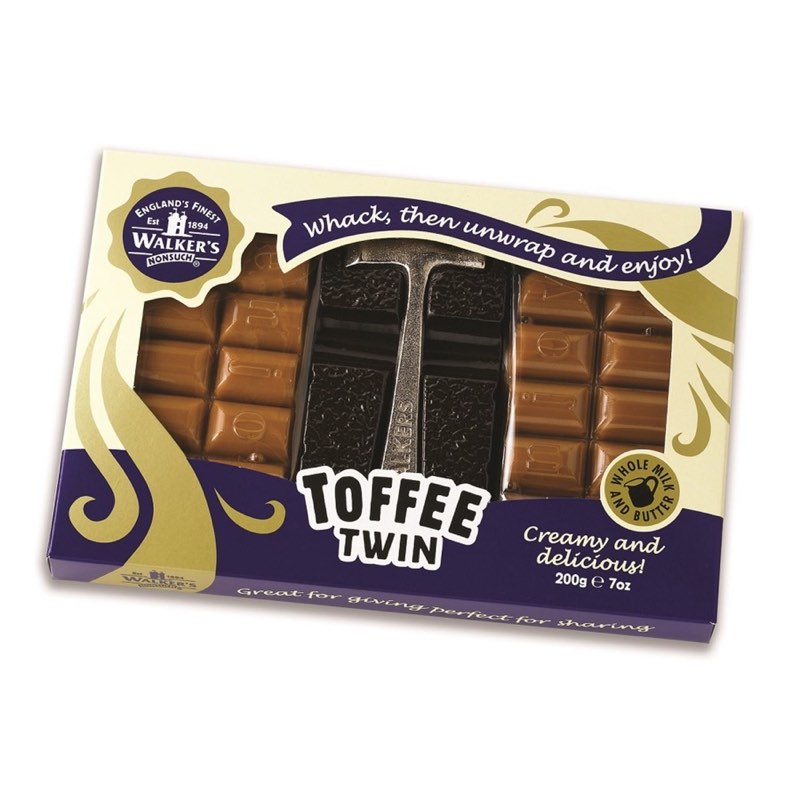
If the purchase is a gift and you want it to be unmistakably one, the 350g box is the format to choose, because a box is a gift and a pack is a purchase. If you are buying several small thank-yous and the budget is tight, the 200g Walker's Nonsuch Twin Hammer Pack at £3.99 brings the unit cost down by two pounds a head, which matters when you are buying eight of them.
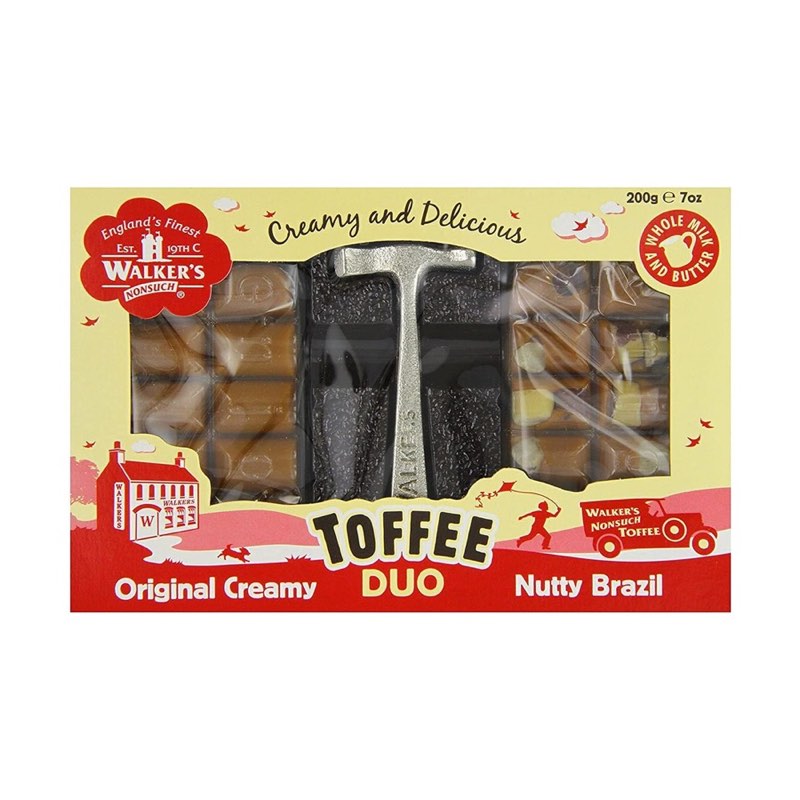
If you want the largest single item from the range for a hamper or a family tin, the 400g selection is the one, and at £6.49 the step up from this box is small. And if you simply want an alternative at the same lower price point, the 200g Duo Hammer Pack, also £3.99 covers the same ground with a different pairing.
For most people buying one thing for one person, the answer is this box. For anyone buying in quantity for a list of recipients, mixing the formats — larger boxes for the two or three people who matter most, smaller packs for the rest — is how to keep the total sensible without anyone receiving something that looks like an afterthought. The twin pack format is the workhorse for that second tier.
Finding it, and what is next to it
Toffee is a small, well-defined corner of the shop. There are six lines under the toffee type and five under toffee as a flavour, which makes it one of the few categories you can read in full before deciding. That is worth doing if you are buying a gift, because the differences between formats matter more here than in most categories.
The neighbouring shelves are the traditional ones — retro, mints, bon bons and chews — which is where the rest of a sideboard tin comes from. Beyond that, the Candy & Chocolate hub is the overview page and the right starting point if you are assembling a hamper rather than buying a single item.
If you would rather browse the whole range and filter it down, everything we stock is one page, and for gift-building specifically the useful sequence is to pick your centrepiece first, then your two or three middle-layer boxed items, then the small bags that fill the gaps.
Questions about this box
What is in the assortment?
The listing describes it as an assorted box of toffee and chocolate eclairs at 350g, and beyond that we are not going to itemise it for you, because we would be guessing. The manufacturer's own packaging carries the full detail and will be in your hands when the order arrives. What the word assorted tells you reliably is that it is not one thing repeated, which is what makes a box like this work for a group rather than for a single palate.
How much is it and are there other sizes?
£5.99 for 350g, in a single size. There is no larger or smaller version of this particular box, but the same maker's range includes 200g packs at £3.99 and a 400g selection at £6.49, which gives you three price points to work with if you are buying for several people at once.
Is it suitable as a gift on its own?
Yes, and that is the main thing it is bought for. A 350g box is substantial enough in the hand to be a proper gift and modest enough in price not to create an obligation, which is exactly the band that thank-you gifts should sit in. It needs no wrapping to be presentable, it keeps, and it suits almost any recipient of any age.
Will it post well?
Toffee is among the best-behaved things you can put in the post. It does not shatter the way hard sweets can, it is far less temperature-critical than chocolate, and a box protects the contents from the crushing a bag would suffer. For a parcel to a student or someone working away, this is a more reliable choice than most of what is in the shop.
Is toffee hard work to eat?
It is the most demanding category we sell, and that is largely the point. The way to eat it is to let a piece warm in the mouth for twenty or thirty seconds before applying any pressure, rather than biting into it cold. Anyone with dental work should be careful, and anyone buying for someone who is should consider a softer format instead.
Why has my box gone sticky?
Moisture in the air, almost always. Toffee draws damp from a humid room and the surfaces become tacky, after which the pieces begin to adhere to one another. Keep the box closed between servings rather than open on a sideboard, store it somewhere cool and dry, and if pieces have stuck, an hour somewhere genuinely cool will firm them enough to separate without tearing.
Can I keep it in the fridge?
Better not to. This is the one category where refrigeration actively works against you: cold toffee is very hard, which is when teeth come off worst, and the return to room temperature draws moisture onto the surface and leaves it tacky. A cool, dry cupboard is the right storage in every season.
How long will a box last on a table?
Considerably longer than the weight suggests, because a single piece of toffee occupies several minutes and nobody eats it in handfuls. For catering purposes, count toffee as roughly double its weight in staying power against quick sweets. A 350g box put out for visitors will still be producing pieces long after a bowl of jellies would be empty.
Is it suitable for children?
Sweets are a treat rather than everyday food, whatever the type. Small hard sweets and whole gummies are a choking risk for young children and should always be eaten under supervision, and toffee in particular asks for care because it is firm and sticky. If anyone in the household has an allergy, check the manufacturer's own packaging when the order arrives and before anybody eats.
What should I put with it in a hamper?
Something minty to clear the palate, something sharp for the people who find toffee heavy, something soft for anyone who would rather not chew, and one obviously seasonal item so the whole parcel reads as current rather than assembled from a cupboard. Keep the deep, sweet items to one or two — a hamper with four caramel-register things in it has only one idea.
Which format should I buy for end-of-term gifts?
If you are buying one or two, this box at £5.99 is the right register. If you are buying eight, the 200g packs at £3.99 bring the total down substantially without any recipient receiving something that looks like an afterthought. Mixing the two — the box for the people who matter most, packs for the rest — is how most people manage a long list.
Is it in stock?
Yes, this line is showing in stock. Boxed traditional lines come under the most pressure in the run-up to Christmas and around the end of the school year, which are the two peaks for gift-buying, so if you have a fixed date it is sensible to order ahead rather than in the final week.
The short of it
A 350g assorted box at £5.99 is the most useful shape a sweet gift can take: big enough to hand over without apology, small enough not to burden anyone, sturdy enough to post, and varied enough to suit a room full of different people rather than one palate. The toffee inside is the slowest thing in the shop, which means the box outlasts its weight and keeps producing pieces long after a bag of anything quick would be finished.
Buy it for a visit, a thank-you, a hamper layer or a sideboard tin. Put a mint and something sharp alongside it so the deep sweetness has somewhere to push against, keep it closed, cool and dry between servings, and let each piece warm for half a minute before you bite down.
More from Walkers
More toffee sweets
More toffee sweets
Where this sits
Walker's Nonsuch Assorted Toffee & Chocolate Eclairs Gift Box 350g appears on these shelves. Browse them, or jump to something nearby.
You might also like