Home / Loose Sweets / Walker's Nonsuch Toffee Twin Hammer Pack 200g
Walkers · 200g
Read the full guide
Walker's Nonsuch Toffee Twin Hammer Pack 200g
£3.99
✔ In stock — ready to ship
Fresh stock
Free over £20
Same-day dispatch
Secure checkout
Two hundred grams for £3.99 works out at exactly £2.00 per 100g, and that number is the honest starting point for thinking about this pack. It is not the cheapest way to buy sweets by weight on this site and it was never going to be, because a slab toffee in a boxed hammer-pack format carries the cost of the box and the format as well as the toffee. What you are paying for is a specific thing: toffee in a form you break up yourself, presented in a way that looks like a proper item rather than a scoop of something in a bag.
The more useful sum is cost per sitting rather than cost per gram, and toffee does very well on that measure. Toffee is a slow sweet. A piece stays with you — you are not going to put six in your mouth in a minute the way you might with jellies. A sensible piece is small, and 200g broken down properly will give you somewhere in the region of twenty-five to thirty-five pieces depending on how enthusiastically you break it. That is a lot of separate eating occasions out of £3.99. Measured in minutes of sweet per pound spent, toffee is close to the best value in the shop.
The full guide to Walker's Nonsuch Toffee Twin Hammer Pack 200g
6,065 words on how it eats, who it suits, how to serve it and what to put beside it.
What £3.99 actually buys you here
Held against the rest of the shelf, £3.99 sits at the affordable end of a boxed item. Plenty of by-weight lines run to £5.49 and above for their standard bag. This is comfortably under that, which makes it one of the easier things to add to an order without thinking hard about it. It is also a good price point for buying several — two or three of these is still under a tenner, which matters when you are filling a hamper or setting a table.
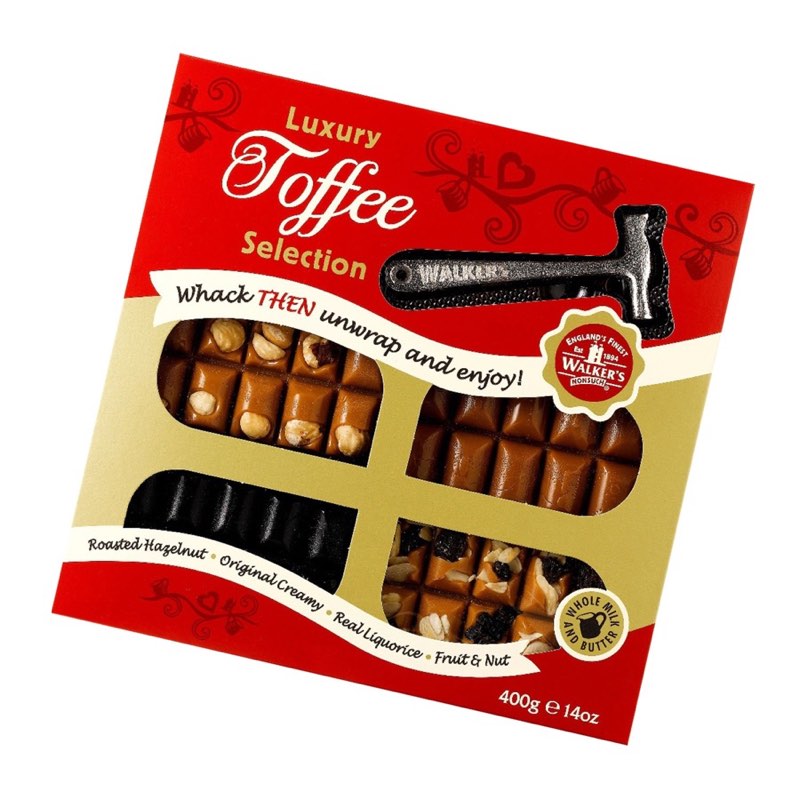
If you want the per-gram figure to come down, the way to do it is to step up rather than to buy more of the same. The Walkers Toffee Hammer Selection 400g at £6.49 works out at roughly £1.62 per 100g, which is a meaningful saving over buying two of these — you would pay £7.98 for the same 400g bought as two separate packs. If you know you want 400g of toffee in the house, that is simply the better buy, and the only reason not to take it is if you specifically want two separate boxes to give to two separate people.
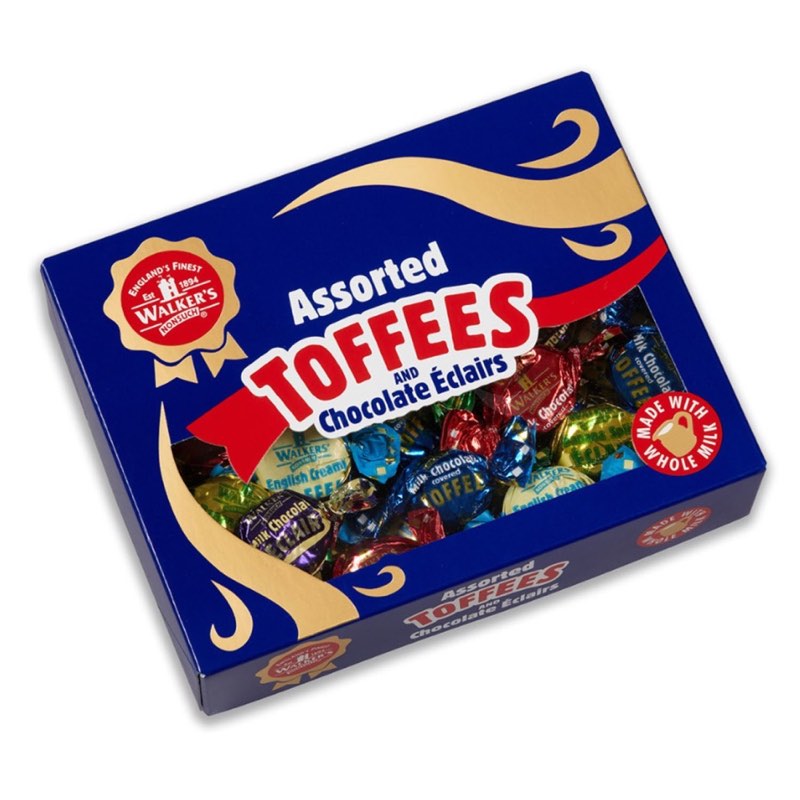
The Walker's Nonsuch Assorted Toffee & Chocolate Eclairs Gift Box 350g at £5.99 lands at about £1.71 per 100g, so it is also cheaper per gram than this pack, and it is the one to reach for when the buying occasion is a present rather than a cupboard. And the Walker's Nonsuch Toffee Duo Hammer Pack 200g matches this one exactly on both weight and price at £3.99, which makes the choice between those two a question of what you want inside rather than a question of money.
Portioning it properly
How you break this up matters more than with almost any other sweet we sell, and most people get it wrong the first time by leaving the pieces too big.
The instinct with a slab is to break it into squares that look like a reasonable mouthful. That is too much toffee. A large piece of toffee is hard work — it occupies your whole mouth, it takes a long time, and it stops being pleasant about halfway through. The piece you actually want is roughly the size of the top joint of your thumb, or a bit less. At that size it is a genuine treat rather than a commitment, and you can have a second one without feeling you have overdone it.
So: break it down further than feels right, and do it all at once rather than piece by piece. Put the whole lot on a board or in a tray, break the slab into rough halves, then work across each half breaking smaller. Some pieces will come out larger and some will come out as shards. Keep the shards — they are the best bit for dropping into a cup of coffee or for handing to somebody who only wants a taste.
For planning purposes, here is how the 200g divides up in practice:
| Use | Roughly how much | What that means from one £3.99 pack |
|---|---|---|
| One person, one sitting | 15–20g | Ten to thirteen separate sittings |
| A bowl on a coffee table for two | 50g | Four evenings |
| A small dish on a party table | 100g | Two dishes, or one refilled once |
| A component in a mixed hamper | the whole 200g | One box, used as one item |
The pack is a single size — £3.99 for 200g is the only option on this particular line — so the way you scale is by buying more boxes or by moving across to one of the larger Walker's items. That simplicity is actually helpful. There is no agonising over which weight to choose; there is only the question of how many you need, and the table above answers it.
What you are looking at
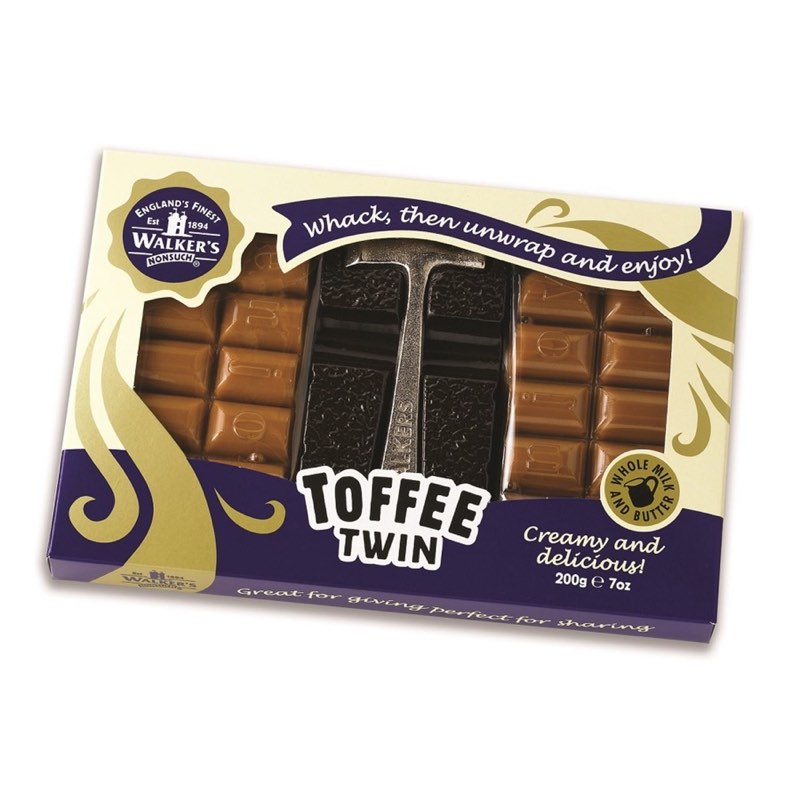
This is the Walker's Nonsuch Toffee Twin Hammer Pack, 200g of toffee, brown, in a boxed hammer-pack format. The name tells you what kind of product it is rather than being decorative: a hammer pack is toffee sold as a slab to be broken up, rather than toffee sold as individual wrapped pieces. That single difference shapes everything about how you buy it, serve it and eat it.
We list what is inside as toffee and the colour as brown. We do not publish the detail of exactly what the box contains beyond that, so if the specifics matter to you — and for a gift they sometimes do — the packaging that arrives is the thing to read. What we can tell you confidently is the format, the weight, the price, and how it behaves once you open it, which is most of what actually affects your decision.
Out of the box, toffee in this format has a real presence. It is dense, it is heavy for its size, and it looks like something rather than like a portion. That is a genuine advantage when you are putting it on a table or into a hamper: a boxed slab reads as a proper item in a way that a bag of loose sweets does not, even when the bag costs more. If you have ever tried to make a gift box look generous and found that bagged sweets disappear into it, this is the sort of thing that fixes the problem.
The eating experience, start to finish
Toffee is a sweet you commit to, and the pleasure of it is in the length of the experience rather than in any single moment.
The first stage is the break. A piece of toffee at room temperature snaps — a hard, decisive break rather than a tear, with a clean edge and sometimes a little dust. Cold toffee snaps harder and more unpredictably, which is worth knowing if you have had yours in a cold room. Warm toffee does not snap at all; it bends and stretches, which is a nuisance when you are trying to portion it and a pleasure when you are trying to eat it.
The second stage is the first thirty seconds in your mouth, and this is where toffee separates itself from everything else. A piece of toffee does not immediately become chewable. It sits there, hard, doing very little, while the surface slowly softens. Most people do not wait — they try to chew it straight away, which is how the sweet gets its reputation for being difficult. If you let it sit for twenty or thirty seconds first, it transitions of its own accord into something pliable, and from that point onwards it is easy.
The third stage is the chew proper, and it is long. Toffee resists in a very particular way: it pushes back against your teeth, it stretches rather than crumbles, and it changes texture as you work it, going from stiff to elastic to soft. The flavour builds through this stage rather than being front-loaded. Unlike a fudge, which gives you everything immediately, toffee releases gradually, so the third minute tastes different from the first.
The fourth stage is the finish, which is where toffee earns its loyal following. Long after the piece itself has gone, there is a warm, deep sweetness left behind that carries on for several minutes. This is why one piece of toffee genuinely satisfies where one jelly sweet does not, and it is the single best argument for buying toffee rather than something cheaper per gram.
Two practical notes. First, toffee and dental work have a complicated relationship, and anybody with fillings, crowns or anything loose should take it slowly, let each piece soften properly before chewing, and use small pieces. Second, temperature is your main lever: if you want it easier, let it come up to room temperature and give it time in your mouth before working at it; if you want it firmer and slower, keep it somewhere cool.
A party planner's view: what to buy, how much, and what goes first
Anybody who has put sweets out for twenty people knows that the interesting problem is not which sweets to buy, it is how they behave over the course of an evening. Different sweets empty at completely different rates, and the ones that look most generous at eight o'clock are often the ones nobody has touched by eleven. Toffee sits in a very specific place in that dynamic, and planning around it properly makes a noticeable difference.
Here is the basic pattern. Bright, soft, fruity sweets go first and they go fast, usually taken in handfuls by children and by anybody standing up. Chocolate goes second, steadily, all evening. Toffee goes slowly and it goes late — it is taken one piece at a time by people who have sat down, usually with a drink, usually in the second half of the evening. Sours are taken by a small number of people who take a lot of them, and ignored entirely by everybody else.
That pattern gives you your quantities. For a gathering of twenty people over an evening, you want roughly this split: about half your total weight in fast-moving fruity and soft sweets, a quarter in chocolate, a fifth in toffee and other slow items, and a small remainder in novelty and sour. Two hundred grams of toffee — one box of this — is about right for twenty people as a slow item. If you put out 500g of toffee for that crowd you will be carrying most of it back to the cupboard.
Timing matters as much as quantity. Put everything out at the start and the fast sweets are gone within forty minutes, after which your table looks picked-over for the rest of the night. The better approach is to hold back about a third of the fast-moving items and refill once, and to put the toffee out from the beginning, because it is not going anywhere quickly anyway. A table that gets refilled once mid-evening feels abundant the whole way through, even though you bought exactly the same amount.
Presentation for toffee specifically: small pieces, shallow dish, and put it where people sit rather than where they queue. Toffee is not a grab-and-walk sweet. Nobody takes a piece of toffee on their way past a table, because they know it will occupy them for five minutes. Put it next to the chairs, next to the drinks, next to wherever the slower half of the party ends up, and it will disappear. Put it by the door and it will not.
For the fast-moving half of the table, the jelly and gummy shelf is where you should be shopping, and quantity matters more than variety there — two large bags of one thing beats six small bags of six things, because nobody notices the variety once it is in a bowl. The Candy Paradise Juicy Grenade Gummies at £1.39 are the cheapest way to add visual interest to a table, and the shape does more work than the price suggests.
For the chocolate quarter, the Cadbury Dairy Milk Christmas Little Robins Chocolate Bag 77g at £2.49 gives you individual pieces rather than something you have to break, which is exactly what you want on a shared table — nobody wants to be the person who snaps a bar in front of everybody. Two or three of those bags scattered across a table is more useful than one large item.
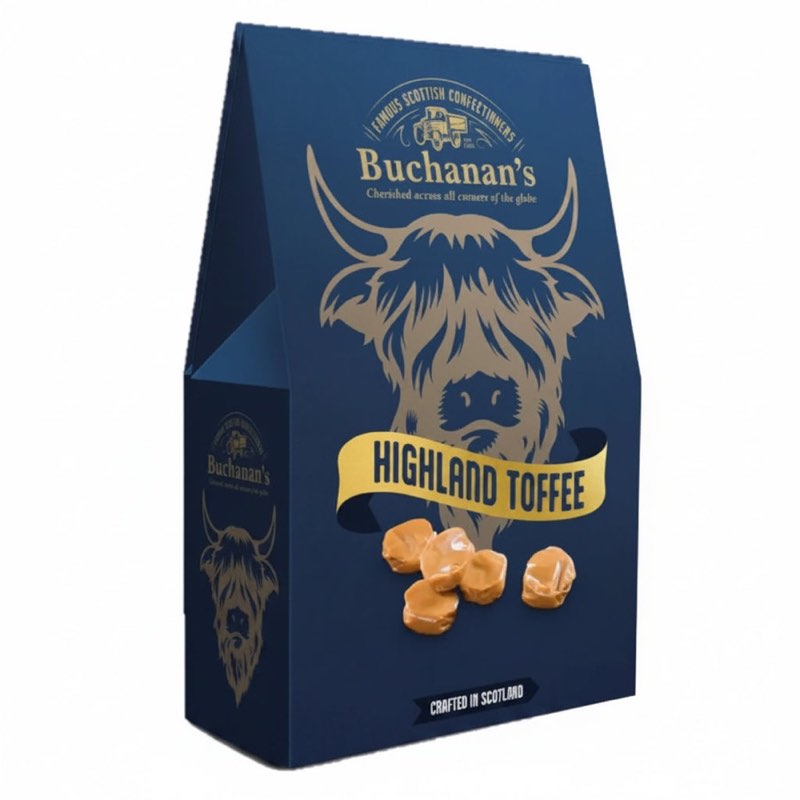
For the slow quarter alongside the toffee, the Bristow's Traditional Salted Caramel Bon Bons at £5.49 are the obvious partner. They are in the same broad register but eat completely differently, so somebody who has had enough toffee will still take a bon bon. The Buchanan's Highland Toffee Carton 150g at £3.49 is a second toffee in a different format, and having two toffees in two formats is more interesting on a table than 400g of one.
A worked plan for twenty people, coming in around £30: two bags of fruity gummies for the fast slot, one box of this toffee and one carton of the Highland at £3.49 for the slow slot, a bag of Bulgari Pumpkin Mallows at £5.49 for the light slot, two festive chocolate bags for the chocolate slot, and a small bag of sours for the handful of people who will want them. That table has something for everybody and does not leave you with a cupboard full of leftovers in one category.
Three things that reliably go wrong, and how to avoid them. One: not enough bowls. Sweets in bags do not get eaten; sweets in bowls do. Two: everything in one register. A table of six sweet, soft, fruity things tastes like one thing after ten minutes. Three: no bin. Toffee in a hammer pack does not generate wrappers the way individually wrapped sweets do, which is a small and genuine advantage, but everything else on your table will, and a table with nowhere to put a wrapper stops being used.
Finally, the question of what to do with leftovers, which is the part nobody plans for. Toffee is the best leftover on the table by some distance, because it stores well and because it was never going to be eaten in one night anyway. Anything soft and fruity will be stale-feeling by the following week. Buy your fast items tight to what you need, and let the toffee be the thing that has a life after the party.
Where toffee lands on the sour-to-sweet spectrum, and how to build around it
Every sweet on this site can be placed somewhere on a single line running from aggressively sour at one end to deeply, unapologetically sweet at the other. Understanding where a sweet sits on that line is the most useful single thing you can know when you are putting an order together, because a good selection spreads across the line and a poor one bunches up at one end.
Toffee sits right at the sweet end. Not near it — at it. There is no acid edge at all, nothing sharp, nothing that cuts. It is the purest expression of the sweet end of the spectrum that confectionery offers, and everything about how it eats reinforces that: the long chew, the slow build, the coating finish. If you imagine the line as running from one to ten, with ten being the most intensely sour thing we sell, toffee is a one.
That position has consequences. The first is that toffee is fatiguing in quantity. Anything at the far sweet end of the line hits a ceiling — after three or four pieces your palate stops registering it properly, and the fifth piece is noticeably less enjoyable than the first. This is not a flaw in the sweet; it is what being a one on the scale means. It is also exactly why the portioning advice above matters, and why a party table needs something else on it.
The second consequence is that toffee is the best possible anchor for a spread precisely because it is so far out at one end. When you are building a selection, the extremes do the work. A table of sweets rated four, five and six on the scale tastes monotonous no matter how many different products are on it. A table with a one and an eight on it feels varied even if there are only four items.
So what goes at the other end? The Barnett's Mega Sour Apple Candy Bags 104g at £3.99 are the clearest counterweight we stock — these are built for the sour end and they do not pretend otherwise. Put a small dish of those next to a dish of toffee and the two make each other better. A piece of toffee, then a sour apple, then another piece of toffee, and the toffee tastes as it did the first time because the acid has reset your mouth. It is the same trick a sorbet plays in the middle of a long meal, and it works just as well with sweets.
Do not overcorrect. Sours are dominant, and the common mistake is to put out as much sour as sweet. The ratio you want is somewhere around one part sour to six or eight parts everything else. Anything more and the sours take over, because a strong sour leaves your palate altered for several minutes and everything you eat afterwards tastes flat.
The middle of the spectrum is where most of the shop lives, and it is where you get your bulk. Chews sit around a three or four — sweet, but with enough character and enough work in the chewing that they do not fatigue the way toffee does. The Barratt Black Jack Chews at £5.49 are a good example of that middle ground, and they share toffee's long-chew quality while sitting in a completely different flavour register, which makes them an unusually good companion. Chewing Nuts at £7.99 is another by-weight line in the chewy middle of the shelf.
Foam and mallow sweets sit at a two or three but feel lighter than their position suggests, because the airiness changes how sweetness registers. The BUBS Banana & Caramel Foam Sweets at £7.50 are a useful thing to know about here: the caramel side of them is in the same broad family as toffee, but the foam texture means they do not fatigue the palate the way a dense sweet does. If you like the toffee register but find slab toffee too heavy in quantity, that is the line to try.
Chocolate sits slightly apart from the spectrum rather than on it, because cocoa brings a mild bitterness that pulls in a different direction. That is why chocolate works next to toffee even though both are sweet — the bitterness does some of the same job that sourness does, more gently. A table with toffee, chocolate and one sour item covers the ground properly.
A last thought on the spectrum: your own position on it is not fixed. People who eat a lot of sour sweets find mild things tasteless; people who mostly eat chocolate find a mega sour genuinely unpleasant. If you are buying for other people, assume their line is calibrated differently from yours, and spread wider than you personally would want. That is the single most useful thing the spectrum idea gives you.
The toffee register, and what sits near it
We list this simply as toffee, without a flavour breakdown, and that is the right level of description because toffee is its own register rather than a flavour applied to a base. It belongs to the same broad family as caramel, butterscotch, fudge and cream sweets — the group where the sweetness itself is the event rather than a carrier for a fruit note.
Within that family, the distinctions that matter are about texture and about how long the experience lasts. Fudge is soft and gives everything up immediately. Caramel is softer still and coats more. Bon bons are chewy but lighter, with a powdered outside that changes the first second entirely. Toffee is the hardest and the longest, and it is the one that builds rather than arriving all at once. Those are genuinely different eating experiences and most people have a strong preference among them once they have tried them side by side.
If you want to explore the family, the six toffee lines we carry are the obvious starting point and small enough to work through properly. The salted caramel bon bons at £5.49 are the most useful contrast in the group, because the salted edge pulls the register in a direction that plain toffee does not go, and the bon bon texture is lighter. Briquette at £5.49 is another by-weight option in the same broad corner of the shop and worth a look when you are browsing.
The wider point is that the toffee family rewards buying two things rather than one. Four hundred grams of a single toffee is less interesting than 200g each of two different ones, even though it costs about the same. Variety within a register does more for you than volume within it.
Building a bag or a board around it
Because this comes boxed rather than loose, it plays a slightly different role in a mixed order from the by-weight lines. You are not scooping it into a shared bag; you are adding it as an item. That makes it a natural centre for a board or a selection rather than a component of a mix.
For a sweet board — the kind of thing you put out on a coffee table for an evening — think of it in four zones. The slow zone is your toffee, broken small. The fast zone is something fruity and soft that people take by the handful. The light zone is mallow or foam, which stops the board feeling heavy. And the sharp zone is one small dish of something sour to reset between the others.
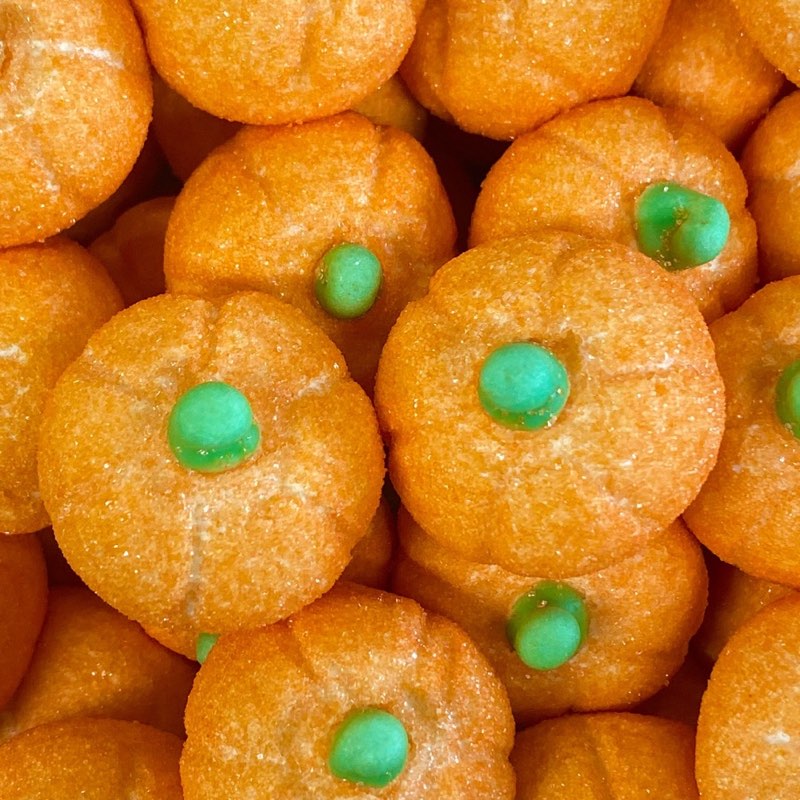
For the fast zone, shop the build-your-own pages and weigh out a couple of hundred grams of two or three fruity things. For the light zone, the pumpkin-shaped mallows at £5.49 are the airiest thing in this group and provide a texture nothing else on the board does. For the sharp zone, a small quantity of the 104g sour apple bags is plenty.
If you would rather build a proper mixed bag than a board, the same logic applies with different proportions. Break about 50g of this toffee into small pieces and scatter it through 400g of other things, and you have a bag where roughly one in eight pieces is a slow, rich interruption to everything else. That is a very good bag. Go heavier than that and the toffee starts to dominate, because each piece occupies so much more time than the things around it.
Two more components worth knowing about when you are building. The chews at £5.49 give you a long-lasting sweet at a lower intensity than toffee, which is useful if you want the duration without the richness. And the banana and caramel foams at £7.50 bridge the gap between the light zone and the toffee register, which means they tie a board together rather than just adding another item to it.
Gifts, hampers and the times of year it sells
The boxed format makes this one of the more giftable things at its price. Under four pounds does not usually buy you something you can hand over on its own, but a boxed toffee is an acceptable small gift in a way that a bag of loose sweets is not — it looks deliberate.
For hampers it is close to ideal. It sits flat, it does not squash, it does not melt in a warm hallway, and it holds its shape under other items, which means you can build around it rather than around the fragile things. A hamper with a boxed toffee at the base and softer items above it packs far better than one built the other way up.
If the gift is the point rather than the filler, the 350g assorted gift box at £5.99 is the better choice — it is presented as a gift item, it is larger, and at about £1.71 per 100g it is also better value. Two pounds more buys a noticeably more substantial present. Keep this 200g pack for the cases where it is one item among several rather than the whole thing.
Toffee has a strong seasonal pull towards the colder half of the year, and it is worth planning around. From roughly October onwards, a boxed toffee on a table is exactly right; in July it feels heavy, and it also behaves less well in a warm room, softening and fusing in a way it does not in winter. If you are buying for a summer event, keep it somewhere genuinely cool until the last moment, or choose something from the fruity gummy range instead and come back to toffee when the weather turns.
Around the festive table specifically, toffee earns its place as the thing that is still there on the third day. Chocolate goes, the fruity things go, and there is a box of broken toffee sitting by the chair that somebody dips into every time they sit down. Pair it with something festive and short-lived such as the £2.49 seasonal chocolate bag and you have covered both halves of how a December table actually gets eaten.
Keeping it in good condition
Toffee is one of the easier things to store, but it has two specific weaknesses and both are worth knowing.
The first is warmth. Toffee softens in heat and, once softened, pieces will fuse back into a single mass. This is not spoilage and the toffee is perfectly fine, but you will be breaking it up again, and the second break is messier than the first because the pieces have flattened against each other. Keep it in a cool cupboard away from any heat source and this simply does not happen. An unheated cupboard on an internal wall is fine; above a radiator or next to a cooker is not.
The second is humidity. Toffee left open in a damp kitchen goes tacky on the surface and picks up a slightly sticky film. Airtight storage solves it completely. Once you have broken the slab up, put the pieces in a lidded tub rather than leaving them in the opened box — this is the single most useful thing you can do, and it also stops the smaller shards getting lost.
If pieces have fused together, the fix is to chill the tub for twenty minutes and then knock it once against a work surface. Cold toffee is brittle and will separate along the joins. Do not try to prise fused warm toffee apart with a knife; it stretches rather than breaking and you will end up with a worse mess than you started with.
Do not store toffee in the fridge as a matter of course. It works as a short-term trick for separating pieces, but kept cold permanently the toffee becomes hard enough to be genuinely difficult, and moving it in and out creates surface moisture that makes it tacky. A cool cupboard is better than a cold fridge in every respect that matters.
One last note: keep it away from strongly scented things. Toffee picks up smells from its neighbours, and a box stored next to anything aromatic will taste faintly of it within a week or two. If you keep all your sweets in one big container, give the toffee its own tub inside it.
This pack, or one of the others?
This line comes in one size only — 200g at £3.99 — so the real choice is between this and the other Walker's items we carry. Here is how they compare.
| Pack | Weight | Price | Roughly per 100g |
|---|---|---|---|
| Toffee Twin Hammer Pack (this one) | 200g | £3.99 | £2.00 |
| Toffee Duo Hammer Pack | 200g | £3.99 | £2.00 |
| Toffee Hammer Selection | 400g | £6.49 | about £1.62 |
| Assorted Toffee & Chocolate Eclairs Gift Box | 350g | £5.99 | about £1.71 |
If you want the cheapest entry point and you are not sure yet whether slab toffee is for you, this 200g pack at £3.99 is the right place to start. It is a small enough commitment that being wrong costs very little.
If you already know toffee is a fixture in your house, go straight to the 400g selection at £6.49. Twice the weight for £2.50 more is the best value on the Walker's shelf and the maths is not close.
If you are buying a present, the gift box format at £5.99 is the one designed for that job, and it happens to be better per gram than this pack as well.
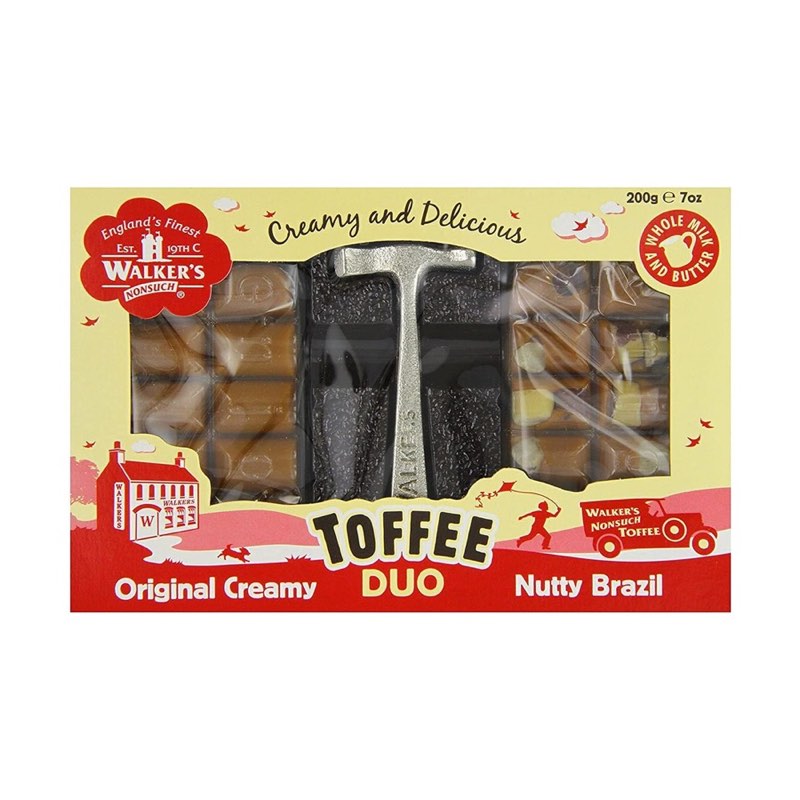
And the Duo pack at the same £3.99 is the direct alternative at identical weight and price, so if you are buying two boxes for two different people, buying one of each gives you variety for exactly the same money as buying two of the same.
Finding it, and what is shelved beside it
On the site this appears in two categories. Our toffee shelf is the narrow one, six lines deep, and it is the fastest way to see the whole of this part of the range at once. The loose sweets department is the broad one, running to 356 lines, and it is where most people end up browsing because it holds everything sold by weight alongside boxed items like this.
From there the useful directions are these. For the entire catalogue in one view, browse every line we stock. To weigh out your own combination, the mix-your-own section is the place. For bars and bagged chocolate to sit alongside the toffee, try the candy and chocolate department. For the fruity, soft counterweight that every toffee order needs, the jellies and gummies are gathered together. And for sweets that have been familiar for a long time, the retro shelf collects them in one place.
Among individual lines nearby, the ones worth knowing are the 150g Highland toffee carton at £3.49 as the natural second toffee, the £7.99 by-weight line called Chewing Nuts for something chewier from the same corner of the shop, and the Briquette line at £5.49 as another by-weight option. At the opposite end of the spectrum, the sour apple bags at £3.99 are the thing to add if your order is bunching up at the sweet end, and the £1.39 grenade gummies are the cheapest way to add another texture.
Things shoppers ask us
Does the pack come with a hammer?
It is sold as a hammer pack and that is the format the name describes, but we do not publish a contents breakdown for this line on the site, so we would rather you checked the packaging when it arrives than have us guess on your behalf. What we can say for certain is that this is slab-format toffee intended to be broken up rather than individually portioned sweets, and that if you need to break it yourself, a rolling pin or the back of a heavy spoon against a board does the job perfectly well.
How many pieces will I get?
That depends entirely on how you break it, which is the point of a slab format. Broken to a sensible size — roughly the top joint of a thumb — 200g gives you somewhere in the region of twenty-five to thirty-five pieces. Break it larger and you will get fifteen or so, but larger pieces are harder work to eat and most people find they enjoy it less. Our advice is to break smaller than feels right the first time.
Is it too hard for older teeth or for anyone with dental work?
Toffee is firm, and anyone with fillings, crowns, bridges or anything that feels loose should take it slowly. The technique that makes the difference is patience: put a small piece in your mouth and let it sit for twenty or thirty seconds without chewing. It softens on its own and becomes easy to work from that point. Chewing a cold piece straight away is what causes problems. Small pieces and a little time solve almost all of it.
Why has my toffee stuck together in one lump?
Warmth, almost always. Toffee softens in a warm room and the pieces fuse back together where they touch. It has not gone off and it is perfectly good to eat. The easy fix is to put the container somewhere cold for twenty minutes and then give it a firm knock against a work surface — cold toffee is brittle and separates along the joins. Storing it in a cool cupboard rather than a warm one stops it happening again.
Is this better value than the 400g selection?
No, and it is not close. This pack is £2.00 per 100g. The 400g option at £6.49 works out around £1.62 per 100g, so buying 400g as one item saves you about £1.49 against buying two of these. The only reasons to buy two 200g packs instead are if you want two separate boxes for two separate people, or if you want to try a smaller amount first.
What is the difference between the Twin pack and the Duo pack?
They are both 200g and both £3.99, so the money is identical. We list them as separate products because they are separate lines from the same brand, and the difference is in what each box holds rather than in size or price. We do not publish the contents breakdown for either, so if the specifics matter, the packaging is the place to check. If you simply want variety, buying one of each costs exactly the same as buying two of the same.
How much should I buy for a party?
Less toffee than you think. Toffee is a slow sweet that people take one piece at a time, usually late in the evening and usually sitting down. For twenty people over an evening, one 200g box is about right as the slow item on the table — that is roughly a fifth of your total sweet weight. Spend the rest on fast-moving fruity items, some chocolate, and one small dish of something sour.
Can I put it in a pick and mix bag?
You can, and it works well, but keep the proportion low. Break about 50g into small pieces and scatter it through 400g of other things, so roughly one piece in eight is toffee. Any more than that and it dominates, because each piece takes several minutes to eat while the things around it take seconds. Build the bulk of the bag from the mix-your-own range and use the toffee as the high point.
Does it travel and post well?
Better than most things we sell. It is dense, it is boxed, and it does not need keeping cold. The realistic risks are that the slab arrives already broken into smaller pieces, which does not matter at all since you were going to break it anyway, and that it softens if it spends a long time somewhere hot. Give it a couple of hours in a cool cupboard after it arrives and it will firm up.
I need to check allergens — where do I look?
On the manufacturer's packaging, once your order arrives, and before anybody eats any of it. We do not publish ingredient or allergen information for this line on the site, so the pack itself is the only source you should rely on. If what you read on it does not match what you need, please do not eat it — get in touch with us instead and we will sort it out.
Is it suitable for children?
Sweets are a treat rather than everyday food, and firm sweets need supervision with young children in particular — small hard sweets and whole gummies are a choking risk and children should be watched while they eat them. Toffee also takes real chewing, so break pieces down very small for younger children or choose something softer from the older-style sweets shelf or the gummy range instead.
What should I order alongside it?
Something at the other end of the spectrum, and something light. For the sharp end, the £3.99 sour apple bags reset your palate between pieces and make the toffee taste new again. For lightness, the mallows at £5.49 are the airiest thing near it. For a second slow sweet in a different texture, the bon bons at £5.49 are the natural pairing. And if you want chocolate on the same table, the chocolate lines are all in one place.
In short
Two hundred grams of toffee for £3.99, boxed, brown, in a hammer-pack format you break up yourself. At £2.00 per 100g it is not the cheapest sweet by weight on the site, but measured in how long a piece lasts and how satisfied you are afterwards, it is among the best value we sell. Break it smaller than you think, keep it airtight and somewhere cool, put it where people sit rather than where they walk, and put something sharp next to it. If it becomes a regular, move up to the 400g selection and save yourself the difference.
More from Walkers
More toffee sweets
More loose sweets sweets


Where this sits
Walker's Nonsuch Toffee Twin Hammer Pack 200g appears on these shelves. Browse them, or jump to something nearby.
You might also like