Haribo · 1000g
Read the full guide
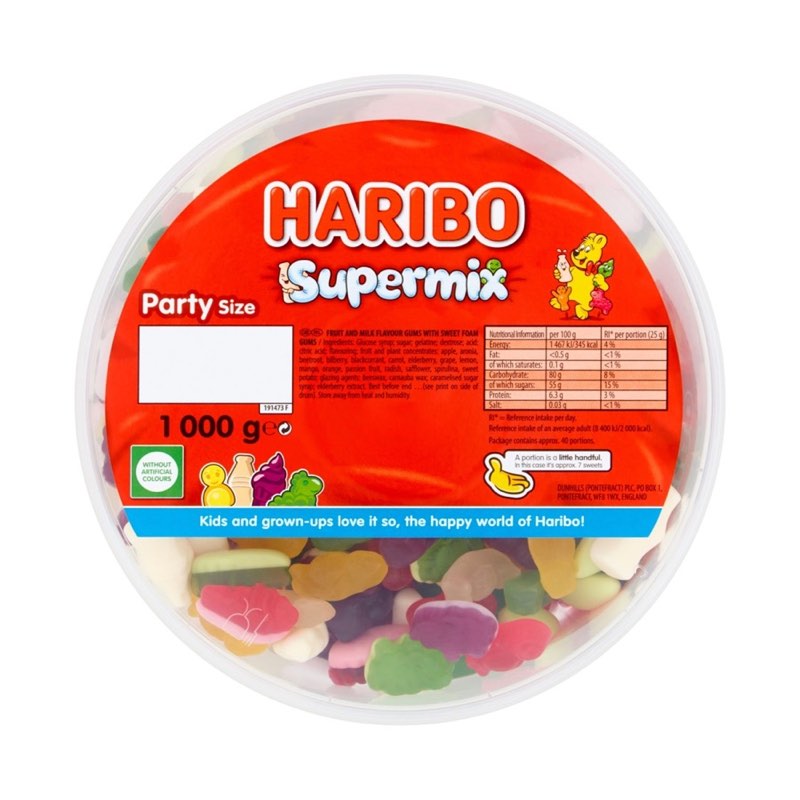
Haribo Supermix Sweet Tub 1kg
£11.99
✔ In stock — ready to ship
Fresh stock
Free over £20
Same-day dispatch
Secure checkout
A kilo is a commitment, and the honest first question about the Haribo Supermix Sweet Tub 1kg is not whether it is nice — it is whether you are one of the people it is built for. There are four or five of those people, they buy it for completely different reasons, and if you are not one of them there is almost certainly a smaller thing on the shelf that suits you better.
The household that keeps sweets in, rather than buying them. This is the biggest group by some distance. If there are sweets in your house most weeks, you are already spending the money — you are just spending it in small, expensive instalments on whatever was near the till. A kilo in a tub changes that pattern into a standing supply: one purchase, one container, one place everyone knows to look, and weeks of not thinking about it. The tub is the point here as much as the kilo.
The full guide to Haribo Supermix Sweet Tub 1kg
5,752 words on how it eats, who it suits, how to serve it and what to put beside it.
Who a whole kilo is actually for
The person catering something. A kilo is a genuine catering quantity — it will cover a room, fill party bags, or stock a table, and the arithmetic for all three is set out further down. Crucially, a mix is the right thing to cater with, because the one thing you cannot know about twenty guests is what any of them like. Buying variety is how you stop guessing.
The gift-builder. A kilo of mixed sweets is the raw material for a great many presents — hampers, boxes, jars, letterbox parcels, teacher gifts, care packages — and it is a far better starting point than buying gift items individually. The whole middle of this page is about that job, because it is the one where a little thought pays off most.
The office, the staff room, the clubhouse. Any shared space where a bowl gets refilled by whoever notices it is empty. Tubs suit these places specifically: they close, they stack, they sit on a shelf without looking like litter, and nobody has to own the leftovers.
The person who is tired of choosing. Underrated, this one. Some people genuinely do not want to make a decision about sweets every week, and a large mix removes the decision entirely for a month or more. There is no more shopping to do after this.
Who should buy something smaller instead
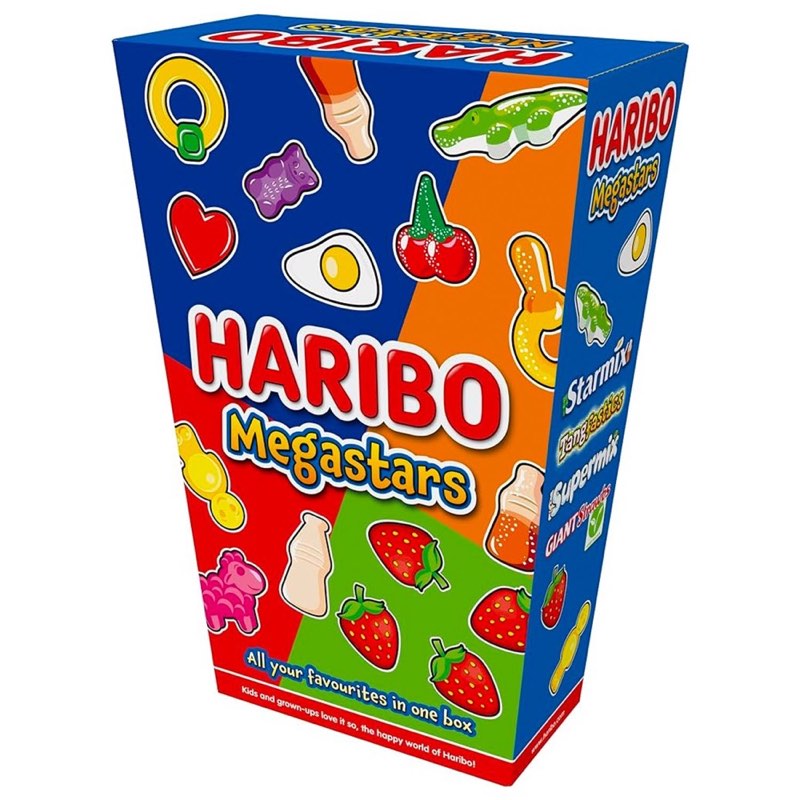
If you are buying for one person to eat alone, a kilo is too much — not because it will spoil, but because the pleasure of sweets falls off sharply when there is no scarcity at all, and a tub that never empties stops being a treat. If you are buying a present for one person and the present is the sweets, a gift box usually presents better than a tub and costs less: the Megastars gift box at £6.99 for 800 g is the obvious example, and the reasons are covered in full below. And if you want to try a line before committing to a kilo of it, Haribo Starmix Sweet Tub at £4.99 is the lower-priced way into the tub format, though we do not list a weight against it, so treat it as a smaller outlay rather than a calculated saving.
What turns up on the doorstep
It arrives as a tub, and the tub deserves a paragraph of its own because it is half of what you are buying. A rigid container with a lid that actually closes is a different proposition from a bag, and the difference shows up every single day you own it. It stands up on a shelf. It does not tip, spill, split or go limp. It can be opened one-handed, closed without being folded and clipped, and moved from a cupboard to a table to a car boot without any of the usual anxiety about the bottom going. Once empty, it is a container you will find a use for.
The contents are a mix, recorded as multi-coloured and fruit-flavoured, and the first impression is colour — a kilo of assorted colours in one open container is a genuinely striking thing, and considerably more so than the same kilo in a bag. That visual effect is worth more than it sounds when the tub is doing a job in a room. An open tub on a table draws people to it in a way a bag never does, which is exactly what you want at a party and exactly what you may not want in a kitchen on a quiet Tuesday.
The scale takes a moment to register. A kilo is more than most people picture — deeper than you expect, heavier than you expect in the hand, and enough that the first few helpings make no visible difference at all to the level. That non-denting quality is part of the appeal for a shared space and part of the risk for a household. Both are covered below.
A kilo of mixed sweets as the best raw material in gifting
Bought sweet gifts are often disappointing for a reason that has nothing to do with the sweets: they are assembled to a price by someone who has never met the recipient. A tub of mixed sweets fixes that, because it turns you into the person assembling, and you do know the recipient. This is the single most useful thing a kilo of variety can do, and it is worth going through properly.
Hampers, and the rule that makes them work
The failure mode of a homemade hamper is uniformity. Twelve sweet things in a basket read as one thing, however much they cost, and the recipient's eye slides across the lot. A good hamper needs contrast — in colour, in format, in price point, and especially in what each item is for. A kilo of mixed sweets gives you the volume and the colour cheaply, which frees your budget for two or three items that give you the contrast.
The structure that works is simple: bulk, accent, centrepiece. The bulk is the mixed sweets, decanted into jars or bags so they look chosen rather than poured. The accents are small things with personality — something sharp, something novelty, something grown-up. Barnett's Mega Sour Fruits Candy Bags 104g at £3.99 is the classic sharp accent, and it works precisely because it is the one item in the basket that is not sweet and friendly. Bolci Freeze Dried Dark Chocolate Strawberry 80g at £4.49 for 80 g is the grown-up accent, and its higher price per gram is the point — in a hamper, one deliberately expensive small thing raises the read of everything around it.
The centrepiece is the item the recipient sees first. A tub itself can be the centrepiece if you leave it whole, which is the lazy and entirely valid option. Or you can break the kilo up and let something with more visual drama sit in the middle: Chupa Chups Mini Candy Sushi Tray 100g at £2.99 is a novelty format that reads immediately as a gift rather than as groceries, and it costs less than three pounds to add that.
A kilo will fill three or four generous jars, which is enough for three or four separate hampers of the bulk element. If you are making more than one basket — Christmas, end of term, a run of birthdays — the per-hamper cost of the sweets element drops to around three pounds, and that is where buying a kilo stops being a treat purchase and starts being a sensible one.
Letterbox parcels and posting sweets
Posting sweets to somebody is one of the kindest small things you can do and one of the easiest to do badly. The constraints are depth, weight and breakage, and mixed sweets handle all three better than most alternatives.
Depth is the binding constraint for anything going through a letterbox. A rigid tub will not go through one, so posting means decanting into flat bags and laying them in a shallow box. This is fine and in some ways better — a flat parcel of three or four clear bags of colour-sorted sweets looks considered in a way a shop-bought tub does not. Sort by colour rather than tipping at random; it takes five minutes and it is the whole difference between a parcel that looks like a present and one that looks like a delivery.
Weight matters because postage is priced by it, and a kilo is heavy. Splitting a tub across several parcels over several months is usually cheaper and unquestionably nicer than sending the lot at once — the same money buys four moments instead of one. Around 200 to 250 g per parcel is a good unit: substantial enough to feel generous, light enough not to be punished at the counter.
Breakage is the reason to think about what you post. Mixed sweets travel well as a category because there is nothing structural to snap and nothing to leak. Small, self-contained items travel best of all, which is why Chupa Chups Soft & Chewy Fruity Flavour Mini Tubes 130g at £1.49 are such a good thing to post alongside — each tube protects its own contents, and they lie flat.
Teacher gifts and end-of-term
End of term is the occasion where a kilo genuinely changes the economics. A jar of sweets is a good teacher gift for the plain reason that it gets used and shared rather than displayed and quietly given away, which is more than can be said for most of what arrives in July. But buying six individual jars of sweets is expensive, and buying six identical shop-bought boxes is visibly a job lot.
A kilo decanted into four or five jars with a handwritten label costs you around £2.50 of sweets per gift and looks like you made an effort, because you did. If you have several teachers, teaching assistants and a school office to cover, this is comfortably the most efficient gift you can assemble, and it scales without embarrassment — nobody minds receiving the same thoughtful thing as a colleague.
One sensible caveat for a school setting: give sealed or clearly labelled items, and leave the manufacturer's packaging with the gift wherever you can, so that anyone with an allergy can check it before eating. Sweets are a treat, and the person receiving them should be able to make their own decision about them with the pack in front of them.
Care parcels
A care parcel — for a student, someone in hospital, someone working away, someone having a bad month — has a different brief from a present. It needs to last, to be shareable, and to require nothing of the recipient. Mixed sweets are close to ideal on all three counts, and variety is specifically valuable because you are sending to someone whose mood you cannot predict.
For a student, send the tub whole if you can, because the container is half the gift: a tub survives a shared kitchen, closes against a room that is not always tidy, and can be defended. For a hospital parcel, send small sealed bags rather than an open tub, keep the quantity modest, and check first — there are often restrictions, and food gifts are not always welcome or appropriate. For someone working away, small and repeated beats one large parcel, for the same reason as with posting.
A care parcel is also the one context where adding something with novelty value is worth more than adding something expensive. Candy Realms Halloween Pumpkin Light Pop 11g at £1.49 is eleven grams of sweet and a great deal of silliness, and silliness is often the actual payload of a parcel like that.
Presentation, cheaply
Four things make decanted sweets look like a present rather than a portion. Sort by colour — the single highest-impact thing you can do, and free. Use clear containers, so the colour is the decoration and you need no other. Overfill slightly, because a container that is two-thirds full reads as mean however much is in it. And label by hand, even badly; a written label does more for the read of a gift than any amount of ribbon.
What to avoid: cellophane bags twisted at the top, which read as party-bag filler; mixing your sweets in with strongly flavoured items in a sealed container, which lets one flavour colonise the rest over a fortnight; and over-wrapping, which makes the recipient work to get to something whose entire virtue is that it is easy.
What a kilo costs, per gram, per handful and per guest
At £11.99 for 1 kg, this works out at £1.20 per 100 g, or a little over a penny a gram. That is a genuinely useful benchmark to carry around the shop with you, because it sits right on the line between "bulk" and "not bulk", and you can judge almost anything else against it in your head.
| What you are measuring out | Portion | Portions from 1 kg | Cost each |
|---|---|---|---|
| A small handful | 25 g | 40 | About 30p |
| A proper counter-sized scoop | 50 g | 20 | About 60p |
| A party bag portion | 30 g | 33 | About 36p |
| A generous share for one evening | 75 g | 13 | About 90p |
| A hamper jar | 250 g | 4 | About £3.00 |
The party bag row is the one that surprises people. Thirty-three party bags from one tub, at about 36p of sweets each, is the difference between an afternoon that costs you twelve pounds and one that costs you forty. If you have ever bought pre-filled bags, the comparison is stark, and the only cost is ten minutes with a scoop and a set of scales.
For catering by head rather than by bag, work on 50 g a guest if sweets are the only thing on the table and 25 g if they are one item among several. That gives you twenty guests covered generously from one tub, or forty covered as part of a spread. Those are planning numbers rather than limits — people take more from an open tub than from a bowl, because the tub does not look like it is running out, and that psychological effect is real enough to budget for.
The honest comparison, including where this loses
Here is the thing most product pages will not tell you: per gram, this tub is not the cheapest Haribo on our shelf, and it is beaten by the gift boxes. Haribo Jelly Babies & Wine Gum Gift Box 800g at £6.99 for 800 g comes to £0.87 per 100 g, and the Megastars box at the same price and weight is identical on that measure. A 140 g bag of Happy-Cola at £1.25 works out at £0.89 per 100 g. All three undercut £1.20.
| Line | Price | Weight | Per 100 g |
|---|---|---|---|
| Haribo Megastars Gift Box | £6.99 | 800 g | £0.87 |
| Haribo Jelly Babies & Wine Gum Gift Box | £6.99 | 800 g | £0.87 |
| Haribo Happy-Cola | £1.25 | 140 g | £0.89 |
| Candy Realms Tutti Frutti Tubes Tub | £7.99 | 780 g | £1.02 |
| This Supermix tub | £11.99 | 1 kg | £1.20 |
| Chupa Chups Soft & Chewy Fruity Flavour Mini Tubes | £1.49 | 130 g | £1.15 |
So what is the extra thirty-odd pence per 100 g buying? Three things, and whether they are worth it depends entirely on your use. First, the container — a rigid, resealable, reusable tub, which a box is not, and which matters enormously if this is going to live on a shelf and be opened daily for a month. Second, the round kilo, which makes every piece of planning arithmetic trivial and is worth real money to anyone catering. Third, variety in one container rather than variety assembled by you across several purchases.
If none of those three matter to you — if you want the most sweets for the least money and you will eat them within a fortnight — buy a gift box and ignore the tub. That is the correct answer for a lot of people, and saying so is more useful than pretending the tub wins on every measure. If you are stocking a shared space, catering an event, or building several gifts from one purchase, the tub earns the difference back easily.
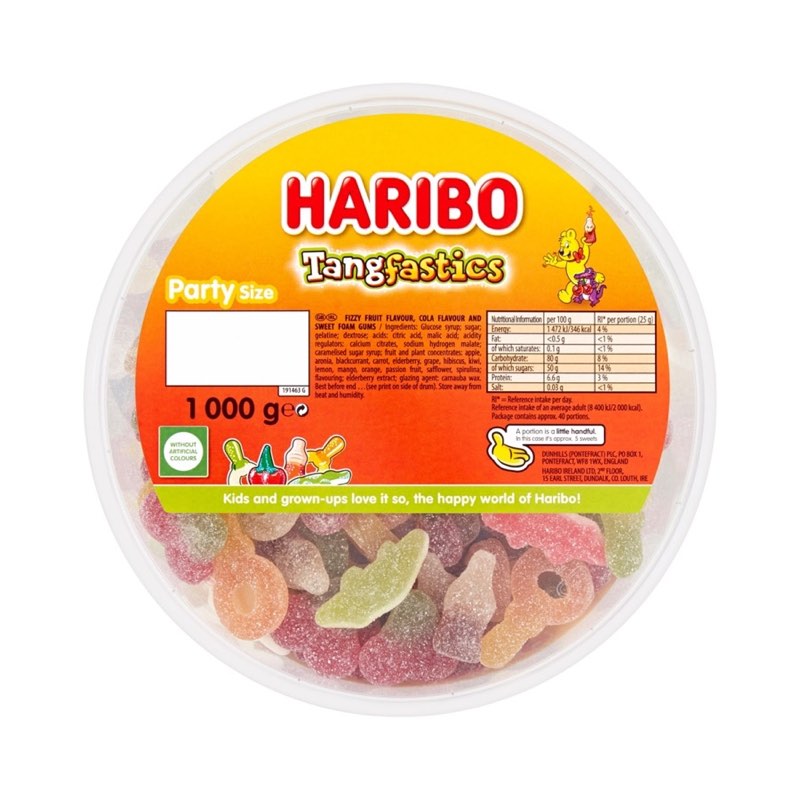
For a like-for-like on format, Haribo Tangfastics Sweet Tub 1kg is the same £11.99 for the same kilo in the same container, so the choice between those two is purely about what is inside and costs you nothing either way. And Candy Realms Tutti Frutti Tubes Tub 780g at £7.99 for 780 g is the nearest non-Haribo tub, at £1.02 per 100 g — slightly cheaper per gram, slightly smaller, and a different kind of contents.
The arithmetic of what a mix saves you
One last calculation, and it is the one that makes the strongest case for buying variety in a single container. Assembling the same breadth yourself from individual lines means buying four or five separate items, most of them priced between £1.25 and £5.49, and most of them in quantities larger than you need of each. You would spend more, you would end up with more total weight than you wanted, and you would have four containers instead of one.
That is the real economic argument for a mix and it holds at every size. You are not just buying sweets; you are buying the curation and the packing, and at £1.20 per 100 g you are buying them cheaply. Where the argument stops holding is if you actually want only one thing — in which case buying that one thing is obviously better, and a great deal of our Haribo shelf exists to serve exactly that.
Fruit flavours in a mix, and how variety changes eating
The flavour here is recorded simply as fruit, and in a large multi-coloured mix that description is the right one. What you are buying is breadth across the familiar fruit register rather than any single carefully drawn flavour, and breadth is the product — the point of a mix is that the next piece is not the last piece.
Variety changes how people eat in ways that are easy to observe and rarely discussed. A mix gets eaten more slowly per person and over a longer period than a single line of equivalent weight, because each piece is a small decision rather than a repetition, and decisions slow you down. It also gets eaten by more people, because a room of ten contains at least three flavour preferences and a mix accommodates all of them. If you have ever put out a kilo of one thing and watched half the room ignore it, this is the fix.
The other universal behaviour is ranking. Everybody develops a private order of preference within a mix, usually within the first few handfuls, and everybody assumes theirs is obvious. What follows is the entire social life of a mixed tub: the trading, the picking, the complaint that someone has taken all of one colour, the piece that is always left until the end. This is not a trivial pleasure — it is a large part of why mixes get bought again and single lines often do not.
Worth knowing for planners: the picking behaviour means a tub does not deplete evenly. After a fortnight in a shared space you will have a tub that is disproportionately one or two colours, and people will start describing it as finished when it is a quarter full. There is no fixing this and it is not a fault; just budget for the last quarter going slowly, or decant it into a smaller container where it looks like a deliberate selection rather than the remainder.
If you know the room's preferences well enough to skip the lottery, buying to a single flavour is the alternative. The fruit flavour shelf runs to 161 lines and is the broadest in the shop, so there is a single-flavour answer available for almost any preference a mix might leave unsatisfied, and the strawberry shelf is the narrower version of the same idea for the most partisan flavour of the lot.
Building a table around a kilo
A kilo of mixed sweets is a foundation rather than a finished spread. It covers breadth, volume and colour by itself, which means everything else you add should be chosen for what the mix cannot do. There are three such things.
An edge. A mix is, by design, agreeable. Nothing in it is going to startle anybody, and over a long event that is a limitation. One sharp item gives the table a second register and gets talked about — the sour bag mentioned earlier does this for £3.99 and you need very little of it.
A format the mix does not have. Variety within one container is still variety within one format. Adding a different shape of thing entirely — a tube, a tray, a novelty, something people pick up rather than scoop — changes the physical activity of the table, not just the flavour. Haribo Friendship Rings at £5.49 are a ring format that people put on a finger before they eat, which is a different action from taking a handful, and that matters more at a children's party than any flavour decision you will make.
Something for the adults. Every table catering for children also has adults at it, and they are usually forgotten. Traditional lines do this job well without needing explanation — Barratt Jelly Babies and Barratt Fruit Salad Chews, both £5.49, are the sort of thing adults reach for absently and children largely ignore, which means they widen the table rather than competing for the same hands. BUBS Banana & Caramel Foam Sweets at £7.50 pull in a different direction again, towards the caramel end of things rather than the fruit end, which gives the table somewhere to go once the fruit register is exhausted.
And a cola note is almost always worth including, because cola is the one flavour that reads as neither fruit nor sweet-shop-traditional and therefore never competes with anything else on the table. Haribo Giant Cola Bottles at £5.49 cover it at size.
Four components — the kilo, an edge, a format, an adult line — will cover a room of twenty properly and cost you well under thirty pounds. That is a better table than most people build for twice the money, and the reason is that each item is doing a job no other item can do.
Occasions where a tub is the right shape of purchase
Children's parties are the obvious one and the tub format is doing real work there: it opens and closes repeatedly through a chaotic afternoon, it can be moved out of reach and brought back, and it does not spill when it inevitably gets knocked. Thirty-three party-bag portions from one tub covers most school-year parties with room to spare.
Christmas is where a kilo earns its keep hardest, because December is a month of small obligations rather than one big one — a jar for a neighbour, a bag for a postman, a tub topped up for whoever calls in, something for the table nobody has to prepare. One purchase in late November covers most of that, and the tub keeps the rest in usable condition between occasions.
Halloween takes a kilo easily, and mixed sweets are the correct thing for it, because you are giving to a large number of children whose preferences you do not know. Portion into small bags in advance and you will be a great deal calmer on the night.
Long school holidays, road trips and family visits are the quiet uses. A tub in the boot or on a kitchen shelf covers six weeks of small requests without a single extra shopping trip, and there is a real domestic peace in not having to answer the question every few days.
Where a tub is the wrong shape: a single present for one adult, where a box presents better for less money; a small gesture, where a kilo is simply too much to hand somebody; and anywhere you need portion control rather than abundance, because a tub is designed to signal the opposite.
Keeping a kilo in good condition
The tub is the storage solution, which removes most of the usual advice. Close the lid properly after every use — the whole advantage of the format evaporates if it lives half-open on a worktop — and keep it somewhere cool, dry and out of direct sun. A cupboard is better than a windowsill, and away from the hob and kettle is better than near them, because steam is the enemy of anything sugar-finished.
Do not decant into something worse. People routinely tip a perfectly good tub into a glass bowl for a party and then leave it there for a week, at which point the sweets are exposed to the air continuously. Decant what you need for the afternoon and keep the rest in the tub with the lid on. The same applies to hampers and jars: decant at the last sensible moment rather than weeks ahead.
If you are splitting a kilo across several gifts over time, keep the undistributed portion sealed in the original tub rather than in bags, since a rigid sealed container holds condition better than a folded bag. Check the date on the manufacturer's packaging when it arrives, and keep that packaging while any of the sweets remain, so anyone with an allergy can read it before eating — that pack is the authoritative source for anything of that kind, and it is worth keeping for as long as the tub lasts.
One practical note for shared spaces: a tub that is refilled from smaller bags over time ends up with old sweets permanently at the bottom. Empty it properly before topping it up rather than pouring onto the existing contents, or the bottom layer will still be there at Christmas.
Choosing between the tubs and the boxes
Haribo lines on our shelf split into three shapes of purchase, and picking the right shape matters more than picking the right contents.
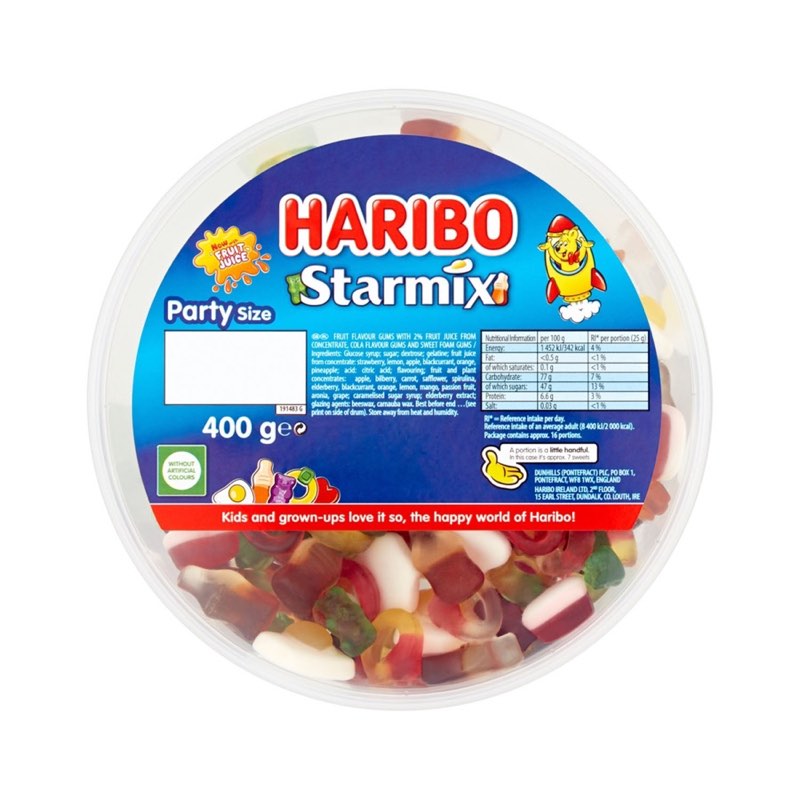
Tubs are for keeping. The container is rigid, resealable and reusable, which makes them the right choice for a shelf, a shared space, a long occasion, or anything that will be opened repeatedly over weeks. You pay a little more per gram for that, as set out above. Two are available at a kilo and £11.99 — this one and the Tangfastics — plus the lower-priced Starmix tub, for which we do not list a weight, so judge that one on outlay rather than on a per-gram comparison.
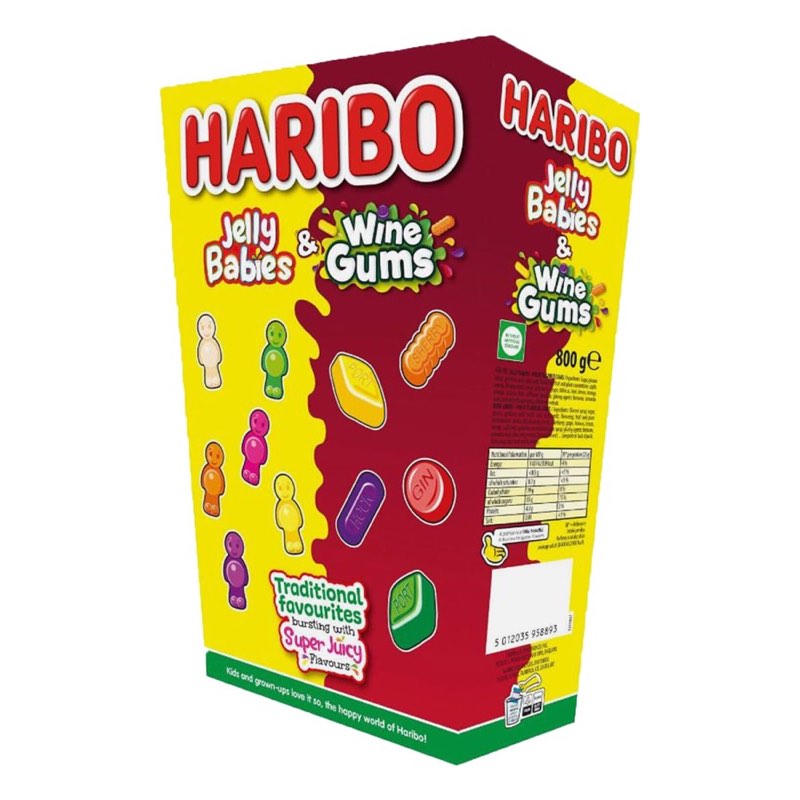
Gift boxes are for giving and for value. At 800 g for £6.99 they are the cheapest route to a large quantity on this shelf, and they present well without any effort from you. What they do not do is close properly or survive being carried about half-eaten, so they suit a present or a single occasion rather than a standing supply.
Bags are for a specific want. Single-line bags are the answer when you know exactly what you want and do not need variety, and they run from £1.25 for a small one up to £5.49 for the larger loose lines. If you find yourself picking one colour out of a mix every time, the bag of that thing is the purchase you actually wanted.
The decision, then, is not really about flavour at all. Ask how long it needs to last, how often it will be opened, and whether anybody is receiving it as a gift. Those three answers pick the format, and the format narrows the choice to two or three lines, at which point you can pick on contents. You can see all 43 Haribo lines in one place to make that comparison directly.
Where to go next on the site
This product sits on two shelves. The Haribo shelf holds 43 lines and is the place to go if you have settled on a maker and are choosing a format. The fruit shelf holds 161 lines, making it the largest in the shop, and is the place to go if you have settled on a flavour direction and are open about everything else.
If you are comparing makers rather than browsing by flavour, Kingsway and Sweetzone are the other two brand shelves worth a look for volume purchases in particular, since both carry lines in the large formats that suit catering. And the whole shop is there if you want to scan the lot rather than work down from a category.
For a specific job, work backwards from it. Building a hamper means pulling one bulk item, two accents and a centrepiece from different shelves. Catering a party means one volume item, one edge and one adult line. Posting a parcel means small, flat, self-contained items. In each case the tub is the anchor and the rest is chosen around it — so it is usually easiest to browse everything we carry with the anchor already decided.
Questions worth asking before you buy a kilo
What is in the mix?
It is an assorted, multi-coloured, fruit-flavoured mix, sold by weight as a kilo rather than by a fixed list of contents. The proportions of each colour vary from tub to tub, which is normal for any assortment. If you need certainty about getting one specific thing, a single-line bag is the right purchase and we carry plenty of them — the whole point of a mix is the breadth rather than a guaranteed composition.
Is a kilo too much?
For one person eating alone, probably. For a household, a shared space, a party, or a gift-building session, no — a kilo is about twenty generous 50 g servings or thirty-three party-bag portions, which most of those uses get through comfortably. The useful test is whether more than one person will be eating it and whether it has somewhere to live. If the answer to either is no, buy smaller.
How does the price compare to the gift boxes?
The tub is more expensive per gram. This works out at £1.20 per 100 g against £0.87 for the 800 g gift boxes at £6.99. What you get for the difference is a rigid resealable container, a round kilo for easy planning, and everything in one place. If you want maximum sweets for minimum money and will finish them quickly, the box is the better buy and we would rather tell you that than not.
How many party bags will it fill?
About 33 at 30 g each, or about 40 at 25 g. At 30 g you are looking at roughly 36p of sweets per bag, which is substantially less than pre-filled bags cost. Weigh rather than count, since pieces in a mix vary in size, and a set of kitchen scales makes the whole job take about ten minutes.
Does the tub reseal properly?
Yes — that is the main practical reason to choose a tub over a bag or a box. It closes without being folded, clipped or bagged, it stands up on a shelf, and it survives being carried and knocked. That matters most if the sweets will be opened repeatedly over weeks rather than eaten in one sitting, which is exactly the use case a kilo implies.
How should I store it once opened?
Lid on, in a cool dry cupboard, away from steam and sunlight. Do not leave it open on a worktop, and do not decant the whole tub into an open bowl for a party and then leave the remainder there afterwards. If you are portioning it out for gifts over several weeks, keep the undistributed part in the original tub rather than in bags.
Is this the same as the Tangfastics tub?
Same format, same kilo, same £11.99 — the difference is entirely in what is inside. Since the price and quantity are identical, there is no financial angle to the decision at all, which is unusual and quite freeing: pick on contents alone. Some households buy one of each and keep them side by side, which works well in a shared space because it doubles the breadth without doubling the number of containers on the shelf.
Can I post these to someone?
Yes, though not in the tub, which is too deep for a letterbox. Decant into flat bags, sort by colour so it looks deliberate, and lay them in a shallow box. Splitting a kilo into four parcels of around 250 g is usually better value on postage and makes four occasions out of one purchase. Mixed sweets travel well because there is nothing to snap or leak.
Is it suitable for a children's party?
It is one of the better choices, because variety covers a room whose preferences you cannot know. Sweets are a treat rather than everyday food, and whole pieces are a choking risk for young children, so keep an adult supervising with the youngest guests. Portion into bags in advance rather than leaving an open tub out, which is both calmer and considerably more economical.
What if a guest has an allergy?
Keep the manufacturer's packaging and let them read it themselves before eating anything. We do not publish ingredient or allergen information for this line on this page, and the pack that arrives with your order is the authoritative source. If you are giving sweets away as a gift, pass the packaging on with them for the same reason.
What should I add to make it a proper spread?
Three things the mix cannot do on its own: one sharp item for an edge, one different format so people are doing something other than scooping, and one traditional line for the adults. Four components in total, including the tub, will cover twenty people well for under thirty pounds. Adding more variety of the same kind rarely improves a table; adding a different kind always does.
Is it in stock and is there another size?
It is in stock, and it comes in one size only — the 1 kg tub at £11.99. There is no larger or smaller version of this particular line, so if you want less, look at the gift boxes or the bags, and if you want more, buy a second tub or pair it with the other kilo tub on the shelf. The price does not taper with quantity, so two tubs is simply twice the money for twice the sweets.
The short of it
A kilo of assorted, multi-coloured, fruit-flavoured sweets in a rigid tub that closes properly — which is a boring sentence describing a genuinely useful object. The variety is what makes it work for a room, a gift or a household, because it removes the need to guess what anyone likes. The tub is what makes it work over weeks rather than an afternoon. At £11.99 it is £1.20 per 100 g, which is not the cheapest route to a kilo of sweets on this shelf and does not need to be: you are paying a little extra for a container you will keep using and a round number that makes every other decision easy. Buy it to stock a shelf, cater a room, or build four presents out of one purchase. Buy a box instead if you just want the most sweets for the least money.
More from Haribo
More fruit sweets

Where this sits
Haribo Supermix Sweet Tub 1kg appears on these shelves. Browse them, or jump to something nearby.
You might also like