Home / Loose Sweets / Candy Realms Halloween Pumpkin Light Pop 11g
Candy Realms · 11g
Read the full guide
Candy Realms Halloween Pumpkin Light Pop 11g
£1.49
✔ In stock — ready to ship
Fresh stock
Free over £20
Same-day dispatch
Secure checkout
The first thing that registers is how little it weighs. Eleven grams is a very small amount of confectionery — less than a single square of most things, about the mass of a couple of coins — and almost all of that weight sits at the top, in the sweet itself. The handle is the other half of the object and it contributes almost nothing to the scales, because a handle full of air and a light is a handle full of air and a light. The result is a pop that feels faintly unreal when you pick it up, like a prop rather than a sweet, and that is a large part of the appeal rather than a criticism of it.
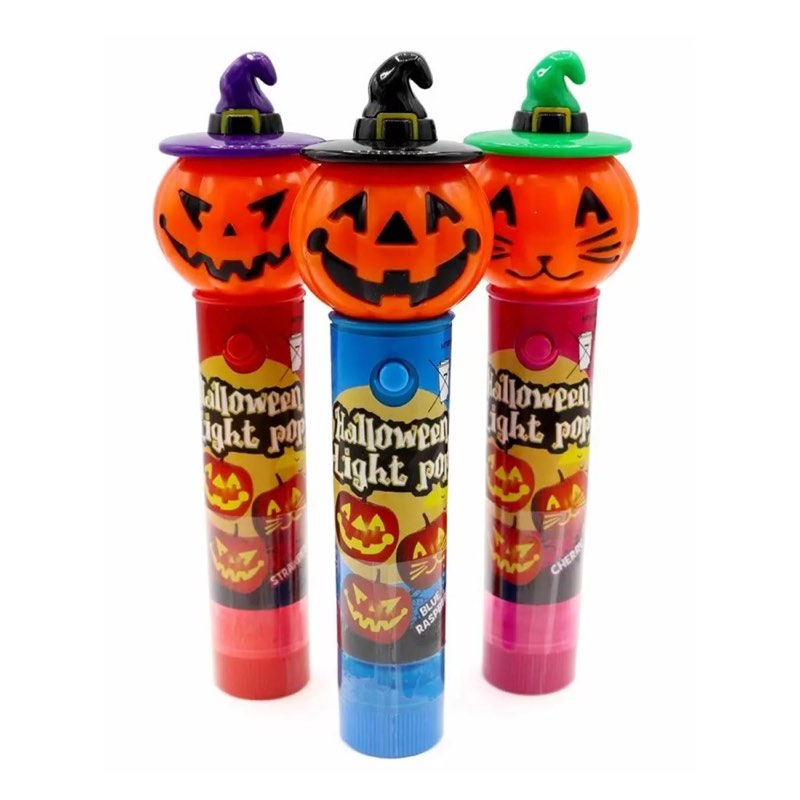
In a lit room it reads as a lollipop with a slightly chunky grip. In a dark one it reads as something else entirely. That is the whole design brief of a light pop and the reason the format has survived in Halloween aisles for as long as it has: it is a sweet that does something when the lights go down, and Halloween is the one night of the year when the lights reliably go down. The sweet at the top is a boiled sweet, moulded into a pumpkin, and the illuminated handle turns it from a thing you eat into a thing you carry about a dark room.
The full guide to Candy Realms Halloween Pumpkin Light Pop 11g
5,847 words on how it eats, who it suits, how to serve it and what to put beside it.
In the hand, in the dark, in the mouth
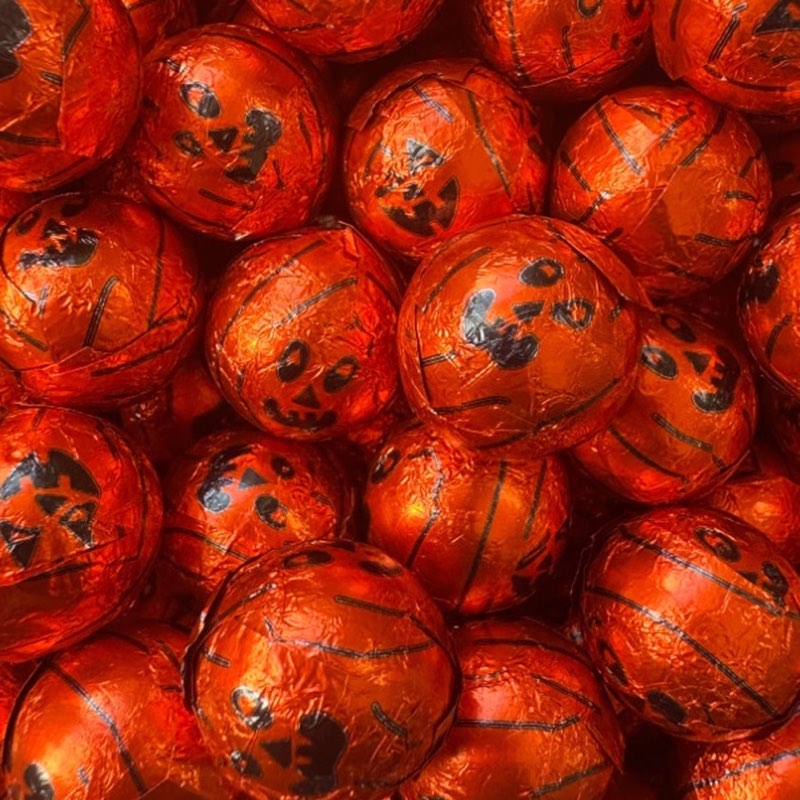
Look at the pumpkin itself before you unwrap it. Boiled sugar takes a mould extraordinarily well — better than chew, better than jelly, better than anything else in a sweet shop — because it is poured as a liquid and sets as a glass, picking up every ridge and line of the mould face as it goes. That is why the pumpkin has ribs and a stalk rather than being a vague orange blob. A jelly version of the same shape would have soft, rounded-off edges within a day; a boiled one holds its detail until you eat it.
The first taste is straightforward and arrives fast. It is a fruit flavour, which is the family the pack lists, and boiled sweets deliver flavour in a particular way that is worth understanding: nothing happens for the first second or two while the surface wets, and then the flavour comes on steadily and holds at the same level for as long as the sweet lasts. There is no build and no fade. A chew ramps up and crashes; a boiled sweet switches on and stays on. If you bite it — and people do, despite every instruction to the contrary — it shatters into sharp-edged fragments that dissolve in a minute or two and the whole experience is over in a rush.
Eaten properly, which is to say slowly, an 11 g boiled sweet is a genuinely long occupation. Sugar glass dissolves from the outside in at a fairly constant rate, so the sweet gets smaller and smoother and the ribs of the pumpkin wear away first, then the stalk, and by the end you have an anonymous rounded lozenge that could be any sweet at all. Watching a child work through that sequence is half the entertainment of buying one. Ten to twenty minutes is a realistic range depending on how much patience the eater has, which makes this an unusually good value proposition in time-per-penny terms even though it is a poor one in grams-per-penny.
The handle is the other half of the experience and it outlasts the sweet. Long after the pumpkin is gone the handle is still there, still lit, and still being waved about. That is not a flaw in the product — it is arguably the point of it. What you are buying at £1.49 is a few minutes of boiled sugar and a small light-up object, and the light-up object is what gets taken round the neighbourhood.
A pumpkin that tastes of fruit, and why that is fine
Here is a thing worth clearing up early, because it causes more confusion than any other aspect of Halloween confectionery. The pumpkin here is a shape, not a flavour. The flavour listed for this line is fruit. Nobody has made you a pumpkin-flavoured sweet, and on the whole you should be relieved about that — the American pumpkin-spice tradition does not translate well to hard confectionery, and a boiled sweet tasting of squash and warm spice would be a much harder sell than one tasting of fruit.
Halloween confectionery in Britain works almost entirely this way. The season is expressed through shape, colour and theatre rather than through taste. You get pumpkins, ghosts, skulls, bats and eyeballs in exactly the flavours the sweet shop already sells all year round, because the seasonal element is visual. This is not laziness on the manufacturer's part; it is a sensible recognition that a child at a Halloween party wants a sweet that looks like Halloween and tastes like a sweet. The same logic runs right through the shelf and right through the calendar year: the shapes change with the season, the flavour families largely do not. The Candy Realms mallow stacker built for the festive season is the same trick performed six weeks later at £1.50, and nearly everything else that appears in October or December is doing a version of it too.
The light is the other seasonal element, and it is the one that makes this particular pop worth the premium over a plain moulded lolly. A light in the hand is genuinely useful on the one night of the year when children are walking about outside after dark. It is not a torch and it is not a safety device — do not treat it as either — but it is a visible point of light attached to a small person, and every bit of that helps.
The format also solves a specific Halloween problem, which is that trick-or-treating requires a free hand. A bag in one hand, a costume to manage, a door to knock on: a sweet on a handle can be held in the same hand as the bag or tucked under an arm in a way that a loose bag of sweets cannot. Small practicalities like this are why the on-a-stick format persists long after the rest of confectionery moved on to pouches.
On the sofa and at the controller: how it paces, how it messes, how it shares
This is where a light pop turns out to be a more interesting object than its price suggests, because the on-a-stick format has properties that matter enormously for film nights and gaming and barely at all anywhere else.
Start with pacing. The central problem with snacking through a film is that most snacks have no natural rhythm. A bowl of anything gets eaten at whatever speed your hand moves, which during a tense scene is very fast indeed, and then you are forty minutes into a two-hour film with an empty bowl and nothing to do with your hands. A boiled sweet on a handle imposes a rhythm from the outside. It cannot be eaten quickly without being crunched, and crunching ends it. Held properly, one pop occupies a good chunk of a film's first act, and it does it at a fixed rate you cannot accelerate.
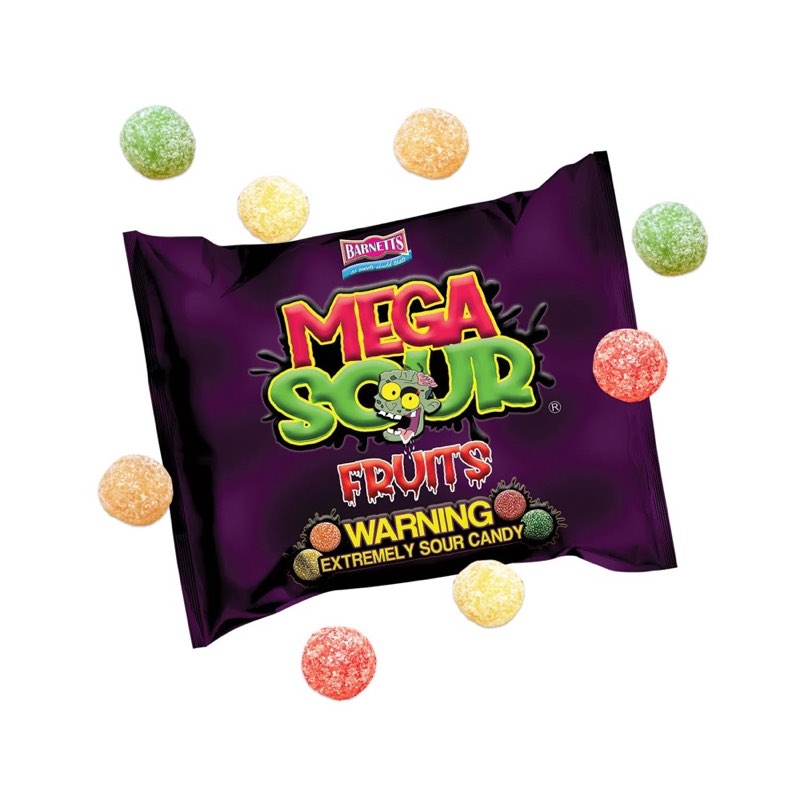
That external pacing is genuinely valuable. It means one 11 g sweet covers a stretch of viewing that would otherwise consume several times its weight in handful-format sweets. If you have ever gone through a 150 g pouch in the opening twenty minutes of something and then felt vaguely ill through the rest of it, you already understand the problem the pop solves. For comparison, a bag-format sweet like Barnett's Mega Sour Fruits Candy Bags at £3.99 for 104 g is a completely different eating pattern — fast, repeated, hand-to-mouth — and the sour coating is the only thing pacing you.
Now mess, which is the criterion nobody puts on a product page and everybody cares about. Here the pop is a mixed result and it is worth being honest. On the good side, a boiled sweet does not melt on your fingers, does not transfer colour to a controller, does not leave crumbs in a sofa, and does not require a napkin. It is one of the cleanest things you can eat in the dark. On the bad side, it has to be put down somewhere between mouthfuls, and a wet lollipop put down on a coffee table is a sticky ring you will find tomorrow. The handle solves half of that — there is a clean part to hold — but nothing solves the other half except a saucer. Put a saucer out. It sounds fussy and it takes ten seconds and it will save you a table.
For gaming specifically, the calculation shifts. A pop is a one-handed snack in a two-handed hobby, which makes it awkward during play and excellent between rounds. The honest verdict is that it suits turn-based, story-heavy and co-op-with-a-lull games and suits nothing that requires both thumbs continuously. Where it genuinely excels is as the thing you have during cutscenes, loading, lobbies and map screens — exactly the moments where a controller is idle and a hand is free. If you want something for continuous play, a sweet you can take one of and forget about serves better, which is where Barratt Fruit Salad Chews at £5.49 or a bag of small gums come in.
Then shareability, where the pop is unambiguously poor, and that is by design. A lollipop is a single-person object. It cannot be passed, divided, or offered round. Everyone who wants one needs their own, which at £1.49 each is a real per-head cost rather than a rounding error — six people is £8.94, which buys a lot of bagged sweets. The upside of unshareability is that nobody has to negotiate, nobody gets more than their share, and there is no bowl-based conflict. For a group of small children, that is not a small consideration.
The sensible structure for a film night with a group, then, is one pop per person as the opening event — with the lights off, which is when the handle actually earns its keep — and a shared bowl for the rest of the running time. The pop gives everyone their own thing for the first twenty minutes. The bowl handles the remaining ninety. Something from our pick and mix built to the room's taste does the bowl job better than any single pre-packed bag, because you can load it with what your particular group actually eats.
One last pacing note that applies to both films and games: a lit handle in a dark room is a light source in someone's peripheral vision. In a group of six watching something, six lit handles is genuinely distracting. Either everybody gets one at the start and they are finished before the film properly begins, or you accept a lightly illuminated living room for the duration. Both are fine; drifting into the second one by accident is what causes complaints.
Who should pick one up
This is a children's product first and it does not pretend otherwise. It suits a child of roughly five and upwards who wants something for the walk, the party or the film, and it suits them best on or around the 31st of October when the light has a reason to exist. It suits a parent who needs a small, cheap, immediately exciting thing to hand over — £1.49 is a price at which you can say yes without a negotiation.
It suits the party-bag filler slot extremely well, because it is a single self-contained item that looks more substantial than it costs. A pop with a light in the handle reads as a bigger gift than a bag of sweets of the same price, purely because it is an object rather than a quantity.
It suits adults who like boiled sweets and are prepared to be seen holding one, which is a smaller group than it should be. It does not suit an adult who wants a Halloween treat with no theatre attached — for that, a proper bag of boiled sweets such as Swizzels Barley Sugar at £5.49 is the grown-up route to the same texture without the handle.
It does not suit very young children unsupervised. Sweets are a treat, and small hard sweets and whole gummies are a choking risk for young children, who should be supervised while eating them — and a hard sweet on a rigid handle adds a second consideration, which is that small children run about with things in their mouths. The standard advice applies with a bit more force here: sitting down, supervised, and not while moving. Anyone in the house with an allergy should check the manufacturer's packaging on arrival before eating.
It also does not suit anyone shopping for volume. Eleven grams is eleven grams. If what you want is a quantity of fruit-flavoured sweets for a bowl, this is the wrong shape of purchase entirely and 161 fruit-flavoured lines on our fruit shelf will serve you far better per pound.
Which sweet counter this belongs to
Every sweet carries a date stamp, whether or not it means to. Hand somebody a sweet and they will place it — not by reading the pack, but by recognising a format. The light pop places itself very precisely, and the era it belongs to is more recent than most of the things around it on our shelves.
The deep past of the British sweet counter is glass jars and scales. That world is boiled sweets, barley sugar, mint imperials, pear drops, sugar-dusted things weighed out into a paper bag and twisted shut. It is a world with almost no packaging in it and therefore almost no novelty — a sweet was a shape and a flavour, and that was the whole proposition. The survivors of that era are still on our shelves and they are still excellent: Stockley's Chocolate Flavoured Limes at £5.49 are a properly old-counter sweet, as is barley sugar, and you can see the whole family together on our retro shelf.
The middle era is the wrapper era. Individually wrapped sweets meant branding, and branding meant characters, colours and personality — this is where the named chew and the printed sweet came from, and it is the era most British adults are actually nostalgic for, because it is the era of the corner shop and the penny tray. Fruit salad chews sit squarely in this period. So, in a different way, does seaside rock, which industrialised the printed-image-through-sugar trick at scale — McAdam's England Football Chopped Rock Pouch at £1.99 is that tradition still running.
The light pop belongs to a third era: the novelty-mechanism era. This is the period when confectionery started competing on what the packaging did rather than only on what the sweet tasted like. Sweets that spin, sweets that light up, sweets that come in a container you keep, sweets with a gimmick attached to the delivery rather than to the flavour. It is the same design instinct that produced the sour-powder drum and the sweet-in-a-toy, and it is unmistakably a product of a world where children's attention was being competed for by screens.
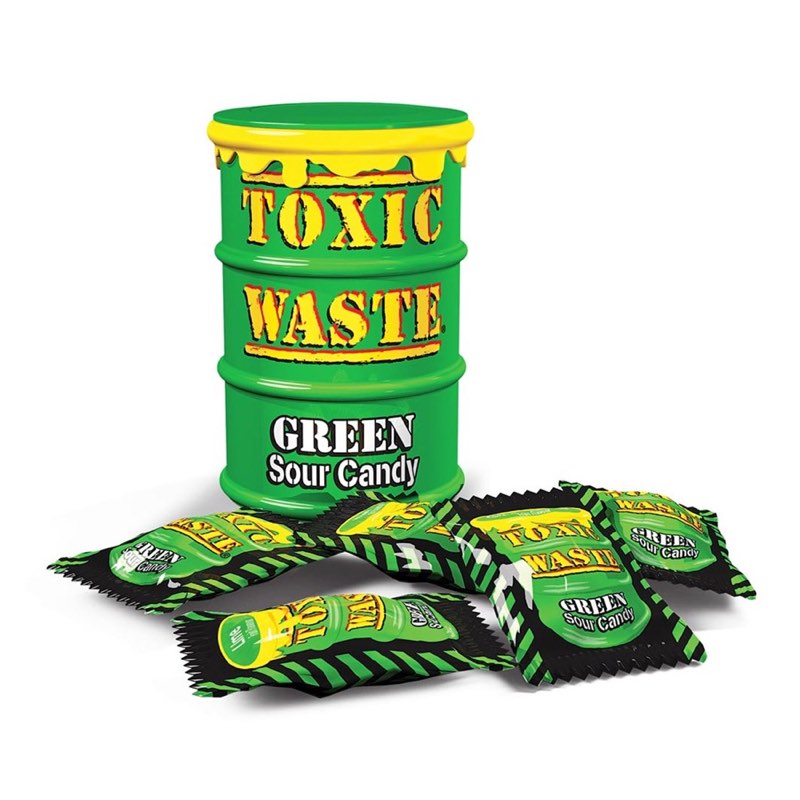
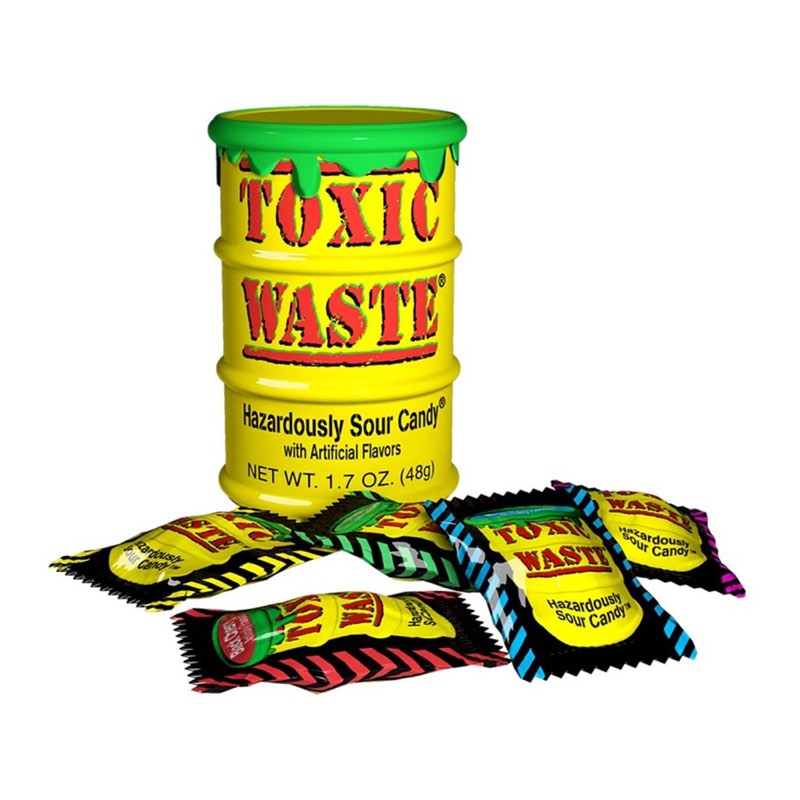
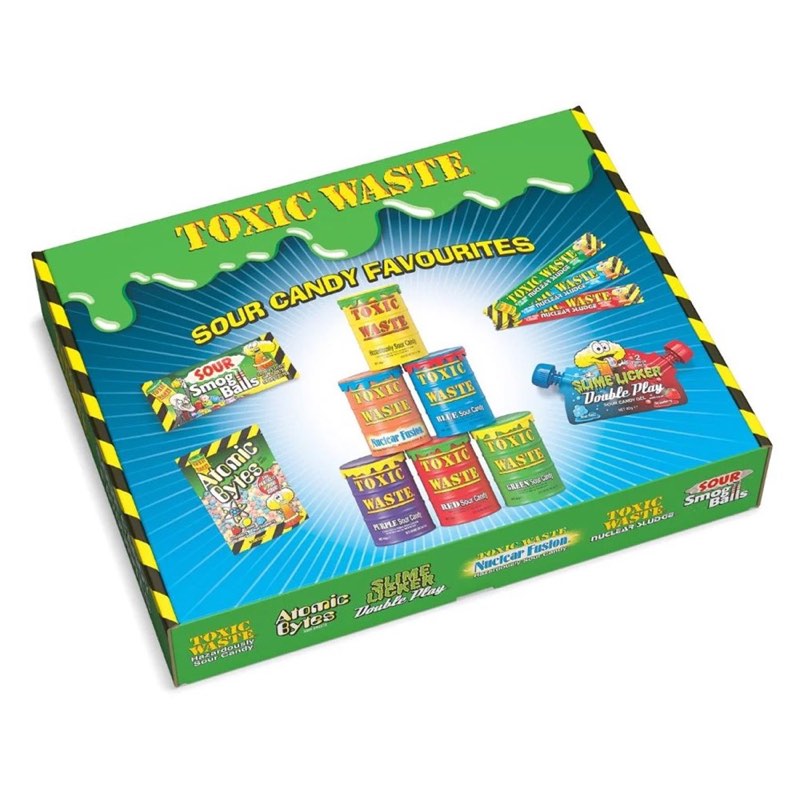
The third-era sweets on our shelves are easy to spot once you know the tell. the Toxic Waste Green Drum at £1.99 is a container-first product — the drum is the identity, the contents follow. Warheads Blue Raspberry Cubes at £2.49 lead with an experience — the sour hit as a dare — rather than with a flavour. The light pop leads with a function. All three are doing the same thing in different registers: making the sweet an event.
What is interesting is that the sweet inside a third-era product is very often a first-era sweet. Strip the handle and the light off this pop and you have boiled sugar, moulded, fruit-flavoured — a technique and a texture that predates every gimmick attached to it by more than a century. That is the quiet joke at the centre of the novelty-mechanism era, and it is why these products tend to be better than their packaging suggests. The mechanism is new. The confectionery underneath is old, and old confectionery is old because it works.
Generationally, this produces a nice split at a Halloween party. The adults recognise the boiled sweet and are mildly dismissive of the light. The children do not care about the boiled sweet at all and are entirely there for the light. Both groups are getting exactly what they came for from the same £1.49 object, which is a more elegant bit of product design than it gets credit for.
What "fruit" means on a boiled sweet
The flavour listed here is fruit, and that deserves a bit of unpacking because fruit means something specific in boiled confectionery that it does not mean elsewhere.
Boiled sugar is cooked very hot. That temperature limits what flavours can survive the process, which is why the boiled-sweet flavour vocabulary is narrower and sharper than the jelly or chew vocabulary. Delicate, rounded, creamy notes tend not to make it through; bright, high, acid-leaning notes do. This is why hard sweets skew towards clear fruit flavours and mints, and why the softer, rounder end of flavour lives in chews and fudges instead. The flavour you get in a boiled sweet is the flavour that survives 150-odd degrees, and that self-selects for clarity.
The second thing boiled sugar does to flavour is hold it at a constant level. Because the sweet dissolves at a steady rate, the amount of flavour released per second is steady too. This produces the characteristic boiled-sweet experience: a plateau rather than a curve. It is the reason people describe hard sweets as "clean" — not because the flavour is simple, but because it does not move.
The third thing is that acid and sugar are held in the same glass, so a fruit boiled sweet tends to read as more sour towards the end than at the start. Nothing has changed in the sweet; your palate has adapted to the sugar and the acid stands out more against it. This is a genuine and slightly counter-intuitive effect and it is worth noticing next time you finish one.
If you want to explore the fruit family properly, the range on our shelves is wide. The soft end is chews and jellies — Kingsway Vegan Garden Fruits at £5.49 sit there, and our supplier lists that line as vegan, which is the sort of thing worth knowing if you are catering for a mixed room. The hard end is where this pop lives, and you can browse the boiled sweets shelf for its thirty companions. The extreme acid end is where Warheads and the mega sour bags operate, and it is a genuinely different experience rather than just a louder one — the coating does the work there, not the sugar.
For a broad sweep of the whole family in one place, the fruit flavour category pulls together every fruit line we carry regardless of texture, which is the most useful single view if you know what you want to taste but not what you want to chew.
Building a Halloween table around it
A light pop is a great opening item and a poor centrepiece. Here is the shape of a table that uses it well.
The handout. One pop per child, given at the door or at the start, lights on. This is the thing that sets the tone and it does it in about four seconds. At £1.49 a head it is the cheapest theatrical moment available.
The bowl. Something high-volume, broadly liked and easy to grab in the dark. Fruit chews and jellies are ideal because they need no unwrapping attention and they do not shatter. Build it from our loose sweets shelf, which runs to 356 lines, or from the pick and mix if you want exact control over the ratio.
The dare. Every Halloween table benefits from one thing that is a challenge rather than a treat, because children will organise themselves around it for half an hour without any adult input. The sour drum and the blue raspberry cubes are both built for this job. Put a small amount out, not a lot — the point is the dare, not the quantity.
The grown-up corner. Something for the adults who are supervising, ideally with a bit of bitterness or complexity to it so it does not get raided by children. Chocolate limes do this well. So does barley sugar, which has the additional advantage of being the sort of thing that an older relative will be visibly pleased to see.
The texture outlier. One item that behaves completely differently from everything else on the table, to stop the whole spread reading as one note. BUBS Banana & Caramel Foam Sweets at £7.50 are aerated and light in a way that nothing else on a Halloween table will be, and the contrast does a lot of work.
The seasonal carryover. If you are buying for Halloween you are usually about six weeks from buying for Christmas, and it is worth knowing that Candy Realms Festive Mallow Stacker 45g at £1.50 is essentially the same kind of purchase in a different season — a small novelty-format item at a pocket-money price from the same house. Buying both at once saves a second delivery.
Ratios, for a party of ten children: ten pops, roughly 500 g of bowl, a small amount of dare, and whatever the adults want. That comes to about £15 of pops plus a bowl, which is a well-proportioned spend for an event of that size.
What £1.49 is actually paying for
Let us be blunt about the arithmetic, because the per-gram figure looks alarming until you understand what it measures.
£1.49 for 11 g is £13.55 per 100 g. That is, by a distance, one of the highest unit prices in the shop. A bag of Swizzels Fruity Pops at £5.49 is the same broad idea in bulk; the chopped rock pouch is 150 g for £1.99, which is £1.33 per 100 g — a tenth of the unit price of this pop.
| Item | Price | Weight | Per 100 g |
|---|---|---|---|
| This light pop | £1.49 | 11 g | £13.55 |
| Chopped rock pouch | £1.99 | 150 g | £1.33 |
| Mega sour fruits bag | £3.99 | 104 g | £3.84 |
| Blue raspberry cubes bag | £2.49 | 99 g | £2.52 |
| Festive mallow stacker | £1.50 | 45 g | £3.33 |
So on sugar-per-pound this loses to everything. Now measure it differently.
Measure it per minute of occupation and the picture inverts. A boiled sweet of this size, eaten as intended, occupies ten to twenty minutes. Call it fifteen. That is under ten pence a minute, and the handle keeps working long after the sweet has gone. A 104 g bag of sour sweets, eaten the way sour sweets are actually eaten, is gone inside twenty minutes too — for £3.99.
Measure it per child at a party and it is a £1.49 line item that produces a genuine reaction. Almost nothing else in a shop does that at that price. Party bag fillers are a category where the perceived value matters more than the contents, and an object with a light in it wins that comparison against a bag of sweets every time.
Measure it as a yes — the thing you hand over when a child asks for something in a shop — and £1.49 is squarely in the range where saying yes costs nothing and buys a good deal of goodwill.
The honest conclusion is that this is not a way to buy sweets. It is a way to buy a small event that happens to include sweets, and at £1.49 it is priced correctly for that. If you find yourself doing per-gram maths on it, you probably want a bag instead, and loose sweets by the bag is where to go.
Keeping it in good order
Boiled sweets are the most robust thing in a sweet shop in some ways and the most fragile in others.
They do not melt, go rancid, squash or stick together in the way chews and jellies do, and a wrapped boiled sweet will sit in a drawer for a long time without meaningful change. That makes this an easy thing to buy in advance of Halloween, which matters, because Halloween stock is seasonal and the last week of October is not when you want to be hunting for it.
Their one real vulnerability is moisture. Sugar glass is hygroscopic — it pulls water out of the air — and a boiled sweet that has been exposed to damp develops a tacky, slightly frosted surface and eventually welds itself to its wrapper. This is entirely a humidity problem, not a temperature one, so the rule is dry first and cool second. A kitchen drawer near a kettle is the worst place in the house. A bedroom drawer is fine.
The second vulnerability is impact. A moulded boiled sweet is glass, structurally speaking, and it will chip and crack if the pop is dropped on a hard floor or rattled about in a bag with heavier items. A cracked pumpkin still eats perfectly well but it has lost the detail that made it worth buying, and a child will notice. Post or carry it packed rather than loose.
On the handle: the light is a separate thing from the sweet and it has its own lifespan. Once the sweet is finished the handle is a small plastic object with electronics in it and it should be disposed of appropriately rather than dropped in general waste — the same consideration that applies to any small battery-containing item. Do not leave it where a very young child can get at it once the sweet is gone.
After opening, a partly-eaten boiled sweet is a slightly awkward object. It will not keep well unwrapped, and rewrapping a wet lolly is not a success. The practical answer is that this is a finish-it item rather than a save-some-for-later item, which is another way in which the 11 g size is sensible rather than mean.
One size, and what to buy instead if it is wrong
This line is listed in a single size — 11 g at £1.49 — and there is no larger or multipack version on our shelves, so the sizing decision is made for you. What there is instead is a decision about format, and it is worth laying out.
- If you want the same sweet without the novelty, a bag of boiled sweets gives you the texture in quantity. A bag of barley sugar at £5.49 is the classic route.
- If you want lollipops in bulk rather than one on a light, the fruity pops bag at £5.49 is the volume version of the on-a-stick format.
- If you want a different novelty at the same price point, the £1.50 festive mallow stacker and the £1.99 sour drum are the nearest neighbours by price and by spirit.
- If you want more sweets for the money and do not care about the format, the chopped rock pouch at £1.99 for 150 g is the best per-gram value in this price bracket on the whole list above.
- If you want softer and safer for very small children, move away from hard sweets entirely and look at the jelly and gummy section.
Stock, as with anything seasonal, is the real constraint rather than choice. Halloween lines appear, sell and disappear on a short cycle. If you want these for the 31st, buying them in early October rather than late is the difference between having them and not.
Where this sits on our shelves
You will find this pop filed in three places, each of which is a useful route to something else. It is on the loose sweets shelf, our biggest category at 356 lines and the general home of everything sold by weight and by bag. It is under everything we carry that is boiled, a tighter shelf of 30 lines and the right place to go if the hard-sweet texture is specifically what you are after. And it is in the fruit flavour category, which at 161 lines is the largest flavour grouping we run.
The neighbouring shelves worth knowing: the pick and mix section for building your own bag rather than buying a pre-made one, the candy and chocolate shelf for the chocolate side of a party table, the jelly and gummy shelf for soft textures, and sweets filed under retro for the old-counter end of the range — which, as the era section above argues, is where the sweet inside this pop genuinely comes from even if the handle does not.
If you would rather not navigate by shelf at all, the whole shop in one list is the fastest route when you know a product name. And when you are putting together a full seasonal order rather than hunting one item, it is usually quicker to browse the full range and build a basket in one pass than to go shelf by shelf.
Common questions
Does it actually taste of pumpkin?
No. The pumpkin is the shape. The flavour listed for this line is fruit, which is the standard arrangement for British Halloween confectionery — the season is carried by how a sweet looks rather than by how it tastes. If you were hoping for a spiced, squash-forward flavour, this is not that, and honestly very little in a British sweet shop is. What you get is a fruit-flavoured boiled sweet in a pumpkin mould, which is a much easier thing to eat.
How long does one last?
Sucked rather than bitten, somewhere in the region of ten to twenty minutes, depending on the eater. Boiled sugar dissolves at a fairly constant rate, so the sweet gets steadily smaller and the moulded detail wears away in order — ribs first, stalk next. Bitten, it is over in a couple of minutes, because crunching a boiled sweet turns one slow object into a dozen fast fragments. The slow route is considerably better value for the same £1.49.
Is the light reusable after the sweet is gone?
The handle is a separate component from the confectionery and it carries on working after the sweet has been finished, which is part of why the format appeals to children. We would not treat it as a lasting toy, though. It is a small item with electronics inside, and once the novelty has worn off it should be disposed of appropriately rather than left about — particularly in a house with very young children, who should not have access to it once there is no sweet attached.
Is 11 g not a bit small?
It is small, and the price per 100 g is correspondingly high — £13.55, which is at the top of the whole shop. The counter-argument is that a boiled sweet occupies far more time per gram than any other format, and that what you are really buying at £1.49 is a small event rather than a quantity of sugar. If quantity is the goal, a bag will serve you ten times better per pound and we would rather point you at one than sell you twelve pops.
Can small children have one?
Sweets are a treat, and small hard sweets and whole gummies are a choking risk for young children, who should be supervised while eating them. A hard sweet on a rigid handle deserves a little extra care on top of that, because children tend to move about with a lollipop in their mouth. Sitting down and supervised is the sensible rule. For the very youngest, a soft format from the jelly and gummy shelf is a better fit than anything boiled.
What about allergies?
Check the manufacturer's packaging on arrival, before anyone eats anything. The pack carries the manufacturer's own information and that is the source to work from — we do not hold verified ingredient data for this line and will not guess at it. If you are catering for a mixed group, do that check when the order lands rather than on the night, when the lights are off and everybody is in a costume.
Will it survive being carried around trick-or-treating?
Reasonably well, with one caveat. A wrapped boiled sweet does not melt, squash or go sticky, so it copes with a pocket and a cold night far better than chocolate does. What it does not cope with is being dropped on a paving slab — sugar glass chips and cracks on impact. It will still eat fine, but the moulded pumpkin detail is what you paid for and that is what breaks. Carry it in a hand or a bag rather than loose in a pocket with keys.
How many do I need for a party?
One per child, because a lollipop cannot be shared, split or passed round. That is the honest answer and it is the main cost consideration with this format: ten children is £14.90. The usual approach is to use the pops as the handout at the start — the moment where everyone gets their own thing — and then run the rest of the party off a shared bowl, which is far cheaper per head and lasts far longer.
Is it available in other sizes or a multipack?
No. It is listed in one size only, 11 g at £1.49, and there is no larger version or multipack on our shelves. If you need several you buy several. If you want the same texture in bulk, a bag of boiled sweets is the route, and if you want lollipops in bulk specifically, the fruity pops bag at £5.49 is the volume equivalent of the on-a-stick idea.
How should I store them if I buy early?
Dry first, cool second. Boiled sweets pull moisture out of the air, and a damp one goes tacky and welds itself to its wrapper — so keep them away from kitchens that steam up. Temperature matters much less than humidity here, which is the opposite of the rule for chocolate. A bedroom drawer or a high cupboard is ideal. Stored properly they will sit happily from early October to the 31st without any change at all.
Is this a good stocking or party-bag filler generally, or only at Halloween?
The sweet inside works all year — a fruit-flavoured boiled sweet is not seasonal. The pumpkin and the light are, and a pumpkin in July reads as a leftover rather than a treat. If you want the same pocket-money novelty outside October, the festive mallow stacker at £1.50 is the winter equivalent from the same house, and it is worth knowing about if you are already ordering.
Is it suitable for vegetarians or vegans?
Our supplier lists no dietary tags against this particular line, so we cannot tell you either way and will not guess — the manufacturer's packaging is the place to check when it arrives. If you specifically need a line our supplier has tagged, Kingsway Vegan Garden Fruits is listed by our supplier as vegan and sits at £5.49, which makes it a straightforward answer for a mixed party table.
In short
The Candy Realms Halloween Pumpkin Light Pop is 11 g of fruit-flavoured boiled sugar moulded into a pumpkin and mounted on a light-up handle, in one size at £1.49, in stock now. Per gram it is expensive. Per minute, per child and per reaction it is very cheap indeed, and those are the measurements that actually apply to a product like this.
Buy one each rather than one between two, because a lollipop cannot be shared. Buy them in early October rather than late, because seasonal stock does not wait. Use them as the opening moment of a party or a film night and run the rest off a bowl. Keep them dry, keep them off hard floors, supervise the youngest, and check the pack when it lands. Then turn the lights off, which is the only condition under which this particular sweet makes complete sense.
More boiled sweets
More fruit sweets


More loose sweets sweets
Where this sits
Candy Realms Halloween Pumpkin Light Pop 11g appears on these shelves. Browse them, or jump to something nearby.
You might also like