
Home / Loose Sweets / Kingsway Jelly Filled Skulls
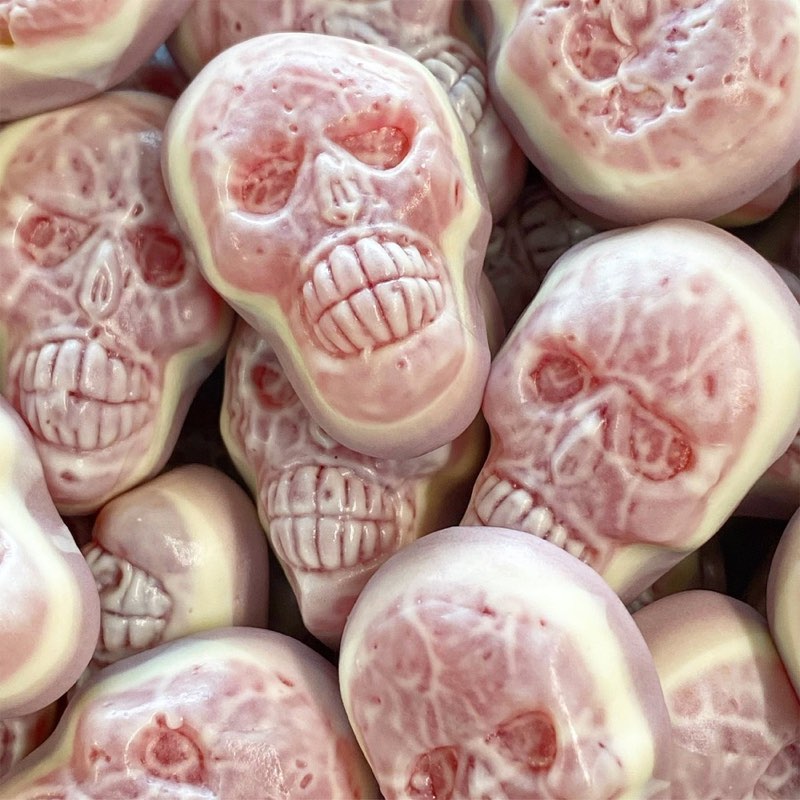
Kingsway · 250g
Read the full guide
Kingsway Jelly Filled Skulls
£5.49
✔ In stock — ready to ship
Fresh stock
Free over £20
Same-day dispatch
Secure checkout
Kingsway Jelly Filled Skulls are for the person who has worked out that a filled sweet and a solid sweet are not the same purchase. That sounds like a small distinction and it is not. A solid jelly is a texture you meet once and then repeat. A filled one has two stages to it, which means it holds attention for longer, gets commented on, and tends to be the thing people pick out of a mixed bowl on purpose rather than by accident. If you have ever watched a table and noticed that one particular sweet keeps getting fished out while everything else gets taken at random, it was almost certainly a filled one.
The second shopper is the shape hunter — and there are far more of these than the trade generally admits. This is someone who browses by mould rather than by flavour, who will happily try a fruit jelly they have never eaten because it has been made into a skull, and who knows perfectly well that the shape does not change the recipe. They are not being fooled. They simply enjoy the novelty as a thing in its own right, in the same way that people enjoy a well-made biscuit tin. If that is you, you already know whether you want these, and the rest of this page is mostly about quantities.
The full guide to Kingsway Jelly Filled Skulls
5,283 words on how it eats, who it suits, how to serve it and what to put beside it.
The shopper this one is aimed at
Third: the person putting together a themed table who has realised that one strong centrepiece beats five weak ones. A skull is about as unambiguous as a shape gets. It needs no sign, no orange napkin underneath it and no explanation to anyone under ten. Put a dish of these in the middle and the table is themed, whatever else is on it. For people who do not enjoy decorating, that is an efficient purchase.
Fourth, and this is the quietest group, it is for the shopper doing arithmetic. At £5.49 for 250g with a run of larger weights above it, this is a line where buying the right size makes a real difference to what an event costs, and we have given a whole section below to working that out properly. If you cater for anything on a regular basis — a club, a stall, a big family — that section is the useful part of this page and you should skip ahead to it.
Who should look elsewhere? Anyone who wants a quick, uncomplicated handful sweet. A filled shape is not a thing you graze on without noticing; it asks for a moment. If what you want is the fast, small, keep-going bowl that people empty without looking down, the Terrific Turtles from Haribo at £5.49 do that job instead, and plenty of tables want one of each.
A skull with something in the middle
The name is refreshingly literal. These are moulded skull shapes, and they are filled rather than solid — that is the format, and it is the reason to choose them over any other skull-shaped sweet you might come across. A filled format means an outer shape and a centre, which changes both how the sweet looks when it is broken and how it behaves when you eat it.
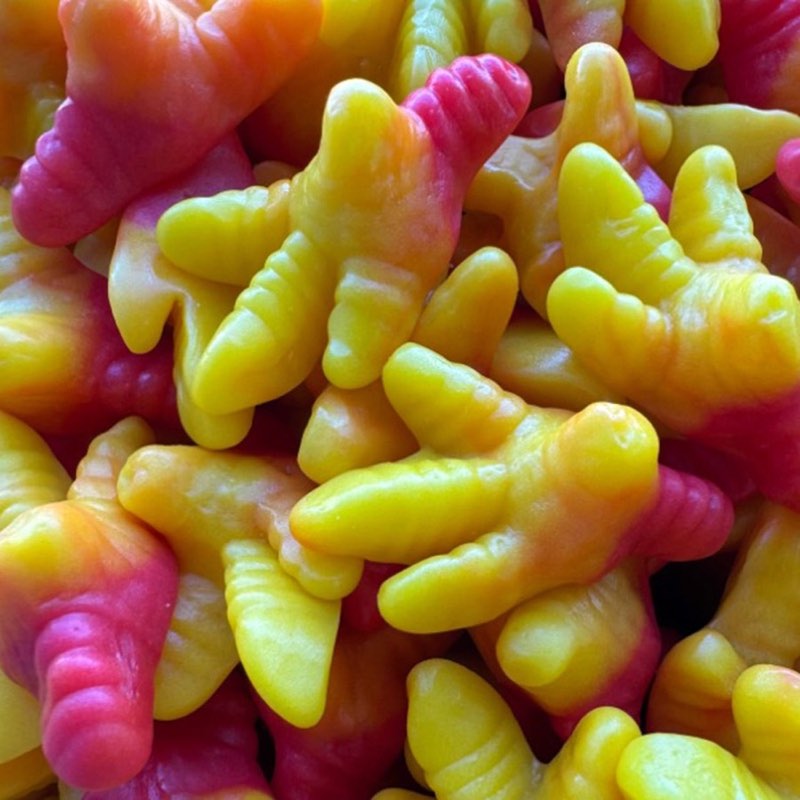
They come multi-coloured. It is worth pausing on that, because a skull is the one Halloween shape that could easily tip into genuinely grim, and colour is what stops it. A tray of bone-white skulls belongs in a display. A tray of skulls in bright mixed colours is clearly a sweet having fun with itself, and it sits comfortably on a table where there are small children as well as adults. The colour is doing real work here, not just decorating.
The mould aims for immediate recognition rather than realism — a rounded cranium, the two eye hollows, a suggestion of a jaw. From across a room you read "skull" in a fraction of a second, which is the entire brief. Anything more detailed would be less effective, not more, because detail slows down recognition and recognition is the product.
In the hand they are substantial without being unwieldy. A skull is a compact shape, roughly as deep as it is wide, so these pack into a bowl or a bag efficiently and do not leave the air gaps that long shapes do. Practically, that means a given weight takes up less room than you might expect and a jar of them looks dense and full rather than airy. If you are filling a display container, that density is in your favour.
The bite: shell first, then centre
A filled sweet is eaten in a particular order whether you intend it or not, and knowing the order makes it better. The first thing you meet is the outside of the shape, which gives you a chew to work against. Then, a moment later, you reach the middle, and the character of the mouthful changes. That two-stage arrival is the whole appeal of a filled format and it is not something a solid sweet can imitate.
Most people bite these in half rather than taking the whole thing at once, partly because of the size and partly because a filled sweet invites you to look at the cross-section. Children in particular will break one open before eating it, every single time, and then show somebody. That is not a waste of a sweet — it is a large part of what you have bought. A sweet that gets examined before it gets eaten is doing more for a party than one that simply gets swallowed.
The fruit note arrives with the first proper chew rather than slowly, and it does not hang around long after you have finished. That short finish is deliberate across this whole category and it is what makes a bowl re-visitable. A sweet whose flavour lingered for several minutes would stop you after two pieces; one that clears quickly keeps a table going all evening.
Because there is more going on per piece, these eat slower than a plain jelly of the same weight. That is worth knowing when you are estimating quantities: people take fewer of a filled sweet in a given stretch of time than they take of a small solid one, and they take them more deliberately. It means a bag goes further than the raw weight suggests, which is one of the few cases where a novelty format genuinely saves you money rather than costing you extra.
One practical note. Because a filled shape has a centre, it is slightly more sensitive to being squashed than a solid piece is. Do not pack them under the heavy end of a hamper, and do not leave a jar of them where somebody will press down on the lid to get it shut. They are not fragile, but they are not indifferent either.
Chasing shapes: how a collector thinks about a mould
There is a way of shopping for sweets that treats the mould as the point, and if you have never done it, it looks eccentric from the outside. It is not. It is a coherent hobby with its own logic, and a skull is one of the shapes that sits right at the centre of it. Here is how it works.
A mould is a season, not a fixture
The everyday lines on a sweet shelf are permanent furniture. They were there last year, they will be there next year, and there is no urgency to buying them. Shape novelties do not work like that. A mould exists because somebody decided to make it, and it continues to exist only while that decision still makes sense. Shapes appear, run for a while, and are not always replaced by the same shape the following time round.
We are careful not to promise anything about how long any particular shape will be available, because we genuinely do not know, and anyone who tells you otherwise is guessing. What we can say is the general principle: if you see a shape you want and it is in stock, that is the moment to buy it. That is the whole of the collector's discipline, and it is why shape shoppers tend to buy earlier in a season than everyone else.
The calendar a shape shopper keeps
Anyone who shops this way develops a rough calendar in their head. Autumn is the richest period for shape novelties by a distance, because the theme is so well-defined — skulls, ghosts, heads, eyes, teeth, bones, pumpkins. Midwinter has its own set. Spring has another. The rest of the year is thinner and the shapes that run through it tend to be the evergreen ones: hearts, animals, faces, fruit.
The practical consequence is that a table built around autumn shapes has more to choose from than a table built around almost any other theme. You can assemble a genuinely varied spread of shapes that all pull in one direction, which is very hard to do at other times of year. That is worth taking advantage of while the choice is there rather than buying one thing and being disappointed by the spread.
Completing a set on one table
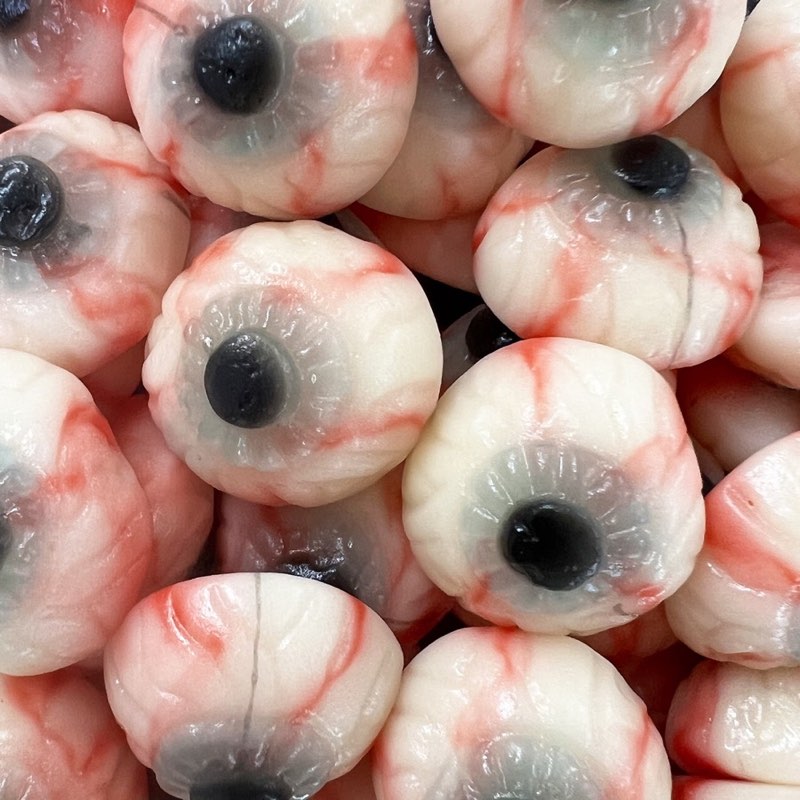
The most satisfying thing a shape shopper does is build a matched set — several different moulds that read as one idea. Skulls give you the anchor. Add Kingsway Jelly Eyeballs at £5.49 and you have two shapes from the same brand at the same price that plainly belong together. Add Kingsway Witches Heads, again £5.49, and the set has a face in it, which changes the character of the table entirely.
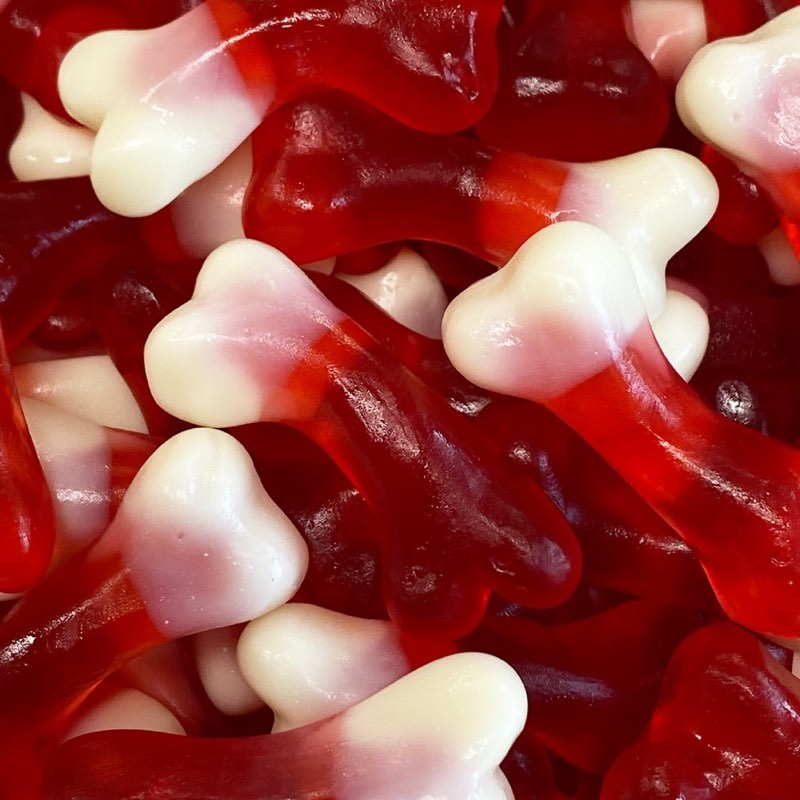
For a fourth, Kingsway Gummy Bones at £5.49 give you a long shape against three compact ones, and the difference in silhouette is what stops a set of shapes looking like one product in four costumes. Four bowls, four moulds, one price point, one idea. That is a complete table and it takes about ninety seconds to order.
If you want a fifth element that breaks the jelly texture, Pumpkin & Ghost Marshmallows at £5.49 are the obvious choice — still on theme, still on shape, but soft and pale against firm and bright. A set that is all one texture always reads as flatter than it should, however good the shapes are.
Format versus flavour, and why collectors prefer format
Here is the part that puzzles people who do not shop this way. A shape collector will often buy several products that are, in flavour terms, quite similar, and be perfectly happy. That seems irrational until you realise they are not buying flavours. They are buying formats, and a format is a genuinely different experience even when the flavour listing is identical.
A filled skull, a long bone, a small fang and a flat chew eat differently from each other in ways that have nothing to do with taste — different chew lengths, different release rates, different numbers of pieces per handful, different amounts of attention required. Put four of them on a table and you have four experiences. Put four flavours of the same format on a table and you have one experience in four colours. The collector has simply worked out which of those is more interesting.
You can test the principle cheaply. The Vidal Jelly Filled Strawberries tub at £7.99 is another filled format in a completely different shape, and a Fini Mini Mochis bag at £1.35 is a format so different it barely belongs to the same category. Put all three next to these skulls and the argument makes itself.
A word against hoarding
Collectors have one reliable failure mode, which is buying shapes to keep rather than to eat. It does not work. Sweets are not a collectible object; they have a date on the packaging and they change in texture over time whatever you do. A bag put aside unopened for a year will not be what it was when it arrived.
So buy what you will actually get through in a sensible span, and if you want a record of a shape, photograph it. Buy two bags rather than eight, eat one and take your time over the other. The fun of shape shopping is in the finding and the serving, not in the storing, and a cupboard full of bags you are saving for a special occasion is a cupboard full of sweets going quietly past their best.
Doing the sums: what these actually cost you
This is the section worth reading twice if you cater. Most people choose a bag size by feel and then wonder where the money went. The five weights on this line are priced so that the unit cost falls steadily as you go up, and the gaps are large enough to matter.
Cost per kilo across the five weights
| Size | Price | Works out at |
|---|---|---|
| 250g | £5.49 | £21.96 per kg |
| 500g | £9.99 | £19.98 per kg |
| 750g | £12.99 | £17.32 per kg |
| 1kg | £16.49 | £16.49 per kg |
| 2kg | £28.99 | £14.50 per kg |
Read that column on its own and the shape of the offer is clear. Moving from the 250g to the 2kg takes the unit cost down by about a third. That is a bigger spread than people expect, and it means the size you choose is a more consequential decision than the product you choose.
Put another way, in terms of what you save against buying the same weight in small bags: the 500g at £9.99 saves you 99p against two 250g bags. The 750g at £12.99 saves £3.48 against three. The 1kg at £16.49 saves £5.47 against four. And the 2kg at £28.99 saves £14.93 against eight 250g bags — which is to say, the big bag effectively gives you an extra two and a half small bags for nothing.
There is also a sensible middle step people miss. The 1kg at £16.49 is £3.49 cheaper than two 500g bags at £9.99 each, and the 2kg at £28.99 is £3.99 cheaper than two 1kg bags. So even if you were always going to buy a large quantity, buying it as one bag rather than two smaller ones is worth about four pounds each time.
Cost per handful
Kilos are abstract. Handfuls are not. Reckoning an adult handful at about 25g, here is the same information in the form you will actually use when you are deciding whether to put out a second bowl:
- From a 250g bag: about ten handfuls, at roughly 55p each.
- From a 500g bag: about twenty handfuls, at roughly 50p each.
- From a 750g bag: about thirty handfuls, at roughly 43p each.
- From a 1kg bag: about forty handfuls, at roughly 41p each.
- From a 2kg bag: about eighty handfuls, at roughly 36p each.
At those numbers, the thing to notice is how cheap a single serving is at any size. Even at the small-bag rate, a generous handful costs you a little over half a pound. That is why sweets are such good value as party catering compared with almost anything savoury, and it is why the real risk at an event is buying too much rather than too little.
Remember also the point we made earlier about filled shapes eating slower. In practice people take fewer skulls per visit to the bowl than they would take of a small solid sweet, so your effective cost per person over an evening is lower than the raw handful figure suggests.
Cost per guest, and how much to buy
Here is the calculation most people want. If sweets are one element of a wider spread and you reckon on 20g of any single line per adult, a 250g bag covers about twelve guests, a 500g covers about twenty-five, a 1kg covers about fifty and the 2kg covers about a hundred. For children at a party where sweets are a bigger part of the event, double the per-head figure and halve those guest numbers.
Worked through: a table of thirty adults with four different sweet lines out needs roughly 600g of each, so a 750g bag at £12.99 per line is the right call, with a little spare. That comes to about 43p of skulls per guest. A children's party of fifteen with three lines needs around 600g of each as well, because children eat more sweets and fewer sandwiches, and the same 750g bag covers it.
For bagging up rather than bowls, work backwards from the bag. Thirty party bags at 30g each is 900g, so the 1kg at £16.49 is the efficient purchase at about 55p of sweets per bag — and you have 100g over, which is exactly the margin you want for the two extra children who turn up.
When the big bag stops being cheaper
Unit price is only half of value. The other half is whether it gets eaten. A 2kg bag at £28.99 is the cheapest per kilo by a wide margin, but if a third of it goes soft in an open container over three months then the effective price per kilo you actually ate is worse than if you had bought 250g and finished it.
So the honest rule is this. Buy the largest size you can properly store and realistically consume within a sensible span, and no larger. If you have airtight tubs and a cool cupboard, go big and split it on arrival. If your storage is a kitchen drawer next to the oven, buy the 250g at £5.49 and buy it again when you want more. The second approach costs more per kilo and less per year.
And if you are buying for a one-off event, do the guest arithmetic first and then choose the bag, rather than choosing a bag that feels generous and hoping. Feeling generous is what leads to eating Halloween sweets in December.
Fruit, across a multi-coloured bag
The flavour listing is fruit, and the bag is multi-coloured, which together set an expectation of variety. Colour does a surprising amount of that work before anything reaches your tongue: you see a mixed bowl and you read it as a range, and that reading is a genuine part of the enjoyment rather than a deception.
These sit at the sweet rather than the sharp end of the fruit spectrum, which is the right position for a sweet that has to please a whole room. Sharpness divides people. If you want a sour element in the same spread, buy it deliberately as a separate line — BUBS Big Sour Skulls at £7.50 are the obvious partner because they take the same shape idea to the opposite end of the taste range, and a bowl of each lets guests pick their own side.
For scale, the Sweetzone Sour Twin Cherries tub at £7.99 gives you 800g of sharp in a single tub, which is the efficient way to cover the sour end of a big table without buying several small bags.
Among the sweeter neighbours, Barratt Jelly Babies at £5.49 remain the reference point for a soft British fruit jelly and will always be picked up by somebody, while Taveners Fruit Pastilles at the same price bring a firmer chew and a sugared coating that adds a textural layer these do not have.
If you want a hard shell in the mix for contrast, Skittles at £6.99 give you a crack instead of a chew in a similarly multi-coloured format, and Barratt Jelly Spogs at £5.49 pull firmly in an older, more divisive direction that some guests will go straight for and others will avoid entirely. Both are useful on a table where you want people to have opinions.
Assembling a table around them
Skulls are a centrepiece, so build outwards from them rather than treating them as filler. The first decision is what sits beside them in terms of size, because a table of shapes that are all roughly the same size looks monotonous however different the moulds are.
Put something small next to them. Haribo Terrific Turtles at £5.49 are a good answer — a compact multi-piece shape that people take by the handful, which gives your table a fast bowl alongside a slow one. Guests will move between the two without thinking about it, and that movement is what makes a spread feel alive rather than static.
Then add something that is a single large event. The Crazy Jo Peelablezz jumbo banana gummy at £2.99 is one big piece rather than many small ones, and its job is to be picked up, shown to someone and shared. It will not be the thing most of your guests eat, and it does not need to be.
Add fizz if there are children. Kingsway Vegan Fizzy Tongue Painting Dummies at £5.49 come with a built-in party trick, and the bubblegum tongue painters at the same price do the same thing in a different register. One of the two is plenty on a single table; both is showing off.
For the mechanics of laying it all out, a shallow wide dish shows a skull shape far better than a deep bowl does, because the shape is only worth having if people can see it. Two-thirds full looks generous; brimming looks careless and makes refilling awkward. Keep the rest of the bag sealed in the kitchen and top up in stages.
Browse our pick and mix selection if you want to put a larger spread together in one go, and it is worth a look through the whole shop before you check out — the gap in a table is usually a texture you have not thought of rather than a flavour you have missed. For a hamper, the candy and chocolate section gives you the heavier items to build the base around.
Occasions worth opening a bag for
Halloween first, obviously, and skulls need no defending there. But treat the shape as broader than one night. Skull-and-crossbones means pirates, which is one of the most reliable children's party themes there is, and a bowl of these on a pirate table does as much as any amount of bunting.
Day of the Dead tables have become a genuine fixture in a lot of households, and multi-coloured skulls suit that palette far better than anything monochrome would. If that is your reference point rather than a horror one, these are the more appropriate shape of the two on offer, precisely because of the colour.
Beyond parties, they work well as a gift component. A 250g bag at £5.49 dropped into a box of otherwise serious things gives the box a sense of humour, and a filled novelty shape is more interesting to receive than a bag of something plain at the same price. For teenagers in particular, a shape novelty lands better than a sensible chocolate.
They are good for a film night with a horror theme, good for a late-autumn class treat, and good for the sweet jar on a counter where something needs to look interesting through glass. That last use is where the compact shape pays off — skulls pack densely in a jar and fill it properly rather than leaving gaps.
Keeping a filled sweet in good order
The basics are the same as any jelly — cool, dark, sealed — but a filled shape gives you one extra thing to think about. Warmth affects a filled piece faster than a solid one, because there is less material holding the shape together. A bag left somewhere warm will soften and the pieces will start to settle against each other, and once they have done that they do not fully recover their crispness of outline.
Reseal the bag properly every time, or better, tip what you are not immediately using into an airtight tub. Air firms the outside of a jelly from the surface inwards, which on a filled piece changes the balance between shell and centre — not spoiled, but not what you bought either.
Do not refrigerate and definitely do not freeze. Cold makes the chew hard and flattens the flavour, and the condensation as they come back up to room temperature leaves them tacky. A cupboard away from the cooker and out of direct sun is all that is required.
If you have bought 1kg or 2kg for an event, split it into several tubs on the day it arrives rather than working out of one large open bag. Each tub stays sealed until you need it, and the last serving is as good as the first. This is the single piece of advice that decides whether a bulk purchase was good value or not.
Check the manufacturer's packaging when your order arrives and keep it while the sweets last. Anyone in the household with an allergy should read that packaging themselves before eating anything from the bag.
Choosing between the five weights
The arithmetic above tells you what each size costs. This is the plain-English version of which one to press.
250g at £5.49. A household bag, or one bowl among several on a shared table. Buy this if you have not had them before, or if you want the shape on a table without committing to a quantity. It is also the right size for a gift component.
500g at £9.99. The size for a party of up to about twenty-five adults where skulls are one of several lines, or a family that will pick at a bowl over a couple of weeks. It is the smallest size where the per-kilo saving starts to be worth noticing.
750g at £12.99. The event size. Thirty adults across four lines, or a children's party of fifteen. If you are running one specific occasion and you want to get it right without leftovers, this is usually the bag.
1kg at £16.49. For bagging up. Thirty party bags at 30g with a margin, or a large table with a jar that needs refilling. At £16.49 per kilo it is where the value curve starts to flatten, so unless you need the volume there is no great gain in going further.
2kg at £28.99. The cheapest per kilo by some distance and the hardest to store. Right for a stall, a club, a counter jar you refill all season, or two or three households buying together — which, for a street party or a school fair, is the sensible way to do it.
Where to find it on the site
This bag appears in several places depending on how you like to browse. It belongs to our loose sweets section, which at 356 lines is the biggest part of the shop and the best place to start if you are building a table rather than looking for one item.
By texture it sits on the jelly and gummy shelf with 96 lines on it, which is the shelf to browse if what you want is the chew rather than a particular flavour. By flavour it is on the fruit listing, the largest flavour grouping we have at 161 products.
By brand, the Kingsway shelf runs to 75 lines and is where most of the shape novelties on this site live, so it is the natural home for anyone shopping the way the collector's section above describes. The Haribo range is the other brand shelf worth walking, for a different house style on similar ideas.
On supplier tags: our supplier lists this line as dairy free and gluten free. Everything else carrying those tags is gathered on the dairy free listing, currently 51 lines, and the gluten free listing, currently 54. We pass on the tags exactly as our supplier gives them to us, which is why we always ask you to check the manufacturer's own packaging when the order lands.
If you would rather just look around, the loose counter and the rest of the Kingsway shapes are both worth an unhurried scroll, and both will turn up things a search box would never have shown you.
Your questions
What does "jelly filled" mean here?
It means the format: these are filled shapes rather than solid ones, so there is an outside and a centre and the sweet eats in two stages. That is the reason to pick them over a plain moulded skull. We do not publish anything about what goes into the filling — the manufacturer's packaging is the place for that, and it will be in the parcel when it arrives.
How many skulls are in a 250g bag?
We do not give a piece count, because moulds and batches vary slightly and a number we could not stand behind would be worse than no number at all. Plan in grams instead: 250g fills a standard shallow serving dish well, and because a skull is a compact shape it packs more densely than a long one, so it looks solid in a bowl rather than airy.
Are they actually good value against the bigger bags?
Against the bigger bags, no — the 250g is the most expensive per kilo at £21.96, and the 2kg is the cheapest at £14.50. But per kilo is only useful if you eat the whole thing. The 250g at £5.49 is excellent value for a household that wants one bowl, and terrible value for a school fair. Match the size to the job and the per-kilo figure sorts itself out.
Do the filled pieces leak or go sticky?
Kept cool and sealed, no. Warmth is what causes trouble: a bag left somewhere hot will soften and the pieces will settle against each other. That is a storage problem rather than a fault, and it is easily avoided by putting the bag in a cupboard rather than on a sunny shelf and by resealing it properly after each use.
Are they too frightening for small children?
The colours take most of the edge off, and children generally treat a bright multi-coloured skull as funny rather than alarming. The real thing to be careful about is not the shape but the size: whole gummies are a choking risk for young children, so supervise little ones while they are eating, and remember that sweets are a treat rather than an everyday item.
Are they sour?
No, these are at the sweet end with no sour coating. If your table needs a sharp option, buy one as a separate line and give it its own bowl — people will self-select and both bowls will go down faster than a single compromise would.
Can I buy several sizes in one order?
Yes, and for an event it is often the smartest way to do it: one large bag of the line you expect to shift most of, plus several 250g bags of contrasting products. That gives you variety on the table without committing to large quantities of anything you are unsure about, and everything arrives together.
How far ahead of Halloween should I order?
Earlier than feels necessary. Shape novelties move fastest in the final fortnight of October, and if you are buying for a fixed date you do not want to be depending on that window. Unopened bags keep perfectly well somewhere cool and dark, so ordering two or three weeks ahead costs you nothing and removes the risk entirely.
Will they survive being posted in warm weather?
Jellies travel far better than chocolate does. In hot weather a filled piece can soften in transit and settle a little, but it firms back up once it has spent a few hours somewhere cool. Unpack the parcel promptly rather than leaving it in a warm hall, and move the bag to a cupboard straight away.
Can I use them on a cake or a dessert?
They work well pressed into buttercream or set on top of a set dessert, and the shape is bold enough to read from across a table. Add them shortly before serving rather than the night before — a jelly left sitting on a moist surface for hours will begin to soften at the base and the colour may run slightly into whatever is underneath.
Is this line in stock?
Yes, all five weights are in stock as listed on this page. If a size is showing as available, you can order it.
Last word
What you are buying here is a shape that does a job no flavour can do, in a format that gives you two things to eat instead of one, at a price that falls away steeply as the bag gets bigger. Those three facts are the entire case for these, and none of them needs dressing up.
Take the 250g at £5.49 if you want the shape on a table this weekend. Do the guest arithmetic and take the 750g at £12.99 if you have a date and a headcount. And if you are building a set, order the eyeballs and the bones at the same time — four moulds on one table is a far better evening than one mould in four bowls.
More from Kingsway
More jelly & gummy sweets
More fruit sweets

Where this sits
Kingsway Jelly Filled Skulls appears on these shelves. Browse them, or jump to something nearby.
You might also like