Home / Loose Sweets / Fini Mini Mochis Bag
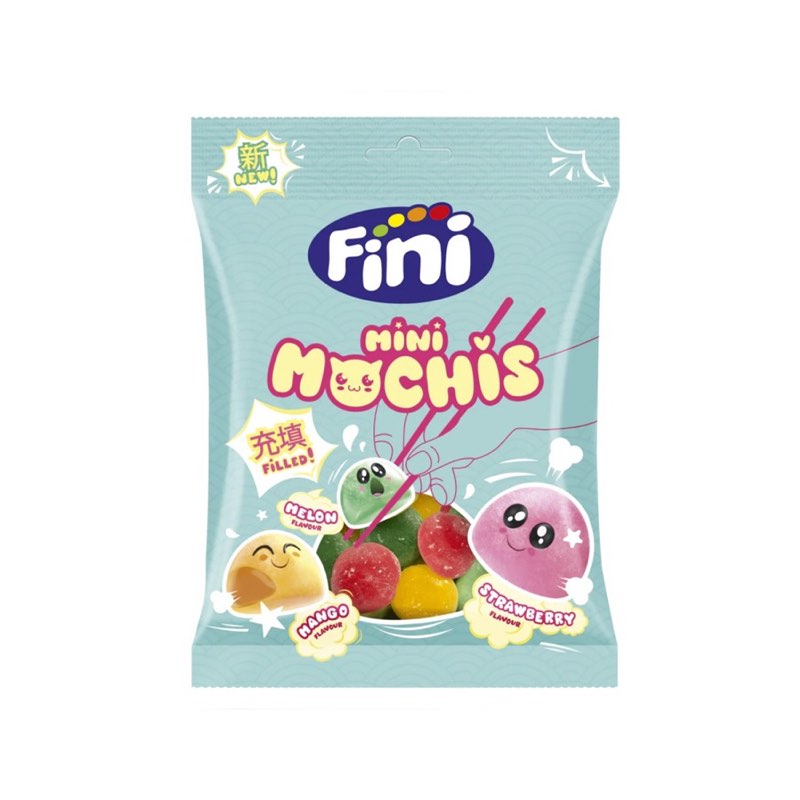
Fini · 90g
Read the full guide
Fini Mini Mochis Bag
£1.35
✔ In stock — ready to ship
Fresh stock
Free over £20
Same-day dispatch
Secure checkout
Almost every decision a shopper makes in a sweet shop is, underneath, a decision about one axis: how sharp do you want this to be. People do not usually say it that way. They say they want something fruity, or something for children, or something that is not too much. But what they are navigating is a spectrum that runs from completely round and sweet at one end to genuinely mouth-puckering at the other, and knowing where a product sits on that line tells you more about whether you will enjoy it than almost anything else on the label.
Fini Mini Mochis sit at the sweet end, and they sit there deliberately. This is a mild, fruit-led, rounded sweet with no sharp edge to it at all. There is no spike at the front, no tingle at the sides of the tongue, nothing that makes you pull a face. What you get instead is a steady, gentle fruit sweetness that arrives quickly, sits at a comfortable level all the way through, and fades without leaving anything behind. In a shop where a great deal of shelf space is given over to sourness, that is a genuinely useful position to occupy.
The full guide to Fini Mini Mochis Bag
5,166 words on how it eats, who it suits, how to serve it and what to put beside it.
Where these land on the sweet-to-sour line
The five positions on the line
It is worth laying the spectrum out properly, because once you can see it you can build a bowl, a bag or a party table with intent rather than by guesswork.
- Round and sweet. No sharpness whatsoever. Fruit flavours read as ripe and soft. This is where these mochis live, along with most traditional jellies — Taveners Fruit Jellies are the classic British example, sold loose at £5.49 and about as far from sour as a fruit sweet gets.
- Sweet with a lift. Still sweet, but with a brightness at the front that reads as juice rather than sugar. Many fruit gummies live here; Kingsway Filled Whales and Haribo Friendship Rings 480g are both in this band.
- Balanced. A definite tang that is noticed but not commented on. Most people's default preference sits here, which is why so much of the shelf does.
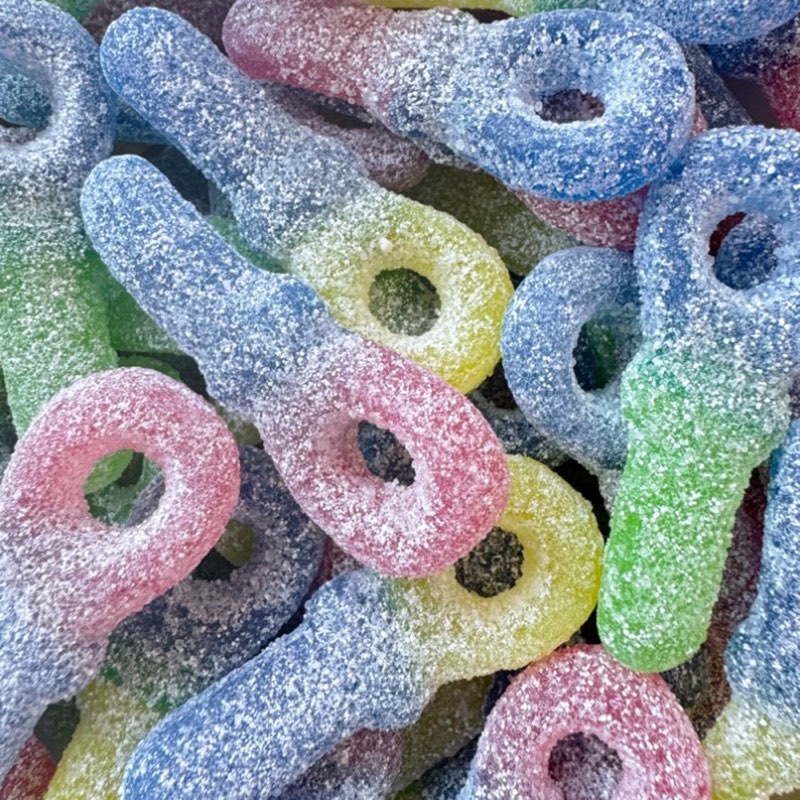
- Properly sour. A sharp opening that fades into sweetness. Dulce Plus Sour Strawberry Rings at £5.49 are a good example: recognisably a strawberry sweet, but with an edge you have to want.
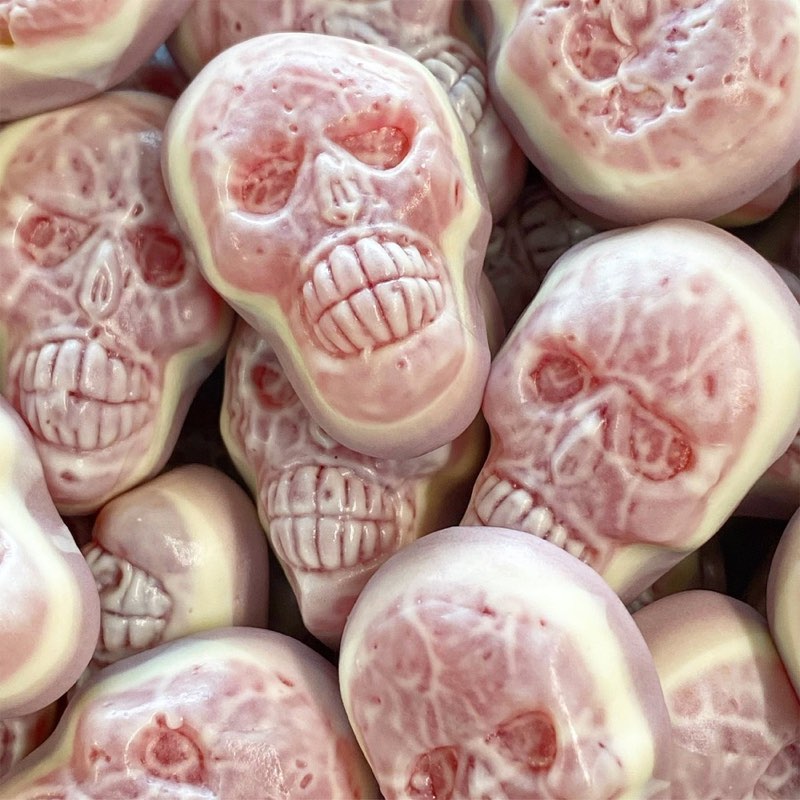
- Extreme. Sourness as the entire point, eaten for the reaction. BUBS Big Sour Skulls at £7.50 are the end of the line, and they are a completely different kind of purchase — a dare rather than a snack.
Why the sweet end is underrated
Sour gets the attention because it produces a reaction, and reactions are what people film and talk about. But the sweet end does most of the actual work in a sweet shop, for three reasons that are easy to miss.
The first is endurance. A sharp sweet is brilliant for three pieces and tiring by ten, because the mouth cannot stay in a heightened state indefinitely — salivation increases, the tongue becomes sensitised, and the fun turns into work. A mild sweet has no such ceiling. You can eat these across an entire afternoon without the experience degrading, which is precisely why the mild items on a party table need replacing and the sour ones often do not.
The second is range. Sour narrows your audience sharply. Roughly speaking, a sour sweet is loved by a minority, tolerated by a majority and actively disliked by a meaningful number of people, and the disliking group skews towards both the youngest and the oldest guests. A mild fruit sweet is liked by nearly everybody and disliked by almost no one. If you have one item to put out and a room of mixed ages, mild wins on arithmetic alone.
The third is that mild sweets are what make sharp sweets work. A sour piece is only sharp relative to what came before it. Put sour sweets in a bowl on their own and by the fifth piece the effect has flattened, because the palate has adapted. Put them in a bowl that is two-thirds mild and every sharp piece lands as a surprise. The mild component is not filler — it is the thing that keeps the sharp component doing its job.
Building outward from the sweet end
If these are your anchor, you have two directions to move in, and they produce different bowls.
Moving one step up the line gives you a bowl that stays comfortable. Add something with a lift rather than a sting: Barratt Jelly Love Hearts at £5.49 sit close enough that nobody will flinch, and they bring a shape and a bit of nostalgia that a small plain piece does not. That is the bowl for a christening, a baby shower, a grandparent's birthday, or any table where the guests have not opted into anything.
Moving two or three steps up gives you a bowl with a proper spread. Keep these as the base — say two-thirds — and add one sharp item as the top note. sour strawberry rings at £5.49 are the natural partner here because the strawberry direction echoes one of the flavours in this bag, so the sharp piece reads as a variation rather than an intrusion. That is a considerably more elegant way to introduce sourness than dropping in something unrelated.
What not to do is jump straight from one end of the line to the other with nothing in between. A bowl that is half mild mochis and half extreme sour skulls is not a spread, it is two products sharing a dish, and guests will simply pick out whichever end they are on. If you want the extreme item on the table, give it its own bowl and let it be the event it wants to be.
Where sweetness and texture interact
One more thing about the spectrum that is worth knowing: softness pushes a sweet further towards the mild end than its flavour alone would put it. A soft piece releases flavour gradually and spreads it across the whole mouth, so nothing concentrates. A hard or chewy piece of identical flavour will read as more intense, because the flavour arrives at one point and builds. These are soft, small and quick, which stacks on top of an already-mild flavour profile and puts them about as far towards the gentle end as anything we sell.
The practical consequence is that if somebody has told you they find sweets "too much", this is the sort of thing to hand them. Not a smaller quantity of something strong — a mild thing in a small format. It is a different solution to the same problem and it works far better.
What one of these is like to eat
They are small. That is the first and most important fact about them, and it is in the name. These are properly bite-sized pieces — one to a mouth with room to spare, the sort of size where a handful is genuinely a handful rather than four items. Tip some into a palm and they sit in a loose heap without rolling away, and the whole lot has very little weight to it.
The surface is matt rather than glossy, and it is not tacky. That is a real practical advantage over a bare gummy, which will cling to its neighbours and to your fingers in any warm room. You can put these in a bowl on a summer table and take a few without needing to prise anything apart or wipe your hand afterwards, which is why they work as a table sweet in a way that many soft sweets do not.
The bite has no resistance to speak of. There is no snap, no crack, no moment where you have to commit. The piece gives immediately and completely under very little pressure, and then it is a soft mass in the mouth rather than something you are working on. Where a chew asks for fifteen or twenty seconds of jaw, this is done in three or four. That changes the pace entirely: you are not eating one sweet slowly, you are eating several quickly, and the bag goes down in a different rhythm from anything firmer.
There is a two-stage quality to the give. The outside yields first and the middle behaves slightly differently — softer again, and it lets go of its flavour a moment later. It is a subtle thing and you will not notice it if you are eating three at a time, but eat one on its own and pay attention and you will feel the sequence. That small internal contrast is the whole reason the mochi format exists as a sweet, and it is what stops a soft piece being a one-note mouthful.
Flavour arrives almost immediately — there is no waiting for a coating to dissolve — and it lands broad rather than sharp. It spreads across the tongue rather than concentrating at the tip or the sides, sits at a comfortable level for the couple of seconds it takes to eat, and then goes. The finish is clean and fast, with nothing left on the palate after ten or fifteen seconds. That is why you can follow one with another and still taste it properly, and it is also the reason a 90g bag does not last long if you have it open in front of you.
Eaten one at a time the flavours stay readable and distinct. Eaten by the handful they blur into a general fruit impression, which is not unpleasant but is a waste of the fact that there are three directions in the bag. If you have bought these to try rather than to graze on, do the first few singly.
Mango, strawberry, and the broad fruit note
The bag runs across three flavour directions, and they are genuinely different enough that it is worth knowing what each one does.
Mango is the most interesting of the three and the one least often found on a British sweet shelf. As a flavour family, mango is rounder and heavier than most fruit notes. It is not sharp in any register — it has almost no acid character to it — and it arrives slightly slowly, sits warm rather than bright, and lingers marginally longer than the others. People who find fruit sweets samey usually respond to mango precisely because it does not behave like the standard fruit set. It is also a flavour that reads as slightly grown-up, which makes these less obviously a children's item than the format suggests. If mango is what brought you here, the five mango lines we stock is a short but worthwhile shelf, and Crazy Jo Peelablezz Jumbo Mango Gummy 136g at £2.99 is the same flavour direction in a completely different and much larger format.
Strawberry is the opposite in every way: the most familiar flavour in British confectionery, immediately recognisable, and the one that sets everybody's expectations. It reads bright and slightly floral, it arrives fast, and it is the direction most people will identify without looking. In a soft mild piece, strawberry is at its most comfortable — it has nowhere to be sharp and nothing to compete with, so it comes across as a ripe, generous, rounded version of itself. It is also the flavour that makes these instantly legible as a fruit sweet to anybody trying them for the first time. The strawberry shelf runs to 78 lines if you want to go deeper, and it spans the whole spectrum from these to the sharp end.
Fruit as a general note is the connecting tissue. Not every piece in a mixed bag announces a specific fruit — some read simply as fruit-sweet, bright and unspecific, and that is a legitimate flavour in its own right rather than a failure to be something. General fruit pieces are the ones that make a bag feel like a mix rather than a pair, and they are also the ones that go with everything if you are eating several at once. The fruit-flavour shelf is our largest flavour category at 161 lines, which tells you how much of a sweet shop is really built on this one idea.
Across all three, the thing that holds them together is mildness. None of them has an edge. If you are used to fruit sweets that announce themselves loudly, the first impression here may be that they are quiet. Give it three pieces. What reads as quiet on piece one reads as pleasant on piece three and as extremely easy to keep eating by piece ten, which is the entire design.
A party planner's view: how many, when to put them out, and what goes first
If you are catering rather than snacking, the questions change completely. Nobody planning a table cares how a sweet eats in isolation. They care how much to buy, when to put it out, and what will be empty at eight o'clock. Here is how we would think about it.
Quantities
Start from the weight. This bag is 90g at £1.35. A generous adult handful from a bowl is somewhere around 25 to 30 grams, which makes a bag roughly three adult handfuls or four or five children's. That is the number to build everything else on.
For a mixed table — where sweets are one of several things on offer and there is savoury food as well — plan on 40 to 60g of sweets per guest in total, across all varieties. For a sweets-led event, a children's party with a pick-and-mix table or a wedding sweet cart, plan on 80 to 120g per guest. Those are the working figures, and they are deliberately generous, because the failure mode of running out is far worse than the failure mode of having some left.
| Event | Guests | Total sweets | Bags of these as the mild base | Spend on this line |
|---|---|---|---|---|
| Small gathering, sweets on the side | 8 | ~400g | 2 | £2.70 |
| Children's party, one bowl among several | 12 | ~1.2kg | 4 | £5.40 |
| Children's party, sweets are the point | 12 | ~1.4kg | 6 | £8.10 |
| Teenage gathering | 15 | ~1.5kg | 5 | £6.75 |
| Office or team table | 25 | ~1.2kg | 5 | £6.75 |
| Family film night | 4 | ~300g | 2 | £2.70 |
Read the table as a starting point rather than a rule. The column that matters is the last two: these are cheap enough that doubling the mild base costs you a couple of pounds, and the mild base is the component you are least likely to regret over-buying, because it does not go stale quickly and nobody objects to it the following week.
Timing: when things go out
This is the part most people get wrong. Sweets should not all go out at the start. A table that is full at the beginning and picked over an hour later looks worse than a table that is replenished twice, even if the total quantity is identical.
The sequence that works: put out the mild base and one middling item at the start, hold the sharp and the novelty items back, and bring them out at the point where attention starts to drift — usually about two-thirds of the way through. That gives you a second event without a second expense. If the sharp items go out at the start, they will be gone in twenty minutes, and the mild base will carry the rest of the party on its own anyway.
For a children's party specifically, put sweets out after food rather than before. Put them out before and food becomes an argument. The mild items are also the ones to have available for the whole session, because they are the ones a parent is least likely to object to.
What runs out first
In rough order, from a table with a mixture on it:
- Anything novel. Unusual formats disappear first, whether or not people like them, because everybody takes one to look at. Vidal Gummi Ice Pops at £5.49 are the sort of item that clears on shape alone.
- Anything sour, at a teenage party. Eaten for the reaction and taken two at a time.
- Anything small and easy. Which is this bag. Small mild pieces get taken in handfuls rather than singly, so they leave the bowl faster by weight than anything requiring a decision.
- The recognisable brands. People reach for what they know, particularly adults, who browse less at a sweet table than children do.
- The big statement items. Large or expensive pieces go slowly, because taking one feels like a claim. They are there to make the table look generous, not to be eaten.
- Anything with a divisive flavour. Liquorice, aniseed and very strong mint will still be there at the end, every time.
The planning consequence of that order is simple: buy the most of the things at positions two and three, and the least of the things at position five. Because these sit at position three, they are one of the two or three lines you should be buying multiples of rather than singles.
Presentation
Small pieces want shallow bowls, not deep ones. In a deep bowl, everything below the top inch is invisible and untouched, and you will find half the bag still there at the end while people complained the bowl was empty. Spread them wide and shallow and refill twice; that is the single biggest improvement you can make to any sweet table.
Keep the mild items in their own bowls rather than pre-mixing. Guests mix for themselves on the plate, and separate bowls let people avoid what they do not want without picking through. It also means you can top up the popular bowls without redistributing the whole table. If you would rather buy a proper mixed selection than assemble one, our Pick & Mix is built for exactly that.
Take-home bags
If you are sending guests home with something, a small mild sweet is the right choice for the same reason it is the right choice for the table: no parent objects, and no child refuses. You can fill ten small bags from three of these with room for one or two other items in each, which comes to around £4 of content across ten bags. That compares extremely well with buying ten individual items.
Who these suit
The obvious buyer is somebody catering for a mixed group, for all the reasons above. But there are three other shoppers these fit particularly well.
The first is the person buying for a small child. Small, soft, mild, not messy, and cheap enough that a bag is a reasonable everyday treat rather than an event. The one caution is the same as for any sweet: these are a treat rather than a food, and whole soft pieces are a choking risk for young children, so they should be eaten sitting down and supervised.
The second is the person who does not really like sweets but wants something. Mildness and small size are the two things that make confectionery approachable to somebody who finds most of it overwhelming, and this bag has both. It is a far better recommendation for that shopper than a small quantity of something strong.
The third is the curious shopper — somebody who wants to try a format they have not had before without committing. At £1.35 this is close to the cheapest way into an unfamiliar style of sweet that we sell, which is the entire argument for buying it speculatively. If you like it, Fini Mini Mochis Berries Bag is the immediate next purchase at the same price in a different flavour direction.
Putting them in a mixed bag
As a component in a pick-and-mix bag, these do a specific job: they are the small, soft, neutral pieces that fill the space between the statement items. Every good mixed bag needs some. Without them a bag is a collection of individually interesting things that fight each other; with them it has a floor.
The textures to put alongside them are firmer ones. Jelly Belly 20 Assorted Flavour Mix Jelly Beans Bag 70g at £2.40 gives you a shell that breaks and a centre that chews, which is about as far from a soft piece as you can get while staying in fruit territory, and the twenty-flavour spread means it brings variety as well as contrast. The filled whales bring a larger piece with its own internal contrast, so the bag has something to slow it down.
For a bag that leans nostalgic rather than modern, swap the modern formats for traditional ones: the Taveners jellies and the Barratt love hearts are both in that register, and the Retro shelf has the rest of it. That is a bag that reads as a gift for an older relative rather than a haul for a child, and the mild mochis fit into it perfectly well despite being the newest thing in it.
Avoid putting these directly against anything genuinely extreme. A mild piece eaten immediately after the £7.50 bag of sour skulls will taste of very little, because the palate has been overwhelmed. Both can be on the table; they should not be in the same handful.
Occasions
Children's parties. The default. Cheap, mild, small, and easy to portion into bags. Buy three or four rather than one.
Baby showers and christenings. The register here is soft and inoffensive, and this is exactly that. Pair with a 480g bag of Friendship Rings, which brings a shape that suits the occasion and enough volume to fill a table.
Film nights. Quiet to eat, no wrappers, nothing on the fingers to transfer to a remote control or a sofa. A bag between two is a small treat rather than a binge.
Lunchboxes. A 90g bag divides neatly across a week if you decant into something smaller, and at £1.35 it is one of the cheaper ways to put something nice in a box.
Summer tables. The non-tacky surface is the reason to reach for these in July rather than a bare gummy. They survive an outdoor table far better than most soft sweets, and mango reads as a summer flavour in a way that very little else on the shelf does.
Stocking fillers and small gifts. At this price a bag is a filler rather than a gift, but three bags with something else makes a small present. Add Fuji Candy DIY Handmade Ferris Wheel Kit Box 20g at £2.99 if you want the gift to have an activity in it as well as something to eat.
£1.35 for 90g
That is 1.5p a gram, which is at the cheap end of everything we sell, and it is the part of this product that makes the rest of it possible. At this price the bag is not a considered purchase — it is something you add to an order because it is cheaper than thinking about whether to.
Look at it per occasion and it holds up just as well. Three adult handfuls means three sittings for one person, or one shared bowl between two or three people, for less than a pound fifty. Two bags at £2.70 covers a family film night. Five bags at £6.75 is the mild base of a table for fifteen. There is very little on the site that does more per pound, and the reason is the combination of a low price with a small piece size — small pieces make a given weight look and feel like more, because what people count is pieces rather than grams.
Where the value argument stops is at volume. If you are buying kilos rather than hundreds of grams, bagged lines at this size are not the efficient way to do it, and our Loose Sweets counter at 356 lines will give you a better rate and more control over the mix. The bagged format is for convenience and for small quantities; the counter is for catering.
Keeping them right
Soft sweets want cool, dry and dark, and they are more sensitive to warmth than firmer sweets are. A bag left in sun or on a warm surface will soften further and the pieces will start to settle into each other. Store in a cupboard, not on a windowsill, and not in a car.
Do not refrigerate them. Cold firms up a soft sweet and mutes a mild flavour, which takes away both of the things that make this bag worth buying. If a bag has come in from somewhere cold, leave it at room temperature for half an hour before you open it.
Once opened, close the bag properly — fold it twice and clip it, or decant into a small airtight tub. The matt surface means these do not weld together the way a bare gummy will, but air will still dry the outside over a week or two and a dried soft sweet loses the quick, immediate give that is the point of it.
Keep them away from steam. An open bag next to a kettle will pick up moisture faster than anywhere else in the house, and damp is the one thing that will make these tacky.
Check the date on the bag when it arrives and follow whatever the manufacturer's packaging says about storage. If anyone eating them has allergies, read the manufacturer's packaging on arrival before eating — the bag in your hand is the authority on that, not this page.
One size, and the sister bag
We list this in one size at £1.35 and that is the entire range for this particular bag, so quantity is your only decision. The related choice is flavour direction, and there the range gives you one clear alternative: the berries version at the same £1.35, in the same format and the same size.
How to choose between them. This bag spans three directions including mango, which is the unusual one and the reason to pick it if you want variety or something outside the standard fruit set. The berries bag runs in a single family, which is the better buy if you already know that berry flavours are what a particular person reaches for. At £1.35 each the sensible answer for a first order is both — £2.70 to find out, which is less than most single bars cost, and you will know for certain which one to reorder.
For a party table, buying both is worth doing anyway, because two similar-looking bowls in different flavour directions give guests a choice without adding a second format to manage.
Where these sit on the site
You will find these on the loose sweets shelves, our largest section by some distance, and on the Jelly & Gummy shelf alongside the other 95 soft lines we carry. By flavour they are listed under our fruit flavour listing, every strawberry line we carry and the mango shelf — that last one being short enough to read in a minute, which makes it a good place to start if mango is the thing you came for.
If you are browsing more widely, the full shop has everything in one place, everything filed as jelly and gummy narrows it to the soft end, the Candy & Chocolate shelf covers the boxed and bagged branded lines, and retro sweets is where the traditional British jars and counter lines live. Browse the whole catalogue if you would rather wander than search.
Questions we get asked about these
Are they sour at all?
No. These sit at the mild end of the spectrum with no sharp opening and no tingle. If you want sourness in the same fruit territory, the sour strawberry rings are the nearest step up, and the big sour skulls are the far end of the line. Buy those if sour is what you are after; buy these if you want something everybody at a table will eat.
What flavours are in the bag?
We list three directions for this line: fruit, mango and strawberry. Mango is the unusual one and the reason a lot of people try these; strawberry is the familiar anchor; the general fruit pieces connect the two. We do not list a breakdown of how many of each are in a bag, so we will not guess at one.
How many pieces are in 90g?
We do not have a verified piece count and we would rather not invent one. What we can tell you is that 90g works out at roughly three generous adult handfuls or four to five children's, which is the more useful number for planning. For a party, work from the weight rather than the count.
Are they very sweet?
They are sweet, because they are sweets, but they are mild rather than intense — the flavour is broad and comfortable rather than concentrated, and the soft texture spreads it across the mouth instead of concentrating it. People who find confectionery overwhelming generally get on with these better than with harder or sharper things.
Will they stick together in the bag?
Much less than a bare gummy will, because the surface is matt rather than tacky. In genuine heat they can settle into each other, but they separate easily and it does not affect how they eat. Keep the bag out of sun and away from radiators and you will not see it at all.
Are these suitable for a children's party?
They are one of the better choices for one — mild, small, cheap, easy to divide into take-home bags and unobjectionable to parents. The standard caution applies: sweets are a treat rather than a food, and whole soft pieces are a choking risk for young children, so they should be eaten sitting down with an adult present.
How many bags for twelve people?
If sweets are one thing among several, four bags of these as the mild base plus two or three other lines. If the sweets are the main event, six. The mild base is the part you should over-buy rather than under-buy, because it is the component that carries the whole session and it is the cheapest thing on the table.
What is the difference between this and the berries bag?
Same brand, same format, same £1.35, same size. This one runs across three directions including mango; the berries bag stays within one family. Buy this for variety and for the mango; buy that one if you know somebody has a berry preference. Buying both costs £2.70 and settles the question properly.
Do they go with chocolate?
On the same table, yes, though they are not an obvious partner. Chocolate leaves a coating and a mild fruit sweet eaten through it will barely register. If you are serving both, keep them in separate bowls and expect people to treat them as two different parts of the evening rather than one mixed handful.
Can I freeze them?
We would not. Freezing changes the texture of soft sweets and the change is not reversible — you will not get back the quick, immediate give that makes them worth eating. A cool dry cupboard is all they need, and they do not want a fridge either.
Is there a bigger bag?
Not in this line — one size at £1.35 is the whole range. If you need volume, buying several bags is the straightforward answer, but for anything above about a kilo the loose sweets counter will give you a better rate and let you build the mix yourself.
To sum up
A small, soft, mild fruit sweet at £1.35 for 90g, sitting deliberately at the gentle end of the shelf. On its own it is an easy everyday bag, and the mango direction gives it something most fruit sweets on a British shelf do not have. On a table it is more useful than that: it is the base layer that lets everything sharper around it work properly, and at this price it is the one component you can afford to over-buy. Get two if you are sharing, four if you are catering, and put something firmer next to it.
More jelly & gummy sweets
More fruit sweets

More loose sweets sweets
Where this sits
Fini Mini Mochis Bag appears on these shelves. Browse them, or jump to something nearby.
You might also like