Home / Loose Sweets / Swizzels Sweet Shop Advent Calendar 220g
Swizzels · 220g
Read the full guide
Swizzels Sweet Shop Advent Calendar 220g
£8.99
✔ In stock — ready to ship
Fresh stock
Free over £20
Same-day dispatch
Secure checkout
Start with the sound. An advent calendar is one of the few things you buy that makes a noise before it does anything else — the small dry tearing of a perforated door coming away from the card, a sound somewhere between a page turning and a crisp packet being opened very slowly. On the Swizzels Sweet Shop Advent Calendar that noise is the whole opening ceremony. There is no ribbon, no cellophane theatre, no unboxing. There is a piece of printed board, a numbered door, and a fingernail. That is the entire mechanism, and it has survived a century of competition from more elaborate formats because it works.
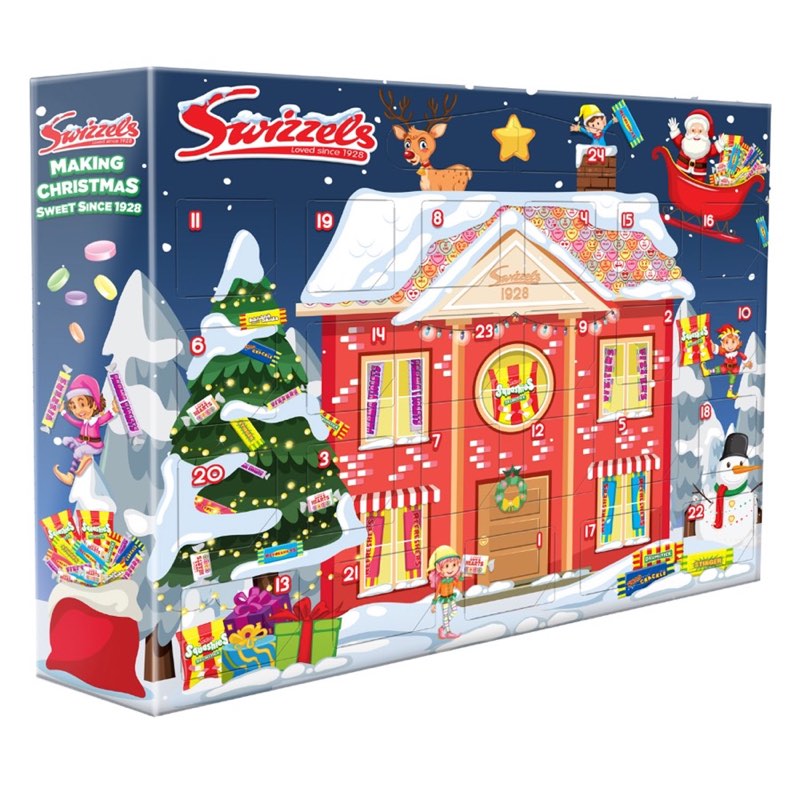
Pick the box up before you open anything and you will notice it is lighter than it looks. That is the nature of the format: 220 g of sweets distributed across a wide, flat board with air behind every door. It sits in two hands like a slim hardback. The face of it is the selling surface — a printed shopfront, the sort of illustrated sweet-shop scene the format has always leaned on — and the back is plain. There is a slight give to the card if you press the middle, because there is nothing structural behind the doors except the tray that holds the contents in place. Handle it like a box of eggs rather than a book and it will reach the 1st of December in the state it left us.
The full guide to Swizzels Sweet Shop Advent Calendar 220g
6,549 words on how it eats, who it suits, how to serve it and what to put beside it.
What the first door actually feels like
The first door is always the hardest to open cleanly, and this is not a fault of the calendar — it is a fault of enthusiasm. The perforations want a slow, even pull from one corner, with a thumbnail rather than a whole finger. Go fast and you take a triangle of the printed front away with the door and leave a pale scar on the shopfront. Go slow and the door hinges open and stays open, which is half the pleasure of the object: by the middle of the month the front of the calendar is a wall of little open flaps, and you can see at a glance how much December you have used up.
Behind each door is a recess, and in the recess is a sweet. The reveal is quick — a flash of wrapper colour against the white of the tray — and then the sweet is in your hand and the calendar's job for that day is done. What comes next depends entirely on what that particular door held, and the honest position is that we do not publish a door-by-door manifest, because the assortment is set by the manufacturer and printed on the pack. If you want to know exactly what is in yours, the box itself will tell you the moment it arrives. What we can tell you is what the experience is like, which is what most people are actually asking.
The eating is fast. Sweet-shop calendar portions are small by design — a single sweet, not a handful — and that is the point of the format rather than a shortcoming of it. You get roughly a mouthful a day. It arrives, it is over in under a minute, and the pleasure is as much in the ritual and the countdown as in the sugar. People who come to this format expecting a substantial daily snack are usually disappointed; people who come to it expecting a small, reliable, faintly silly bit of punctuation at the start of a December morning are almost never disappointed at all.
The flavour arrival, in general terms, is the sweet-shop kind: immediate, bright, unsubtle, and gone within a couple of minutes of the sweet finishing. That is not a criticism. The whole category is built on flavours that announce themselves in the first second because a small sweet does not have the time or the mass to build slowly. There is no long finish to hunt for and no development to wait on. The sweet arrives at full volume and leaves quietly, which is exactly what you want at half past seven in the morning on a school day.
The object itself, and why the format persists
An advent calendar is a counting device that happens to contain sugar. That order matters. The thing people are buying is the countdown — a physical, tearable, visible record of how close Christmas is — and the sweets are the reward that makes the countdown worth performing. This is why a calendar that costs £8.99 for 220 g is not competing on price-per-gram with a bag of loose sweets, and why comparing it that way misses what is being sold. You are buying twenty-odd mornings of small anticipation, packaged in a way a child can operate without help.
The design decisions in a calendar of this kind are all in service of that. The doors are numbered but scattered rather than laid out in rows, so there is a small hunt each morning. The recesses are shallow so the sweet comes out with one finger. The board is wide so the box has presence on a windowsill or a mantelpiece, because a calendar that gets put in a cupboard stops working as a countdown. None of that is accidental, and none of it is expensive engineering — it is a format that has been refined by decades of repetition until there is nothing left to remove.
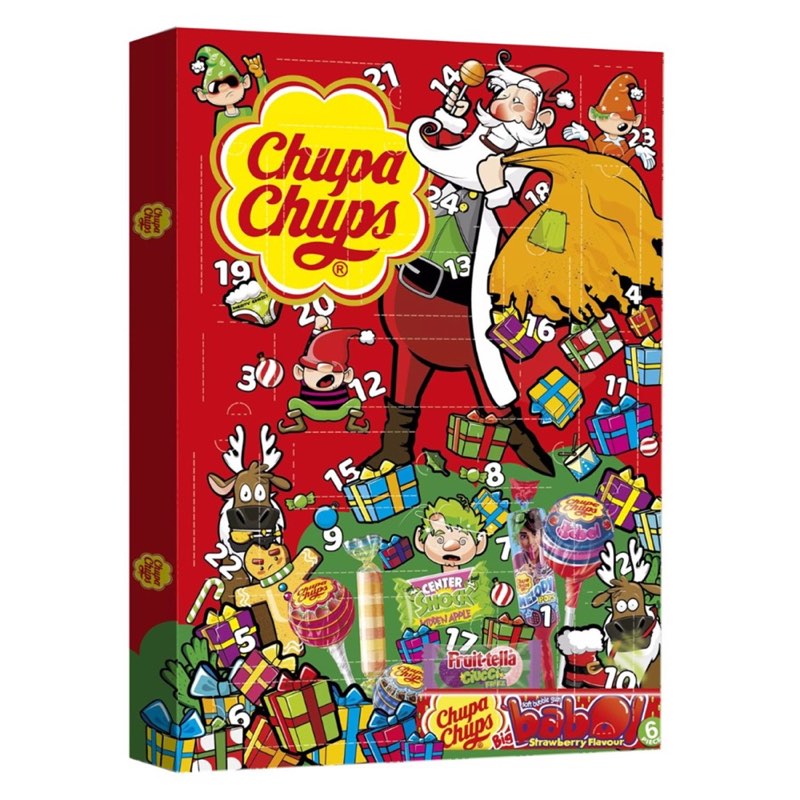
The Swizzels name on the front tells you which end of the sweet-shop world you are in: the bright, retro, printed-wrapper end rather than the chocolate end. If you want the chocolate-behind-the-door experience instead, that is a different purchase entirely and you should look at what we carry in the candy and chocolate aisle, where the seasonal chocolate lines live. If you want a sweet-shop calendar but from a different house, the closest thing we stock is the Chupa Chups Advent Calendar 210g, which is the same £8.99 for 10 g less and takes the lollipop route rather than the mixed-sweet route.
One practical note about the object: it is a seasonal line, and seasonal lines have a hard deadline built into them. A calendar bought on the 3rd of December has already lost two doors, and there is no way to get them back except by opening two at once, which every household solves differently and nobody solves happily. If you are buying this as a gift, buy it in November. If you are buying it for yourself, the same advice applies with less social pressure attached.
Who this suits, and who should buy something else
This is a calendar for a household that wants the countdown without the fuss. It suits children old enough to open a door without tearing the front off, which in practice means roughly five upwards, and it suits them enormously — a numbered door is a concept a small child grasps instantly and enforces ruthlessly. It suits adults who want a bit of December structure on a desk at work. It suits a classroom or an office kitchen where one calendar is opened communally each morning, although at one sweet a door you will want more than one box if the room has more than a handful of people in it.
It suits people who like sweet-shop sweets specifically. That sounds obvious, but it is the single biggest source of disappointment in this category: a household that expects chocolate opens a sweet-shop calendar and feels short-changed, when what has actually happened is that they bought the wrong format. If the people you are buying for think of "advent calendar" and picture a small moulded chocolate, buy them chocolate. If they think of a paper bag from a counter, this is their format.
It does not suit very young children unsupervised. Sweets are a treat, and small hard sweets and whole gummies are a choking risk for young children — a calendar makes this slightly trickier than a bag does, because the whole appeal is that the child operates it themselves. The sensible arrangement in a house with a toddler is that the child opens the door and an adult hands over the sweet, which preserves the ritual and removes the risk. Anyone in the house with an allergy should check the manufacturer's packaging on arrival, before the first door is opened, rather than on the morning of the 1st when everyone is in a hurry.
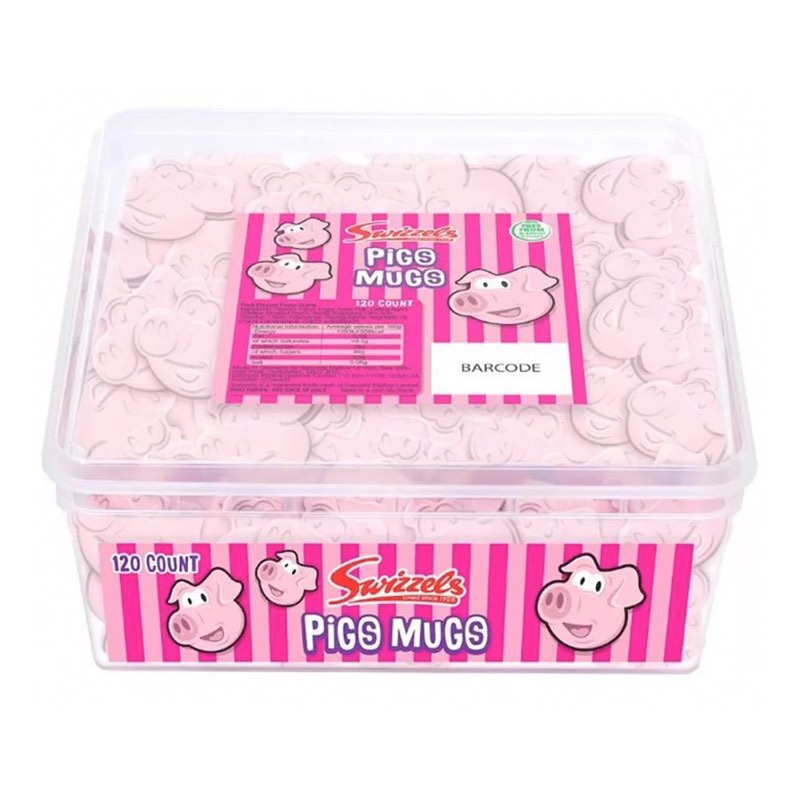
It also does not suit somebody who wants volume. If what you actually want is a big quantity of Swizzels sweets to have in the house over Christmas, a calendar is a poor way to buy it and a tub is a good one. Swizzels Pigs Mugs Tub 576g is the same £8.99 as this calendar for well over double the weight, and Teeth N Toothbrush Tub 576g is priced identically again. Buying one calendar for the ritual and one tub for the bowl is a very common and very sensible December order.
The arithmetic: what £8.99 buys, door by door and gram by gram
Let us do this properly, because value is the question that sits underneath every advent calendar purchase and most product pages dodge it.
The headline numbers are £8.99 for 220 g. That is £4.09 per 100 g, which is a high unit price for sweets and there is no point pretending otherwise. For context, using prices from our own shelves: the Giant Milk Bottles tub is £9.99, Squashies Love Hearts in mixed fruit are £1.25 for 120 g, which is about £1.04 per 100 g, and Sour Shooting Stars Squashies are £1.29 for 100 g. On pure sugar-per-pound, the loose and bagged lines win every time.
But the per-gram number is the wrong measurement for this product, and here is the better one: cost per morning. Divide £8.99 by the number of doors and you get the true unit of consumption, because that is how the calendar is actually used — one door, one morning, one small event. The exact door count is printed on the box; rather than guess it for you, here is the arithmetic laid out so you can read off whichever line matches the calendar in front of you.
| Doors on the calendar | Cost per door | Sweets per door | Approximate grams per door |
|---|---|---|---|
| 20 | 45p | One | 11 g |
| 24 | 37p | One | 9 g |
| 25 | 36p | One | 9 g |
Somewhere between 36p and 45p a morning, then, depending on how the box is laid out. That is the number worth holding on to, because it is the number that makes the purchase make sense. Thirty-odd pence for a small, dependable moment of pleasure at the start of the day is not an extravagance by any reasonable standard — it is less than a supermarket chocolate bar spread over a month, and it comes with a ritual attached that the chocolate bar does not.
The per-door weight is the other useful figure. Nine to eleven grams is a single sweet-shop sweet: one chew, one small bagged item, one pressed tablet. It is not a handful and it will not be one. Knowing that in advance is the difference between a calendar that delights a household and one that produces a daily grumble about how small the sweets are. Set the expectation on the 30th of November and nobody grumbles.
Now scale it. If you are buying for more than one person, the temptation is to share a single calendar, and it does not work — one sweet split three ways is a third of a sweet and a small argument. Two calendars at £17.98 is the honest cost of a two-child December; three is £26.97. At that point it is worth asking whether a single calendar plus a communal bowl does the same job for less. A calendar at £8.99 for the ritual, plus Barratt Jelly Babies at £5.49 or Barratt Black Jack Chews at the same £5.49 for the bowl, comes to £14.48 and feeds considerably more people considerably more sweets — with the countdown still intact for whoever is doing the opening.
There is a third way to think about the maths, which is replacement cost. A calendar is a thing you buy once a year and it is gone by Christmas Day. A tub is a thing you buy once and it sits in a cupboard being drawn down for a month or more. At £8.99 for 576 g, that 576 g Pigs Mugs tub works out at £1.56 per 100 g, which is well under half the calendar's unit price, and a tub of that size will outlast the calendar by weeks. Neither is better value in the abstract. They are answers to different questions — one is buying a month of anticipation, the other is buying a month of supply — and the households that are happiest in December usually buy both.
One last figure for anyone catering rather than snacking. If you want to give a sweet to each of thirty people at a December event, this calendar is the wrong tool: you would need more than one box and you would be tearing doors off to get at the contents, which is both wasteful and faintly sad. Thirty single sweets is comfortably inside a single 576 g tub with plenty left over. Use the calendar for the person, and the tub for the crowd.
How chew, snap and fizz are built — and why a calendar needs all three
The second thing worth understanding about a mixed sweet-shop calendar is that its real engineering is textural rather than aromatic. Flavour in this category is comparatively easy; texture is the hard part, and it is what makes one day's door feel different from the next even when the flavours are cousins.
Consider the four basic textures a sweet shop works in. A hard boiled sweet is sugar cooked to a very high temperature and cooled fast enough that it never gets the chance to crystallise — the result is a glass, technically speaking, and it behaves like one. It is transparent, it shatters rather than deforms, and it dissolves slowly from the outside in. That slow dissolve is why a hard sweet is the longest-lasting thing you can put behind a door: nine grams of boiled sugar can occupy ten minutes.
A chew is the opposite. It is cooked less far, worked while warm, and often pulled or aerated so that it holds a soft, plastic structure at room temperature. The eating experience is resistance followed by surrender: you bite, it pushes back, and then it gives all at once and coats the teeth. Chews deliver flavour faster than boiled sweets because chewing constantly exposes new surface, and they finish faster for the same reason. A chew is a two-minute sweet where a boiled sweet is a ten-minute one.
A gum or jelly sits between the two. Its texture comes from a setting agent rather than from the sugar itself, which is why it can be soft and bouncy at the same time — the sugar is carried in a network rather than being the structure. The eating character is bounce: the first bite compresses, the second cuts through, and the whole thing releases flavour steadily rather than in a rush. Squashies-style sweets take this further by aerating the jelly so it compresses further before it cuts, which is where that distinctive soft squeeze comes from.
A pressed tablet — the little round pastille format that the sweet-shop world has built half its identity on — is a fourth thing again. It is not cooked at all in the way the others are. It is powder, compacted under pressure into a disc that holds together until saliva undoes it. Tablets have a chalky snap and a clean, fast dissolve, and they are the only format on this list where the sweet can be broken cleanly in half between two fingers. That snap is a big part of why the format reads as nostalgic: it is a sound most people first heard in childhood and rarely hear anywhere else.
Fizz is the fifth element and it is not a texture so much as a reaction. A fizzy sweet carries an acid and a carbonate held apart by being dry; introduce moisture and they meet and produce gas, which is the prickle you feel on the tongue. The engineering problem is entirely about keeping them dry until the moment of eating, which is why fizzy sweets are the most packaging-dependent thing in a sweet shop and why a fizzy sweet that has been left out overnight is a sad, flat object. A calendar protects fizz rather well, as it happens: each sweet sits sealed in its own recess behind its own door until the morning it is wanted.
Why does any of this matter to a calendar specifically? Because variety of texture is what stops a month-long daily ritual becoming monotonous. Twenty-four consecutive days of the same mouthfeel would be tedious no matter how good that mouthfeel was. A mixed sweet-shop assortment gets its interest from the fact that today's door works completely differently in the mouth from yesterday's — a slow dissolve one morning, a two-minute chew the next, a chalky snap the morning after. The flavours rotate too, but it is the texture rotation that does the heavy lifting on keeping attention across a whole month.
It is also why the small portion size works. A single sweet is enough to register a texture completely. You do not need five chews to know what a chew is doing; one tells you everything, and the second onwards is just repetition. The calendar format, whether by design or by happy accident, gives you exactly the quantity at which a texture is interesting and stops before it becomes routine.
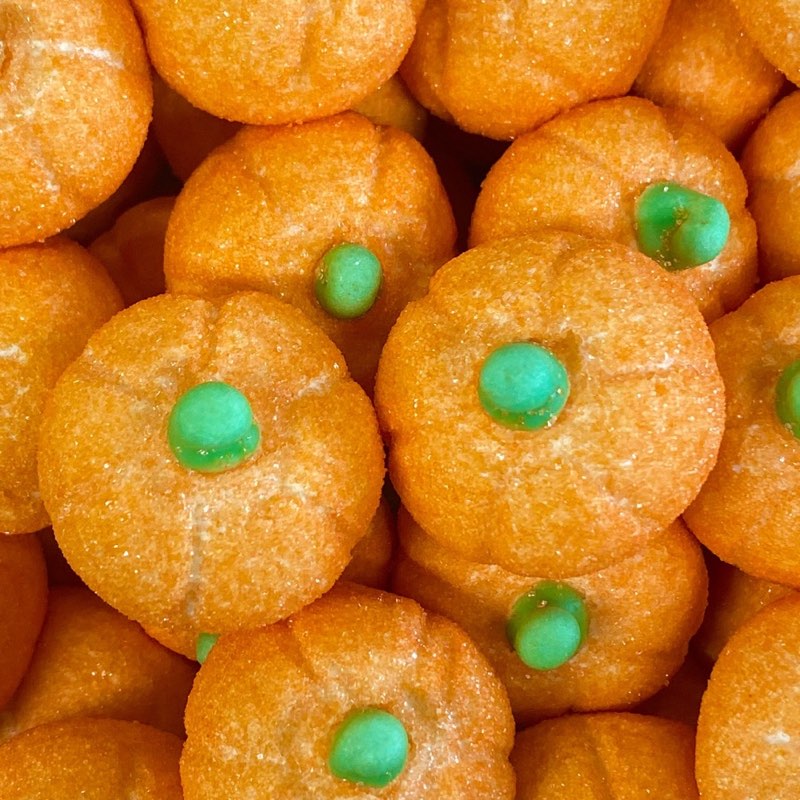
If texture is what you are chasing, there is a whole education available on our shelves. The foam texture — aerated, light, almost meringue-like, a completely different family again — is best met in BUBS Banana & Caramel Foam Sweets at £7.50. The crystalline-fudge end of the spectrum, where sugar is deliberately encouraged to crystallise into a fine grain rather than prevented from doing so, is Buchanan's Butter Tablet Carton 150g at £3.49, and it is genuinely worth tasting alongside a hard boiled sweet to feel how differently the same raw material can behave. The marshmallow structure, which is a foam set with a gelling agent rather than a jelly aerated, turns up in Bulgari Pumpkin Mallows at £5.49. And for the acid end, Barnett's Mega Sour Apple Candy Bags at £3.99 will show you what happens when the sour coating is dialled up as far as it goes.
Reading the flavour families in a sweet-shop assortment
We do not list individual flavours for this calendar, because the assortment is the manufacturer's to set and it is printed on the box. What is useful in advance is knowing the families a sweet-shop assortment draws from, so you can recognise what you have got when you open it.
The red fruits family — strawberry, raspberry, cherry — is the backbone of British sweet-shop flavour. It is sweet-forward, low in acid, and it is what most people mean when they say a sweet tastes "like sweets". It is also the most reliably popular family across all ages, which is why it turns up more than any other. You can taste a clean version of the raspberry end in the sour shooting stars format where it is deliberately pushed against acid.
The citrus family — lemon, lime, orange — brings acid and structure. Citrus flavours cut through sweetness, which is why they tend to be the ones adults reach for and children swap away. A citrus sweet feels shorter and cleaner than a red-fruit one even at identical sugar levels, because the acid clears the palate on the way out.
The tropical family — pineapple, mango, the general blue-and-yellow end of the spectrum — is the newest of the traditional families and the most divisive. It is louder and more perfumed than the others, and it either reads as exciting or as artificial depending entirely on the eater. A mixed assortment will usually carry one or two tropical notes as contrast rather than as a mainstay.
The aniseed and liquorice family is the one that splits a room. It is dark, medicinal, faintly savoury, and it has almost no middle ground: people love it or they will not have it in the house. In a family assortment it is the door that gets traded. If your household is on the loving side of that divide, the Black Jack chew format at £5.49 is the concentrated version, and it is worth having a bag alongside the calendar purely so the liquorice-lovers get more than one day of it.
The cream and caramel family is the comfort end — milk, vanilla, toffee, butterscotch. These are the slow, round, low-acid flavours, and they behave completely differently in the mouth from the fruit families: where fruit flavours arrive fast and leave fast, cream flavours build and linger. Bristow's Traditional Salted Caramel Bon Bons at £5.49 are the clearest example of that long, coating finish we stock.
The cola and fizzy drink family is its own thing, borrowing flavour from soft drinks rather than from fruit. It carries a built-in acid tang that makes it read as refreshing, and it pairs unusually well with everything else, which is why it is a pick-and-mix staple.
Knowing the families is genuinely useful with a calendar, because it turns a random daily reveal into something you can talk about at the table. "That's the citrus one" is a better breakfast conversation than "that's a sweet", especially with children, and it costs nothing to teach.
Building a December spread around the calendar
A calendar on its own is a ritual. A calendar plus a bowl is a Christmas. Here is how we would build the second part.
Start with a base — a high-volume, broadly liked, texturally simple sweet that everybody will eat and nobody will fight over. Jelly babies do this job about as well as anything can, which is why a bag of jelly babies at £5.49 is the default recommendation for a December bowl. Soft, mild, recognisable, and there is no one in the average household who will refuse them.
Add a chew for length. Chews slow a bowl down — they take longer to eat than a jelly and they are harder to take three of at once — which matters more than it sounds when a bowl is sitting out all afternoon. This is where Black Jacks or a fruit chew earn their place.
Add one sour for contrast and one for the teenagers. The sour bag is the one that gets picked over by a specific subset of any room and ignored entirely by everyone else, so it does not need to be large. Candy Paradise Juicy Grenade Gummies at £1.39 are cheap enough to throw in as an experiment, and the mega sour apple bags will cover anyone who wants the full acid hit.
Add one chocolate item, because a bowl of pure sugar confectionery starts to feel one-note after an hour and chocolate resets the palate. Cadbury Dairy Milk Christmas Little Robins at £2.49 are the seasonal, small-format way to do that without committing to a whole box.
Add one adult item that the children will leave alone. This is the single most underrated move in building a sweet spread: something dark, bitter, aniseed-forward or intensely caramelised that exists so the adults in the room have somewhere to go. Briquette at £5.49 fills that slot, as do the salted caramel bon bons.
Finally, if you want to build the spread yourself rather than by the bag, our pick and mix range lets you assemble exactly the ratio you want, and our loose sweets shelf carries 356 lines to choose between. The advantage over buying five separate bags is control: you can put in twice as much of the thing your household actually eats and skip the thing that always gets left.
A note on ratios. For a bowl that sits out through an afternoon, roughly half base, a quarter chew, and a quarter split between sour, chocolate and adult is a proportion that empties evenly. Get it wrong in the other direction — too much sour, too little base — and you will find the bowl half-full of the same three sweets on Boxing Day.
Occasions this earns its place at
The obvious one is a household December, one calendar per person, opened at breakfast. This is the format working exactly as intended and there is nothing to improve on it.
As a stocking or secret-santa item it is close to ideal, because it is flat, light, immediately recognisable, requires no wrapping skill, and lands at a price point — £8.99 — that sits comfortably in the range most secret-santa arrangements set. It also has the rare property of being a gift that keeps being used for a month rather than being opened and finished in an evening. Do check the date, though: gifting a calendar at a mid-December office party leaves the recipient with a fortnight of doors to catch up on.
In a hamper it works as the flat item at the bottom that everything else sits on. Hampers are awkward to pack because most confectionery is bagged and shapeless; a rigid rectangular calendar gives you a floor. Build up from it with tubs and cartons — the butter tablet carton is another good rigid shape — and fill the gaps with bags.
In a classroom or nursery it is a fixture, although one calendar for a class of thirty is a logistical problem rather than a treat. The usual solution is that the calendar is opened as a class ritual and the actual sweet goes to whichever child is on the rota, with something separate provided for everyone else.
In an office, a communal calendar on the kitchen counter is a small, cheap, surprisingly effective bit of December morale. It costs less than a round of coffees and it gives people a reason to be in the kitchen at the same time. The unwritten rule is that whoever opens the door does not automatically get the sweet, but every office negotiates that differently.
For a long-distance family member, sent in late November, it is one of the better small gifts in the shop: light enough to post cheaply, flat enough to fit a standard box, and it delivers a daily reminder that somebody thought of them for the whole of December rather than for one morning.
Keeping it in good condition until the 1st
Confectionery has three enemies — heat, moisture and time — and a calendar has a fourth, which is being bought early and then stored badly for a month.
On heat: keep it below room temperature if you can and well away from radiators, which in a British December is harder than it sounds because that is exactly where flat decorative objects end up. Warmth softens chews until they weld to their wrappers and it dulls the snap on anything pressed. A cool cupboard is better than a warm shelf, even though the shelf is where it looks good.
On moisture: keep it dry, and keep it out of the kitchen if your kitchen steams up. Anything fizzy is particularly vulnerable, for the reason described above — the whole fizz mechanism depends on the acid and the carbonate staying apart, and ambient humidity is what brings them together prematurely. A calendar stored above a kettle for three weeks is a calendar with a lot of flat doors in it.
On flat storage: store it lying down or standing upright, never leaning. A leaning calendar puts all the weight of the tray on one edge and you will find the sweets in the bottom row have migrated or been pressed against the card. Flat on top of a wardrobe is the classic hiding place and it is also, by accident, the correct one.
On hiding it from children: this is a real storage consideration and worth planning. A calendar bought in November and left in view will be found, and a found calendar will be opened early. Top of a wardrobe, back of a high cupboard, or inside something else are the three places that work.
Once December starts, the calendar takes care of itself. Each sweet stays sealed in its recess behind an unopened door, which is genuinely good short-term storage, and the doors you have already opened have nothing left behind them to protect. The only thing to watch is an opened door that did not get eaten — if somebody opens the 4th and leaves the sweet sitting in its recess, put it in a tin rather than leaving it exposed.
And once it is finished, the empty calendar is a surprisingly good craft object. Children will happily spend an afternoon turning a flat board with twenty-four hinged flaps into something else, which extracts a little more value out of the £8.99 than the sweets alone did.
Sizes and alternatives: what the options actually are
This calendar comes in one size only — 220 g at £8.99, listed as a single option — so there is no size decision to make. That simplicity is worth stating plainly, because a lot of confectionery pages bury the fact that the line only exists in one format and leave shoppers hunting for a bigger box that was never made.
What you do have is a choice between formats, and it is worth setting out honestly.
| If you want | Buy | Price |
|---|---|---|
| A sweet-shop countdown with mixed sweets | This calendar, 220 g | £8.99 |
| A countdown built around lollipops instead | Chupa Chups Advent Calendar, 210 g | £8.99 |
| Volume of Swizzels sweets for a bowl | Pigs Mugs Tub, 576 g | £8.99 |
| A second tub in a different shape | Teeth N Toothbrush Tub, 576 g | £8.99 |
| The largest Swizzels tub we list | Giant Milk Bottles Tub | £9.99 |
| A small, cheap Swizzels line to try | Squashies Love Hearts, 120 g | £1.25 |
The pattern in that table is worth noticing: £8.99 is clearly a shelf price point for this brand, and at that single price you can buy a calendar, a lollipop calendar, or either of two 576 g tubs. That is a real decision rather than a false one, and the answer depends entirely on whether you are buying an experience or a supply. For ten pence more, a £9.99 tub of giant milk bottles is the largest single item at this end of the shelf.
If you want to try the brand before committing to a calendar, the £1.25 and £1.29 bags are the cheap route in. Buy one of each, see which direction your household leans — soft and mild, or sour and sharp — and let that decide what else goes in the December order.
Finding your way around the rest of the shop
This calendar sits on two shelves. The first is the Swizzels shelf, which carries twelve lines from the brand, and it is the fastest way to see the tubs, bags and Squashies formats side by side at their real prices. The second is weighed-out loose sweets, our largest single category at 356 lines, which is where the by-the-bag and by-the-weight end of the shop lives.
From there, the useful neighbours are these. Building a bag yourself is handled in the pick and mix section, which is the right place to go if you want a specific ratio rather than a pre-made assortment. The chocolate side of the shop is where seasonal chocolate lines and boxed items live, and it is the natural second stop for a December order. If you are shopping by brand, everything we carry from Kingsway and the Haribo shelf are the two other big single-brand shelves worth knowing about — between them they cover most of the gummy and jelly world.
And if you would rather not navigate by category at all, the full sweet shop lists everything in one place, which is often the quickest route when you know the name of what you want but not which shelf we filed it on. It is also the best way to spot the seasonal lines that only appear for part of the year.
Two more paths worth knowing. If you arrived here looking for a gift rather than for sweets specifically, work backwards from price: decide your budget, then browse everything in stock and filter by what fits. If you arrived looking for a particular texture — sour, chewy, fizzy, soft — go to the rest of the Swizzels line-up first, because that brand covers an unusually wide textural range for a single house and you can often find what you want without leaving one shelf.
Questions we get asked about this calendar
How many doors does it have, and what is behind them?
The door count and the assortment are set by the manufacturer and printed on the box, and we do not publish a door-by-door list because we would be guessing at a line that can change between production runs. What we can tell you is the total: 220 g of sweets for £8.99, which works out at somewhere between 36p and 45p a door depending on the layout, and roughly nine to eleven grams — one sweet — behind each one. Everything else is on the pack, which you will have in your hands well before the 1st of December if you order in reasonable time.
Is this chocolate or sweets?
Sweets. This is a sweet-shop calendar from a sweet-shop brand, and it belongs to the printed-wrapper, bright-flavour end of confectionery rather than the moulded-chocolate end. If chocolate is what the recipient is expecting, this will disappoint them through no fault of its own, and you would be better served by something from the chocolate side of the shop. Getting this distinction right before you buy is the single most useful thing on this page.
Can I share one calendar between two children?
You can, but we would not. There is one sweet behind each door, so sharing means either splitting a single small sweet in half or alternating days, and both of those arrangements produce more December arguments than they are worth. Two calendars is £17.98, which is the honest price of a peaceful breakfast. If the budget will not stretch, the better compromise is one calendar for the ritual — with the opening rotated fairly — plus a shared bowl of something cheap and plentiful so nobody feels short-changed.
When should I order it?
November, and ideally the first half of it. A calendar is the one confectionery purchase with a hard deadline attached, and every day it arrives after the 1st of December is a door you have to either skip or double up on. Ordering early also means the box has time to sit somewhere cool and dry rather than being rushed straight from a delivery van onto a warm mantelpiece. It is a seasonal line, so it is also the sort of thing that sells through rather than restocking indefinitely.
How should I store it between buying and December?
Flat or upright, never leaning, somewhere cool and dry and out of sight of anyone likely to open it early. Away from radiators, away from steam, away from direct sun through a window. Top of a wardrobe is the traditional answer and it happens to be the technically correct one too. Do not put it in the fridge — confectionery does not want the humidity — and do not put it in a garage or shed where the temperature swings overnight.
Is it suitable for young children?
Sweets are a treat rather than everyday food, and small hard sweets and whole gummies are a choking risk for young children, who should be supervised while eating them. With a calendar the practical arrangement that works is that the child opens the door — which is the bit they actually care about — and an adult hands the sweet over. That keeps the ritual intact and removes the risk. For older children it is straightforwardly self-service.
Someone in the house has an allergy. What do I do?
Check the manufacturer's packaging on arrival, before anybody opens the first door. The box carries the manufacturer's own information and that is the source to work from — we do not hold verified ingredient data for this line and will not guess at it. Doing that check in late November rather than on the morning of the 1st is worth the five minutes, because a calendar is the kind of object that gets opened by somebody in a hurry before anyone has read anything.
What is the cheapest way to try this brand before buying a calendar?
The small bagged lines. At £1.25 and £1.29 respectively, the mixed-fruit Squashies and the sour shooting stars format cost a fraction of a calendar and will tell you within one bag whether the household leans soft and mild or sharp and sour. Buy one of each, run the experiment in October, and let the result decide what goes in the December order. It is a two-pound piece of research that can save you nine pounds of disappointment.
Is it good value compared with just buying a bag of sweets?
Not on price per gram, and we would rather say so than dodge it. At £4.09 per 100 g it is several times the unit price of a bagged or loose line. What you are paying the difference for is the format: twenty-odd separate small events, a physical countdown, and packaging that a child can operate alone. If you want sugar, buy a tub. If you want December, buy this. Plenty of households sensibly buy one of each.
Can I use it as a table decoration rather than opening it daily?
You can — it is a wide printed board designed to be looked at, and it stands up perfectly well on a mantelpiece or windowsill. Just be aware that a calendar left unopened until Christmas Eve is twenty-odd sweets that have spent a month at room temperature in a warm room, which is not ideal for anything fizzy or chewy. If decoration is the main job, keep it somewhere cool and accept that the contents are secondary.
What happens if a door tears badly?
Nothing structural — the sweet behind it is unaffected and the calendar carries on working. Torn doors are almost always the result of pulling fast from the middle rather than slowly from a corner, and they are the reason it is worth showing a child the technique on the 1st rather than letting them discover it on the 12th. Thumbnail, one corner, slow and even, and the door hinges open cleanly and stays open.
Does it need to be kept upright in the post?
It travels better flat, which is how a box of this shape naturally wants to be packed. If you are posting it on to somebody else, put it in a box rather than a padded envelope — the card front is the vulnerable part, and a crease across the shopfront illustration takes the shine off a gift even though the sweets inside are perfectly fine. Fill the space around it so it cannot slide.
The short version
The Swizzels Sweet Shop Advent Calendar is 220 g of sweet-shop confectionery behind a set of numbered doors, priced at £8.99 in a single size, and it is currently in stock. On price per gram it is expensive; on price per morning it is somewhere between 36p and 45p, which is the number that actually matters, because what this box sells is a month of small daily events rather than a quantity of sugar.
Buy it if you want the countdown. Pair it with a tub or a bowl if you also want the supply, because the two jobs are genuinely different and one box will not do both. Order it in November, keep it cool, dry and hidden until the 1st, open the doors slowly from the corner, and check the manufacturer's packaging when it arrives if anyone in the house needs to. Everything else — which door is best, who gets to open it, whether the aniseed ones can be traded — is between you and your household, and working that out is most of the fun.
More from Swizzels


More loose sweets sweets



Where this sits
Swizzels Sweet Shop Advent Calendar 220g appears on these shelves. Browse them, or jump to something nearby.
You might also like