Home / Loose Sweets / Vidal Strawberry Belts
Vidal · 250g
Read the full guide
Vidal Strawberry Belts
£5.49
✔ In stock — ready to ship
Fresh stock
Free over £20
Same-day dispatch
Secure checkout
Reach in and the first thing your fingers find is a corner. Belts do not sit in a bag the way round sweets do — they fold, they layer, they lean against one another, and the one you pull out usually brings a neighbour halfway with it before letting go. That small tug of separation is part of the format. You are not scooping, you are extracting, and the belt comes free with a faint give that tells you before you taste anything that this is a sweet with some structure to it.
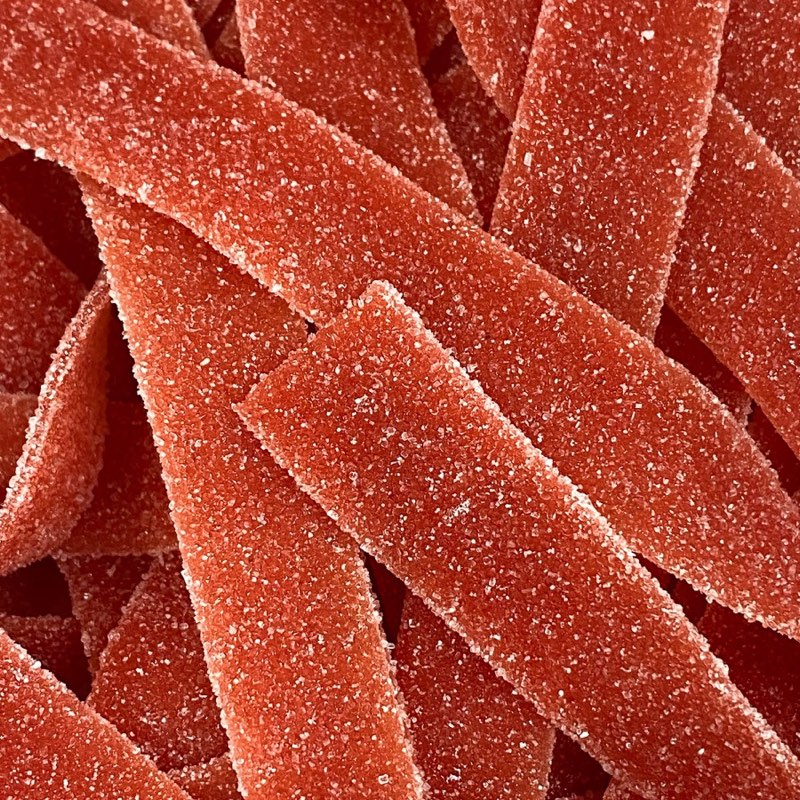
Held up, a Vidal Strawberry Belt is a flat red ribbon. Red is the colour listed on the product, and it is a confident, unambiguous red rather than a blush or a deep berry shade — the kind of red that photographs well on a party table and shows up clearly against a white bowl. The surface is not glossy. It carries the matte, faintly granular finish that puts this line on our fizzy sweets shelf, and you can feel it before you taste it: run a belt between finger and thumb and there is a whisper of grip, a drag that a plain jelly sweet simply does not have.
The full guide to Vidal Strawberry Belts
5,996 words on how it eats, who it suits, how to serve it and what to put beside it.
The first belt out of the bag
The length is the bit people underestimate. A belt is long enough to hang from the hand, long enough to be draped over the edge of a bowl, long enough that a child will hold one up at eye level before eating it because the shape invites that. This matters more than it sounds. Sweets that ask to be looked at get eaten more slowly, and slowly is generally how you want a 250g bag to go.
Bite in and there are two events, not one. The first is the coating, which arrives on the tip of the tongue almost immediately: a sharp, prickling, sour-fizzy lift that makes the mouth water and tells you why this sits on both our sour sweets shelf and the fizzy one. It is brisk rather than brutal. If you have worked your way through genuinely punishing sour sweets — the kind that make a teenager's eyes water on a dare — this is not that. It is the sourness of a sweet designed to be eaten repeatedly, which means it has to stop short of punishing you.
The second event is the belt itself. Underneath the coating is a chew: dense, elastic, with real resistance. Your teeth meet it and it pushes back a little before yielding. This is the jelly character that files it under jelly and gummy sweets, though a belt eats nothing like a moulded gummy bear. A gummy bear is a single bite and gone. A belt is a strip you work through, and the way most people eat one — tearing off lengths with the front teeth, or feeding it in gradually — stretches the whole business out considerably.
The strawberry note arrives second and stays longest. The fizz is a front-loaded thing; it flashes, it fades, and by the time you are three chews in it has largely handed over. What is left is a soft, sweet, unmistakably strawberry impression that sits in the middle of the mouth and takes its time going. The finish is clean. It does not coat your teeth the way a toffee does, and it does not leave the dry, powdery afterfeel that some heavily coated sour sweets do. You finish one belt and the honest reaction is that you could have another, which is the whole trick of a good pick-and-mix line.
Temperature changes it noticeably. Straight from a cool cupboard the chew is firmer and the sour hit reads sharper because you are working harder to release the flavour. Left on a warm windowsill, the belt softens, gets stretchier, and the strawberry comes forward faster while the fizz feels gentler. Neither is wrong. It is worth knowing, though, if you are putting them out on a table in August and wondering why they taste milder than they did in the bag.
Who reaches for a belt, and when
There are three shoppers who buy this bag over and over, and they want quite different things from it.
The first is the parent doing a party, a sleepover or a half-term afternoon. Belts are good value in that context because they are visually generous — a small number of belts fills a bowl and looks like a lot — and because they occupy a child for longer than a sweet that vanishes in one bite. The red colour does a job on a table. And at £5.49 for 250g, it is not a line you agonise over putting out.
The second is the adult buying for themselves and slightly embarrassed about it. This is a bigger group than the sweet trade likes to admit. Belts are a desk sweet, a long-drive sweet, a watching-something-badly-written-on-a-Tuesday sweet. The chew gives your hands and jaw something to do, which is why they turn up in glove boxes and in the drawers of people who have given up smoking. One belt is a small, contained event. Nobody needs to know you had four.
The third is the mixer — the shopper building a bag or a jar out of several lines, who needs belts specifically because of their shape. In a bag of round sweets, belts are the thing that creates visual variety and stops the whole mix reading as one texture. That is a real job, and we will come back to it further down.
When to reach for it is mostly a question of pace. If you want a sweet that is over quickly and lets you get on with something, a belt is the wrong choice — it takes attention. If you want a sweet that stretches an hour across a film or a car journey, it is close to ideal. Our supplier lists this line as vegetarian, which is worth knowing if you are catering for a mixed group and want something you can put out without a conversation; you can see everything else carrying that supplier tag on our shelf of lines listed as vegetarian.
How a strawberry gets built: the craft of a recognisable note
Here is a thing worth saying plainly, because it is not an insult and it is not a secret: a strawberry sweet does not taste like a strawberry. It tastes like strawberry — the idea, the shorthand, the note. Put a real strawberry next to a strawberry belt and they have almost nothing in common. The real fruit is watery, faintly tart, grassy at the edges, fleeting, and different every single time depending on the season and how long it sat in a punnet. The sweet is consistent, concentrated, and identical in March and in September. That consistency is the product. It is the thing a confectioner is actually selling.
So how does a recognisable fruit note get built? The first principle is that it is built in layers over time, not delivered all at once. Think of the eating of a single belt as having a beginning, a middle and an end, and understand that a sweet is designed against that timeline the way a piece of music is written against bars. On this belt, the coating owns the beginning. The sour-fizzy lift is not flavour in the fruit sense — it is sensation, a physical prickle and a mouth-watering reflex. It does two jobs. It wakes the palate up, and it buys time, because while your mouth is dealing with that the chew has not yet released much of anything.
The middle belongs to the fruit impression, and the middle is where the real craft sits. A fruit note in confectionery is almost never a single idea. It is a stack: a bright top that reads immediately, a rounder body underneath that gives it weight, and a low, slightly jammy or slightly creamy base that stops it reading thin. Take any one of those away and shoppers will tell you something is wrong without being able to say what. A strawberry note with only the bright top tastes like a boiled sweet. A strawberry note with only the base tastes muddy, like something spooned from the bottom of a jar. Get the ratio right and the brain does the rest — it fills in the fruit, the redness, the memory of summer, all of it, from a note that is nothing like the fruit itself.
The second principle is that texture is part of the flavour, not a separate feature. This is the one most people find surprising. How fast a sweet releases what it has depends almost entirely on how hard your jaw has to work and how much saliva the sweet draws. A dense chew like a belt releases slowly and evenly, which is why the strawberry on this line reads as a long, sustained note rather than a flash. A soft foam sweet releases everything at once and then has nothing left. A hard-boiled sweet drips its flavour out over ten minutes in tiny increments. Identical flavouring in those three formats would be described by shoppers as three different flavours. The format is the flavour, to a degree that would surprise anyone who has not thought about it.
The third principle is contrast. A confectioner building a sour fruit line is not trying to make the fruit note louder; they are trying to make it clearer. Sourness on the surface of a sweet acts the way a squeeze of lemon acts on a rich sauce — it does not add fruit, it sharpens the edges of what is already there and stops the sweetness reading as flat. This is why the sour coating on a belt of this kind is nearly always restrained. Push it too far and the fruit underneath disappears entirely; all you taste is the assault. Pitch it right and the fruit arrives more defined than it would have on its own. That balance is the difference between a line that people finish and a line that people try once.
The fourth principle is colour, and this is where confectionery gets genuinely strange. Colour changes what people taste. Tests of this have been run for decades and the result is always the same: a taster given an identically flavoured sweet in two colours will describe the flavours differently and be confident about it. Red reads as strawberry, cherry, raspberry — the red family — before the taster has even taken a bite, and once the expectation is set the brain works hard to confirm it. A confectioner choosing a red for a strawberry line is not decorating. They are making a flavour decision. You can see the same logic at work across our strawberry flavour shelf, where the shade is doing a lot of quiet work on every single product.
The fifth principle is restraint at the finish. A well-built fruit sweet gets out of the way. It fades rather than lingering, it does not leave a chemical bitterness at the back of the throat, and it leaves the mouth in a state where the next one is welcome. Confectioners think about this explicitly, because in a pick-and-mix context nobody eats one of anything. The note has to survive being eaten repeatedly, and that is a harder design problem than making something taste strong once.
Put all five together and you can see why sweets that taste "obvious" are anything but. The obviousness is the achievement. Haribo Giant Strawbs, at £5.49, solve the same problem in a completely different format — a dense, moulded, fruit-shaped sweet with no sour coating at all — and the strawberry note they land is recognisably a cousin of this one while eating nothing like it. Put the two side by side some time. It is a genuinely interesting five minutes.
Which sweet counter this belongs to
Every sweet carries a period with it, whether or not the shopper can name the period. Hand somebody a belt and watch their face: a good proportion of adults go somewhere before they say anything. That reaction is worth taking seriously, because it is a large part of why this line sells, and it is why it sits on our retro shelf alongside the sweets that do the same job.
The belt belongs to the self-serve counter. Not the jar-and-scoop era, where a shopkeeper stood behind a wall of glass and you pointed at what you wanted and got a quarter weighed out in a paper bag — belts are too unruly for that. Belts belong to the era of the open bin and the plastic scoop and the paper or cellophane bag you filled yourself, where the pleasure was partly in the choosing. That change, from being served to serving yourself, altered what sweets needed to be. In a jar shop, the sweet had to look good through glass. In a self-serve shop, the sweet had to look good tangled in a heap with a hundred of its siblings, and it had to survive being dug out with a scoop by a nine-year-old in a hurry. Belts are extremely good at both. They drape over the edge of a bin. They show their colour from across a shop. They do not shatter.
The other thing self-serve did was make the mix personal. Once you are filling your own bag, the bag becomes a statement — this is what I like, this is my ratio, this is the one I always put in first. People who grew up with that have opinions about sweets in a way that people handed a pre-packed bag never quite develop. A lot of the shoppers who buy belts by the kilo are that generation, still building the bag they always built, just at home now and with a better budget.
Belts also sit in a specific memory of place. The cinema foyer. The newsagent on the walk home. The shop attached to the swimming baths, where you spent whatever was left after the entry fee. The video rental shop, which had a counter of loose sweets precisely because it needed something to sell you while you decided. Sweets with length — belts, laces, strips, poles — did extremely well in all of those settings because they were the best possible value for the small coin a child actually had, measured in minutes of eating rather than in weight. That calculation has not changed. It is still the reason a belt beats a chocolate bar on a long walk.
There is a generational split in how people eat them, too, and it is oddly consistent. Children almost always eat a belt from one end, feeding it in, often with an element of performance. Adults tend to fold it, or tear it into three, or eat it in one dignified go while pretending the format is incidental. Neither group will admit the other's method is better. Both are wrong, obviously: the correct way is to bite from the middle and work outwards, which nobody does.
Nostalgia in sweets is not only about age. It is also about a very particular kind of low-stakes pleasure that has become rarer. A sweet costs little, asks nothing of you, arrives with no subscription and no account, and delivers exactly what it says on the bag. The reason a bowl of retro sweets works at a fortieth birthday is not that everybody there ate these exact sweets as a child — many of them did not — but that the format signals a mode: unhurried, uncompetitive, a bit silly. Set a bowl of belts next to something like Barratt Jelly Love Hearts at £5.49, or the old-fashioned chew of Drumstick Chew Bars in a ten pack at £2.50, and you have built that mode on a table for under a tenner. It works every time, and it works on people far too young to be nostalgic about any of it.
If you want to go further into that territory, the Kingsway range is where a lot of the traditional-counter lines live on our site, and a good number of them share a bowl with belts happily.
Notes on the strawberry family
Strawberry is the most-attempted flavour in confectionery and one of the most varied in execution, which is why it is worth understanding as a family rather than as a single note. Broadly, shop-bought strawberry sweets land in one of four places.
There is bright strawberry — high, sharp, almost sherbet-adjacent, usually paired with a sour or fizzy surface. That is where this belt sits. The fruit reads clean and forward, with the coating keeping it lifted. It is the version that does best in hot weather and the version children pick first.
There is jammy strawberry — rounder, deeper, closer to the memory of something spread on toast than something picked in a field. This is the register you get from denser, uncoated formats. Vidal Jelly Filled Strawberries in a tub at £7.99 lean this way, with the filled centre adding a second texture and a softer, more rounded delivery than a flat belt can give.
There is creamy strawberry — the strawberries-and-cream register, where the fruit is deliberately softened by something rounder sitting underneath it. It is the gentlest of the four and the one that appeals most reliably to older shoppers.
And there is sherbet strawberry, where a powdery, effervescent element is the point rather than a finishing touch. Stockley's Sherbet Strawberries at £5.49 are a clear example, and they make an interesting contrast with the belts because the fizz there is structural rather than surface-level. Similarly, Kingsway Fizzy Strawberries, also £5.49, give you the fizzy-strawberry idea in a moulded, bite-sized shape rather than a strip, which changes the pace of eating completely.
If you are building a bowl and want the whole family represented, taking one from each register is more interesting than taking three versions of the same register. Most people default to three brights, and the bowl ends up tasting monotonous by the second handful.
Worth noting too that strawberry sits next to apple better than it sits next to most things. The two are the standard pair in fruit confectionery for a reason — the green-apple register is tart and high where strawberry is round and sweet, and they read as a deliberate combination rather than an accident. Vidal Apple Belts at £5.49 are the obvious partner here: identical format, identical price, opposite end of the fruit spectrum, and a bowl with both in looks intentional in a way that a bowl of one colour never does.
Building a bag around belts
If you are making a mix — in a jar, a bowl, a cone or a party bag — belts do a structural job that is easy to miss until you leave them out. They are the only common sweet format with length. Everything else in a typical mix is a ball, a bear, a disc, a cube or a ring. Drop belts in and suddenly the mix has lines running through it, things draping over the rim, an overall shape that looks handmade rather than poured. Take them out and the same sweets look like a bag of gravel.
A workable rule for a mixed bowl is four roles: the length, the chew, the sharp one and the soft one. Belts cover the first, and partly the second. For the sharp one you want something that genuinely bites — Barnett's Mega Sour Apple Candy Bags 104g at £3.99 will do that job with room to spare, and the apple keeps it in the same fruit conversation as the belts. For the soft one, Red Band Dizzy Dolphins in a 100g bag at £1.39 bring a gentler, squashier texture in at a low price, which is useful when you are buying five or six lines and the total is creeping up.
For a mix aimed at adults, swap the sour-bomb for something with more chew and more bitterness at the edge. BUBS Cool Cola Skulls at £7.50 bring a cola note that cuts across all the fruit without competing with it, and Taveners American Hard Gums at £5.49 add a firm, long-lasting gum that slows the whole bowl down. Both are sweets that an adult will go back to and a child will mostly ignore, which is a useful property if you are trying to make one bowl serve a mixed room.
Colour is the other thing to plan. This line is red, and red dominates a bowl visually — more than its proportion by weight would suggest. If you want a mix that looks balanced rather than red-with-bits, keep the belts to roughly a quarter of the volume and put something multi-coloured in as the main body. Vidal Rainbow Belts, same brand and same £5.49, are the direct solution: same format and same eating experience, but the multi-coloured strips spread the palette across the whole bowl instead of concentrating it. A lot of people buy both and mix them, and honestly that is the better bowl.
If you would rather have somebody else do the arranging, our pick and mix range has ready-built jars and platters, and the loose sweets counter — 356 lines at last count — is where you go if you want to assemble it yourself from scratch.
Parties, film nights, hampers and the seasonal table
Belts earn their place at a party because of how they behave on a table over two hours rather than how they taste in the first five minutes. They do not melt. They do not fuse into a single block the way some coated sweets do. They do not shed crumbs across a tablecloth. They can be picked up with fingers without anybody needing tongs, and they survive being handled and put back by a four-year-old with more dignity than most sweets. If you have ever come back to a party table an hour in and found a bowl of chocolate welded to itself, you will appreciate the difference.
For a children's party, 250g spread across a couple of small bowls goes further than one big bowl, because children take from whichever bowl is nearest and a single bowl empties in one visit. For a party bag, a belt or two folded into each bag reads as generous, because the length photographs as bulk.
For a film night, belts are the best sweet in the shop for the simple reason that they are quiet. No wrapper, no crunch, no rustle. You can eat one through dialogue without annoying anybody, which is more than can be said for a tub of anything hard. Pair with something you can eat by the handful in the loud bits, and you have the two speeds a film needs.
For hampers and gifts, belts are a good filler and a mediocre centrepiece. They look better in a jar than in their bag, so if you are gifting, decant. A 500g bag at £9.99 fills a decent-sized sweet jar properly, which matters — a half-full jar looks mean no matter what is in it. Combine with a taller, showier item as the centrepiece and let the belts do the volume. The Vidal Happy Smiles tub at £7.99 arrives ready-presented and works well as that centrepiece, with belts filling in around it.
Seasonally, the red does most of the work for you. A bowl of these reads Christmas without any effort, reads Valentine's without any effort, and reads summer-fair without any effort. Halloween is the one exception, where you want the colour doing something stranger: Vidal Jelly Filled Brains at £7.99 handle that brief properly, and belts can be draped around them to fill the platter. For a table with a heart theme, Vidal 3D Triple Hearts at £5.49 pair obviously with strawberry, and Vidal Chicken Feet, also £5.49, are the one to reach for when the brief is "make the children laugh" rather than "make the table look nice".
What £5.49 actually buys, and when to size up
The 250g bag is £5.49, which works out at £2.20 per 100g. That is the number to keep in your head, because every other size on this product is cheaper per gram, and the gap gets wide faster than people expect.
| Size | Price | Per 100g | Versus buying 250g bags |
|---|---|---|---|
| 250g | £5.49 | £2.20 | — |
| 500g | £9.99 | £2.00 | Saves 99p on two 250g bags |
| 750g | £12.99 | £1.73 | Saves £3.48 on three 250g bags |
| 1kg | £16.49 | £1.65 | Saves £5.47 on four 250g bags |
| 2kg | £28.99 | £1.45 | Saves £14.93 on eight 250g bags |
In portion terms, a sensible handful of belts is somewhere around 30g to 40g once you allow for the fact that length makes a portion look bigger than it weighs. On that basis, 250g is six to eight helpings — enough for a family film night with something left, or enough for one person to make last a fortnight if they have that kind of self-control. The 500g at £9.99 is the size for a small party or for a household that goes through sweets steadily. The 1kg at £16.49 is the party size proper, or the size for filling a large jar with a good top-up left over. The 2kg at £28.99 is for a fete, a stall, a big buffet or a school event, and at £1.45 per 100g it is the only size that competes on price with the cheapest bagged sweets in the shop.
The honest advice is this: unless you are buying to try it, skip the 250g. The step up to 500g costs £4.50 more and gives you another quarter kilo — you would be paying £4.50 for 250g rather than £5.49, which is a better deal than the 250g bag will ever be. The 250g earns its place as a taster, as a stocking filler, as a single item in a hamper where 500g would be too bulky, or as the size you buy when you want three different flavours rather than a lot of one.
Against the rest of the shop, £2.20 per 100g puts the 250g bag in the middle of the loose-sweet range — not the cheapest thing on the counter, not close to the priciest. What you get for it is a sweet with a long eating time per gram, which is the metric that actually matters for a party or a journey. Measured in minutes rather than grams, belts are one of the better-value things we sell.
Keeping them right
Belts want three things: cool, dry and sealed. Get those and they stay in the condition you bought them in for a long while. Miss them and the sweet does not spoil so much as change character, usually in the direction of stickier and softer.
Warmth is the main enemy, and it is warmth rather than heat — a sunny shelf or a cupboard above a radiator is enough. Warm belts soften, stretch further, and start to fuse to each other, so that pulling one out brings three. They are still perfectly good; they are just harder to serve and less pleasant to handle. A cool cupboard sorts it.
Damp is the subtler problem, and it is the one that specifically affects a fizzy, sour-coated line. That coating is a surface, and surfaces absorb moisture from the air. A bag left open in a steamy kitchen will lose its prickle within a day or two — the belt underneath is unchanged, but the sharp first hit is gone and what you have left is a plain chewy strawberry strip. If you have ever wondered why the last few belts in a bag taste flatter than the first, that is the reason, and it is entirely preventable.
So: clip the bag, or decant into something with a proper lid. A jar with a rubber seal is ideal and looks better on a shelf anyway. A freezer bag with the air squeezed out is the cheap version and works almost as well. Avoid the fridge — the cold is fine but the humidity inside a fridge is not, and the coating suffers.
Do not decant into the same jar as anything strongly flavoured. Mint and aniseed in particular will transfer through the air inside a sealed container and will ruin a fruit sweet within a week. Keep the fruit family together and the strong stuff separate. If you are storing a 1kg or 2kg bag, it is worth splitting it: keep a working jar out and leave the rest sealed, so you are only ever exposing a small amount to the room.
Choosing your size, and the rest of the range
All five sizes are the same sweet. There is no difference in the belts themselves between the 250g bag and the 2kg — the only decision is how much you want and how fast you will get through it. The one genuine argument for the smaller sizes is freshness through use: if it takes you three months to finish 2kg, the last of it will have spent three months being opened and closed, and a fizzy coating does not love that. Buy the size that matches your actual rate of eating, not the size with the best per-gram figure.
A practical split for a household: 500g at £9.99 as the standing order, stepping up to 1kg at £16.49 when there is an event on. For a stall or a school fair, go straight to the 2kg at £28.99 and portion it into bags yourself — at £1.45 per 100g you have room to price sensibly and still take something for the cause.
Across the wider Vidal range — nineteen lines with us — the belts are the format that most people start with, but they are far from the whole story. The tubs run larger and present better as gifts, the filled lines bring a second texture into play, and the novelty shapes are there for when the table needs a talking point rather than another bowl of fruit.
Where this sits on the site
This product is filed in several places at once, and which door you came in by probably says something about what you were after. It is on the jelly and gummy shelf because of the chew, on the fizzy and sour shelves because of the coating, on the retro shelf because of the format's history at the counter, and on the strawberry shelf because of the flavour. It also carries our supplier's vegetarian tag.
If you are browsing rather than hunting, the most useful starting points are the full range of sweets if you want to see everything, or the candy and chocolate section if you are building a mixed order and want chocolate in it as well as sweets. The Haribo shelf is the other obvious neighbour for anybody shopping by chew and fruit rather than by brand loyalty.
Nearby on the counter, in the sense of what people tend to buy in the same basket, you have the fruit-and-fizz group and the retro-chew group. Both overlap with belts and neither replaces them, which is why most baskets with belts in have two or three other things alongside.
Questions we actually get asked
How sour are these, really?
Moderately. They sit on our sour shelf, and the first hit on the tongue is a genuine sharp prickle, but this is a sweet built to be eaten several at a time rather than a challenge sweet. If you find dedicated extreme-sour lines unpleasant, you will almost certainly be fine with these. If you specifically want something that makes your eyes water, this is not it and you should look further along the sour shelf for something built for that.
Are they suitable for young children?
Sweets are a treat rather than everyday food, and any chewy sweet eaten in a hurry is worth supervising — small hard sweets and whole gummies in particular are a choking risk for young children. With belts, the sensible approach is to tear them into shorter lengths for smaller children rather than handing over a whole strip. As with anything we sell, if there are allergies in your household, check the manufacturer's packaging when your order arrives, before anybody eats anything.
What is the difference between the 250g and the bigger bags?
Only the quantity and the price per gram. The belts are identical. The 250g is £5.49, which is £2.20 per 100g; the 2kg is £28.99, which is £1.45 per 100g. Everything in between steps down gradually. Buy small if you are trying them or want variety across several flavours, buy big if you are catering or you know you will finish it.
Will they stick together in the bag?
They can, if they get warm. Belts lying against each other in a warm room will lean together and need separating. They come apart cleanly with a bit of patience and the sweet is unaffected. Storing them somewhere cool prevents it almost entirely, and if a bag has gone clumpy, half an hour somewhere cool firms them up enough to pull apart easily.
Can I post these?
They travel better than most sweets, because there is nothing to melt into a mess and nothing to shatter. A sealed bag in a padded envelope arrives in good order. If it is high summer, a 250g bag is the safer size to send than a kilo, simply because a smaller quantity is less likely to compress into a block in a warm sorting office.
Are they vegetarian?
Our supplier lists this line as vegetarian. We pass that on as it is given to us and we do not extend it — it is not a vegan claim and we would not make one. If you want to browse everything carrying that supplier tag, it is all gathered on one shelf on the site.
What else should I buy with them for a party?
Aim for contrast rather than more of the same. Something sharp, something soft, something with a different shape. Sour apple against the strawberry works well because apple and strawberry are the classic fruit pairing; a softer, squashier line balances the chew; and something multi-coloured stops the bowl reading entirely red. Three or four lines chosen that way look far better than six chosen at random.
How long will an open bag stay good?
Sealed properly and kept cool, a long time — the limiting factor is not the belt but the coating, which loses its fizz if it is exposed to damp air. Clipped or decanted into a sealed jar, you will not notice a change for weeks. Left open on a kitchen counter, the sharpness starts going within a couple of days while the chew stays fine.
Do children prefer these to gummy shapes?
It depends entirely on the child, but format tends to matter more than flavour at that age. Children who like a long, slow, slightly theatrical sweet love belts. Children who want a sweet finished in one bite so they can get to the next one find them frustrating. If you are buying blind for a party, having both formats in the bowl is the safe play.
Is the strawberry very sweet, or is it tart?
Both, in sequence. The coating gives you a tart, fizzy opening and the chew underneath is the sweet part, so the overall impression depends on how fast you eat it. Bitten through quickly, it reads sharp. Worked slowly, it reads as a sweet strawberry with a bright edge at the start. Neither is stronger than the other; they just arrive in order.
Can I use them for cake decorating?
Yes, and the length is why. Belts can be cut, curled, layered, or stood on end in a way that round sweets cannot, and the firm chew means they hold a shape once placed. They do soften against a wet icing over several hours, so decorate close to the time rather than the night before.
Is 250g enough for a children's party?
For a bowl on a table alongside other things, yes — 250g looks like a lot of belts and spreads across two small bowls comfortably. If belts are the main sweet and you have a dozen children, go up to the 500g or the 1kg. The step up is cheap enough per gram that running out is the more expensive mistake.
The short version
A flat red strip with a sour, fizzy opening and a long strawberry chew underneath, at £5.49 for 250g and cheaper per gram in every size above that. It is one of the few sweets that works equally well in a party bowl, a glove box and a film night, mostly because it takes time to eat and makes no noise doing it. Our supplier lists it as vegetarian. Buy the 250g to try it and the 500g or larger once you know you like it — and put something apple-coloured next to it in the bowl.
More from Vidal

More jelly & gummy sweets



More strawberry sweets


Where this sits
Vidal Strawberry Belts appears on these shelves. Browse them, or jump to something nearby.
You might also like