Home / Loose Sweets / Sweetzone Juicy Berries Tub 805g
Sweetzone · 805g
Read the full guide
Sweetzone Juicy Berries Tub 805g
£8.99
✔ In stock — ready to ship
Fresh stock
Free over £20
Same-day dispatch
Secure checkout
Most people build a pick-and-mix by choosing things they like and hoping the total works. It usually half-works. The bags that eat well from the first handful to the last are built the other way round — you choose a job first, then pick a sweet that does it, and a firm jelly berry is one of the few sweets that can do the most important job of all.
That job is the anchor. Every mixed bag needs something substantial at the base of it: a sweet with enough body to give the bag weight, enough resistance to slow people down, and enough familiarity that nobody has to think before taking one. Without an anchor, a mix is a collection of accents — interesting for four sweets and directionless after that.
The full guide to Sweetzone Juicy Berries Tub 805g
5,437 words on how it eats, who it suits, how to serve it and what to put beside it.
Start with the bag: where a jelly berry belongs in a mix
These are 805g of that. At £8.99 the tub is the cheapest way on this shelf to buy an anchor in quantity, and because it is a jelly rather than a foam or a hard sweet, it brings a middle texture that the rest of a bag can be built around in either direction — softer things above it, harder things below.
A working shape for a kilo bag, if you want a starting point rather than a theory: roughly 400g of anchor from this tub, 250g of something with a different chew, 200g of something sharp, 100g of something soft, and 50g of one novelty. Those proportions are not sacred, but the shape is — one dominant texture, two supporting ones, one contrast, one talking point. Build to that and the bag will still be enjoyable when it is two thirds gone, which is where most home-built mixes fall apart.
The sharp element is the one people most often leave out and most often miss. Dulce Plus Sour Strawberry Rings at £5.49 sit in the same berry family as this tub but pull in the opposite direction on sourness, which is exactly what you want from a supporting sweet. For the different chew, Barratt Milk Bottle Gums at £5.49 are firmer and slower, and they read as a complete change of subject next to a berry jelly rather than as more of the same.
What the tub actually is
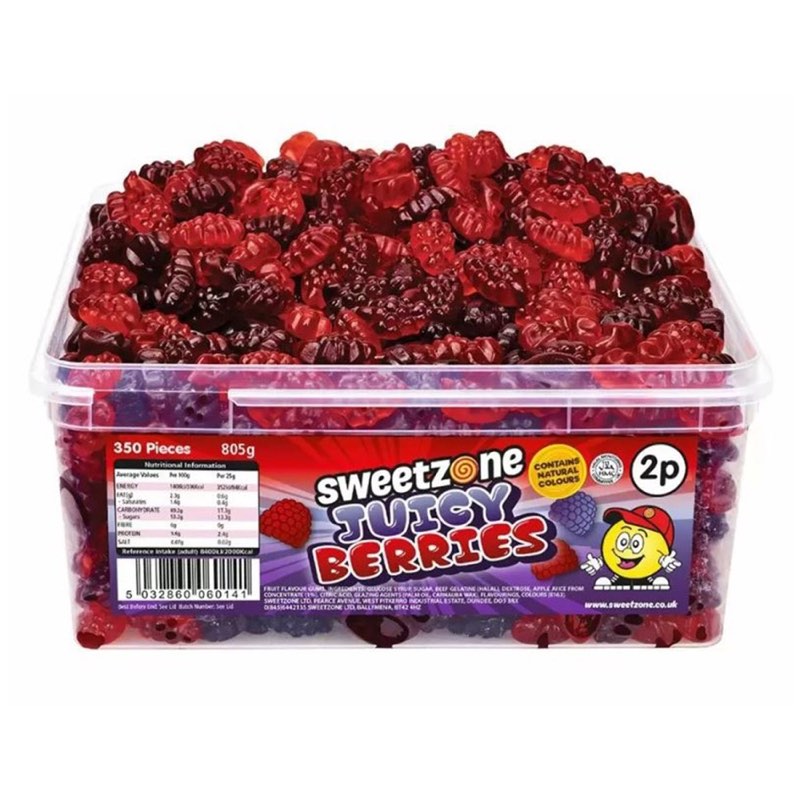
805g of red berry jelly sweets in a lidded tub, in blackberry and strawberry, at one size and one price of £8.99. It is in stock and there is no alternative size of this particular line — if you want more or less, the decision is which Sweetzone tub to buy rather than which size of this one.
The tub matters more than it sounds. A bag of 800g of jellies is a bag that will be open, folded over, clipped, unclipped and eventually abandoned half-full at the back of a cupboard. A tub with a lid is a container you can keep going back to for weeks, which is the entire reason the format exists at this weight. It also means the sweets arrive without being crushed by whatever else was in the parcel, which matters for jellies more than for most things — they take a squash and hold the shape they were squashed into.
And it is re-usable in a way a bag is not. Once the sweets are gone you have a sealed tub, which is genuinely useful if you are the sort of household that decants, bakes, or builds party bags. Several people buy tubs specifically to end up with the tub.
How they look, and how they eat
Tipped into a bowl, these read as red — a deep, saturated red that holds its colour under kitchen lighting, where paler sweets tend to wash out. Jellies have a surface quality that foam and dusted sweets do not: light catches them, and a bowl of them has depth to it rather than sitting flat. That is why jellies photograph well and why they are so often the thing on top of a display rather than underneath it.
Pick one up and it is denser than it looks. That is the first surprise for anyone who has been handling lighter formats: the same visual volume weighs considerably more, so a small bowl of these is a lot of sweets by weight. You will feel it when you fill a party bag, and you will feel it again in the arithmetic later on this page.
Press one and it resists, then gives, then springs back. A good jelly has that return in it — it should not stay dented. The surface is slightly yielding but not tacky, and the sweets separate cleanly from each other rather than coming out of the tub as a clump, which is the practical test of a jelly that has been stored properly.
The first bite is the opposite of a foam sweet's collapse. There is a real moment of resistance, then a clean break, and then something to chew. It takes a few seconds of actual work, which is what makes jellies satisfying and what makes them slow down a bowl. The flavour does not arrive all at once; it builds across those seconds as the sweet breaks down, reaches its peak somewhere in the middle of the chew, and is still faintly there after you swallow.
That longer arc is the whole argument for a jelly as an anchor. A sweet that occupies you for ten seconds means fewer sweets per minute, which means the bowl lasts, which means a mix stays interesting rather than being demolished. The finish is clean enough that you are ready for a different texture next, which is exactly what you want from the largest single component of a mixed bag.
How a jelly behaves next to everything else in one bag
Everything above is about how a sweet eats on its own. The more useful knowledge — and the part almost nobody thinks about until a bag disappoints them — is how sweets behave when several hundred grams of them are pressed together in the same space for a day or two.
Weight, and the honest scoop
Mixes are usually built by eye and sold by weight, and those two things disagree. Dense sweets like these hit a weight target quickly, so a scoop of jellies is more grams and fewer pieces than a scoop of something aerated. If you are filling party bags to a set weight, jellies will get you there fast and the bags will look smaller than you expected. If you are filling to a set look, you will use far more weight than you planned. Decide which you are doing before you start, because switching halfway through twenty bags produces twenty inconsistent bags.
Sticking, and the sweets that cause it
Jellies are the format most likely to bond to their neighbours, and warmth is what does it. In a mixed bag left in a warm room, jellies will fuse gently to each other and to anything else soft, and you will end up separating them by hand. The practical defences are simple: keep mixes cool, do not build them days in advance, and do not pack a jelly directly against another soft sweet if the bag is going to sit in a car.
Dusted sweets and the transfer problem
Any sweet with a powdery or sugared surface will shed onto its neighbours in a shared bag, and jellies pick that dust up more readily than hard sweets do, because their surface is slightly yielding. It is harmless and it is cosmetic, but if you are building a mix that people will see before they eat it — a gift jar, a favour bag, a display — keep the dusted items in their own layer or their own bag, and put the jellies where nothing can fall onto them.
The crush order
Pack a bag in the order things can take weight. Hard sweets at the bottom, jellies in the middle, anything foamed or wafer-light at the top. Do it the other way round and the light things arrive compressed and the jellies arrive with a flat side. This applies to postal parcels as much as to party bags, and it is the single most useful packing habit for anyone who sends sweets anywhere.
What gets eaten first, and what is left at the bottom
In a shared bag, people eat the novel thing first, the sour thing second, and the familiar anchor steadily throughout. That is why a well-built mix ends with anchor sweets in the bottom of the bag — and that is a feature, not a failure. The worst outcome is a bag that ends with only the odd, sharp or unusual sweets left, because nobody finishes those. Build so that the last handful is the reliable one.
Flavour bleed between neighbours
Sweets in prolonged contact will exchange a little of their character, particularly where a strongly flavoured item sits against a milder one. Over a day it is imperceptible; over a fortnight in a sealed jar it is real. If you are assembling something to be kept — a gift jar, a hamper component, a mix made well in advance — favour a coherent flavour family over a wildly mixed one, because related notes blur into each other pleasantly and unrelated ones simply blur.
How many components is too many
Four to six types is the sweet spot for a bag of about a kilo. Below four it reads as a bag of one thing with extras. Above six, people stop choosing and start grabbing, and the individual character of each sweet is lost — which is a waste of the effort and the money you spent choosing them. If you find yourself wanting eight, build two bags instead of one.
Three combinations that work
- The berry bag. These jellies as the anchor, Vidal Strawberry Slices at £5.49 for a softer version of the same idea, and BUBS Wild Strawberry & Pomegranate Ovals at £7.50 to take the family somewhere less expected. One flavour idea, three treatments.
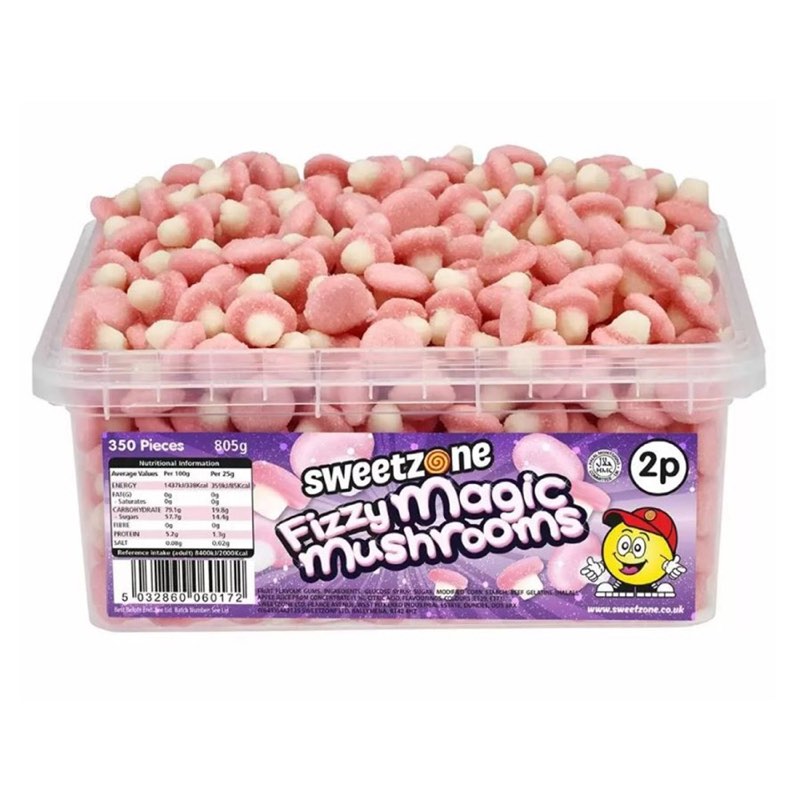
- The mixed-ages bag. These as the base, Kingsway Vegan Garden Fruits at £5.49 alongside for a second fruit-led shape, and the Magic Mushroom foam tub at £7.99 for the soft element that younger children reach for first.
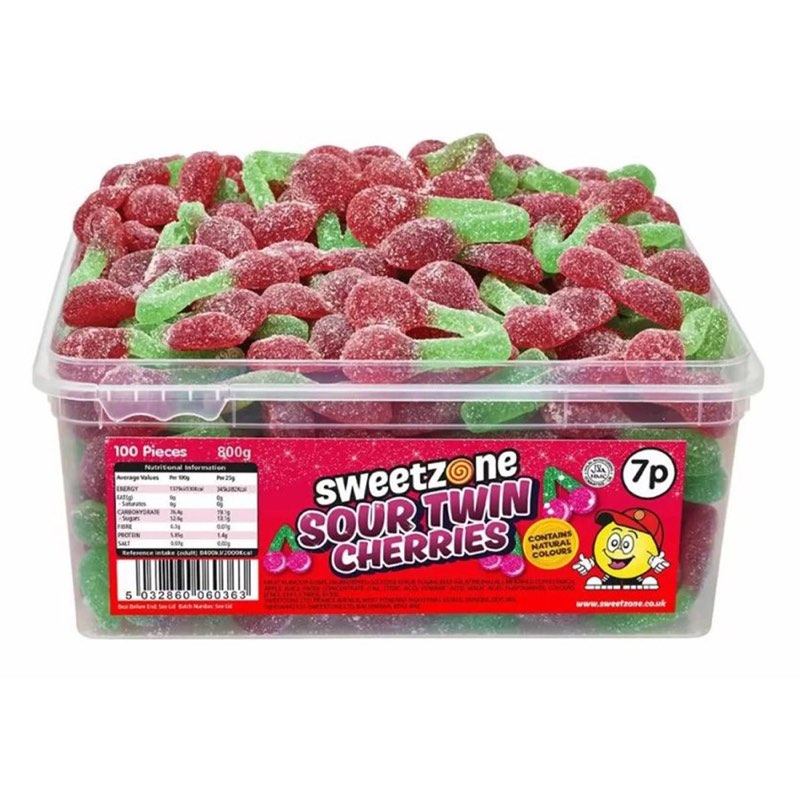
- The grown-up bag. These with Briquette at £5.49 for something firmer and more traditional, and the Sour Twin Cherries tub at £7.99 for the sharp corner. No novelty item at all, which is a legitimate choice for an adult table.
If assembling from tubs feels like more work than you want, the build-your-own pick and mix range does the same job in one order, with the fillings chosen at the point of buying and the mixing already done.
Who this tub suits
Households who want one large sweet purchase to last rather than several small ones. A dense jelly at 805g in a lidded tub is a month's cupboard for most families, and it is the format least likely to go stale in the meantime.
Anyone who builds — party bags, cones, jars, hampers, favours, advent-style countdowns. Jellies are the workhorse of all of those because they hold shape, hold colour and do not shed.
People who find soft sweets unsatisfying. There is a real division in taste here, and it is not about flavour: some people want a sweet that gives way immediately and some want one they can chew. If you are in the second group, a jelly tub will always be better value to you than a foam one, whatever the price per gram says.
Anyone posting sweets. Jellies travel better than almost anything else on this shelf, which is the entire subject of the next section.
Who should look elsewhere: anyone feeding very young children, who generally do better with softer formats; anyone who wants sourness, where a dedicated sour line is the better buy; and anyone who needs a talking point rather than a supply, where something small and strange like the £1.49 Crazy Candy Factory Zombie Brain does more for a table than another 800g of anything.
Gifting: hampers, letterbox parcels, thank-yous and care packages
An 805g tub is not a gift. It is eight gifts, and that is the most useful thing to understand about buying it at £8.99.
Dividing a tub into presents
Decanted into small jars, bags or cones, this tub makes roughly eight 100g gifts, sixteen 50g gifts, or twenty-six 30g party-bag portions. At £8.99 that is about £1.12 of sweets per 100g gift, 56p per 50g one and 34p per party-bag portion — before whatever you put them in. Nothing you can buy ready-made as a small gift comes close to that, which is why anyone giving to a class, a team, a ward round of colleagues or a long list of neighbours ends up buying tubs and dividing them.
The economics only work if the presentation is decent, and with sweets that means visible. Clear jars, clear cones, clear bags — a red jelly sweet is doing your decorating for you and hiding it in an opaque bag throws that away. One ribbon and a handwritten tag is enough. Anything more elaborate costs more than the sweets did.
Teacher and end-of-term thank-yous
The problem with teacher gifts is that thirty families have the same idea on the same day, and the recipient ends up with a great deal of the same thing. A small jar of loose sweets sidesteps that: it is personal, it is obviously assembled rather than bought off a shelf, and it can be shared in a staffroom, which is what most of it ends up being used for anyway. If you are doing this for a whole class's worth of staff, one tub covers eight jars, and two tubs of different textures covers sixteen with variety between them.
Letterbox treats and posting sweets
Sweets are one of the better things to post, and jellies are the best of the sweets for it. They do not melt in a warm van, they do not shatter like a hard sweet, they do not crumble like a wafer, and they do not compress permanently like an aerated one. A flat, shallow parcel needs the contents packed in a single layer, which is where you decant rather than posting a whole tub — a tub is a heavy, deep, awkward thing to send, and a shallow bag inside a padded envelope is not.
Pack posted sweets in the crush order described above, seal each type separately if you are mixing them, and put a note in. The note is the gift; the sweets are the reason the note arrives with something attached to it.
Care parcels for people away from home
Students, people working away, someone in the first weeks of a new city, a relative in a place where the shops are unfamiliar. The thing that makes a care parcel land is recognisability rather than quality — people want what they know, and a familiar berry jelly does more emotional work than something exotic. Send a mix of formats rather than one thing in bulk, and send less than you think, more often.
Hampers
In a hamper, a tub is a structural component: it is rigid, it does not crush, and it will hold up a shelf of softer things above it. Put it in low and to the back. If the hamper is for a household rather than a person, one tub plus one boxed item plus one small novelty is a complete hamper, and the tub is the part that will still be being eaten a month later. For the boxed element, Haribo Friendship Rings at £8.99 match this tub's price exactly in a smaller 480g format, which makes them the presentation piece to this tub's supply.
Gifts that need to look homemade
Some gifts want to look assembled rather than bought, and sweets are well suited to it. Combine a decanted jar from this tub with something small and interactive — the Fuji Candy DIY Handmade Ferris Wheel Kit at £2.99 is a 20g box that turns a gift into an activity, which is the right addition for a child's present, and the Fini Mini Mochis bag at £1.35 adds an unfamiliar texture for very little money.
Blackberry and strawberry, and where to go next with them
The two notes here are deliberately unequal, and the pairing is better for it. Strawberry is the most familiar berry note in British confectionery — soft-edged, sweet, immediately recognised by everyone including small children. Blackberry is a darker, quieter note, less common on a sweet shelf and less instantly identifiable, and it works here precisely because it does not compete: it deepens the tub rather than dividing it.
That is a more sophisticated pairing than it looks. A tub of two loud flavours makes people pick sides and leave half. A tub with one obvious note and one supporting note reads as a single thing with depth, which is why this format works so well as the anchor of a mix — it does not argue with whatever you put beside it.
If you want to follow the strawberry thread, the strawberry shelf runs to seventy-eight listings, from soft to sour and every format in between. The blackberry thread is much narrower: just three listings carry it, which is worth knowing if it is the note you actually came for, because your options are genuinely limited and this tub is one of them. For the texture rather than the flavour, the jelly sweets category gathers twenty-seven listings in one place.
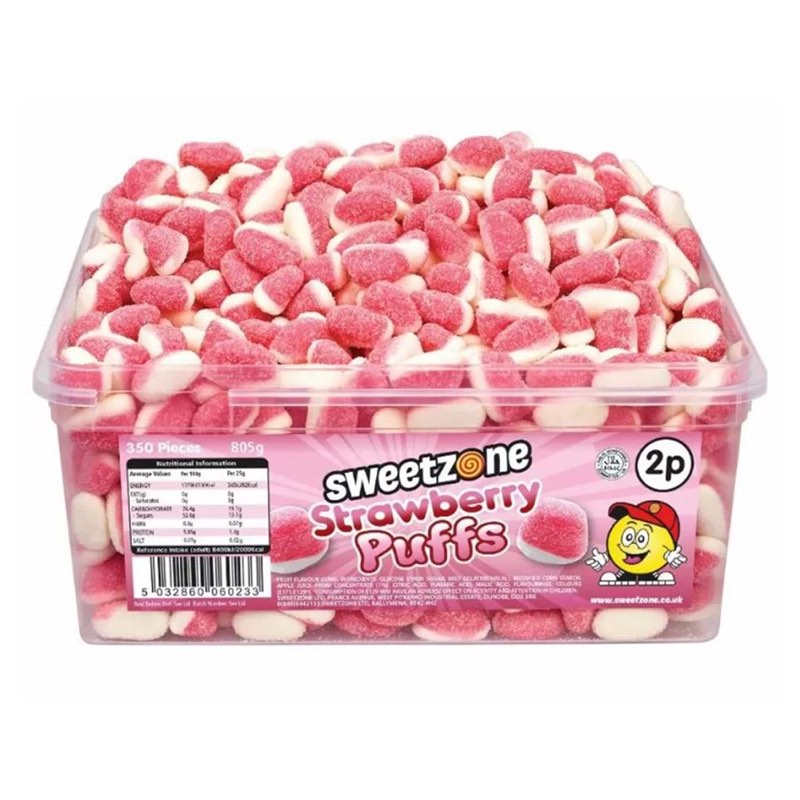
Within the same brand, the rest of the range moves away from berries in useful directions. The Strawberry Puffs tub at £7.99 takes the strawberry idea into a light format, while the Apple Pencils tub at £10.99 leaves the berry family entirely for something green and sharp.
Parties, film nights and the seasonal table
At a party, jellies are the sweet that is still there at the end, in the good sense. They do not dry out on an open table over an afternoon the way lighter formats do, and they do not go tacky in a warm room the way sugared ones can. If your event runs long — a wedding table from four until midnight, a fête that opens at eleven and clears at four — this is the format to put out first and leave out.
For a film night, the calculation is about pace rather than duration. Dense sweets that take a few seconds to eat slow a bowl down considerably compared with anything that dissolves, which means a bowl of these will survive a feature film where a lighter sweet would not survive the first act. If you want one bowl to last the evening for three or four people, 200g of jellies does it comfortably; if you want to be generous, 300g.
On a seasonal table, red is an easy colour to place — it sits naturally on a Christmas table, a Valentine's spread and a summer party without any effort, which is not true of every colour on the shelf. For a themed table, keep the tub as the reliable element and let a smaller, stranger item do the theming.
For a children's party, hold a quarter of the tub back for the bags. Filling twenty bags at 30g a time from an 805g tub leaves you enough over to put a bowl out as well, which is a rare instance of one purchase covering both the table and the take-home.
Serving and decanting: the small mechanics
Most of the difference between a sweet table that works and one that does not comes down to a handful of unglamorous decisions about containers, and jellies in particular reward getting them right.
Choose the bowl for the grab, not the room. A deep bowl invites a deep hand and empties in a way that surprises the person who filled it. A shallow, wide bowl holds the same weight, looks more generous because more of the surface is visible, and physically limits how much comes out at once. If you only change one thing about how you serve sweets, change the depth of the bowl.
Use something to serve with. Tongs or a small scoop per bowl. It is not ceremony — it is the thing that stops the bottom third of a bowl being the part nobody wants, which is the usual fate of a self-service table two hours in.
Decant in sessions, not in full. Put out what you expect to be eaten and leave the rest in the tub with the lid on. A jelly on a table for an afternoon is fine; a jelly in an open display jar for a fortnight is a different sweet by the end of it.
Match the container to the colour. Red against clear glass is one of the easiest looks in confectionery, and it costs nothing. Against a coloured or opaque container the same sweets read as brown, which is a waste of the one visual advantage this tub hands you for free.
Fill by weight when it matters, by eye when it does not. Kitchen scales are worth ten minutes of your evening if you are building more than about ten bags, because eyeballing dense sweets produces a wide spread between the first bag and the last, and children compare bags with a precision adults never manage.
Keep a reserve out of sight. The tub itself is the reserve. An event where the bowls are refilled once feels abundant twice, and the whole reason to buy 805g in a resealable container rather than a large bag is that the reserve stays in good condition until you need it.
£8.99 for 805g, and what the extra pound buys
The base number is £1.12 per 100g, or about £11.17 a kilo. Every calculation below comes off that.
Most of the 805g Sweetzone tubs sit at £7.99, which is 99p per 100g, so this one carries a premium of exactly a pound on the tub, or about 13p per 100g. Whether that is worth paying is not a question about value, it is a question about texture. Per gram, foam and jelly are not comparable products: one is eaten several at a time and gone in seconds, the other is eaten one at a time and occupies you. Measured by how long 805g lasts in a real household, the denser tub almost always outlasts the lighter one by a wide margin, and the extra pound disappears inside that difference.
Measured as gifts, the pound is close to invisible. Split into eight jars it is 12.5p a gift. Split into sixteen small bags it is around 6p each. If you are dividing a tub at all, the choice between a £7.99 tub and an £8.99 one should be made entirely on what you want in the jar.
Measured against the smaller bags on the site, the tub wins easily: most of the £5.49 lines listed nearby come in well under 500g, so a tub at 805g is a different class of buying altogether. And against the largest tub in the range — the 1100g Fizzy Rainbow Pencils tub at £11.49, which works out at about £1.04 per 100g — this one is slightly dearer per gram and considerably smaller overall, which is the trade-off between a tub that fits in a cupboard and one that dominates it.
One more way to look at it, for households rather than event planners. At a 40g portion twice a week for two people, 805g is about five weeks. At a 30g lunchbox portion five days a week, it is about five and a half weeks. At a 200g film-night bowl every Friday, it is four weekends. Pick the line that matches your house and you will know whether one tub is a month or a fortnight, which is more useful than any price per kilo.
Storing a jelly tub properly
Jellies are easier to keep than most formats, with two specific vulnerabilities: warmth and moisture.
Warmth makes them soften and bond to each other, which is how a tub becomes a single mass. Keep it somewhere cool and away from anything that produces heat — not above the oven, not on a sunny windowsill, not in a car boot in summer. A cool cupboard is all it takes.
Moisture makes the surfaces tacky and encourages sticking. Keep the lid properly closed rather than resting on top, and do not decant into a container that has been recently washed unless it is completely dry inside.
Do not refrigerate them. Cold makes jellies hard and rubbery to bite and dulls the flavour considerably, and the condensation when they come back out causes the exact stickiness you were trying to avoid. Room temperature, in the dark, with the lid on.
If the sweets have clumped, leave the tub somewhere cool for an hour and then shake it firmly rather than pulling them apart by hand — jellies stretch before they separate, and forcing them leaves you with misshapen sweets. For a mix you have built yourself, store it in the container you built it in rather than transferring it, since every transfer redistributes dust and breaks surfaces.
When the tub arrives, read the manufacturer's own printed information on the packaging, including the date. That packaging is the only reliable source for what is in these, and anyone with an allergy or intolerance in the household should check it before anything is opened. Sweets are a treat rather than everyday food, and small hard sweets and whole gummies are a choking risk for young children, who should be supervised while eating them.
One size, and picking between the tubs
There is a single option on this listing — one size, £8.99 — so the choosing happens across the range rather than within the product.
| Tub | Price | Per 100g | Pick it when |
|---|---|---|---|
| Juicy Berries 805g | £8.99 | about £1.12 | You want a dense anchor for mixes, gifts and posting |
| Magic Mushroom 805g | £7.99 | about 99p | You want soft and light for a mixed-age room |
| Strawberry Puffs 805g | £7.99 | about 99p | You want one clear strawberry idea, lightly |
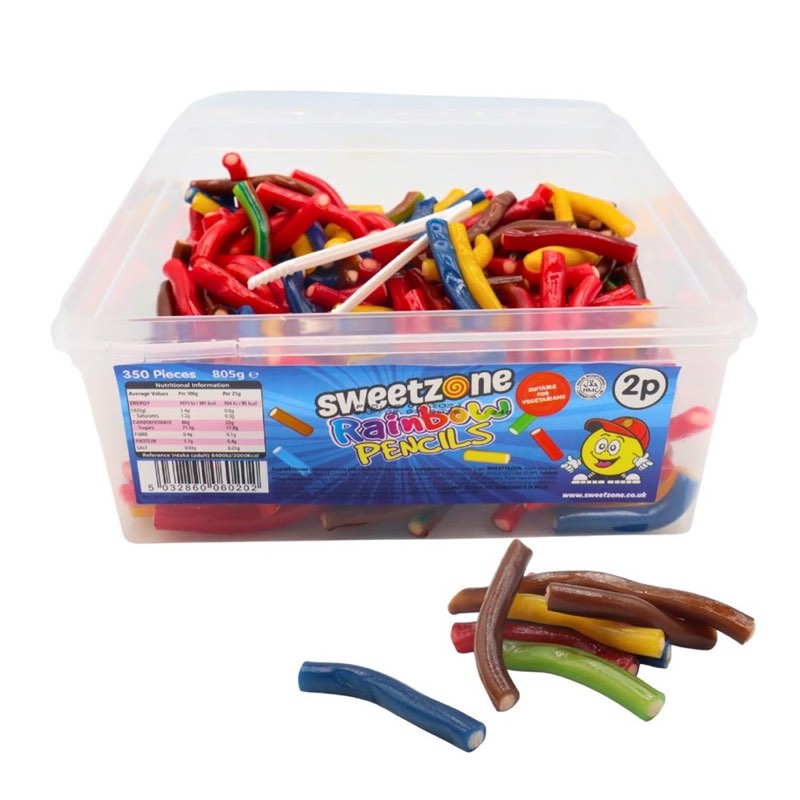
| Rainbow Pencils 805g | £7.99 | about 99p | You want length and chew rather than pieces |
| Sour Twin Cherries 800g | £7.99 | about £1.00 | You want the sharp corner of a table covered |
| Fizzy Rainbow Pencils 1100g | £11.49 | about £1.04 | You need the largest single tub in the range |
| Apple Pencils | £10.99 | — | You want out of the berry family altogether |
The honest summary: if you are buying one tub for a household, buy the texture your household prefers and ignore the 13p. If you are buying two for an event, make them different textures rather than different flavours — the Rainbow Pencils tub at £7.99 alongside this one gives you 1.6kg across two genuinely different eating experiences for under £17, which is a better table than 1.6kg of the same thing at any price.
Where it sits on the site
You will find it on the loose sweets shelf, 356 listings deep, which is where the large-format buying lives. The Sweetzone shelf narrows that to twenty-four listings and is the fastest way to compare the tubs against each other rather than one at a time.
Alongside it, the Haribo shelf and the Kingsway listings cover much of the same mixed-bag territory in different house styles, and anything wrapped or chocolate-led sits under the Candy & Chocolate section, which is the shelf to add from when a table needs something that is not loose. If you are starting from nothing and want to see the whole range at once, every listing we carry is in one place.
Questions shoppers ask before buying a jelly tub
What flavours are in it?
Blackberry and strawberry. Strawberry is the familiar, forward note and blackberry is the darker, quieter one behind it. The pairing is deliberately unequal, which is why the tub reads as one coherent flavour rather than two competing ones — useful when it is going into a mix with other things.
How is a jelly different from a foam sweet?
Density and duration. A jelly resists the bite, takes several seconds to chew, and releases its flavour gradually across that time. A foam sweet collapses immediately and is gone in a moment. In practice that means the same weight of jellies lasts a household considerably longer, and slows down a bowl at a party.
Why is this tub a pound more than the others?
It is £8.99 against £7.99 for most of the 805g tubs, which is about 13p per 100g. The tubs are different formats rather than different grades, so the right way to choose is by texture, not by price. Divided into eight gift jars, the difference works out at around 12.5p each.
How much do I need for a party?
Around 30g a head for party bags or a table with other food, 50g where sweets are the main offer. One tub covers about 26 people at 30g and 16 at 50g. Because jellies are dense, they reach a weight target with fewer pieces than lighter sweets, so bags filled by weight will look smaller than you expect — fill by look if appearance matters more than arithmetic.
Do they post well?
Better than most sweets. They do not melt in a warm van, shatter like a hard sweet or compress permanently like an aerated one. For a shallow parcel, decant into a flat bag rather than posting the tub, and pack hard things at the bottom, jellies in the middle and anything light on top.
Will they stick together?
Only if they get warm or damp. Kept in a cool cupboard with the lid properly closed, they separate cleanly. If they have clumped, cool the tub for an hour and shake it firmly rather than pulling them apart — jellies stretch before they separate and forcing them leaves misshapen sweets.
Can I refrigerate them?
Better not to. Cold makes jellies hard and rubbery to bite, quietens the flavour, and produces condensation when they come back out, which causes the stickiness you were trying to prevent. Room temperature, dark, lid on.
How long will 805g last a family?
Roughly five weeks at a 40g portion twice a week for two people, or four Friday film nights at a 200g bowl. The denser format tends to outlast a light one by some margin at the same weight, simply because people eat fewer of them at a sitting.
Is it a good base for a pick-and-mix?
It is one of the best. A mix needs one substantial, familiar anchor making up roughly 40 per cent of the bag, with the remainder split across a different chew, something sharp, something soft and one novelty. Four to six components in total is the range where a mix stays interesting to the last handful.
Can I use it for party bags and a bowl from the same tub?
Yes, and it is one of the few purchases that covers both. Twenty bags at 30g uses 600g, which leaves around 200g for a bowl on the table. Fill the bags before the party rather than during it.
Do you publish ingredients or allergen information?
Not on this page. The tub carries the manufacturer's own printed information, and that is the only reliable source for it. If there is an allergy or intolerance in the household, read the packaging on arrival before anything is opened.
Is the tub re-usable?
It is a lidded plastic tub, so plenty of people keep it for storing their own mixes, party-bag components or baking supplies once the sweets are finished. It is one of the quiet advantages of the tub format over a bag, along with the fact that sweets arrive uncrushed.
What size bowl should I put out?
A shallow, wide one rather than a deep one. It holds the same weight, shows more of the sweets so it looks more generous, and limits the size of a grab without anyone having to say anything. Add tongs or a scoop, and refill from the tub at the midpoint rather than putting everything out at the start.
Can I mix this with other tubs before an event?
Yes, but not days ahead. Mixed sweets left pressed together in a warm room will soften against each other, and anything with a dusted surface will shed onto its neighbours. Build the mix the day before at the earliest, keep it cool, and store it in the container you built it in rather than transferring it about.
To close
805g of red berry jelly sweets for £8.99 — £1.12 per 100g, about eight decanted gifts, or five weeks in a family cupboard. Its real value is as a base rather than a treat: dense enough to anchor a mixed bag, firm enough to post, stable enough to sit on a table for an afternoon, and familiar enough that it is the handful people are happy to find at the bottom. Build around it with one contrasting chew and one sharp note, keep it cool with the lid on, and check the tub's own packaging when it lands.
More from Sweetzone
More jelly sweets
More strawberry sweets
Where this sits
Sweetzone Juicy Berries Tub 805g appears on these shelves. Browse them, or jump to something nearby.
You might also like