Home / Loose Sweets / Crazy Candy Factory Zombie Brain
Crazy Candy · 120g
Read the full guide
Crazy Candy Factory Zombie Brain
£1.49
✔ In stock — ready to ship
Fresh stock
Free over £20
Same-day dispatch
Secure checkout
Start with the arithmetic, because at this end of the shop the arithmetic is most of the decision. This is £1.49 for 120g in a single size. That is a small note or a handful of change, and it puts the product in the category of things people add to a basket without a conversation. Nobody weighs up a £1.49 purchase. They either want it or they do not.
The useful comparison is against the loose lines, where you buy by weight from a bag. A 120g novelty pack will always look expensive per kilo next to a 1kg bag of anything, and that comparison misses the point entirely. What you are buying here is a single themed item with its own presentation, not a quantity of sweets. It is closer in purpose to a card than to a shop of groceries: the thing itself is small, the effect is in the handing over.
The full guide to Crazy Candy Factory Zombie Brain
5,245 words on how it eats, who it suits, how to serve it and what to put beside it.
What £1.49 actually buys
For party-bag planning, this is the price point that makes the maths work. Twelve children at £1.49 is £17.88 for the headline item in every bag — the thing the child actually looks at first. Compare that with trying to achieve the same effect with a boxed item at three or four pounds each, and the reason novelty lines sit where they do becomes obvious. A themed pack is the cheapest way to make a bag look like it was assembled rather than filled.
For a Halloween table, think in terms of visible units rather than grams. A single pack is one object on a table. Three or four packs arranged together become a display. Ten packs in a bowl with the wrappers showing become a shop-style pile that children will work through in an hour. At £1.49 a unit you can afford the pile, which you could not at four pounds a unit, and the pile is what makes the table look right.
For a household treat, the 120g size is roughly a bowl's worth rather than a cupboard's worth — an evening's supply for a couple of people, or a week of small rations for one child if you are the rationing sort. That is a deliberate size. It is big enough that the pack feels like something and small enough that it does not need storing carefully for a fortnight afterwards.
There is also the stall and the fundraiser use, where you are buying to sell on or to hand over. Single-price novelty lines are the easiest thing in the world to run a table with: one price, no weighing, no bags, no scales, no arguments. If you are running a school stall and want something that a child can buy with their own money and feel they have made a real purchase, a themed pack at this price is exactly the right shape of thing.
Where the value case is weakest is bulk catering. If you need to fill four large bowls for a party of forty, individual small packs are not the economical route and never will be — that job belongs to weighed-out lines, and the 356 loose lines we stock are where the cost per head comes down properly. Use the novelty packs as the top layer of that table rather than as its foundation.
The honest summary on value is that this is priced as an impulse and behaves like one. Nobody is going to feel they have been clever about buying it, and nobody is going to feel stung either. £1.49 is the amount of money where the decision is about whether you want the thing, and not about what it costs.
The pack in front of you
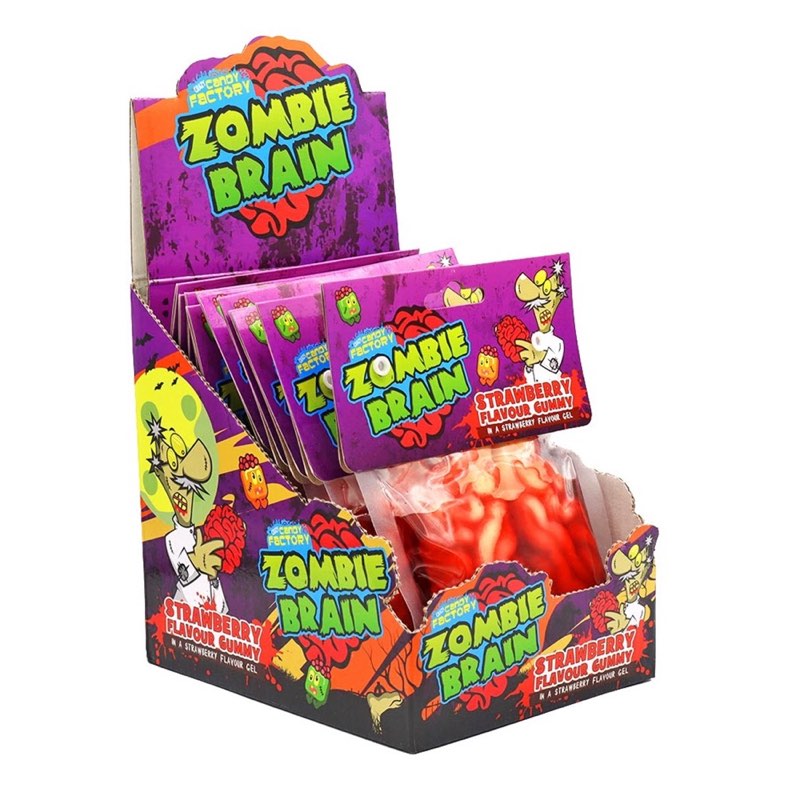
What you have is a themed novelty pack at 120g, red, under the name Zombie Brain. There are two images on the listing rather than the single shot most lines carry, which tells you the presentation is part of the product here rather than an afterthought — this is a line where what it looks like is doing real work.
Red is the entire visual proposition and it is well chosen for the theme. Of all the colours available to confectionery, red is the one that does the most from a distance: it advances rather than recedes, it reads clearly under the bad lighting of a village hall or a school corridor, and it is unambiguous in a way that an orange or a green is not. On a Halloween table, red is the colour doing the storytelling.
The name is doing the rest. Zombie Brain is a piece of deliberate comic horror, which is a very specific register: it is not trying to frighten anyone, it is trying to make a nine-year-old laugh and pull a face at the same time. That distinction matters when you are choosing what to buy for children, because genuinely macabre themes make some parents uncomfortable and cartoonish ones almost never do. This sits firmly on the cartoon side.
In the hand, a 120g pack is a proper object — noticeably more substantial than the small 20g and 25g novelty boxes that sit at the pound mark, and small enough to disappear into a coat pocket or the bottom of a party bag. That size is the sweet spot for the party-bag trade: large enough to be the item a child notices, small enough that twelve of them do not fill the boot of a car.
The line is in stock and comes in one size only, at £1.49, so there is no decision to make beyond how many you want. That is a relief in a category where a lot of listings offer five weights and turn a novelty purchase into a spreadsheet exercise.
What we can tell you about eating it, and what we will not guess
We hold a flavour for this line and we do not hold a texture classification, so we are going to be straight with you about both rather than inventing the missing half. The flavour on the listing is strawberry. The sweet type is not specified, which means we are not going to tell you whether it is chewy, soft, hard or anything else — if you want that level of detail before buying, the manufacturer's own packaging will carry it when the pack arrives.
What we can talk about usefully is strawberry, because flavour behaviour is largely independent of format and it is the thing that determines what you put next to it.
Strawberry in confectionery is a bright, high, immediately recognisable note. It arrives fast — faster than almost any other fruit flavour — and it announces itself before you have made any decision about what you are tasting. That speed is why it is used so heavily for children's lines and for anything that needs to make an impression in a single mouthful. It is also why strawberry is the flavour most likely to dominate a mixed bowl if you put too much of it in.
It sits high in the flavour range rather than deep. Where chocolate, toffee and liquorice occupy the bass end and fill in underneath a mix, strawberry occupies the treble and sits on top of everything. A spread with nothing but high notes in it feels thin after twenty minutes, which is the practical argument for pairing strawberry items with something darker rather than with more fruit.
The other thing worth knowing about strawberry is that it is the most conservative choice on any children's table. Whatever else is refused, this will not be. If you are buying for a group you do not know, a red strawberry item is the safest thing in the shop, and that is exactly why so many novelty lines use it: the theme carries the interest and the flavour carries no risk.
On the red colour specifically, there is a well-documented effect worth knowing. People identify flavours considerably more accurately and more confidently when the colour matches their expectation, and red primes a fruit reading before anything reaches the tongue. The colour is not decorative; it is part of how the flavour is delivered.
Which era of the sweet counter this comes from
Novelty horror sweets belong to a very particular corner of the trade, and it is a more interesting corner than it first appears. The tradition is the gross-out sweet: the item bought not because a child wants to eat it but because a child wants to show it to somebody. That is a completely different purchase motivation from flavour, and it has been part of the shop-doorway economy for as long as there have been shops with a low shelf at child height.
Picture that shelf. The items at the front are the ones with the strongest idea rather than the best contents: shapes that look like things they should not, colours that do not occur in food, packaging with a joke on it. What a child is buying there is social currency. The sweet is a prop. You buy it, you show it to three people, somebody says that is disgusting, and the transaction has already paid for itself before anything is eaten. Zombie Brain is a direct descendant of exactly that shelf.
The counter this belongs to is the one where small change was the unit of account — where a child arrived with whatever they had, and the whole shelf was arranged so that almost everything on it was within reach of a small amount of money. The pricing logic of novelty confectionery has never really changed since: the item must cost about what a child can carry, because the child is the one making the decision.
The horror theme itself has a long run behind it. Sweets that play at being frightening have appeared in every generation of the shop, and they follow whatever the children's culture of the moment finds funny. The names change, the aesthetic changes, the joke does not. A sweet that pretends to be something unpleasant is a reliable seller because the pleasure is in the pretending rather than in the thing pretended at.
Halloween is the season that carries this whole category now, and it has become a far larger sweet event in Britain than it was a generation ago. That growth has changed what people buy: where a Halloween table once meant a bowl of ordinary sweets and a paper decoration, it now means themed items bought specifically for one evening. Novelty packs with names like this are the beneficiaries of that change, and it is why the seasonal end of the shop expands every autumn.
The other thing about nostalgia in this part of the shop is that it is short-cycle. Chocolate nostalgia goes back decades; novelty nostalgia refreshes every ten years or so, because each cohort of children has its own set of gross-out favourites and does not much care what the previous one liked. So the adults buying these are usually not buying their own memory. They are buying the current version of an idea they recognise from their own childhood, which is a subtly different and more generous act.
Within the same maker's range, the companion piece to a brain is a bone. Crazy Candy Factory Bone Breaker at £1.00 is the smaller, cheaper sibling in the same comic-horror register, and the two together make a set rather than two separate purchases — which is exactly how they get bought for party bags.
The wider tradition of the shape-as-joke is alive well beyond the horror shelf, and some of the best examples are entirely wholesome. Kingsway Filled Whales at £5.49 and Hannah's Animals at £5.49 are the friendly end of the same idea: a sweet that is a character before it is a flavour. Children have always bought characters, and the shelf has always known it.
And for the oldest end of the counter — the plain, dark, unglamorous lines that were on the shelf before any of this and are still there — Briquette at £5.49 is about as traditional as loose confectionery gets. It is worth having one such item on any nostalgia table for the sake of the one guest who wants it.
The sour-to-sweet spectrum and where to place this
Half of building a good sweet spread is understanding the sour axis, because it is the one variable that changes how much people eat and how long they stay interested. Here is the map, and where a strawberry novelty pack sits on it.
The far sweet end is chocolate, mallow, foam, fudge and toffee. These are rich, they coat the mouth, and they satisfy quickly. Nobody eats a large quantity of them in one sitting without stopping. They are the anchor of a table rather than its engine.
The plain fruit middle is where most jellies, gums and fruit-flavoured novelty lines sit, and it is the broadest part of the range. The defining characteristic is that the flavour is bright and the finish is clean, so the mouth resets quickly and people keep going. This is the part of a table that actually gets eaten.
The lightly sour band adds a tartness that cuts the sweetness without becoming an event in itself. This is the most useful zone on any mixed table, because a small amount of sourness makes everything around it taste more of itself, and because almost nobody dislikes it. Explicitly sour fruit lines like Dulce Plus Sour Strawberry Rings at £5.49 live here, and one bowl of them will change the character of an entire spread.
The seriously sour end is a different proposition altogether — a dare rather than a snack. These lines get bought for the reaction, not for the eating, and they are a children's-party phenomenon in the same way that horror-themed novelties are. They are best deployed as one bowl among many rather than as the theme of a table, because a spread built entirely out of extremes stops being fun after ten minutes.
Where does this pack go? The listing gives it as strawberry and gives no sour designation, so we place it in the plain fruit middle and we would not sell it to you as a sour item. That is a useful position rather than a dull one: the middle of the range is where the most-eaten items sit, and it means this can go on a table next to anything without fighting its neighbours.
The practical rule for building around a middle-of-the-range fruit item is to reach outwards in both directions. Put something distinctly sour on one side of it and something rich and dark on the other, and the fruit item in the middle becomes the thing people return to between the two extremes. A table with only a middle is monotonous; a table with only extremes is exhausting; a table with all three is the one that empties.
Quantities follow the same logic. Your middle-of-the-range items should be the largest volume on the table because they are what people eat most of. Your sour items should be a bowl, not a tray — a little goes a long way and the bowl is largely there to be talked about. Your rich items should be modest, because nobody eats many of them, and they are the ones most likely to be left over.
Order of service matters too, if you are the sort of host who thinks about it. Sour first wakes the palate up and makes everything afterwards taste stronger. Sour last leaves people with a clean mouth and, oddly, more inclined to have another. Sour in the middle of a rich run is the reset that keeps a long evening going. All three work; what does not work is having no sour at all, which is the most common fault in a home sweet table.
For the fruit-flavoured backbone of a spread, the 78 lines under the strawberry flavour shelf are one obvious hunting ground, and the wider fruit flavour hub is where to go if you want the same brightness across a spread of different fruits rather than one repeated note.
Strawberry across the shop
Because strawberry is the most-used flavour in children's confectionery — we have 78 lines carrying it, which you can see gathered together on the strawberry listing — it is worth knowing which of its versions do what, so that a table does not end up with four bowls of the same idea.
The confectionery strawberry — the bright, high, sweet one — is what most novelty lines use, and it is the version this pack is listed under. It is recognisable instantly and it is designed to be, and it pairs well with anything in the same register: bubblegum, cola, cream flavours and other red fruits.
The wild-berry version is a darker, slightly deeper reading of the same fruit, and it changes the balance of a bowl noticeably. BUBS Wild Strawberry & Pomegranate Ovals at £7.50 are a good example: recognisably the same fruit family, but with enough depth behind it that the two versions side by side taste like two different things rather than a repetition.
The gum and bubblegum version combines strawberry with a long, slow release, which is a different job again. Hubba Bubba Mega Long Strawberry Bubblegum at £1.59 sits at almost the same price as this pack and is the natural partner for it in a party bag — same flavour family, same price band, completely different duration.
The many-flavours-at-once approach is the opposite strategy and a valuable one on a table, because it gives people something to compare against. A 70g bag of Jelly Belly's 20-flavour assortment at £2.40 turns a bowl into a guessing game, and a guessing game will hold a group of children far longer than any single flavour can.
Finally there is the mixed-fruit staple that every table needs as its quiet volume item — recognisable, uncontroversial and bought in a size that fills a bowl properly. Haribo Friendship Rings at £8.99 for 480g is the standard answer, and it is the sort of line that quietly does eighty per cent of the eating while the novelty items get all the attention.
Building a Halloween table around a novelty pack
A themed pack is a starting point rather than a plan. Here is how we would build outwards from one.
First, decide whether the table is a theme or a spread. A theme means everything on it obeys the idea — colours restricted to red, black, orange and green, shapes restricted to the macabre, names doing half the work. A spread means ordinary sweets with a few themed items placed on top. Themes photograph better and cost more; spreads feed more people for less. Most households end up doing a spread and calling it a theme, which is entirely sensible.
Second, get your colour blocks right. Halloween is a four-colour palette and the mistake people make is to spread those colours evenly. Block them instead: a bowl of red, a bowl of orange, a bowl of something dark. Blocks of colour read as decoration from across a room in a way that a mixed bowl never does.
Third, include at least one item that is a joke rather than a flavour. That is what this pack is for, and what its smaller stablemate is for — the £1.00 Bone Breaker pack is the cheapest way to add a second gag to a table without adding a second bowl.
Fourth, include one activity item, because a table that children can do something with beats a table they can only eat from. Build-it-yourself kits are the obvious route: the Fuji Candy DIY Handmade Ferris Wheel Kit at £2.99 gives you a construction project that occupies considerably longer than eating anything does, which is worth real money at a party.
Fifth, include something unfamiliar for the older children, who have seen everything on a standard table before and will announce as much. Fini Mini Mochis at £1.35 are exactly the sort of thing that gets picked up and investigated rather than simply eaten, and at that price it is a cheap way to add novelty for the group that is hardest to impress.
Sixth, have a volume line underneath everything. The themed items are what people look at; the volume line is what they actually eat. Buy it loose and by weight, put it in the largest bowls, and let the novelty packs sit on top as the visible interest. If you want to shop for that layer directly, the mix-your-own shelves are arranged for building exactly this sort of spread.
Seventh, keep a few packs sealed and aside. There is always a child who arrives late, a sibling who did not come, or a parent who needs something to hand over on the doorstep. Sealed single packs are the only items on a sweet table that can be handed over intact at the end of the evening, and they are the ones that save you.
Occasions beyond Halloween
Party bags, all year round. A themed pack is the item a child pulls out first, and at this price it can be the headline of every bag without the total getting out of hand.
Reward jars and treat drawers, where the size is the advantage: 120g is enough to feel like something and not so much that it becomes a week's supply that needs policing.
Stocking fillers and advent-style calendars, where small themed packs in the £1 to £2 range are the workhorses. The horror theme is not seasonal in a child's estimation — a zombie is funny in December as well as October.
Cinema and car journeys, where a single pack that is opened once and finished is easier to manage than a bag that needs rationing, and where you know exactly what has gone into the back seat.
School stalls and fundraisers, because a single-price line requires no scales, no bags and no explaining. One price, one item, a queue that moves.
Film nights with a horror theme, where the decoration budget is nil and the sweets are the set dressing. A few of these on a coffee table do more for the atmosphere than any amount of effort elsewhere.
Who this is for
Children between about six and twelve are the obvious audience, because that is the age at which a gross-out joke is at peak value and the age at which social currency in the playground is a real consideration.
Parents buying a dozen party bags, for whom the price, the theme and the single-size simplicity together solve a problem that would otherwise take an evening.
Anyone who wants one themed item on an otherwise ordinary table, which is most households in late October. A spread of normal sweets plus three novelty packs reads as a themed table at a fraction of the cost of a properly themed one.
Adults with a taste for the daft, who are a larger group than they admit to. Office Halloween, a horror film marathon, a flatmate's birthday — a comically named pack does work at any age as long as nobody is taking it seriously.
Less suited to: anyone catering for volume, who should be buying weighed lines instead, and anyone who needs to know the texture before purchase, since we do not list a sweet type for this line and are not going to invent one.
One size, and what that means
There is a single option here — 120g at £1.49 — and the only decision is quantity. That makes it one of the simplest things in the shop to buy in multiples, because the maths is a straight multiplication and there is no per-kilo comparison to run.
For a party, count heads and add two. For a table, buy three or four so that they can be grouped rather than sitting alone, since a single novelty pack on a big table looks stranded while a cluster looks intentional. For a treat cupboard, one at a time is the point of the format.
If you want a companion pack rather than more of the same, the 25g Bone Breaker box from the same range gives you a second theme at a lower price, and the two together cover a party bag's novelty requirement for under two pounds fifty.
Keeping it in good order
Store the pack sealed, somewhere cool, dry and out of direct sun. That is the whole of the advice for an unopened novelty pack and it is genuinely all that is required — the packaging is doing the work, and the enemy is heat and light rather than time.
Avoid the car glovebox as a long-term home, tempting though it is. A glovebox in summer gets considerably hotter than any room in a house, and heat is what damages sweets faster than anything else.
Once opened, treat it as an open pack of anything: use a clip or move the contents to a sealed container if it is not going to be finished the same day. Loose sweets exposed to air change texture, and no amount of careful storage afterwards brings that back.
Keep it away from strongly scented things in a cupboard. This matters more for opened packs than sealed ones, but it is a good habit either way.
If you are buying several packs ahead of an event, keep them in their own box rather than loose in a cupboard, and keep the box off any surface that gets warm. Sealed packs will happily wait weeks that way.
Where this sits in the shop
This is filed with the loose and small-pack lines rather than the boxed confectionery, and by flavour it sits with strawberry, which is one of the biggest flavour shelves we have. Those two routes will get you to most of its natural neighbours.
The adjacent shelf worth knowing about is the wider fruit flavour grouping, which is where to go if you want the same brightness spread across several different fruits rather than four bowls of the same one. Beyond that, the Candy & Chocolate hub is the overview page — the right place to start if you are building a table rather than buying one thing.
If you would rather see the whole lot and narrow it down yourself, the full range is there, and the usual route people take is flavour first, then price, then size. For seasonal shopping specifically, working from the weighed-out lines for volume and adding small themed packs on top is the approach that gets the best-looking table for the least money.
Questions people ask
What flavour is it?
Strawberry — that is what the listing carries and it is the one flavour note we can give you with confidence. In confectionery terms that means a bright, high, immediately recognisable fruit flavour that arrives fast and finishes clean, which is the most universally accepted flavour on any children's table and the reason so many novelty lines use it.
Is it sour?
We do not list it as a sour line, so we are not going to tell you that it is. Treat it as sitting in the plain fruit middle of the range rather than at the sour end. If sourness is what you are after specifically, buy something that is described as sour on its own listing and put the two on the table together — the contrast does more for a spread than either does alone.
What texture is it?
We do not hold a sweet-type classification for this line, and rather than guess at chewy, soft or hard, we will point you at the manufacturer's own packaging, which carries that detail and will be in your hands when the order arrives. What we can tell you is the size, the colour, the flavour and the price, which is enough to decide whether it belongs on your table.
How much is in a pack?
120g, in a single size, at £1.49. There is no larger or smaller version of this line, so buying more means buying more packs — which is straightforward for party planning since the cost is a simple multiplication with no per-kilo comparison to run.
Is it too scary for young children?
The register here is comic horror rather than genuine horror — a name and a theme designed to make a child laugh and pull a face, not to frighten anyone. That is the traditional territory of the gross-out sweet and it is a long way from anything genuinely macabre. Whether it suits a particular child is a judgement for the adult buying, but nothing about the presentation is aiming to unsettle.
Is it good for party bags?
It is close to purpose-built for them. A sealed pack survives being handled, it is the item a child notices first, and at £1.49 you can afford to put one in every bag. Twelve bags is under eighteen pounds for the headline item, which is a proportion of a party budget most people can live with.
Is it in stock?
Yes, this line is showing as in stock. Seasonal novelty items move quickly in the autumn, so if you are buying for a fixed date it is worth ordering a couple of weeks ahead rather than in the last few days, when the whole category is under the most pressure.
Is it suitable for children generally?
Sweets of any kind are a treat rather than everyday food. Small hard sweets and whole gummies are a choking risk for young children and should always be eaten with an adult present. If anyone in the household has an allergy, check the manufacturer's own packaging when the order arrives and before anything is eaten, since that packaging is the authoritative source for what is in the product.
What goes with it on a table?
Something sour on one side and something dark and rich on the other, with a large bowl of an ordinary crowd-pleasing line underneath the lot. A bright fruit item in the middle of that arrangement becomes the thing people keep returning to. Keep the colours in blocks rather than mixing everything, because blocks read as decoration from across a room.
How should I store it before an event?
Sealed, cool, dry and out of the sun, in a box of its own rather than loose in a warm cupboard. That is genuinely all that is needed for unopened packs, and stored that way they will happily wait several weeks. Avoid the car, which gets hotter than anywhere in a house.
Is there anything else in the same range?
There is a smaller companion pack at £1.00 in the same comic-horror register, which is the obvious thing to buy alongside if you want two gags rather than one. The two together cover the novelty requirement in a party bag for a very modest sum, and they look deliberately matched rather than randomly assembled.
Can I use it as a stocking filler?
Yes, and it works better than people expect. A zombie joke is not seasonal in a child's estimation, and a small themed pack in the £1 to £2 range is exactly the format that stockings and advent drawers are built around. The sealed pack is the useful property: it survives being packed, moved and hidden for weeks.
In short
This is a £1.49 novelty pack doing the oldest job in the sweet shop: being a joke you can eat. At 120g it is substantial enough to be the headline item in a party bag, cheap enough to buy a dozen of, and bright enough in red to do real work on a themed table. The flavour is strawberry, which is the safest thing you can put in front of a group of children you do not know, and the theme is comic rather than genuinely grim.
Buy one for the joke, a dozen for the party bags, or three or four to cluster on a table where a single pack would look stranded. Put a weighed-out volume line underneath it, something sour on one side and something dark on the other, and the table will look considered without costing what a genuinely themed spread would. Everything we stock is one page away if you want to build the rest of it in the same order.
More strawberry sweets
More loose sweets sweets
Where this sits
Crazy Candy Factory Zombie Brain appears on these shelves. Browse them, or jump to something nearby.
You might also like