Home / Pick & Mix / Baby Shower 'It's a boy' Pick & Mix Sweet Mega Jar
pick and mix · 2000g
Read the full guide
Baby Shower 'It's a boy' Pick & Mix Sweet Mega Jar
£25.99
✔ In stock — ready to ship
Fresh stock
Free over £20
Same-day dispatch
Secure checkout
There is a particular hour at a baby shower when the room needs something to do with its hands. The arrivals are done, the coats are somewhere, the cards have been read out or pointedly not read out, and there is a stretch of time before whatever comes next — the food, the games, the cake, the long conversation with an aunt about hospital parking. That hour is what a two-kilo sweet jar is actually for. It gives people a reason to drift back to the same corner of the room, it gives the host something to point at, and it keeps working for hours without anybody having to top it up, carve it, plate it or apologise for it.
The Baby Shower 'It's a boy' Pick & Mix Sweet Mega Jar is £25.99 for 2,000 g, in one size, and it is in stock as we write this. Two kilos is the number to hold on to, because it is the number that decides everything else on this page — how long it lasts, how many people it feeds, whether it belongs on a side table or a main table, and whether you need anything else on the spread at all. It is a genuinely large amount of sweets. It is not a gesture. A lot of the items people compare it against are a third of the weight and half the presence.
The full guide to Baby Shower 'It's a boy' Pick & Mix Sweet Mega Jar
5,874 words on how it eats, who it suits, how to serve it and what to put beside it.
The afternoon this jar was built for
We should be straightforward with you about one thing immediately, because it shapes how this page is written. We are not going to print a list of what is inside. This is a pick and mix jar, listed on our Pick & Mix shelf alongside the rest of the build-your-own range, and the selection is something set at the point of ordering rather than fixed by us in a paragraph of marketing copy. Anything we invented here would be a guess dressed up as a fact, and a guess is worth nothing to somebody planning a table for twenty-five people. So this page is about the format, the occasion and the choosing — the parts we can actually be useful about.
Occasions, ranked honestly by how well the jar performs
Not every event is improved by a two-kilo jar. It is worth being blunt about where it shines and where something smaller would do the job better, because a jar bought for the wrong day sits half-full on a worktop for a fortnight and slowly stops feeling like a treat.
The baby shower itself
This is the obvious one and it is also the one the format genuinely suits, for reasons that have nothing to do with the label. Showers tend to run long, tend to have a wide age range in the room, and tend to involve a lot of standing. A jar handles all three. Guests who do not know each other will happily talk over a sweet jar in a way they will not over a plated dessert, because reaching into a jar is a low-stakes, repeatable action — you can do it three times in an hour without it being a comment on you. Set it at roughly elbow height on a side table rather than in the middle of the food, and it becomes a station people move towards rather than a course people wait for.
The gift, sent rather than carried
A mega jar works as the whole present, not the thing you bring alongside the present. At £25.99 it sits at a price point people recognise as a proper gift rather than a token, and it has the advantage of being obviously generous on sight, which cards and vouchers are not. If you are sending it to expectant parents rather than turning up with it, the jar's other virtue shows up: it does not need refrigerating, it does not need eating that week, and it does not add to the pile of things that need washing, assembling or finding a shelf for. It also survives being opened late. Nobody is offended by a jar that got put away for a fortnight.
The gender reveal, and the table that goes with it
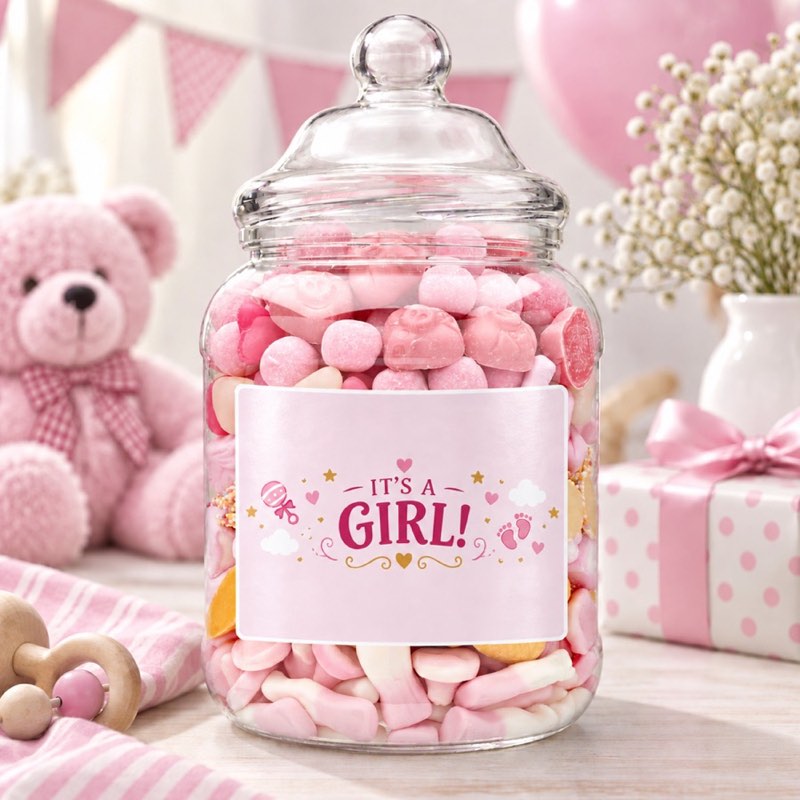
If the jar is doing duty at a reveal rather than a shower, the practical question is what sits next to it. The honest answer is its counterpart: the 'It's a girl' mega jar is the same 2,000 g at the same £25.99, and two matching jars either side of a table is the neatest solution anybody has found to the problem of decorating for an answer you do not yet have. Buy both, open one, and the other is a perfectly good jar of sweets for the following weekend. Nothing is wasted except the label.
The hospital-bag-era thank you
Midwives, ward staff, the neighbour who took the dog, the friend who did three school runs in a week. A jar of this size can be decanted into smaller bags and distributed, which is a use people do not think of until they are standing in front of one. If that is the plan from the start, though, buy for the plan: a handful of 250 g snack pouches at £5.49 each arrive already bagged and already sealed, and save you an evening with a roll of ribbon.
Where it is the wrong tool
Two kilos is too much for a household of two who want a treat for the weekend. It is too much for a car journey. It is too much for a single film night unless the film night has eight people at it. And it is the wrong shape for anything that needs carrying between venues — a jar of this weight is a two-handed object, and the last thing you want on the day is to be walking it across a car park. For those jobs, the pouches exist. A 500 g mini pouch at £9.99 covers a family weekend without leaving a fortnight of leftovers, and it lies flat in a bag.
What arrives, and what two kilos actually looks like
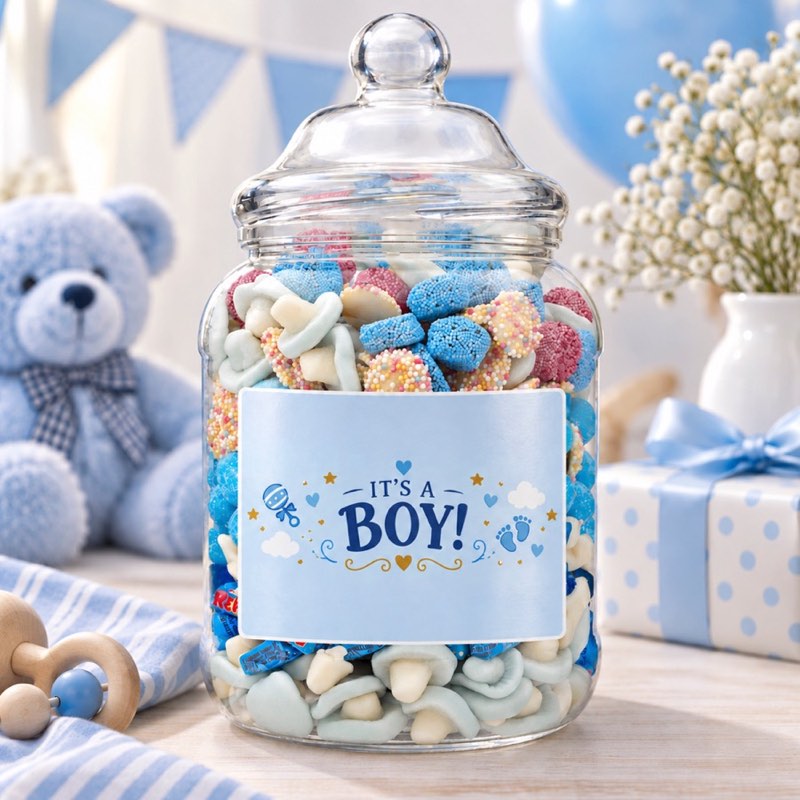
People underestimate 2,000 g. The number is abstract until it is on a table. Two kilos of mixed sweets is a substantial, heavy object — the kind of thing you set down deliberately with both hands rather than carry across a room while talking. It has presence on a table in a way that a bag never does, and that presence is a good part of what you are paying for. A pouch of the same weight is a flat, folded, slightly slumped thing; a jar is architecture. It stands up, it holds its shape when it is half empty, and it looks intentional from the other side of the room.
There are two photographs on the listing, and they are worth looking at before you order, because a jar is a product where the proportions matter and where people's mental image is usually of something smaller. The lid is part of the appeal and part of the function: it goes back on. That sounds trivial and it is the single most practical difference between a jar and everything else on a party table. A resealable container is the reason the jar is still good on Tuesday when the sandwiches are not.
Handle it the way you would handle anything heavy and rigid. Set it down on a flat surface rather than a tablecloth edge, keep it back from the edge if there are small children at chest height with the rim, and if it is going on a decorated table, put it in position before you dress the table rather than after. Nobody enjoys lifting two kilos over a laid-out spread.
A collector's eye: why the novelty format is the product
There is a way of looking at sweets that has very little to do with eating them, and it explains this jar better than any description of its contents would. Call it the collector's view. It is the instinct that makes somebody buy the tin rather than the bag, keep the box after the chocolates are gone, or photograph a shelf in a sweet shop they are never going to visit again. It is not about flavour at all. It is about format, occasion and scarcity — and an occasion-labelled mega jar sits squarely inside it.
Occasion-labelled formats are, by their nature, short runs
A standard bag of sweets is made continuously and will be there next year in the same livery. An occasion format is not like that. It exists because a particular kind of day exists, and its whole reason for being is that it is only right for a few weeks of anybody's life. That is what makes it interesting to a collector's eye, and it is also why these formats tend to appear, change and quietly disappear rather than sitting on a shelf unchanged for a decade. The label on a jar like this is doing the same job that a seasonal shape does at Easter or Christmas — it is marking a moment rather than describing a product.
This has a practical consequence for shoppers that is worth saying plainly: if you like the format, buy it for the occasion you have, not for an occasion you might have. Occasion lines are the most changeable part of any sweet shop's range, and that is true of ours as much as anybody's. The Happy Birthday mega jar, twenty fillings for the same £25.99, and the Best Teacher Ever mega jar at that same price are the two closest relatives of this one, and the three of them together show the pattern clearly enough: one container, one price, and a label that decides which day of your year it belongs to.
The container outlives the sweets, and that is not a small thing
Collectors of sweet packaging — and there are more of them than you would think — are really collecting containers. The sweets are consumable and gone; the tin, the jar, the box is what stays. It is worth thinking about a mega jar in those terms when you are weighing the price, because unlike almost every other item in a sweet shop, this one leaves you with an object at the end of it. A two-litre-class jar with a lid is a genuinely useful thing to own. People keep them for flour, for pasta, for craft supplies, for the next round of sweets bought loose by weight. A pouch leaves you with a pouch.
That reframing matters most when you compare across formats at similar money. The 2000 g giant pouch with forty fillings at £28.99 is the same weight of sweets for £3 more, and gives you twice as many separate fillings to choose — a better buy if variety is what you are after and the container is irrelevant. The jar is the better buy if the container is doing a job: standing on a table, being looked at, being handed over, being kept.
Novelty formats and the slow drift of what counts as normal
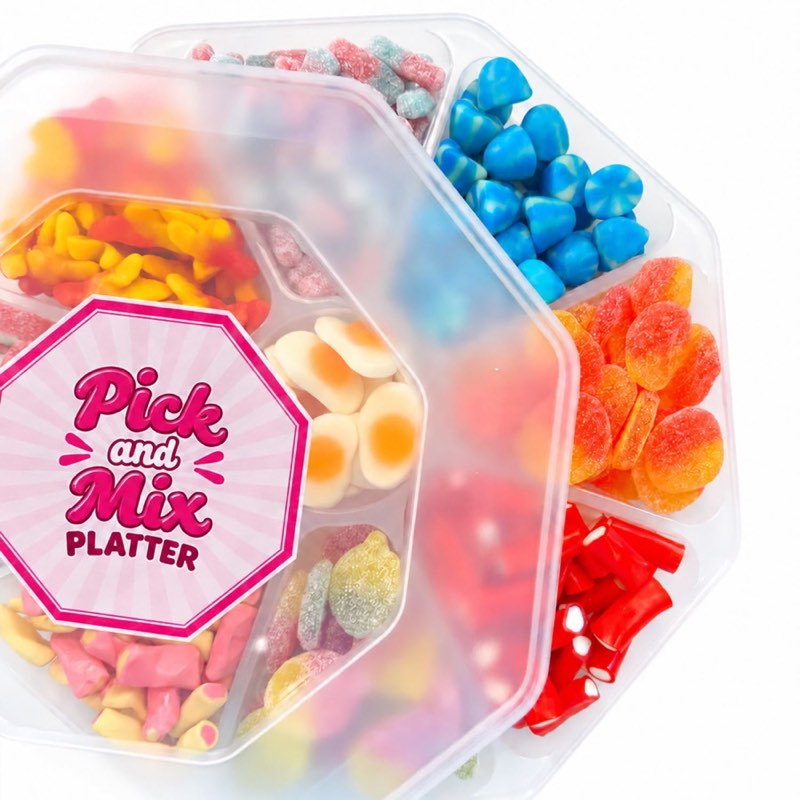
Every novelty format in a sweet shop started as somebody's odd idea and either stuck or did not. Buckets, platters, hampers, tubes, giant single sweets, jars with names on. The ones that stick do so because they solve a real problem that a bag does not. The bucket solved the party-table problem before the jar did — our own Bon Bon Sweet Bucket at £18.99 is a direct descendant of that idea, wide-mouthed and low, which makes it easier for small hands and harder to keep tidy. The platter solved the problem of wanting the sweets visible and separated rather than mixed; the Create Your Own Pick & Mix Platter at £24.99 is essentially a cheeseboard logic applied to confectionery, and it photographs better than anything else we sell.
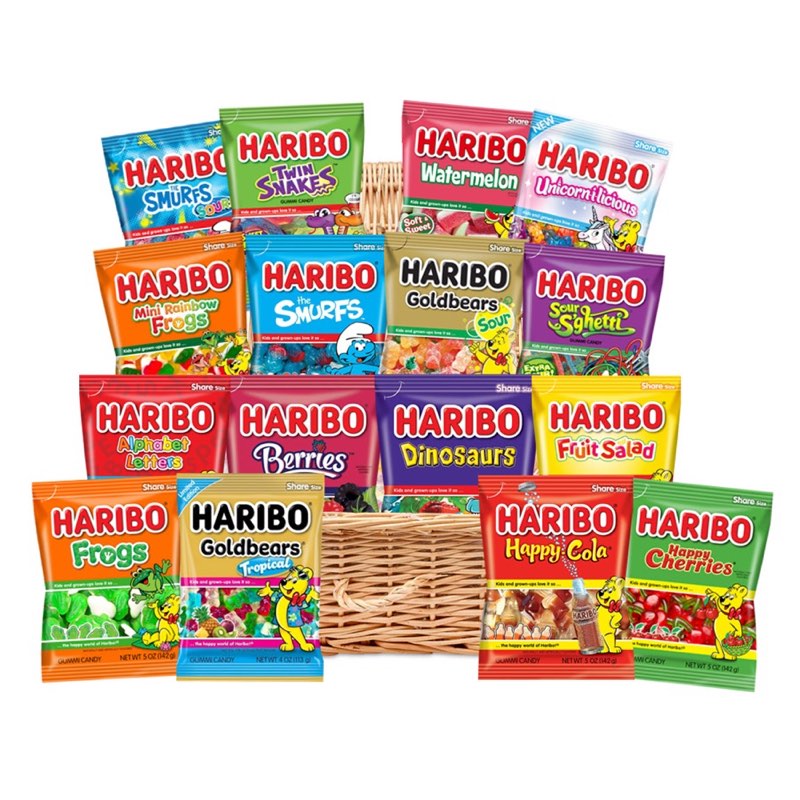
The hamper is the oldest idea of the lot and the most stubbornly popular, because it does something none of the others do: it arrives looking like an event. The £44.99 Haribo International Hamper is the top of that particular tree, and if you are buying for someone at a distance and want the unboxing to be the moment, it beats a jar on theatre even though the jar beats it on table presence. Formats are not better or worse. They are answers to different questions, and knowing which question you are asking is most of the skill in buying sweets for other people.
Two images, one size, and what a collector reads into that
The listing gives one size and one price. There is no small version and no giant version of this particular labelled jar. For a collector's eye, a single-size line is a cleaner thing than a range — there is no agonising over which one is the "real" one, no sense that you bought the compromise. You buy the jar or you do not. If you want the same idea at a different scale, you step sideways into the unlabelled range rather than up and down within this one: the 1,000 g mega pouch with twenty fillings at £16.49 is the half-weight answer, and the 2,000 g giant pouch mentioned above is the same weight in a different shell.
The corner shop, the seaside, and where a jar like this comes from
The second thing worth saying about this jar has nothing to do with babies. It has to do with where the shape came from. The jar on a shelf is the single most recognisable image in British sweet-shop culture, and a mega jar sold for a party is a direct descendant of it — not a modern invention dressed up as nostalgia, but the actual old thing, resized.
The shelf behind the counter
The classic arrangement was a wall of jars behind a counter, out of reach, with a set of scales and a paper bag. You asked, somebody reached, the jar came down, the lid came off, the scoop went in, and the bag went on the scales. Everything about that ritual was about weight and choice: you were not buying a product, you were buying a quantity of a thing you had chosen by looking. That is exactly what a pick and mix is, and it is why the pick and mix format has never really gone away despite every possible attempt to replace it with pre-packed bags. The build-your-own aisle is the part of a sweet shop that most closely reproduces the old counter, and a mega jar is that counter compressed into one object you take home.
What the seaside did to the format
Seaside sweet shops took the jar idea and made it louder. The seafront shop's job is different from the corner shop's: it is selling to people who are out for the day, who are buying a souvenir as much as a snack, and who will happily spend more than they would at home because the whole point of the day is spending a bit more than you would at home. That is where the oversized formats come from — the giant lollipops, the enormous bags, the jars far bigger than any household needs. A two-kilo jar is a seaside object in origin. It is sized for an occasion rather than for a week's eating.
It is also where the labelled jar comes from. Seaside shops have sold jars with names, dates, towns and jokes printed on them for as long as anybody can remember, because a printed label turns a commodity into a memento. An occasion jar for a baby shower is precisely the same move, applied to a different kind of day out.
The pennies, and why cheap things still matter on a big table
The other half of corner-shop culture is the opposite end of the price list: the individual item that costs pennies and exists so that children with pocket money can be customers rather than spectators. That tradition is alive and it matters on a party table more than people expect. Scatter something small and individually wrapped around the base of a jar and the table reads as abundant rather than as a single expensive object. Bond's Milk Chocolate Coins at £1.00 do that job for almost nothing, and they have the advantage of being a shape people pick up without thinking about it. A £5.99 Haribo Fun-Size Treat Box does the same with individually bagged portions, which is useful when you want guests to be able to take something away at the end rather than graze on the spot.
Loose by weight, still the best way to buy
The honest advantage of the old model is that buying loose lets you buy exactly what you like and none of what you do not. That is still true, and it is the entire argument for the pick and mix format over pre-packed bags. Our loose sweets shelves are the largest part of the shop for that reason. If you have never built your own selection, the sensible way in is a small one: a 250 g pouch costs less than a sandwich and teaches you more about your own taste than any amount of reading will.
Choosing the selection: how to balance two kilos
Since we are not going to invent a contents list, let us do something more useful and talk about how to choose one. Two kilos is a lot of decisions, and the mistake almost everybody makes on their first big jar is choosing twenty things they personally love, which produces a jar that is monotonous in a way you do not notice until the third handful. Here is how to think about it instead.
Balance by texture before you balance by flavour
Texture is what makes a mix feel varied; flavour is what makes it feel interesting. They are not the same thing, and texture is the one people neglect. A jar that is entirely soft chews will feel heavy by the fourth piece no matter how many flavours are in it. A jar with something firm, something soft and something that dissolves will feel lively even if the flavour range is narrow. Aim for at least three distinct textures across the selection and you will have a jar people come back to rather than one they try once.
Balance by intensity, and give people somewhere to land
Strong sweets are the ones people remember and the ones that empty slowest, because nobody eats six of them in a row. Every mix needs a mild, unchallenging majority and a small, loud minority. If you weight it the other way round you get a jar that is exciting for two minutes and untouched for the rest of the afternoon. The practical ratio most people settle on is roughly three quarters easy, one quarter bold.
Balance by colour, because a jar is seen before it is eaten
This is the one consideration that is unique to the jar format. In a pouch, nobody sees the mix until it is open. In a glass-clear container on a table, the selection is the decoration. If the day has a colour scheme, the jar is the easiest place in the room to honour it, and if it does not, then a mix with real contrast in it — light against dark, bright against pale — reads better from a distance than twenty things in the same register. It is worth choosing two or three of your twenty on looks alone.
Balance by who is in the room
A baby shower usually has the widest age range of any party you will host: grandparents, small children, and everybody in between. Older guests tend to gravitate to the traditional end of the shelf and younger ones to the sour and fizzy end, and a jar that ignores either group will be visibly half-eaten in one direction. Choose for the room rather than for yourself, and keep at least a few slots for the sort of thing somebody's grandmother would recognise from her own childhood.
A note on children, told plainly
Sweets are a treat and they are best treated as one. Small hard sweets and whole gummies are a choking risk for young children and should only be given under supervision — that is worth saying out loud at a shower specifically, because showers have more small children per square metre than most gatherings and more adults who are not watching them. Put the jar where you can see it, not where a three-year-old can reach it unattended. And if anyone in the room has allergies, they should check the manufacturer's packaging on arrival before eating anything. That is not something we can answer for you on a page, and we would rather say so than guess.
Building the rest of the table around the jar
A mega jar can carry a table on its own, but it carries it better with two or three things around it that do a different job. The principle is contrast: if the jar is tall, put something flat next to it; if the jar is mixed, put something singular next to it; if the jar is help-yourself, put something portioned next to it for the people who would rather take a sealed thing than reach into a shared container.
A platter of sweets laid out in sections is the natural partner, because it is the flat, ordered, separated thing to the jar's tall, mixed, communal thing — and at £24.99 it is a similar level of buy rather than an afterthought. If the shower is running into the evening and you want something that behaves more like dessert, chocolate is the move: a ten-bar chocolate box at £14.49 is enough to put one bar in front of each of a small group, and twenty-five bars for £31.99 turns the same idea into a table centrepiece in its own right. At the top of that range, the thirty-bar chocolate hamper at £42.99 is the version you buy when the chocolate is the main event and the sweets are the supporting act.
For a smaller shower — twelve people in a front room rather than thirty in a hall — the jar plus one pouch is plenty. A 750 g sharing pouch at £12.99 gives you fifteen more fillings to widen the range without adding another large object to the table, and it can be refilled into the jar as the jar goes down, which keeps the display looking full for longer. That trick — a hidden refill pouch under the table — is the single most useful piece of party logistics in this whole page.
£25.99 across two kilos: doing the sums
Here is the arithmetic, because it is the first thing a careful shopper wants and the last thing most product pages give them. At £25.99 for 2,000 g, the jar works out at £1.30 per 100 g. That is the number to compare everything else against.
| Format | Weight | Price | Per 100 g |
|---|---|---|---|
| This mega jar | 2,000 g | £25.99 | £1.30 |
| Giant pouch, 40 fillings | 2,000 g | £28.99 | £1.45 |
| Mega pouch, 20 fillings | 1,000 g | £16.49 | £1.65 |
| Sharing pouch, 15 fillings | 750 g | £12.99 | £1.73 |
| Mini pouch, 10 fillings | 500 g | £9.99 | £2.00 |
| Snack pouch, 5 fillings | 250 g | £5.49 | £2.20 |
Read down the right-hand column and the shape is clear: the jar is the cheapest per 100 g of anything in the build-your-own family, and it is cheaper per gram than the same weight in a pouch despite being the more impressive object. That is unusual. Normally the presentation format carries a premium. Here the premium is going the other way, and the pouch is charging for the extra twenty fillings rather than for the packaging.
Per guest, which is the number that actually plans a party
Cost per 100 g is for comparing. Cost per guest is for deciding. Two kilos across a guest list works out roughly like this: at twenty guests, 100 g each — a generous handful or two over an afternoon, and about right for a shower where there is also food. At thirty guests, roughly 67 g each, which is a decent taste but will look thin by the end if the jar is the only sweet thing on the table. At forty guests, 50 g each, and you want a second item. At twelve guests, 167 g each, which is more than most people will eat and means you are buying leftovers on purpose — not a bad plan if the leftovers are going home with the parents-to-be.
The leftovers are part of the value
A jar is the only party-sweet format where the leftovers are genuinely welcome, because the lid goes back on and the remainder looks exactly as good as it did at the start. There is no sad half-bag. That means you can buy deliberately long — plan for 100 g a head knowing that the 600 g nobody ate is a gift in itself, still sealed, still presentable, and still obviously a nice thing to be handed at the door on the way out.
What it compares to outside the pick and mix range
Against a hamper, the jar is better value per gram and less of an event. Against a bucket at £18.99, the jar is more money for more weight and a tidier shape. Against buying four or five branded bags at £5–£8 each, the jar is roughly the same outlay and arrives as one considered thing rather than five things you have to arrange. That last comparison is the one that matters most for a party, and it is the reason mega jars sell for occasions rather than for households.
Keeping it in good condition
Storage for a sweet jar is simple and mostly comes down to three enemies: warmth, damp and daylight. Keep the jar somewhere cool and dry, out of direct sun, and put the lid back on properly every single time. A lid that is resting on top rather than seated is the most common reason a jar goes tacky — it lets moist air in and out with every change of temperature in the room.
Do not keep it in the fridge. Cold, damp air is worse for most sweets than a cool cupboard, and condensation on the inside of the glass when it comes back out is a real problem rather than a theoretical one. A kitchen cupboard away from the oven, a hallway shelf, or any room that stays at a steady temperature is better than any part of a fridge.
If the jar is going to be open on a table for several hours in a warm room, that is fine — that is what it is for — but put the lid back between sessions rather than leaving it off for the whole day. On a long party, the practical routine is to open it when guests arrive, lid it during the food, and open it again afterwards. Nobody will notice you doing it and the last handful will be as good as the first.
Once the jar is well down and the sweets are rattling around in a lot of empty air, decant into something smaller. Air is the thing that stales sweets, and a nearly-empty large jar holds a great deal of it. Whatever the remainder goes into, keep it sealed and keep it out of the sun, and check the manufacturer's packaging that came with the sweets for the dates and storage guidance specific to them.
One size, and the decisions either side of it
There is only one version of this jar: one size, £25.99, in stock. That makes the decision unusually clean, and it moves the real choosing to the question of whether the jar is the right format at all. Three honest tests:
- Is the container doing a job? If it is going on a table, being photographed, being handed over as a gift, or being kept afterwards, the jar wins. If the sweets are simply going to be eaten out of sight, a pouch is cheaper and lighter.
- How many separate fillings do you actually want? If the answer is "as many as possible", the forty-filling giant pouch is the better instrument at the same weight. If the answer is "a well-chosen handful of things everyone likes", the jar is not costing you anything.
- Is two kilos honest for your numbers? Under fifteen guests with other food on the table, look at the 1,000 g option at £16.49 instead, and spend the difference on something for the table.
If you are buying for a reveal rather than a shower and want the pair, buy both labelled jars. If you are buying for a shower, buy the one and spend the rest of the budget on contrast rather than on more of the same.
Finding your way around the rest of the shop
This jar lives on the Pick & Mix category page, which is where the whole build-your-own family sits — jars, pouches, platters and buckets in one place, which makes it the fastest way to compare formats at a glance rather than one listing at a time. Directly next door, the loose sweets section is where the individual lines live: everything that can go into a mix, listed on its own terms with its own weight and price. If you like knowing exactly what you are choosing between before you start filling anything, start there and work back to the format.
The candy and chocolate shelf is the place to look for the things that sit next to a jar rather than inside it — bars, boxes and the sort of item that gets handed to one person rather than shared out of a container. And when you want to see the whole range in one list rather than by category, the full shop page has everything we stock, which is the right starting point if you are buying for an occasion and do not yet know what shape the answer is. If it is specifically hampers and gift formats you are after, the Haribo hamper at £44.99 is the biggest single gift item in that direction.
Questions people ask before they buy a mega jar
How many people does 2 kg feed?
As a working rule, plan 100 g a head if the jar is the main sweet thing on the table, which makes 2,000 g comfortable for around twenty guests over an afternoon. Thirty is possible at roughly 67 g each if there is other food. Forty is stretching it, and you would want a second item alongside. If your numbers are under fifteen, you are buying deliberate leftovers — which is fine, and often the point when the jar is also a gift, but worth doing on purpose rather than by accident.
What is actually in the jar?
The selection is a pick and mix choice rather than a fixed recipe we can print here, which is why this page talks about how to choose rather than what we have chosen. We would rather tell you nothing than tell you something that turns out to be wrong on the day. The options available are shown on the listing itself, and the sensible approach is to balance textures and intensities across the selection rather than picking twenty variations of the same thing.
Is this suitable for vegetarians, or for anyone with allergies?
We do not hold verified dietary information for this line, so we will not claim any. If you or your guests need to know, check the manufacturer's packaging that arrives with the order before anybody eats anything — that is the only source worth trusting on the question. If dietary requirements are a firm constraint for your event, it is better to build a selection from lines where the supplier has given us that information than to buy a large mixed jar and hope.
Can I buy this and the 'It's a girl' jar together?
Yes, and it is the standard solution for a reveal. Both are 2,000 g at £25.99, so a matched pair is £51.98 and gives you a symmetrical table. The unopened one is a perfectly good jar of sweets afterwards — nothing is spoiled by the label being the wrong one, and it keeps until you have a reason for it.
Does the jar reseal?
It has a lid, and that is the format's main practical advantage over a bag. Seat it properly rather than resting it on top, keep the jar somewhere cool and dry, and the remainder will be in good condition days after the party. Once the jar is more than half air, decant the rest into something smaller and sealed.
Is the jar better value than the same weight in a pouch?
On price per gram, yes — £1.30 per 100 g against £1.45 for the forty-filling giant pouch. The pouch's advantage is the number of separate fillings, not the price. So the question is really variety against presentation: if you want the widest possible mix and nobody is looking at the container, the pouch; if the container is on a table, the jar, and you save money doing it.
Can I send it straight to someone as a gift?
It works well as a sent gift — it is ambient, it does not need eating quickly, and it arrives looking like a proper present rather than a token. If you want the arrival itself to be the moment, a hamper format has more theatre. If you want the thing to still be useful and present in the recipient's kitchen a fortnight later, the jar wins comfortably.
Is it safe to leave out with children around?
Supervise it. Sweets are a treat, and small hard sweets and whole gummies are a choking hazard for young children — they need an adult watching rather than a jar within reach. In practice that means putting it at adult height and in your eyeline rather than on a low table in a side room, which is where most of the trouble at family parties starts.
How far ahead can I order?
Ordering ahead is sensible for an event, and a sealed jar kept cool, dry and out of sunlight is happier waiting than almost anything else you would put on a party table. Check the dates on the manufacturer's packaging when it arrives so you know what you are working with, and keep it closed until the day rather than "just having a look".
What else should I put on the table with it?
Something flat, something portioned, or something chocolate — those are the three useful contrasts. The sectioned platter at £24.99 covers the first, individually bagged fun-size portions for £5.99 cover the second, and a ten-bar chocolate box for £14.49 covers the third. You do not need all three. One is usually enough to stop the table looking like a single object on a cloth.
Is there a smaller version of this exact jar?
Not of this labelled jar — it is one size only. The way down in scale is sideways into the unlabelled build-your-own range: the 500 g pouch with ten fillings at £9.99 or the 750 g at £12.99 are the nearest equivalents, and you lose the label and the container rather than the idea.
Can I use it for something that is not a baby shower?
Plenty of people do, though the label makes it a slightly odd choice for a general party. If you want the identical format without the baby-shower wording, the Happy Birthday version at £25.99 is the same jar at the same price with a different occasion on it, and the Best Teacher Ever jar covers end-of-term. The format is the constant; the label is the variable.
The short of it
Two kilos for £25.99, one size, in a container that stands up on a table and closes again afterwards. It is the cheapest per gram of anything in our build-your-own range, it is the only one of them that leaves you with a useful object at the end, and it is sized for an occasion rather than for a week. If the day needs a centrepiece that keeps working for four hours without anyone tending it, this is the shape that does that job — and if it does not, the rest of the pick and mix family has a pouch at every size below it for a good deal less money.
More pick & mix sweets
Where this sits
Baby Shower 'It's a boy' Pick & Mix Sweet Mega Jar appears on these shelves. Browse them, or jump to something nearby.
You might also like