Home / Pick & Mix / Best Teacher Ever Pick & Mix Sweet Mega Jar
pick and mix · 2000g
Read the full guide
Best Teacher Ever Pick & Mix Sweet Mega Jar
£25.99
✔ In stock — ready to ship
Fresh stock
Free over £20
Same-day dispatch
Secure checkout
A big jar is not simply a small bag scaled up. Two kilos of sweets in one container behaves differently from two kilos spread across several bags, and if you are going to buy at this scale it pays to think about the mix the way somebody filling the jar would.
The governing fact is that everything in a jar is visible and everything in a jar is shared. Nobody gets a private bag; people reach into the same container over days or weeks. That means the mix has to survive repeated visits from several different palates, which is a harder brief than a bag for one person. A bag can be perfectly tuned to one set of preferences. A jar has to be broad enough that nobody walks away empty-handed and interesting enough that the same person coming back on day four still finds something they want.
The full guide to Best Teacher Ever Pick & Mix Sweet Mega Jar
5,653 words on how it eats, who it suits, how to serve it and what to put beside it.
Composing two kilos: how to think about what goes in a mega jar
The way people who build mixes for a living think about it is in roles rather than in favourites. A well-composed two-kilo mix generally covers five of them.
- The backbone. The soft, familiar, broadly liked pieces that make up the bulk. This is not the exciting part and it is the part that stops the jar being divisive. If the backbone is wrong, nothing else rescues the jar.
- The chew. Something with genuine length to it, for the person who wants a sweet to last more than twenty seconds. Chews slow a jar down, which is useful when the jar has to last a term rather than an evening.
- The sharp. One thing with real acidity, for contrast and for resetting the mouth. A jar with nothing sharp in it goes flat by the third visit, however good the rest is.
- The hard sweet. Something that has to be sucked rather than chewed. It is the slowest thing in the jar and it is disproportionately popular with adults, who tend to want one sweet that lasts rather than six that do not.
- The novelty. One thing that makes people say something when they see it. Shape, size, printing, fizz — it does not matter which, as long as it is a talking point. In a shared jar this matters more than in a private bag, because part of the point of a shared jar is that it gets talked about.
Proportions matter as much as the list. As a rough working split for two kilos: about half the weight in the backbone, a fifth in chews, a tenth in sharp things, a tenth in hard sweets and the remainder in novelties. The most common mistake, by a distance, is over-weighting the exciting categories. A jar that is a third sour is not an exciting jar; it is a jar where the sour pieces are still sitting at the bottom in June, because nobody wants three in a row.
The second most common mistake is buying variety that is not variety. Five different soft fruit pieces in five different shapes are, to the mouth, more or less one thing. Two soft items and three genuinely different textures give a much richer jar than five variations on the same theme. Judge variety by texture first and flavour second, because texture is what people actually navigate by when their hand is in a jar.
If you would rather assemble your own mix from scratch rather than take a jar as it comes, that is exactly what our build-your-own formats are for — the 1000 g mega pouch with twenty fillings at £16.49 lets you choose every element yourself, and the 2000 g giant pouch with forty fillings at £28.99 gives you the same weight as this jar with maximum breadth. What those pouches do not give you is the jar, which turns out to be most of the point when the sweets are a gift rather than a supply.
The jar itself: what you are buying
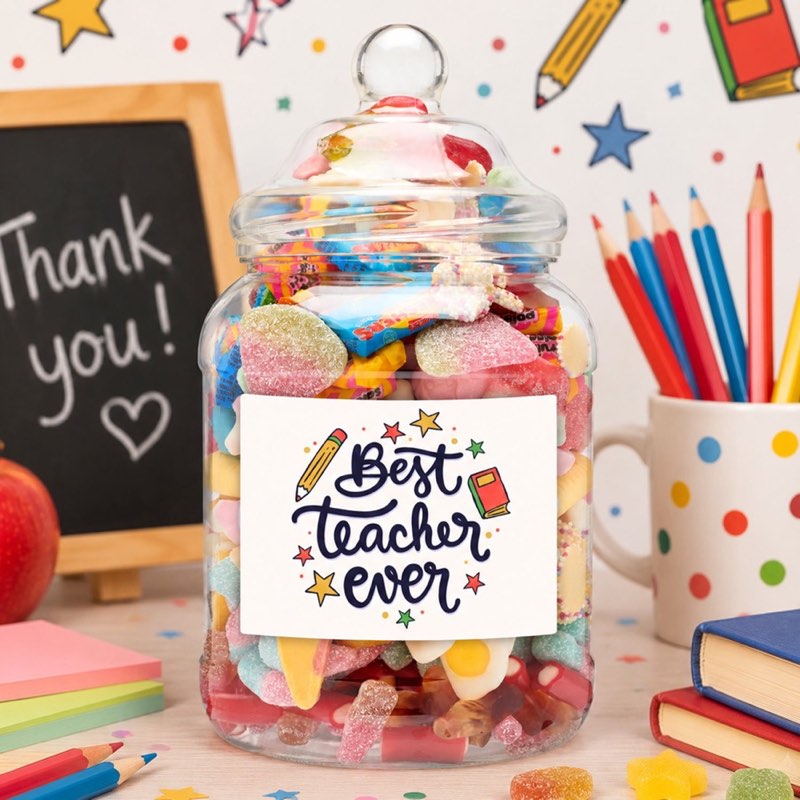
The Best Teacher Ever Pick & Mix Sweet Mega Jar weighs 2,000 g, costs £25.99, comes in one size, and is in stock at the time of writing. Two photographs on the listing show how it presents, and on a gift product the photographs are the part of the page to spend your attention on.
Two kilos in a jar is more substantial than the number suggests when you read it. It is the sort of object that has to be carried with two hands and that occupies a proper share of a table or a staff-room worktop. That physical presence is a large part of what you are paying for, and it is the thing that separates this from the same weight of sweets in a pouch: a jar is a present, and a pouch is groceries.
What we do not do on this page is claim knowledge of exactly which sweets are in it, in what quantities. We publish the name, the price, the weight, the size options and the stock position, because those are the things we can stand behind. Anything about specific contents comes from the listing photographs and from the product itself, and everything printed by the manufacturer on the individual items — dates, storage, and all ingredient and allergen information — is on those items when they arrive. If anyone eating from the jar has an allergy, that packaging is the only thing to trust, and it should be read before the jar is opened rather than after.
Sour and sweet: the spectrum, and where to sit on it
Sourness is the most misunderstood dimension in confectionery. People talk about it as though it were a single switch — sour or not sour — when in practice it is a spectrum with at least four distinct positions on it, and knowing which one you are aiming at is the difference between a mix people love and a mix with a pile of survivors at the bottom.
Position one is the barely-there tang. A faint brightness that lifts a fruit flavour and stops it reading as flat. Most people do not consciously register this as sourness at all; they just find the sweet more interesting than the same thing without it. This level is almost universally liked, which is why so much of the fruit end of the trade sits here.
Position two is the noticeable sharp. You know it is there, it makes the sides of your tongue prickle briefly, and then it settles. It is still comfortable for nearly everybody, and it is the level that does the most useful work in a shared jar, because it provides genuine contrast without being a dare.
Position three is properly sour. A real pucker, a definite physical reaction, eyes closing for a second. Plenty of people enjoy this and plenty do not, and crucially, almost nobody wants several in a row. It is an event sweet, not a grazing sweet.
Position four is the extreme end, where the sourness is the entire point and eating one is a small competitive act. This belongs in a jar only as a deliberate novelty, and only if you know your audience well.
The important structural point is that sourness in sweets arrives in two quite different ways, and they feel completely different in the mouth. There is sourness carried on the surface — a fine coating that hits the tongue immediately, delivers a sharp spike, and is gone within a few seconds as it dissolves. And there is sourness built into the body of the sweet, which arrives more slowly, more evenly, and lasts as long as the piece does. Surface sourness is a firework; body sourness is a weather system. If you have ever wondered why one sour sweet seems to punch and then vanish while another keeps going for a minute, that is the reason.
Tolerance varies more than almost any other preference in food, and not in the direction people assume. Children frequently seek out levels that adults find genuinely unpleasant, and they habituate quickly, which is why a child who liked position two last year is asking for position three this year. Adults more often want position one or two, and value sourness for what it does to the rest of the mix rather than for its own sake.
That last point is the practically useful one. A sharp item in a mix is not mainly there to be eaten; it is there to make everything else taste better. Sweetness dulls the palate progressively — after ten soft pieces in a row, the eleventh registers as less than the first, even though nothing about it has changed. An acidic sweet resets that, sharply and immediately, and the next soft piece tastes as it did at the start. One well-placed sour item can extend the useful life of a jar by hours at a party and by weeks in a staff room.
The counter-rule is sour fatigue, which is faster and more absolute than sweetness fatigue. Three genuinely sour pieces in a row and most people are done for the evening — not just with the sour things, but with the whole jar, because the mouth has had enough. This is why proportion matters so much. A tenth of the weight in sharp items is plenty; a quarter is a jar that people will take a single handful from and then avoid.
Placement is worth thinking about too, if you are setting out a spread rather than handing over a jar. Sour items belong slightly apart from everything else. Surface coatings transfer — a handful taken from a mixed bowl carries the coating onto the next piece, and onto the fingers, and from there onto everything else on the table. Give the sharp things their own small container and the whole spread stays cleaner and tastes more distinct.
Finally, on building a mix around a jar: if you have bought this one as a gift and you want to add something with a different acidity profile alongside it, the sensible approach is to add one item at a level the jar does not cover rather than more of what it already has. If you do not know the recipient's tolerance, err downwards. A mix that is slightly too mild gets eaten. A mix that is too sharp gets politely admired and left.
Eating out of a two-kilo jar, over weeks
A jar of this size is not consumed in a sitting, and the experience is shaped by that from the first day.
In week one, the jar is full, the lid comes off constantly, and people take from the top without looking. Everything is available, the good things are visible, and the jar is at its most generous. This is the period a jar is bought for, and it is the reason presentation matters — a full jar looks like an occasion.
By the middle of its life, the jar has developed a character. Certain things have gone, certain things have not, and the remaining mix is a fingerprint of whoever has been eating from it. In a staff room this happens remarkably fast and is always instructive: within a fortnight you will know exactly which textures the room prefers. This is also the point at which a well-composed mix proves itself, because a jar with genuine breadth still has something for everybody at the halfway mark, while a narrow one has already become a jar of one thing.
At the bottom, every jar develops the residue — the pieces nobody chose, plus whatever fine material has worked its way down. That is normal and universal, and the honest solution is to decant the last few hundred grams into a bowl where they are visible again. Sweets at the bottom of a deep container are effectively invisible; the same sweets in a shallow bowl get eaten within a day. People are not rejecting them. They just cannot see them.
Two practical habits make a big jar much better. First, keep the lid on properly between visits — a jar left open in a warm room will soften and start to cling. Second, do not let people dig with their hands where you can avoid it. A small scoop or a spoon in the jar is more hygienic, and in a shared space like a staff room it makes a real difference to how long the jar stays appealing.
Who this jar is for
The name tells you the first answer: this is a thank-you gift, made for the end of a school year, a leaving day, or any moment where somebody wants to say something to a teacher and does not want to do it with another mug.
What makes it work as a thank-you is that it is a shared object. A box of chocolates given to a teacher tends to stay with that teacher; a two-kilo jar tends to end up in the staff room, where it does a job for a whole team and keeps doing it for weeks. That is either the point or not, depending on your recipient, and it is worth thinking about which of the two you want. If you want the gift to be personal and private, a jar is the wrong shape and something smaller and more precise is better — a 500 g pouch with ten fillings at £9.99 chosen around what you know they like says something a big jar cannot.
Beyond teachers, the same logic covers a good deal of the year: a retirement, a coach at the end of a season, a ward or a team you want to thank collectively, a neighbour who has done you a favour repeatedly, a club committee, the people who run the scouts. Anywhere the thank-you is really to a group but has to be handed to a person, a big jar is the right physical answer.
It also works as a group gift in the literal sense — several families or colleagues putting in a few pounds each and giving one substantial thing rather than a scattering of small ones. At £25.99 split across a class or a team, it is a very small amount per contributor for something that visibly is not a token.
Two notes of caution, both practical. Some schools and workplaces have their own policies about gifts, and it is worth a quick check before ordering anything of this scale so that your gift is not an awkwardness. And if the recipient's dietary requirements matter, a large mixed jar is the hardest kind of gift to guarantee in advance — we hold no supplier dietary information for this line, so we cannot tell you what it is or is not suitable for, and the packaging on arrival is the only reliable source.
The jar as an object: presentation, colour and the moment of handing it over
A gift has two lives: the moment it is given, and the weeks afterwards. A jar is unusual in confectionery because it is designed to be good at both, and understanding how it achieves that helps you get more out of it.
Start with transparency, which is the jar's defining property. A bag conceals; a jar displays. Everything inside is on show from the moment it is handed over, which means the contents are doing the decorating before anyone has opened anything. That is why colour composition matters more in a jar than in any other sweet format — you are effectively looking at a column of colour, and the way those colours stack and mix is the whole of the visual impression.
The practical consequence is that a jar looks best when the mix has both variety and enough of each thing to register. A jar with two dozen different things in tiny quantities reads as speckled and slightly chaotic. A jar with a smaller number of components in meaningful quantities reads as deliberate, because the eye can see blocks and patterns rather than noise. This is one of those cases where the thing that looks better is also the thing that eats better, which does not happen as often as it should.
Then there is scale, and the specific way a two-kilo jar uses it. Volume in a transparent container is a visual argument — you can see exactly how much is there, and two kilos looks like an unmistakable quantity rather than a number on a label. A pouch containing the identical weight makes no such impression, because nobody can see it. That is the entire premium you are paying for when you choose a jar over a pouch of the same weight, and whether it is worth it depends purely on whether anyone is watching when it is handed over.
The printed message is the third element, and it changes the category of the object. An unlabelled jar of sweets is a generous thing to receive. A jar with a message on it is a card and a present at once, which is why these formats have taken over the end-of-term gift so thoroughly. It also means the jar survives being empty — plenty of people keep a labelled jar long after the sweets have gone, for pens, for paperclips, for the next lot of sweets. The same occasion logic runs through the rest of this family: the Happy Birthday mega sweet jar with twenty fillings at £25.99 for a birthday, the ‘It’s a girl’ baby shower jar and the ‘It’s a boy’ jar at the same price for a new arrival. Same object, different sentence, completely different gift.
If you are photographing it — and most gifts of this kind end up in a group chat before they end up on a table — a few things help. Photograph it against something plain, because a jar is already visually busy and a patterned background turns the whole thing to soup. Shoot from slightly below eye level rather than looking down at it, which makes the jar look its full height. Use daylight from the side; overhead lighting bounces off the curved surface and produces a white stripe across the middle of your photograph. And if the label is the point, turn the jar so the message is square to the camera, even if the contents look marginally better from another angle.
For a table rather than a photograph, the jar's job is to be the tall thing. Displays need height, and a jar provides it without any staging. Put it at the back or the centre with flatter items in front, and the whole arrangement acquires a shape. Two or three lower bowls around one tall jar is the standard arrangement, and it works because the eye is given a hierarchy instead of a field. If you want the flatter items handled for you, the Create Your Own Pick & Mix Platter at £24.99 arrives already laid out, and a platter plus a jar is about as complete a two-purchase sweet table as it is possible to assemble.
One last presentation thought, and it is the one people miss: a jar looks best full, so if it is going to be on display for a while, decant rather than deplete. Take out a bowl's worth for people to eat from and leave the jar looking intact. It is the same sweets, it costs nothing, and it keeps the object doing its job for far longer.
Occasions this suits beyond the end of term
The end of the school year is the obvious peak, but a two-kilo labelled jar earns its keep at several other moments.
Leaving dos and retirements. A jar lands well because it is shared with the team the person is leaving, which is usually what the person wants anyway. It also survives the long afternoon in a way that a bunch of flowers does not.
Staff rooms and offices generally. Two kilos is roughly a month of a communal sweet habit for a dozen people. As a gesture from one team to another — after a hard project, a busy season, a difficult week — a jar on a shared table says more than an email.
Raffles and fundraisers. A jar is one of the best-performing raffle prizes there is, because it photographs well on a poster, it is instantly understood, and it appeals to adults and children equally. School fairs, club nights and charity quizzes all take them happily.
Big birthdays and shared celebrations. At scale, a jar is the centrepiece rather than the gift. If you are laying a table for thirty, a jar in the middle with bowls around it sets the tone for the whole thing.
Christmas for a household rather than a person. Where a hamper is too much and a box of chocolates is too little, a jar lands neatly. If you want the larger version of the same instinct, the three-kilo Haribo International Hamper at £44.99 is the step up in both scale and presentation.
The long-haul gift. Anyone facing a long stretch of something — revision, a dissertation, a difficult rota, a new baby — appreciates a container that keeps giving for weeks. A jar suits that better than anything you finish in an evening.
What £25.99 for two kilos comes to
The rate is £1.30 per 100 g, or £12.99 a kilo. That is a keen number for a gift format, and the comparisons on our own shelves are worth laying out because they are not what most people expect.
| Format | Price | Weight | Per 100 g |
|---|---|---|---|
| This mega jar | £25.99 | 2,000 g | about £1.30 |
| The forty-filling giant pouch | £28.99 | 2,000 g | about £1.45 |
| The three-kilo hamper | £44.99 | 3,000 g | about £1.50 |
| The kilo mega pouch | £16.49 | 1,000 g | about £1.65 |
| The 750 g sharing pouch | £12.99 | 750 g | about £1.73 |
| The 250 g snack pouch | £5.49 | 250 g | about £2.20 |
The instructive line is the first two. The jar is cheaper per 100 g than the pouch of identical weight, which inverts the usual assumption that presentation always costs more. What the pouch buys you instead is control — forty fillings of your own choosing rather than a fixed mix — and for some purchases that is worth the difference and for others it is not. If you know the recipient's tastes in detail, pay for the control. If you are giving to a group, the jar is both cheaper and better suited.
In servings, two kilos is forty generous 50 g helpings or twenty 100 g ones. For a staff room of a dozen people it is about 165 g each, which in practice means a jar that lasts several weeks rather than several days. As a raffle prize it is, obviously, one prize, and its value is in how it looks on the table rather than in the arithmetic. For a family of four, rationed at a modest rate, it is well over a month.
The cost per person is where a jar makes its strongest case. Split across a class of thirty families contributing to one gift, it is under a pound each. Split across a team of ten colleagues, it is about £2.60 a head for something that sits on a table for a month. Very little else at that price per person leaves a physical object behind.
Keeping a big jar in good order
Two kilos will be open for a long time, so storage is not an afterthought here — it is the difference between a jar that is still good in six weeks and one that has quietly gone tired.
The lid is the whole game. Sweets deteriorate through contact with air and moisture, and a jar with the lid properly on is one of the better storage containers you can have. A jar with the lid resting on top, which is what happens in every staff room by the second week, is barely better than an open bowl. If the jar is in a shared space, it is worth being the person who puts the lid on properly.
Keep it out of the sun. A clear jar on a windowsill is the worst place in any building for sweets: light degrades colour, and the glass or plastic acts as a small greenhouse. A shelf, a cupboard or the back of a worktop is much better. The same goes for any spot directly above a radiator or next to a kettle, where the combination of heat and steam is exactly wrong.
Watch the humidity in particular. Anything in the mix with a powdered or granular surface will draw moisture out of a damp room, go tacky, and start sticking to its neighbours. A kitchen where the kettle runs all day is a damp room. If the jar has to live somewhere steamy, decant a working portion into a bowl and keep the main jar elsewhere.
Do not refrigerate a jar. Cold makes chews hard work and jellies tough, and bringing a cold jar into a warm room puts condensation on everything inside it, which is the fastest way to ruin a mix.
As it empties, transfer the last portion to a smaller container. A nearly empty two-litre jar has a lot of air in it, and air is what dries sweets out. A smaller container with less headspace keeps the remainder in better condition and, as noted above, makes the survivors visible again.
Keep hold of the manufacturer's information that comes with the product. Dates, storage instructions and allergen information all live on the original packaging, and once a jar is being eaten from communally there is no other way to answer a question about it. Check it before anyone with an allergy eats from the jar, and treat sweets as the treat they are — with the usual caution that small hard sweets and whole gummies are a choking risk for young children, who should be supervised.
Jar, pouch, platter, box or hamper?
There is one size of this jar — 2,000 g at £25.99 — so the real decision is the format, not the quantity. A short guide:
- Choose the jar when the gift will be handed over in front of people, when it is going into a shared space, or when you want the container to outlast the sweets.
- Choose a pouch when you know exactly what the recipient likes and want every filling to be chosen. The ladder runs from five fillings in 250 g at £5.49 up to forty fillings across two kilos, with fifteen fillings in 750 g at £12.99 being the most common middle choice for a decent personal gift.
- Choose a platter when the sweets are going straight onto a table and you would rather not arrange anything yourself.
- Choose a chocolate format when the recipient is a chocolate person rather than a sweets person, which is a distinction worth taking seriously. A ten-bar chocolate box at £14.49 is the personal-scale version, the 25-bar mega box at £31.99 is the team-scale one, and the 30-bar chocolate hamper at £42.99 is the full gesture.
- Choose a bucket when you want volume with a handle on it — the Bon Bon Sweet Bucket at £18.99 carries and pours more easily than a jar and suits a party better than a presentation.
- Choose the small box when you need many small gifts rather than one big one. The Haribo Fun-Size Treat Box at £5.99 breaks down into individual sealed packs, which is the efficient way to thank a lot of people at once.
And if the gift needs one small finishing touch, Bond’s Milk Chocolate Coins at £1.00 are the cheapest way to add something to the top of a jar or the corner of a gift bag without changing the budget.
Where it lives on the site
This jar sits on our Pick & Mix shelf, which at the time of writing holds 31 lines: the jars, the pouches, the platters and the build-your-own formats. It is the shelf to browse if you are shopping by occasion and by scale rather than by brand, and it is where all the other labelled jars live if this particular message is not the one you want.
The shelves either side are useful for filling gaps. Loose Sweets is everything sold by weight, and it is the efficient way to add bulk to a table without paying for packaging. Candy & Chocolate is where the branded bags, bars and boxes sit, and it is where to solve the one thing a sweet jar cannot do for itself, which is chocolate. Or start at the whole shop in one list and work through it however you prefer.
Questions worth answering before you order
What sweets are in the jar?
It is a pick and mix jar weighing 2,000 g in total. We do not publish an item-by-item contents list, because we do not hold verified information at that level of detail and we will not guess about food. The listing photographs show how it presents, and the definitive information on each item is on its own packaging when it arrives.
Is it big enough for a whole staff room?
Two kilos across a dozen people is around 165 g each, which in practice means a jar that sits out for several weeks rather than one that disappears in a day. For a much larger team, or for a jar that needs to survive a whole term, buying two is more sensible than stretching one — and a second jar in a different format keeps the table interesting.
Can I choose what goes in it?
Not on this listing, which is a fixed mix in a jar. If choosing is the point, our build-your-own pouches exist for exactly that, from five fillings up to forty. Some people buy both: the jar for the presentation and the moment of handing over, and a small pouch chosen around one person's known favourites as the personal part of the gift.
Is it suitable for someone with allergies or a specific diet?
We hold no supplier dietary information for this line and will not imply any. A large mixed jar is the hardest kind of purchase to verify in advance, so if a guarantee is needed before the gift is given, choose something you can check first. Please read the manufacturer's packaging on the items when the jar arrives, before anyone eats from it.
Will it last until the end of term if I buy it now?
Kept sealed, cool, dry and out of direct sunlight, an unopened jar keeps comfortably, and the best-before dates on the packaging are the authority rather than any general rule. Buying a few weeks ahead is normally fine and takes the pressure off the last week of term. Do not store it in a sunny window or above a radiator, which is where good sweets go to soften.
Is a jar a better gift than a box of chocolates?
It is a different gift. Chocolates tend to stay with the person you give them to; a jar of this size tends to be shared with everyone around them. If you want the gift to be personal, chocolates or a small chosen pouch are better. If you want it to do something for a whole staff room or team, the jar is the right shape and will be remembered for longer simply because it is around for longer.
How much does it cost per person if we club together?
At £25.99, a class of thirty families contributing equally is well under a pound each; a team of ten is about £2.60 a head. That is the strongest argument for a jar as a group gift — the cost per contributor is trivial and the result is visibly substantial rather than a collection of small tokens.
Does the jar get reused?
Very often, in our experience of how these formats are used — a labelled jar has an afterlife on a shelf for pens, biscuits or the next lot of sweets, which is part of why the printed-message formats have become the standard end-of-term gift. That is a reason to look after the lid, since a jar without a working lid is just a vase.
What should I add to it to make a bigger gift?
Add a different category rather than more of the same. Chocolate is the usual answer, because a sweet jar cannot supply that texture for itself. Beyond that, something with a different eating pace — a hard sweet or a chew — and one small novelty item. Three well-chosen additions make a gift feel composed; six more bags of similar things just make it heavy.
Is it too much sugar for a school setting?
That is a judgement for the school rather than for us, and it is worth a quick check of any gift policy before you order something at this scale. What we will say plainly is that sweets are a treat rather than an everyday food, that small hard sweets and whole gummies are a choking risk for young children, and that supervision matters wherever children are eating them.
How should it be served once it is open?
Decant a working portion into a shallow bowl and leave the jar looking full. People cannot see the bottom of a deep container, so sweets down there go uneaten while the same pieces in a bowl disappear within a day. Keep the lid properly closed between visits, and use a scoop rather than hands where the jar is being shared by a group.
Is it in stock?
Yes, at the time of writing, in its single 2,000 g size at £25.99. Labelled gift jars move quickly in the last fortnight of a school term and in the weeks before Christmas, so the live availability shown on this page is more reliable than anything written earlier. If it is unavailable, the other mega jars and the two-kilo pouch are the closest equivalents by scale.
The short of it
Two kilos at £25.99 — about £1.30 per 100 g, forty generous helpings, and a jar that costs less per gram than the pouch of the same weight while looking like a present rather than a shop. Buy it when the thank-you is really to a group, when it will be handed over in front of people, or when you want something that sits on a table for weeks rather than an evening. Keep the lid on, keep it out of the sun, decant into a bowl so the bottom third gets eaten, and read the packaging that comes with it before anyone with an allergy takes a handful.
More pick & mix sweets
Where this sits
Best Teacher Ever Pick & Mix Sweet Mega Jar appears on these shelves. Browse them, or jump to something nearby.
You might also like