Home / Pick & Mix / Create Your Own Pick & Mix Platter
pick and mix · 2000g
Read the full guide
Create Your Own Pick & Mix Platter
£24.99
✔ In stock — ready to ship
Fresh stock
Free over £20
Same-day dispatch
Secure checkout
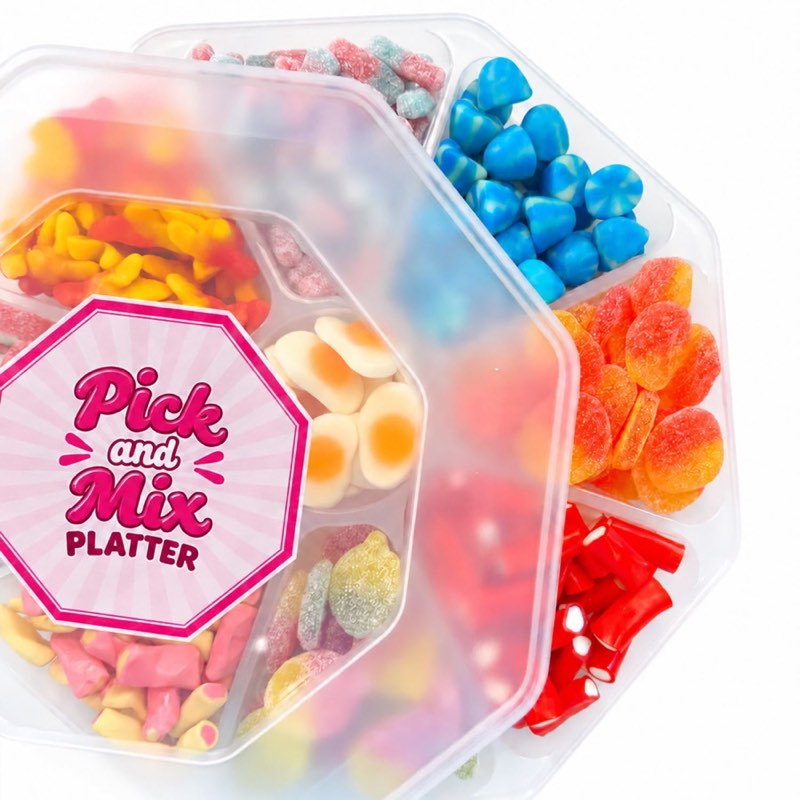
Most people have no accurate picture of two kilos of sweets until it is in front of them, and the number is usually a surprise in the right direction. It is not a bowl. It is a surface. Two kilos spread out in a single layer covers something close to a large tray, and if you group it into sections rather than tipping it into a heap, it reads as a proper table centrepiece rather than as a snack. That scale is the first thing to understand about this, because it changes what you use it for. A bag of sweets gets handed round. A platter gets stood in front of and looked at.
The visual effect comes from grouping rather than from any one component. Sweets mixed together at random turn into a speckled mass at any distance over a metre — the eye cannot separate them, and the whole thing goes a muddy pastel. Sweets laid out in blocks of one kind stay legible. You see a band of red, a band of pale yellow, a dark stripe of something chocolate, a run of stripes, and the contrast between adjacent blocks is what makes it look considered. This is the single most useful piece of presentation advice on this page and it costs nothing: the same two kilos, arranged two different ways, will get two completely different reactions.
The full guide to Create Your Own Pick & Mix Platter
6,203 words on how it eats, who it suits, how to serve it and what to put beside it.
What two kilos of sweets looks like once it is laid out
Height is the second variable. A flat layer looks tidy and a little clinical; a few small heaps among the flat areas look generous. The usual approach is to keep most of the surface at one piece deep and pile two or three areas up. It gives the whole thing a landscape rather than a grid, and it makes the platter look fuller for longer as people eat their way into it, because the heaps collapse gradually and fill the gaps behind them.
Then there is the sound and feel of it, which nobody thinks about until they are standing over one. A platter of mixed sweets is quietly tactile in a way a bag is not. You can see everything, so you choose rather than accept, and the choosing is most of the pleasure. People will stand at a platter for a genuinely long time — far longer than they would spend at a bowl — comparing, picking up, putting back, working out what they want. That browsing behaviour is what you are buying at this scale, and it is why a platter works at an event where a bag would simply be eaten.
Eating from it follows a predictable arc across an afternoon. The first pass is enthusiastic and undiscriminating: everyone takes one of whatever is nearest and brightest. The second pass, twenty minutes later, is selective — people go back for the specific thing they liked. By the third and fourth pass the platter has gaps in it, the popular blocks are down to stragglers, and what is left is the more demanding stuff, the very sour and the very chewy, which gets eaten last by the people who actually wanted it in the first place. If you build with that arc in mind, you put your crowd-pleasers on the outside edge and your specialist items towards the middle, and everything gets eaten in the right order.
The flavour experience is not really a single experience at all, which is the honest thing to say about any build-your-own product. What it tastes like is what you chose. That is the point of the format and it is also the challenge of it, because the difference between a good platter and a mediocre one is almost entirely in the selection, not in the individual sweets. Everything below is about making that selection well.
The pick-and-mix counter, and why Britain never let it go
The pick-and-mix bay is one of the few pieces of retail theatre this country invented and then refused to give up. It survived the collapse of the high street chains that made it famous, it survived the shift to sealed packaging, and it survived every prediction that shoppers would rather have a barcode than a scoop. It is still here, in seaside shops, in independent sweet shops, in garden centres and cinemas, and in the online form you are looking at now.
Its appeal was never really about price. Loose sweets were rarely cheaper than packets and often dearer. What the counter sold was agency. Standing in front of forty containers with an empty bag in your hand is one of the very few shopping experiences where a child has complete authority, and adults are not immune to it either. Every other part of buying food involves accepting someone else's decisions about what goes together. Here you make all of them, and nobody can tell you that liquorice and sour cherry is a strange combination because it is your bag.
The physical ritual mattered as much as the choice. The scoop, the tongs, the bag that never quite opened first time, the weighing, the number on the scale that you had to interpret, the moment of finding out what it cost. Every one of those steps slowed the transaction down and made it an event. Fast retail has spent forty years removing steps like that from shopping, and the pick-and-mix bay is one of the last places where the slowness is the product.
The seaside made the format spectacular. Coastal sweet shops had a specific problem — a short, intense season and a customer who was on holiday and in a spending mood — and the answer was scale and colour. Walls of jars, bays of open containers, a scoop in every one, and nothing muted anywhere. The point was to be visible from the promenade and overwhelming from the door. Anybody who has walked into one of those shops as a child and simply stopped in the doorway knows exactly what that design was for. A two-kilo platter is a domestic version of the same idea: it works because it is more than you need, laid out where everyone can see it.
The corner shop ran the modest version all year round. A few containers by the till, a handful of penny lines, a paper bag, and a customer counting coins. That counter taught two or three generations of British children how to plan a purchase under a budget constraint, and it is where the national habit of the mixed bag comes from. In a lot of countries, sweets come one flavour to a packet and an assortment is a special-occasion item. Here the mix is the default, and a single-flavour bag is the exception.
What has changed in the online version is only the mechanism. You are still choosing every component; you are simply doing it from a list rather than with tongs, and the weighing has already been done for you. What has not changed is the psychology, which is why the create-your-own formats sell as well as they do. Our pick and mix section runs to 31 lines, and almost every one of them exists because somebody wanted to make the choices themselves rather than accept a ready-made assortment.
The other inheritance from the old counter is the idea of the house selection. Every good sweet shop had one — the mix the shopkeeper put together, the one they recommended when a customer froze in front of the jars. The modern equivalents are the themed jars. The Happy Birthday mega sweet jar at £25.99 is that idea with an occasion attached, and it is the right choice for anyone who wants the selection made for them with a label on the front. The platter is the opposite instinct: no label, no theme, every decision yours.
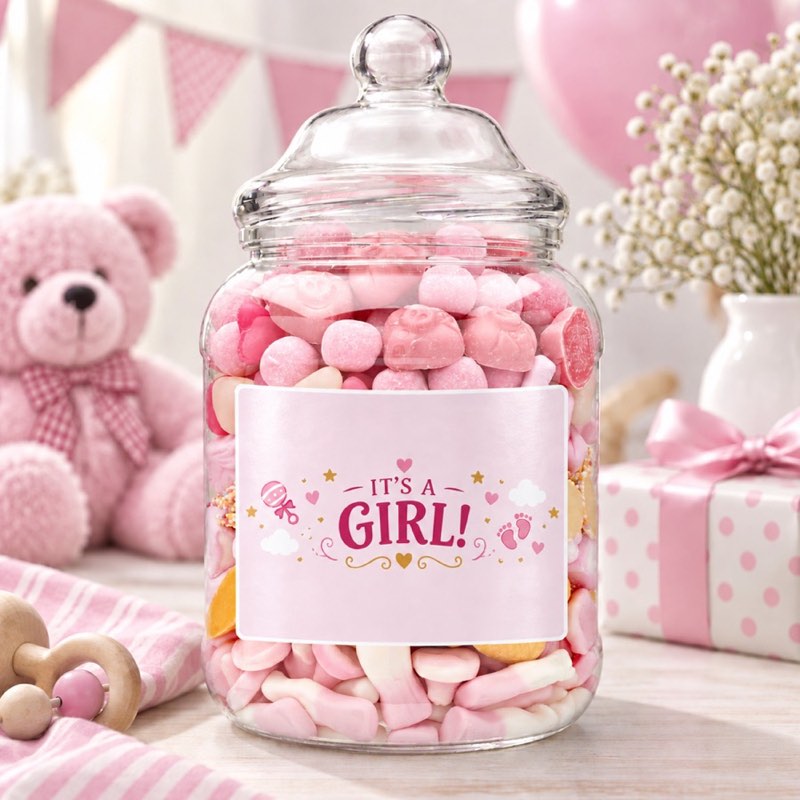
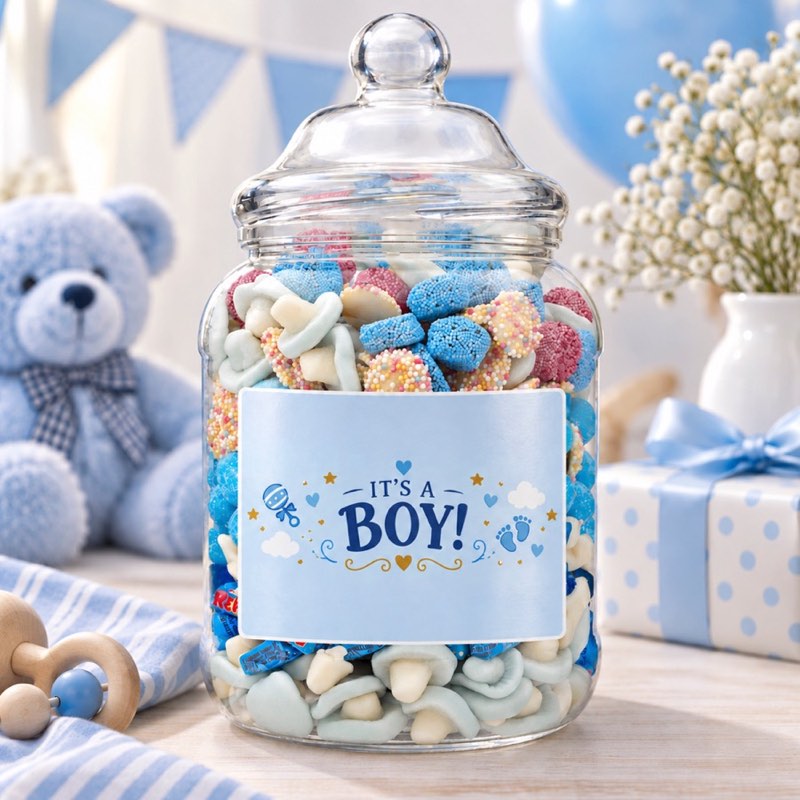
There is also a long tradition of the sweet gift with a message on it, which the jars carry on. The Best Teacher Ever mega jar, also £25.99 is the clearest example we stock — a mix that exists to be handed to a specific person for a specific reason. The 'It's a girl' baby shower jar and the 'It's a boy' version, both at the same £25.99, do the same job for the other great occasion for handing over sweets. If the sweets are the card as much as the gift, a jar says something a platter cannot.
Texture is what makes a platter work, not flavour
Here is the thing most people get wrong when they build a mix for the first time: they choose by flavour. They pick strawberry, cherry, raspberry, apple and blackcurrant, look at a list of five things they like, and cannot understand why the finished bag is boring. The reason is that all five eat identically. Flavour variety without texture variety produces a mix that your mouth experiences as one sweet in five colours.
Texture is engineered, deliberately and precisely, and the levers are worth knowing because they are what you are really choosing between. The first is piece size. A bigger sweet is not simply more of the same experience — it lasts disproportionately longer, because the jaw has to reduce it in stages and the middle is shielded by the outside for most of the chew. Two sweets of identical make-up at different sizes belong in different slots on a platter.
The second lever is thickness, which is not the same as size. A thin flat piece is crushed in one movement and dumps its flavour immediately; a thick piece deforms, resists and releases slowly. Confectioners vary thickness specifically to control how long the eating event lasts, and you can feel the difference between a flat chew and a chunky one even when they taste the same.
The third is surface finish. A matt, slightly dry outside grips the tongue and teeth and makes a sweet feel firmer than it really is; a glossy outside slips and the same sweet feels softer. A dusted or crystalline surface adds a fraction of a second of friction before the chew begins, which the mouth reads as a separate stage. This is why two sweets that are structurally identical can feel like different products.
The fourth is the one nobody sees: settling time. Sweets of this general kind are not finished when they leave the mould. They spend a period drying and firming before they are packed, and the length of that period sets the final resistance more than almost anything else. Short settling gives a soft, quick-yielding sweet; long settling gives one that has to be worked at. The same shape from the same equipment can be made into two noticeably different products purely by changing how long it waits.
The fifth is the coating, which operates on a different clock entirely. Anything with a hard shell or a sour dusting has a first stage that happens before the chew even starts, and that stage is the whole appeal for a lot of eaters. A sour coating in particular paces people: it makes them stop between pieces in a way that a plain sweet does not, which is genuinely useful when you are trying to make two kilos last an afternoon rather than an hour.
The sixth is not chewing at all. A lollipop or a hard sweet runs on minutes rather than seconds, and one of those on a platter changes the behaviour of the room. A child with something to suck is occupied; a child with something to chew is back at the table in fifteen seconds. If you are catering for children and you want any peace at all, at least one slow item is not optional.
Put those levers together and the planning rule falls out on its own: build your platter across chew lengths first and flavours second. You want something that yields instantly, something that needs working at, something with a shell or a coating, something sour that paces people, and something that has to be sucked. Get those five present and the flavours can be almost anything — the platter will still feel varied. Get only one of them and no amount of flavour range will save it.
Chocolate is the sixth texture and it deserves its own note, because it does not chew at all — it melts, and melting is a completely different sensation from any of the above. A platter with no chocolate on it feels like a children's platter even when it is not. Bond's milk chocolate coins at £1.00 are the cheapest possible way to fix that: a pound adds a whole texture category and a shiny, unmistakable shape that photographs better than anything else on the board.
A slot-by-slot method for building yours
Two kilos is enough to be intimidating if you approach it as one large decision, and straightforward if you break it into slots. Here is the method that works for most people, expressed as proportions of the total rather than as specific products, so you can apply it whatever you end up choosing.
Slot one, the base, about 30 per cent. Soft, sweet, universally liked, nothing challenging. This is the part that everyone eats without thinking about it and the part that keeps the platter looking full. Do not spend your interesting money here. The base exists so that the rest of the platter has something to be interesting against.
Slot two, the chew, about 20 per cent. Something that has to be worked at. This is the slot that stops the platter feeling like it is all one sweet, and it is the one most first-time builders leave out. A proper chew also slows people down, which makes the whole thing last longer.
Slot three, the sour, about 15 per cent. Sour items do two jobs: they reset the palate between everything else, and they pace the eater. Fifteen per cent sounds low and is about right — sour is a spike, not a foundation, and a platter that is a third sour is exhausting rather than exciting.
Slot four, chocolate, about 15 per cent. The melt category, as above. It also brings the only genuinely dark colour most platters have, which matters enormously for how the finished thing looks.
Slot five, the slow item, about 10 per cent. Lollipops, hard sweets, anything on a minutes-long clock. Low in weight terms, high in effect, particularly with children.
Slot six, the novelty, about 10 per cent. Something that does not look like sweets, or is shaped like something else, or comes in its own small container. This is the bit people photograph and talk about, and ten per cent of the weight is plenty for it.
Applied to two kilos that gives you roughly 600 g of base, 400 g of chew, 300 g of sour, 300 g of chocolate, 200 g of slow and 200 g of novelty. You will not hit those numbers exactly and you do not need to. What matters is that all six slots have something in them.
If you want to test the method before committing to two kilos, do it small. The 250 g snack pouch at £5.49 with five fillings gives you exactly five choices, which forces you to pick one per slot and drop one — a genuinely instructive exercise. The 500 g mini pouch at £9.99 with ten fillings lets you do all six slots with room for a couple of favourites on top, and is the size most people use as their trial run before they build anything larger.
For a mid-size build, the 750 g sharing pouch at £12.99 with fifteen fillings is where the slot method starts to feel comfortable rather than constrained, and the 1 kg mega pouch at £16.49 with twenty fillings gives you enough choices to put two or three different things in the base slot alone, which is when a mix stops feeling like a list and starts feeling like a shop.
At the top end, the 2 kg giant pouch at £28.99 with forty fillings is the same weight as this platter in a completely different format. Forty separate choices is a great many, and the honest warning is that most people run out of genuine preferences somewhere around twenty-five and start choosing things they do not especially want. If that sounds like you, fewer components in larger quantities makes a better spread than more components in small ones.
Balancing the flavour families once the textures are settled
With the texture slots filled, flavour becomes a much simpler problem, and it comes down to keeping four families represented and none of them dominant.
The fruit family is the largest and the least controversial — the bright, high-pitched notes that almost everyone recognises and almost nobody dislikes. This is where your base slot will mostly come from, and the only real risk is letting it take over the whole platter. If more than half of what you have chosen is a fruit note, take something out.
The dark family is cola, liquorice, aniseed and anything in that register: rounder, faintly spiced, slightly savoury at the edges. These are the pieces that break up a run of fruit and give the palate somewhere else to go. They are also the flavours most likely to divide a room, which is a reason to include them rather than avoid them — a platter that offends nobody also excites nobody.
The creamy family covers chocolate, fudge-adjacent things, anything with a milky or caramel character. It is the comfort end of the platter, it eats slowest, and it is the category adults reach for most often when there is a full spread in front of them.
The sharp family is sour, citrus and fizzy. Small quantities, high impact. Keep it near the edge of the platter where people can find it deliberately rather than stumble into it.
The balancing rule is simply that each family should be obvious when you look at the board and none should be the first thing you notice. If one colour or one register dominates the view, adjust before you finalise. And if you are building for a specific person rather than a crowd, throw the balance out and build to their taste — a platter made entirely of what one person likes is a far better gift than a well-balanced one made for nobody in particular.
Laying it out so it looks like two kilos
Arrange in blocks, not in a mix. This is worth repeating because it is the difference between a platter that looks designed and one that looks tipped out. Group each component together and put contrasting colours next to each other. Dark against pale, matt against shiny, round against long.
Work from the outside in. Put the things everyone will eat around the edge where hands land first, and the specialist items towards the middle. People take from the perimeter on the first pass and only reach across when they are choosing deliberately, so this arrangement gets your crowd-pleasers eaten first and leaves the sour and the challenging for the people who actually want them.
Leave the dark colours until last when you are laying out. Chocolate and anything black-brown reads as a shadow at a distance and will anchor the whole composition, so place it once everything else is down and use it to break up any area that has gone too pale.
Keep the lollipops and anything on a stick at one end rather than scattered. Sticks lying across the board catch on hands and drag other sweets with them. A cluster at one corner is tidier and also reads as a deliberate feature.
Set out only what you will serve in the next couple of hours and keep the rest back. Two kilos laid out all at once in a warm room for a whole afternoon will not be at its best by the end, and a platter that is topped up twice looks better all evening than one that is full at four o'clock and picked over by six.
Who you are building it for
For a room of children, weight the build towards the base and the slow slots, keep the sour low, and make sure there is a novelty item. Children eat with their eyes and their hands before their mouths, so shape and colour count for more than flavour subtlety. They also eat faster than adults, so two kilos goes further than you think with adults and less far than you think with a room of eight-year-olds.
For a room of adults, invert it. Raise the chocolate and the chew, raise the sour a little, drop the novelty. Adults graze rather than raid, and they will happily eat a more challenging platter across a whole evening. This is also the audience that appreciates the older, more traditional lines that children have never met.
For a mixed room, which is most rooms, build the six slots evenly and put the children's favourites on the side of the table they can reach. The single most useful thing you can do at a mixed event is make sure the platter is at a height that both groups can get to without asking.
For one person as a gift, forget all of the above and build entirely to their taste. If they only like sour, make it mostly sour. The platter format is at its best as a personal gift precisely because it can be tailored in a way a boxed assortment cannot.
For an office or a counter, a platter is the wrong format and a container is the right one. Anything laid out flat in a workplace is dust and drying within a day. The Bon Bon sweet bucket at £18.99 is the format that actually suits that job — a lidded container that sits on a desk and gets topped up rather than a spread that gets set out once.
Occasions
Birthday parties are the main one, and the platter earns its place by being the thing the room gathers around rather than something handed out. If you are also filling take-home bags, plan that separately and buy for it separately — raiding the platter for party bags is how a spread that looked generous at two o'clock looks sparse at four.
Film nights and long evenings in are the domestic use, and here the grazing arc described at the top is the whole point. A platter set out at the start of a film is a slower, more sociable thing than a bag passed along a sofa.
Weddings, christenings and anniversaries increasingly use a sweet table, and two kilos is roughly the right scale for one element of it rather than the whole thing. If you are doing a full sweet table, plan on several containers of different heights rather than one large flat area, and use the platter as the ground floor.
Christmas tables want the dark colours raised and the novelty slot filled with something seasonal. A platter also solves the specific Christmas problem of guests arriving at different times across an afternoon — it can sit out and be grazed at rather than served.
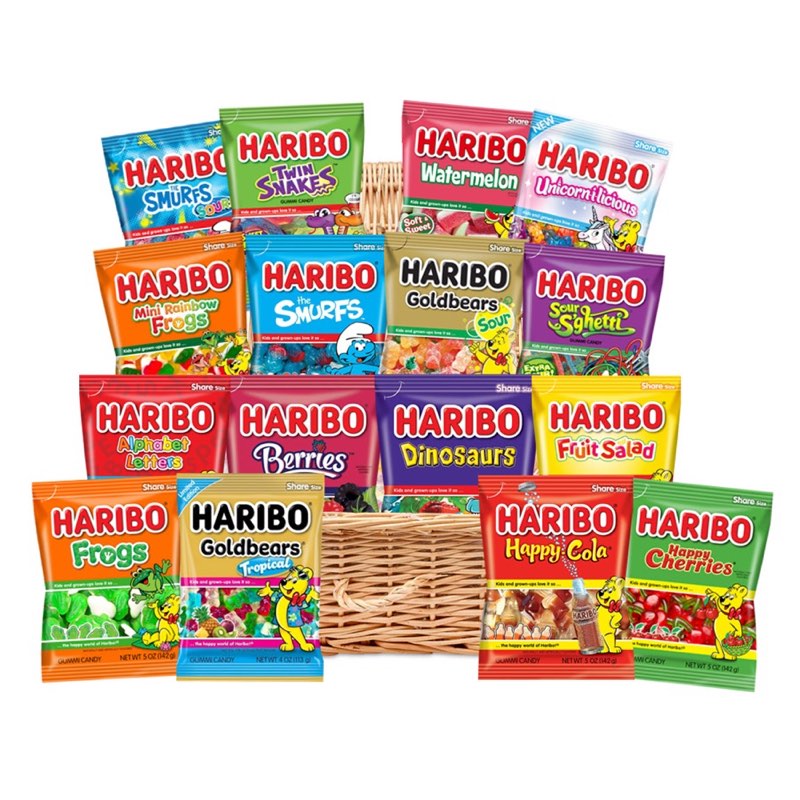
Gifting is where you choose between formats rather than contents. A platter is generous and immediate but it is not a parcel. If it has to be wrapped, handed over and opened, a hamper or a box does the job better. The Haribo international hamper at £44.99 is the largest gift format we carry and is a genuine present rather than a catering item; at the other end, the fun-size treat box at £5.99 is the small, sensible thing to add to somebody else's present rather than to give on its own.
Fêtes, stalls and fundraisers use a platter as the display and something bulkier as the stock. Set out a small, well-arranged board to draw people in and keep the volume in containers behind it. A platter sells; a heap does not.
What £24.99 for two kilos actually means
This platter is 2 kg for £24.99, which is £1.25 per 100 g. Set against the rest of the create-your-own range, that is the cheapest per gram anywhere on this part of the site, and it is worth seeing the whole ladder in one place because the shape of it is genuinely useful.
| Format | Weight | Price | Per 100 g |
|---|---|---|---|
| Snack pouch (5 fillings) | 250 g | £5.49 | £2.20 |
| Mini pouch (10 fillings) | 500 g | £9.99 | £2.00 |
| Sharing pouch (15 fillings) | 750 g | £12.99 | £1.73 |
| Mega pouch (20 fillings) | 1 kg | £16.49 | £1.65 |
| Giant pouch (40 fillings) | 2 kg | £28.99 | £1.45 |
| This platter | 2 kg | £24.99 | £1.25 |
The comparison that matters is the last two rows. The giant pouch and this platter are the same weight, and the platter is four pounds less. What you give up is the number of separate fillings and the resealable pouch; what you gain is four pounds and a format that is laid out rather than poured. If you want forty distinct components and a bag you can close, the pouch is the right buy. If you want two kilos on a table, this is straightforwardly cheaper.
Against the themed jars at £25.99 the decision is different again, because those are sold as a presented gift with an occasion attached rather than as catering weight. You are paying for the jar and the label, and for a birthday, a teacher's end of term or a baby shower that is exactly the right thing to pay for.
Portioning two kilos is easier than it sounds if you work in 60 g per adult guest across an afternoon and 80 g per child. On that basis two kilos covers roughly thirty adults or twenty-five children if the platter is the only sweet item, and considerably more if it is one element among several. For a household rather than an event, two kilos at 30 g a serving is around sixty-five servings, which is a long-running supply rather than a weekend.
The chocolate equivalents are worth a glance if you are pricing a gift rather than a spread, because they are sold by the bar rather than by weight and the arithmetic runs differently. The ten-bar chocolate box at £14.49 works out at £1.45 a bar, the 25-bar mega box at £31.99 at £1.28 a bar, and the 30-bar hamper at £42.99 at £1.43 a bar. The 25-bar box is the best per-bar value of the three, which is not the one most people assume, and it is worth knowing before you order the biggest one out of habit.
One last piece of value thinking. If you are catering an event with both a table and take-home bags, the efficient split is one large format for the table and several small pouches for the bags, rather than buying one enormous quantity and portioning it yourself. The small pouches cost more per gram but they save an evening of scooping, and they arrive already divided.
Storing it, and making it ahead
The first rule is that a platter is a serving format, not a storage format. Sweets laid out flat are exposed to the air over their whole surface, which is exactly the condition that dries them out and firms them up. If you are building for an event, keep everything in its original packaging until the day and lay out at the last sensible moment.
Keep components separate in storage. This matters more than people expect. Softer sweets pressed against firmer ones in a sealed container for a week will exchange moisture, and the soft ones go firm while the firm ones go tacky. Anything sour-coated will shed its coating onto its neighbours. Chocolate will pick up the smell of whatever it is next to. Keep them apart until the moment of assembly and every component tastes like itself.
Cool, dry, dark and steady is the storage condition for all of it, and steady is the important word. Repeated warming and cooling changes texture permanently, particularly for anything chocolate, which will set dull and soft after a few cycles. An internal cupboard away from the oven, the kettle and any sunny window is better than a fridge in every respect.
Never refrigerate chocolate. A fridge is damp, and condensation on the surface when it comes back out does real damage to the finish and can leave it looking pale and grainy. It is also flavour-muting: chocolate needs to melt to taste of anything, and a chilled piece takes noticeably longer to get there.
Leftovers keep perfectly well if you deal with them promptly. Sort them back into their groups, seal each group separately, and they will be fine. Sweep the whole lot into one bag and within a fortnight you will have a single homogeneous mass of compromise. Ten minutes of sorting on the evening of the party is worth more than any amount of good intention the following week.
If you are making up bags in advance from a large order, assemble them no more than a day or two ahead and keep them somewhere cool. Small bags have a high surface-to-volume ratio and dry out faster than a large sealed container does.
Choosing between this and the other build-your-own formats
Choose the platter if the sweets are going on a table and being looked at. Two kilos, laid out, is a centrepiece, and at £1.25 per 100 g it is the cheapest way to get that weight in this part of the range. It is the right answer for parties, sweet tables, film nights and any event where the display is part of the point.
Choose a pouch if the sweets are going to be carried, posted, stored or eaten over weeks rather than hours. A resealable pouch is a better long-term container than anything laid flat, and the pouch range runs from 250 g up to 2 kg so you can match the quantity precisely. The ten-filling mini pouch and the fifteen-filling sharing pouch in particular are the household default for most people.
Choose a jar if it is a gift with an occasion attached. The birthday jar, the teacher jar and the two baby shower jars all cost £25.99 and all do something a platter cannot, which is arrive looking like a present with a reason printed on it.
Choose a chocolate format if the recipient is a chocolate person rather than a sweets person. A ten-bar selection at £14.49 is the modest version and a thirty-bar chocolate hamper at £42.99 the serious one; either way they are a different product for a different palate, and mixing the two rarely satisfies anyone completely.
Choose a bucket or a hamper if the format needs to survive being kept. A lidded bucket lives on a desk for a month; a hamper is a proper gift that is opened rather than eaten from. Both outlast a platter by design.
And if you cannot decide, the sensible hedge is a small pouch alongside a larger format. Build the platter for the table and a single small pouch of somebody's specific favourite to hand over separately. It costs £5.49 and it is the part they will remember.
Finding the rest of it on the site
Everything discussed above lives within one section of the shop, and it is worth knowing how it is organised. The loose sweets counter is the deepest part of the site and holds the individual lines that make up any mix — it is where to go when you want to know what a specific component actually is before you put it in a build.
The create-your-own formats all sit together in the pick and mix area linked earlier, which is the fastest way to compare the pouches, jars, platters and boxes side by side rather than one at a time. If you are still deciding on format, start there rather than on any individual product page.
For ready-made rather than build-your-own, the candy and chocolate section is where the branded tubs, boxes and bags live, and it is the right place to look for the one impressive item that goes in the middle of a table with a platter around it.
And the full catalogue is there for open-ended browsing, which is genuinely the best way to build a mix — scroll until something catches your eye, rather than working from a list of things you already know you like. That is how the physical pick-and-mix bay worked, and it is still the method that produces the most interesting bags.
Questions people ask before they order one
How much is two kilos, really?
Enough to cover a large tray in a single layer, and enough to serve roughly thirty adults at 60 g each across an afternoon, or around twenty-five children at 80 g. If the platter is one of several things on a table, those numbers stretch considerably. For a household rather than an event, treat it as about sixty-five servings of 30 g, which is a supply rather than a single occasion.
Do I choose everything that goes on it?
That is the point of the format — the selection is made when you order rather than decided for you. If you would rather not make the choices, the themed mega jars at £25.99 come as a ready assembled selection with an occasion on the label, and the branded tubs and boxes elsewhere on the site are assortments somebody else has balanced.
How many different sweets should I put on it?
Between eight and fifteen distinct components is the range that works for most two-kilo builds. Fewer than eight and it looks repetitive laid out; more than fifteen and each block becomes too small to read as a block, and you end up with the speckled effect described at the top. The slot method above is the easiest way to get to a number in that range deliberately rather than by accident.
Can I make it all one kind of sweet?
You can, and for a gift to one person with a very clear preference it is often the right call. For a table of guests it is not, because a platter of one texture stops being interesting after the first few pieces however much people like the flavour. If you want to go in that direction, keep the flavour narrow but vary the chew length across your components.
Is it suitable for vegetarians, vegans or anyone with an allergy?
We do not hold verified dietary information for these lines and will not guess. Anyone with a dietary requirement or an allergy should check the manufacturer's packaging when the order arrives, before anything is laid out or shared. If you are serving to guests you do not know well, keep the packaging to hand so people can read it for themselves.
Is a platter safe around small children?
Sweets are a treat rather than a food, and small hard sweets and whole gummies are a choking risk for young children, who should be supervised while eating. A platter needs a little more thought than a bag on this point simply because it is self-service and within reach — set it at a height you are happy with, and keep an eye on the lollipops and the very small pieces.
How far in advance can I prepare it?
Order in advance by all means, but lay it out on the day. Keep every component in its own sealed packaging until the last sensible moment, because sweets exposed flat to the air dry and firm up, and different types left touching each other will swap moisture and coatings. Assembly takes ten or fifteen minutes and is best done shortly before guests arrive.
What is the difference between this and the 2 kg giant pouch?
Same weight, different format and different price. The forty-filling giant pouch is £28.99 and comes in a resealable bag; this platter is £24.99 and is built to be laid out. If the sweets are going on a table, this is four pounds cheaper. If they are going in a cupboard to be eaten over a month, the pouch is the better container.
Can I order more than one?
Yes, and for a large event two smaller displays often work better than one enormous one — people spread out rather than queue. If you are catering something big, a common arrangement is one platter at each end of the room, topped up from sealed stock kept back in the kitchen.
What should I put in the middle of the table alongside it?
Something with height and something in a container. A platter is flat by definition, so a jar, a bucket or a boxed item next to it gives the table a vertical element and makes the whole spread look planned. A lidded sweet bucket and a large gift hamper both do that job; so does any tall jar with a lid.
Do sweets on a platter go stale quickly?
They firm up rather than spoil, and how fast depends on the room. A dry, warm room will noticeably change the texture of exposed sweets within a few hours; a cool room will take much longer. The practical answer is to lay out what you will serve in the next two hours and keep the rest sealed, topping up as gaps appear. The platter looks better for it as well.
Is this a good gift, or should I buy something presented?
It is a generous gift and an immediate one, but it is not a parcel — there is nothing to unwrap. If the handing over matters, a jar, a hamper or a boxed chocolate selection does that job properly and the platter does not. If you are taking sweets to a gathering rather than giving them to a person, the platter is the better buy every time.
To sum up
Two kilos, £24.99, every component your decision. The format is cheaper per gram than anything else in the build-your-own range and it is the only one designed to be looked at rather than poured. Build it across six texture slots rather than six flavours, lay it out in blocks rather than mixing it, keep your crowd-pleasers on the outside edge, and hold half of it back to top up with. Do that and two kilos will look like more than it is, last longer than you expect, and get eaten in roughly the order you intended.
More pick & mix sweets
Where this sits
Create Your Own Pick & Mix Platter appears on these shelves. Browse them, or jump to something nearby.
You might also like