Home / Pick & Mix / Create Your Own Chocolate Mega Box (25 Bars)
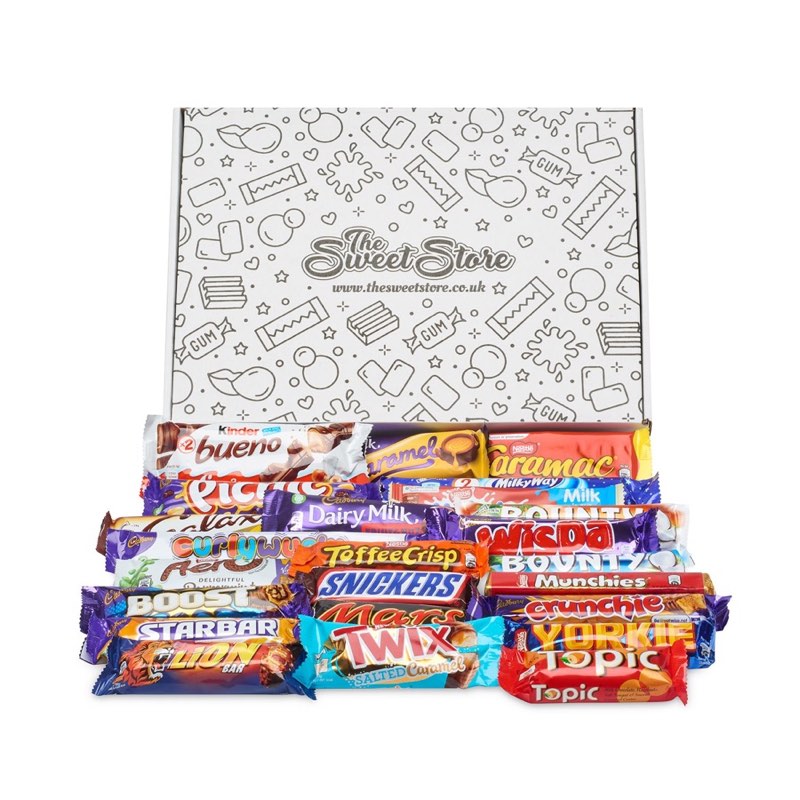
pick and mix · 3000g
Read the full guide
Create Your Own Chocolate Mega Box (25 Bars)
£31.99
✔ In stock — ready to ship
Fresh stock
Free over £20
Same-day dispatch
Secure checkout
Lift the lid and the first thing that registers is not any individual bar — it is the field of them. Twenty-five wrapped bars sitting next to each other read as a surface rather than as objects, the way a tray of books in a charity shop reads as a surface until you start pulling them out. You do not see twenty-five choices. You see a block of colour, and then, after a second or two, you start picking out the ones you recognise.
That second or two is the whole experience of this box and it is worth slowing down for. A ten-bar box is scanned in one glance. Twenty-five is past the number the eye can take in at once, so the brain switches from looking to searching, and searching is a far more enjoyable thing to do with a box of chocolate. People dig. They lift the top layer to see what is underneath. They put one back and take another. Nobody does that with a selection box because there is nothing to find.
The full guide to Create Your Own Chocolate Mega Box (25 Bars)
5,500 words on how it eats, who it suits, how to serve it and what to put beside it.
Twenty-five bars, opened all at once
In the hands it is substantial without being unmanageable. You carry it in front of you with both arms, the way you carry a full recycling box, and there is a definite shift inside when you tip it — twenty-five separate objects moving a centimetre each and sounding like the inside of a paper bag. The listing records the packed weight at 3,000g, and that is a fair guide to what you are picking up: a box you put down on a table rather than balance on a knee.
Take one out and the sensory scale changes completely. A single bar in the hand after that mass of them is a small, precise object — cool if the house is cool, faintly firm through the wrapper, and giving very slightly under a thumb if the room is warm. The wrapper is the first noise of eating, and it is a noise nobody has ever improved on.
Then the snap. Chocolate at room temperature breaks with a short, clean sound and a fracture that travels a little further than you intended. Cold chocolate snaps harder and louder; warm chocolate does not snap at all, it bends and tears and comes away with your fingerprint on it. That single variable — the temperature of the room the box has been sitting in — changes the eating more than most people realise, and it is the reason the same bar can feel brittle and bright one week and soft and heavy the next.
On the tongue there is a stall before anything happens. Chocolate arrives as a solid and has to become a liquid before it tastes of very much at all, which is why the first half-second of a bite is mostly texture: the edges softening, the piece going from something you are chewing to something you are holding. Once it turns, the flavour arrives all at once rather than gradually, and it arrives with warmth behind it.
The finish is the part that separates one bar from another more than the first bite does. Some clear the mouth quickly and leave you ready for the next piece. Some sit there for a minute afterwards, coating everything, and make a second piece feel like too much. Neither is better. But if you are choosing twenty-five bars for a household, you want some of each, because a box entirely made of long-finish bars is a box where people eat one piece and stop.
The format, stated plainly
You choose twenty-five chocolate bars and they arrive in one box for £31.99. There is a single size on this listing at that price, it is in stock, and there is nothing else to decide beyond the contents. No pre-set assortment, no substitutions you did not ask for, no theme imposed on you.
Twenty-five is a deliberate number and it is worth understanding what it is for. It is past the point of being a gift for one person — hand twenty-five bars to an individual and you have given them a project, not a present. It is also short of the largest format we list. It sits exactly where a household sits: enough to stock a cupboard properly for a stretch of weeks, enough to cover a party and still have something left, and enough that two or three people with genuinely different tastes can all find their own things in it without negotiating.
The other thing twenty-five buys you is room to be wrong. With ten slots, every choice has to count and a dud costs you ten per cent of the box. With twenty-five you can afford four or five experiments, which is how anyone ever discovers anything new. If you have wanted to try something but not enough to spend a whole gift on it, this is the format where it costs you almost nothing to find out.
How a flavour gets built to be recognised
Ask somebody to describe what makes a sweet taste of orange and they will usually say "it tastes of orange", which is true and completely unhelpful. The interesting question is how confectionery makes a flavour legible — how a small object with no fruit in sight can make a room full of people all independently arrive at the same word.
Recognition happens in the nose, not the mouth
The tongue is a blunt instrument. It reports sweet, sour, salt, bitter and savoury, and that is close to the end of its vocabulary. Everything you think of as "flavour" — orange, mint, caramel, berry — is smell, arriving from the back of the mouth up into the nose while you chew. That is why nothing tastes of anything much when you have a cold, and it is why flavour in confectionery is really an exercise in releasing aroma at the right moment.
Chocolate complicates this in a way that is worth knowing about. It has to melt before it releases anything, and it melts at close to body temperature, which means the aroma does not appear until the piece is already warm in your mouth. Compare that with a boiled sweet, which starts giving off its note the moment it hits saliva. The delay is why chocolate flavours feel like they bloom and fruit-sweet flavours feel like they strike.
The three-part shape of a note
Any recognisable flavour in confectionery has a shape in time, and it is usually described in three parts.
- The top. The bright, volatile part you get in the first moment — the lift in a citrus note, the cold in a mint one. It is the part that announces what you are eating. It is also the part that fades first, which is why a sweet that has been unwrapped on a table for an hour tastes flatter than the one you just opened.
- The body. The middle, where the bulk of the identification happens. This is what makes a note read as ripe rather than green, as cooked rather than fresh, as dark rather than light. Most of the difference between two products that claim the same flavour is a difference in the body rather than in the top.
- The finish. What stays after you have swallowed, sometimes for a few seconds and sometimes for a minute. A long finish makes a small portion feel like a large one, which is a real consideration when you are portioning a box among a room of people.
Why the same word means different things in different formats
A strawberry note in a chewy sweet and a strawberry note in chocolate are doing entirely different jobs. In the chewy sweet, the note has to punch through a texture that keeps the flavour trapped and releases it slowly over a long chew — so it is built loud and bright, with the top note doing most of the work. In chocolate, the note has to sit inside something that already has a strong, warm character of its own, so it is built rounder and deeper, and it works by complementing rather than competing.
This is the single most useful thing to know when you are assembling a mixed spread. If you put a bright fruit-led sweet and a fruit-led chocolate bar next to each other on the same table, people will taste them within a minute of each other and find them oddly unrelated despite the label agreeing. That is not a fault. It is two different construction problems with the same name on the front.
Sweetness is a volume control, not a flavour
Sweetness does something specific in perception: it rounds off edges and it masks bitterness. Turn it up and a sharp note becomes friendly; turn it down and the same note reads as sour, or as more grown-up, depending on your generosity. This is why the same fruit note can read as a children's sweet in one product and as something for adults in another without the underlying note changing much at all.
It also explains why people's tastes move over a lifetime. Children generally prefer high sweetness because it flattens everything difficult; most adults gradually tolerate and then seek out the bitterness, sourness and astringency that sweetness was covering. If you are buying twenty-five bars for a mixed-age household, you are really buying across a sweetness range, not across a flavour range.
Temperature, and the easiest way to change how a bar tastes
Serve the same bar cold and it will taste quieter, firmer and less sweet, because cold slows the melt and the melt is what releases the aroma. Serve it warm and it tastes louder, softer and sweeter, sometimes to the point of being cloying. Nobody needs a thermometer here, but it is worth knowing that a box brought straight in from a cold car will eat quite differently from the same box after an hour in the kitchen — and if someone tells you a bar tastes different from how they remember it, the room is a more likely explanation than the bar.
Texture carries flavour, and a flat box tastes flat
Flavour perception depends heavily on how long something stays in the mouth and what it does while it is there. Something that dissolves in four seconds delivers a short, bright event. Something that has to be worked at delivers a long, slow one. A box of twenty-five bars that are all the same physical format will start to taste like one thing after the first week, not because the flavours are similar but because the delivery is. Spreading across formats — the fast ones and the slow ones — does more for the variety of a big box than spreading across flavour names does.
Which sweet counter you grew up with
Every adult in Britain is carrying around a private map of a shop that probably no longer exists in the form they remember it. A big box of bars is an unusually direct way to walk back into it, because the bar is the one confectionery format that has stayed recognisably itself across every version of the sweet counter anybody remembers.
For some people the map is a corner shop with a high counter and a row of jars that had to be reached down by an adult. Sweets came in a small white paper bag, the bag was folded over at the top, and the whole transaction had a ceremony to it: pointing, waiting, watching the weighing. What people remember from that era is usually not the flavour. It is the bag.
For others the map is a newsagent on the walk home, the shelf at child height by the door, and a fixed amount of money that made the maths part of the pleasure. This is the generation for whom a bar was the standard unit of currency and a bar-and-a-bit was a good day. The memory attached is one of arithmetic — what you could get for what you had — and it explains why a lot of adults still cannot buy sweets without doing sums in their head. If that is you, the value section further down this page is written for how your mind already works.
For others again the map is the cinema kiosk, or the corner of the supermarket where a parent's resistance could occasionally be worn down, or the tin that appeared once a year and got passed round a sofa in a particular order that everyone in the family could recite. The specific shop changes by decade and by town. What does not change is that the memory is social. Almost nobody's strongest sweet memory is of eating alone.
Which is exactly the argument for a twenty-five-bar box over any individual purchase. A single bar is a private act. A box on a table is the social version, and it reproduces the mechanism most of those memories were made by: choosing in front of other people, with other people watching, from a shared supply. That is why the digging matters. The choosing is the nostalgic part, not the eating.
There is a generational split worth planning around, too. Older shoppers in a household will often reach first for the formats they associate with the counter and the weighed bag — the things that came loose. Younger ones tend to reach for whatever is most novel. A box built entirely to one taste will visibly serve one generation and ignore the other, which you will notice a fortnight later when the same five bars are still there. If you are stocking a house with three generations in it, budget your twenty-five accordingly: a third for the old guard, a third for the new, and a third that anybody would take.
And if the nostalgia you are chasing is specifically the loose-sweet counter rather than the bar shelf, the honest answer is that a bar box is the wrong tool for it, and the weighed pouches are the right one. The 750g sharing pouch at £12.99 with fifteen fillings is the closest thing on the site to the paper-bag experience, and the loose sweets shelf is the whole aisle that idea lives on.
Spreading twenty-five bars across the flavour families
With twenty-five slots the risk is not running out of ideas — it is clustering without noticing. People tend to choose in streaks, and a box chosen in one sitting often turns out to be five variations on the same idea repeated five times.
A workable spread looks something like this. Six or seven plain and familiar, which are the ones that get eaten without anybody thinking about it and which do the day-to-day work of a stocked cupboard. Five or six with texture in them — anything where there is something to bite through rather than just melt — because those are the ones that hold attention across a long evening. Four or five fruit-led, which read brighter and lighter and are what people reach for when they have had enough of rich. Three or four dark-leaning for the adults in the house, which will sit untouched by the children and be gone before the rest if there is an adult who likes them. And three or four outliers — the unfamiliar, the odd, the ones you are buying purely to find out.
Two mistakes recur. The first is weighting the whole box to one person's palate and calling it a household buy. The second is choosing entirely for novelty, which produces a box where there is nothing anybody actually wants on an ordinary Tuesday. Twenty-five bars should include some boring ones. Boring is what gets eaten.
If your household's tastes genuinely run to fruit and chew rather than chocolate, the arithmetic changes and so should the order. The pick-and-mix builds cover that ground properly: the 1000g mega pouch at £16.49 gives you twenty fillings to spread across, and the 2000g giant pouch with forty fillings at £28.99 sits at almost exactly this box's price if you would rather have breadth of loose sweets than depth of bars.
Who actually needs twenty-five
Households of three or more. This is the core of it. Twenty-five bars is roughly a month's steady supply for a family who treat chocolate as a most-evenings thing rather than a weekend thing, and it is the size where the cupboard stops running out on a Wednesday.
People who host regularly. If there is a film night, a games night, a book group or a Sunday where people end up round a table at yours more than once a month, a big box is a better way to be ready than repeatedly buying small ones. You are buying readiness, not quantity.
Anyone running something for a group — a club, a team, a staffroom, a rehearsal, a long committee meeting. Twenty-five bars covers a group of twenty with a few spare, or a group of eight generously across several sessions.
Two-person households with opposite tastes. This is a quieter use and a common one. When one of you will only eat one kind of thing and the other will eat the opposite, a large mixed box ends the weekly negotiation entirely: your half is your half.
People who are buying for a long stretch of time rather than an event — someone going away for a few weeks, a student's first term, a night-shift worker's locker, a caravan. Wrapped bars keep, travel and portion better than anything loose, and twenty-five of them is a stretch of weeks rather than a night.
Who should not buy it: anyone giving to one person. Twenty-five bars handed to an individual is more burden than treat, and the ten-bar box at £14.49 is the size that reads as a gift rather than a delivery. And anyone catering a large children's party will get further with small individually wrapped items than with bars, where the Haribo Fun-Size Treat Box at £5.99 is built for handing out rather than for sharing out.
Running it as a stock cupboard, not a gift
The single best way to use a twenty-five-bar box is to stop thinking of it as a box at all and start thinking of it as stock. That means one decision at the start and no decisions afterwards.
Split it on arrival. Take out five or six and put them somewhere accessible — a bowl, a tin, the shelf everybody raids. Put the rest somewhere deliberately less convenient. This is not rationing for its own sake; it is the difference between a box that lasts five weeks and a box that lasts five days, and the mechanism is simply that people eat what is in front of them. Restock the accessible pile once a week and the box manages itself.
Earmark a few. If there is someone in the house who will be genuinely disappointed to find their one gone, put it aside on day one. Every large shared box produces exactly one small domestic grievance, and it is always about the last of something.
Keep the outliers for when the ordinary ones run low. The unfamiliar bars are the ones least likely to be taken while there is still something safe in the bowl, so if you put them out first they will still be there at the end, and if you put them out last they get eaten with genuine curiosity. Sequencing costs nothing and changes the whole life of the box.
And do not put twenty-five bars out on a table at once unless the room has twenty-five people in it. A full box on display is read as an invitation to take several, and it will empty in an evening regardless of how many people are there.
Building the rest of the table around it
Twenty-five bars is a lot of one format, and formats get boring faster than flavours do. If the box is heading for an occasion rather than a cupboard, pair it with something that behaves differently in the hand.
The obvious partner is something loose and pourable. A 500g mini pouch at £9.99 is enough to fill two bowls and gives people something to graze between bars; a 250g snack pouch at £5.49 is the small version for when you only need one bowl or one person's share.
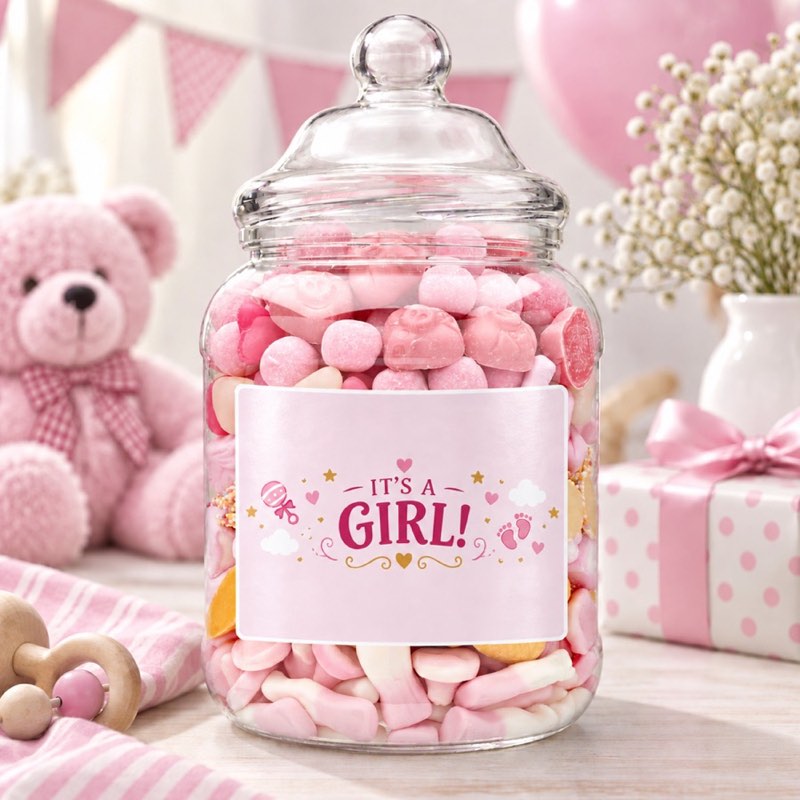
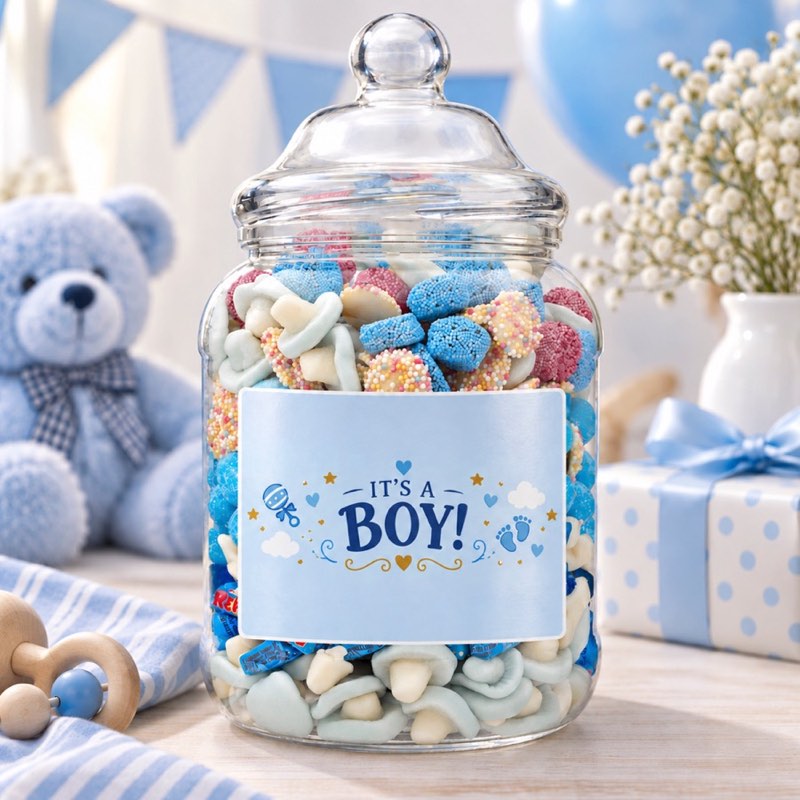
If the table needs a centrepiece rather than more supply, a jar does the job that a box cannot, because a jar has height and a box is flat. The Happy Birthday Mega Sweet Jar with twenty fillings is the one to reach for when there is a candle involved, while the 'It's a girl' mega jar and the 'It's a boy' version, both £25.99, cover the other occasion where a sweet table is expected to announce something.
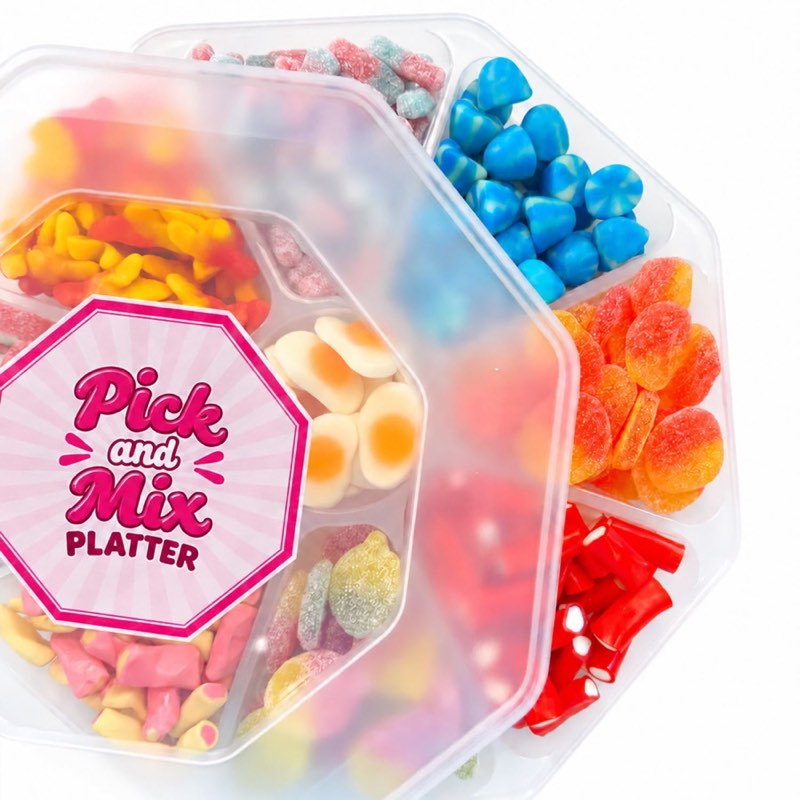
For a spread that looks arranged, the Create Your Own Pick & Mix Platter at £24.99 lays out low and wide where the bar box stacks — the two together give a table both a floor and a texture. For an event where you would rather not arrange anything at all, the £18.99 Bon Bon Sweet Bucket arrives in its own container and can simply be put down.
Two more worth knowing about. Bond's Milk Chocolate Coins at £1.00 are the cheapest way to add small, countable chocolate to a table where the bars are the main event — useful for games, prizes, advent-style counting and stocking corners. And the Haribo International Hamper at £44.99 is the non-chocolate equivalent of what you are doing here: a large, broad supply bought in one go rather than assembled from small purchases.
Parties, hampers and the long seasonal table
At a party, twenty-five bars is a supply rather than a display. Keep the box behind you and refill a bowl from it — that way the bars last the evening and the table never looks picked over, which is the thing that makes a spread look tired long before it has actually run out.
In a hamper, a bar box is the structural element. Bars are the only thing in most sweet hampers that can take weight without crushing, so they belong at the bottom, flat, as the floor the softer things sit on. Twenty-five of them will underpin a very large basket, and if you are building a hamper for a household rather than an individual, this box plus one jar plus one pouch is a complete, balanced hamper with nothing missing.
Across a long seasonal day — Christmas, a birthday that runs from lunch to late, an all-afternoon christening — wrapped bars have one enormous practical advantage over anything in a bowl: they do not deteriorate on the table. Something loose that has been sitting out since noon looks and eats like something that has been sitting out since noon. A wrapped bar at eight in the evening is exactly the bar it was at midday. Put the loose things out in waves and let the bars hold the table between them.
For end-of-term thank-yous where a staffroom rather than a person is the recipient, twenty-five bars divides neatly and needs no plates. If you want the sentiment said out loud as well, the Best Teacher Ever Pick & Mix Sweet Mega Jar at £25.99 does that part for you and pairs with a bar box for a department rather than an individual.
What £31.99 works out at
Twenty-five bars for £31.99 is £1.28 a bar to the nearest penny. Among the build-your-own chocolate formats that is the keenest per-bar figure we list: the ten-bar box at £14.49 comes out at about £1.45 a bar, and the thirty-bar hamper at £42.99 at about £1.43. Buying in the middle, in this particular range, is where the arithmetic is best.
Put it into household time instead of unit price and it reads differently again. Twenty-five bars at one a day is a little over three and a half weeks. At five a week — a Friday-and-weekend household — it is five weeks, which works out at about £6.40 a week for a family's entire chocolate supply. At two a night for a couple, it is under two weeks. Pick whichever of those describes your house and you will know immediately whether twenty-five is the right number or whether you want the smaller box.
For an event, divide differently. Twenty-five bars across a group of twelve is two each with one spare, which is a properly generous evening. Across twenty it is one each plus five for the people who came back. Across forty it is half each, which is not a treat, and at that point you want the loose formats where a kilo spreads much further than twenty-five wrapped units do.
The last piece of arithmetic is the one people forget: the cost of the trips you are not making. A large box bought once replaces several small purchases made in a hurry at full price on the way home, and the saving there is usually larger than the seventeen pence a bar you gained by buying twenty-five instead of ten.
Keeping a big box in good condition
Twenty-five bars will be in your house for longer than ten would, so storage matters more here than it does on a smaller order.
Cool, dark, dry, and — most importantly — steady. Chocolate copes with a consistently coolish cupboard far better than it copes with a cupboard that is cold at night and warm whenever the oven is on. If you have a choice, store it on an internal wall away from the kitchen. A hallway cupboard, a bedroom shelf or the bottom of a wardrobe will all do a better job than the cupboard above the kettle.
Avoid the fridge. Refrigeration brings condensation when the bars come back out and lets chocolate pick up the smell of whatever else is in there, which is a particular risk in a full family fridge. If a hot spell forces your hand, seal the bars in an airtight container first and let them return to room temperature still sealed.
If bars do warm and then cool again, you may see a pale, chalky bloom on the surface. It is a temperature effect and a cosmetic one, and it is the main practical reason to keep the box somewhere stable rather than shuttling it between a cold car, a warm hall and a cool cupboard on the same afternoon.
Store them flat and stacked rather than upright and crowded, where something heavy will lean on them and break the middle of the run. Keep opened bars folded over and returned to the box rather than loose in a drawer. And check every bar's own manufacturer's packaging when the box arrives — that is where each product's printed information lives, including anything relevant to allergies, and it is the only place to check it. Sweets and chocolate are a treat rather than everyday food; small hard sweets and whole gummies are a choking risk for young children, who should be supervised.
Ten, twenty-five or thirty
This listing is one size at £31.99, so the decision is not within the product but across the range.
| Format | Price | Per bar | What it is really for |
|---|---|---|---|
| Chocolate box, 10 bars | £14.49 | about £1.45 | A gift with one person's name on it |
| Chocolate mega box, 25 bars | £31.99 | about £1.28 | A household's stock, or a group event |
| Chocolate hamper, 30 bars | £42.99 | about £1.43 | The largest bar format we list |
The rule of thumb: buy ten if one person will open it, twenty-five if a house will live off it, thirty if you want the biggest single delivery of bars we do. And if the honest answer is that your people prefer chewy and fruity to chocolate, none of the three is right and the pouches are — start at the smallest and work up.
Where it sits on the site
The build-your-own formats all live together on the Pick & Mix shelf, thirty-one listings deep, which is the quickest way to compare sizes side by side rather than one at a time. Everything chocolate-led sits under the Candy & Chocolate section, and if you want to browse without a format in mind, every product we stock is listed in one place.
The useful sequence when you are planning something bigger than a single order is: decide the headcount, decide how long it has to last, then pick a wrapped format and a loose format to cover both. Most people who end up disappointed with a sweet order bought the right quantity in the wrong shape, and looking across two shelves rather than one is the fix.
Questions people ask before ordering twenty-five
Do I choose all twenty-five myself?
Yes. Every slot in the box is yours to fill, which is the point of the format — you are not buying an assortment somebody else designed. If choosing twenty-five feels like work, a practical approach is to pick ten quickly from what you already know, then use the remaining fifteen to spread across the flavour families and formats described above.
Is £31.99 good value against the smaller box?
Per bar, yes — about £1.28 against about £1.45 for ten. But value only applies if you wanted twenty-five. Buying fifteen more bars than you need to save seventeen pence on each of the first ten is not a saving, it is a cupboard problem. Buy the size that matches your household, not the size that wins the arithmetic.
How long will twenty-five bars last a family?
Between two and five weeks in most houses, depending on whether chocolate is an everyday or a weekend thing. One a day is roughly three and a half weeks. If you put all twenty-five out on a table at once, it is one evening, which is why splitting the box on arrival is the single most useful thing you can do with it.
Can I use it as a gift?
For a household or a group, absolutely — it lands very well as a family gift or a thank-you to a team. For one individual it is a lot, and most people find the ten-bar format reads better as a personal present. If you are set on the large box for one person, it helps to say it is for the house.
Will they all be different?
That depends entirely on you. Nothing stops you choosing several of the same thing, and for a household with a clear favourite that is often the sensible move — three or four of the one everybody wants, and the remaining slots spread wide. A box of twenty-five entirely different bars looks impressive and can leave the crowd-pleasers under-stocked.
Does it come gift-wrapped or presented?
It arrives as a box of twenty-five bars, which is presentation enough for most uses. If it is going under a tree or on a hamper table, people generally add their own ribbon or a card rather than rewrapping the box itself.
How should I store it if I only want to use some now?
Take out what you need for the week and store the rest somewhere cool, dark and stable, ideally away from the kitchen. Wrapped bars are patient if the temperature is; the enemy is swing, not time. Keep them flat and stacked so nothing leans on them.
What goes with it for a party?
Something loose in a bowl. Bars are excellent for handing out and poor for grazing, so a pouch or a bucket alongside covers the part of the evening where people are picking rather than choosing. One wrapped format plus one loose format is the most reliable pairing on the site.
Can I order this alongside a pick-and-mix pouch?
Yes, they are separate listings that go into the same basket and arrive together. It is the most common two-item order for anyone catering an event, because the pouch covers bowls and the box covers hands. Any of the weighed build-your-own pouches will do the job; pick the one that matches your headcount.
Do you publish ingredients or allergen details for the bars here?
No. Each bar carries its own manufacturer's packaging with its own printed information, and that packaging is the only reliable source for it. If there is an allergy or intolerance in the household, check each wrapper on arrival before anything is opened.
Is it suitable for children?
Sweets and chocolate are a treat rather than everyday food, and the usual sense applies — supervise young children, and remember that small hard sweets and whole gummies are a choking risk for them. Bars are easy to portion for children precisely because they break, so a shared piece rather than a whole bar is straightforward.
What if I want more than thirty bars?
Order more than one box. There is no ceiling on quantity, and two twenty-five-bar boxes built differently — one weighted to adults, one to children — is a more useful fifty than fifty chosen in a single sitting, where the choices tend to blur together towards the end.
In short
Twenty-five bars for £31.99, about £1.28 each, all chosen by you. It is the household size rather than the gift size: enough to stock a cupboard for a month, cover an evening for a dozen people, or settle a two-person difference of opinion permanently. Spread it across sweetness levels and physical formats rather than flavour names alone, split it on arrival so it lasts, keep it somewhere cool and steady, and check each bar's own packaging when it lands. If you want something to pour into bowls alongside it, the weighed pouches are on the same shelf, and the smallest of them costs less than a fifth of this box. If you are still deciding what shape the order should take at all, it is worth looking across everything we sell before you commit to bars.
More pick & mix sweets
Where this sits
Create Your Own Chocolate Mega Box (25 Bars) appears on these shelves. Browse them, or jump to something nearby.
You might also like