Home / Pick & Mix / Haribo International Hamper
pick and mix · 3000g
Read the full guide
Haribo International Hamper
£44.99
✔ In stock — ready to ship
Fresh stock
Free over £20
Same-day dispatch
Secure checkout
Start with the arithmetic, because a hamper is one of the few sweet purchases where the number on the label is big enough that people want to justify it before they enjoy it.
£44.99 for 3,000 g works out at almost exactly £1.50 per 100 g, or £15 a kilo. Hold that figure in your head while you look at the rest of the shelf, because it is the number that tells you what kind of purchase this is. Our Create Your Own 2000g Pick & Mix giant pouch with 40 fillings at £28.99 lands at about £1.45 per 100 g, so the two are in the same territory by weight. Step down through the smaller pouches and the rate climbs steadily: the 1000g mega pouch with 20 fillings at £16.49 is roughly £1.65 per 100 g, the 750g sharing pouch at £12.99 is about £1.73, the 500g mini pouch with ten fillings at £9.99 is £2.00 flat, and the 250g snack pouch with five fillings at £5.49 is around £2.20. That is the normal shape of confectionery pricing: the more weight you commit to, the less each hundred grams costs you.
The full guide to Haribo International Hamper
5,169 words on how it eats, who it suits, how to serve it and what to put beside it.
Three kilos, £44.99, and what that works out at
So on pure rate, three kilos in a hamper is at the efficient end of our range. What you are also buying, and what the rate does not capture, is presentation and the fact that somebody else has done the choosing. A pouch arrives as a pouch. A hamper arrives as a thing you can hand over.
Now translate 3 kg into servings, because that is the number that actually governs whether you buy one hamper or two. At a generous 100 g a head — the sort of portion an adult will work through over an evening without thinking about it — three kilos is thirty servings. At a more realistic party portion of 50 g, it is sixty. Filled into party bags at 75 g each, it makes forty. Spread across an office of twenty people it is 150 g each, which is a very solid Friday. Rationed across a family of four at 50 g a day, it lasts a fortnight, which is a long time in sweet terms and worth knowing before you decide it is a single-sitting purchase. It is not. Almost nobody finishes three kilos in a sitting, and buying it expecting to is the one way to be disappointed by it.
One more piece of value maths that people forget: the cost of not having enough. The most expensive sweet purchase is the second emergency one made at eight o'clock on the night, at whatever price is available locally. A hamper's real economic argument is that it removes that risk entirely for anything short of a very large party.
What arrives, and what we can and cannot tell you about it
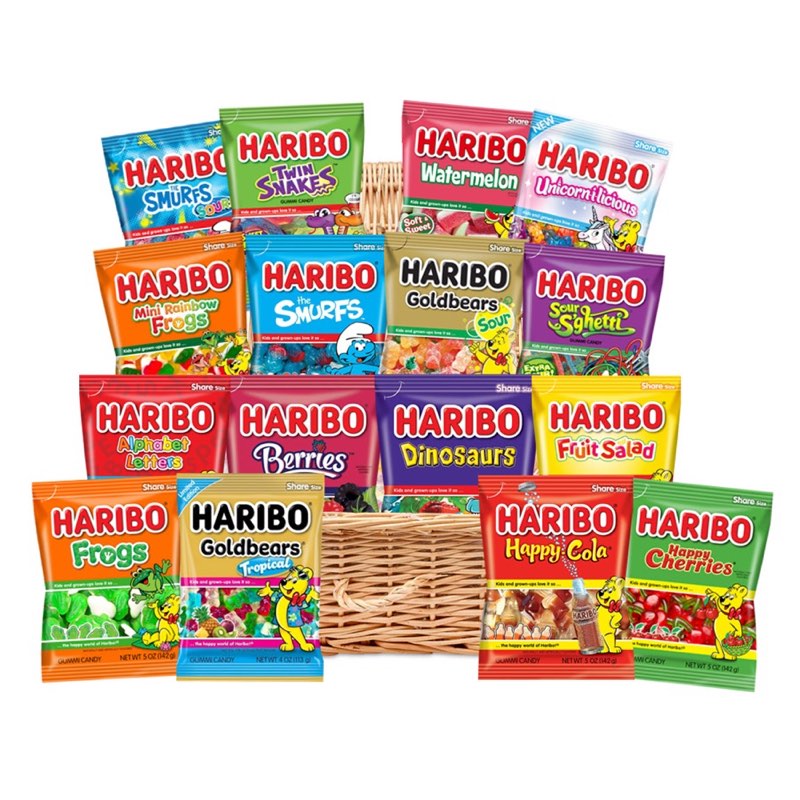
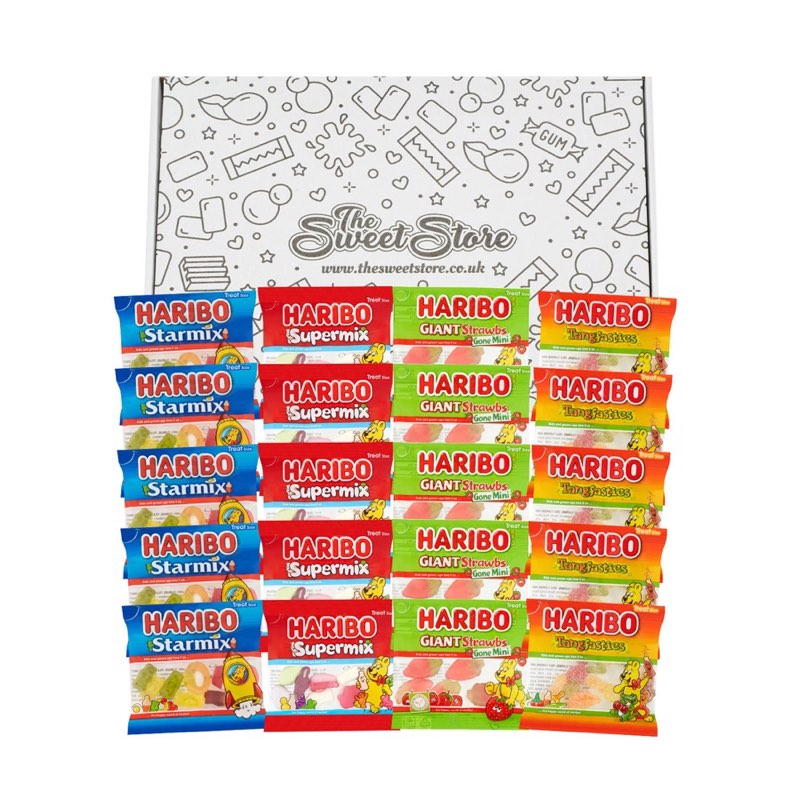
The Haribo International Hamper is sold here in one size, at £44.99, weighing 3,000 g, and it is in stock at the time of writing. There are three photographs on this listing and they are worth a proper look before you buy, because on a hamper the photographs do more work than any description can.
Here is the honest part, and it matters more on a hamper than on any other kind of listing: we do not publish an item-by-item contents list for this hamper, and we are not going to invent one. We hold verified information about its name, its price, its weight and its availability, and that is what you will find asserted on this page. Anything else — which specific lines are inside, in what quantities, in what pack sizes — comes from the product itself and from the photographs, not from a paragraph we made up to fill a gap. The word "International" in the name is doing a lot of work in people's imaginations and we are deliberately not going to translate it into a list of specifics on your behalf.
That sounds like a limitation. In practice it changes very little about how you should shop, because a hamper is bought for what it is rather than for a checklist. You are buying three kilos of assorted sweets in a presentation format, chosen and assembled by somebody else, arriving in one box. The right questions are about size, occasion, presentation and planning — how many people it covers, whether it works as a gift as it stands, how to break it down, how to store what is left. Those are all answerable, and the rest of this page answers them.
The first impression of a three-kilo hamper, when it lands, is simply scale. Three kilos is heavier than most people picture. It is the weight of a large bag of potatoes, and it does not sit unobtrusively on a kitchen worktop. That scale is the point of the format — a hamper is supposed to look like an event when it is handed over — but it is also the thing to plan for, because you need somewhere to put it and, eventually, somewhere to put the part of it you have not eaten.
Who buys a hamper, and why
Four kinds of shopper reach for a three-kilo hamper, and they want quite different things from it.
The gift buyer is the most common. They want something that reads as substantial the moment it is handed over, they want to stop thinking about it once it is bought, and they are usually buying for someone whose specific tastes they do not know in detail. A large assortment is close to the ideal answer to that brief, because breadth covers uncertainty in a way that a single carefully chosen item cannot. If you know exactly what someone likes, buy that. If you do not, buy range.
The event buyer is stocking a table: a birthday party, a christening, a wedding sweet table, a school fair, a leaving do. They care about total weight, about how it looks laid out, and about what it costs per head. For them, the hamper is raw material rather than a finished gift, and they will often be decanting the whole thing into bowls and bags within ten minutes of it arriving.
The office buyer wants one purchase that covers a whole team, sits in a communal space, and does not require anyone to make decisions. Three kilos in a shared kitchen is roughly a fortnight of goodwill.
The household stocker is buying at scale because they have worked out that buying small bags repeatedly costs more and involves more trips. They are the ones who will get the most out of the per-100 g arithmetic above, and the ones for whom storage advice actually matters.
Who should not buy it: anyone catering for a group with specific dietary requirements they need to guarantee in advance. We hold no supplier dietary information for this line, so we cannot tell you what it is or is not suitable for, and a large multi-line assortment is the hardest kind of purchase to check in advance. In that situation, a smaller and more specific purchase you can check properly is a better plan than a big box you have to work through item by item. Whatever you buy, read the manufacturer's packaging on the individual items when they arrive, before anyone eats anything.
A short course in the texture families inside any big assortment
The real reason a large assortment works better than three kilos of one sweet has almost nothing to do with flavour. It is texture. Flavour fatigue is real but slow; texture fatigue is fast and brutal. Eat fifteen identical soft pieces in a row and your mouth stops registering them properly, however good they are. Alternate between three different textures and you can keep going more or less indefinitely, which anyone who has sat next to a well-built sweet table already knows in their jaw if not in their head.
It is worth understanding the main texture families and what each one is doing, because it makes you better at building a table and better at judging what you are eating.
The firm jelly. The defining property is elastic recovery: press it and it pushes back, deform it and it returns to shape. A firm jelly resists the teeth for a moment before yielding, and then keeps giving small amounts of resistance all the way through the chew. That resistance is what makes it satisfying and also what makes it slow — a firm jelly occupies your mouth for far longer than its size suggests. This is the workhorse texture of the whole category, and the reason is straightforward: it survives packing, transport and a warm room better than almost anything else, and it keeps its printed shape, which matters for any sweet that is supposed to look like something.
The foam or marshmallow texture. Here the material is a structure full of trapped air, and the eating experience is entirely governed by how that structure collapses. There is very little resistance; the piece compresses almost immediately, and what you notice is the softness and the speed at which it disappears. Foams are the palate's rest stop in an assortment. They are also the most fragile texture in any box, because air-filled structures are the first thing to suffer if a box gets crushed or warm.
The chew. Denser than a jelly, with much less spring and much more plasticity. A chew stays where the teeth put it rather than bouncing back, which is why a proper chew gives you a long, slow, working sort of pleasure rather than a quick one. It is the texture that most reliably makes people stop talking for a moment.
The sanded or sugared surface. Not a texture in its own right so much as a modifier applied to another one. A granular coating on the outside of a soft piece does three jobs at once: it stops pieces sticking to each other in a bag, it gives the tongue an initial rough contact before the soft interior arrives, and it delivers a burst of flavour to the front of the mouth a fraction of a second before the body of the sweet does. That fractional head start is why coated pieces taste sharper than uncoated ones even when the interiors are identical.
The fizz. A powdered surface treatment that reacts on contact with the moisture in your mouth and produces a brief effervescence. The engineering challenge is keeping the powder inert until it gets there, which is why fizzy sweets are the most sensitive things in any sweet cupboard to humidity — a fizzy piece that has been left in a damp kitchen has already had its reaction, quietly, in the packet. This is the single strongest practical argument for airtight storage of any assortment.
The hard boiled sweet. A rigid, glassy solid with no give at all, which either dissolves slowly or fails suddenly under pressure. It is the longest-lasting texture in the shop by a wide margin and the one that demands the most patience. A single hard sweet can occupy ten minutes; a foam occupies four seconds.
Two things follow from all this, and they are the practical payoff. First, when you lay out a big assortment, sort it by texture rather than by colour or by brand. Soft in one bowl, firm in another, coated in a third. People navigate by texture even when they think they are choosing by flavour, and a bowl sorted this way empties evenly instead of leaving an unloved residue. Second, if you are supplementing a hamper with other purchases, the useful question is not "what flavour is missing?" but "what texture is missing?" A box of bars like our Create Your Own Chocolate Box with ten bars at £14.49 adds the melt family, which is the one texture that a gummy-led assortment cannot supply for itself, and the contrast is felt immediately on a table.
Temperature affects every one of these families and it is the lever you control at home. Everything gets firmer cold and softer warm. Jellies become tough and almost brittle in a cold room; foams go dense; chews become genuinely hard work. If a hamper has been somewhere cold, give it a couple of hours in a normal room before you serve from it, and it will eat the way it is supposed to.
The builder's view: how a hamper behaves next to a hand-picked bag
Anyone who has built their own pick-and-mix bag develops a way of thinking about sweets that is quite different from buying by packet. You stop thinking about products and start thinking about roles. A well-built bag is not the fifteen sweets you like most; it is a balanced set where each item is doing a distinct job, and where nothing is duplicating anything else. Once you see it that way, the hamper question becomes much clearer.
A hand-built bag gives you control and precision. If you loathe one particular family of sweet, it need never appear. If you are buying for one person whose tastes you know exactly, you can hit them squarely every single time. That is what our fillings-based pouches are for, and why we sell them in a ladder of sizes: a 250 g snack pouch with five fillings at £5.49 for one person's week, the ten-filling mini pouch at £9.99 for a couple or a small gift, fifteen fillings in a 750 g sharing pouch for £12.99 when it is going on a table, a full kilo with twenty fillings at £16.49 for a proper spread, and two kilos across forty fillings for £28.99 when variety itself is the point.
A hamper gives you the opposite: breadth without decisions, and presentation you cannot replicate by pouring sweets into a bag yourself. Those are genuinely different products, and the mistake is treating them as competitors. Ask which of three things you actually need — control, breadth, or presentation — and the answer picks itself. Control means a pouch. Breadth means a hamper or the widest pouch. Presentation means a hamper or a jar.
The builder's discipline is still worth applying to a hamper, though, because it tells you what to buy alongside it. Four rules, all of them learned the hard way by people who have filled a lot of bags:
- Never duplicate a role. If the hamper is carrying the soft-and-chewy load — and a three-kilo sweet assortment almost inevitably is — then a second soft-and-chewy purchase adds weight without adding interest.
- Always include one thing that resets the mouth. Something mint, something sharp, or something salty. Without it, everything after the first twenty minutes tastes like the same note played louder.
- Include one thing with a completely different eating pace. A hamper is full of fast sweets. Something slow — a hard sweet, or a bar you have to unwrap — changes the rhythm of a table and stops it being eaten out in an hour.
- Include one thing that looks impressive. A container with visual weight does more for a table than a fourth bag. the Bon Bon Sweet Bucket at £18.99 is the obvious candidate: a bucket reads as generosity from across a room, and it holds its shape when a bag would slump.
The last builder's habit worth stealing is holding stock back. Anyone who runs a sweet table regularly keeps a third of the total out of sight and refills at the halfway point. A table that gets restocked feels abundant all evening; a table that was enormous at seven and bare by nine feels like it ran out, even though the same weight of sweets was eaten.
Planning around a hamper you have not itemised
Because we do not publish a contents list, it is worth being practical about how to plan when you do not know exactly what is coming. The answer is to plan by structure rather than by item, which is a better way to plan anyway.
Assume the hamper covers the assorted-sweets slot comprehensively. That is what three kilos of a mixed assortment does. What it will not cover, by definition, is the chocolate slot, the traditional-boiled-sweet slot and the novelty slot. So if you are building a full table rather than handing over a gift, budget for one purchase in each of those three areas and you will have a properly rounded spread regardless of what is inside the box.
For chocolate, the scale of the occasion decides the format. a ten-bar chocolate box at £14.49 suits a family table; the 25-bar Create Your Own Chocolate Mega Box at £31.99 suits a party or an office; the 30-bar chocolate hamper at £42.99 is the direct chocolate equivalent of this sweet hamper, and buying both is how people put together a genuinely serious gift for a household rather than an individual. For something small and cheap that fills the novelty slot without any thought at all, Bond's Milk Chocolate Coins at £1.00 do a disproportionate amount of work on a children's table for the money.
For the traditional slot, browse the loose sweets we sell by weight and pick one thing with a strong, old-fashioned character. It does not need to be a large quantity. The purpose of the traditional item on a modern sweet table is contrast and conversation, and 200 g of something distinctive achieves that as well as a kilo would.
Breaking three kilos down: bags, bowls and parcels
Most hampers get broken up, and doing it well takes about twenty minutes and makes a real difference.
For party bags, decide your per-bag weight first and work backwards. At 50 g a bag, three kilos makes sixty; at 75 g, forty; at 100 g, thirty. Use kitchen scales for the first three bags to calibrate your eye, then fill the rest by eye and spot-check. Give every bag a spread of textures rather than sorting by type — a bag of nothing but one thing feels mean even if it weighs the same as everyone else's.
For a buffet table, use more bowls and shallower ones than instinct suggests. Six shallow bowls of 300 g beat two deep bowls of a kilo every time, because people will not reach into the bottom third of a deep bowl and that stock effectively never gets eaten. Space the bowls out rather than clustering them; a cluster creates a queue and a queue makes people take too much when they finally get there.
For care parcels and post, three kilos divides neatly into three or four smaller parcels for students, grandchildren or anyone away from home. Portion into airtight tubs or resealable bags, and include a note about checking the original packaging for allergen information, because once sweets leave their own packs that information has gone with them.
For rationing at home, the trick that works is portioning on day one rather than relying on restraint on day five. Divide into daily or weekly pots, put the bulk of it out of easy reach, and the hamper lasts the fortnight the arithmetic says it should.
Occasions where a hamper is the right answer
Christmas is the obvious one, and the hamper's real Christmas virtue is that it solves several people at once. One box covers the household rather than one recipient, and a large assortment is the thing on a Christmas table that still gets eaten on the 28th when everyone has had enough chocolate.
Birthdays work best when the hamper is the centrepiece rather than an add-on — a three-kilo box is a statement present for a teenager, a sweet-obsessed adult or a shared household. If you want a birthday-specific presentation instead, the Happy Birthday Mega Sweet Jar with twenty fillings at £25.99 does the same job in a jar and with the occasion printed on it, which some recipients prefer to a generic box.
Thank-you gifts are where the occasion-specific jars come into their own. the Best Teacher Ever Pick & Mix Sweet Mega Jar at £25.99 says something a hamper cannot, because the message is part of the product. A hamper says generosity; a labelled jar says a specific thank you to a specific person.
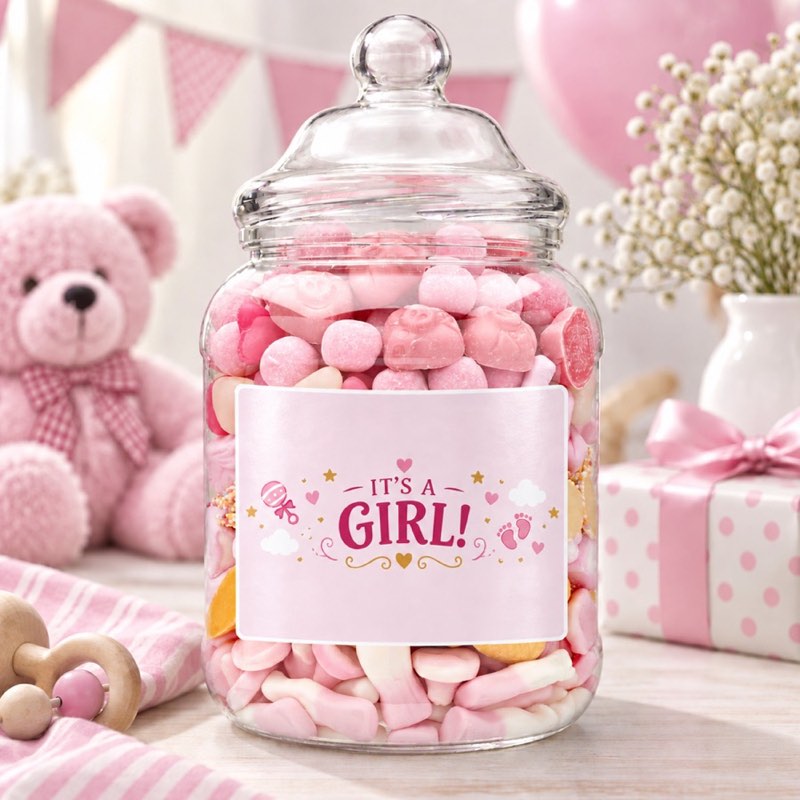
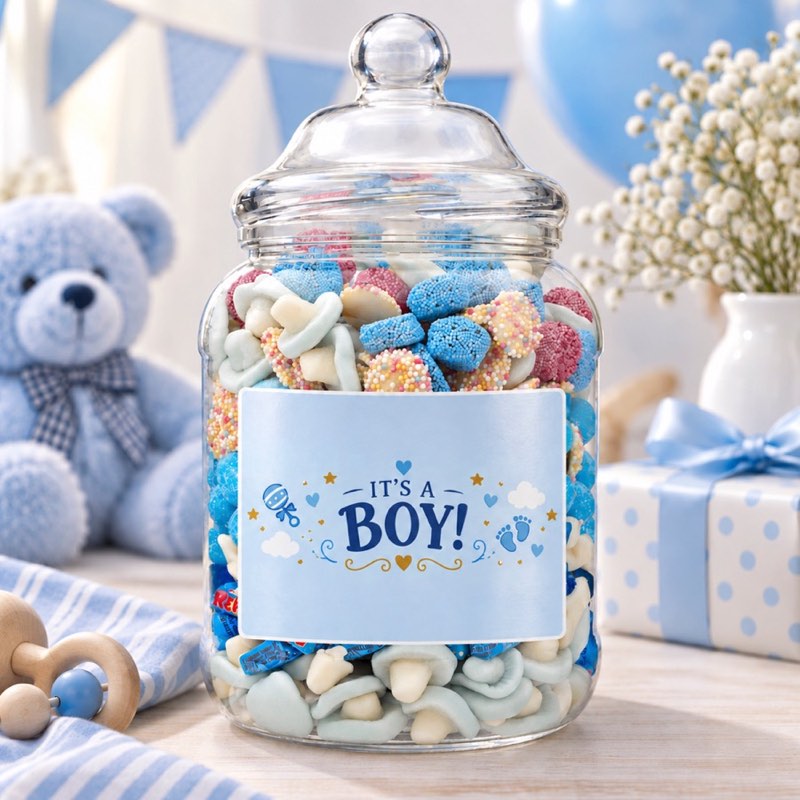
New-baby gifts follow the same logic — the ‘It’s a girl’ baby shower mega jar and its ‘It’s a boy’ counterpart, both £25.99, are built for one occasion and look it. A hamper is the better choice when you are feeding a houseful of visitors rather than marking the moment.
Office and team occasions — a leaving do, the end of a hard quarter, a Friday for no reason — are where three kilos is exactly the right amount. Put it in the kitchen, break it into two or three bowls, and top up from the box for a week.
Fundraisers, fairs and raffles use hampers differently again: as a prize, where the size is the entire appeal, or as stock to be broken into bags and sold on. For the second use, the per-100 g arithmetic at the top of this page is the number to build your pricing on.
Keeping three kilos in good condition
The storage problem with a hamper is not that sweets are delicate. It is that three kilos is more than most households can eat quickly, so it will be open for weeks, and that is a completely different storage question to a bag you finish on Saturday.
Cool, dry and dark is the whole of the law. A cupboard away from the oven, the kettle, the radiator and the window will keep an assortment in good condition for as long as the dates on the individual packs allow. Sunlight is worse than most people realise, both for colour and for softening.
Humidity is the specific enemy of an assortment, because a mixed box will usually contain things that hate damp. Anything with a powdered or granular surface loses its character first — the coating draws moisture, goes tacky, and the sweet underneath starts sticking to its neighbours. If your kitchen is steamy, move the box somewhere else entirely rather than trying to seal it in situ.
Once anything inside is opened, transfer it to an airtight container rather than folding the pack over. This is the single highest-value habit for hamper owners, and a few cheap clip-lid tubs will do more for the last kilo of the box than anything else you can do. Keep different textures in different tubs where you can; soft pieces stored against coated ones will transfer moisture between them and both come off worse.
Do not use the fridge as default storage. Cold makes jellies and chews hard work, and the damp environment means condensation forms on the surface the moment things come back out into a warm room. Sealed tubs in a cool cupboard beat the fridge on every measure except on the hottest few days of the year.
Finally, the paperwork: the best-before dates, storage instructions and all allergen and ingredient information are printed on the individual packaging inside the hamper. Keep that packaging until the item is eaten, especially if you are splitting the hamper up for other people, and check it before eating if anyone in the house has an allergy. We hold no verified allergen data for this line and will not guess at it.
Choosing between this and the other big formats
There is only one size of this hamper — 3,000 g at £44.99 — so the decision is not which hamper, but whether a hamper is the right shape of purchase at all. A short way to decide:
| If what matters most is | Buy | Because |
|---|---|---|
| Scale and presentation in one box | This hamper at £44.99 | Three kilos, assembled and boxed, nothing to decide |
| Exact control over contents | the forty-filling giant pouch | Two kilos, every filling chosen by you, £28.99 |
| A gift that names the occasion | a Happy Birthday mega jar | The message is part of the product, £25.99 |
| Chocolate rather than sweets | the 30-bar chocolate hamper | Same gift scale, entirely different family, £42.99 |
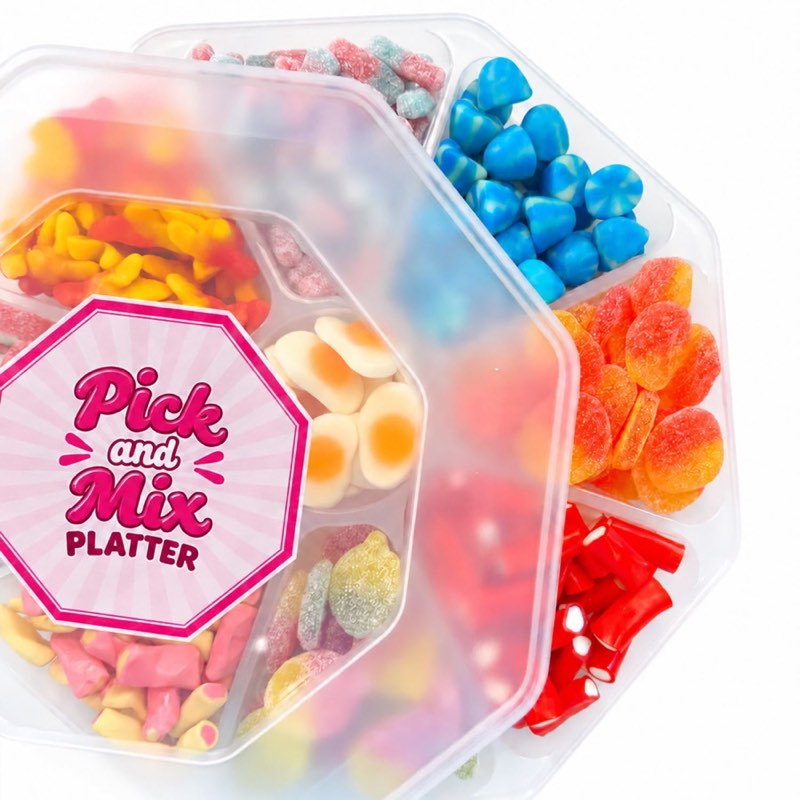
| Something laid out ready to serve | the Create Your Own Pick & Mix Platter at £24.99 | Arrives as a spread rather than as stock |
| A smaller, cheaper version of the same idea | the Haribo Fun-Size Treat Box at £5.99 | The assortment idea at a fraction of the size and price |
Plenty of people buy two of these rather than one of something. A hamper plus a platter covers both the gift and the table; a hamper plus a chocolate box covers both texture families; a hamper plus a labelled jar lets you give the big thing to a household and the personal thing to one person in it.
Finding your way around the rest of the shop
This hamper sits on our Pick & Mix shelf, alongside 31 other lines at the time of writing — the jars, the pouches, the platters and the build-your-own formats. It is the right shelf to browse if you are buying by occasion or by scale rather than by brand.
Next door, Loose Sweets is where sweets sold by weight live, and it is the place to go for traditional lines and for filling your own containers. the Candy & Chocolate shelf holds the branded bags, boxes and bars — the place to solve the melt-and-snap gap that any gummy-led assortment leaves open. And if you would rather not use categories at all, browse everything we stock and filter it however suits you.
A few specific neighbours worth a look while you are deciding: a sweet bucket at £18.99 for a container with presence, a 25-bar chocolate mega box when a whole office is involved, the blue baby shower jar or the pink one for new arrivals, and a pound’s worth of chocolate coins as the cheap finishing touch on any parcel you are making up yourself.
Questions people ask before buying a hamper
How many people will three kilos cover?
At a party portion of about 50 g a head, three kilos covers sixty people; at a generous 100 g it covers thirty. For a family of four treating it as a stock purchase rather than a single event, it works out at around a fortnight at 50 g a day. If you are laying on a table for more than sixty, plan on a second purchase, ideally in a different format so the table has variety as well as volume.
What exactly is inside it?
We do not publish an itemised contents list for this hamper and we will not guess at one. The listing photographs are the best guide available before purchase, and the definitive information is on the packs inside the box when it arrives. What we can confirm is the format and the scale: three kilos of assorted sweets, presented as a hamper, in one size at £44.99.
Is it suitable for someone with allergies or a specific diet?
We hold no supplier dietary information for this line, so we cannot tell you that it is suitable for any particular diet and we will not imply it either way. A large multi-line assortment is the hardest kind of purchase to verify in advance. Please check the manufacturer's packaging on each item when the box arrives, before anyone eats anything, and if a guarantee is needed in advance, choose something you can check first.
Does it arrive gift-wrapped or ready to give?
It arrives as a hamper, which is the format doing the presentation work — that is a large part of what distinguishes it from the same weight of sweets in pouches. The photographs on this listing show how it presents. If your recipient would prefer a laid-out spread rather than a box, the pick and mix platter at £24.99 arrives arranged rather than packed.
How long will it last once we start on it?
Longer than most people expect, provided the individual packs inside are opened one at a time rather than all at once, and provided anything opened goes into an airtight tub. The controlling factor is the best-before date on each pack rather than any general rule, so read those before you plan around it. Kept cool, dry and sealed, an assortment stays in good condition for a long time.
Is it better value than buying pouches?
On pure rate, at around £1.50 per 100 g, it is at the efficient end of our range and comparable with the two-kilo pouch. Smaller pouches cost meaningfully more per 100 g — up to about £2.20 on the smallest snack pouch. What the rate does not price in is presentation and the fact that the selection is made for you, which is worth something on a gift and nothing at all if you were going to tip it into bowls anyway.
Can I choose what goes in it?
Not on this listing — it is a fixed assortment in one size. If choosing is the point, our build-your-own range is where to go, and it runs from five fillings up to twenty fillings in a kilo pouch and beyond. Plenty of people buy both: a fixed hamper for breadth, and a hand-picked pouch for the two or three things they know they want plenty of.
Will it survive being posted to someone?
Sweets travel well as a rule, but any assortment prefers a cool journey to a warm one, and air-filled and coated pieces are the most sensitive to being crushed or warmed. If you are forwarding part of a hamper yourself, repack into rigid tubs rather than bags, keep the original packaging with each item so allergen information travels with it, and avoid sending in a heatwave if you can choose your week.
Is it a good children's party choice?
Three kilos makes around forty 75 g party bags, so the arithmetic works very well. Two practical notes: sort by texture rather than by type when you fill the bags so each one feels varied, and remember that sweets are a treat rather than a food. Small hard sweets and whole gummies are a choking risk for young children, so keep them away from under-fives and supervise older children while they are eating.
What should I buy alongside it?
Something that fills a gap rather than deepens a strength. In practice that means chocolate, because a sweet assortment cannot supply the melt texture for itself — a ten-bar box is the usual starting point. After that, something sharp or minty to reset the palate, and one item with visual presence for the middle of the table. Three well-chosen additions beat six more of the same thing.
Is there a smaller version?
Not of this exact hamper, but the fun-size treat box at £5.99 is the same idea at a far smaller scale and price, and it is the sensible choice if you want an assortment for one household rather than an event. The other route down in size is the pouch ladder, where ten fillings in 500 g for £9.99 gives you variety in a much more manageable quantity.
Is it in stock?
Yes, at the time of writing, in its single 3,000 g size at £44.99. Large gift formats move quickly in the run-up to Christmas and around exam-results and end-of-term weeks, so the live availability on this page is always more reliable than a description written weeks earlier. If it has sold out when you look, the jars and the two-kilo pouch are the nearest equivalents by scale.
In short
Three kilos at £44.99 is a gift-scale purchase priced like a bulk one: about £1.50 per 100 g, thirty generous servings, forty party bags, or a fortnight for a family. Buy it when you want breadth and presentation without making decisions, and buy a pouch instead when you want precision. Plan it by texture rather than by flavour, break it down within a day or two of it arriving, keep what is left cool, dry and airtight, and check the packaging inside before anyone with an allergy eats from it.
More pick & mix sweets
Where this sits
Haribo International Hamper appears on these shelves. Browse them, or jump to something nearby.
You might also like