Home / Candy & Chocolate / Charms Fluffy Stuff Cotton Candy 71g
Charms · 71g
Read the full guide
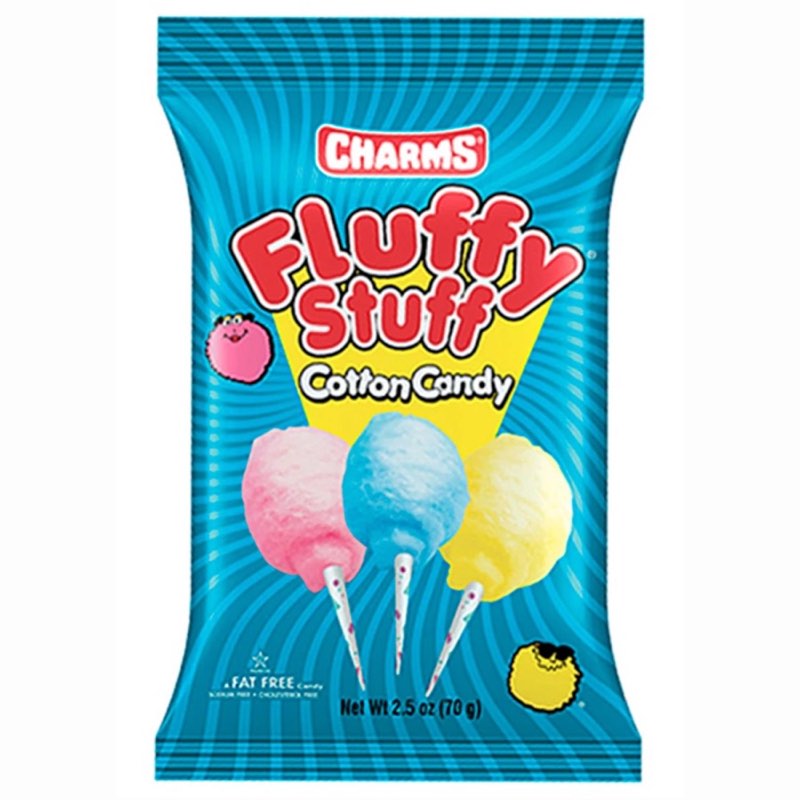
Charms Fluffy Stuff Cotton Candy 71g
£2.49
✔ In stock — ready to ship
Fresh stock
Free over £20
Same-day dispatch
Secure checkout
Some sweets are bought for a moment and some are bought for a mood. A 71 g bag of Charms Fluffy Stuff Cotton Candy at £2.49 is firmly the second kind, and the occasions it suits have more in common with each other than you might expect. They are nearly all occasions where you want the atmosphere of somewhere else — a fairground, a pier, a school fete, a cinema foyer — in a room that is not any of those places.
Children's birthdays are the most obvious. Cotton candy is one of the very few sweets that reads as an event on its own. Put a bowl of jellies on a table and it is a bowl of jellies; put cotton candy on a table and something has happened. It is theatrical in a way almost nothing else at this price is, and for a party where the decoration budget has gone on other things, it does a surprising amount of visual work by simply existing.
The full guide to Charms Fluffy Stuff Cotton Candy 71g
5,285 words on how it eats, who it suits, how to serve it and what to put beside it.
When a bag of cotton candy is the right answer
Fairground and circus themes follow directly from that. If somebody has committed to a theme, this is the single most on-message thing you can buy, and it costs less than most of the decorations. A bag opened and heaped into a bowl signals the theme instantly to every guest who walks past, including the adults, who will recognise it faster than the children will.
Party bags and prize tables work differently but well. A sealed bag is a complete item that needs no dividing and no wrapping, and it looks considerably more generous than its weight because of how much room it takes up. As a raffle prize or a pass-the-parcel layer it is close to ideal: instantly recognisable, obviously fun, and cheap enough to buy several of.
Baking days and cake decorating use it as a material rather than a snack. It is the standard trick for anything that needs to look like a cloud, a mane, a wave or a sunset on top of a cake, and it goes on at the very last minute rather than the night before. Which is exactly the sort of thing that turns a cake into a project children want to help with.
Gifts and small parcels are a legitimate use too, particularly for adults. Sending somebody a bag of cotton candy is a joke and a kindness at the same time, and it lands better than something more expensive and more serious would. In a hamper it is the item that makes people laugh, which is a job worth filling.
A wet Saturday. Worth listing because it is probably the real answer most of the time. There is no occasion, the weather is bad, and the point of the purchase is to make an ordinary afternoon slightly less ordinary. That is a completely valid reason to buy sweets and nobody needs to dress it up as anything else.
One standing note for a page like this: sweets are a treat rather than an everyday food. Small hard sweets and whole gummies are a choking risk for young children and should be eaten with an adult nearby. If anyone in the house has an allergy, read the manufacturer's packaging on the bag itself when it arrives, before it is opened — the pack is the authority on its own contents, not a website.
What it is actually like to eat
The bag is the first surprise. 71 g of spun threads occupies an enormous amount of space, so the bag is large, light and almost weightless in the hand. Pick it up expecting the heft of a normal sweet bag and you will lift it too fast. It gives under the slightest pressure and springs back part of the way, and it makes a faint papery sound when you squeeze it that is unlike anything else on the shelf.
Opening it releases a small puff of sweet air. Inside, the contents are not loose pieces but a single connected mass of spun threads that has been compressed into the bag — so the first thing you do is pull rather than pour. It comes away in a ragged clump, stretching slightly before it separates, and whatever you take leaves a hollow behind rather than collapsing to fill it.
In the hand it is warm-feeling and almost dry to the touch, but only for a moment. The threads are so fine that the slight moisture on your fingertips starts working on them immediately, which is why a piece held too long goes from fluffy to tacky to a small sticky bead. This is not a flaw; it is the same property that makes the eating experience what it is, and it is why cotton candy is best handled quickly and lightly.
The eating itself is the shortest event in confectionery. Put a piece on your tongue and it does not need chewing at all — it collapses on contact and is gone in a second or two, leaving a flash of sweetness and then nothing. There is no texture in the mouth, no work for the jaw, no aftermath. It is the only sweet we sell that is essentially over before you have decided what you think of it.
That brevity is the thing to understand before you buy. People sometimes describe cotton candy as disappointing, and what they mean is that it does not last. It is not supposed to. The experience is the collapse — the moment where something that plainly occupies space turns out to occupy none — and once you accept that as the point rather than a shortcoming, the whole product makes sense. It is a magic trick you are allowed to eat, and it is worth eating a piece slowly with your eyes closed once just to notice how strange the sensation actually is.
The practical consequence is pacing. Because each piece is over so quickly, people take another immediately, and a bag can vanish in a few minutes if nobody is paying attention. It is the opposite of a chew, which rations itself. If you want this to last an afternoon, it has to be handed out rather than left within reach.
Which sweet counter this belongs to
Every sweet carries a period with it, whether or not the shopper notices. Some belong to the jar-and-scoop counter, some to the pocket-money shelf of the 1980s, some to the import aisle of the last decade. Cotton candy is unusual in that it belongs to a place rather than a decade — and the place has been more or less the same for well over a century.
The fairground era, and why it stuck
Spun floss arrived as a spectacle rather than as a product. The machine was the attraction: a spinning drum, a cloud forming out of apparently nothing, an operator winding it onto a stick in front of you. You did not buy a bag, you bought a performance with something edible at the end of it, and the whole appeal depended on watching it happen.
That origin explains almost everything about how the sweet is perceived now. It is why cotton candy still feels like an event rather than a snack. It is why it is associated with crowds, noise and being outdoors. And it is why it is one of the very few sweets that adults will describe in terms of where they ate it rather than what it tasted like — because the where was genuinely the larger part of the experience.
It also explains the scale. Fairground floss is enormous, far bigger than anyone wants to eat, because size is the visual proof of the spectacle. A small portion would defeat the purpose. That expectation of bigness has carried across to the bagged version, which is why a 71 g bag looks and feels far larger than its weight, and why anything smaller would feel like a cheat.
The seaside pier and the cinema foyer
The second home is the British seaside, where floss sits alongside rock and doughnuts in a small group of foods that almost nobody eats anywhere else. Seaside confectionery follows its own rules: it is bought on holiday, by people who will not be back for a year, partly as a souvenir and partly because buying it is what you do there. Nothing about it is practical and nothing needs to be.
The pier and the fairground between them established the whole category of sweet-as-occasion — the thing you buy because of where you are standing. A jar of aniseed balls at £16.99 is the exact opposite: a sweet that exists because it keeps, travels and sits patiently in a jar for months. Both have been sold in British sweet shops for generations, and the difference between them is a difference of purpose rather than of era.
The cinema foyer is the third venue and the one that shaped the American side of this shelf. Cinema confectionery had to be eatable in the dark, quiet enough not to annoy anybody, and shareable from one container — which produced a very specific family of products. Junior Mints at £2.59 and Milk Duds at £2.99 are that family intact, boxes designed around a darkened room. Cotton candy arrived at the cinema later and by a different route, but it fits the brief almost accidentally: silent to eat, no wrapper per piece, and nothing to drop.
The bagged era, and what it changed
Putting floss in a bag was a bigger change than it appears. It removed the machine, the operator and the queue, and left only the product — which means the bagged version has to carry the entire appeal on its own, without the performance that originally created it.
Mostly it succeeds, because the collapse in the mouth is itself a small spectacle, and because the bag preserves the exaggerated size that the fairground version established. What it loses is the freshness of floss that is seconds old, which is genuinely different — looser, warmer, more delicate — and anyone who has had both will tell you so. What it gains is availability, which turns out to matter more. A bagged product can be part of a Tuesday. A fairground one cannot.
It also moved the sweet from an unbranded folk product to a branded one. Nobody asks whose floss they are eating at a fair. On a shelf, the name on the bag is what you choose between, and that is a different relationship with the same thing. It is the same shift that happened to almost everything else in the British sweet shop during the twentieth century, just later and less completely.
How the memory gets handed down
Here is the part that makes this sweet unusual. Most confectionery nostalgia works backwards — an adult buys a thing they remember, the child eats it, and the memory does not transfer, because the child has no reason to attach anything to it. Cotton candy transfers, because the sensation is genuinely remarkable to a person meeting it for the first time. A child handed a piece and watching it disappear has more or less the same experience an adult had at a fair in 1985.
That is why it survives generational turnover far better than most retro lines do. It is not being kept alive by adults buying their own childhood; it is being rediscovered from scratch by every new set of children who meet it, and the adults happen to be pleased about that. Very few old sweets manage both at once.
There is a practical upshot for anyone buying across generations — for a family party, a school event, a care-home tea. This is one of the safest things you can put out, in the sense that nobody needs it explained and nobody is too old or too young for it. The traditional loose sweets shelf holds a great many lines that only land with one generation. This lands with all of them, and there are not many like it.
Pacing, mess and sharing: the during-something snack
A large proportion of sweets are eaten while something else is happening — a film, a game, a long drive, a box set. That context imposes three requirements that nobody ever writes down: it has to be eatable without looking, it has to be clean enough not to ruin what you are holding, and it has to divide sensibly between people. Cotton candy scores unusually well on one of those, badly on another, and it depends on the third.
Pacing: the fastest snack in the shop
Pacing is about whether a snack lasts as long as the thing you are doing. A film is two hours; a gaming session can be considerably longer. A snack that is finished in the first fifteen minutes has failed at the job regardless of how good it was.
By that measure, cotton candy is the worst-pacing product we sell. There is no chew, no resistance and no natural pause, so the rate of consumption is limited only by how fast a hand can move. A 71 g bag put in front of two people during a film will very often be gone before the opening act is over, and nobody involved will have made a decision about it.
There are two ways to handle that, and they are both about deliberate rationing rather than willpower. The first is to treat it as an interval rather than a duration — open it at a specific moment, finish it, and move on to something slower. That actually suits the product, because a short intense thing at a defined point is a perfectly good structure for an evening. The second is to pair it with something that paces properly and let the slow item carry the length. A 140 g bag of Maoam Pinballs at £1.99 is the cheapest way to do that — a proper working chew that takes real time per piece — and the two together give you a fast opening and a long middle.
For gaming specifically, pacing matters more than for films, because sessions are longer and less predictable. The sensible structure is one fast item early and one slow item that lasts, and the Airheads six-bar theatre box at £2.49 is well suited to the second role: six individually wrapped bars means six deliberate decisions spread across an evening rather than a bowl that empties itself.
Mess, and the controller problem
This is where honesty is more useful than salesmanship. Cotton candy is sticky on contact with moisture, and fingers have moisture on them. Take a piece, hold it for three seconds, and your fingertips are tacky. Do that ten times across a film and you have tacky fingers for the rest of the evening.
For a controller, a keyboard or a phone, that is a genuine problem rather than a theoretical one. Sticky fingers on a controller are unpleasant immediately and leave a residue that has to be cleaned off later. Anyone who takes their kit seriously should either not eat this while holding it, or should accept a pause and a hand-wash between the snack and the session.
The workable solutions are simple. Eat it in a defined sitting rather than continuously, with a damp cloth to hand. Or use a fork or a cocktail stick, which sounds ridiculous and works perfectly. Or hand it out in portions so that each person gets a piece, eats it, and does not go back. On a table with children, a plate each solves it entirely, because the problem is repeated handling rather than one piece.
Compare that with the genuinely clean options and the difference is stark. The Mike & Ike Berry Blast theatre box at £2.25 pours from a carton and leaves nothing on the fingers at all, and Nerds in grape and strawberry at £1.49 are about as low-residue as a sweet gets. If you are stocking a games night for people who will be holding equipment, those are the right choices and this is the wrong one — unless it comes out during a break, which is exactly where it belongs.
Sharing out of one bag
The third requirement is dividing. Some formats divide beautifully: anything in individual pieces can be poured into two bowls and the sharing is settled. Cotton candy does not, because it is one connected mass rather than a collection of pieces. Two people reaching into the same bag will tear the same clump, which is companionable with a friend and a source of grievance with siblings.
So it is a bag to portion out rather than to pass. Pull it into rough halves onto two plates at the start and the problem disappears. It is also worth knowing that the mass compresses badly once disturbed — a bag that has been pulled at by several hands does not go back to its original volume, so it looks considerably more depleted than it is.
For a group of more than three, the honest advice is to buy more than one bag, or to make this the shared centrepiece and put something properly divisible alongside it. A 70 g bag of Jelly Belly American Classics at £2.40 is the ideal companion for that, because beans are the most divisible thing in the shop — countable, poured, and impossible to argue about.
Building a spread around it
On a mixed table this occupies a very specific corner: it is the soft, fast, spectacular item. That means the other three corners are open, and filling them deliberately produces a far better table than adding more of what you already have.
The slow corner wants a chew, and the pinballs cover it at the lowest price. The crisp corner wants something with noise in it — Reese's Dipped Pretzels in the 120 g bag at £5.29 are the most substantial option we hold in that direction, and the contrast between a loud, firm bite and something that disappears silently is the most dramatic pairing you can build. The sharp corner wants something with an edge, and the seriously giant spray at £1.89 is the cheapest and most entertaining way to provide it, particularly on a children's table where the novelty is half the value.
For bulk underneath all of it, small bags are the wrong instrument. Weighing out your own selection gives you a far better rate and lets you set the proportions rather than accepting whatever a manufacturer decided, and it is the single best way to cater a party without buying eleven different packets.
If you want a themed spread rather than a balanced one, the American shelf is the easiest theme to assemble because the products already look like a set. The two mint and caramel-box classics, a bean bag, a carton of chews and this make five items that plainly belong together, and the whole thing comes in under fifteen pounds. The candy and chocolate shelf is where all of those live, twenty-six lines deep, and it is small enough to read end to end in a couple of minutes.
One thing to avoid: do not put this in a shared bowl with anything else. It sticks to whatever it touches and it takes up moisture from anything moist sitting next to it, so a mixed bowl containing cotton candy becomes a single sticky lump within the hour. Its own bowl, or its own plate, always.
£2.49 for 71 g, and how to think about the price
At £2.49 for 71 g, the rate works out around £35 a kilo, which sounds high until you look at what you are actually buying. Almost all of the volume in the bag is air, and air is genuinely most of the product — so the weight figure understates the size of the thing you receive by a considerable margin. Nobody who opens this bag thinks they have been given a small amount.
The right comparison is against other single-occasion purchases rather than against bulk. As the centrepiece of a children's party table, £2.49 is less than most decorations and does more. As a shared item for a film, it is cheaper than one person's cinema snack. As the funny item in a hamper, it is the cheapest laugh you can buy. In all three cases the product is doing a job that price-per-kilo does not measure.
Where it is poor value is as a way of getting sweets into a house. If the goal is a full cupboard, buying by weight from the full range listing and choosing dense formats will always give you more for the money, and nobody should pretend otherwise. Cotton candy is bought for what it does, not for what it weighs.
The quantity question is worth thinking through properly, because this is a product people routinely under-buy. One bag serves one or two people for a sitting, or makes one impressive bowl on a table that will be picked at by a group and emptied faster than anything else there. For a party of eight or more, buy at least two and put the second one out later, when the first has gone and people have stopped expecting anything else to appear. That second appearance is worth more than putting both out at the start.
Storing it, which matters more here than almost anywhere
Spun floss is the most fragile format in the shop and the rules are strict, but there are only three of them.
Keep it sealed. The enormous surface area of fine threads means moisture from the air is taken up quickly, and moisture is what turns fluff into a solid mass. An open bag in an ordinary room will noticeably firm up within a day, and in a humid room considerably faster. If you are not going to finish it, clip it tightly or move it into an airtight tub, and press as much air out as you reasonably can.
Keep it cool and away from steam. Not cold — cool. The cupboard above the kettle is the worst place in the house, followed by anywhere near a hob, a bathroom or a tumble dryer. Warmth alone makes the threads soften and compress under their own weight, and warmth plus steam is fatal within hours.
Never refrigerate it. This is the mistake people make with anything that has gone soft, and here it is the fastest possible way to ruin the bag. A fridge is a damp environment, and taking the bag out again puts condensation directly onto the threads. There is no recovery from that.
A note on what happens when it does compress, because people assume it has spoiled. A bag that has firmed up is not dangerous or unpleasant, it is simply a denser, chewier version of itself — it eats more like a soft boiled sweet than like floss. Some people mildly prefer it that way. It cannot be fluffed back up, so if that has happened, use it rather than replacing it.
On a table, put it out at the moment you want it eaten rather than at the start of the event. Sitting in a warm room full of people breathing, it will be visibly different after two hours, and the version people meet at the beginning of a party is considerably better than the version left at the end. Of everything on a sweet table, this is the one to serve late.
Choosing between the two Fluffy Stuff bags
We hold two bags in this range, and they are genuinely different purchases despite costing the same. This one is the 71 g bag at £2.49. The Rainbow Sherbet version comes in a 60 g bag, also at £2.49.
The practical difference is eleven grams, which on a product that is mostly air is a visible difference in bulk rather than a trivial one. If the bag is going to be a centrepiece — a bowl on a table, a decoration on a cake, a prize somebody has to be impressed by — the larger bag is the one to reach for, and at the same price there is no argument against it.
The reason to choose the other one is character rather than quantity. A rainbow sherbet bag is a different proposition on a table, and for anyone assembling a themed spread or a set of party bags where each child gets something slightly different, having two variants to work with is more useful than having more of one.
If you are buying both, the sensible split is the larger bag for the table and the smaller for the hamper or the party bag. If you are buying one and cannot decide, buy this one — at identical prices, more is the simpler answer, and the differences beyond weight are a matter of preference rather than quality.
This line comes in one size only and is in stock. Imported lines do move unpredictably, so if it is going into something with a date attached, buying early is more reliable than assuming availability later.
Where to find it here
This bag sits on our Candy & Chocolate shelf, which is the branded and imported part of the shop — twenty-six lines, most of them American, and the natural home for anything bought by name rather than by weight. It is the shelf to browse if you are assembling a themed spread, because the products on it already look like they belong together.
From there, the two most useful onward routes are opposite in character. Buying loose, by weight is the traditional British side of the shop and the place the money goes furthest — it is where you cover the bulk of any table before adding the interesting items on top. And making up your own mix puts the choosing back in, which is the part of buying sweets that people actually enjoy and the part a sealed bag cannot give you.
If you would rather see everything at once and filter down, the complete product listing is the place to start. And if what brought you here was the texture rather than the name on the bag, that is the thread worth following: the soft, fast, dissolving end of the shop is a small and distinctive group of products, and people who love one of them usually love the rest.
Common questions
How much is actually in the bag?
71 g, which on a product that is mostly air translates into a large bag and a very full bowl. Do not judge the quantity by the weight figure — this takes up several times the space of 71 g of a dense sweet. As a practical guide, one bag is a sitting for one or two people, or one generous-looking bowl on a party table that a group will empty faster than anything else there.
Why does it disappear so fast when I eat it?
Because the structure is almost entirely open space held in very fine threads, and it collapses completely on contact with the moisture in your mouth. There is nothing left to chew, so the whole experience is over in a second or two. That is the point of the product rather than a shortcoming, but it does mean a bag empties much faster than a chewy sweet of the same weight.
Is it too messy for a film night?
It is sticky on the fingers once handled, and that is worth planning around rather than ignoring. The fix is to portion it onto plates at the start instead of passing the bag, or to eat it during a break rather than continuously. If anyone is holding a controller, a keyboard or a phone, this is genuinely the wrong snack for that moment — save it for the interval and put something dry in the bowl instead.
Can two people share one bag?
They can, but it is worth splitting it onto two plates first. The contents are one connected mass rather than separate pieces, so two hands in the same bag pull at the same clump, and it compresses badly once it has been disturbed. Divided at the start, it shares perfectly well. For three or more people, buy two bags.
What is the difference between this and the 60 g bag?
Eleven grams and a different character, at the same £2.49. On a product this light, eleven grams is a visible difference in bulk, so this larger bag is the better choice for anything that needs to look substantial — a bowl, a cake topping, a prize. The smaller Rainbow Sherbet bag is the one to pick if you want variety across a set of party bags or a themed table.
How long does it keep once opened?
Check the date on the pack for the formal answer. Practically, sealed it is stable for a long while; opened and left out, it will start firming up within a day and much faster in a humid room. Clip the bag tightly or move it to an airtight tub, and keep it away from the kettle. Storage matters more with this than with almost anything else we sell.
Mine has gone hard — is it still all right?
It is fine to eat, it has simply taken up moisture from the air and compressed. What you have now eats more like a dense soft sweet than like floss. It cannot be fluffed back up, and a fridge will make it worse rather than better, so the sensible thing is to use it as it is. Sealing the bag properly next time is the only prevention there is.
Is it suitable for young children?
That is a decision for whoever is buying. Sweets are a treat and not an everyday food, and the standard guidance applies — small hard sweets and whole gummies are a choking risk for young children, and an adult should be nearby. Anyone with an allergy should read the manufacturer's packaging on the bag when it arrives, before it is opened.
Can I use it to decorate a cake?
Yes, and it is one of the best things there is for it — light enough not to sink into soft icing and bulky enough that one bag covers a large cake. The one rule is timing: add it shortly before serving rather than the night before, because it draws moisture from icing and from the air and will compress and go tacky if it sits on a cake overnight.
Does it work in a pick and mix?
Not in a mixed bowl — it sticks to everything it touches and takes up moisture from anything moist beside it, so within an hour you have one lump rather than a mix. It works very well as a separate dish alongside a mix, though, and that is how to use it: its own plate, next to whatever else you are weighing out by hand.
Why is it more expensive than a British bag of the same weight?
Partly import costs and partly the format. Lines shipped from abroad arrive in smaller, less predictable quantities than domestic ones, which shows in the shelf price. Beyond that, a product that is mostly air costs more per gram to package and to ship than a dense one does, because you are paying to move a large box containing very little weight.
What should I put next to it on a table?
Something with a long chew and something with a crunch. This covers soft-and-fast completely and nothing else, so a £1.99 bag of pinball chews gives the table a slower rhythm and a firm, noisy 120 g bag of dipped pretzels gives the strongest contrast in the room. Avoid adding a second soft item — two of them together make the whole spread read as one texture.
Last word
A 71 g bag at £2.49 that weighs almost nothing, fills a bowl like a decoration and vanishes on the tongue in about a second. It belongs to the fairground and the pier rather than to any particular decade, which is why it lands with every generation at the same table and needs no explaining to anybody. Serve it late rather than early, give it its own plate, keep it sealed and away from steam, and pair it with something slow so the evening has a middle as well as a beginning. It is not the thing that fills a cupboard. It is the thing people remember about the afternoon.
More candy & chocolate sweets

Where this sits
Charms Fluffy Stuff Cotton Candy 71g appears on these shelves. Browse them, or jump to something nearby.
You might also like