
Home / Candy & Chocolate / Reese's Dipped Pretzels 120g

Reeses · 120g
Read the full guide
Reese's Dipped Pretzels 120g
£5.29
✔ In stock — ready to ship
Fresh stock
Free over £20
Same-day dispatch
Secure checkout
The first thing you notice is the noise. A dipped pretzel is one of the few things on a sweet counter that announces itself before the flavour arrives — there is a dry, brittle snap as the piece breaks, and it happens a fraction of a second before anything else registers. That order matters more than it sounds. Most sweets lead with taste and let texture catch up; this one leads with texture and lets taste arrive second. If you have only ever eaten soft sweets, the reversal is genuinely surprising the first few times.
Take one out of the bag and look at it before you eat it. The piece sits in the palm as a small, solid, slightly uneven shape — the pretzel underneath gives it structure and the coating on top rounds off the edges, so the outline is a little softer and thicker than a bare pretzel would be. The surface is not glossy in the way a boiled sweet is glossy. It has a matte, close finish, and the coating pools slightly thicker at the bottom of each piece where it settled, which is why no two pieces in the bag are quite identical. That unevenness is part of the appeal. It looks handled rather than stamped.
The full guide to Reese's Dipped Pretzels 120g
6,661 words on how it eats, who it suits, how to serve it and what to put beside it.
What the first handful actually does
The Reese's Dipped Pretzels 120g bag is a shareable size rather than a single-serve one, and it feels it. One hundred and twenty grams of a product this light occupies real volume — this is not a dense bag that sits in the hand like a bar of chocolate. Pick it up and it has a bit of give and rustle, and when you pour some into a bowl they take up more space than the weight on the front suggests. That is worth knowing if you are buying for a table, because visually it goes further than the number implies.
Now the eating. Bite down and the snap comes first, clean and short rather than shattering — the pretzel structure gives way in two or three pieces, not a hundred crumbs. A fraction later the coating starts to soften against the warmth of your mouth, and the two textures stop being separate. This is the moment the product is built around: a crisp thing and a smooth thing becoming one thing. It takes about three or four chews. Before that you are eating two textures at once; after it, one.
The flavour follows the same arc. It arrives broad and rounded rather than sharp, builds through the middle of the chew, and then fades slowly — this is a long-finish sweet, not a quick one. You will still be aware of it a good twenty or thirty seconds after you have swallowed. That long tail is the single biggest practical fact about the product, and it drives almost every recommendation further down this page: how many you eat in a sitting, what you put next to it on a table, and why it does not work as a palate-cleanser between other sweets.
Eating pace settles quickly. Most people take two or three pieces, pause, and then come back a few minutes later rather than grazing continuously. The crunch is a natural brake. Soft sweets can be eaten almost without attention, three or four in a row, but something that snaps demands a moment of focus per piece. If you have ever wondered why a bowl of these lasts longer at a gathering than a bowl of jellies of similar weight, that is why.
The shape of the thing in your hand
Format decides more about how a sweet fits into your life than flavour ever does, and this is a very specific format. It is bite-sized, it is loose in a bag rather than individually wrapped, and it is rigid. Those three facts together put it in a particular category: a bowl sweet. You open the bag, you tip some out, and the bag goes back in the cupboard. It is not a pocket sweet — a rigid piece in a coat pocket for an afternoon comes out looking sorry for itself — and it is not a handbag sweet for the same reason.
The rigidity also affects how it travels within the bag. Anything with a crisp structure and a coating will shed a little at the bottom of the pack, and by the time you reach the last third you will find fragments and loose flakes down there. That is not a fault; it is what a dipped crunch product does. Most people tip the last of it straight into their mouth from the corner of the bag, which is honestly the best use for it.
Being loose rather than wrapped changes the social contract at a table too. A wrapped item is a decision — you take one, it is yours, you unwrap it. A loose item is an invitation to graze. That makes this bag better at informal gatherings than at anything where you want people to take a fixed share. If you want the wrapped-and-portioned behaviour instead, something like the Airheads six-bar theatre box at £2.49 does that job properly, with each bar sealed and countable, and the two formats side by side cover quite different needs.
Who this is really for
This suits the shopper who finds most sweets one-note. If your usual complaint about a bag of sweets is that after the fourth piece it stops registering, a product built on textural contrast holds attention much longer, because the interest is in the construction as much as the taste. Texture does not fatigue the way a single flavour does.
It also suits people buying for a mixed group where you cannot rely on everyone liking the same thing. Fruit sweets divide a room surprisingly sharply — there is always someone who will not touch anything sour, and someone else who will eat nothing else. A dipped, coated, crunchy item is closer to neutral ground. It reads as a treat to almost everybody, and it does not ask anyone to be brave.
Conversely, it is not the right buy if you want something to last all evening in one person's hand, or if you need a sweet that survives a rucksack. And if you are shopping specifically for the pucker — the face-pulling, eye-watering end of the counter — this is not on that spectrum at all, and you would be better served by the sharper things further down this page.
Think of it as an anchor purchase rather than a novelty one. At £5.29 it is not the cheapest thing on the shelf, and it should not be the impulse addition at the end of an order. It works best when it is the thing you build the rest of the order around, with lighter and cheaper items filling in the gaps. That is a different buying decision from grabbing a £1.99 bag of Maoam Pinballs on the way past, and it is worth being clear with yourself about which kind of purchase you are making.
Where it lands on the sour-to-sweet scale — and how to build around it
Every sweet you buy sits somewhere on a line that runs from mouth-puckering at one end to broad and rounded at the other. Most people shop by brand or by format and never think about this line at all, which is exactly why so many sweet tables end up unbalanced — four things that all occupy the same half-inch of that scale, and nothing to break the monotony.
Let us be precise about where this product sits. It is at the far rounded end. There is no pucker here, no acid tingle on the tongue, no tightening at the sides of the jaw. The flavour is broad, warm and long. On a scale of one to ten where ten makes your eyes water, this is a one — and importantly, it is a deliberate one. Some sweets are mild because they are bland. This is mild because the entire construction is about richness and texture instead of sharpness. It is not a weak version of a sour sweet; it is a different instrument.
Understanding that has real consequences. The first is ordering. If you eat something genuinely sour and then eat this, you will not taste this properly for a minute or two — acid resets and then dominates the palate, and rounded flavours arriving afterwards read as flat. The reverse order works far better: rounded first, sharp second. The sharp thing cuts through cleanly and actually feels like a relief. So if you are laying out a spread, think of the sour items as punctuation between rounds of the rich items, not as an opening act.
The second consequence is proportion. A table built entirely at the rounded end becomes cloying fast — everyone eats enthusiastically for ten minutes and then stops, and the bowls sit there half-full for the rest of the evening. A table built entirely at the sharp end is exhausting; people take two or three pieces and give up. The workable ratio is roughly two-thirds rounded to one-third sharp, with the sharp stuff in smaller bowls so it reads as a garnish rather than a main course.
So what plays the sharp role next to this? The most efficient answer is the Seriously Giant Vimto Spray at £1.89, which is not a bowl item at all — it is a jolt in liquid form, and a couple of squirts genuinely resets what your mouth is doing without adding another bowl to wash up. For something you can actually put out, Nerds in Grape & Strawberry for £1.49 sits much further along the tangy end and, crucially, comes in tiny pieces — so people take a pinch rather than a handful, which is exactly the dosage you want from a palate-sharpener. Between those two you have the sharp third of the table covered for well under a fiver.
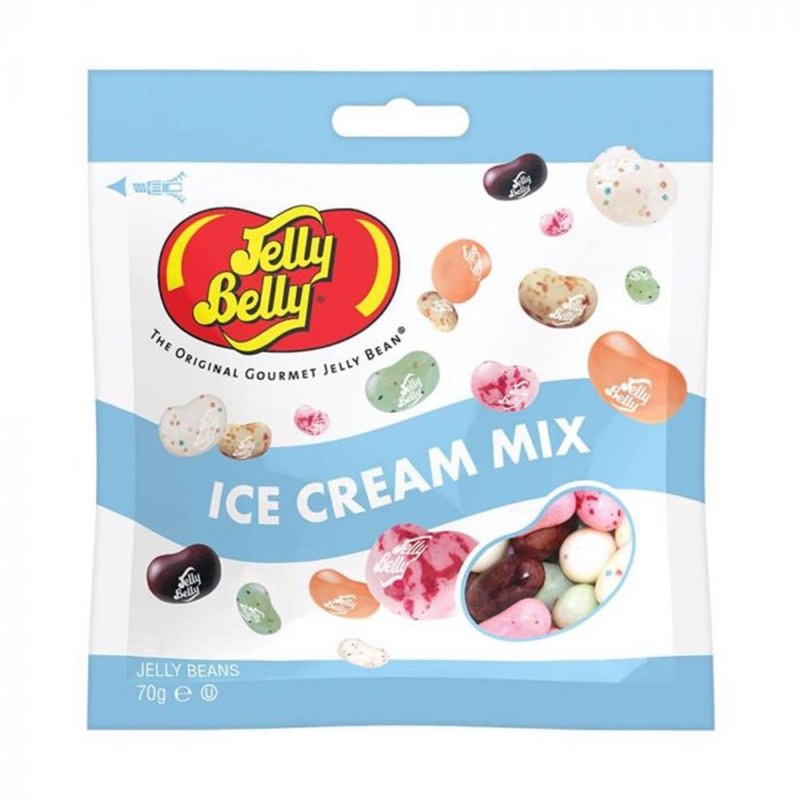
The middle of the scale is worth filling too, and it is the part most people forget. You want something that is neither rich nor sharp — a clean, bright, uncomplicated flavour that sits in between and gives people somewhere to go when they want a break from both extremes. The 70 g bag of Jelly Belly American Classics at £2.40 is very good at this, because a mixed bean bag is itself a spread of positions on the scale rather than a single point, and people self-select. A 140 g bag of Pinballs does something similar at a lower price per gram, with a chew that occupies the hands for longer.
Then there is the far rounded end beyond even this product, and it is worth knowing it exists. Junior Mints at £2.59 add a cool, clean note that reads as a different kind of relief from sourness — not acid, but a brightness that cuts richness just as effectively. Milk Duds, also under three pounds at £2.99, sit right next to this bag on the scale but arrive with a slow chew rather than a snap, which means they cover the same flavour territory with a completely different mouthfeel. Putting those two out together with these pretzels gives you three rich items that nobody would confuse for one another, and that is the real trick — variety within a band, not just variety across bands.
One more position deserves a mention: pure sugar with almost no flavour weight at all. Charms Fluffy Stuff Cotton Candy at £2.49 is essentially texture and sweetness with nothing else going on, and it functions almost like a blank space on the table. People reach for it between other things. It costs very little to include and it stops the spread feeling relentlessly heavy.
If you would rather assemble your own positions along the scale piece by piece instead of buying fixed bags, that is what our pick and mix shelf is for — you weigh out exactly as much of the sharp stuff as you actually want, which is usually a good deal less than a full bag.
The counter this belongs to
Every generation has a sweet counter in its head, and the counter you grew up with decides what a treat is supposed to feel like for the rest of your life. That is not sentimentality; it is just how food memory works. And this product belongs very clearly to one particular kind of counter — the import shelf.
You know the one. It is the section of a shop where the packaging looks slightly wrong: different colours from the domestic stuff, different typography, a shape of bag you do not quite recognise, names that are familiar from screens rather than from shops. For a long stretch of most people's childhoods, that shelf was aspirational in a very specific way — the things on it were harder to get, cost a bit more, and came with a faint sense of occasion. You did not buy from the import shelf on a Tuesday. You bought from it when someone was visiting, or when a trip somewhere had put you in a shop you did not normally use.
That feeling is still attached to this kind of product, and it is a large part of why people buy it. Nobody buys a dipped pretzel because they are short of something crunchy. They buy it because of what it represents — a slightly out-of-the-ordinary treat with a recognisable name on the front. The price supports that reading: at £5.29 this is not a pocket-money item, and it never pretended to be. It is a small event.
Contrast that with the counters other things on this site belong to. There is the jar counter — the one with rows of glass jars behind a shopkeeper and a scoop and a paper bag, where sweets came by weight and the ritual was watching someone tip them onto a scale. Our aniseed balls in a sweet jar at £16.99 is a direct descendant of that counter, and the format itself is the nostalgia: the jar is the point as much as what is in it. People who grew up with that counter have a completely different definition of a treat — for them it is a weighed quarter in a paper bag, not a printed pack.
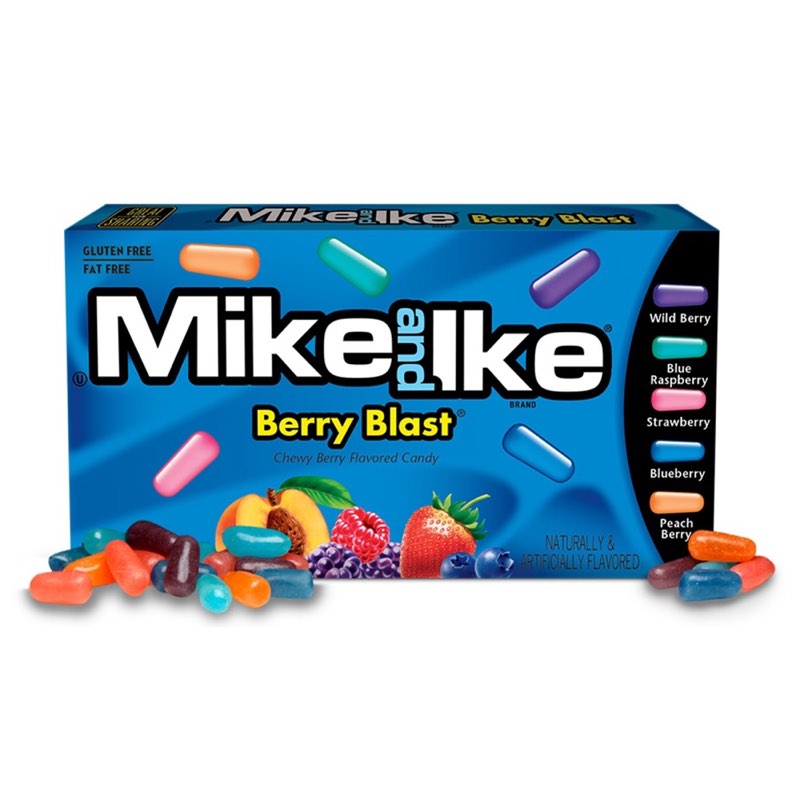
Then there is the cinema counter, all tall cardboard boxes with a particular rattle to them, bought in the dark and eaten in the dark. The box format is one of the most durable pieces of design in confectionery precisely because it is so tied to a place. A Mike & Ike Berry Blast theatre box at £2.25 carries that memory whether you eat it in a cinema or not, which is a strange and rather wonderful thing for a cardboard box to be able to do. The six-bar Airheads box in the same theatre format belongs to the same shelf in the memory, even though what is inside it is entirely different.
And there is the fairground counter — the stall at the end of a pier or the edge of a field, where the sweets were absurd in scale and short on subtlety. Spun sugar is the purest survivor of that counter; a bag of Fluffy Stuff is that memory packaged, and the fact that it now comes in a resealable bag rather than on a paper cone is a small comedy in itself.
What makes the import shelf different from all three is that its nostalgia is second-hand. The jar counter, the cinema counter and the fairground stall are memories of places you actually stood in. The import shelf is a memory of things you saw before you tasted — names encountered in films and on screens years before any shop near you stocked them. That produces a very particular emotion when you finally eat one: recognition without familiarity. You know the name intimately and the taste not at all.
There is a generational split in this worth being honest about. If you are older, this kind of product was genuinely difficult to get and the treat was partly in the acquisition. If you are younger, it has simply always been on a shelf somewhere, and the nostalgia attaches to something else entirely — to the specific corner shop, or the specific holiday, or the specific person who bought it for you. Both are real. Neither is more authentic than the other. It just means that when you put a bowl of this out at a gathering with a wide age range, different people are having different experiences of the same object, and it is rather nice to watch.
Practically, all this affects gifting. A product with this kind of memory attached is a better gift than its price suggests, because the recipient is not just getting 120 grams of something — they are getting a reference to a shelf they remember. That is why import-aisle sweets turn up in hampers far more often than their cost would justify, and why they work so well as the small extra item alongside a main present. If you are building that kind of parcel, our Candy & Chocolate shelf is where most of the recognisable names live, and it is the fastest way to find several at once.
The coated-crunch family, and what else lives in it
Sweets group into families by construction more usefully than by flavour, and this one belongs to the coated-crunch family: something rigid with something smooth around it. It is a small family on most counters and a very distinctive one, because it is the only group that gives you two textures in the same bite.
The defining characteristic of the family is contrast decay. The moment you bite, contrast is at its maximum — one hard component, one smooth component, entirely separate. Within a few seconds the contrast collapses as the coating softens and the crunchy part breaks down. The whole pleasure of the family lives in those few seconds. This is why coated-crunch sweets are almost always made small: a large piece would spend most of its eating time past the interesting part. Bite-size is not a marketing decision here, it is a structural necessity.
It also explains why the family suffers more than any other from poor storage. A soft sweet that goes slightly stale is still a soft sweet. A coated-crunch sweet that has absorbed moisture has lost the entire point — the crisp component softens, the contrast never happens, and what you are left with is a dense, chewy thing that tastes broadly the same but eats completely differently. There is a whole section on storage further down this page, and for this family it is not optional advice.
Within our range, the nearest relative is the Reese's Popped Snack Mix at £3.99, which is built on the same principle of mixed textures in a single handful but distributes them across several different components rather than layering them in one piece. It is a useful comparison because it shows the two ways of solving the same problem: layer the textures, or scatter them. This bag layers. The 113 g mix scatters. Most people end up preferring one approach quite strongly, and it is worth finding out which you are before you commit to a big order.
Slightly further out sits the chew-with-a-centre group — things where the contrast is soft-against-soft rather than hard-against-soft. The Milk Duds box lives there, and the difference in eating rhythm is instructive: contrast decay is slower, the piece lasts longer, and the experience is less of an event per piece. Neither is better. They are different clocks.
And at the far edge of the family, barely holding on, are sweets where the crunch is the whole story with no coating at all. Small, hard, sharp pieces like the Grape & Strawberry Nerds box give you crunch without any softening phase whatsoever, which is why they read as so much more aggressive despite being tiny. Putting one of those and one of these in the same mouthful is a genuinely interesting experiment and not at all unpleasant.
Building a bowl, a board or a mix around it
Start from a simple principle: this bag is the centrepiece, not the filler. It is the most expensive thing per gram in most of the combinations below, it has the strongest single identity, and it is the item people will name afterwards. Everything else you add is there to make it land better.
A good four-bowl spread built around this needs the anchor, a volume item, a sharp item and a wildcard. The anchor is here. For volume, you want something cheap that fills a large bowl and that nobody will feel guilty about finishing — the 140 g Pinballs bag, at £1.99 the best value on this page, is the obvious pick, and its chew is long enough that a small bowl lasts a surprisingly long time. For sharp, the £1.49 Nerds in a small dish. For the wildcard — the thing people pick up and ask about — spun sugar in a bag earns its place, because it is a conversation piece as much as a sweet.
If you are building a board rather than bowls — everything laid out flat on a platter — the calculus changes. Boards reward visual variety over flavour variety, because people eat with their eyes first and reach for whatever looks different. Rigid, irregular pieces like these photograph and display far better than uniform soft sweets; they give a board its texture. Pair them with something small and brightly coloured for contrast, which is where a bag of American Classics beans earns its place, and with something dark and uniform to calm the whole thing down — a box of Junior Mints tipped out in a corner does exactly that, and the small neat discs give the eye somewhere to rest.
For a genuine pick-and-mix, the rule is different again. Weighed-out mixes work best when no single component dominates, and something with a long finish like this will dominate unless you keep it to perhaps a fifth of the total by weight. Build the bulk from things with shorter finishes and let this be the occasional find. Our loose sweets section is where the by-weight lines live, and it is the right place to start that kind of build rather than working backwards from pre-packed bags.
Two-item pairings for smaller occasions are worth having in your back pocket. This bag plus a box of Duds is the rich-and-richer combination, suited to a film where nobody wants to think. This bag plus a giant Vimto spray is the sweet-and-sharp combination and works much better for a group of children, because the spray is a game as well as a sweet. This bag plus a jar of aniseed balls is the long-and-short combination — one thing that disappears in a minute, one thing that occupies a mouth for a quarter of an hour.
Occasions where it earns its place
Film nights. This is close to the ideal film-night sweet, and the reason is the crunch. A soft sweet eaten in front of a screen barely registers; you look down and half the bag is gone with no memory of it. Something that snaps forces a small moment of attention per piece, which paradoxically makes it more satisfying and makes the bag last through the whole film rather than the first act. Put it in a bowl between two people rather than leaving the bag with one of them.
Parties with a wide age range. Its neutrality is the asset here. There is no sourness to frighten anyone, no unfamiliar flavour to explain, and the format is easy to eat standing up with a drink in the other hand. One 120 g bag will not cover a party on its own — see the portioning section below — but as one of four or five bowls it does a lot of work.
Gifting and hampers. The recognisable name on the front is doing real work in a gift context. A hamper made entirely of unfamiliar things reads as random; one recognisable item anchors the whole parcel and makes the rest feel curated rather than arbitrary. Pair it with one jar item for height and one boxed item for shape, and you have a parcel with visual structure. The £16.99 jar is the obvious height item, and any of the theatre boxes give you the flat rectangles that make a hamper stack properly.
Seasonal tables. On a table that already has a lot going on, this has the advantage of not needing a bowl of its own if you are short — it sits perfectly well in a shallow dish among other things without losing its identity, because the shape is distinctive enough to pick out. It also holds up for several hours in a warm room better than most soft sweets, which sag.
Office and desk sharing. Slightly against it here. It is a loose bag, so it needs decanting into something, and the fragments at the bottom make it a slightly messy desk proposition. If you want something for a shared desk, a wrapped format is genuinely the better tool. That is a real limitation and worth saying plainly.
Travel and packed bags. Also not its strength. Rigid coated pieces in a bag that gets squashed will arrive as fragments, and warmth is not kind to a coating. For a journey, choose a box or a wrapped bar instead and save this for the destination.
What £5.29 for 120 grams actually buys you
Let us do the arithmetic honestly, because this is one of the pricier items per gram on this page and you deserve a straight answer about it. £5.29 for 120 g works out at a little over four and a half pence per gram. By comparison, Pinballs at £1.99 for 140 g come in around one and a half pence per gram, roughly a third of the price for a heavier bag.
So it is not the value play, and it would be dishonest to dress it up as one. What you are paying for is a construction that takes more doing than a moulded sweet, a recognisable name, and a piece-by-piece eating experience that lasts longer than the weight suggests. Whether that is worth three times the per-gram cost of a chew bag is a genuine judgement call, and it depends entirely on the job you need it to do. As the anchor of a spread — yes, comfortably. As the bulk of a party table — no, and you would be better spending the same money on three cheaper bags and putting a smaller amount of this alongside them.
For portioning: as a treat for one person over several sittings, 120 g is roughly a week of small evening portions. As a bowl for two people watching a film, expect it to be finished, with a little reaching around the empty bowl at the end. As one of several bowls at a gathering of eight or ten, put it out in a small dish and expect to refill once — a party of that size will get through a bag of this in well under an hour if it is the most interesting thing on the table.
A sensible build for a spread at around fifteen pounds: this bag as the anchor at £5.29, a bag of Pinballs for volume, Nerds for the sharp corner, Junior Mints at £2.59 for the cool note, and the £2.40 bean bag to give people choice. That is five bowls, five genuinely different experiences, and no two items occupying the same position on the scale discussed earlier. You can see the whole range to price a spread your own way over on our full sweet range.
Keeping it crisp — storage that actually matters
For most sweets, storage advice is a formality. For this one it is the difference between the product working and not working, because the crisp component is the whole architecture and crispness is the first thing to go.
Two enemies: moisture and warmth. Moisture is the serious one. A crisp structure will pull humidity out of the air given half a chance, and once it has softened there is no getting it back. This means the bag must be properly closed after opening — not folded over, not clipped loosely, but sealed or transferred into an airtight container. A clip-top jar or a sealed tub is ideal. If you have decanted some into a bowl for the evening, do not tip the leftovers back into the bag; they have already been exposed and they will drag the rest down with them.
Warmth is the second problem, and it affects the coating rather than the crunch. A coated sweet left somewhere warm will soften, and the pieces will stick to each other. If that happens, a short spell somewhere cool will firm them up again, but they will have set as a clump and the surface will have lost its even finish. It is cosmetic rather than fatal, but it is avoidable. A kitchen cupboard away from the oven, or any cool dark shelf, is all it takes.
Do not put it in the fridge as a matter of routine. Fridges are humid, and every time you take the bag out and put it back you are cycling it through condensation, which is precisely the moisture problem in an accelerated form. The only time a fridge makes sense is a genuinely hot spell, and then you want the bag inside a sealed container so it is not sitting in the fridge's own damp air.
Practical routine: keep the unopened bag in a cupboard, and on the day you open it, transfer the contents into an airtight tub. Take out what you want, close the tub, put it back. Done that way the last handful eats like the first. Done carelessly, the last third is noticeably duller than the first third, and you will wonder whether you imagined how good it was on day one.
One more small thing: keep it away from strongly scented things in the same cupboard. Coated products pick up odours readily. A bag stored next to something aromatic for a fortnight will taste faintly of its neighbour, and it is a surprisingly hard fault to diagnose when it happens.
One size — and why that is fine
This line comes in a single option: the 120 g bag at £5.29. There is no larger sharing pack and no smaller single-serve version to weigh up, which makes the decision simple but does raise a practical question if you need more than 120 grams.
The answer is usually not to buy several bags. Multiples of the same item on a table look like a job lot and give your guests no more choice than one bag does. If you need more volume, buy one of these and spend the difference on variety — two different items at £2.50 each will make a table feel considerably more generous than two identical bags at £5.29, even though you have spent less.
The exception is if this is genuinely somebody's favourite and you are buying for them specifically. In that case, multiples make sense and the storage advice above becomes important, because a second bag will sit unopened for a while and wants to be kept properly. A sealed bag in a cool cupboard keeps its texture for a long time; an opened one does not.
If you want the same brand in a different format rather than a different size, the Popped Snack Mix in its 113 g bag is the alternative, and at £3.99 it comes in a pound and change cheaper. That is the closest thing to a size decision available here: not bigger or smaller, but layered or scattered. Anyone shopping the brand rather than the format should look at both of the lines we carry under that name together and decide which texture behaviour they actually want.
Finding your way around the rest of the shop
This sits on the Candy & Chocolate category page, which currently holds twenty-six lines and is the home for the branded, boxed and bagged items rather than the weighed-out ones. If you came here from a search and want to see what else shares this shelf, that is the page to start on — it is the most efficient way to find the other recognisable names in a single scroll.
Next door in a practical sense is the loose sweets shelf, which works on an entirely different principle: sold by weight, chosen by the handful, and much better suited to people who want to control exactly what goes into a bag. There is very little overlap between the two shelves in terms of products, but a lot of overlap in terms of what people are trying to achieve, and it is common to build an order from both.
The pick and mix shelf is the third place to look, and it is the one to use when the occasion matters more than the brand — birthday tables, party bags, anything where you want a spread of colours and shapes rather than a set of named products. If you are assembling something for a specific event, start there and add one or two branded anchors like this bag on top.
For a complete view with nothing filtered out, the full catalogue page lists everything we stock in one place. It is the right tool when you are browsing rather than hunting, or when you want to price up a large order and need to see the whole range at once. And if you specifically want more from the branded chocolate and candy aisle, that shelf will always be the fastest route to the things that sit closest to this one.
Questions people actually ask
How many pieces are in the bag?
We do not publish a piece count for this line, and we would rather not guess at one, because pieces in a dipped product vary in size and the number in any given bag will vary with them. What we can tell you is the weight: 120 grams. In practice that is a bowl that comfortably serves two or three people for an evening, or a personal bag that lasts a week if you are rationing. If exact counts matter for your planning — party bags, for instance — a weighed option from our loose sweets shelf gives you far more control than any pre-packed bag can.
Is it too rich to eat more than a few at a time?
Most people naturally slow down after three or four, and that is the product doing its job rather than a problem. The long finish means each piece stays with you for half a minute or so, and the crunch makes each one a small, deliberate act. That is why a bag lasts longer than its weight suggests. If you want to keep eating for longer, put something clean-tasting alongside — the cool note of Junior Mints or a small dish of something sharp resets things and lets you come back.
Will it arrive broken?
Some fragmentation is normal in any rigid product sold loose in a bag, and you should expect a little loose material in the bottom, particularly in the last third. Outright breakage into unusable pieces is not normal. If a bag arrives genuinely crushed rather than simply settled, get in touch and we will sort it out. If you are ordering for a display where appearance matters, it is worth ordering a day or two earlier than you need so you have time to check.
Can I put it in a pick and mix?
You can, but keep the proportion low. Anything with a long finish and a strong identity will dominate a mix if it makes up more than about a fifth of the weight, and the other components stop registering. A better approach is to build the mix from things with shorter, cleaner finishes and let a few of these be the occasional find. Our pick and mix shelf and the loose sweets section are both better starting points for the bulk of a mix than any single pre-packed bag.
Is this suitable for young children?
Sweets are a treat and should be treated as one, whatever the age. Small hard sweets and whole gummies are a choking risk for young children and should always be eaten under supervision — that applies to anything rigid, including this. Beyond that, we would say the practical limit is less about age and more about the format: it is a bowl sweet, it makes crumbs, and it is easier to manage at a table than in a car or a pushchair.
What should I check when it arrives?
Check the manufacturer's packaging itself. We do not restate ingredient, nutrition or allergen information on our product pages, because the pack in your hands is the authoritative source and we would rather you read that than take our word for it. If you or anyone you are feeding has an allergy, read the packaging before eating and do not rely on any description on this site. Also give the bag a quick look for seal integrity, particularly if it has come a long way in warm weather.
Does it work as a gift on its own?
It works better as part of something. A single 120 g bag is a nice small gesture but reads as slight on its own; add a jar item for height and a boxed item for shape and you have a parcel that looks considered. The recognisable name is genuinely useful in a gift context because it anchors the rest of the selection — the unfamiliar items around it read as curated rather than random once there is one thing the recipient knows.
How long does it keep once opened?
Texturally, days rather than weeks if you leave the bag folded over, and weeks if you seal it properly or decant it into an airtight tub. The flavour will outlast the crunch by a long way, which is the trap — it can taste fine while eating quite wrong. Always go by the date on the manufacturer's packaging for the formal shelf life, and use the storage advice above to protect the texture within that window.
What is the closest thing you stock if this is out of stock?
The nearest relative by brand and by texture behaviour is the Popped Snack Mix at £3.99, which delivers mixed textures across separate components rather than layered in one piece. If it is the crunch you are after rather than the brand, look at the smaller, harder options on the Candy & Chocolate shelf. If it is the richness, Milk Duds at £2.99 cover similar ground with a slow chew instead of a snap.
Can I order several bags for a party?
You can, and stock permitting we will send them. But we would gently suggest not to. Two bags of the same thing on a table give your guests no more choice than one, and for the same money you could put three or four genuinely different items out. Buy one of these as the anchor and spend the rest on variety — the full catalogue makes it easy to see what would fill the gaps.
Is there a sour version?
Not in this line. This product sits firmly at the rounded, non-sour end of the counter and there is no sharp variant of it. If you want sour alongside it, the better approach is to add a separate sharp item to the table rather than looking for a sour version of this one — a small dish of something tangy next to a bowl of this gives you a far better contrast than any single product could.
Does it need a bowl, or can I serve it from the bag?
Use a bowl. Serving loose rigid pieces from a bag means people reaching into a narrow opening, which breaks pieces and puts everybody's hands in the same small space. A shallow wide bowl shows the pieces off, keeps the fragments visible so nobody is fishing blindly, and lets you control how much is out at once. Keep the rest sealed and top the bowl up rather than putting it all out at the start.
In short
A crunch-first, rich-finish bowl sweet at the rounded end of the counter, in a 120 g bag at £5.29, that does its best work as the anchor of a spread rather than as the whole spread. Keep it sealed, serve it in a shallow bowl, put something sharp next to it, and it will hold a room's attention for an evening. If you are building an order around it, the shelves above will fill in the rest.
More candy & chocolate sweets
Where this sits
Reese's Dipped Pretzels 120g appears on these shelves. Browse them, or jump to something nearby.
You might also like